


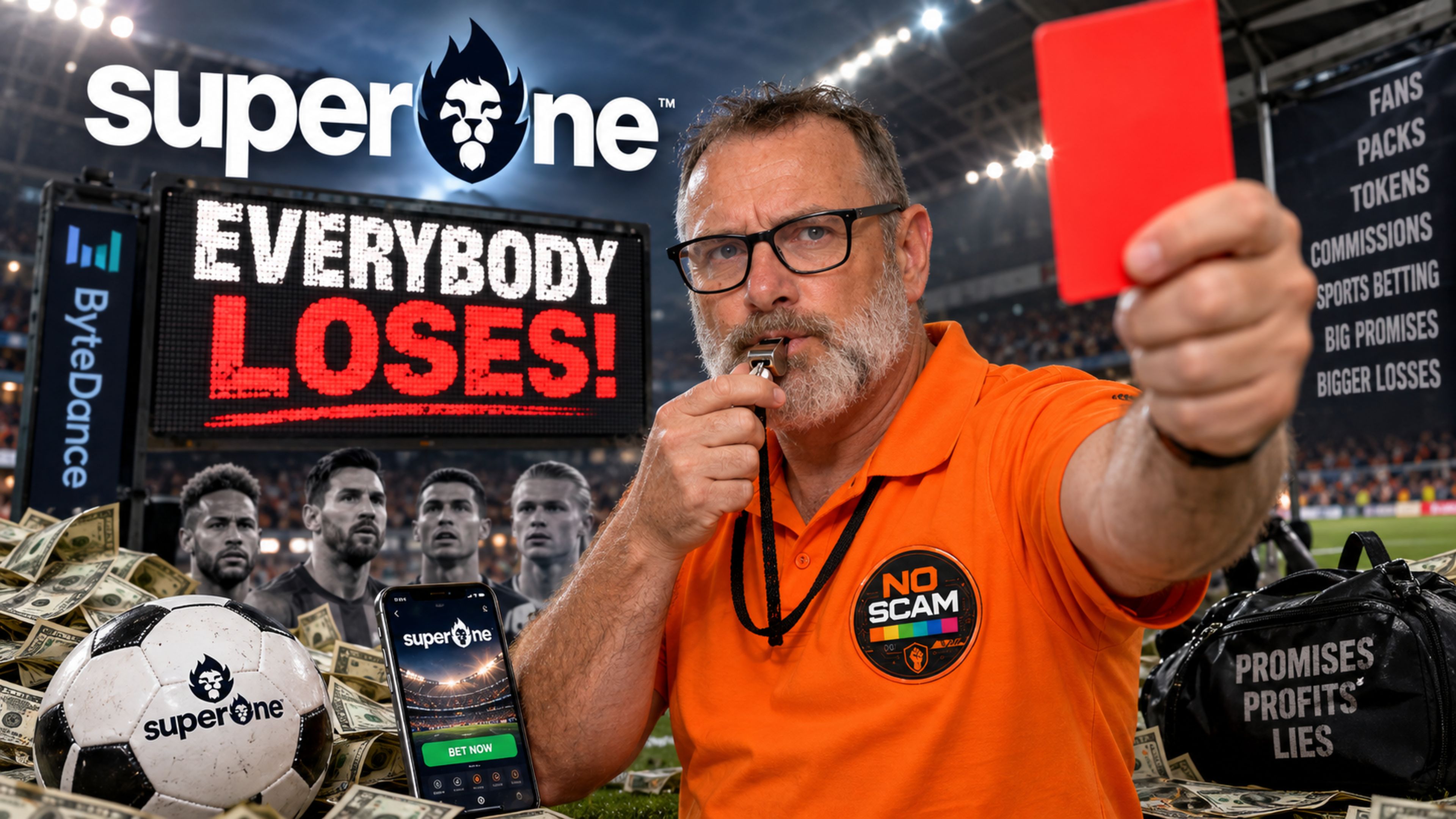
“Even if it takes me a month, I will remove your account and continue to report from it every day.”
For almost four years, I have documented SuperOne and Andreas Christensen. I have sat through the presentations, archived the promises, challenged the promoters, spoken with people involved and followed the corporate paper trail in Norway.
In June 2026, that trail reached an extraordinary point: SUPERLABS AS was compulsorily dissolved. The official Norwegian business registry now records the reason plainly — failure to submit the annual accounts — with the compulsory liquidation opened on 2 June 2026.
You might reasonably think that would be the end of the story. Instead, something very different has happened.
Over the last few weeks, I have watched SuperOne suddenly reappear across YouTube, promoted by people selling what sounds remarkably familiar: XRP-funded packages costing hundreds or thousands of dollars, allocations of thousands of supposed “fans,” recruitment commissions, passive and residual income projections, Super tokens, BytePlus and ByteDance, global football stars and the familiar message that now is the time to get in early. One presentation even encouraged viewers to look under the “mattresses and cushions and piggy banks” for the $2,500 needed to secure 24,000 fans before a promotional deadline.
At almost exactly the same time, something else started happening.
 My historical investigations into SuperOne began attracting defamation complaints through YouTube. Videos that had existed publicly for years were suddenly being restricted. First came Norway. Then came the United Kingdom. The notices repeatedly told me: “We have received a defamation complaint regarding your content. After review, the following content has been blocked from view…” Even my reporting about the compulsory liquidation itself has been caught up in this wave of complaints.
Then there are the WhatsApp messages.
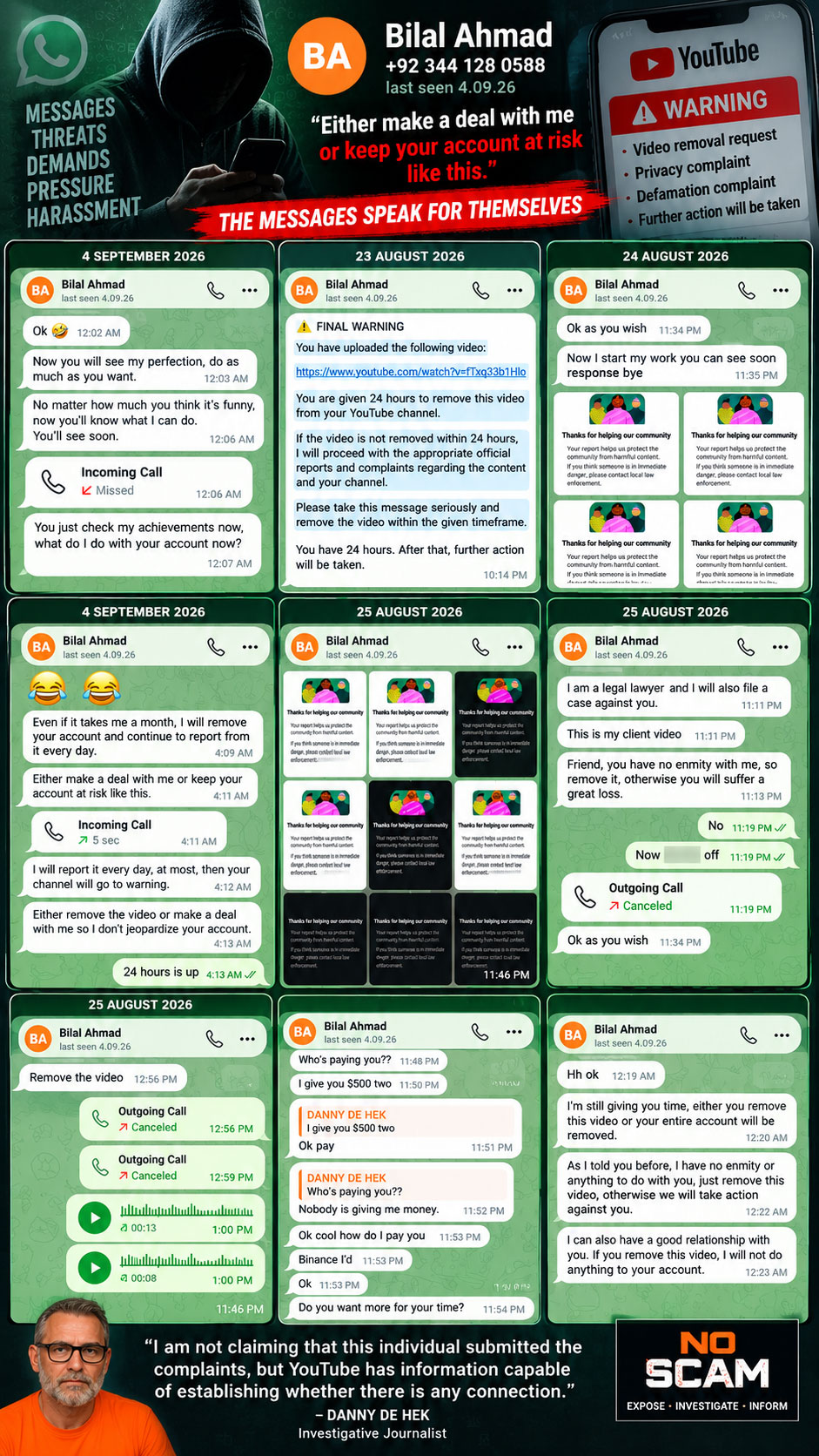
An account identifying itself as Bilal Ahmad repeatedly demanded that I remove a video, called me at ridiculous hours and threatened what would happen if I refused. “Either make a deal with me or keep your account at risk like this,” one message warned. Another was even clearer: “I will report it every day.” The messages were accompanied by screenshots apparently showing reports being submitted to YouTube.
I am not claiming that this individual submitted the defamation complaints that resulted in my videos being geo-blocked. I currently don’t have the evidence to establish that. What I do have is an extraordinary sequence of events that deserves scrutiny, and YouTube has information capable of establishing whether there is any connection.
I have appealed the restrictions and escalated the matter through YouTube Legal Operations. What I want now is remarkably simple: show me what I supposedly said that was defamatory. Tell me the precise statements complained about, the legal basis relied upon, whether the complaints affecting Norway and the United Kingdom are connected, and whether any court order, judgment or injunction exists. So far, I have not been shown any court finding that my SuperOne reporting is defamatory.
Meanwhile, SuperOne is being promoted all over again.
So this investigation isn’t another history lesson about a company I have already spent years documenting. It’s about what is happening right now. Why is SuperOne experiencing another promotional push after the compulsory dissolution of SuperLabs AS? What exactly are people being encouraged to buy? What evidence supports the extraordinary income, partnership and celebrity narratives being circulated? And while those new promises are spreading across YouTube, who is trying to make the old reporting disappear?
SuperLabs Was Compulsorily Dissolved — That’s Not My Opinion
Before looking at the extraordinary new wave of SuperOne promotion, there is one fact that needs to be firmly established. SUPERLABS AS was compulsorily dissolved in Norway. This isn’t something I’ve concluded from a YouTube video, an anonymous tip or somebody’s opinion about Andreas Christensen. It is recorded by the Norwegian authorities.

An official extract from the Brønnøysund Register Centre, dated 25 August 2026, identifies SUPERLABS AS under organisation number 920 804 276 and records its status as: “Compulsorily dissolved due to not submitting the annual accounts (2 June 2026).” The same record identifies SUPERLABS AS TVANGSAVVIKLINGSBO, organisation number 937 810 199, as the compulsory liquidation estate and records the bankruptcy as opened on 2 June 2026, with Adv. Øivind Rief Armo appointed as official receiver.
That distinction matters because I don’t need to exaggerate what happened. A compulsory dissolution does not, by itself, prove fraud, nor does it prove every allegation ever made about SuperOne. The official record gives a specific reason: failure to submit the annual accounts. What it does establish is that the Norwegian company reached the point where it was compulsorily dissolved and its affairs entered a formal liquidation process.
I’ve already documented the much longer history behind SuperOne — the corporate changes, financial and legal problems, promotional presentations and years of ambitious promises — in my previous investigation. There is little value repeating all of that here. What makes this new investigation important is what happened after 2 June 2026.
Because instead of SuperOne quietly disappearing, something remarkable happened.
The promoters came back.
The SuperOne Promotion Machine Starts Again
If compulsory dissolution sounds like the end of a business story, somebody apparently forgot to tell the promoters. Within weeks, I began seeing SuperOne being pushed across YouTube again, complete with the same ingredients I have documented for years: enormous future projections, passive-income language, recruitment commissions, cryptocurrency payments, celebrity names, major technology companies and an urgent reason to get involved before everybody else.
One of those promoters is Jaime Soriano, whose YouTube channel is called Best Passive Income Programs Online. Soriano isn’t new to my radar. I’ve previously documented him promoting BitHarvest and Zionix Global, and now SuperOne has joined the list. In one recent video he promotes a time-sensitive offer built around purchasing “Agent Packs,” telling viewers that a $500 pack could provide 1,000 fans, while a $2,500 Ultra pack provided 24,000 fans during the promotional period. He repeatedly describes the objective as accumulating fans from whose activity the purchaser could potentially earn passive income, while reminding viewers that the allocation would decrease as the promotion progressed.
Then there is Pierre Maxim, operating the YouTube channel The Perfect Wealth. The channel itself promotes access to what it calls “paying passive programs doubling your money every 30 to 90 days.” In his SuperOne video, Maxim walks viewers through the back office and demonstrates depositing cryptocurrency and purchasing a $2,500 Ultra Agent Pack. He describes receiving 24,000 fans and tells viewers they could receive 10% of what those fans spend, saying: “you get that for life.” He also discusses $5,000 and $25,000 membership levels and tells viewers the promotional allocation is shrinking each week, creating an obvious incentive to act quickly.
Another name appearing in this renewed promotional activity is Francene Loomiller, who operates the YouTube channel Impact Earnings TV. Loomiller describes herself as having spent more than 25 years in financial markets, including institutional equity trading and research sales. Her channel says its current focus is helping people understand digital assets, AI, automation, emerging technologies and new financial models. She also says she hosts weekly community calls featuring occasional founders and project leaders. Importantly for this investigation, her recent content has included SuperOne, placing the project alongside the other emerging financial and technology opportunities she discusses with her audience.
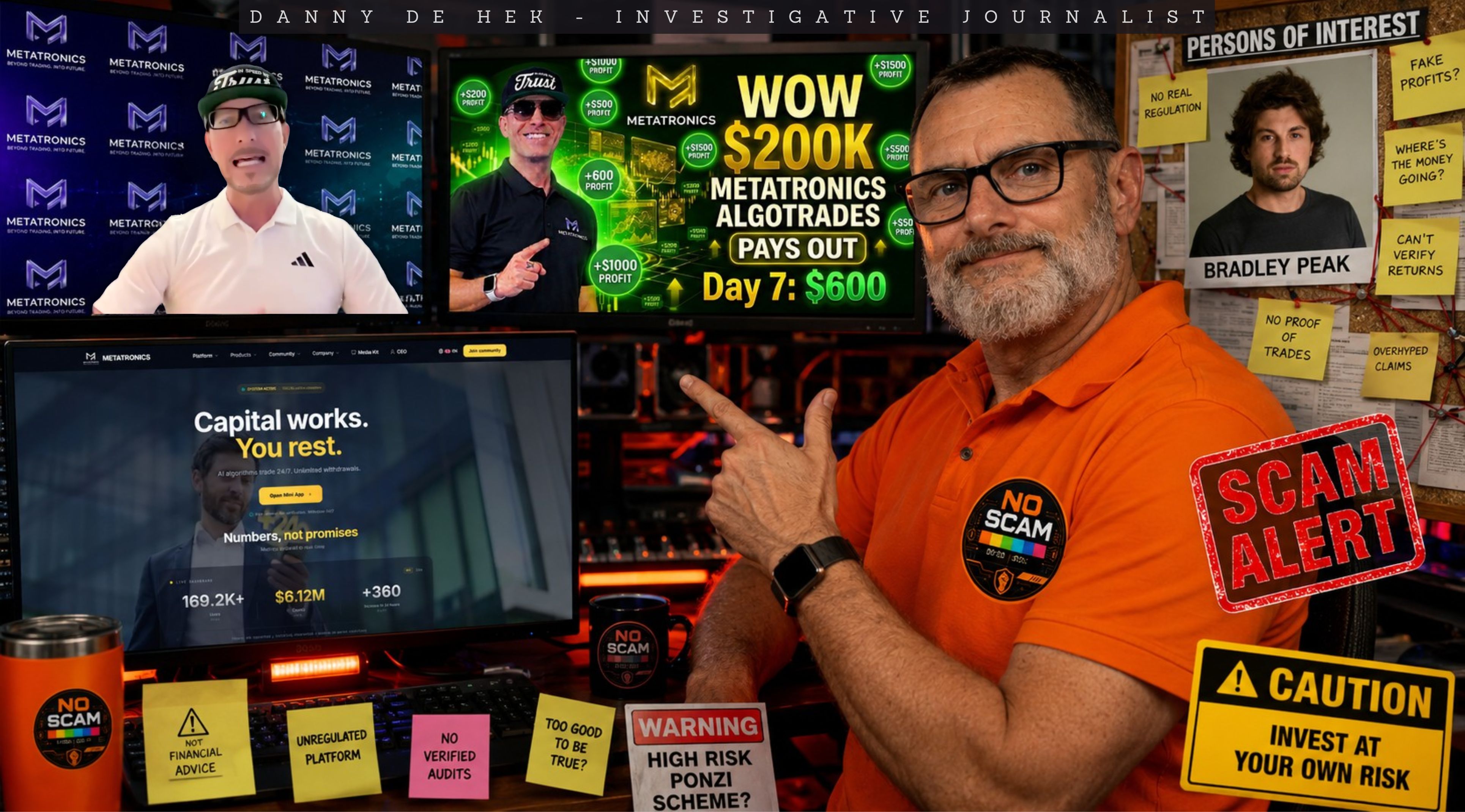
Then there is Alex Zubarev, also known as Alex Z, another online marketer whose activities I have previously encountered while investigating Metatronics. His SuperOne video takes the 24,000-fan proposition and actually puts numbers around it. Using an example of fans spending $10 per week, he calculates $240,000 in weekly fan revenue and then a hypothetical $24,000-per-week commission. He subsequently reduces the assumed participation to 50% and then 10%, but continues to present potentially substantial weekly income. To his credit, Zubarev does qualify some of the celebrity speculation, saying he isn’t personally guaranteeing that names such as Neymar, Messi, Cristiano Ronaldo or Erling Haaland will become involved. But those names are nevertheless being discussed while the opportunity is being promoted.
And then there is Mark Hamlin. His August presentation takes the numbers even further. Viewers are shown Creator Packs ranging all the way to $25,000, Agent Packs, Super tokens, NFTs, multi-level commissions and supposedly AI-acquired fans generating recurring revenue. One example suggests that spending $1,000 across a Creator Pack and Agent Pack could potentially position someone for $500 to $1,000 per week “for life.” Elsewhere, the presentation describes larger packages as potentially producing thousands of dollars per week.
The disclaimers are there. Viewers are told these are hypothetical projections, that results aren’t guaranteed and that they should conduct their own due diligence. But listen to what surrounds those disclaimers. One presenter tells viewers they should be looking under “the mattresses and cushions and piggy banks, whatever it takes to get $2,500” before the 24,000-fan promotion expires. Later, viewers are told “now is the time for you to not procrastinate” and encouraged to get positioned before the allocation is cut in half.
This isn’t obscure material buried in an archive from four years ago. These are promotions circulating in 2026, after SUPERLABS AS had already been compulsorily dissolved on 2 June.
And underneath the packages, projections and countdown timers sits an even bigger sales narrative: ByteDance, TikTok, artificial intelligence and some of the biggest football stars on the planet.
ByteDance, Football Superstars And The New Billion-Dollar Story
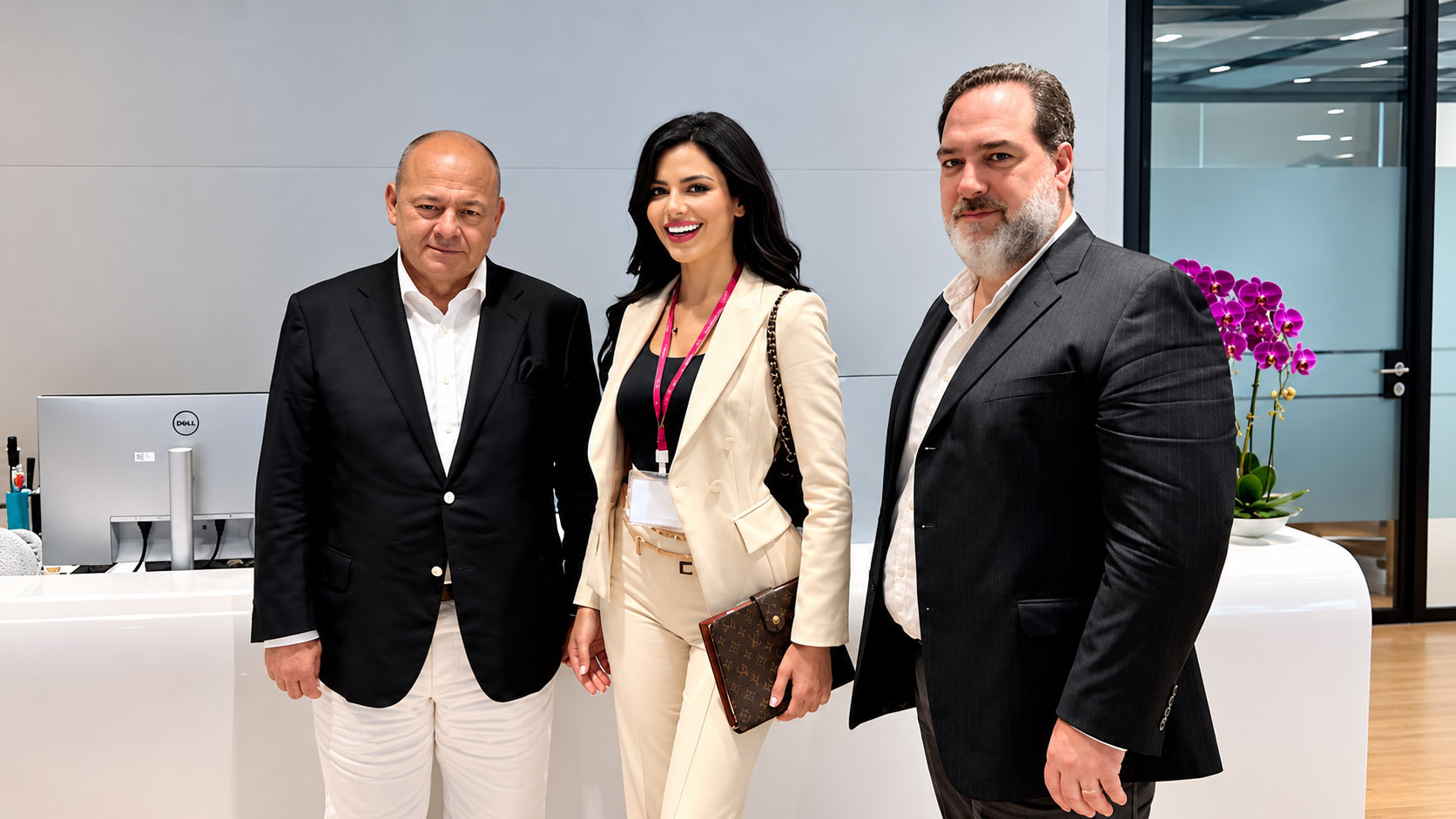
The new SuperOne promotion is not being sold simply as another affiliate programme. It is being wrapped in a much bigger story involving ByteDance, BytePlus, TikTok, artificial intelligence and globally recognised football stars. That combination is being used to create the impression that SuperOne is on the verge of reaching an enormous international audience.
The company itself is actively feeding that narrative. On 19 August 2026, SuperOne distributed a press release through GlobeNewswire titled “SuperOne Founder Andreas Christensen Takes Charge of AI Strategy, Unveils Billion-User Roadmap.” Importantly, GlobeNewswire identifies the source as SuperOne, so I treat this as company-issued promotional material rather than independent verification of the claims being made.
What makes the release relevant is its timing. It appeared less than three months after SUPERLABS AS was compulsorily dissolved in Norway on 2 June 2026. Yet SuperOne was publicly presenting itself as moving aggressively forward, with Andreas Christensen identified as Founder and supposedly taking direct control of the project’s artificial-intelligence strategy. The release describes an AI-native rebuild, a dedicated research and engineering unit with Digital One Solutions, enterprise-scale infrastructure and a roadmap towards potentially billions of users. These are SuperOne’s own claims, but they demonstrate that the marketing operation was very much alive after the Norwegian liquidation.
That same story is filtering down through the promoters, sometimes becoming even more ambitious along the way. In presentations I reviewed, viewers are told about a relationship involving BytePlus, while some promoters loosely describe this as partnering with ByteDance or connect it directly to TikTok and its enormous user base. Those distinctions matter. A technology relationship involving BytePlus does not automatically mean TikTok’s users are somehow going to become SuperOne users — and it certainly doesn’t establish where the thousands of “fans” being allocated with expensive Agent Packs will actually come from.
The celebrity narrative adds another layer. Promoters have discussed names including Neymar, Lionel Messi, Cristiano Ronaldo and Erling Haaland, while talking about a global superstar with hundreds of millions of followers supposedly becoming involved. In fairness, not every promoter presents those names as confirmed. Alex Zubarev, for example, qualifies some of the speculation rather than personally guaranteeing those stars will participate. But those enormous names are nevertheless being discussed in presentations promoting an opportunity where people are being encouraged to spend thousands of dollars.
The financial projections are equally ambitious. Viewers are encouraged to think in terms of billions of football fans, enormous social-media audiences and substantial recurring revenue. Mark Hamlin’s presentation connects that vision directly to Creator Packs, Agent Packs, Super tokens, multi-level commissions and hypothetical passive-income calculations.
None of this is particularly surprising to me after following SuperOne for almost four years. In a TownHall presentation recorded on 8 June 2026, Andreas Christensen was already discussing names including Binance, ByteDance, OpenAI, NVIDIA, Microsoft and Google DeepMind, alongside potential revenues and token valuations stretching into the billions.
The question therefore isn’t whether SuperOne is still marketing itself. Clearly it is. The more important question is what sits behind the marketing today. Which legal entity is now operating SuperOne? Which entity receives the XRP being deposited by participants? What precisely is the commercial relationship with BytePlus? Which celebrity relationships have actually been signed? And what evidence supports the assumption that purchasers of Agent Packs could ultimately receive thousands of active, revenue-generating fans?
After a compulsory dissolution, those aren’t unreasonable questions.
They’re basic due diligence.
“I Will Report It Every Day”
While SuperOne promoters were busy telling people about 24,000 fans, passive income and billion-dollar possibilities, something very different was happening behind the scenes.
I began receiving repeated WhatsApp messages from an account identifying itself as Bilal Ahmad. The tone was not subtle. I was told to remove a video or face consequences for my entire YouTube channel. One message warned: “I will report it every day.” Another said: “Either make a deal with me or keep your account at risk like this.” There were repeated calls, including at ridiculous hours, and screenshots apparently showing reports being submitted to YouTube.
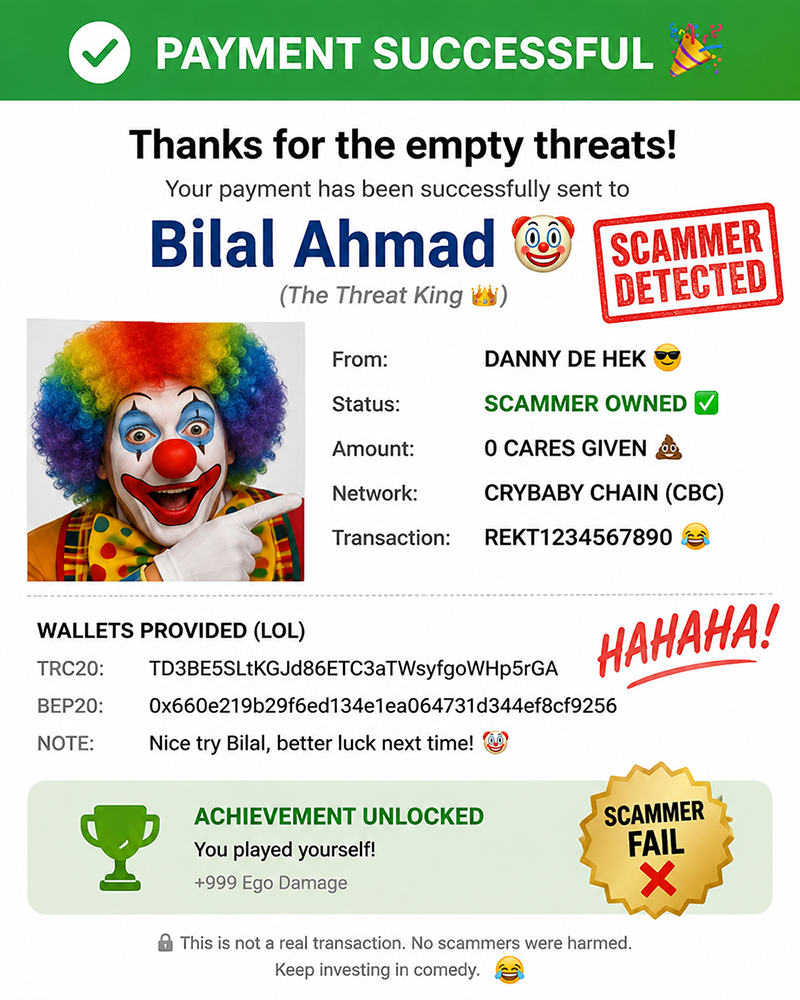 At one point I decided to test just how serious this person was about wanting me to remove the content. I told him I would give him $500 to go away. He replied: “Ok pay.” When I asked how, he said: “Binance I’d.” I then asked if he wanted more for his time. His response was: “How much you can give.” The conversation then moved directly back to my channel, with him saying words to the effect that if he stopped doing anything to my account, he would “stop work on chanel.”
I never paid him a cent. Instead, I sent him the parody payment receipt reproduced in this article.
That might have been funny, but what followed was not. After receiving it, he replied: “Now you will see my perfection, do as much as you want.” Then came another warning: “No matter how much you think it’s funny, now you’ll know what I can do. You’ll see soon.”
That exchange matters because it shows more than somebody simply disagreeing with my reporting. It documents an account explicitly threatening my YouTube channel, discussing payment in connection with stopping whatever he claimed to be doing, and repeatedly referring to reporting my content.
I need to make one point absolutely clear. I cannot presently prove that this individual submitted the defamation complaints that later resulted in my videos being geo-blocked in Norway and the United Kingdom. I do not have access to YouTube’s internal complaint records, and I am not going to pretend I know something I cannot establish.
What I can establish is the sequence.
First came the threats. Then came repeated claims that my channel would be targeted. Then came screenshots apparently showing reports being made. And during the same broader period, a series of my SuperOne investigations began attracting defamation complaints and geographic restrictions.
That is why I have asked YouTube Legal to look at this properly.
If there is no connection, YouTube can establish that. If there is a connection, YouTube can establish that too.
Privacy Complaints First, Then Defamation Complaints
The defamation complaints were not where this started. Before YouTube began telling me that my SuperOne investigations were being restricted in individual countries, I was already receiving multiple privacy complaints against the same body of reporting.
One example arrived from the YouTube Legal Support Team on 31 August 2026 concerning my video “EXPOSING BAD ACTOR Andreas Christensen: SUPER.ONE Scam: False Promises, Shady Deals & Millions Lost!” The notice stated that YouTube had received a “privacy concern” about the video and gave me an opportunity to review and remove any potentially private information before YouTube assessed the complaint. Importantly, YouTube itself made clear that receiving the notice did not mean the video had violated its privacy guidelines and that no action had been taken against my channel at that stage.
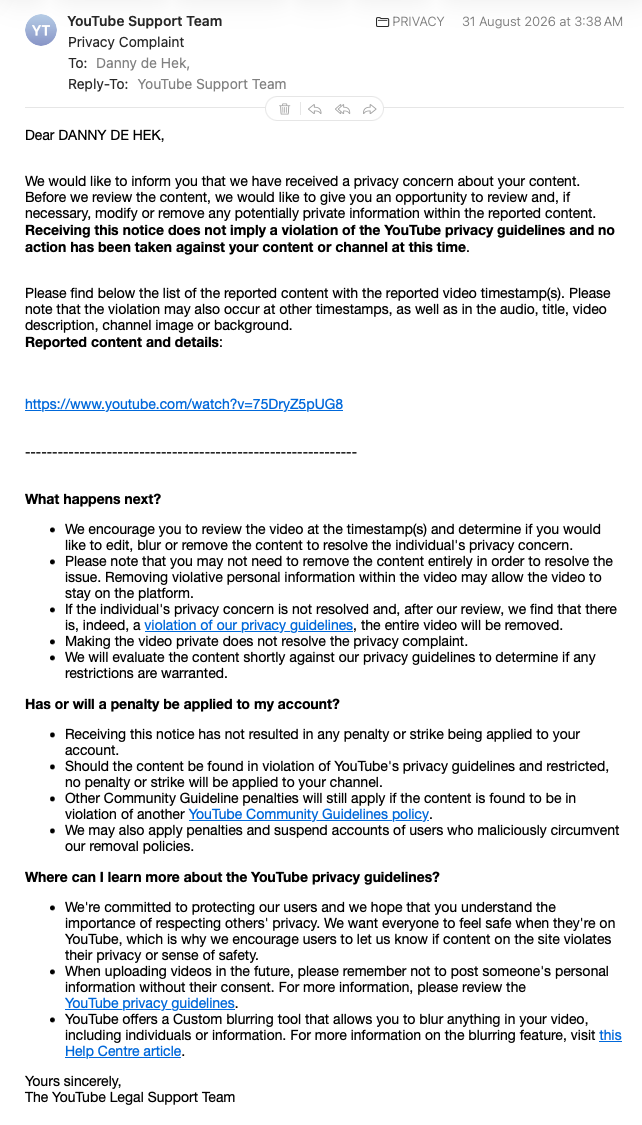 That wasn’t an isolated event. I began receiving multiple privacy complaints concerning SuperOne content, forcing me to repeatedly review older investigative videos and respond to allegations that private information had supposedly been exposed. Then the nature of the complaints changed.
The next wave came through YouTube’s defamation process.
The wording was different and the consequences were much more significant: “We have received a defamation complaint regarding your content. After review, the following content has been blocked from view on the YouTube country site(s) listed below.” Multiple videos from my SuperOne investigation began being restricted, initially in Norway and subsequently in the United Kingdom.
Some of these videos had been online for years. They include interviews, SuperOne presentations, commentary on promoters and my investigations into Andreas Christensen and the project itself. More remarkably, the restrictions reached my recent video “What Happened To SuperOne? Court Orders Liquidation After Years Of Promises Finally Unravel By Court.” That reporting concerns an event independently supported by the Norwegian corporate register, which records that SUPERLABS AS was compulsorily dissolved on 2 June 2026 due to not submitting the annual accounts.
The progression is what concerns me: privacy complaints first, followed by defamation complaints, followed by country-specific restrictions. I am not claiming that every complaint came from the same person, nor can I presently establish that the privacy complaints and defamation complaints were coordinated. YouTube holds that information, not me. But against the backdrop of messages from an account explicitly threatening to report my channel repeatedly, the pattern deserves proper examination.
I appealed the restrictions and escalated the matter through YouTube Legal Operations. I now have a growing collection of correspondence and case-reference numbers, yet I am still trying to obtain answers to some remarkably basic questions. What exact words are alleged to be defamatory? What factual statements are supposedly false? Who is claiming their privacy was violated and by what specific material? Are these complaints related? What legal basis justified the country restrictions? And has any court actually ruled that anything I published about SuperOne or Andreas Christensen is defamatory?
So far, YouTube has not shown me any court order, judgment or injunction finding my SuperOne reporting defamatory. That does not mean YouTube necessarily requires one before restricting content. It means exactly what I have written: despite repeatedly challenging these restrictions, I have not been shown one.
If somebody believes I published private information improperly, identify it. If somebody believes I made a defamatory factual statement, identify the statement. Give me the timestamp. Tell me what is alleged to be false and provide the evidence contradicting it. That gives a journalist something meaningful to investigate, correct if necessary, or defend.
Instead, while new promoters are uploading videos encouraging people to put hundreds or thousands of dollars into SuperOne, the historical reporting warning people about it is being challenged through multiple YouTube legal processes and restricted from viewers in Norway and the United Kingdom.
None of that proves who submitted the complaints.
But it gives YouTube every reason to investigate whether separate legitimate complaints are being made — or whether its privacy and defamation systems are being systematically used to suppress a body of investigative journalism.
YouTube has the records. I don’t.
And after this many complaints, I think I’m entitled to know what is going on.
You Can Geo-Block My Videos — You Can’t Geo-Block The Evidence
 After almost four years investigating SuperOne, I have accumulated far more than a collection of YouTube videos. I have archived presentations, promotional material, company records, court-related documents, correspondence, screenshots and statements made by the people actually promoting this opportunity. That evidence does not suddenly cease to exist because YouTube prevents viewers in Norway or the United Kingdom from watching one of my videos.
The same applies to what is happening today. Jaime Soriano, Pierre Maxim, Alex Zubarev and Mark Hamlin are not characters I invented. Their SuperOne promotions exist. The packages and income examples discussed in those presentations exist. One presentation promotes Creator Packs reaching $25,000, Agent Packs offering thousands of supposed fans, multi-level commissions and recurring-income scenarios, while another repeatedly encourages viewers to act before the promotional allocation is reduced. And sitting underneath all of this is an official Norwegian record stating that SUPERLABS AS was compulsorily dissolved due to not submitting the annual accounts on 2 June 2026.
That leaves me with questions for Andreas Christensen and whoever is currently operating SuperOne. Which legal entity is now receiving these XRP deposits? What relationship actually exists between SuperOne and BytePlus or ByteDance? Which football stars have signed agreements with SuperOne? Where do the thousands of “fans” allocated to Agent Pack purchasers come from? What evidence supports the assumptions being used to project recurring income from those fans? And what happens to somebody’s money if the promised scale of engagement never materialises?
I also have questions for YouTube. What specific statements in my videos have been alleged to be defamatory? What evidence was supplied to support those allegations? Why have multiple SuperOne investigations been restricted across Norway and the United Kingdom? Are these complaints connected? Has YouTube examined the reporting history surrounding my channel for signs of coordinated abuse? And, particularly in light of the threats I have preserved, will somebody within YouTube Legal finally investigate whether its complaint process is being used to suppress legitimate investigative reporting?
I am giving the relevant parties the opportunity to answer those questions. If SuperOne, Andreas Christensen or YouTube provides substantive information that changes, corrects or adds context to anything documented here, I will publish it and update this investigation accordingly.
But I won’t remove documented reporting simply because somebody threatens my channel, and I certainly won’t accept money—or pay money—to make uncomfortable evidence disappear.
YouTube can decide that people in a particular country cannot watch one of my videos. What it cannot do is rewrite the Norwegian corporate register, erase the promotional presentations already made, delete the messages stored on my devices or remove the documentary evidence archived outside its platform.
That is precisely why I maintain an independent investigative website.
You can geo-block my videos. You can’t geo-block the evidence.
Disclaimer: How This Investigation Was Conducted
This investigation relies entirely on OSINT — Open Source Intelligence — meaning every claim made here is based on publicly available records, archived web pages, corporate filings, domain data, social media activity, and open blockchain transactions. No private data, hacking, or unlawful access methods were used. OSINT is a powerful and ethical tool for exposing scams without violating privacy laws or overstepping legal boundaries.
About the Author
I’m DANNY DE HEK, a New Zealand–based YouTuber, investigative journalist, and OSINT researcher. I name and shame individuals promoting or marketing fraudulent schemes through my YOUTUBE CHANNEL. Every video I produce exposes the people behind scams, Ponzi schemes, and MLM frauds — holding them accountable in public.
My PODCAST is an extension of that work. It’s distributed across 18 major platforms — including Apple Podcasts, Spotify, Amazon Music, YouTube, and iHeartRadio — so when scammers try to hide, my content follows them everywhere. If you prefer listening to my investigations instead of watching, you’ll find them on every major podcast service.
You can BOOK ME for private consultations or SPEAKING ENGAGEMENTS, where I share first-hand experience from years of exposing large-scale fraud and helping victims recover.
“Stop losing your future to financial parasites. Subscribe. Expose. Protect.”
My work exposing crypto fraud has been featured in:
- Coffeezilla 2026): Featured in the investigation exposing the alleged $328M Goliath Ventures Ponzi scheme
- Bloomberg Documentary (2025): A 20-minute exposé on Ponzi schemes and crypto card fraud
- News.com.au (2025): Profiled as one of the leading scam-busters in Australasia
- OpIndia (2025): Cited for uncovering Pakistani software houses linked to drug trafficking, visa scams, and global financial fraud
- The Press / Stuff.co.nz (2023): Successfully defeated $3.85M gag lawsuit; court ruled it was a vexatious attempt to silence whistleblowing
- The Guardian Australia (2023): National warning on crypto MLMs affecting Aussie families
- ABC News Australia (2023): Investigation into Blockchain Global and its collapse
- The New York Times (2022): A full two-page feature on dismantling HyperVerse and its global network
- Radio New Zealand (2022): “The Kiwi YouTuber Taking Down Crypto Scammers From His Christchurch Home”
- Otago Daily Times (2022): A profile on my investigative work and the impact of crypto fraud in New Zealand

Leave A Comment