


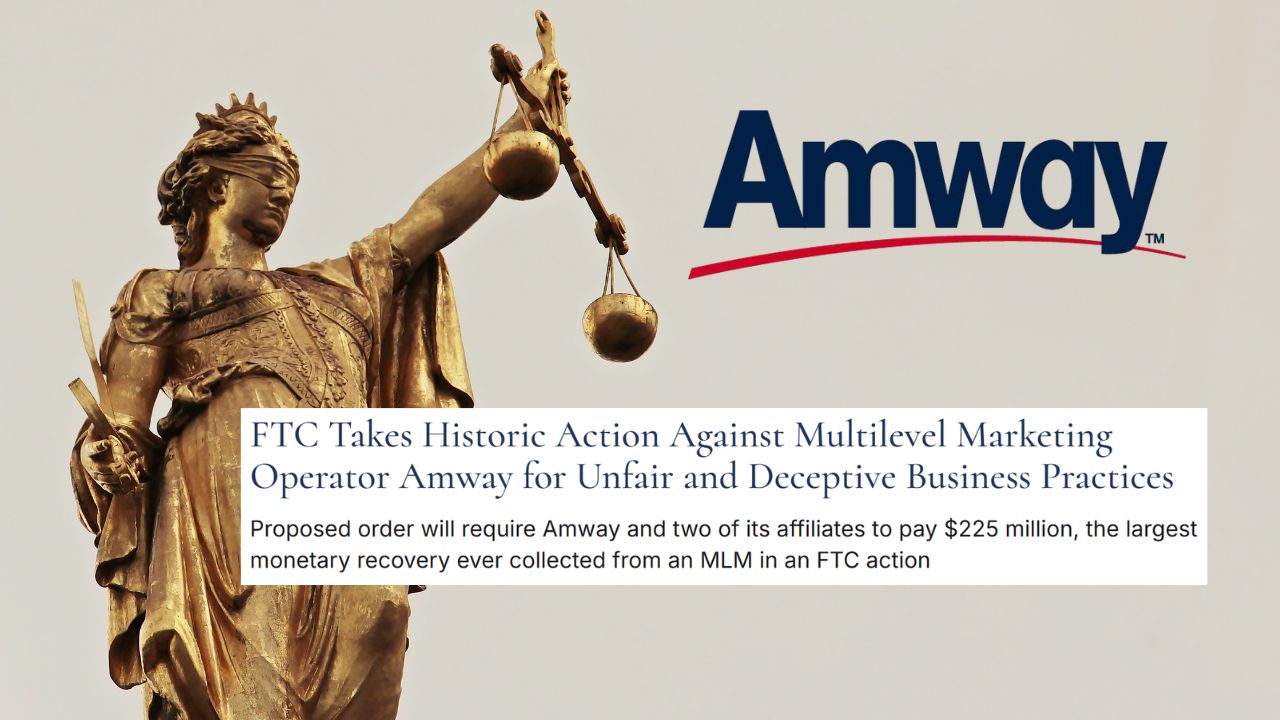
On September 17, 2026, the Federal Trade Commission (FTC), in partnership with the State of Washington, announced one of the most consequential enforcement actions in the history of multilevel marketing. Amway Corporation, along with two of its larger affiliate organizations, World Wide Group (WWG) and Leadership Team Development (LTD), agreed to pay $225 million to resolve allegations of unfair and deceptive business practices. According to the FTC, this is the largest monetary recovery ever obtained in an action against an MLM.
This case is not simply about one company’s misconduct. It is a watershed moment for the entire MLM industry, a validation of decades of consumer advocacy, and a turning point for regulators who have long struggled to rein in deceptive recruitment schemes. It is also a warning to every MLM that has relied on inflation earnings claims, recruitment-driven compensation structures, and pressure tactics that exploit the hopes of ordinary people.
The Allegations Against Amway and Its Affiliates
The FTC’s Complaint outlines a pattern of conduct that fundamentally misrepresented the nature of Amway’s business opportunity. Amway and its affiliates promoted the idea that individuals could become Independent Business Owners (IBOs) and earn substantial income selling Amway’s products. In practice, the FTC alleges that the vast majority of participants earned little or nothing, and many lost money. They have also handed in a Proposal.
One of the central allegations is that Amway and its affiliates misrepresented likely earnings. WWG and LTD told prospective recruits they could earn more than $40,000 annually, despite internal data showing that only about one percent of participants reached that level. Most individuals who joined after 2020 spent more on Amway products and training materials than they ever earned back.
The FTC also alleges that Amway encouraged participants to purchase products they did not want and could not sell, solely to qualify for compensation. This practice created the illusion of product demand while shifting financial risk onto participants.
Perhaps most troubling, the complaint states that Amway and its affiliates instructed IBOs to falsely report sales that never occurred. This was done to create the appearance that Amway’s model revolved around retail sales rather than recruitment — a critical distinction in determining whether an MLM is operating legally.
Perhaps most troubling, the complaint states that Amway and its affiliates instructed IBOs to falsely report sales that never occurred. This was done to create the appearance that Amway’s model revolved around retail sales rather than recruitment — a critical distinction in determining whether an MLM is operating legally.
WWG and LTD also sold expensive training materials and seminars, often costing thousands of dollars per year. These trainings were marketed as essential to success but, according to the FTC, served primarily to pressure participants into purchasing more Amway products each month, regardless of whether they could resell them.
Why This Case Is Historic
The $225 million Settlement is not merely a financial penalty. It is a declaration by federal regulators that the MLM industry’s longstanding practices are no longer acceptable. The FTC emphasized that it “will not tolerate any company deceiving workers — whether through deceptive earnings claims or by promoting reports of false sales.”
Nearly all of the monetary relief will be used to compensate consumers harmed by Amway’s deceptive tactics. Thousands of Washington residents alone may be eligible for redress.
This action surpasses previous enforcement cases against Herbalife, Advocare, and Vemma, marking a new era of regulatory scrutiny.
The Broader Implications for the MLM Industry
Amway is not just another MLM. It is the industry’s prototype — the company that shaped the compensation structures, recruitment culture, and political lobbying strategies that define modern multilevel marketing. For decades, Amway has been held up as the “gold standard” of legitimacy within the MLM world.
The FTC’s action challenges that narrative directly.
The allegations strike at the core of the MLM model: recruitment over retail, pressure to buy inventory, inflated income claims, and training systems that profit from participants rather than consumers. These are not isolated issues. They are structural features of MLMs.
By targeting Amway, regulators have signaled that no MLM is too large or too politically connected to face consequences.
What This Means for Consumer Advocates
For advocates, this case represents a long‑awaited validation. For years, consumer protection activists, anti‑MLM educators, and whistleblowers have documented patterns of deception across the industry. They have argued that MLMs rely on:
- exaggerated income claims
- emotional manipulation
- recruitment‑driven compensation
- pressure to buy inventory
- and misleading marketing narratives
The FTC’s findings align with these concerns. The agency’s language mirrors what advocates have been saying for decades: MLMs often profit not from product sales, but from the purchases and hopes of their own recruits.
This case strengthens the credibility of advocacy work. It provides a concrete example that can be cited in future investigations, legislative efforts, and public education campaigns. It also demonstrates that persistent advocacy—despite years of dismissal, ridicule, and industry pushback — can lead to meaningful change.
For those who have been targeted, harassed, or dismissed for speaking out, this case is a turning point. It shows that regulators are listening.
What This Means for Consumers
For consumers, the Amway case offers both a warning and a source of clarity.
The warning is straightforward: if an MLM promises substantial income, requires you to purchase inventory, or pressures you to attend costly training programs, you are likely entering a system designed for you to lose money. The FTC’s findings show that even the most established MLMs can engage in deceptive practices.
The clarity comes from the FTC’s explicit statements. Consumers now have a federal ruling that outlines the red flags of MLM fraud:
- income claims that exceed reality
- pressure to buy products you cannot sell
- training systems that cost more than you earn
- instructions to falsify sales
- compensation tied to recruitment rather than retail
These findings empower consumers to make informed decisions. They also provide a basis for legal recourse if they have been misled.
A Turning Point for Regulation
The FTC’s action against Amway is part of a broader trend. Regulators have recently taken action against other MLMs, including Amare Global, which was sued for misrepresenting health claims and misleading recruits about earnings.
This suggests a shift in regulatory philosophy. Rather than treating MLMs as benign business opportunities, regulators are increasingly viewing them as high‑risk financial schemes that require oversight.
The Amway case may encourage lawmakers to revisit MLM regulations, strengthen consumer protections, and close loopholes that have allowed deceptive practices to flourish.
The End of an Era
Amway’s $225 million settlement is more than a legal action. It is a cultural reckoning. For decades, Amway has been held up as the model of legitimacy within the MLM industry. The FTC’s findings challenge that narrative and expose the structural vulnerabilities of the MLM model itself.
For consumers, this case provides clarity. For advocates, it provides validation. For regulators, it provides a blueprint for future enforcement.
Most importantly, it signals the end of an era in which MLMs could operate with minimal scrutiny while promising financial freedom that rarely materialized. The FTC has made clear that deceptive earnings claims, pressure tactics, and falsified sales reports will no longer be tolerated.
Amway’s reckoning is not just about one company. It is about an industry built on unrealistic promises, emotional manipulation, and systemic exploitation. The consequences of this case will ripple outward, shaping the future of consumer protection and redefining what accountability looks like in the world of multilevel marketing.
The era of unchecked MLM abuse is ending. And this case is the beginning of what comes next.
By Beth Gibbons (Queen of Karma)
Beth Gibbons, known publicly as Queen of Karma, is a whistleblower and anti-MLM advocate who shares her personal experiences of being manipulated and financially harmed by multi-level marketing schemes. She writes and speaks candidly about the emotional and psychological toll these so-called “business opportunities” take on vulnerable individuals, especially women. Beth positions herself as a survivor-turned-activist, exposing MLMs as commercial cults and highlighting the cult-like tactics used to recruit, control, and silence members.
She has contributed blogs and participated in video interviews under the name Queen of Karma, often blending personal storytelling with direct confrontation of scammy business models. Her work aligns closely with scam awareness efforts, and she’s part of a growing community of voices pushing back against MLM exploitation, gaslighting, and financial abuse.




Leave A Comment