


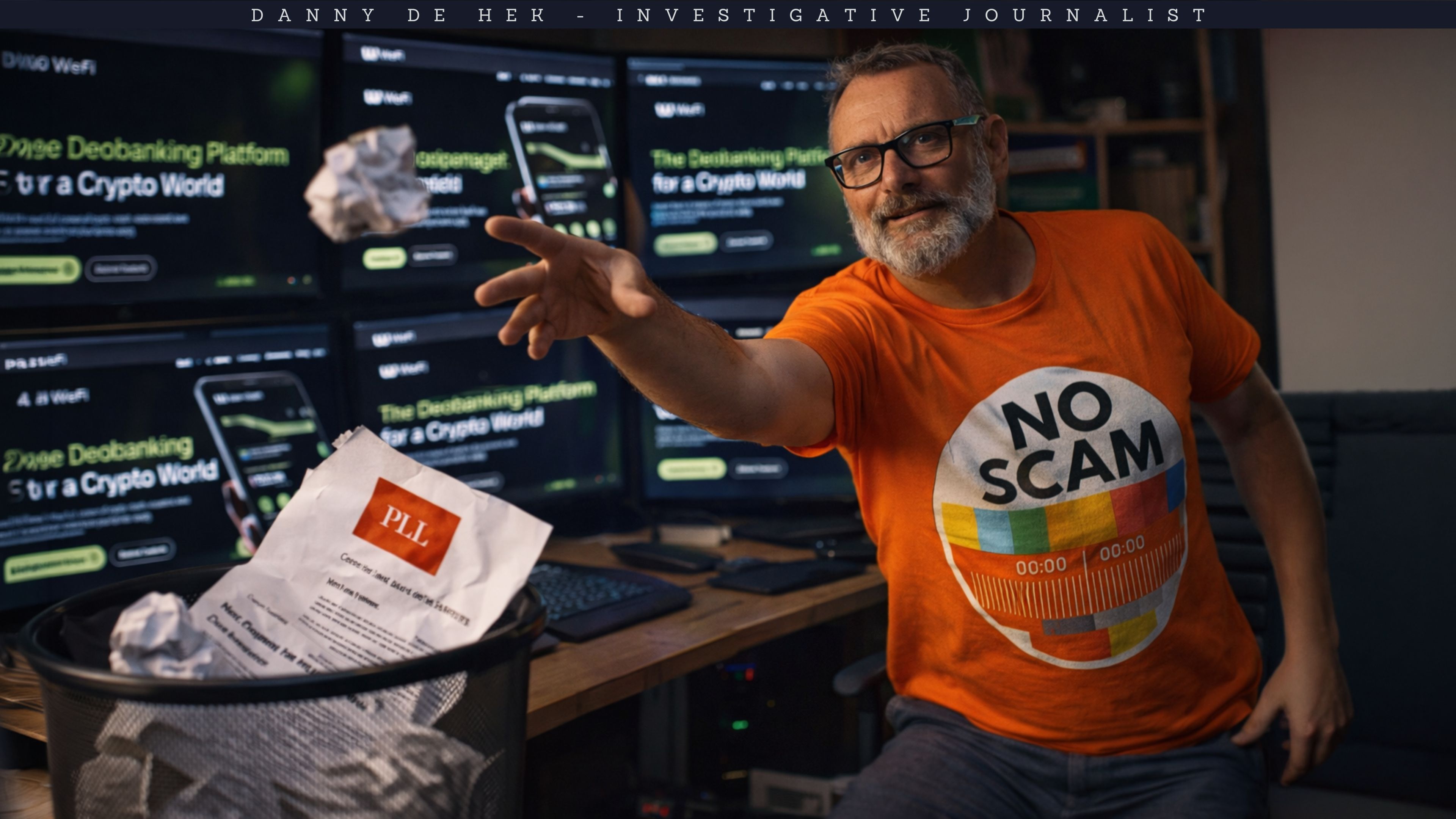
“When scrutiny is met with legal threats instead of answers, you’re no longer looking at a misunderstanding — you’re looking at a pattern.”
After publishing my investigation into WEFI, I received a formal cease and desist letter.
On the surface, it’s the kind of document designed to intimidate — legal terminology, accusations of defamation, references to intellectual property, and a clear attempt to shut the conversation down.
I’ve seen this before.
Not once or twice, but repeatedly across multiple investigations into crypto schemes, MLM structures, and high-risk financial platforms. The pattern is consistent. When scrutiny reaches a certain point — when the right questions start being asked publicly — the response often shifts away from explanation and toward pressure.
That shift matters. Because it tells you something about where the weakness lies.
This isn’t about whether a company has the right to defend itself. Of course it does. The real question is this:
Why respond with a legal threat instead of a clear, transparent explanation of the business model?
The strategy behind the legal threat

Cease and Desist letters are often misunderstood. They are not rulings. They are not judgments. They are not proof that anything written is false.
They are a strategy.
In this case, the strategy is clear. The letter focuses heavily on reputational harm — how the article may affect perception, branding, and public trust. It raises objections to language, disputes certain claims, and demands corrective action.
What it does not do is engage meaningfully with the core concerns raised in the Original Investigation.
There is no detailed explanation of how returns are generated.
There is no audited financial data presented.
There is no clear regulatory framework outlined.
Instead, the emphasis is on removing the criticism itself.
That’s not unusual. In fact, it’s a pattern that tends to emerge at a very specific stage in these types of operations — the moment when public scrutiny starts to threaten momentum.
Because once people stop focusing on the opportunity and start focusing on the structure, the conversation changes.
The admission that matters most
Within the legal response is one statement that stands out above everything else.
WEFI confirms that it does not hold a banking licence.
That is not interpretation. That is not inference. That is their own position, stated clearly.
And yet the platform continues to be marketed as a “decentralised bank.”
This is not a small inconsistency. It is a fundamental contradiction.
In any regulated environment, the use of the term “bank” carries legal meaning. It implies oversight, compliance, capital requirements, and accountability. It is not a branding choice — it is a regulatory classification.
So when a platform presents itself as a bank in marketing, while simultaneously distancing itself from that definition legally, it creates a gap.
A gap between perception and reality.
And that gap is where risk lives.
The MSB argument — and why it matters
A significant part of the defence leans on the concept of Money Services Business (MSB) registration. This is presented as evidence of legitimacy, as if it implies oversight or approval.
It doesn’t.
Regulators have gone out of their way to clarify this, because the misunderstanding has been exploited repeatedly. The U.S. Financial Crimes Enforcement Network (FinCEN) states:
“FinCEN does not approve or endorse any business that has registered as an MSB… Any such claim is false and may be part of a scam.”
That warning exists because people have been misled by this exact argument before.
An MSB registration allows limited activity — typically money transmission. It does not authorise:
- banking services
- deposit-taking
- investment products
- yield generation
So when MSB status is used as a shield against deeper questions, it doesn’t resolve the issue.
It highlights it.
Because it shows that the defence is relying on a classification that does not match the claims being made.
What they disputed — and what remains unanswered
To be clear, the legal letter does dispute certain elements of the original article. In particular, it challenges claims relating to individuals and aspects of third-party reporting.
Those points have been acknowledged, and where necessary, clarified to reflect that some claims remain disputed and unverified. That’s part of responsible investigative work.
But even after making those adjustments, the core structure remains unchanged.
There is still no independently verifiable:
- source of revenue supporting returns
- audited financial reporting
- regulatory oversight across the full operation
- explanation of how the model sustains itself over time
These are not minor details that can be brushed aside. They are the foundation of any legitimate financial system.
And they remain unanswered.
That’s the key point.
Because when a response addresses peripheral issues but avoids the central questions, it doesn’t resolve the concern.
It reinforces it.
What the response avoids completely
This is where the pattern becomes most obvious.
The legal response does not address the behavioural mechanics that were highlighted in the original investigation. It does not explain the reliance on affiliate-style promotion. It does not address the use of independent funnel sites. It does not clarify how user participation ties into the broader financial model.
These are not isolated observations. They are patterns that have appeared across multiple collapsed platforms over the years.
And when those patterns are present, the burden shifts.
It is no longer enough to rely on branding, reputation, or association with known figures. The structure itself needs to stand up to scrutiny.
Because without that, you are not looking at transparency.
You are looking at a system that depends on continued belief.
Why investors being “locked in” matters more than anything else
This is the part most people overlook — and it’s one of the most important pieces of the puzzle.
WEFI promotes long-term participation models, including lock-in periods that can stretch for years. On the surface, this is framed as commitment, long-term vision, or strategic positioning.
In reality, it changes the entire dynamic of the system.
When investors are locked in, they cannot easily withdraw their funds. That removes immediate pressure on the platform to prove liquidity or sustain withdrawals. It creates a buffer — time in which the model can continue operating without being tested under real-world conditions.
But there’s another layer to this.
When someone commits funds for an extended period — especially years — something psychological happens. They don’t just invest financially. They invest emotionally.
They defend the decision.
They justify the model.
They promote it to others.
Not necessarily because they understand it — but because they need it to be true.
This is not unique to WEFI. It’s a pattern seen across multiple high-risk investment structures. Long lock-ups don’t just protect the system financially.
They protect it behaviourally.
Because once enough people are locked in, the system doesn’t just run on money.
It runs on belief.
Why this matters right now
Most people don’t analyse legal threats. They react to them.
They see legal language, they see pressure, and they assume that something must have been proven wrong. That assumption is exactly what these tactics rely on.
But a legal threat is not evidence of legitimacy.
It is a response to scrutiny.
And in many cases, it appears at a very specific point in the lifecycle — when enough questions are being asked that the narrative starts to shift.
From opportunity…
to risk.
From belief…
to doubt.
And once that shift happens, the conversation changes permanently.
Where this leaves things
The cease and desist letter does not change the structure that was analysed in the original investigation.
It does not introduce audited financials.
It does not clarify regulatory oversight.
It does not explain the source of returns.
What it does do is confirm key points — including the absence of a banking licence — while avoiding the questions that matter most.
This isn’t about escalating the situation.
It’s about keeping the focus where it belongs:
On the structure, the evidence, and the unanswered questions.
Because when those questions remain unanswered, the risk does not disappear.
It grows.
Disclaimer: How This Investigation Was Conducted
This investigation relies entirely on OSINT — Open Source Intelligence — meaning every claim made here is based on publicly available records, archived web pages, corporate filings, domain data, social media activity, and open blockchain transactions. No private data, hacking, or unlawful access methods were used. OSINT is a powerful and ethical tool for exposing scams without violating privacy laws or overstepping legal boundaries.
WEFI representatives retain the right of reply. If independently verifiable evidence is provided, this article will be updated accordingly.
About the Author
I’m DANNY DE HEK, a New Zealand–based YouTuber, investigative journalist, and OSINT researcher. I name and shame individuals promoting or marketing fraudulent schemes through my YOUTUBE CHANNEL. Every video I produce exposes the people behind scams, Ponzi schemes, and MLM frauds — holding them accountable in public.
My PODCAST is an extension of that work. It’s distributed across 18 major platforms — including Apple Podcasts, Spotify, Amazon Music, YouTube, and iHeartRadio — so when scammers try to hide, my content follows them everywhere. If you prefer listening to my investigations instead of watching, you’ll find them on every major podcast service.
You can BOOK ME for private consultations or SPEAKING ENGAGEMENTS, where I share first-hand experience from years of exposing large-scale fraud and helping victims recover.
“Stop losing your future to financial parasites. Subscribe. Expose. Protect.”
My work exposing crypto fraud has been featured in:
- Coffeezilla (2026): Featured in the investigation exposing the alleged $328M Goliath Ventures Ponzi scheme
- Bloomberg Documentary (2025): A 20-minute exposé on Ponzi schemes and crypto card fraud
- News.com.au (2025): Profiled as one of the leading scam-busters in Australasia
- OpIndia (2025): Cited for uncovering Pakistani software houses linked to drug trafficking, visa scams, and global financial fraud
- The Press / Stuff.co.nz (2023): Successfully defeated $3.85M gag lawsuit; court ruled it was a vexatious attempt to silence whistleblowing
- The Guardian Australia (2023): National warning on crypto MLMs affecting Aussie families
- ABC News Australia (2023): Investigation into Blockchain Global and its collapse
- The New York Times (2022): A full two-page feature on dismantling HyperVerse and its global network
- Radio New Zealand (2022): “The Kiwi YouTuber Taking Down Crypto Scammers From His Christchurch Home”
- Otago Daily Times (2022): A profile on my investigative work and the impact of crypto fraud in New Zealand





More AI slop from our retarded illiterate buddy. That’ll do it!
“We note that your website is not officially recognized as a consortium of journalists and is
not registered as such anywhere in the world. It has not been registered as a mass media
outlet, newspaper, or online media outlet in New Zealand, the USA, or anywhere else. The
possibility of commissioning a report on any company for a fee, as advertised on your
website, is enough to invoke the laws on unfair competition and brand damage, which are
prerequisites for applying competition laws.”
Ah, John Citizen (Daniel Carrion) — back again with another anonymous drive-by comment.
For anyone reading this, it’s worth noting that this individual has been posting repeatedly under different aliases, using the same infrastructure, while refusing to identify themselves. That alone should tell you how much weight to give their opinions.
Let’s address the substance (if we can call it that).
You seem confused about what journalism actually is. There is no global licensing body that decides who is or isn’t a journalist. Independent journalists exist all over the world — they are defined by their work, their research, and their public record, not by a certificate.
If you’d like to educate yourself, you’re welcome to start here:
https://en.wikipedia.org/wiki/Danny_de_Hek
Or simply search my name in Google News — you’ll find coverage including:
A two-page feature in The New York Times (print and online)
A Bloomberg documentary investigating crypto fraud networks
Coverage connected to The Guardian’s reporting on the same schemes
These are not self-published claims — they are independent, internationally recognised media outlets.
You also reference “commissioning reports.” Let’s be clear: investigating and documenting public information is standard practice in journalism. The difference is transparency — I operate under my real name, with my work publicly available and open to scrutiny. You, on the other hand, hide behind a fake identity while making baseless assertions.
If you have credible evidence to present, feel free to do so — using your real name. Until then, this reads less like a serious critique and more like someone who is unhappy about being exposed or connected to those who have been.
For everyone else: this is exactly what happens when you shine a light on questionable operations — anonymous noise follows. Fortunately, facts don’t change just because someone posts them in a comment section.
— Danny de Hek
NYT Featured Investigative Journalist | OSINT | Cult Survivor | Exposing Scams, Ponzi Schemes & MLMs | Name & Shame the Bad Actors Behind the Lies