



“When one opportunity collapses, how long does it take before the same promoters find the next one?”
That question was already sitting in the back of my mind while I was investigating METATRONICS. I had watched the presentations, spoken with people caught inside it, collected transaction evidence and documented what happened as withdrawals became a problem.
One of the names that kept appearing throughout that investigation was Jan Gregory, a veteran promoter who had enthusiastically presented METATRONICS as another opportunity built around automated trading and passive returns. Then, while that story was still unfolding, Jan appeared around something new: OxusTech.
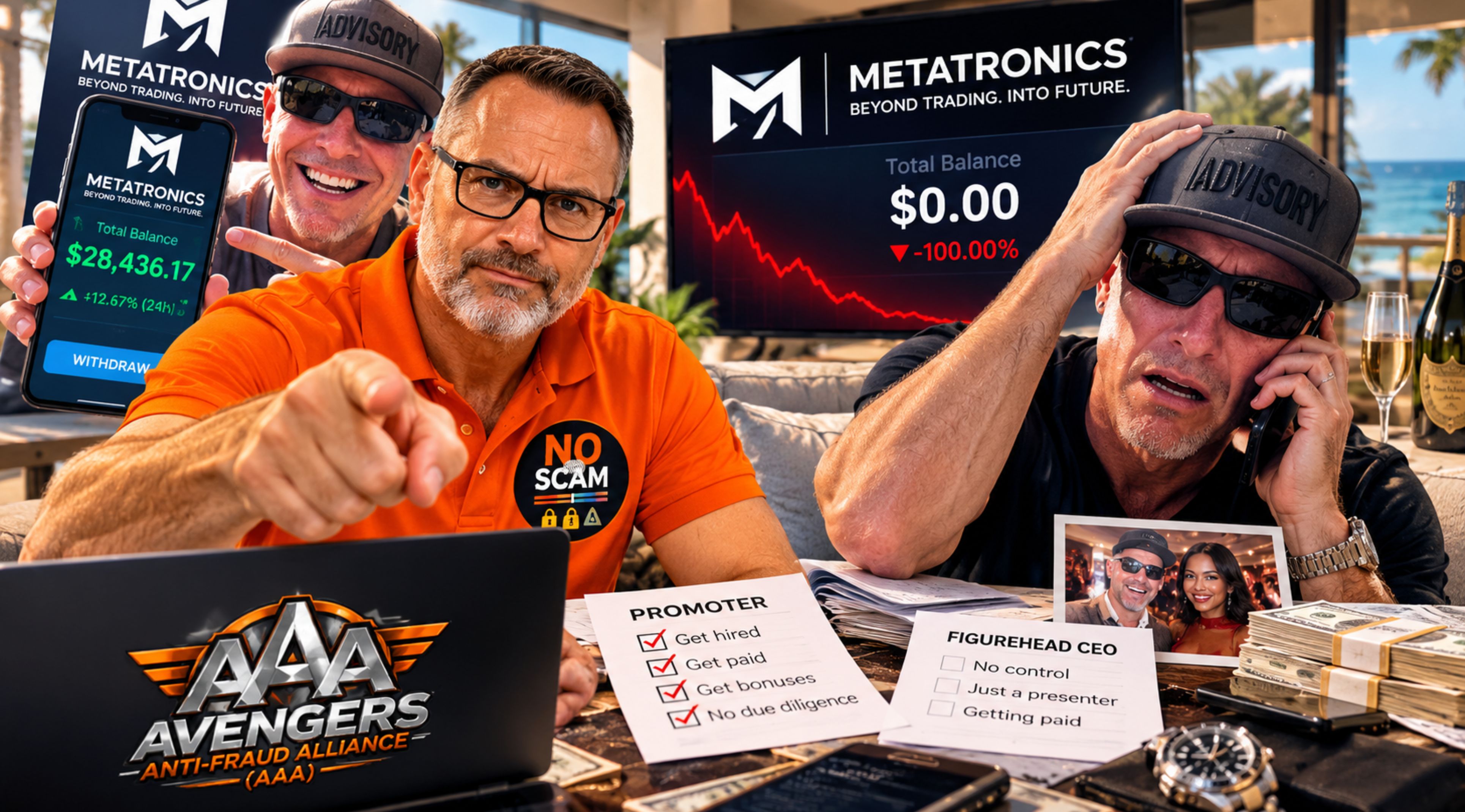
So I investigated it.
This time the technology story has changed. OxusTech isn’t selling the METATRONICS narrative. It presents itself as a sophisticated operation using autonomous arbitrage agents on Polymarket, supposedly identifying tiny pricing discrepancies and executing trades faster than ordinary humans possibly could. Participants deposit USDT, algorithms supposedly do the work, and OxusTech advertises daily returns ranging from 0.45% to 0.75%. On the surface, it is wrapped in all the familiar language of algorithms, artificial intelligence, high-speed execution and mathematical certainty.
But I didn’t have to dig very far before the story became considerably more interesting.
 I obtained and reviewed the complete 22-slide OxusTech presentation being used to explain the opportunity. Behind the polished technology pitch is an elaborate compensation structure involving direct recruitment commissions, daily payments linked to personally recruited partners, deeper downline rewards, pool bonuses, a Trust Bonus, 17 ranks, team-volume requirements and bonuses that eventually reach extraordinary figures. At the top rank, OxusTech’s own presentation describes a $250,000 personal deposit, $250 million in team volume and a $1 million one-off rank bonus.
And then there are the people.

Alongside Jan Gregory is another familiar name from the promotional world: Marcos Schroeckenthaler, also known as Marcos Caleb. I had already encountered the Jan-and-Marcos combination while examining previous crypto opportunities. That history doesn’t prove anything about OxusTech by itself, and I’m not interested in declaring something fraudulent simply because familiar promoters have arrived. What it does do is give me a very good reason to start asking questions early — before another group of investors discovers the answers after their money is already trapped.
This investigation therefore isn’t based on whether I like Jan Gregory, Marcos Caleb or anybody else promoting OxusTech. It is based on something much more useful: OxusTech’s own numbers, its own presentation, its own compensation plan and its own claims about where the money comes from.
If autonomous Polymarket arbitrage really generates enough external profit to pay investors up to 0.75% every day, while simultaneously funding multiple layers of recruitment commissions, pools and enormous rank bonuses, there should be evidence.
That’s where this investigation begins.
What OxusTech Says It Actually Does
At the centre of the OxusTech pitch is Polymarket, a prediction market where users trade positions on the outcomes of real-world events. OxusTech says its autonomous agents continuously scan these markets looking for temporary pricing discrepancies where the combined cost of both possible outcomes falls below the eventual settlement value. According to the presentation I reviewed, its technology operates 24/7, supposedly finding opportunities and executing trades automatically before the price discrepancy disappears.
OxusTech provides a remarkably simple example. Imagine the YES position on a Polymarket event can be purchased for $0.56 while the NO position costs $0.42. Buying both would cost $0.98. Because one side ultimately settles at $1.00, OxusTech says the trade produces a $0.02 profit regardless of the outcome. In principle, arbitrage itself is nothing mysterious. Price discrepancies exist across financial and betting markets, and sophisticated traders have been exploiting them for decades.
The extraordinary part isn’t the concept. It’s the scale, speed and consistency OxusTech claims to achieve with it.
Its presentation says these opportunities can disappear within 10–50 milliseconds, while OxusTech claims its infrastructure can execute in just 2–5 milliseconds. It also advertises a claimed 1.5%–2.5% spread per successful trade. The presentation describes an automated system capable of identifying both sides of an opportunity, filling the orders independently and repeatedly extracting these supposedly outcome-independent profits.
That technological explanation is important because it gives prospective participants something tangible to believe in. Their money isn’t supposedly being generated by recruiting the next person. It is presented as being put to work by sophisticated autonomous agents operating inside a large, established prediction market. The algorithms are faster than humans. The mathematics supposedly removes directional risk. The system never sleeps.
Then OxusTech attaches an investment proposition to that story.
Participants deposit USDT, starting from as little as 50 USDT, and the presentation divides deposits into four levels. The advertised daily return begins at 0.45% and rises to 0.75% per day for deposits of $25,000 or more. OxusTech itself translates those figures into approximately 13.5% to 22.5% every 30 days, before introducing the additional bonuses available through its compensation structure.
This is where I stopped looking at OxusTech simply as an interesting piece of arbitrage technology.
If the company is really producing these returns from Polymarket, the important question isn’t whether arbitrage exists. The question is whether OxusTech is actually conducting enough profitable arbitrage to support what it promises participants. And unlike vague claims about a secret trading algorithm, substantial activity on a blockchain-based prediction market should leave evidence that can be examined.
The presentation explains the theory very well. What I wanted to find was the money.
Up To 0.75% A Day — Follow The Mathematics
Once I understood the story OxusTech was telling about Polymarket arbitrage, I turned to the numbers in its presentation. This is where the proposition moves from clever technology into something investors need to examine very carefully. OxusTech divides deposits into four levels, beginning at just 50 USDT, with the advertised daily return increasing according to how much money a participant puts into the system.
At the lower end, OxusTech advertises 0.45% per day. Higher deposit levels increase that to 0.55% and 0.65%, before reaching 0.75% per day for deposits of $25,000 or more. The company doesn’t hide what those percentages mean. Its own presentation converts them into approximately 13.5% to 22.5% over 30 days.
The examples make the scale easier to understand. According to the presentation, a $5,000 deposit can generate approximately $675 in 30 days. A $15,000 deposit is shown producing approximately $2,925, while somebody depositing $50,000 is shown earning approximately $11,250 in just 30 days.
Those aren’t projections I’ve invented. They are OxusTech’s own examples.
Then I looked at what happens when those daily percentages are sustained. A return of 0.75% a day represents 273.75% of the original principal over 365 days using simple multiplication, before even considering reinvestment or any of the additional rewards OxusTech advertises. That doesn’t automatically prove the underlying trading cannot produce it, but it sets an extremely high evidential bar. Extraordinary and consistent returns require extraordinary and consistent profits somewhere upstream.
OxusTech says that upstream profit comes from arbitrage. Its presentation claims approximately 1.5%–2.5% profit per trade, from which a 20% protocol fee is taken. But investors aren’t the only people expecting to be paid from this machine. The same presentation describes substantial affiliate compensation, daily recruitment-related payments, deeper downline rewards, pool distributions, rank bonuses and additional incentives for leaving principal inside the system.
That creates the question I keep returning to throughout this investigation: how much genuine external trading profit must OxusTech generate every day to satisfy all of these obligations?
There is another detail in the presentation that deserves attention. OxusTech doesn’t merely reward participants for depositing money; it introduces financial incentives for keeping that principal inside. Its Trust Bonus follows a repeating 5%, 3% and 2% monthly cycle, which OxusTech says can provide an additional 40% over 12 months. Withdraw the principal, however, and the Trust Bonus resets.
That matters because the sustainability of any high-yield investment proposition depends not simply on money entering, but also on how much money investors attempt to take back out. Incentivising people to leave principal untouched can reduce that pressure.
None of this, standing alone, establishes where OxusTech’s payouts actually originate. That requires following the money. But before doing that, there was another part of the presentation I needed to understand.
Because once I examined the compensation plan, OxusTech stopped looking like merely an automated Polymarket trading product.
Seven Ways To Get Paid — This Is More Than A Trading Bot
The deeper I went into the OxusTech presentation, the less this looked like a straightforward technology company giving customers access to an arbitrage engine. OxusTech doesn’t just advertise returns from depositing USDT. Its presentation promotes seven separate reward streams, several of which are directly connected to recruiting other participants and building increasingly large teams beneath them.
The first is the Firstline Bonus. According to the presentation, personally introducing somebody to OxusTech can generate an upfront bonus of 10% to 15%, with the percentage determined by the promoter’s own deposit level. But it doesn’t end with the initial commission. OxusTech also advertises ongoing daily rewards based on the volume generated by personally recruited Level-1 partners, beginning at 0.10% and climbing as high as 0.40% per day once a participant has 20 or more active personally recruited partners.
Then the compensation reaches deeper.
OxusTech calls the next layer its Downline Bonus, paying between 0.01% and 0.04% per day on qualifying team volume from Level 2 downward. The presentation gives an extraordinary example of what this supposedly means at scale: $5 million in team volume generating $2,000 per day, $60,000 per month and $720,000 over 12 months.
That example caught my attention because it exposes just how important recruitment and team growth are to the proposition. The person earning that $720,000 isn’t being shown making thousands of individual Polymarket trades. The example is demonstrating income derived from the volume sitting underneath their position in the network.
OxusTech then introduces its Pool Share Bonus. Qualification isn’t based solely on trading performance. Participants must satisfy combinations of their own personal deposits and the volume generated throughout their downline. At the lower end, the presentation shows Pool 1 requiring 1,000 USDT personally and 5,000 USDT in downline volume. At the upper end, Pool 8 requires 100,000 USDT personally and $5 million in downline volume. OxusTech says qualifying participants can share in distributions reaching as high as 7.5% under the pool structure described in its presentation.
Add the Trust Bonus I examined earlier, the rank rewards and the Global Leader Pool, and the economic proposition becomes very different from the simple arbitrage example shown at the beginning of the presentation.
There is nothing inherently fraudulent about paying referral commissions, and a compensation plan by itself doesn’t establish that new deposits are funding existing participants. The critical issue is the source of the money. If OxusTech’s external Polymarket trading generates sufficient realized profit to pay all these obligations, that should be demonstrable. If it doesn’t, then we need to understand what other revenue is funding them.
And that question becomes considerably more important when you see what OxusTech expects its biggest network builders to achieve.
Because the compensation plan doesn’t stop at a few referral commissions.
It eventually requires teams measured in hundreds of millions of dollars.
$250 Million Teams And Million-Dollar Rank Bonuses
If the Firstline and Downline Bonuses showed me that recruitment was an important part of OxusTech, the 17-rank compensation structure removed any doubt about just how large the company expects those networks to become. The ranks don’t simply recognise somebody for using the alleged arbitrage technology. Advancement is tied to a combination of personal deposits and team volume, with the requirements escalating dramatically as participants move through the system.
At the top sits R17. According to the presentation I reviewed, reaching that rank requires a $250,000 personal deposit and $250 million in team volume. OxusTech attaches a $1 million one-off rank bonus to achieving it. Across all 17 ranks, the presentation shows cumulative one-off bonuses potentially reaching $2.111 million.
Those figures matter because they tell us what behaviour the compensation plan is designed to encourage. OxusTech may lead its presentation with autonomous agents and Polymarket arbitrage, but its highest-ranking participants are being challenged to build enormous organisations measured by the amount of money flowing through their teams.
The presentation also includes a 40% rule, apparently designed to prevent one large leg from accounting for all qualifying volume. In other words, reaching the upper ranks isn’t simply about finding one wealthy investor. The structure encourages participants to develop volume across a broader organisation.
Then comes another layer: the Global Leader Pool.
To qualify, the presentation says a participant must already be earning at least $3,000 per day from the Downline Bonus. OxusTech says qualifying leaders then share in a pool funded by 0.01% of what it calls the company’s total “Streamline volume.” That qualification threshold alone tells you the scale being contemplated. Somebody earning $3,000 every day from a downline isn’t casually referring a couple of friends; they are sitting above substantial participant volume.
I kept coming back to the same problem. OxusTech advertises daily passive returns to depositors. It pays substantial upfront Firstline Bonuses. It advertises ongoing daily rewards on personally recruited partners, deeper downline payments, pool distributions, Trust Bonuses, 17 separate rank bonuses and a Global Leader Pool.
Every one of those payments ultimately needs a source.
OxusTech’s answer is essentially that its technology generates the money through highly efficient Polymarket arbitrage. If that’s true at the scale required to support this compensation plan, we shouldn’t have to rely solely on PowerPoint slides and presentations to establish it.
There should be trading.
There should be wallets.
There should be transactions.
And there should be enough independently verifiable profit to make the mathematics work.
Where Is The Polymarket Trading Evidence?
This is the point where I stop listening to the sales presentation and start looking for evidence. OxusTech says the money comes from autonomous agents exploiting arbitrage opportunities on Polymarket. If that explanation is accurate, then the company isn’t simply moving numbers around inside an internal dashboard. There should be substantial underlying trading activity capable of generating the returns being advertised.
That is particularly important because Polymarket isn’t some mysterious private trading platform hidden behind a bank’s closed infrastructure. Its markets operate using blockchain technology, meaning transactions associated with identified trading wallets can potentially be examined. OxusTech itself promotes this idea of transparency, showing what it describes as real-time transactions and an arbitrage engine at work.
But watching transactions flash across a company-controlled dashboard isn’t the same thing as independently verifying them.
What I want are the actual wallets and Polymarket accounts associated with OxusTech’s alleged trading operation. Once those are reliably attributed, blockchain analysts can examine how much capital is really being deployed, which markets are being traded, how frequently positions are opened and closed, and—most importantly—whether the realized profits resemble the extraordinary economics being presented to investors.
The numbers make this particularly important. OxusTech isn’t claiming its technology occasionally discovers a profitable trade. It is building an entire financial proposition around sufficiently consistent arbitrage to advertise 0.45%–0.75% daily returns, while simultaneously supporting its protocol costs and extensive affiliate compensation structure. The company has also promoted multimillion-dollar trading capacity and extremely fast execution as evidence of the sophistication behind the operation.
Those claims should leave a footprint.
There is another reason I want the wallets. If participant USDT enters OxusTech, following those funds could help establish whether significant amounts are actually reaching infrastructure associated with Polymarket trading, remaining in collection wallets, moving through exchanges, being transferred elsewhere, or being used in ways inconsistent with the marketing narrative. A deposit address alone doesn’t prove who ultimately controls every destination wallet, so attribution has to be handled carefully, but transaction history can turn marketing claims into testable questions.
This is also where investors can help the investigation. Deposit addresses, transaction hashes, withdrawal transactions and screenshots showing the network used to send USDT are considerably more useful to me than another promotional video. With enough independently sourced transactions, patterns can begin to emerge.
At this stage, I am not claiming that the absence of publicly identified OxusTech wallets proves there is no trading. What I am saying is that OxusTech is making claims that should be capable of independent verification. If millions of dollars are genuinely being deployed through autonomous agents generating the profits necessary to support this model, producing verifiable evidence should strengthen the company’s case rather than threaten it.
Until that evidence is established, the Polymarket arbitrage engine remains exactly what I found it as:
a central claim in OxusTech’s marketing presentation that still needs to be independently proven.
An Australian Company And A $30 Million Claim
One of the strongest legitimacy signals in the OxusTech presentation is its Australian company registration. The presentation identifies OXUSTECH PTY LTD, gives the Australian Company Number 701 310 670, lists 201 Sussex Street, Sydney NSW 2000 as its office address and names Justin Hall as director. OxusTech’s current website repeats those details, describes Hall as the company’s sole director and tells prospective participants that the entity is verifiable through the ASIC registry.
Then comes the number designed to stand out: $30,000,000.
In the presentation supplied to investors, that figure appears as “Share Capital.” OxusTech’s website currently describes it as both “Authorized capital: $30 million” and “Registered share capital,” while its own expansion timeline says an Australian company was established with a “stated capital of $30 million.” The same $30 million figure is now being repeated through promotional material encouraging people to join OxusTech.
That wording deserves careful scrutiny. A company registration and a stated share-capital figure are not evidence that $30 million in cash is sitting in a bank account, nor do they establish that $30 million is available to protect investors. They also don’t prove that OxusTech’s advertised Polymarket trading is occurring. For this investigation, I want the underlying corporate documentation and financial evidence establishing exactly what that $30 million represents, whether the shares are fully paid, who holds them and what assets actually sit behind the company.
There is another interesting development on OxusTech’s website. The company now promotes a section headed “Registered, Audited, Accountable”, yet the material presented there centres on company-registration documents rather than published audited financial statements. It also says crypto licences are merely planned, a European bank guarantee is being prepared, and Visa/Mastercard integration will come once required registrations and insurance processes are finalised.
Perhaps the most significant institutional claim is the one involving UBS. OxusTech currently states that its delegation has “reached an agreement to cooperate with UBS Bank regarding insurance coverage,” describing this as a step toward institutional-grade protection. Oxus Tech That is precisely the sort of claim I want independently confirmed by the institution supposedly involved, rather than accepted because it appears on an investment website.
None of this means the Australian company doesn’t exist. The important distinction is that incorporation is not verification of the investment proposition. Registering a proprietary company does not, by itself, validate advertised returns, prove that customer deposits are being traded as represented, verify the people operating the platform or demonstrate that the business holds every regulatory authorisation its activities may require.
OxusTech is clearly using its Australian corporate identity as part of the credibility story. That’s fair enough.
But if $30 million, institutional protection and Australian accountability are going to be used to reassure people while they deposit USDT into a platform advertising returns of up to 0.75% a day, I want to know exactly what sits behind those words.
Who Is Really Behind OxusTech?
Once a company starts asking people around the world to send it cryptocurrency in exchange for passive daily returns, I want to know who is actually responsible for the operation. OxusTech now presents Konstantinos Kalatsidis as its co-founder and Chief Executive Officer. Interestingly, its promotional material has also rendered the surname as Kalaitzidis, something worth documenting rather than silently correcting. The company’s current biography says he began his career in Greece with UBS Europe SE as a Market Operations Analyst, working with institutional securities, government bonds, settlement, reconciliation, client reporting, custodians and compliance before moving into the European betting-exchange industry.
That’s an impressive biography. The problem is that when I went looking for independent corroboration, I couldn’t establish that employment history from the public material I searched. Searches for the name produced other people with the same or similar name, but I did not find an independent professional profile connecting the OxusTech CEO to the UBS career described by OxusTech. That doesn’t prove the biography is false. It means the biography remains an OxusTech claim that I have not independently verified. The distinction matters when someone’s supposed institutional-finance background is helping establish credibility for an operation accepting investors’ USDT.
Then there is Michael Paulson, whom OxusTech identifies as its Marketing Director and CMO, describing him as a “Global Web3 ecosystem scaling strategist” responsible for international communities and partnerships. OxusTech’s own communications place Paulson at the centre of its English-language marketing, hosting presentations while other named presenters cover Russian, Spanish, Turkish, Hindi and Portuguese audiences. Oxus Tech Again, I found OxusTech material telling me who Michael Paulson is, but I have yet to establish an independently documented career history connecting this particular individual to the experience implied by that senior executive position.
 Other investigators have gone considerably further. BehindMLM has questioned whether OxusTech’s publicly presented management is genuine and has raised the possibility of a so-called “Boris CEO” arrangement involving people presented as executives while the real operators remain elsewhere. BehindMLM I am not adopting that allegation as a finding. At this stage, I don’t have evidence proving Konstantinos or Michael are actors, fictitious identities or fronts for somebody else. What I do have is a reasonable investigative question: who owns and controls the platform receiving the money?
That question becomes even more interesting when the company’s Australian paperwork names Justin Hall as sole director, while Konstantinos is publicly presented as co-founder and CEO. There is nothing inherently unusual about a CEO not being a company director. But when the investment presentation relies heavily on named executives, Australian incorporation, claimed institutional experience and a $30 million capital figure, I want the relationships between those people documented properly.
OxusTech has certainly assembled an international promotional operation. Its current presentation schedule names different presenters for virtually every day of the week, culminating in a Sunday CEO presentation from Konstantinos. Telemetr What remains far less clear is the ownership and operational structure behind all those presentations.
And while I was trying to establish who was behind OxusTech itself, two names much closer to my previous investigations brought the story full circle:
Jan Gregory and Marcos Schroeckenthaler — better known as Marcos Caleb.
Jan Gregory And Marcos Caleb — Here We Go Again
This is where OxusTech stopped being simply another opportunity that landed on my desk. Jan Gregory is promoting it. Only days earlier, Jan had been publicly associated with METATRONICS as its Global Ambassador, promoting automated trading, passive income, USDT withdrawals and referral recruitment. METATRONICS’ own Telegram posts carried his name and title beneath those promotions. By 17 September 2026, however, Jan was publicly saying METATRONICS was finished after withdrawals stopped, while METATRONICS responded by announcing that it had terminated its relationship with him and making serious allegations of its own. Those competing accusations are part of the record; they don’t change the basic chronology.
And almost immediately, there was Jan again — promoting OxusTech, an opportunity advertising Polymarket arbitrage and daily returns of 0.45% to 0.75%, complete with referral commissions, downline rewards, pools and ranks. That timing is what makes this follow-up investigation important. I’m not suggesting Jan created OxusTech or controls it; I have no evidence of that. What I can document is a promoter moving from one high-yield crypto opportunity into another while the fallout from the previous one is still unfolding. That is a pattern investors deserve to know about before deciding whether his latest recommendation carries any weight.

Jan’s history didn’t begin with METATRONICS either. BitHarvest was another opportunity I investigated while Jan was promoting it. California’s Department of Financial Protection and Innovation had already issued a desist-and-refrain order involving Jan and BitHarvest, and Jan later claimed in a METATRONICS promotional video that he had done “90 million something” through BitHarvest. BehindMLM reports that BitHarvest subsequently collapsed in November 2025 after attracting regulatory attention in multiple jurisdictions.
Then we come to Marcos Schroeckenthaler, better known as Marcos Caleb.
Marcos is another familiar face from my previous investigations. I encountered him around BitHarvest, including training material promoting its BitBooster opportunity, and his name has repeatedly appeared alongside the same wider promotional ecosystem as Jan. That history is why Marcos is now on the Avengers Anti-Fraud Alliance investigation board as we follow OxusTech. But there is an important distinction I won’t blur for the sake of a stronger story: I have evidence that Jan is promoting OxusTech; I have not yet established Marcos’s precise role in OxusTech itself. Until I have the Zoom, referral link, promotional post or other primary evidence connecting him directly, I won’t manufacture that connection.
That is how these investigations should work. Familiar names tell me where to look, not what conclusion to publish.
For Jan Gregory, however, the OxusTech connection takes this story straight back to where it began. METATRONICS was promoted as technology generating passive returns. When withdrawals became a problem, Jan turned against the operation he had previously promoted. Now another opportunity is being placed in front of investors, again wrapped in automated technology, passive daily income and a compensation structure rewarding recruitment.
The branding has changed. The trading story has changed.
The promoter hasn’t.
Follow The Money, Not The Marketing

After working through the entire OxusTech presentation, the question I am left with isn’t whether arbitrage exists or whether artificial intelligence can trade prediction markets. Both subjects make excellent marketing material, but neither establishes that OxusTech is generating the money it promises to distribute.
The financial proposition is extraordinary. Participants are being offered 0.45% to 0.75% per day. Recruiters can receive upfront Firstline Bonuses of 10% to 15%, followed by additional daily rewards connected to personally recruited participants. There are deeper Downline Bonuses, pool distributions, a Trust Bonus encouraging people to leave their principal inside the system, 17 ranks, one-off bonuses reaching $1 million and a Global Leader Pool.
All of that money has to come from somewhere.
OxusTech says its autonomous agents provide the answer. If that’s true, I want to see evidence capable of being independently examined: the trading wallets, Polymarket accounts, transaction history, capital actually deployed, realized trading profits and financial records showing that external trading revenue is sufficient to meet the company’s advertised obligations. I also want clarity around the $30 million share-capital claim, the people controlling the Australian company and the institutional relationships being used to strengthen the credibility of the operation.
Until those questions are answered, screenshots of an earnings dashboard don’t satisfy me. Neither does an Australian company number, an impressive PowerPoint presentation or a video showing transactions moving across a screen. I’ve investigated too many opportunities where numbers displayed inside a company’s own ecosystem were treated as proof of money that nobody had independently verified.
And that brings me back to Jan Gregory.
I have just finished documenting his involvement with METATRONICS. Now, before the dust has even settled on that operation, I find him promoting OxusTech. Alongside this investigation sits another familiar name, Marcos Schroeckenthaler, aka Marcos Caleb, whose previous promotional history with Jan is already of interest to me. I will continue documenting their involvement based on evidence as it emerges rather than assuming everybody around the opportunity has the same role.
The Avengers Anti-Fraud Alliance is now gathering intelligence on OxusTech. I am particularly interested in hearing from participants who can provide deposit addresses, transaction hashes, withdrawal records, referral links, private presentations, Zoom recordings or communications from promoters. Those pieces of evidence can help establish where participant funds actually travel and whether the Polymarket activity being described publicly matches what is happening financially.
I am not interested in waiting until another platform stops paying before asking those questions.
OxusTech has made the claims. It has published the returns. It has designed the compensation plan. It has identified the supposed technology generating the money.
Now the evidence needs to match the presentation.
Disclaimer: How This Investigation Was Conducted
This investigation relies entirely on OSINT — Open Source Intelligence — meaning every claim made here is based on publicly available records, archived web pages, corporate filings, domain data, social media activity, and open blockchain transactions. No private data, hacking, or unlawful access methods were used. OSINT is a powerful and ethical tool for exposing scams without violating privacy laws or overstepping legal boundaries.
About the Author
I’m DANNY DE HEK, a New Zealand–based YouTuber, investigative journalist, and OSINT researcher. I name and shame individuals promoting or marketing fraudulent schemes through my YOUTUBE CHANNEL. Every video I produce exposes the people behind scams, Ponzi schemes, and MLM frauds — holding them accountable in public.
My PODCAST is an extension of that work. It’s distributed across 18 major platforms — including Apple Podcasts, Spotify, Amazon Music, YouTube, and iHeartRadio — so when scammers try to hide, my content follows them everywhere. If you prefer listening to my investigations instead of watching, you’ll find them on every major podcast service.
You can BOOK ME for private consultations or SPEAKING ENGAGEMENTS, where I share first-hand experience from years of exposing large-scale fraud and helping victims recover.
“Stop losing your future to financial parasites. Subscribe. Expose. Protect.”
My work exposing crypto fraud has been featured in:
- Coffeezilla 2026): Featured in the investigation exposing the alleged $328M Goliath Ventures Ponzi scheme
- Bloomberg Documentary (2025): A 20-minute exposé on Ponzi schemes and crypto card fraud
- News.com.au (2025): Profiled as one of the leading scam-busters in Australasia
- OpIndia (2025): Cited for uncovering Pakistani software houses linked to drug trafficking, visa scams, and global financial fraud
- The Press / Stuff.co.nz (2023): Successfully defeated $3.85M gag lawsuit; court ruled it was a vexatious attempt to silence whistleblowing
- The Guardian Australia (2023): National warning on crypto MLMs affecting Aussie families
- ABC News Australia (2023): Investigation into Blockchain Global and its collapse
- The New York Times (2022): A full two-page feature on dismantling HyperVerse and its global network
- Radio New Zealand (2022): “The Kiwi YouTuber Taking Down Crypto Scammers From His Christchurch Home”
- Otago Daily Times (2022): A profile on my investigative work and the impact of crypto fraud in New Zealand





Leave A Comment