


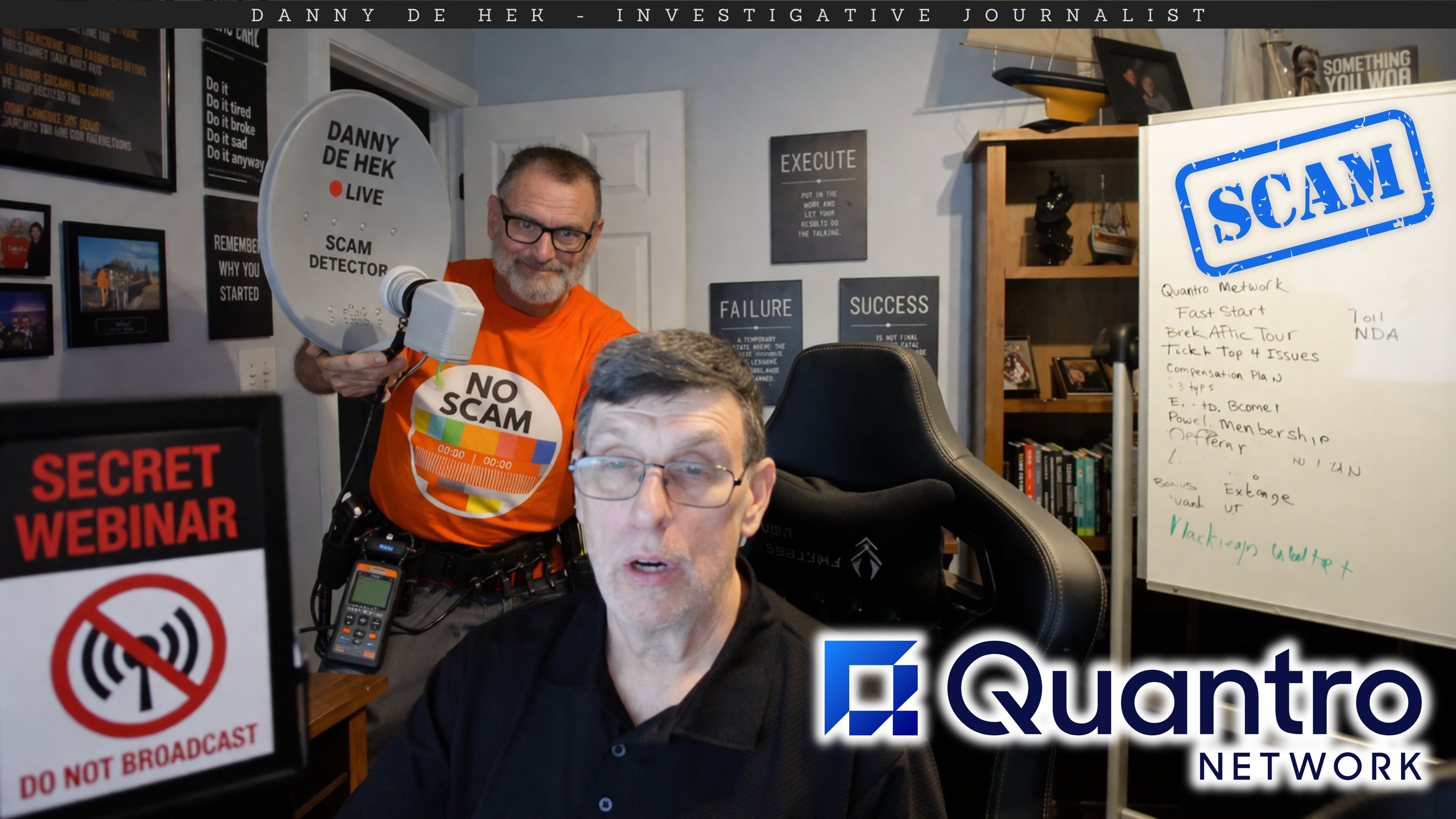
“The only proof we publish is what’s on our site.”
That line didn’t come from a critic. It came directly from Quantro Network’s own AI agent when I asked for verification. And in that moment, everything started to fall into place.
Over the past few days, I’ve taken a deep dive into Quantro Network — their website, onboarding system, legal framework, internal communications, and even direct conversations with their own platform.
What I’ve found is not just a collection of red flags. It’s a coordinated structure, built to present itself as a legitimate automated trading solution while quietly removing transparency and accountability at every level.
This isn’t about one misleading claim. It’s about a pattern — one I’ve seen repeatedly across multiple schemes over the years. The language evolves. The branding improves. The delivery becomes more polished. But underneath, the mechanics remain consistent.
And once you recognise those mechanics, it becomes very difficult to ignore what you’re actually looking at.
A system where you don’t control your own money
The first thing I always examine is how money moves. Not what’s promised — but what’s required.
In Quantro Network, users are instructed to deposit cryptocurrency into a Quantro Wallet, which acts as the central hub for all financial activity. From there, funds are allocated into their internal trading environment, where their expert advisors operate.
At no point does the user connect to a broker.
At no point does the user control execution.
At no point can the user independently verify what is happening.
Everything sits inside Quantro’s infrastructure.
That changes the dynamic completely.
In a legitimate trading environment, you would expect to:
- Control your own brokerage account
- Verify trades independently
- Withdraw funds without reliance on internal approval
- Here, the user is placed inside a closed-loop system, where the company controls the wallet, the execution, and the reporting.
The dashboard presents trades, profit and loss, and performance metrics. But those metrics are generated internally. They are not independently verified. They are not tied to a broker you control.
That doesn’t automatically prove wrongdoing. But it does create a situation where trust replaces verification — and that’s where risk begins to build.
The contradiction they can’t explain
As I worked through their documentation, one contradiction kept surfacing — and it hasn’t been resolved.
On their operational pages, they clearly state:
Users fund a Quantro Wallet
Funds are allocated internally
Trades are executed within their system
But in their legal terms, they claim:
They do not offer asset custody
They are not a financial institution
They do not provide brokerage services
Those two positions cannot logically coexist.
If a company receives funds, holds them, and controls how they are deployed, that is custody and execution — regardless of how it is described.
When I raised this directly with their AI agent, the response was telling. They repeated both claims without addressing the conflict.
This isn’t transparency. It’s carefully structured ambiguity.
And ambiguity at this level isn’t accidental. It serves a purpose — particularly when regulatory classification is something a company may be trying to avoid.
 What makes this contradiction even harder to ignore is the company’s own Internal Presentation Material. In the official Quantro Network deck, the process is laid out step by step — users fund the Quantro Wallet, activate licenses, and have funds deployed into the system where execution is handled internally. What’s also outlined are lock-up periods, withdrawal penalties, and platform-controlled rules around accessing your own capital, including a 75-day trading lock and early withdrawal deductions.
That’s not just software access.
That’s direct control over user funds and how they can be accessed.
So while the legal terms attempt to distance the company from custody and financial responsibility, their own operational documentation tells a very different story.
A recruitment engine disguised as performance
Quantro Network is not just a trading platform. It’s a network-based system.
This becomes clear when you look at how earnings are structured. Members are told that commissions are generated from the “performance activity” of others within their network.
That wording is deliberate.
It links income not only to individual results, but to the activity of recruited participants. When combined with subscription fees and tiered access levels, this creates a structure where growth is driven by new people entering the system.
What removes any doubt is the company’s own presentation material. Their compensation plan clearly outlines a multi-level referral structure, where users earn across multiple levels of a downline, with percentages tied to the activity of others in the network. This isn’t incidental. It’s built into the system.
It even includes rank-based unlocks, volume targets, and leadership requirements, meaning your earning potential is directly tied to how much structure you build beneath you.
So now the model has two moving parts:
- Claimed trading performance
- Structured recruitment rewards
And that combination matters.
Because once earnings are tied to network expansion, the system no longer relies solely on trading. It relies on continuous growth.
Which leads to a simple but critical question:
If the trading is genuinely producing consistent returns, why is recruitment necessary at all?
That question doesn’t need emotion.
It only requires logic.
BehindMLM Confirms the Structure: No Retail Product, Just Money In vs Money Out
When I investigate these opportunities, I don’t rely on a single source. I cross-reference everything with independent analysts who have spent years tracking this space. In this case, a tip of the hat to Oz at BehindMLM, who has already broken down Quantro Network in detail.
What stands out immediately is something I’ve seen before in collapsed schemes:
There is no genuine retail product.
You’re not selling software to outside customers. You’re not providing services to an external market. What’s being sold is access to the system itself — and that access is tied directly to financial expectations.
That distinction matters.
Because once you remove the branding — the AI, the automation, the “institutional tools” — what you’re left with is a model where:
- People pay to join
- People deposit funds
- People are shown returns
- People earn more by recruiting others
There is also no independently verifiable evidence of external revenue.
No audited trading results.
No third-party validation.
No proof that profits exist outside the system.
And that leads to the most important question of all:
If the system can genuinely produce daily returns… why does it need your money?
A legitimate trading operation does not require constant recruitment or subscription-based access.
It simply trades.
When the only confirmed inflow of money comes from participants, the system becomes dependent on continuous growth.
And when growth slows, the outcome is not uncertain.
It is inevitable.
The illusion of automation and certainty
Automation is one of the strongest hooks in Quantro Network’s messaging.
Users are told:
No experience is required
The system runs autonomously
The outcomes are structured and controlled
At the same time, they provide an academy filled with trading education, strategy, and market analysis.
That contradiction is worth examining.
If the system truly requires no understanding, the education becomes unnecessary. If the education is necessary, then the system is not as simple as presented.
In reality, the academy serves another purpose. It helps:
Reinforce belief
Maintain engagement
Extend participation
It is not just education. It is retention.
And then there’s the way performance is described — high win rates, consistent outcomes — without independently verified data.
No broker-linked accounts.
No third-party audits.
Only internally generated dashboards.
What makes this even more concerning is the company’s own Performance Report, which presents detailed metrics such as win rates, profit margins, and millions in reported revenue. But buried within that same document is a critical disclaimer — the figures are not independently verified broker statements, but rather internally compiled and validated data.
That distinction changes everything.
Because if the performance cannot be verified outside the system, then what you are seeing is not confirmed results — it is controlled reporting.
That’s not proof of performance.
That’s control of perception.
A legal framework designed to remove accountability
While the front end builds confidence, the legal framework removes responsibility.
Across their Terms, Disclaimer, and Privacy Policy, Quantro makes it clear that:
- They are not providing financial advice
- They are not responsible for losses
- Users accept all risk
- Information may not be accurate
At the same time, they control:
- Funds
- Execution
- Reporting
This creates a clear imbalance.
Control sits with the company.
Risk sits with the user.
That is not a neutral structure.
The people behind the platform — or lack of them
Every investigation comes back to one question: who is accountable?
In this case, the founder is named as Jeremy McCann. Beyond that, there is no verifiable public footprint.
No professional history.
No independent presence.
No external validation.
When asked for proof, the response was:
“The only proof we publish is what’s on our site.”
That is not transparency.
That is self-reference without accountability.
The role of familiar promoters
This is where the pattern becomes clearer.
Mike Lucas and Mike Donaldson are actively promoting Quantro Network. These are not new players. They have been involved in promoting multiple previous opportunities — including SmartLab and Aqua Marine Club — both of which followed the same trajectory.
Rapid growth.
Aggressive recruitment.
Eventual collapse.
In the case of Aqua Marine Club, credibility was manufactured through a staged CEO persona later exposed as an actor.
That context matters.
Because when the same individuals reappear with a new opportunity using similar structures, it is reasonable to ask:
Is anything fundamentally different — or just better packaged?
The “Secret Webinar”: Control, Silence, and the Real Agenda
“There cannot be a single social media thing with the word Quantro on it… everything needs to come down.”
That statement came directly from a private webinar hosted by Mike Lucas.
This was not a routine update. It was a directive.
Members were instructed:
- Not to post about Quantro publicly
- Not to share earnings
- Not to upload or distribute content
- Not to discuss the opportunity openly
Failure to comply would result in:
- Suspension
- Loss of commissions
- Termination
This is not standard compliance.
This is narrative control.
Because the biggest threat to any system like this is not regulation — it is public scrutiny.
When people begin asking questions openly, inconsistencies surface. When inconsistencies surface, confidence is affected. And when confidence is affected, the system weakens.
So instead of transparency, communication is restricted.
Private webinars replace public ones.
Controlled messaging replaces open discussion.
What you are seeing is not compliance.
It is containment.
Controlling the narrative from within
The internal communications reinforce this structure.
Members are encouraged to:
- Attend mandatory webinars
- Stay “plugged in” to Telegram groups
- Align with updated messaging
- Bring in new prospects
This creates a closed loop where:
- Information is centralised
- Messaging is consistent
- External input is limited
Over time, this reduces independent analysis and strengthens internal belief.
It’s not accidental.
It’s structural.
Final thoughts
I’m not here to tell anyone what to do.
But I am here to point out patterns.
And what I’ve seen in Quantro Network is a combination of elements that consistently appear in systems that rely more on structure and belief than on verifiable external performance:
- Centralised control of funds
- No independent verification
- Recruitment-driven growth
- Controlled communication
- Legal frameworks removing accountability
Individually, these might be explainable.
Together, they form a pattern.
And in my experience, that pattern doesn’t end well.
So before getting involved, ask yourself:
- Can I verify this independently?
- Do I control my funds?
- Where does the money actually come from?
Because once you strip everything else away, those are the only questions that matter.
And the answers will tell you everything.
Update: Copyright Strike Filed — And Now Challenged
Since publishing this investigation, the situation has escalated in a way that deserves to be documented.
The video exposing Quantro Network — “Quantro Network Scam? Dumb & Dumber Mike Lucas & Mike Donaldson Secret Webinar Exposed” — was removed following a copyright complaint. The individual behind that complaint is Mike Lucas.
That immediately raises a serious question.
Mike Lucas has publicly positioned himself as a promoter of Quantro Network, not the owner of the company or its intellectual property. Yet he has filed a copyright strike against content that critiques and investigates the operation.
Copyright law does not protect individuals from scrutiny or criticism. It protects original works, and only the rights holder — or someone authorised by them — has the legal standing to enforce it. On that basis alone, this claim raises serious concerns about whether it was filed in good faith.
I have formally challenged the removal through YouTube’s legal process by submitting a counter notification.
For transparency — and to assist other creators who may face similar situations — below is the exact counter notification I submitted, in full and without alteration:
The YouTube Team
Counter notification as follows:
Videos included in counter notification:
youtube.com/watch?v=Bde-LeccDko
Display name of uploader: DANNY DE HEKDear YouTube Legal Support Team,
I am submitting this response regarding the removal of my video: Video title: Quantro Network Scam? Dumb & Dumber Mike Lucas & Mike Donaldson Secret Webinar Exposed Video URL: youtube.com/watch?v=Bde-LeccDko
I am an investigative journalist featured in The New York Times, Bloomberg, and The Guardian for my work exposing large-scale scams and financial misconduct. I also have a publicly documented body of work, including a Wikipedia presence, reflecting my role in public-interest reporting.
This video constitutes lawful fair use under 17 U.S.C. § 107. The content is a transformative work, consisting of my own narration, commentary, criticism, and investigative analysis. Any third-party material referenced is used solely to expose, critique, and report on matters of public concern, not for entertainment or commercial substitution.
The video:
- Adds substantial original commentary and analysis
- Is used for news reporting, criticism, and education
- Does not replicate or replace the original work
- Does not harm the market value of any alleged copyrighted material
This takedown appears to be a bad-faith attempt to suppress investigative journalism, rather than a legitimate copyright concern. The material is being used in the public interest to warn viewers about potential financial harm. I have a good-faith belief that the removal of this content is a mistake or misidentification.
The video is fully protected under fair use and journalistic principles. I consent to the jurisdiction of the Federal District Court in which YouTube is located, and I am prepared to defend my legal right to use this material in Federal Court if necessary. I respectfully request that this video be reinstated.
Kind regards,
Danny de HekNYT Featured Investigative Journalist | OSINT | Cult Survivor | Exposing Scams, Ponzi Schemes & MLMs | I Name & Shame the Bad Actors Behind the Lies
I swear, under penalty of perjury, that I have a good-faith belief that the material was removed due to a mistake or misidentification of the material to be removed or disabled.
I consent to the jurisdiction of the Federal District Court for the district in which my address is located or, if my address is outside the United States, the judicial district in which YouTube is located, and will accept service of process from the claimant.
YouTube has now confirmed that this counter notification has been forwarded to the claimant.
From this point, the burden shifts entirely.
The claimant now has 10 US working days to provide evidence that they have initiated legal action to prevent the video from being reinstated. If no such action is taken, the content will be restored automatically.
In practical terms, this means the video is expected to return online within approximately 15 days, (April 27th 2026) unless the claimant is prepared to take this matter to Federal Court.
This is where these situations are tested.
Filing a copyright strike is easy.
Standing behind it legally is not.
If this was a legitimate claim, the next step is clear — legal action, evidence, and accountability. If it was not, the likely outcome is just as predictable: no legal filing, no follow-through, and the video reinstated.
At this point, the process is underway, the timeline is defined, and the next move rests entirely with the person who filed the complaint.
Disclaimer: How This Investigation Was Conducted
This investigation relies entirely on OSINT — Open Source Intelligence — meaning every claim made here is based on publicly available records, archived web pages, corporate filings, domain data, social media activity, and open blockchain transactions. No private data, hacking, or unlawful access methods were used. OSINT is a powerful and ethical tool for exposing scams without violating privacy laws or overstepping legal boundaries.
About the Author
I’m DANNY DE HEK, a New Zealand–based YouTuber, investigative journalist, and OSINT researcher. I name and shame individuals promoting or marketing fraudulent schemes through my YOUTUBE CHANNEL. Every video I produce exposes the people behind scams, Ponzi schemes, and MLM frauds — holding them accountable in public.
My PODCAST is an extension of that work. It’s distributed across 18 major platforms — including Apple Podcasts, Spotify, Amazon Music, YouTube, and iHeartRadio — so when scammers try to hide, my content follows them everywhere. If you prefer listening to my investigations instead of watching, you’ll find them on every major podcast service.
You can WORK WITH ME for dedicated access to my time and investigative services — including private consultations, scam-risk reviews, sponsored investigations, support sessions, livestream scam breakdowns, and interviews. I’m also available for SPEAKING ENGAGEMENTS, where I share first-hand experience from years of exposing large-scale fraud, investigating scams, and supporting victims.
“Stop losing your future to financial parasites. Subscribe. Expose. Protect.”
My work exposing crypto fraud has been featured in:
- Coffeezilla (2026): Featured in the investigation exposing the alleged $328M Goliath Ventures Ponzi scheme
- Bloomberg Documentary (2025): A 20-minute exposé on Ponzi schemes and crypto card fraud
- News.com.au (2025): Profiled as one of the leading scam-busters in Australasia
- OpIndia (2025): Cited for uncovering Pakistani software houses linked to drug trafficking, visa scams, and global financial fraud
- The Press / Stuff.co.nz (2023): Successfully defeated $3.85M gag lawsuit; court ruled it was a vexatious attempt to silence whistleblowing
- The Guardian Australia (2023): National warning on crypto MLMs affecting Aussie families
- ABC News Australia (2023): Investigation into Blockchain Global and its collapse
- The New York Times (2022): A full two-page feature on dismantling HyperVerse and its global network
- Radio New Zealand (2022): “The Kiwi YouTuber Taking Down Crypto Scammers From His Christchurch Home”
- Otago Daily Times (2022): A profile on my investigative work and the impact of crypto fraud in New Zealand


Dear DANNY DE HEK,
Thank you for your counter notification. It has now been forwarded to the claimant that submitted the copyright removal request and the associated penalties on your channel may be cleared.
Now that the counter notification has been sent to the claimant, they have 10 US working days from this date to respond. The claimant must respond with evidence that they’ve taken legal action against you to keep the content at issue from being reinstated to YouTube. You can learn more about what legal action the claimant must take in our Help Centre.
If we don’t get a response from the claimant after 10 US working days, your content will be reinstated to YouTube.
Bear in mind that a counter notification is a legal request. As a result, YouTube must process the counter notification in accordance with the law. This process can take some time, so we kindly ask for your patience during the process.
When there are updates on the status of your counter notification, we’ll reply to this email to let you know. You can also check the counter notification’s status in YouTube Studio. In the meantime, if you have any more information that you want to share with us about your counter notification, you can reply directly to this email.
– The YouTube Team
Counter notification as follows:
Videos included in counter notification:
http://www.youtube.com/watch?v=Bde-LeccDko
Display name of uploader: DANNY DE HEK
Dear YouTube Legal Support Team, I am submitting this response regarding the removal of my video: Video title: Quantro Network Scam? Dumb & Dumber Mike Lucas & Mike Donaldson Secret Webinar Exposed Video URL: https://www.youtube.com/watch?v=Bde-LeccDko I am an investigative journalist featured in The New York Times, Bloomberg, and The Guardian for my work exposing large-scale scams and financial misconduct. I also have a publicly documented body of work, including a Wikipedia presence, reflecting my role in public-interest reporting. This video constitutes lawful fair use under 17 U.S.C. § 107. The content is a transformative work, consisting of my own narration, commentary, criticism, and investigative analysis. Any third-party material referenced is used solely to expose, critique, and report on matters of public concern, not for entertainment or commercial substitution. The video: • Adds substantial original commentary and analysis • Is used for news reporting, criticism, and education • Does not replicate or replace the original work • Does not harm the market value of any alleged copyrighted material This takedown appears to be a bad-faith attempt to suppress investigative journalism, rather than a legitimate copyright concern. The material is being used in the public interest to warn viewers about potential financial harm. I have a good-faith belief that the removal of this content is a mistake or misidentification. The video is fully protected under fair use and journalistic principles. I consent to the jurisdiction of the Federal District Court in which YouTube is located, and I am prepared to defend my legal right to use this material in Federal Court if necessary. I respectfully request that this video be reinstated. Kind regards, Danny de Hek
I swear, under penalty of perjury, that I have a good-faith belief that the material was removed due to a mistake or misidentification of the material to be removed or disabled.
I consent to the jurisdiction of the Federal District Court for the district in which my address is located or, if my address is outside the United States, the judicial district in which YouTube is located, and will accept service of process from the claimant.
Danny de Hek
Danny de Hek
Unit 3, 485 Papanui Road
Christchurch 8053
Canterbury
New Zealand
danny@dehek.com
021 961 652
Help Centre • Email options
You have received this email to provide information and updates around your YouTube channel or account.
© 2021 Google LLC d/b/a YouTube, 901 Cherry Ave, San Bruno, CA 94066