


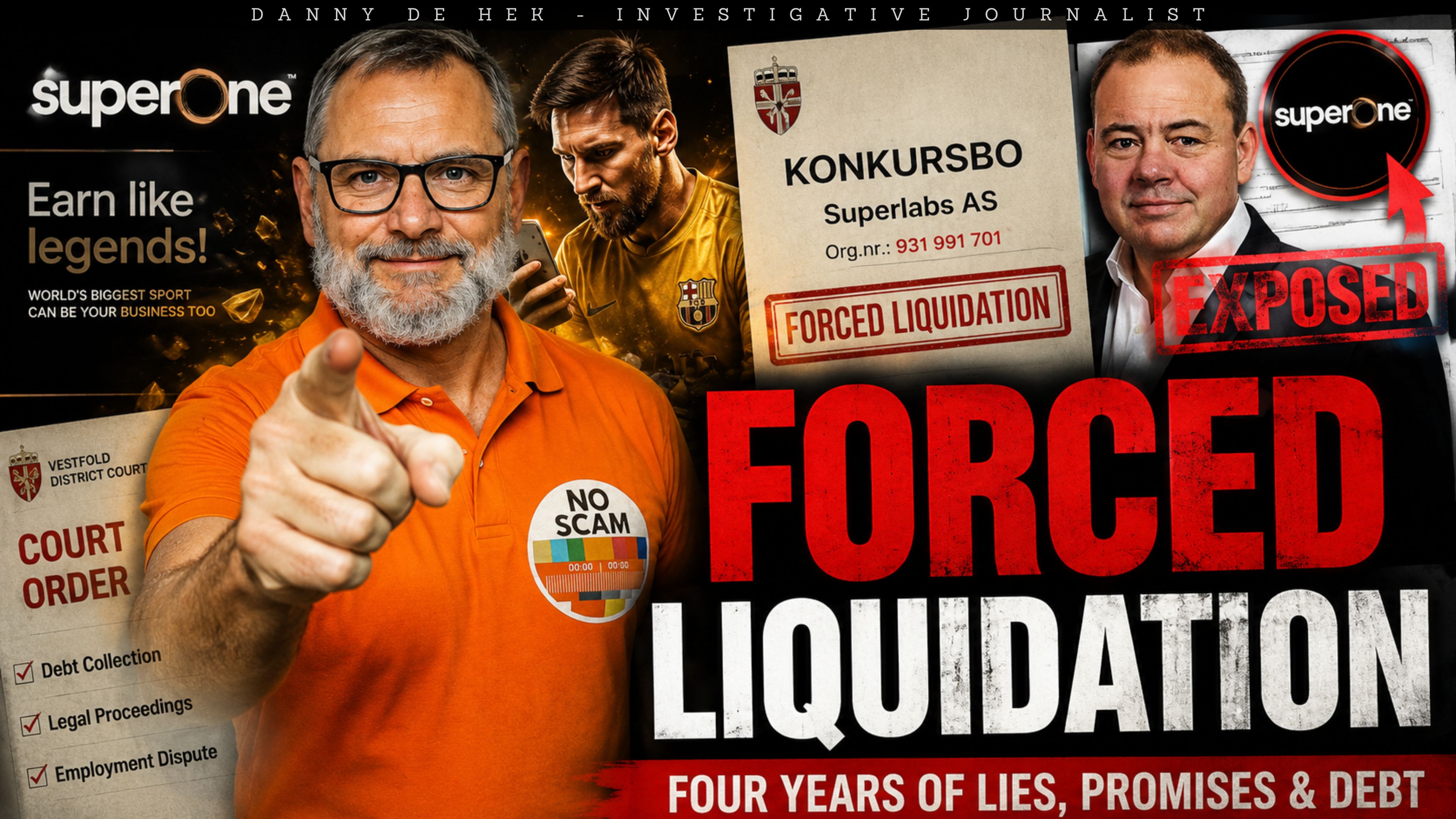
“I’ve learned over the years that the most revealing part of any investigation isn’t what promoters say during a webinar—it’s what they’re doing when they think nobody is watching.”
For almost four years, I’ve been following Andreas Christensen and the evolution of SUPERONE. I’ve infiltrated their Zoom meetings, challenged promoters during live presentations, interviewed people connected to the project, reviewed public company records and followed a steady stream of documents from Norway that tell a story investors were never shown.
While members were being encouraged to believe they were on the ground floor of the next blockchain gaming success, the paperwork was beginning to reveal a very different reality.
This wasn’t one dramatic event that brought everything undone. It was a gradual process that unfolded in plain sight. Court filings, debt collection notices, unpaid creditors, regulatory action and corporate changes slowly accumulated over months until the evidence became impossible to ignore. The latest court order placing SUPERLABS AS into compulsory liquidation didn’t create this story—it simply became the final piece of a puzzle that has been taking shape for years.
If you’ve ever wondered how an opportunity that promised so much could end up before the courts, this investigation will walk you through that journey. Rather than focusing on rumours or opinions, we’ll follow the documented evidence chronologically, examine the claims made by the company alongside what was happening behind the scenes, and ask a simple question every investor should consider before parting with their money: did the reality ever match the promises?
Following The Investigation
When I first came across SUPERONE, it immediately reminded me of dozens of other projects I’d investigated over the years. The branding was polished, the presentations were slick, and the promoters spoke with absolute confidence about a future that was supposedly just around the corner. They weren’t selling a successful product—they were selling the promise of what the product would eventually become. Investors were encouraged to buy into a vision of blockchain gaming, NFTs and token appreciation, with the suggestion that those who joined early would be rewarded once the ecosystem reached critical mass.
As the months passed, I kept watching. I attended webinars, questioned promoters, monitored public statements and archived presentations because experience has taught me that today’s promises often become tomorrow’s evidence. The message rarely changed. New milestones were announced, fresh partnerships were hinted at and launch dates seemed to move whenever they approached. Rather than focusing on what had already been delivered, the conversation was almost always redirected towards what was coming next.
That raised an obvious question: if the public presentations were telling one story, what story were the official records telling? That simple question became the foundation of this investigation and led me down a rabbit hole that would eventually uncover a pattern far removed from the optimistic picture being painted during the company’s promotional events.
The Dream They Were Selling
On paper, SUPERONE had all the ingredients of a revolutionary opportunity. Prospective members were told they were joining the future of mobile gaming, where players could compete in trivia competitions, earn rewards through blockchain technology, collect NFTs and benefit from the long-term appreciation of the SRX token. The marketing was designed to create the impression that SUPERONE wasn’t simply another cryptocurrency project—it was positioning itself as the next global entertainment platform.
The story became even more compelling when promoters spoke about well-known brands, sporting personalities and major corporate partnerships. These names were used to reinforce the perception that SUPERONE had already gained significant industry recognition and that mainstream success was only a matter of time. Combined with a multi-level marketing compensation plan that rewarded recruitment, it created a powerful narrative: join early, build a team, and benefit when the platform inevitably explodes in popularity.
Looking back, what stands out isn’t just what was promised—it’s how those promises were presented. The emphasis was almost always on what was coming soon, rather than what members could independently verify in the present. Every update appeared to move the goalposts a little further into the future, encouraging members to remain patient while continuing to recruit others into the opportunity. For experienced investigators, that’s a pattern worth paying attention to because successful businesses usually demonstrate progress through measurable results, not an endless stream of future announcements.
Looking Beyond The Marketing
As I dug deeper, I realised the real story wasn’t going to be found in the webinars or promotional videos. Marketing material is designed to show a polished version of reality, but company records, financial filings and court documents don’t have the luxury of creative storytelling. They record what actually happened. That’s why I began spending less time listening to what promoters were saying and more time examining what was happening behind the scenes.
A significant part of that work came from a trusted source in Norway who, over many months, supplied me with official documents, registry extracts and court filings as they became publicly available. Each email added another piece to the puzzle. At first, they appeared to be isolated issues—a debt collection notice here, a filing deadline missed there—but as the documents accumulated, a much clearer picture began to emerge. Rather than looking at one event in isolation, I started building a timeline of everything that was happening behind the company while investors continued to hear optimistic presentations about the future.
By early 2026, the public record was revealing a business facing increasing financial and legal pressure. Among the issues documented through official records were:
- Debt collection actions involving multiple creditors.
- Government penalties linked to statutory filing obligations.
- Court proceedings over unpaid liabilities.
- Employment-related legal action.
- Escalating compliance issues involving company reporting requirements.
None of these developments, on their own, prove wrongdoing. Businesses can face financial difficulties for many reasons. However, when viewed alongside years of ambitious marketing, delayed product delivery and continued recruitment, they raised legitimate questions that deserved closer examination. Those questions became even more important as the investigation progressed and the courts themselves became involved.
When The Paper Trail Started Growing
One of the biggest mistakes investors make is assuming that warning signs appear all at once. They rarely do. More often, they emerge gradually, buried inside public records that very few people ever read. That’s exactly what happened here. While SUPERONE continued promoting an exciting future through webinars and recruitment presentations, the official record in Norway began documenting a series of problems that painted a very different picture.
Over the course of many months, I received regular updates from Norway as new documents became available. They weren’t anonymous rumours or social media gossip—they were official records showing an increasing number of financial and legal issues affecting the company behind the project. Every update was carefully checked against public sources before being added to my investigation, allowing me to build a timeline as events unfolded rather than relying on hindsight.
The pattern became increasingly difficult to ignore. Among the documented developments were:
- Outstanding debts referred to collection agencies.
- Legal action by suppliers seeking payment.
- Government penalties for failing to meet statutory obligations.
- Questions surrounding annual accounts and tax filings.
- Court proceedings involving creditors and former employees.
- Repeated signs of financial distress despite ongoing promotional activity.
What struck me wasn’t the size of every individual debt. Some were relatively modest. Instead, it was the consistency of the pattern. Companies genuinely experiencing temporary cash-flow problems usually work quickly to resolve isolated issues. Here, the public record showed new problems continuing to emerge over an extended period while the outward message remained overwhelmingly positive. That contrast between the marketing narrative and the documentary evidence became one of the defining themes of this investigation.
The Court Finally Steps In
By the time the Norwegian courts became involved, this was no longer a story about missed deadlines or unpaid invoices. The evidence had reached a point where the legal system itself was required to intervene. According to official court records, SUPERLABS AS was ordered into compulsory liquidation by the Vestfold District Court under Section 16-15 of the Norwegian Companies Act. The liquidation would proceed under Norway’s Bankruptcy Act, with a court-appointed administrator taking control of the process and creditors invited to lodge their claims.
For many readers outside Norway, compulsory liquidation may sound like just another legal term. It isn’t. It represents the point where the court determines that a company should be dissolved and its affairs placed under independent administration. In practical terms, control moves away from the directors and into the hands of an appointed administrator whose responsibility is to identify the company’s assets, investigate its financial position and deal with the claims of creditors in accordance with the law.
What makes this development particularly significant is that it wasn’t an isolated event. It followed months of documented financial and legal problems that had already appeared in the public record. The liquidation order didn’t create those issues—it brought them together in a formal legal process. For investors who had spent years hearing about exciting product launches, future token value and ambitious expansion plans, the contrast could hardly have been greater. The promotional story was about growth. The court record was about winding the company up.
A Familiar Pattern
One question I’ve been asked repeatedly is whether I believe SUPERONE was simply an ambitious project that failed, or whether the warning signs were visible much earlier. That’s a fair question, and it’s one that every investor should ask before committing their money to any opportunity. Businesses fail every day for legitimate reasons. Markets change, products don’t gain traction and companies run out of capital. Failure, on its own, is not evidence of misconduct.
What concerned me was something different. As I looked further into Andreas Christensen’s business history, I found a recurring pattern that extended well beyond SUPERONE itself. Earlier ventures had also been built around ambitious promises, exciting technology and the expectation that investors simply needed to remain patient while the next breakthrough was just around the corner. When one project lost momentum, another appeared with new branding, a fresh narrative and another opportunity for supporters to believe that success was finally within reach.
That history doesn’t automatically determine the outcome of every new venture, but it does provide important context. Experienced investors don’t evaluate opportunities in isolation—they look at the track record of the people leading them. Questions worth asking include:
- What have they successfully delivered in the past?
- Were previous investors ultimately rewarded?
- Did earlier projects achieve the milestones that were promised?
- How were setbacks explained, and were those explanations supported by evidence?
- Has the business model fundamentally changed, or has it simply been repackaged under a new name?
These are not difficult questions, yet they are often overlooked when excitement takes over. Looking back over the history of SUPERONE, those questions become even more relevant because they encourage investors to judge a business by its demonstrated performance rather than its marketing. In my experience investigating schemes like this, the past doesn’t predict the future—but it often provides valuable clues about what questions should be asked before believing the next promise.
Following The Rebrand
One of the most common tactics I see when investigating long-running investment schemes is reinvention. When confidence begins to fade, the branding changes. A new company appears. A fresh website goes live. The logo is updated. Supporters are told the business has entered an exciting new phase, while uncomfortable questions about the past quietly disappear from the conversation.
That’s exactly why SUPERLABS AS caught my attention.
Rather than presenting itself as a continuation of SUPERONE, the Norwegian company appeared to represent a fresh start. On paper, it looked like a legitimate technology business. But public records told a more complicated story. Company registrations showed ownership ultimately leading back to Andreas Christensen, while the products, messaging and overall vision remained remarkably familiar. The name had changed, yet many of the underlying promises had not.
Over time, the timeline became increasingly difficult to ignore.
- MOWJOW promised to revolutionise gaming.
- WHYBIT introduced another vision built around blockchain technology.
- SUPERONE expanded the story with trivia competitions, NFTs and the SRX token.
- SUPERLABS AS emerged as the latest corporate vehicle behind the same broader narrative.
On their own, rebrands aren’t unusual. Businesses change names for perfectly legitimate reasons every day. However, investors should always ask why a company has been restructured and whether the underlying business has genuinely changed. In this case, the marketing continued to focus on future success while the documentary evidence increasingly pointed towards financial and legal difficulties. That disconnect became one of the defining features of my investigation and ultimately led me to examine not just the company itself, but the pattern of businesses that preceded it.
The Human Cost
It’s easy to become absorbed in court documents, company filings and financial records, but they only tell part of the story. Behind every recruitment presentation and every token purchase are real people who believed they were investing in something with genuine long-term potential. Many weren’t seasoned cryptocurrency investors. They were ordinary people looking for an opportunity to improve their financial future, encouraged by friends, family members and trusted community leaders who genuinely believed they had discovered something special.
Over the years, I’ve spoken with people who joined SUPERONE at different stages of its journey. Some were enthusiastic early adopters. Others became promoters themselves because they believed in the vision being presented. As delays mounted and promised milestones slipped further into the future, many found themselves defending the project rather than questioning it. That’s one of the most damaging aspects of recruitment-driven business models. Once people have invested both money and reputation, admitting that something may be wrong becomes increasingly difficult.
This is why I continue investigating these schemes long after public interest fades. The headlines usually focus on the founders, the court cases and the financial losses, but the real victims are often the people left trying to explain to friends and family why they encouraged others to get involved. Some lose savings. Others lose relationships. Many lose trust—not just in one company, but in legitimate investment opportunities as well. That’s a consequence that rarely appears on a balance sheet, yet it is often the most lasting damage of all.
Lessons Every Investor Should Take Away
One of the reasons I continue documenting schemes like SUPERONE is because the warning signs are remarkably consistent. The technology changes. The branding evolves. The buzzwords come and go. One year it’s cryptocurrency, the next it’s NFTs, artificial intelligence or blockchain gaming. Yet the underlying sales techniques remain surprisingly familiar. Investors are encouraged to focus on the opportunity rather than the evidence, the future rather than the present, and the fear of missing out rather than the need for independent due diligence.
If there’s one lesson from this investigation, it’s this: never confuse a compelling story with a successful business. Before investing in any opportunity, take the time to look beyond the promotional material. Ask difficult questions. Read the financial statements if they’re available. Search public company records. Look for regulatory warnings. Research the people running the business and, perhaps most importantly, examine what they have actually delivered—not what they say they’ll deliver next.
Before committing your money, ask yourself:
- Is there a finished product that people are using today?
- Can the company’s claims be independently verified?
- Does the business generate genuine revenue outside recruitment?
- Are financial statements and company records consistent with the marketing?
- What is the track record of the founders and senior leadership?
- Would I still invest if I removed every promise about the future and judged the business only on what exists today?
Those questions won’t eliminate every investment risk, but they will help filter out many of the opportunities that rely more on hope than evidence. Had more people asked those questions during the life of SUPERONE, I suspect far fewer would have found themselves waiting for promises that, in many cases, never materialised.
The Last Sales Pitch
 One of the last Affiliate Presentations distributed by SuperOne perfectly captures the gap between marketing fantasy and corporate reality. Rather than acknowledging the mounting legal and financial problems that would eventually consume the company, affiliates were handed a polished fourteen-page presentation inviting them to “Earn Like Legends” and build what was described as the future of sports entertainment.
The presentation promised almost everything an investor could hope for:
- a global sports gaming ecosystem
- football clubs, brand games and celebrity partnerships
- real-time revenue sharing
- cash prizes and tournament winnings
- token appreciation and exchange listings
- passive bonuses and affiliate commissions
- luxury founder incentives, including an exclusive Bali event
The financial projections became even more ambitious. One slide forecast 30 million active players, US$1 billion in annual net revenue, US$200 million paid to affiliates, and another US$200 million allocated to token holders. Other pages promoted token valuations, passive income, multi-level bonus structures, expensive presale packages ranging from US$10 to US$25,000, and a roadmap suggesting exchange listings, explosive user growth and worldwide adoption were just around the corner.
Looking back with the benefit of hindsight, the presentation now reads less like a business plan and more like a marketing brochure designed to keep belief alive. While affiliates were being encouraged to recruit new participants using increasingly ambitious projections, the public records tell a completely different story—debt collection notices, employment disputes, court proceedings, compulsory dissolution and ultimately liquidation. That contrast is perhaps the clearest lesson of the entire SuperOne investigation: the promotional material continued to become more extravagant even as the underlying business was falling apart.
Business As Usual
If anyone believed the legal proceedings would cause the promotional machine to slow down, a TownHall meeting recorded on 8 June 2026 tells a very different story. Far from acknowledging the mounting legal and financial problems surrounding the company, Andreas Christensen presented what he described as one of the most exciting moments in SuperOne’s history.
Over the course of the presentation, Christensen described plans that, if taken at face value, would transform SuperOne into a global sports and entertainment powerhouse. He spoke of meetings with Binance, ByteDance, OpenAI, NVIDIA, Microsoft, Google DeepMind, Guinness World Records, FIFA-related opportunities through TikTok, celebrity footballers, NBA stars, NFL personalities and a worldwide launch that he suggested could attract between five and fifty million fans.
The financial projections became even more ambitious. Affiliates were told that a ten-week pre-sale could generate US$250 million, with Christensen suggesting it could potentially reach US$1 billion if participation exceeded expectations. He predicted the company’s token could eventually achieve a valuation of US$5 to US$10 billion, encouraged members to imagine their existing tokens being worth US$10 each, and repeatedly emphasised that everything was finally coming together after years of development.
What struck me most wasn’t simply the size of the projections—it was the timing. By this stage, the company had already accumulated a documented history of debt collection proceedings, employment disputes and mounting legal difficulties that ultimately resulted in compulsory liquidation. Yet none of those issues formed part of the presentation. Instead, affiliates were encouraged to focus on future celebrities, billion-dollar forecasts and life-changing token values. Looking back, the TownHall now serves as a remarkable snapshot of the gap between what was being promised publicly and what the documentary evidence was revealing behind the scenes.
The Last Chapter… Or Is It?
I’ve spent almost four years investigating Andreas Christensen and SUPERONE, and if there’s one thing experience has taught me, it’s that the collapse of a company doesn’t always mean the end of the people behind it. Time and time again, I’ve watched failed ventures disappear, only to re-emerge under a different name, a fresh corporate structure and another compelling story designed to attract a new generation of investors. Whether the compulsory liquidation of SUPERLABS AS marks the final chapter of this saga or simply the beginning of another rebrand remains to be seen.
What cannot be rewritten, however, is the documentary record. The webinars may disappear, the websites may change and the marketing videos may eventually be forgotten, but court orders, company filings, financial statements and public records remain. They tell a story that is often very different from the one presented on stage. My job has never been to tell people what to think. It’s to follow the evidence wherever it leads and present the facts so investors can make informed decisions for themselves.
If you’ve supported SUPERONE, I encourage you to look beyond the sales presentations and ask the difficult questions that should have been asked from the very beginning. If you’re considering your next investment opportunity, remember that promises are easy to make, but evidence is much harder to fake. As for me, I’ll keep doing what I’ve always done—following the paper trail, documenting the facts and holding the people behind these schemes accountable. And if history has taught us anything, it’s that this probably isn’t the last we’ve heard of Andreas Christensen.
Disclaimer: How This Investigation Was Conducted
This investigation relies entirely on OSINT — Open Source Intelligence — meaning every claim made here is based on publicly available records, archived web pages, corporate filings, domain data, social media activity, and open blockchain transactions. No private data, hacking, or unlawful access methods were used. OSINT is a powerful and ethical tool for exposing scams without violating privacy laws or overstepping legal boundaries.
About the Author
I’m DANNY DE HEK, a New Zealand–based YouTuber, investigative journalist, and OSINT researcher. I name and shame individuals promoting or marketing fraudulent schemes through my YOUTUBE CHANNEL. Every video I produce exposes the people behind scams, Ponzi schemes, and MLM frauds — holding them accountable in public.
My PODCAST is an extension of that work. It’s distributed across 18 major platforms — including Apple Podcasts, Spotify, Amazon Music, YouTube, and iHeartRadio — so when scammers try to hide, my content follows them everywhere. If you prefer listening to my investigations instead of watching, you’ll find them on every major podcast service.
You can BOOK ME for private consultations or SPEAKING ENGAGEMENTS, where I share first-hand experience from years of exposing large-scale fraud and helping victims recover.
“Stop losing your future to financial parasites. Subscribe. Expose. Protect.”
My work exposing crypto fraud has been featured in:
- Coffeezilla 2026): Featured in the investigation exposing the alleged $328M Goliath Ventures Ponzi scheme
- Bloomberg Documentary (2025): A 20-minute exposé on Ponzi schemes and crypto card fraud
- News.com.au (2025): Profiled as one of the leading scam-busters in Australasia
- OpIndia (2025): Cited for uncovering Pakistani software houses linked to drug trafficking, visa scams, and global financial fraud
- The Press / Stuff.co.nz (2023): Successfully defeated $3.85M gag lawsuit; court ruled it was a vexatious attempt to silence whistleblowing
- The Guardian Australia (2023): National warning on crypto MLMs affecting Aussie families
- ABC News Australia (2023): Investigation into Blockchain Global and its collapse
- The New York Times (2022): A full two-page feature on dismantling HyperVerse and its global network
- Radio New Zealand (2022): “The Kiwi YouTuber Taking Down Crypto Scammers From His Christchurch Home”
- Otago Daily Times (2022): A profile on my investigative work and the impact of crypto fraud in New Zealand


Leave A Comment