



“I obsess over one financial metric: the 8-to-10x markup margin on API credits resold from the big five or big ten AI platforms.” — Marty Hale’s SHIFT Capital CEO Master Prompt
I have followed Marty Hale’s online activities for years, but SHIFT AI is a much newer investigation. In September 2026, what began as me looking into people promoting this rapidly growing opportunity opened an entirely new investigation into SHIFT AI itself.

And it has moved incredibly quickly.
In a remarkably short period of time I have watched presentations, sat inside Zoom meetings, questioned promoters, examined the technology, followed the compensation structure and eventually confronted Marty directly with questions about where the money comes from, how many genuine retail customers exist and what SHIFT AI has actually built.
Now this investigation has taken a very different turn.
Working with members of the Avengers Anti-Fraud Alliance, I obtained a collection of internal SHIFT documents that provide a remarkable look behind the marketing. I am publishing these source documents with this investigation because I don’t want readers simply taking my word for what they contain.
You can download them, read them and check the numbers for yourself.
The first is the SHIFT CEO Briefing — July 2026, an internal Financial Performance & Growth Model dated July 18, 2026. It gives us something the public presentations never could: SHIFT’s own revenue figures, commission payments, membership numbers, retention problems, recruitment assumptions, growth forecasts and projected operating costs. The underlying SHIFT Financial Forecast spreadsheet provides the financial forecasting data accompanying that picture.
Then there is EcoPay — How the Payouts Work, SHIFT’s own explanation of how money moves through its compensation system; Marty’s Master Prompt, an extraordinary internal document setting out Marty’s priorities, business architecture and financial thinking; the Shiftai Gold Member Term Sheet, proposing a $115,000 Gold Member participation arrangement; and the SHIFT AI Product Overview, which lays out the AI products, EcoPay income streams and membership packages being presented to prospective members.
 Together, these six files give us an unusually detailed picture of the architecture behind SHIFT Capital, AIOS, Clout, SHIFT AI and EcoPay — right down to membership numbers, API costs, commission percentages, credit markups, compensation mechanics and the recruitment targets management believed could drive future growth.
And some of what SHIFT says internally is considerably more revealing than the language I had been hearing publicly.
Marty’s Master Prompt describes SHIFT AI as the “network-marketer-facing ecosystem”, specifically targeting “affiliates, MLM operators, network marketers” — people who already understand an “upline and a comp plan.” CrowdPay is described internally as an “upline genealogy.”
Then there are the numbers.
The SHIFT CEO Briefing — July 2026 reported 188 active members and $184,230 in lifetime gross revenue, with $94,840 — 51.5% of gross revenue — already paid to the field in commissions. The same document described member retention at just 46%, using the company’s own extraordinary phrase: “At 46% you need 2 recruits to net 1 member — the treadmill problem.”
At the same time, the briefing estimated that the AI infrastructure supporting 188 members was costing approximately $42.52 per month. OpenAI accounted for $38.58 of that estimate, Anthropic Claude $3.94, while ElevenLabs and Fal.ai were shown at approximately zero additional monthly cost in the briefing.
That immediately raised another question: what exactly has SHIFT AI invented?
Marty’s Master Prompt describes AIOS as a white-label engine bringing third-party AI services together, including ChatGPT, Claude, HeyGen and ElevenLabs. Meanwhile, the prominent “patent pending” language in the SHIFT AI Product Overview points toward EcoPay — SHIFT’s attribution and compensation architecture — rather than evidence in these documents of a proprietary foundational AI model. Marty’s internal priorities even instruct the company to “Get EcoPay patent pending.”
EcoPay — How the Payouts Work is where the economics become particularly interesting. SHIFT’s own payout document says five commission streams can distribute 61% of every credit purchase back through the network. And Marty’s CEO instructions say the entire model depends upon maintaining an 8-to-10-times markup on API credits, describing that margin as the foundation that makes the payouts and commissions possible.
Then there is the Shiftai Gold Member Term Sheet. This document goes far beyond a conventional monthly AI subscription. It proposes a $115,000 participation amount, an “Annual Guaranteed Return” mechanism and potential conversion of an outstanding balance into non-voting SHIFT equity using a $100 million pre-money valuation. The document itself also acknowledges that the participation interests “may constitute securities under applicable federal and state laws.”
These aren’t figures supplied by a critic of SHIFT AI.
They come from SHIFT’s own documents.
Throughout this investigation I have asked some very simple questions: Where does the money come from? How much comes from genuine retail customers? What technology does SHIFT actually own? What exactly is patent pending? Why does an AI platform need such an elaborate compensation structure? And what happens when recruitment slows?
We can now begin answering some of those questions using SHIFT’s own internal material.
I am making the source documents available throughout this investigation so people can examine the evidence themselves rather than simply taking my interpretation of it.
Because this investigation has reached a very different stage.
The game is up, Marty.
The Documents Behind The Curtain
Until now, most of what I have investigated about SHIFT AI has come from what Marty Hale and his promoters chose to show the public: Zoom presentations, marketing material, websites, compensation explanations and statements made when prospective members were being encouraged to join. These documents are different. Several are plainly written for internal or restricted use, and they discuss the mechanics of the business with a level of detail that simply doesn’t appear in the sales pitch.
One of the most revealing is a confidential CEO briefing dated July 18, 2026. It records SHIFT Capital’s claimed financial position at that moment: $184,230 lifetime gross revenue, $78,275 lifetime net revenue, 188 active members and more than $100,568 gross revenue during July alone. The document then breaks those numbers down further, showing estimated July net revenue of $34,706, monthly recurring subscriptions of only $8,118 from 82 active $99 subscribers, and a corporate salary of zero at the time, scheduled to change on August 1.
That immediately gives us something valuable: a snapshot of what the company itself claimed was happening financially, rather than what somebody standing on a Zoom call told potential recruits was happening.
The second document is even more revealing because it appears to capture how Marty wanted his own business understood internally. Titled Master Prompt — CEO, it instructs an AI assistant to operate as Marty’s strategic right hand across SHIFT Capital and its subsidiaries. Marty is described as Founder and CEO, fundraiser, strategist, designer, copywriter and “architect of the commission engine.” Most importantly, the document says his overriding objective is not likes, recognition or brand awareness. It says: “I care about gathering customers, closing customers, and collecting money. That is the north star.”
That same document lays out the corporate architecture in surprisingly straightforward language. AIOS is described as the underlying AI suite and “white-label engine”, integrating Claude, ChatGPT, HeyGen, ElevenLabs and other services through APIs. Clout is the creator-facing ecosystem. SHIFT AI is described as the network-marketer-facing version, aimed at affiliates, MLM operators and network marketers, with CrowdPay adding an “upline genealogy” to its compensation system. All three are described as sitting beneath SHIFT Capital.
Then we have the documents explaining the opportunity itself. The SHIFT AI Product & Opportunity Overview describes eleven AI studios, the membership tiers and EcoPay income architecture. The separate EcoPay — How the Payouts Work document goes much deeper, explaining exactly how purchases are attributed through referrals, Clubs, populations, ranks and weekly pools. According to that document, 61% of every credit purchase can be distributed back through the network when all five streams are active.
Finally, there is the proposed Gold Member Participation Term Sheet. This isn’t a $99 AI subscription. It describes someone paying $115,000, receiving Gold Member status and participating in EcoPay commissions generated through referrals or downline activity. The proposed arrangement runs for 24 months. Elsewhere it introduces a 10% annual-return mechanism and a potential conversion into non-voting equity based on a $100 million pre-money valuation.
I will make these source documents available alongside this investigation so readers can examine them themselves. I don’t want anyone taking my word for what they contain. Read Marty’s own words. Look at SHIFT’s own numbers. Follow its own compensation diagrams.
Because once these documents are placed beside what SHIFT AI has been telling the public, we can finally start reconstructing what this company actually is.
What SHIFT AI Actually Built
One of the biggest questions I have asked throughout this investigation is deceptively simple: what has SHIFT AI actually invented?
The public-facing Product & Opportunity Overview presents SHIFT AI as a “decentralized AI membership platform” combining eleven AI studios inside one credit-based dashboard. Members are offered ChatLIVE, ImageLIVE, VoiceLIVE, AvatarLIVE, TranslateLIVE, VideoLIVE, DeckLIVE, ProspectLIVE, MusicLIVE and other tools, with EcoPay sitting across the platform as the economic layer. On the surface, it sounds like a substantial proprietary AI ecosystem.
But Marty’s own internal document gives us a much clearer description of what appears to be underneath it.
The Master Prompt — CEO identifies AIOS (aios.ai) as the underlying technology suite and describes it as: “every major AI tool (Claude, ChatGPT, HeyGen, ElevenLabs, and others) API’d into one unified user experience.” It then calls AIOS “the white-label engine licensed to the front-end brands.” SHIFT AI and Clout are described as two independently branded ecosystems running on top of that same AIOS suite.
That distinction matters. Based on these documents, SHIFT AI does not appear to be claiming internally that it trained its own equivalent of ChatGPT, Claude or ElevenLabs. The model described here is an aggregation and commercialisation layer: established third-party AI services are accessed through APIs, brought together through AIOS, packaged into SHIFT’s own interface and consumed using SHIFT credits.
And then I found the page that, for me, makes the economics considerably easier to understand.
The confidential July CEO briefing contains a section titled “Infrastructure: Near-Zero Cost.” SHIFT claimed that the AI infrastructure supporting its 188 members was projected to cost just $42.52 per month — approximately 23 cents per member. Of that, $38.58 was attributed to OpenAI and $3.94 to Anthropic’s Claude. ElevenLabs and Fal.ai were shown at approximately zero dollars for the period. The document specifically identifies OpenAI as providing image generation, Claude providing chat and translation, ElevenLabs providing text-to-speech and voice cloning, and Fal.ai providing video generation using services including Hailuo, Kling and Veo 3.
This doesn’t mean there is no software development involved in building the interface, connecting APIs, managing credits or constructing the backend. There clearly can be considerable work involved in integrating different services into a usable platform. But it does tell us something important about where the underlying AI capabilities were coming from, according to SHIFT’s own internal records.
More importantly, Marty’s CEO prompt explains how SHIFT intended to make money from those services. It identifies the “8-to-10x markup margin on API credits resold from the big five or big ten AI platforms” as the financial metric Marty was supposed to obsess over. The document calls that spread “non-negotiable to the model” because it makes the payouts, commissions and claimed sustainability possible.
Later, the same document says it again even more explicitly: “API credits resold from the big five or big ten platforms must carry 8 to 10 times markup margin.” According to the document, if that markup falls below eight times, “the model breaks”; if it remains at eight-to-ten times or better, the model can scale.
Suddenly the business becomes much easier to follow. SHIFT acquires access to third-party AI services through APIs, converts usage into its own credit system, and says the economics depend upon maintaining a substantial markup on those credits. Sitting above that is EcoPay, which determines how part of the resulting revenue is distributed among members.
This also changes how I look at the repeated “patent pending” language surrounding SHIFT AI. The Product Overview doesn’t identify a newly invented SHIFT artificial-intelligence model as patent pending. It specifically describes EcoPay as the “patent-pending revenue-sharing engine.” Marty’s own internal priority list is equally specific: “Get EcoPay patent pending. Get all the names trademarked. Lock down IP ownership and corporate structure cleanly.”
So we need to be precise about what is being claimed. These documents support the proposition that SHIFT considered EcoPay and its associated intellectual property important enough to pursue patent protection. They do not, by themselves, establish that SHIFT owns an issued patent, nor do they establish that SHIFT invented the underlying AI models powering the tools.
That leaves us with an important distinction: the AI appears to come largely from other providers; the part SHIFT presents as its differentiator is the economic machinery wrapped around it.
And that is where this investigation gets much more interesting.
Follow The Money: How EcoPay Really Works
Once I understood that the underlying AI tools were being supplied through third-party APIs, the next question became obvious: what exactly is EcoPay doing with the money?
SHIFT’s own EcoPay document answers that surprisingly well. It says that whenever credits are purchased, the transaction can feed five separate commission streams simultaneously, with as much as 61% of every dollar distributed back through the network when all streams are active. The company retains the remaining portion to fund the platform. Importantly, the document also says individual streams can be switched on or off by an administrator.
The largest immediate stream is ConnectPay, which allocates 20% when somebody you directly referred purchases credits. That relationship is permanent: according to the document, once somebody signs up through you, that person remains attributed to you for their future purchases. Another 20% is allocated through CrowdPay, which contains five tier slots connected to a member’s position within the network. CompetePay and CreditPay each receive another 10% for weekly distribution, while ContentPay receives 1% when attributed content leads to a purchase.
This is where SHIFT’s terminology can make something relatively familiar sound considerably more complicated than it is. Instead of simply talking about ranks, teams and downlines, EcoPay uses words such as Clubs, codes, populations, seals, broadcasts and attribution.
But the underlying mechanics are described clearly in their own document.
Every member begins with a Standard Club. When people connect through that member, they are added to the Clubs the member currently has open. The document says membership of those populations is permanent. Purchases made by people inside the population then contribute purchase volume toward the relevant Club. Once enough volume accumulates to reach the next threshold, the Club “seals,” its population becomes locked, the member advances, and the corresponding CrowdPay position can generate commissions from future purchases within that population.
The tier ladder starts with Standard and progresses through Bronze, Silver, Gold, Platinum and Diamond, with increasingly large purchase-volume thresholds attached to advancement.
This becomes particularly significant when compared with Marty’s internal CEO instructions. There is no ambiguity in that document about the intended audience for SHIFT AI. It calls SHIFT AI the “network-marketer-facing ecosystem” and says its audience consists of “affiliates, MLM operators, network marketers — people who already know how to work an upline and a comp plan.” It then describes CrowdPay as “an upline genealogy that pays a percentage of commission based on coded rank.”
Those aren’t words I have applied to SHIFT AI. They are contained in the documents describing the business itself.
That matters because throughout this investigation I have repeatedly questioned why an operation supposedly centred on selling AI tools needs ranks, leaderboards, referral commissions, multiple income streams and a network structure. The internal material provides a straightforward answer: the compensation architecture wasn’t some incidental feature sitting beside the AI product. It was deliberately designed into the SHIFT AI ecosystem.
The confidential financial briefing shows how important those commissions had already become. By July 18, SHIFT reported $184,230 in lifetime gross revenue, with $94,840 — 51.5% — paid in field commissions. The company reported retaining $78,275 after commissions, costs and fees.
And this is where the 8-to-10-times API markup discussed earlier becomes important. According to Marty’s own internal instructions, that spread was supposed to provide enough margin to sustain the payouts and commissions.
So the picture emerging from SHIFT’s own material is not simply an AI software subscription with a small affiliate programme attached.
The AI products generate credit consumption. The credits generate revenue. EcoPay distributes part of that revenue through a structured network of referrals, populations, ranks and pools. And the economics depend upon maintaining enough margin between the underlying API cost and what members ultimately pay.
The next question is therefore crucial: how dependent was this system on continually adding and retaining members?
The Recruitment Treadmill
The confidential CEO briefing contains one sentence that cuts through much of the language surrounding SHIFT AI: “At 46% you need 2 recruits to net 1 member — the treadmill problem.”
That is SHIFT describing its own retention problem.
As of July 18, 2026, the company reported 188 active members, but only 82 were active $99-per-month subscribers. Another 14 were trialling, 21 were described as “ConnectPay-only,” and 105 of the 188 were not subscribed to the $99 plan, although 60 of those were still inside a free window. The internal briefing calculated retention at just 46% and identified both churned subscribers and people who had never converted as separate problems requiring attention.
This is important because SHIFT’s public-facing Product Overview describes a platform supposedly serving content creators, businesses, entrepreneurs and network builders who need professional AI tools. If the underlying product has strong independent retail demand, I would expect recurring subscriptions and continuing AI usage to become an increasingly important part of the business. Yet the internal documents show management intensely focused on retention, conversion and adding members.
The financial model makes that dependence even clearer. SHIFT’s corporate salary projections were calculated directly against membership growth. At 186 members, the model contemplated paying five corporate members $1,000 each per week. Reaching $2,000 per week required 317 members; $3,000 required 448; $5,000 required 711; and the $10,000-per-week scenario required 1,366 members. The underlying formula assumed average gross revenue of $535 per member per month, with 60% allocated to the field before Stripe fees, overhead and payroll.
In other words, adding members wasn’t merely something promoters happened to be doing on the side. Membership growth was built directly into the company’s financial planning.
The July briefing then identifies the events expected to drive that growth. A Chicago event was projected to add 15–25 members. The September 24 Miami launch was expected to add 45–80 members and was labelled an “exponential inflection.” Beyond that sat what the document called a “200K-network warm lead”, described as a potential multiplier.
The strategic priorities repeat the same message. SHIFT wanted to improve retention from 46%, convert the 105 members who weren’t subscribed, create salary increases tied to sustained membership thresholds and “maximize Miami.” The briefing says Miami was the “single biggest variable in the entire model” and instructed the team to activate the warm-lead pipeline before the event.
This gives important context to the Miami event I had already been following before receiving these documents. What looked publicly like another launch event was being treated internally as a major growth catalyst tied directly to the company’s financial projections.
None of this, standing alone, establishes that every dollar entering SHIFT came from recruitment rather than genuine retail consumption. The documents don’t give us enough information to make that claim. What they do establish is that SHIFT’s own management was measuring recruitment, conversion, retention and membership growth as critical financial variables.
And remember Marty’s stated “north star” from his own CEO prompt: “gathering customers, closing customers, and collecting money.”
The internal numbers show just how important keeping that machine moving had become.
From $99 A Month To A $1.115 Million Membership
The deeper I went into SHIFT’s own material, the harder it became to view this simply as a $99-a-month AI software subscription. The Product & Opportunity Overview shows a membership ladder beginning at $99 per month and extending all the way to a $1,115,000 Platinum Club position. Between those extremes sit a $499 Standard Club, $1,000 Founder’s Club, $5,000 Bronze Club, $15,000 Silver Club and a $115,000 Gold Club.
SHIFT says these packages come with usable AI credits and additional benefits. But higher tiers also change a member’s position within the EcoPay economy. The $115,000 Gold package, for example, is advertised with 23 million credits, top-tier CreditPay sub-pool placement, founder events, invite-only retreats and “founding-rank lock-in.” The $1.115 million Platinum package advertises 223 million credits alongside enhanced CompetePay weighting, a Founder’s Council seat, direct founder access, private-jet travel twice a year and “Top-of-stack across every stream.”
Then I examined the separate Gold Member Participation Term Sheet, and the nature of the $115,000 proposition became considerably more interesting.
The proposed agreement describes a person paying $115,000 to Shiftai Capital for Gold Member participation over a 24-month term. That Gold Member would earn EcoPay commissions from new members enrolled through their referral link or downline. But the document doesn’t stop at AI credits and commissions. It introduces something called an “Annual Guaranteed Return.”
Under the proposed terms, the company would pay a 10% annual return on what it defines as the member’s “Unpaid Balance.” EcoPay commissions received by the member reduce that $115,000 balance. If cumulative EcoPay commissions eventually equal or exceed the entire participation amount, the annual-return and equity-conversion rights terminate. The document even says AI credits used are included in the final calculation at their current market value.
If money remains outstanding after 24 months, the Gold Member can potentially elect to convert that balance into non-voting equity in Shiftai Capital, calculated using a $100 million pre-money valuation. The example provided says a $57,500 outstanding balance would translate into 0.0575% equity.
There is also a contradiction worth documenting carefully. Section 3 calls the payment an “Annual Guaranteed Return.” Yet the acknowledgements later say the annual return and equity conversion depend upon the company’s financial condition and ability to pay, adding that “this instrument does not constitute a guarantee of return.”
I don’t need to decide what regulators would ultimately classify this arrangement as, because SHIFT’s own draft raises the issue. Its legal notice states that “Participation interests may constitute securities under applicable federal or state laws” and says compliance with securities laws is the responsibility of the company and its counsel.
There is another important qualification: this document identifies itself as a non-binding term sheet for discussion purposes, subject to negotiation, due diligence and execution of definitive agreements. So I cannot establish from this document alone whether anyone actually signed these terms or paid $115,000 under this particular arrangement.
But its existence tells us what SHIFT was at least contemplating offering.
By this point, we have moved a very long way from somebody paying $99 a month because they want convenient access to AI tools. We are looking at six- and seven-figure membership tiers, network commissions, proposed annual returns and potential equity conversion at a $100 million valuation.
That deserves scrutiny in its own right.
What The Financials Reveal
By this stage of the investigation, I wanted to strip away the terminology and look at the simplest question of all: where was the money actually coming from, and where was it going? The confidential July CEO briefing gives us the clearest internal snapshot I have seen so far.
As of July 18, 2026, SHIFT reported $184,230 in lifetime gross revenue. Of that, $94,840 had gone to field commissions, $6,115 to costs and fees, leaving $78,275 described as company-retained net revenue. In other words, the document says 51.5% of lifetime gross revenue had already been paid to members in commissions.
What caught my attention was the breakdown of the revenue streams. SHIFT reported only $8,118 in monthly recurring revenue from 82 active $99 subscriptions. By comparison, ConnectPay was shown at $47,219 for July month-to-date and described as the “Top stream.” CreditPay and CompetePay were also operating as pools awaiting their Friday distributions.
That doesn’t prove there were no genuine retail customers. It does, however, give us an important internal benchmark. The straightforward recurring subscription component was relatively small compared with the wider flow of money being processed through the credit and compensation ecosystem.
The company’s own forecasting model reinforces that picture. SHIFT calculated future revenue using an assumption of $535 in average gross revenue per member per month, with 60% allocated to the field, approximately 2.96% to Stripe and $9,000 per month in overhead. Those assumptions were then used to calculate how many members were required to support increasing salaries for five corporate members.
At the same time, the actual AI infrastructure was described internally as almost negligible. SHIFT projected $42.52 per month to provide the AI services being used across 188 members. Marty’s CEO prompt explains why that gap mattered: the business depended on maintaining an 8-to-10-times markup on API credits, because that spread funded the payouts, commissions and wider economic model.
Put those documents beside each other and the business becomes easier to understand. The expensive part wasn’t necessarily providing the underlying AI. The financial model was built around monetising access to it, marking up credits and distributing a substantial portion of the resulting revenue through EcoPay.
There is also something else worth remembering. The Product Overview tells prospective members that SHIFT pays more than 50% of gross platform revenue back through its income streams, comparing this with airlines returning only 1–2% through loyalty miles. But money distributed through EcoPay has to originate somewhere. It isn’t being created by the AI.
That is why the distinction between outside retail consumption and spending by people participating in the opportunity matters so much. These documents give us member numbers, subscription numbers, revenue, commissions and internal forecasts, but they do not provide a clean audited breakdown showing how much revenue came from genuine external retail customers with no participation in EcoPay versus members buying credits while pursuing commissions, ranks or rewards.
For an operation built around claims of a revolutionary economic model, that is not a minor missing number.
It is one of the most important numbers of all.
The Patent-Pending Question
Throughout SHIFT AI’s marketing, “Patent Pending” is positioned prominently enough to give the platform an aura of proprietary technology. It appears directly beneath the SHIFT AI name in the Product & Opportunity Overview, alongside EcoPay and SHIFT Capital. But after reading these documents together, I think it is important to separate two very different things: the artificial intelligence being offered through SHIFT and the EcoPay system wrapped around it.
SHIFT’s own Product Overview describes the platform as eleven AI studios combined with a “patent-pending revenue-sharing engine — EcoPay.” Marty’s internal CEO prompt is even clearer about what he wanted protected. Under “Protect the Idea & IP,” the first instruction is: “Get EcoPay patent pending. Get all the names trademarked. Lock down IP ownership and corporate structure cleanly.”
That is significantly different from saying SHIFT AI invented the underlying artificial intelligence.
In fact, the same internal document tells us the opposite about the core AI services. AIOS is described as the white-label engine bringing together Claude, ChatGPT, HeyGen, ElevenLabs and others through APIs. The confidential financial briefing then identifies OpenAI, Anthropic, ElevenLabs and Fal.ai as providers powering specific functions inside the platform.
So when somebody hears “patent-pending AI platform,” they need to ask a much more precise question: what exactly is patent pending?
Based strictly on the documents I have reviewed, the claimed intellectual property appears to centre on EcoPay — the attribution and revenue-sharing architecture that tracks referrals, content, credits, rankings and network positions. The documents I have been given do not contain a patent application number, an issued patent, claims from a patent specification, or enough information for me to independently establish from these materials alone what protection has actually been sought.
That distinction matters because “patent pending” does not mean “patented.” More importantly for this investigation, these documents do not support the idea that SHIFT owns the underlying AI models powering ChatLIVE, image generation, voice cloning or the other generative tools. SHIFT’s own internal material identifies third-party providers behind those capabilities.
There is another revealing line in Marty’s CEO prompt. It describes backend integration as the biggest bottleneck: “AI APIs, websites, commission engine, apps — they all have to work together perfectly.” That description fits what the rest of the evidence shows: a platform integrating existing AI services with SHIFT’s websites, applications, credit system and EcoPay compensation engine.
There is nothing inherently improper about building software on other companies’ APIs. Thousands of legitimate technology companies do exactly that. The issue is how the resulting product is represented to the people being asked to put money into it, particularly when membership packages climb into six and seven figures.
If SHIFT’s real proprietary innovation is EcoPay, then say that clearly. If SHIFT claims ownership of some additional patented AI technology, show us what it is. If a patent application has actually been filed, provide the application details so the claims can be examined.
Because after reading SHIFT’s own internal documents, I can see plenty of evidence of third-party AI, a white-label engine and an elaborate compensation architecture. What these documents do not show me is an exclusive, patented SHIFT artificial-intelligence technology.
The Contradictions Are Getting Harder To Ignore
This is where the documents start connecting with what I have personally witnessed during this investigation. I have watched SHIFT AI presentations, followed the promoters, examined the websites and eventually found myself inside a Live Zoom Meeting asking Marty Hale some very basic questions about where the money comes from, how many genuine retail customers exist, why credits are being treated almost like a financial position, and what technology SHIFT actually owns.
Those questions mattered because the internal documents describe the business far more plainly than much of the language I had been hearing publicly.
Marty’s own CEO prompt doesn’t shy away from network marketing terminology. It describes SHIFT AI as the “network-marketer-facing ecosystem”, aimed at “affiliates, MLM operators, network marketers” who understand an “upline and a comp plan.” CrowdPay is described as an “upline genealogy” paying commissions according to coded rank.
The Product Overview tells us the network was growing through a “structured direct-network model”, supported by nightly connection calls, weekly worldwide socials, destination trips and annual conventions. Meanwhile, the confidential CEO briefing talks openly about recruitment and retention: 46% retention, “2 recruits to net 1 member,” converting unsubscribed members and activating a 200,000-person warm network ahead of Miami.
Then look at how the money is structured. EcoPay says as much as 61% of every credit purchase can be distributed through the network. ConnectPay rewards referrals. CrowdPay uses tier positions and populations. CompetePay rewards weekly performance. CreditPay rewards members according to credits held. ContentPay rewards attributed content.
None of those features needs to be hidden or dressed up. They can be examined for exactly what SHIFT’s own documents say they are.
What concerns me is the gap between the simple story — we’ve built an amazing AI ecosystem where everybody can share in the value — and the considerably more complicated machinery underneath it. The internal material describes third-party AI APIs, an 8-to-10-times credit markup, a white-label engine, an upline genealogy, coded ranks, recruitment targets, commission pools and membership packages reaching $1.115 million.
There is also an important question these documents cannot answer for us: how much genuine retail demand exists independently of the income opportunity?
SHIFT reported 188 active members in July, but only 82 active $99 monthly subscriptions. The documents show substantial credit purchases and commission payments, but they do not give us a clean breakdown separating ordinary outside customers who simply wanted AI services from participants buying credits while also pursuing EcoPay commissions, rankings or advancement.
That is exactly why I asked Marty about retail customers.
I wasn’t trying to catch him out with some obscure accounting question. Retail demand goes directly to the sustainability of the story being sold. If hundreds or eventually thousands of ordinary customers are purchasing SHIFT AI because its tools offer compelling value independently of EcoPay, show the numbers. If most of the money is instead circulating through people who joined because they can earn from referrals, credits, Clubs and the wider compensation structure, that tells us something very different about the business.
The documents don’t allow me to make that final determination yet.
But they explain why Marty needed to answer the question — and why ending a conversation doesn’t make the question disappear.
What SHIFT AI Appears To Be
After putting these documents side by side, I think we can finally describe SHIFT AI without relying on a promoter’s presentation, a marketing slogan or my own assumptions.
At the top sits SHIFT Capital. Underneath it, Marty’s internal CEO document identifies AIOS as the technology layer — a white-label engine integrating third-party services including ChatGPT, Claude, HeyGen and ElevenLabs. AIOS then powers two separately branded ecosystems: Clout, aimed at creators, and SHIFT AI, aimed specifically at affiliates, MLM operators and network marketers.
SHIFT AI then adds its own commercial layer. Members buy subscriptions and credits to access AI tools. Marty’s internal instructions say those API credits need to carry an 8-to-10-times markup for the economics to work. On top of those transactions sits EcoPay, distributing money through referrals, an upline genealogy, credit holdings, competitions and content attribution.
That is the structure these documents describe.
What I don’t see in them is evidence that SHIFT created its own foundational AI model. Instead, SHIFT’s confidential CEO briefing identifies the outside providers and even records their projected costs. Nor do these documents establish that SHIFT possesses an issued patent covering proprietary artificial intelligence. What they repeatedly identify as patent pending is EcoPay, the economic and attribution architecture surrounding transactions.
And once you understand that distinction, the entire operation looks different.
The AI is certainly part of the product. People can use the tools and consume credits. But according to Marty’s own documents, the business model extends well beyond selling AI software. It includes a compensation engine capable of distributing 61% of credit purchases through the network, permanent referral attribution, tier advancement, coded populations, commission pools and a financial model explicitly dependent upon conversion, retention and membership growth.
At the upper end, SHIFT was contemplating something much larger again: a $115,000 Gold Member arrangement involving EcoPay commissions, a proposed annual-return mechanism and potential equity conversion based upon a $100 million valuation. Its own draft acknowledges that participation interests may constitute securities.
None of this requires speculation. This is the company explaining itself.
There are still questions these documents cannot answer. We don’t know from them alone whether the proposed Gold term sheet was ever executed, how many genuinely independent retail customers exist, whether the projected economics survived beyond July, or precisely what patent application—if any—was ultimately filed. Those are matters that require separate evidence.
But we now have something I didn’t have when this investigation began: a remarkably detailed picture of what the people building SHIFT apparently believed they were building.
It isn’t simply eleven revolutionary AI tools.
It appears to be third-party AI technology wrapped inside a branded platform, monetised through marked-up credits, with EcoPay sitting over the top as a network-based attribution and compensation system.
Once you understand that architecture, many of the questions I have been asking Marty Hale suddenly make a lot more sense.
The Questions SHIFT Still Needs To Answer
After reviewing the internal documents, I am left with a much shorter list of questions than when I started — but they are far more important.
First: how much revenue comes from genuine retail customers outside the compensation opportunity? SHIFT’s financial briefing gives us members, subscriptions, credit purchases, commissions and retention figures, but it does not provide a clean separation between ordinary retail customers and people participating in EcoPay. With only 82 active $99 subscriptions among 188 active members at the time of the briefing, that distinction matters.
Second: what exactly has been filed as “patent pending”? SHIFT’s documents repeatedly connect that language to EcoPay, while the AI itself is described as being supplied through third-party APIs. If there is a patent application covering EcoPay or some other proprietary SHIFT technology, provide the application details and let people see precisely what intellectual property is being claimed.
Third: what became of the $115,000 Gold Member proposal? Was this term sheet ever offered in substantially this form? Did anyone sign it? Did anyone pay the $115,000 participation amount? Were any annual returns promised or paid? Was anybody given equity or a contractual right to convert an outstanding balance into shares at the proposed $100 million valuation? The document itself says participation interests “may constitute securities”, making those factual questions especially important.
There is also the strange wording surrounding the proposed return. Why does one part of the document call it an “Annual Guaranteed Return” and say the company “shall pay” 10%, while another says payment depends upon the company’s financial condition and that the instrument “does not constitute a guarantee of return”?
Fourth: which version of EcoPay are members actually being sold? One SHIFT document describes five commission streams distributing 61% of every dollar. The Product & Opportunity Overview describes six income streams, says more than 50% of gross platform revenue is distributed, and presents ClubPay percentages tied to Bronze, Silver, Gold and Platinum positions. These may represent different versions or stages of the compensation model, but the documents themselves do not explain the discrepancy.
Fifth: what supports the $100 million valuation? The Gold Member term sheet uses that figure as the pre-money valuation for calculating potential equity conversion. Yet the confidential financial briefing dated July 18 reported lifetime gross revenue of $184,230 and lifetime retained net revenue of $78,275. A valuation can obviously be based on expectations about future growth rather than current revenue alone, but SHIFT should be able to explain the assumptions behind such a substantial number.
And finally, what happens when recruitment and credit purchasing slow down?
That question comes directly from SHIFT’s own numbers. The CEO briefing called 46% retention the “treadmill problem,” calculated how many new recruits were needed to offset losses and identified the Miami launch and a 200,000-person warm network as major growth catalysts. Marty’s own internal instructions simultaneously say the 8-to-10-times API-credit markup is the foundation that makes commissions and payouts possible and that “If the markup compresses below 8x, the model breaks.”
Those aren’t questions invented by critics.
They are questions created by SHIFT’s own documents.
The Game Is Up, Marty
When I started investigating SHIFT AI, I was looking at the same material everyone else could see: AI tools, credits, memberships, compensation plans, Zoom presentations, promoters and some extraordinary claims about what this business could become.
Now I have seen behind the curtain.
SHIFT’s own confidential financial briefing recorded $184,230 in lifetime gross revenue, with $94,840 already paid to the field. It documented a retention rate of only 46% and actually called the situation “the treadmill problem.” Management was planning around recruitment, conversion, Miami and access to a potential 200,000-person network.
Marty’s own CEO document tells us that SHIFT AI was deliberately designed for “affiliates, MLM operators, network marketers” who understand an “upline and a comp plan.” It describes CrowdPay as an “upline genealogy.” It identifies AIOS as the white-label technology layer integrating services including ChatGPT, Claude, HeyGen and ElevenLabs.
The same document tells us the economics depend upon reselling API credits at an 8-to-10-times markup, calling that margin the foundation that makes the payouts and commissions possible. It goes further: “If the markup compresses below 8x, the model breaks.”
Then we have EcoPay: referrals, upline positions, credit holdings, competitions and content attribution distributing as much as 61% of purchases through the network.
We have memberships stretching from $99 per month to $1.115 million. We have a proposed $115,000 Gold Member arrangement containing an “Annual Guaranteed Return,” potential conversion into non-voting equity at a $100 million valuation, and a legal notice acknowledging that the participation interests “may constitute securities.”
And underneath the AI platform serving those 188 members, the confidential briefing estimated monthly AI infrastructure costs of just $42.52.
That doesn’t make every element of SHIFT AI illegitimate, and these documents alone don’t answer every legal or regulatory question. Using third-party APIs isn’t inherently problematic. Marking up a product isn’t inherently problematic. Paying referral commissions isn’t automatically unlawful. And a draft term sheet isn’t proof that anybody actually entered into the proposed agreement.
But taken together, these documents allow people to examine what SHIFT AI actually is, rather than what somebody standing on a Zoom call wants them to believe it is.
That is why I am publishing the source material alongside this investigation.
Don’t take my word for it.
Read the documents. Follow the numbers. Compare the public claims with the internal language. Ask where the retail revenue comes from. Ask what is actually patented. Ask what SHIFT itself says about MLM operators, uplines, recruitment, retention and commissions. Ask what happened with the $115,000 Gold Member proposal.
Those questions don’t disappear because they are uncomfortable.
I gave Marty Hale opportunities to explain the business. I even confronted him directly with questions that now look considerably more important after seeing these documents. What I wanted was transparency.
Now the internal documents are providing some of it.
The game is up, Marty.
The marketing presentation is no longer the only version of the story people get to see.
Update — SHIFT AI Stops Accepting New Members
On September 24, 2026, another significant development landed while I was documenting SHIFT AI’s internal financial model.
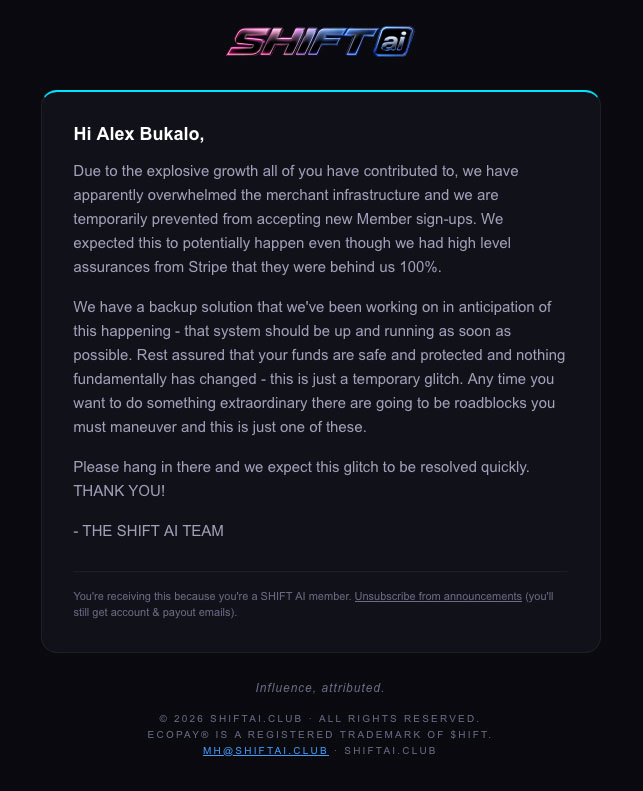
SHIFT AI sent members an email announcing that it had been “temporarily prevented from accepting new Member sign-ups.” The company blamed what it called “explosive growth,” claiming that its merchant infrastructure had been overwhelmed.
The email specifically referenced Stripe, stating:
“We expected this to potentially happen even though we had high level assurances from Stripe that they were behind us 100%.”
That wording immediately caught my attention because I have already been investigating SHIFT-related payment processing, including Shopify storefronts associated with Marty Hale.
SHIFT also told members that it had a “backup solution” already being developed “in anticipation of this happening”, and assured members:
“Rest assured that your funds are safe and protected and nothing fundamentally has changed.”
That statement now raises an important question: where exactly are those funds?
As a Shopify Partner, I know that a successful customer payment does not necessarily mean the merchant immediately receives that money in their bank account. With Shopify Payments, transactions normally pass through a settlement and payout process. Shopify’s own documentation explains that payouts can also be held or reserves imposed in circumstances including account reviews, compliance issues, disputes, elevated risk and significant changes in transaction activity.
That means some recent customer payments could potentially still be within the payment-processing system rather than sitting in a SHIFT-controlled bank account. If payouts have been held or reserves imposed, those funds could potentially be available to deal with refunds, disputes or chargebacks.
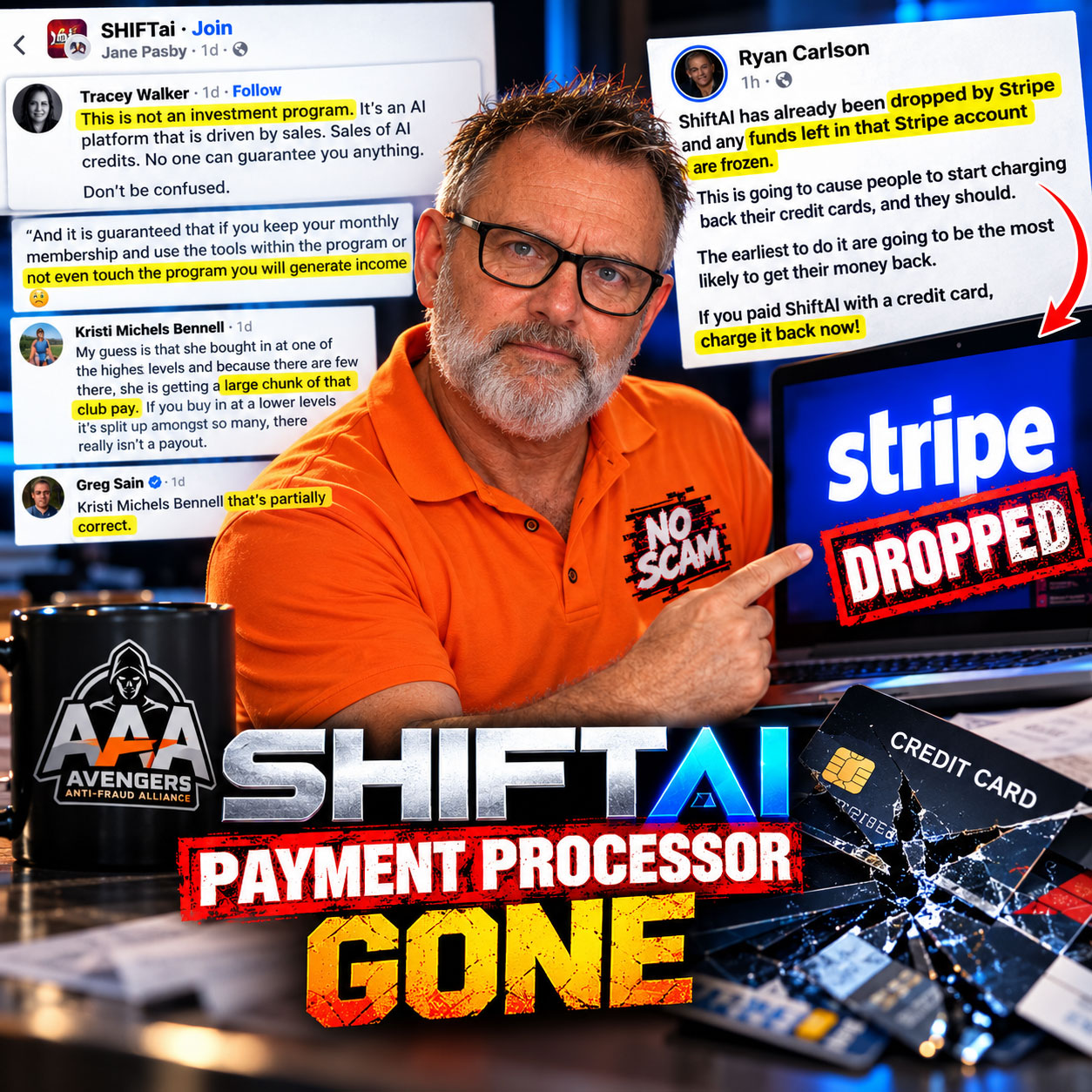 However, I currently have no evidence establishing that Shopify has frozen SHIFT’s funds, imposed a reserve, terminated its payment processing or decided to refund customers. Nor does SHIFT’s email establish that Stripe terminated the company. SHIFT itself characterises the problem as merchant infrastructure being overwhelmed.
Those distinctions matter.
What I now want to establish is whether SHIFT’s payment processing was interrupted simply because of rapid transaction volume, as the company suggests, or whether a payment provider has conducted a risk or compliance review. I also want to know whether any customer funds are currently being held, whether scheduled payouts have been suspended, and what SHIFT means by its mysterious “backup solution.”
The timing makes this particularly important.
SHIFT’s own confidential financial documents show a business model heavily focused on membership growth, credit purchases, commissions and retention. Its July CEO briefing described 46% retention as “the treadmill problem” and identified major recruitment events as critical growth catalysts.
Now, while this investigation is unfolding, SHIFT says it can no longer accept new member sign-ups through its existing merchant infrastructure.
So the question is no longer simply whether payments have stopped.
The question is why they stopped, where the money currently sits, and what happens to the customers who have already paid.
Disclaimer: How This Investigation Was Conducted
This investigation relies entirely on OSINT — Open Source Intelligence — meaning every claim made here is based on publicly available records, archived web pages, corporate filings, domain data, social media activity, and open blockchain transactions. No private data, hacking, or unlawful access methods were used. OSINT is a powerful and ethical tool for exposing scams without violating privacy laws or overstepping legal boundaries.
About the Author
I’m DANNY DE HEK, a New Zealand–based YouTuber, investigative journalist, and OSINT researcher. I name and shame individuals promoting or marketing fraudulent schemes through my YOUTUBE CHANNEL. Every video I produce exposes the people behind scams, Ponzi schemes, and MLM frauds — holding them accountable in public.
My PODCAST is an extension of that work. It’s distributed across 18 major platforms — including Apple Podcasts, Spotify, Amazon Music, YouTube, and iHeartRadio — so when scammers try to hide, my content follows them everywhere. If you prefer listening to my investigations instead of watching, you’ll find them on every major podcast service.
You can BOOK ME for private consultations or SPEAKING ENGAGEMENTS, where I share first-hand experience from years of exposing large-scale fraud and helping victims recover.
“Stop losing your future to financial parasites. Subscribe. Expose. Protect.”
My work exposing crypto fraud has been featured in:
- Coffeezilla 2026): Featured in the investigation exposing the alleged $328M Goliath Ventures Ponzi scheme
- Bloomberg Documentary (2025): A 20-minute exposé on Ponzi schemes and crypto card fraud
- News.com.au (2025): Profiled as one of the leading scam-busters in Australasia
- OpIndia (2025): Cited for uncovering Pakistani software houses linked to drug trafficking, visa scams, and global financial fraud
- The Press / Stuff.co.nz (2023): Successfully defeated $3.85M gag lawsuit; court ruled it was a vexatious attempt to silence whistleblowing
- The Guardian Australia (2023): National warning on crypto MLMs affecting Aussie families
- ABC News Australia (2023): Investigation into Blockchain Global and its collapse
- The New York Times (2022): A full two-page feature on dismantling HyperVerse and its global network
- Radio New Zealand (2022): “The Kiwi YouTuber Taking Down Crypto Scammers From His Christchurch Home”
- Otago Daily Times (2022): A profile on my investigative work and the impact of crypto fraud in New Zealand






Leave A Comment