



“It is literally impossible. It is impossible for anyone to become a club member in SHIFT AI and not make money.” — Marty Hale, SHIFT AI founder
In my first SHIFT AI investigation, I examined its pre-launch AI-credit system, the passive-income claims surrounding it and the question that kept coming back to me: where does the money come from?
My question was deliberately simple: where does the money come from?
Since then, rather than those concerns becoming clearer, the evidence trail has grown considerably.
 I have now watched hours of SHIFT AI presentations, examined the company’s compensation material, gone through its Promotional PDF, entered its private Facebook community and followed the people actively promoting the opportunity. I have listened to Marty Hale explain the model repeatedly, sometimes using language far more revealing than anything I could write myself. I have heard credits compared with an “asset,” payments compared with “dividends,” and examples where purchasing more credits is presented as a way of potentially receiving considerably more cash.
In one presentation, Hale described a participant allegedly purchasing $100,000 of AI credits and receiving $76,000 back on the first day, while still retaining the credits. These are Hale’s claims, not independently verified earnings, but they deserve scrutiny precisely because they are being used to demonstrate what SHIFT AI can supposedly do.
At the same time, the promotional machine has expanded.
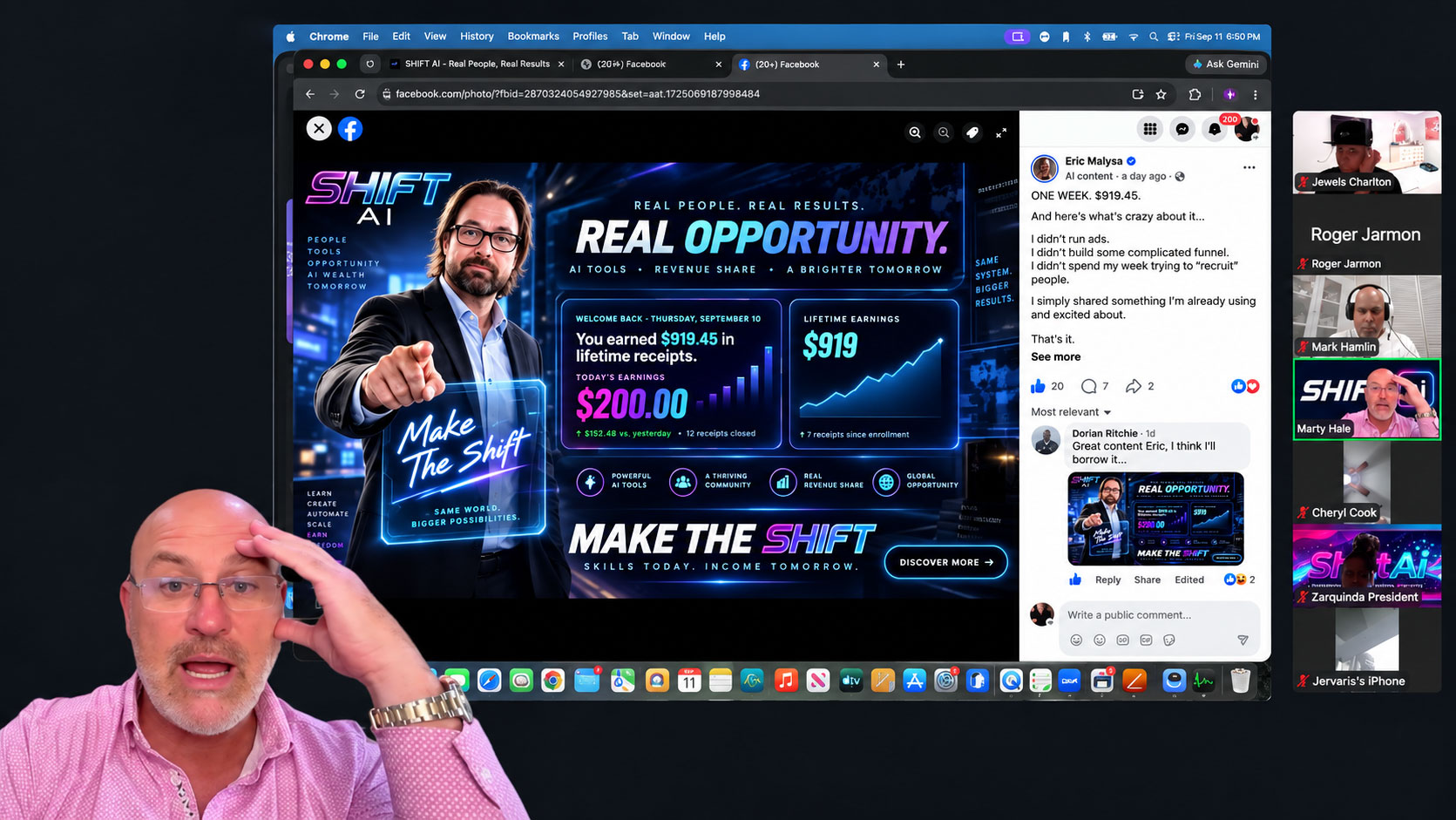
What began with promoters such as Pierre Maxim has grown into a network of YouTubers, network marketers and online opportunity promoters publishing SHIFT AI presentations, explaining the compensation plan and directing audiences towards Founder packages and referral links. Among those I have documented are Michael Lucas, Marquita from The Residual Master, Jaime Soriano, Mark Oestreich, Sal Khan from The Grateful Tribe and T. LeMont Silver, known online as “The Professor.”
Silver openly tells his audience that he loves MLM and has been involved in network marketing since he was 24. In his SHIFT AI presentation, he describes receiving referral compensation, explains how larger recruiters bring more revenue into the company and tells viewers that as they compete, “we all get to eat.”
This matters because SHIFT AI is not merely being marketed as another $99-a-month collection of AI tools. Its own presentation says the company hands participants “up to 50% of the ecosystem’s gross revenue” when AI credits are purchased. The compensation model includes ClubPay, ConnectPay, ContentPay, CreditPay and CompetePay, while the promotional material surrounds the opportunity with supercars, yachts, helicopters and the words “Everything you need. One platform. Unlimited income.”
The question is no longer whether SHIFT AI has an AI product. It clearly has a platform people can interact with.
The question is what role that product plays in the economic engine being promoted around it.
Then there are the technology claims. Depending on which presentation I watch, SHIFT AI is described as combining 20-plus, 26 or 27 AI platforms, with names such as ChatGPT, Claude and Google Gemini repeatedly invoked. Hale has spoken about these companies as partners and described SHIFT AI as being fully integrated with leading AI platforms.
Those are claims that should be capable of verification.
Are there actually commercial partnership agreements with these companies? Are there licensing arrangements, or are we simply looking at access to existing AI services packaged behind one interface?
There is nothing inherently suspicious about using APIs — thousands of legitimate software companies do exactly that — but API access and a strategic partnership are not the same thing.
And then there is Marty Hale himself.
SHIFT AI’s marketing leans heavily on his claimed history of building billion-dollar companies. That makes his business history part of the due diligence, not an irrelevant trip into the past. I have been examining those claims alongside public records, previous companies and litigation that doesn’t appear in the glossy SHIFT AI presentations.
So this investigation goes considerably further than my first one. I am following the AI credits, examining the compensation pools and claimed earnings, identifying the people promoting the opportunity, testing the technology and partnership claims, and looking more closely at the man whose résumé is being used to reassure prospective participants that SHIFT AI is different.
If SHIFT AI really is building the warehouse for the AI revolution, the evidence should support the story. If the real attraction is people buying credits so everybody else can get paid, the numbers should reveal that too.
From One Promoter To A Growing Recruitment Network
When I first started following SHIFT AI, Pierre Maxim was one of the people who caught my attention. His marketing was difficult to ignore: he claimed to have banked $800 in his first 24 hours, promoted $1,000 and $3,000 Founder positions, talked about passive income and encouraged people to get positioned before weekly cut-offs. Pierre also insisted SHIFT AI was “not network marketing,” despite describing referral commissions, qualification requirements and revenue pools. I sent him a detailed right of reply asking what due diligence he had conducted and where the money funding these payments actually came from. Instead of answering those questions, he sent me a link to a recorded presentation with Marty Hale.
Pierre, however, turned out to be only the beginning.

As I continued investigating, I started finding SHIFT AI spreading through exactly the kind of online income-opportunity networks I have spent years monitoring. Michael Lucas created videos explaining how SHIFT AI pays people. Marquita from The Residual Master showed her own $1,000 Founder purchase, discussed her earnings and told viewers where to find her joining link. Jaime Soriano published a referral link carrying his own ref=cryptojaime identifier while his description openly acknowledged that affiliates can earn compensation from customers and new affiliates. Mark Oestreich uploaded Marty Hale’s presentation and encouraged viewers to share it and get back to the person who introduced them.
Then I found Sal Khan from The Grateful Tribe interviewing Hale. Under the video was a SHIFT AI sign-up link, a SHIFT AI Telegram group and a list titled “10 Reasons To Join Shift Ai.” Among those reasons were “Earn From WHOLE Company Growth,” “Daily Payout Even To Bank Account” and “Patented Tech & Patented Comp Plan.” His disclaimer acknowledges that The Grateful Tribe gets paid when people use its links. At that point, whatever label anyone wants to put on the video, I wasn’t looking at somebody merely interviewing an interesting technology entrepreneur. There was a financial relationship attached to the promotion.
And then an old name appeared on my screen: T. LeMont Silver, better known online as “The Professor.” I have followed his online activities for years. In his SHIFT AI presentation, Silver makes his background perfectly clear:
“I love MLM. I love network marketing. That’s what I’ve done since I was 24.”
Silver says he joined SHIFT AI through Mark Hamlin, describes receiving his first commission from a $1,000 purchase and then spends considerable time teaching his audience how the referral and ClubPay system works.
His explanation is particularly useful because it strips away some of the polished terminology. Silver tells viewers that larger recruiters matter because they bring more revenue into the company. As those participants compete for higher positions, he explains, more money enters SHIFT AI and ordinary participants benefit through ClubPay. His summary is remarkably simple:
“We all get to eat.”
He also displays purported weekly earnings of approximately $93,000 for one participant, $37,000 for Michael Lucas and $18,000–$19,000 for his own sponsor. I have not independently verified those earnings, so they remain promotional claims — but they are being shown to prospective participants as examples of what is supposedly happening inside SHIFT AI.

Another promoter has now joined that list: Greg Sain, whose newly created I AM GREG SAIN YouTube channel has rapidly filled with SHIFT AI content. His video titles include “It’s IMPOSSIBLE to LOSE MONEY in SHIFTai,” “Why are so many RICH PEOPLE joining #SHIFTAI?”, “If You’re IN. You know. #SHIFTAI is LEGIT” and the hour-long “How SHIFT Ai Works! My FULL SHIFTai Presentation…MAKE THE SHIFT!”
There is little ambiguity about Sain’s financial involvement. In his presentation, he identifies Dorian Richie as the person who introduced him to SHIFT AI, says his own $1,000 purchase generated a $200 payment to Richie and explains that after he brought in two people himself, “$400 cash” went into his checking account. He displays his SHIFT AI referral page and directs viewers to his link and QR code to get started.
His Facebook promotional material reinforces the picture. One graphic identifies him as “Greg Sain — SHIFT AI Founder — Bronze” alongside a QR code and claims $1,791.12 in lifetime earnings. Another screenshot displays $1,890.92 in lifetime receipts, including multiple CoachPay and ClubPay entries. These are figures displayed in promotional material; I have not independently verified that the amounts shown were actually earned or paid as represented.
But the money displayed is less important than the language Sain uses to sell the opportunity.
During his presentation, Sain tells viewers:
“Because you cannot lose money. And B, you cannot not make money.”
He also demonstrates how purchasing additional credits could potentially move somebody up the CreditPay leaderboard. Looking at one participant’s position, Sain estimates that purchasing roughly another million credits might cost “four or five grand”, before adding:
“But he’s going to make 20.”
Sain then predicts that “big money people are going to be fighting every Tuesday” as participants purchase additional credits and compete for leaderboard positions. That is particularly relevant to this investigation because it reinforces the question I keep returning to: are people purchasing credits primarily because they need more AI, or because purchasing credits can potentially help them make more money?
Sain also runs hypothetical growth scenarios through the compensation system. At 10,000 club members, he illustrates one participant potentially moving from around $3,000 to approximately $77,000, while his own illustrated ClubPay amount could rise from around $275 to approximately $5,000. He then pushes the hypothetical further, modelling substantially larger numbers as membership and customer counts increase. These are hypothetical illustrations rather than verified future earnings, but they demonstrate how growth in participants, customers and credit purchases becomes part of the promotional story.
Then comes something I consider even more revealing — because this time the words come directly from Marty Hale.
During material included in Sain’s presentation, Hale discusses people earning from SHIFT AI whether they use their credits or not and tells participants they can “buy your way” into higher club levels. But when discussing how people should introduce the opportunity to others, Hale tells the audience:
“Stop asking questions. Just stop it.”
He then suggests how somebody might respond when a prospect asks a question they cannot answer:
“That’s a good question, but I don’t know. What I do know is if you become a club member, you get paid every day.”
Later, the recruiting process becomes even simpler:
“Show them the leaderboard… Here. Here’s my link. Sign up.”
For me, that is the opposite of how due diligence should work.
People considering spending hundreds, thousands or potentially much larger amounts of money should ask questions. They should ask where the revenue comes from. They should ask how many credits are genuinely consumed. They should ask what percentage of purchases comes from retail customers rather than people participating in the compensation plan. They should ask about the claimed patents, the alleged relationships with major AI companies and the mathematics behind the earnings being displayed.
This becomes especially important when compared with SHIFT AI’s own opportunity presentation. The company says it is “currently in pre-launch,” yet an active network of promoters is already explaining compensation, displaying claimed earnings, sharing referral links and encouraging people to position themselves within the system. Whatever “pre-launch” means operationally, the money-making opportunity is already being marketed.
The promotional history matters too. Silver’s channel currently contains extensive material about other income opportunities, including numerous videos devoted to SoSana, alongside his new SHIFT AI content. Greg Sain’s channel may be new, but it has already become heavily concentrated on SHIFT AI promotion. Neither fact, by itself, establishes wrongdoing. What it does establish is why I believe the due-diligence process of the people financially promoting this opportunity is a legitimate subject of investigation.
The same broader pattern keeps appearing: experienced opportunity promoters are bringing audiences, mailing lists, Telegram groups, Facebook communities and YouTube subscribers into something being marketed as the next great technological shift.
I have sent rights of reply to promoters where appropriate, and I will update my reporting if substantive responses or evidence arrive. But I don’t need to wait indefinitely before documenting what they have already said publicly.
SHIFT AI may still describe itself as being in pre-launch, but its recruitment and promotional network is already very much in business.
What Are People Actually Buying?
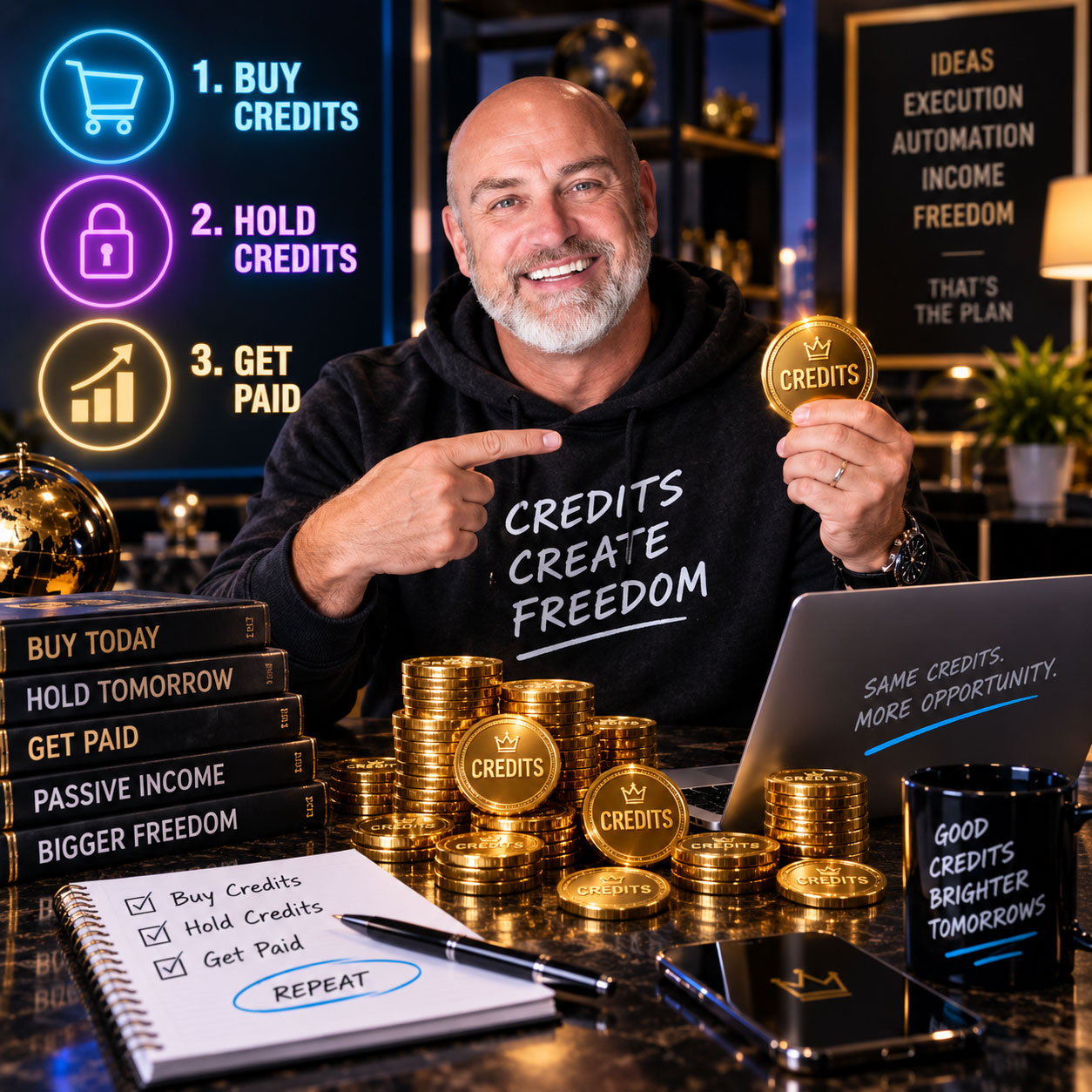 Strip away the supercars, yachts, AI buzzwords and earnings screenshots and SHIFT AI’s underlying product is surprisingly simple: people buy AI credits. Those credits can then be spent using tools inside the SHIFT AI platform to generate things such as text, images, music and other content. On its face, there is nothing inherently unusual about that. Plenty of legitimate software platforms sell usage credits.
But SHIFT AI adds another layer. The credits aren’t merely presented as something to consume. How many credits you purchase can also affect how much money you potentially receive. That distinction is crucial.
SHIFT AI’s own material describes CreditPay as a competition between its top “Consumers,” but it measures two different things: “AI Credits Purchased” and “AI Credits Used.” The more credits purchased, the higher someone can place on one side of the leaderboard; the more credits actually used, the higher they can place on the other. That means purchasing the product and consuming the product are separately rewarded activities.
Marty Hale has been even more explicit during presentations. I have heard him describe credits as being “like an investment” for some participants and discuss people accumulating credits rather than consuming them. In one presentation, he described someone purchasing roughly $5,000 of credits every week without using them. In another explanation of the leaderboard strategy, Hale told participants they might purchase another $1,000 of credits and potentially make another $3,000 in cash.
Then came perhaps the clearest description of all:
“This leaderboard gives you the ability to buy money. I know it sounds crazy, but it does.”
That isn’t my description of SHIFT AI. That’s the founder explaining his own compensation system.
Hale has gone further, saying participants can buy AI credits and potentially make thousands of dollars without creating content, referring anyone or recruiting anybody. In another presentation he said some people receiving payments may never even have logged in. Those statements create an obvious question: if the economic purpose of an AI credit is to purchase AI services, why is somebody who doesn’t consume those services potentially being financially rewarded simply for holding or purchasing credits?
T. LeMont Silver’s presentation gives us a practical example of how this psychology reaches prospective participants. Silver explains that $99 gets someone into SHIFT AI, while the $499 package gets them into the first ClubPay pool. He tells his audience that he had received around $13 in ClubPay after purchasing the qualifying package and doing very little else. His conclusion is that this income could offset part of his monthly subscription. He then explains how participants can progress towards Bronze, Silver and Gold as purchases made by them and the people they personally refer accumulate.
Silver even explains why a customer purchasing additional credits matters. If somebody runs out, he says, they may “top up and buy some more credits,” with those purchases contributing towards progression through the clubs. The product purchase therefore performs more than one function: it buys AI usage, generates revenue feeding the compensation system and can contribute towards qualification and leaderboard positioning.
There was also an unintentionally useful moment during Silver’s live product demonstration. When SHIFT AI’s lyric-writing function failed to produce the lyrics for the song his group was creating, Silver simply opened ChatGPT, asked it to write the song, copied the resulting lyrics and pasted them back into SHIFT AI. The music generation continued from there.
A pre-launch product having a technical hiccup proves very little by itself. Software breaks. Features fail. That’s not my concern. What interested me was that one of the AI services SHIFT AI is supposedly bringing together could immediately be accessed directly when SHIFT AI’s own function didn’t work.
That brings us to the distinction at the centre of this investigation.
Are people primarily buying AI credits because they need to consume AI services — or are some buying more credits because those purchases can improve their position inside a compensation system that promises to distribute money back to them?
To answer that properly, we need to stop looking at the AI for a moment and follow the money.
A Pre-Launch Company With A $198 Million Dashboard
There is something else in SHIFT AI’s own opportunity presentation that deserves a closer look before we follow the compensation money.

The presentation says SHIFT AI is “currently in pre-launch.” Yet the glossy dashboard artwork used to sell the opportunity displays numbers that look remarkably like live operating statistics: “TOTAL REVENUE $198,352,987,” “ECOPAY TRANSACTIONS $78,369,281,” “GLOBAL CREATORS 128,752” and “MARKETPLACE ACTIVE LISTINGS 24,875.”
That creates an obvious problem of presentation.
If those figures are merely illustrative mock-up data used to make a futuristic dashboard look impressive, they should not be mistaken for SHIFT AI’s actual financial performance or customer activity. A company describing itself as being in pre-launch cannot simultaneously have generated $198 million in SHIFT AI operating revenue unless there is a substantial part of the business history that has not been explained.
And the numbers aren’t tucked away in an obscure technical mock-up. They appear against exactly the lifestyle imagery being used to frame the opportunity: a Lamborghini, luxury property, infinity pool, helicopter and yacht, accompanied by the slogan:
“Everything you need. One platform. Unlimited income.”
That’s why context matters.
A prospective participant flipping through an opportunity presentation could reasonably see “TOTAL REVENUE $198,352,987” and interpret it as evidence of an enormous existing business. If it isn’t real SHIFT AI revenue, it should be clearly presented as demonstration data rather than something resembling a live company dashboard.
The same distinction applies throughout this investigation. A projected number isn’t revenue. An illustrated earning scenario isn’t an earning. A dashboard mock-up isn’t an audited financial statement. And an impressive number becomes meaningful only when we know what it actually represents.
SHIFT AI says it is in pre-launch.
So before anybody points to $198,352,987 as evidence of scale, I want a very simple clarification:
Whose revenue is it?
Follow The Money: How The Compensation Model Works
SHIFT AI’s own Opportunity Presentation makes an extraordinary proposition: “The only AI that pays you.” It says the company hands participants up to 50% of the ecosystem’s gross revenue and explains that EcoPay distributes money through five compensation streams: ClubPay, ConnectPay, ContentPay, CreditPay and CompetePay.
The wording matters. One page says participants can “get paid every single time someone uses AI.” But shortly afterwards, the presentation becomes more specific: EcoPay pays on new AI credits purchased. That is a materially different proposition. Using credits consumes an existing balance. Purchasing credits introduces new money into the system.
ClubPay is perhaps the easiest place to see how this works. SHIFT AI says that whenever AI credits are purchased, money is allocated across five clubs. According to the presentation, each club receives 5% of ecosystem gross revenue, meaning the five ClubPay pools collectively represent 25% if the percentages operate as presented. Participants then share the relevant pools according to their qualifying points. Standard members participate in one club, while people progressing through Bronze, Silver, Gold and Platinum can participate in additional pools. At Platinum, the presentation shows a participant positioned across all five.
That creates an important incentive: higher positioning can give someone access to more pieces of the same revenue being generated when credits are purchased.
Then there is ConnectPay — subsequently referred to as CoachPay in some presentations — which is marketed as paying up to 20% when people someone connects to SHIFT AI purchase credits. ContentPay is marketed as paying up to 20% when shared content results in credit purchases. CreditPay rewards leaderboard positioning based on credits purchased and credits used. CompetePay then looks across the other compensation streams and awards additional money to leading participants.
The deck repeatedly uses phrases such as “up to 20%” for individual streams while elsewhere saying up to 50% of ecosystem gross revenue is returned overall. Those figures should not simply be added together as though one participant automatically receives every advertised percentage. What matters for this investigation is something more fundamental: the compensation streams repeatedly lead back to the same economic event — somebody purchasing AI credits.
T. LeMont Silver explained this particularly clearly to his own audience. He said that from every purchase, SHIFT AI allocates part of the money into the ClubPay pools. A participant at Standard receives a small portion; reach Bronze and they participate in Standard and Bronze; reach Silver and they participate in another pool again. Silver described watching people’s earnings “shoot up” as they moved into higher clubs.
He then explained why he believed large recruiters entering SHIFT AI benefited everybody else. They wanted to climb the rankings, he said, and in doing so would bring more business into the company:
“They’re bringing more revenue to the company. And we all get to eat.”
That sentence gets remarkably close to the question I have been asking since the beginning. Silver isn’t describing revenue arriving from an advertising network, an outside corporate customer or some mysterious AI trading engine. He is talking about people entering SHIFT AI, purchasing packages and credits, pursuing higher positions and increasing company revenue, from which other participants receive a share.
Silver also explains that somebody can start at $99, while purchasing the approximately $499 package gets them into the first ClubPay pool. He tells viewers that his own ClubPay had produced roughly $13 after only a few days and says that, averaged across four weeks, it could already cover around half of his monthly subscription. He hadn’t needed to sell AI-generated songs to outside customers to receive that ClubPay. His explanation was straightforward: he had positioned himself by purchasing the package that qualified him for the pool.
SHIFT AI’s own calculator takes the concept much further. Under a specific set of assumptions — including $500 of personal credit purchases every month, 25 connected people averaging $100 in monthly credit purchases, 50,000 active members, $2.5 million in monthly ecosystem credit revenue and 12% monthly platform growth — the company illustrates Month 12 earnings of approximately $35,300, equivalent to a $423,000 annualized rate.
The presentation does include a disclaimer explaining that the illustration is hypothetical and actual results may be zero. That context matters. But so does the enormous $423K figure sitting above a scenario built on assumptions about rapid growth, credit purchasing and high leaderboard positions. It is an illustration, not evidence that an ordinary participant will earn anything approaching $423,000 a year.
And this is where the mathematics becomes more important than the marketing.
If SHIFT AI distributes a substantial percentage of gross credit-purchase revenue back through these pools, we need to know who is purchasing the credits and why. How much revenue comes from genuine retail customers who simply want AI services and have no interest in earning money? How much comes from Club Members purchasing credits themselves? How much is connected to maintaining qualification, climbing leaderboards, progressing through clubs or attempting to increase compensation?
Those figures would tell us far more about the sustainability of SHIFT AI than another demonstration of an AI-generated song.
Because distributing revenue isn’t magic.
Before SHIFT AI can pay money out, somebody has to put money in.
When Buying More Credits Becomes The Strategy
 This is where SHIFT AI becomes particularly interesting. Buying credits isn’t always being presented simply as buying more AI usage. It can become a strategy for making more money.
Marty Hale has described the behaviour openly. In one presentation, he talked about a participant purchasing around $5,000 worth of credits every week without using them. Hale said the participant viewed the credits “like stock.” Elsewhere, he explained how participants watch the CreditPay leaderboard and calculate whether buying additional credits before the cut-off could move them into a more profitable position.
His example was remarkably direct:
“You might buy $1,000 of more credits and make $3,000 more cash.”
Hale has also described an unusual rush immediately before the weekly cut-off. According to him, roughly 48% of the week’s revenue can arrive during the final ten minutes on Tuesday as participants “jockey” for leaderboard position. If accurate, that is an important behavioural signal. Why would almost half a week’s revenue potentially arrive within ten minutes? People don’t suddenly need dramatically more AI-generated images, videos or songs because a compensation deadline is approaching.
They may, however, want more credits if purchasing them could improve their position on a leaderboard.
And now I have an actual SHIFT AI leaderboard showing the kind of numbers participants are being presented with.

The screenshot displays Glyn Taylor at $97,864.66, Mark Oestreich at $93,229.02, Michael Lucas at $37,547.40, Mark Hamlin at $18,870.05 and Mike Donaldson at $11,618.58, alongside several other participants displaying five-figure amounts. The leaderboard itself labels the column “EARNINGS.”
I have not independently verified that these figures represent money actually received by each person, so I am treating them as amounts displayed inside the SHIFT AI system rather than independently verified earnings. But that distinction doesn’t diminish the significance of the image. Prospective participants are being shown a competitive ranking system containing substantial dollar amounts while being taught that purchasing additional credits can affect where somebody finishes.
That matters even more when we look at how promoters explain the leaderboard.
Greg Sain, another SHIFT AI promoter I have documented, walks his audience through the CreditPay rankings and discusses what could happen if somebody purchased enough additional credits to move higher. Looking at one participant, Sain estimates that acquiring roughly another million credits might cost “four or five grand” before saying:
“But he’s going to make 20.”
He then predicts:
“Big money people are going to be fighting every Tuesday.”
That language fits remarkably closely with Hale’s own description of participants “jockeying” for position during the final minutes before the weekly cut-off.
Hale puts the concept even more bluntly elsewhere:
“This leaderboard gives you the ability to buy money. I know it sounds crazy, but it does.”
He has told audiences that someone can purchase AI credits and potentially make thousands of dollars in profit without creating content, referring a person, recruiting anyone or even telling their spouse they did it.
That deserves considerably more scrutiny than the usual argument that a business must be sound simply because “we have a real product.”
Having a usable product does not automatically answer questions about the economics of an income opportunity built around that product. What matters is why people are purchasing it. If I buy $500 worth of AI credits because I genuinely need $500 worth of AI processing, that is straightforward consumption. If I buy $500 because doing so qualifies me for a compensation pool, moves me up a leaderboard or creates the possibility of receiving substantially more money back, the economic motivation has changed.
SHIFT AI’s own opportunity deck reinforces that distinction. CreditPay doesn’t merely recognise consumption; it explicitly has a component based on “AI Credits Purchased.” The more credits someone purchases, the higher they can place. A separate component rewards “AI Credits Used.” In other words, the company itself distinguishes between purchasing the credits and actually consuming them.
Even Hale appears to recognise why that distinction matters. During one Founder discussion, a participant specifically raised the concern about credits being purchased but not consumed. Hale responded:
“If we were doing everything on Credit Pay Hold, it’d be a Ponzi scheme.”
That statement does not establish that SHIFT AI is a Ponzi scheme, and I am not presenting it as one. It is significant because the comparison was introduced by SHIFT AI’s own founder while discussing the very issue I am examining: participants accumulating credits and receiving money through a system influenced by those holdings.
SHIFT AI appears to have attempted to address this by including actual credit usage as another component of CreditPay. Hale has repeatedly encouraged participants to use the product, and the company clearly has functioning AI services. Those facts deserve to be acknowledged.
But they don’t make the purchasing incentive disappear.
The result is a peculiar economic loop. Participants buy credits. Those purchases generate company revenue. Portions of that revenue feed compensation pools. Participants can receive money from those pools. Purchasing additional credits can influence qualification or leaderboard positioning. Those additional purchases generate more revenue, portions of which can again be distributed.
And the more people who enter and compete, the more money potentially moves through the system.
T. LeMont Silver essentially describes this dynamic when discussing the arrival of major recruiters. He says they want to get “at the top of the chain” and that while they compete against each other, they bring additional revenue into SHIFT AI — increasing what ordinary participants receive through ClubPay.
This does not, by itself, establish anything illegal. But it does identify the question SHIFT AI needs to answer with numbers rather than presentations:
How much credit revenue is generated by people who genuinely need more AI services, and how much is generated by participants buying credits because buying credits can help them make money?
Until we know that ratio, calling every credit purchase ordinary retail demand would be an assumption — and it’s an assumption I’m not prepared to make.
The “20 AI Minds” Claim
SHIFT AI’s product pitch rests heavily on another proposition: why subscribe to numerous AI services separately when SHIFT AI can supposedly bring them together in one place? Its official presentation describes “One AI brain. The intelligence of 20+ platforms,” names services including ChatGPT, Claude, Gemini, HeyGen, Higgsfield and ElevenLabs, and places a prominent “PATENT-PROTECTED” badge alongside the technology.
But even the number seems to move depending on who is presenting it.
SHIFT AI’s own material says 20+ platforms. Michael Lucas has promoted 26 powerful AI engines. In another presentation, Marty Hale talked about 27 of the top AI platforms in the world, describing them as SHIFT AI’s “partners.” He went considerably further than simply saying his software connects to them, claiming:
“We have an exclusive relationship with them and it’s patented.”
Those are claims I want to separate carefully because they mean very different things.
There is nothing remarkable or suspicious about one software platform communicating with several AI providers. Developers can legitimately build applications that send requests to third-party AI models and return the results through their own interface. A customer could therefore interact with one dashboard while different services perform work behind the scenes.
That alone does not establish a partnership, an exclusive relationship or ownership of the underlying AI technology.
So when Hale describes companies behind products such as ChatGPT, Gemini and Claude as SHIFT AI’s partners, I want to know exactly what “partner” means.
Does SHIFT AI have direct commercial agreements with these companies? Reseller arrangements? Enterprise contracts? Licensing agreements? Or is SHIFT AI purchasing access to third-party AI services in a way that is also available to other developers? And if the relationship really is exclusive, what exactly has SHIFT AI obtained that another developer cannot?
These aren’t unreasonable questions. They are the natural questions created by the company’s own marketing.
There is another issue in the opportunity presentation that makes clarification even more important. The deck doesn’t merely say SHIFT AI has developed proprietary technology. It labels that technology “PATENT-PROTECTED” and describes the patent protection as “the moat that makes SHIFT one of a kind.” Yet elsewhere SHIFT AI has reportedly used “patent pending” language.
Those descriptions are not necessarily interchangeable.
A pending patent application and an issued patent are different things, and neither automatically tells us how broad the claimed intellectual-property protection actually is. If SHIFT AI is relying on patent protection as evidence of its technological advantage, then the relevant application or patent details should identify what was filed, by whom, its current status and what the claims actually cover.
The same applies to Hale’s statement that the patent can be found under EcoPay. If EcoPay is the relevant intellectual property, does the claimed protection concern the compensation architecture, the AI technology, the way multiple models are orchestrated, or something else entirely?
That distinction matters because the opportunity presentation can leave a prospective participant with the impression that the AI “brain” itself is patent-protected.
During T. LeMont Silver’s demonstration, viewers got an interesting glimpse of why I want the underlying technology explained. SHIFT AI was being demonstrated as the convenient interface bringing AI capabilities together, but when the lyric-writing feature failed, Silver opened ChatGPT directly, asked ChatGPT to create the lyrics and then copied them back into SHIFT AI so the demonstration could continue.
Again, a failed feature during a live demonstration proves very little. Software fails. Pre-launch products have bugs. But the moment illustrates the fundamental distinction perfectly.
What has SHIFT AI itself invented, and what is SHIFT AI providing by connecting users to technology invented by somebody else?
If SHIFT AI has developed proprietary orchestration technology, explain it. If it has negotiated special commercial relationships, substantiate them. If it has patent protection, identify the intellectual property and its status.
What I won’t do is automatically treat access as partnership, integration as exclusivity, “patent pending” as a granted patent, or a patent badge as evidence of what that patent actually protects.
SHIFT AI is invoking some of the biggest names in artificial intelligence to help establish credibility for its product.
If those names are going to help sell SHIFT AI, then SHIFT AI should be able to explain precisely what relationship it actually has with them.
Patents, Partnerships And Claims That Should Be Provable
Some of the biggest claims being used to promote SHIFT AI are also among the easiest to substantiate — if they are accurate.
The first is the patent claim. SHIFT AI’s opportunity presentation prominently describes its technology as “PATENT-PROTECTED” and calls that protection the technological “moat” that makes the company unique. Marty Hale has gone further during presentations, saying “it’s patented” and directing people to look up the patent under EcoPay.

But SHIFT AI’s own public website currently uses different language. As of 20 September 2026, it repeatedly describes EcoPay as “Patent Pending” and refers to a “patent-pending EcoPay engine” and “patent-pending architecture.” SHIFT AI-hosted promotional pages also display “PATENT PENDING · ECOPAY™.”
That distinction needs to be clarified.
Patent pending does not mean patent granted. It generally indicates that an application has been filed and remains somewhere in the patent process. If SHIFT AI has an issued patent, it should be possible to identify the patent number, owner, filing history and what the patent actually protects. If the relevant intellectual property is still pending, then the opportunity presentation’s stronger “PATENT-PROTECTED” language and Hale’s repeated statements that the technology “is patented” deserve explanation.
I am not asking SHIFT AI to publish proprietary source code or reveal trade secrets. Give me the patent or application number. That would allow anybody conducting due diligence to establish what has actually been filed or granted and, importantly, whether it concerns EcoPay’s attribution system, the compensation architecture, the AI orchestration technology or something else.
The second major claim concerns SHIFT AI’s relationships with the companies behind the AI products it promotes.
Hale hasn’t merely said SHIFT AI can access multiple AI models. He has described the top 27 AI platforms as SHIFT AI’s “partners,” claimed SHIFT AI has an “exclusive relationship” with them and said the company contacted providers to purchase AI tokens or credits wholesale before making those services available through SHIFT AI.
If that is accurate, it should leave a commercial paper trail.
There should be some form of agreement defining what SHIFT AI is authorised to access, resell, integrate or represent. That does not necessarily mean those contracts need to be published in full. But if major technology companies are being described publicly as partners — particularly exclusive partners — it is reasonable to ask those companies or SHIFT AI to confirm the nature of the relationship.
This matters because using another company’s technology is not automatically the same thing as partnering with that company. A developer can legitimately purchase access to third-party technology without the provider endorsing that developer’s business, compensation plan or income opportunity.
The difference becomes especially important when names such as ChatGPT, Claude, Gemini, HeyGen, Higgsfield and ElevenLabs appear inside presentations being used to establish the credibility and value of SHIFT AI.
I am not disputing that SHIFT AI may be capable of integrating multiple third-party AI services. I am asking something much more precise:
What contractual relationships does SHIFT AI actually have with the companies whose names are being used to promote it?
The same evidentiary standard applies to every major claim in this investigation. If there is a granted patent, identify it. If there is a pending application, identify that instead. If there are exclusive partnerships, substantiate them. If there are wholesale or reseller agreements, explain their nature.
These are not complicated demands from a journalist looking for something to attack.
They are basic due-diligence questions created by SHIFT AI’s own marketing claims.
Before SHIFT AI, There Was Marty Hale
SHIFT AI is being marketed heavily around the experience and credibility of its founder. Marty Hale’s promotional biography presents him as a veteran entrepreneur who has spent decades building technology and direct-sales businesses. His current marketing makes some extraordinary claims, including “$8B+ BUILT,” “7 PARADIGM SHIFTS” and “40+ YEARS AT THE EDGE.” Elsewhere, Hale has described himself as having built multiple billion-dollar companies.

Those claims deserve the same treatment as every other claim in this investigation: separate what can be documented from what is being asserted in promotional material.
Hale’s biography credits him with involvement in businesses including Excel Communications, US Internet/Net Lifestyles, Blue Moon Solutions, Momentis by Just Energy, Veridian/Crius and Folium Biosciences. The promotional history attributes enormous numbers to those ventures — including billion-dollar revenues, hundred-million-dollar first years and substantial company valuations. During SHIFT AI presentations, Hale has used this history to establish why participants should trust his ability to build the new company.
T. LeMont Silver repeats that credibility pitch to his own audience, telling viewers that Hale has developed three businesses worth more than a billion dollars and that two were traded on the New York Stock Exchange. Those remain claims that should be independently matched to specific companies, Hale’s precise role in them and contemporaneous corporate or financial records before being treated as established facts.
There is, however, another part of Hale’s business history that can be documented.
Court records from Texas show that Plains Capital Bank obtained a judgment against Blue Moon Solutions Inc. and Marty Hale in litigation filed in the 98th Judicial District Court of Travis County. A later Order Requiring Turnover and Appointing Receiver, signed on 27 November 2024, records an original final judgment of $304,606.45 plus interest and costs.
The order states that the judgment remained unpaid and records a calculated balance of $945,223.98 as of 26 August 2024, with interest continuing at $112.16 per day. The court appointed receiver Peter C. Ruggero and ordered turnover of non-exempt property under Texas law.
That is a civil debt and receivership matter. It is not evidence that SHIFT AI is fraudulent, and it would be irresponsible to present it that way. But when a founder’s past business achievements are being used as a reason for prospective participants to trust a new financial opportunity, documented liabilities and court judgments are also legitimate due-diligence information.
The same principle applies to another remarkable story Hale has told publicly.
Hale has claimed that Bill Gates invested in “our company,” describing the venture as the first Windows NT-based internet company and saying Gates was its only investor. That would be a significant piece of entrepreneurial history if documented. It should therefore be possible to establish which company Hale was referring to, when the investment occurred, whether Gates invested personally or through another entity, how much was invested and what contemporaneous records support the claim.
I apply the same standard to Hale’s assertion that he has built eight billion-dollar companies.
Name them.
Show Hale’s role in each company. Show what “built” means in each case. Show whether the billion-dollar figure represents annual revenue, cumulative sales, valuation, market capitalisation or something else entirely.
None of those questions requires anybody to dislike Marty Hale or assume the worst about SHIFT AI. They are simply what proper due diligence looks like when a founder’s résumé is being used as part of the sales proposition.
And that matters because promoters repeatedly tell prospective participants that Hale’s history is one of the reasons they trust SHIFT AI.
If Marty Hale’s track record is part of the reason people are being asked to trust this opportunity, then that track record should withstand verification — the successes, the numbers and the court records alike.
The Promoters And The Due-Diligence Problem
One of the recurring themes throughout this investigation has been the word “due diligence.” Promoters regularly tell audiences they have researched an opportunity, spoken directly with the owner or satisfied themselves that the company is legitimate. But speaking to the person selling the opportunity is not independent due diligence.
“Marty told me” is not verification.
If somebody is earning commissions from people they introduce to SHIFT AI, displaying earnings, explaining compensation or encouraging an audience to purchase credits, I believe they have a responsibility to understand the claims they are repeating.

T. LeMont Silver is a particularly useful example because he presents himself as an experienced network marketer. He tells viewers he has been involved in MLM since he was 24 and openly explains how SHIFT AI’s compensation system works. He also says his sponsor is Mark Hamlin, discusses receiving a 20% commission from his first $1,000 referral and encourages viewers to get back to whoever introduced them so they can get positioned correctly.
That experience should make the due-diligence questions easier, not unnecessary.
Before promoting SHIFT AI, did Silver independently verify Marty Hale’s claimed business history? Did he verify the alleged patents? Did he see evidence of the claimed relationships with major AI companies? Did he establish how much revenue comes from genuine customers purchasing AI services rather than participants purchasing credits because they want to qualify for compensation?
Those questions become even more relevant when Silver tells his audience that large recruiters entering SHIFT AI will generate more company revenue and therefore increase what other participants receive through ClubPay.
Then there is Sal Khan from The Grateful Tribe. His interview with Hale was presented as a discussion about whether SHIFT AI could simplify content creation, but underneath the video was a SHIFT AI referral link, a team Telegram group and promotional reasons to join. His own disclaimer states that The Grateful Tribe is paid when viewers use its links.
Again, there is nothing inherently wrong with receiving a referral commission. The issue is disclosure and verification.
When a promoter tells viewers that SHIFT AI offers “Patented Tech & Patented Comp Plan,” “Earn From WHOLE Company Growth” and “Daily Payout Even To Bank Account,” those statements can influence somebody’s decision to spend money. If the promoter is financially rewarded when that person joins, asking what was independently verified beforehand is entirely reasonable.
The same standard applies to Pierre Maxim, Michael Lucas, Marquita, Jaime Soriano, Mark Oestreich and anyone else actively marketing the opportunity.
Did they obtain the patent details?
Did they verify the claimed partnerships?
Did they independently establish where the money funding participant payouts comes from?
Did they ask what percentage of credit revenue comes from ordinary retail customers compared with Club Members participating in the compensation system?
Did they verify the earnings figures before showing or repeating them?
And perhaps most importantly, would they still be recommending SHIFT AI if there were no compensation plan attached to it?
A disclaimer at the bottom of a video description does not answer those questions. Neither does saying “this isn’t financial advice.” Disclosing that you may receive compensation is important, but disclosure does not transform an unverified claim into a verified one.
Promoters have enormous influence in online income communities because audiences often follow the person from opportunity to opportunity. That trust can become more valuable than the product being promoted. When an experienced marketer tells followers they have found something extraordinary, some people will spend money because they trust the promoter long before they understand the compensation mathematics.
That is why I contact promoters and offer them a right of reply. I want to know what they checked, what evidence they saw and whether they can substantiate the claims they are helping spread.
I am not asking them to predict the future.
I am asking them to prove what they say they already know.
SHIFT AI Can Answer These Questions
At this point, SHIFT AI has an opportunity to make this investigation considerably simpler.
I am not asking Marty Hale or his promoters to prove that artificial intelligence is a growing industry. I am not asking whether SHIFT AI can generate an image, write some text or create a song. I have already seen the platform demonstrated.
The unanswered questions are about the business behind the technology.
 First, where does the money come from? SHIFT AI says up to 50% of ecosystem gross revenue can be distributed back through EcoPay. I want to know what percentage of that revenue currently comes from ordinary customers purchasing AI credits purely to consume AI services, compared with Club Members purchasing credits while participating in the compensation system.
How many credits are actually being consumed?
How many are being accumulated?
How much revenue is generated by participants purchasing additional credits to qualify for clubs, improve leaderboard positions or increase their potential compensation?
Those figures would help answer the most important economic question in this investigation.
Second, what exactly is patented? SHIFT AI’s opportunity material uses “PATENT-PROTECTED” language, while its public website currently describes EcoPay as “patent pending.” Hale has told audiences the technology “is patented” and that the patent can be found under EcoPay.
Provide the patent or application number and identify what intellectual property it covers.
Third, what relationships does SHIFT AI actually have with the major AI companies whose products appear throughout its marketing? Hale has described the top AI platforms as SHIFT AI’s “partners” and claimed exclusive relationships. If SHIFT AI has reseller agreements, enterprise contracts, licensing arrangements or other commercial relationships with companies behind ChatGPT, Claude, Gemini, HeyGen, Higgsfield, ElevenLabs or other services, explain the nature of those relationships.
Fourth, what do the enormous numbers shown in SHIFT AI’s own opportunity presentation represent?
The company describes itself as “currently in pre-launch,” yet the dashboard artwork displays “TOTAL REVENUE $198,352,987,” “ECOPAY TRANSACTIONS $78,369,281,” “GLOBAL CREATORS 128,752” and “MARKETPLACE ACTIVE LISTINGS 24,875.”
If those are genuine SHIFT AI operating figures, provide the period and underlying records they represent.
If they are demonstration data used to illustrate what the dashboard could eventually look like, say so clearly.
Fifth, substantiate the founder’s résumé being used to establish trust in the opportunity. Hale’s marketing references billions of dollars in businesses supposedly built during his career, and he has publicly claimed that Bill Gates invested in one of his companies. Identify the companies, Hale’s role in them and the records supporting those claims.
Finally, provide enough information to understand how sustainable the compensation system is without continuing participant-driven credit purchases.
None of this requires SHIFT AI to disclose source code, surrender trade secrets or reveal commercially sensitive contracts publicly. Documents can be redacted where genuinely necessary. Companies routinely confirm patents, corporate relationships, revenue categories and historical business achievements without exposing proprietary technology.
I have offered rights of reply during this investigation, and that remains open. If SHIFT AI, Marty Hale or any promoter named in this article provides substantive evidence contradicting or clarifying something I have reported, I will examine it and update my reporting where appropriate.
That is how evidence-based journalism is supposed to work.
SHIFT AI is asking people to believe some very large claims about its technology, intellectual property, partnerships, founder, revenue-sharing system and earning potential.
The people making those claims should be able to prove what SHIFT AI is today.
Following The Evidence, Not The Hype
When I began looking into SHIFT AI, I didn’t know where the investigation would lead. I saw familiar warning signs: passive-income language, Founder packages, recruitment, revenue sharing, earnings claims and people being encouraged to buy more credits. But warning signs are not conclusions. They are reasons to start asking questions.
The deeper I went, the more those questions became about economics rather than artificial intelligence.
SHIFT AI has a product. People can log into it and use AI tools. That fact isn’t in dispute. The issue is whether genuine demand for those services is driving the financial opportunity being promoted around them — or whether the more powerful incentive is the possibility of making money from buying credits, qualifying for pools, referring other participants and competing for positions while everyone shares portions of incoming revenue.
Marty Hale’s own words are why I keep coming back to that distinction.
He has talked about participants treating credits “like stock.” He has described people buying credits without consuming them. He has explained how someone might spend another $1,000 to potentially make another $3,000. He has said the leaderboard gives participants the ability to “buy money.” He has described people earning thousands without recruiting, referring, creating content or even logging in. And when the subject of unused credits and compensation arose, it was Hale himself who introduced the words “Ponzi scheme” while explaining why he believes SHIFT AI’s structure is different.
I haven’t taken those statements out of somebody else’s criticism of SHIFT AI.
I took them from SHIFT AI’s founder explaining SHIFT AI.
The promoters have helped complete the picture. T. LeMont Silver explains why large recruiters entering the company can benefit existing participants: they compete, they generate more revenue and, in his words, “we all get to eat.” Others promote passive income, company-wide revenue participation, daily payouts, Founder positions and compensated referral links.
That is why I’m not interested in arguing over whether SHIFT AI should be called an MLM, affiliate programme, AI club, revenue-sharing platform or some newly invented marketing term. Changing the label doesn’t change the money flow.
Show me who buys the credits.
Show me why they buy them.
Show me how many they actually consume.
Show me where the payout money originates.
Show me what happens when people stop buying additional credits.
Show me the patents.
Show me the partnerships.
Show me the independently verifiable retail demand.
And show me the evidence supporting the extraordinary business history being used to establish trust in Marty Hale.
If those answers demonstrate a sustainable AI business supported predominantly by genuine customers purchasing services because they want to use them, that evidence belongs in this investigation too. I have no problem publishing information that challenges my concerns. That’s the entire point of asking the questions.
But until those answers arrive, I will continue doing what I have done throughout this investigation: preserving the presentations, documenting the claims, following the promoters and watching the money.
Because after hundreds of scam and income-opportunity investigations, one lesson keeps repeating itself.
Don’t be distracted by what the opportunity says it sells. Find out what motivates people to put money into it.
With SHIFT AI, that’s the question I’m still asking.
Disclaimer: How This Investigation Was Conducted
This investigation relies entirely on OSINT — Open Source Intelligence — meaning every claim made here is based on publicly available records, archived web pages, corporate filings, domain data, social media activity, and open blockchain transactions. No private data, hacking, or unlawful access methods were used. OSINT is a powerful and ethical tool for exposing scams without violating privacy laws or overstepping legal boundaries.
About the Author
I’m DANNY DE HEK, a New Zealand–based YouTuber, investigative journalist, and OSINT researcher. I name and shame individuals promoting or marketing fraudulent schemes through my YOUTUBE CHANNEL. Every video I produce exposes the people behind scams, Ponzi schemes, and MLM frauds — holding them accountable in public.
My PODCAST is an extension of that work. It’s distributed across 18 major platforms — including Apple Podcasts, Spotify, Amazon Music, YouTube, and iHeartRadio — so when scammers try to hide, my content follows them everywhere. If you prefer listening to my investigations instead of watching, you’ll find them on every major podcast service.
You can BOOK ME for private consultations or SPEAKING ENGAGEMENTS, where I share first-hand experience from years of exposing large-scale fraud and helping victims recover.
“Stop losing your future to financial parasites. Subscribe. Expose. Protect.”
My work exposing crypto fraud has been featured in:
- Coffeezilla 2026): Featured in the investigation exposing the alleged $328M Goliath Ventures Ponzi scheme
- Bloomberg Documentary (2025): A 20-minute exposé on Ponzi schemes and crypto card fraud
- News.com.au (2025): Profiled as one of the leading scam-busters in Australasia
- OpIndia (2025): Cited for uncovering Pakistani software houses linked to drug trafficking, visa scams, and global financial fraud
- The Press / Stuff.co.nz (2023): Successfully defeated $3.85M gag lawsuit; court ruled it was a vexatious attempt to silence whistleblowing
- The Guardian Australia (2023): National warning on crypto MLMs affecting Aussie families
- ABC News Australia (2023): Investigation into Blockchain Global and its collapse
- The New York Times (2022): A full two-page feature on dismantling HyperVerse and its global network
- Radio New Zealand (2022): “The Kiwi YouTuber Taking Down Crypto Scammers From His Christchurch Home”
- Otago Daily Times (2022): A profile on my investigative work and the impact of crypto fraud in New Zealand






Leave A Comment