


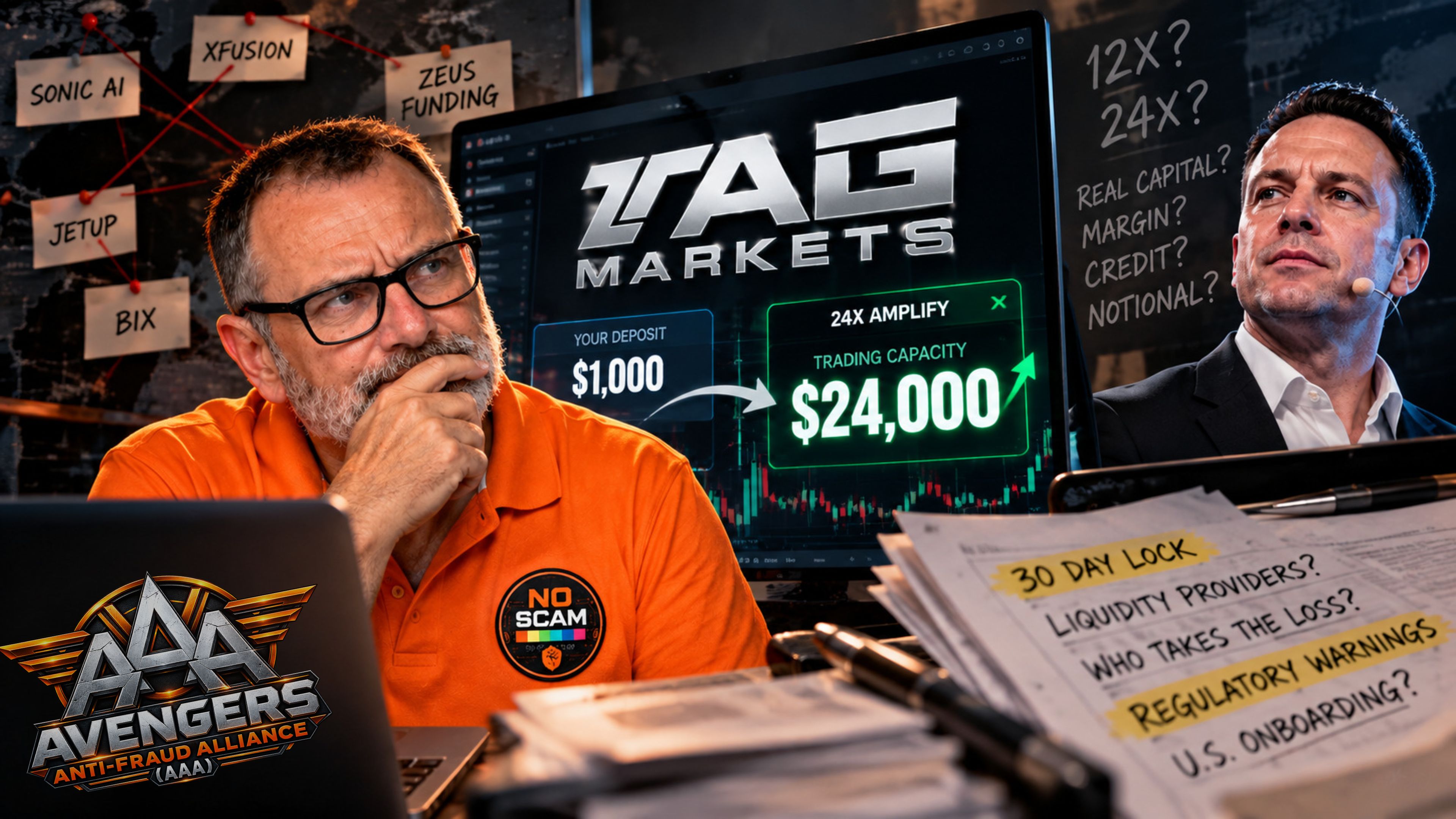
“We need approximately six weeks, then we have earned back the money that we have effectively borrowed for the 24X/12X accounts.” — Niklas Freihofer
What started for me as an investigation into Sonic AI has turned into something much larger. The deeper I followed the money, the trading accounts and the people promoting the opportunity, the more often the same name appeared underneath it all: TAG Markets, operated through Mauritius-registered T.M. Financials Ltd.
 On the surface, TAG presents itself as a regulated forex broker offering trading technology, CopyX social trading and what it calls 12X and 24X Amplify. The proposition sounds extraordinary. Put up $1,000 and, depending on the programme, you can supposedly access as much as $12,000 or $24,000 in trading capacity. Around that infrastructure I found Sonic AI, Neo FX, XFusion, JetUp, Zeus Funding, AITech, Bit1 and BIX — alongside multi-level affiliate commissions, Rolex and Lamborghini incentives, house bonuses and claims of enormous trading volumes.

But the questions become much harder once you look underneath the marketing. Where does the additional 12X or 24X trading capacity actually come from? Is it real third-party capital, margin, credit or simply notional buying power? Why is customer principal locked for approximately 30 days? Who carries the loss when an amplified account reaches its maximum drawdown? And why did TAG founder Niklas Freihofer describe TAG as needing roughly six weeks to recover money it had “effectively borrowed” for these accounts?
Then there is the regulatory picture. Authorities in multiple jurisdictions have published warnings concerning TAG Markets or the entities behind it, while questions remain over the history of the Mauritius licence number displayed by TAG. That issue has now been put directly to the Financial Services Commission of Mauritius for clarification. Meanwhile, evidence supplied to me shows TAG, BIX and CopyX being promoted at an in-person event in the United States, while separate onboarding instructions describe a route involving U.S. residents, Paraguay and Palau.
I gave TAG Markets a detailed right of reply before publication. To its credit, its Legal Department responded and offered the possibility of allowing me to examine commercially sensitive evidence concerning its liquidity providers, banking and payment arrangements. But many of my fundamental questions remain unanswered. TAG subsequently told me its product questions had been referred to its Head of Product and that it was “currently working on” the U.S., Paraguay and Palau matter.
So this investigation isn’t going to begin by declaring that every allegation I’ve encountered is true. Quite the opposite. I’ve spent weeks separating what TAG says, what its promoters say, what regulators have actually published, what independent trading records show, what sources have provided me, and what remains unproven.
Because when a financial ecosystem is handling this much money and making claims this large, the question isn’t whether the presentation looks impressive.
The question is whether the money, the trading and the structure underneath it can withstand scrutiny.
Inside This Investigation
This investigation covers a lot of ground. If you want to jump directly to a particular part of the TAG Markets story, use the index below. I recommend reading it from the beginning, because each section builds on the evidence uncovered before it.
- Following The Money From Sonic AI To TAG Markets
- Who Is Behind TAG Markets?
- The Mauritius Licence Question
- How Does $1,000 Become $24,000?
- Why Is The Customer’s Money Locked?
- Who Takes The Loss When Amplified Trading Goes Wrong?
- When A TAG Markets Strategy Blows Up
- CopyX, Sonic AI And The Trading Evidence
- The Affiliate Machine Behind TAG Markets
- TAG, BIX And CopyX Turn Up At A U.S. Recruitment Event
- The U.S., Paraguay And Palau Onboarding Instructions
- Regulators Are Asking Questions Too
- An Ecosystem Of Separate Brands
- The Scale TAG Markets Claims To Have Reached
- TAG Markets Was Given The Right To Reply
- What Still Needs To Be Proven
Following The Money From Sonic AI To TAG Markets
My investigation didn’t begin with TAG Markets. It began with Sonic AI, an opportunity being promoted around automated or copy trading and eye-catching returns. But once I started examining where Sonic customers were actually being sent, the trail repeatedly led back to TAG Markets. TAG wasn’t simply another name appearing in the marketing; it was the brokerage infrastructure sitting underneath the trading accounts.
The same pattern appeared when I examined XFusion. In its own presentation, XFusion described TAG Markets as the broker it had “partnered up with”, while promoting TAG’s 24X Amplify programme and copy-trading strategies including Neo FX and Sonic. This distinction is important: I have not established that TAG owns XFusion, Sonic or every community using its infrastructure. What I have established is that multiple supposedly separate opportunities are directing customers into the same underlying TAG ecosystem.
Then I found Zeus Funding. Public marketing had previously presented Zeus as working with TAG Markets, and Niklas Freihofer later discussed the relationship himself. In a German-language presentation I obtained, Freihofer described TAG as the “playground” where different trading systems could operate. He specifically discussed a strategy associated with Zeus called Pit Sniper, saying it began with roughly $150,000, grew to around $600,000 and was eventually blown up, leaving people with losses. I’ll return to that episode later because it provides an important counterweight to the near-perfect trading statistics being used elsewhere to promote these opportunities.
The network continued expanding. JetUp states on its own website that trading accounts and financial transactions are conducted through T.M. Financials Ltd, trading as TAG Markets. BehindMLM’s review of JetUp also documented Sonic AI and Neo FX being incorporated into a ten-level compensation structure involving trading fees, ROI matching and recruitment-linked bonuses. Again, that doesn’t establish TAG owns JetUp, but it demonstrates how TAG’s trading infrastructure can sit underneath a separate affiliate organisation.
And now there is BIX. Material supplied to me from an actual event in Minneapolis placed TAG, BIX and CopyX side-by-side, advertising “Trading Technology & Opportunity,” “Global Spending Made Simple” and “AI Trading & Automated Growth.” Most revealingly, the flyer encouraged attendees to “Explore the affiliate programs.”
By this stage, I wasn’t looking at Sonic AI in isolation anymore.
I was looking at an expanding network of trading strategies, communities, affiliate organisations and financial products repeatedly converging on the same broker: TAG Markets.
Who Is Behind TAG Markets?
One of the first things I wanted to establish was who actually owns and controls TAG Markets. That should be a straightforward question for a financial business operating internationally, but the deeper I looked, the less straightforward the public picture became.
In a German-language presentation I obtained, Niklas “Nik” Freihofer was introduced as the founder of TAG Markets. Freihofer said he entered network marketing and the brokerage industry at just 17, later built his own brokerage business, sold it at 23 and, approximately two and a half years before the presentation, founded TAG Markets “together with a partner.” What he didn’t identify was who that partner was.
Other names have appeared publicly around TAG over time. Historical promotional material has identified Jared Esguerra as an owner and Colombian national Kevin Marin as a co-founder and CEO. More recently, TAG announced Craig Lund as its new CEO. Those titles don’t necessarily establish legal ownership, and I have deliberately avoided treating promotional job titles as proof of ultimate beneficial ownership.
That’s why I put the question directly to TAG Markets. I asked its Legal Department to identify the partner with whom Freihofer says he founded TAG and the current ultimate beneficial owners. In my follow-up, I specifically pointed out that this question did not require disclosure of confidential banking arrangements or liquidity-provider contracts.
TAG has not provided those names. Its latest response told me that it could only refer me to official TAG Markets statements and that questions concerning its products and services had been forwarded to its Head of Product.
What TAG does identify clearly in its correspondence is the legal entity behind the brokerage. Its Legal Department states that “Tag Markets” is the business name of T.M. Financials Ltd, incorporated in Mauritius under company number C185265, and describes T.M. Financials as regulated by the Financial Services Commission of Mauritius as an Investment Dealer under licence GB21026474.
And that licence number leads directly to the next part of this investigation — because before T.M. Financials was displaying GB21026474, that same number appeared in the regulatory history of another company: Pure North Markets Limited.
The Mauritius Licence Question
At the centre of TAG Markets’ regulatory claims is Mauritius. TAG’s Legal Department states that T.M. Financials Ltd, company number C185265, is regulated by the Financial Services Commission of Mauritius as an Investment Dealer under licence GB21026474.
The complication is that GB21026474 has a history predating TAG Markets’ current presentation of T.M. Financials. Research supplied to me identified the same licence number in connection with Pure North Markets Limited, including an FSC notice concerning the surrender of its licence effective 18 March 2024. Meanwhile, the current FSC register reportedly shows T.M. Financials with an Investment Dealer licence dated 28 March 2024. That apparent sequence raised an obvious question: what exactly happened during those ten days?
Niklas Freihofer has offered an explanation. In the German-language presentation I obtained, he said TAG acquired Pure North Markets Limited, surrendered the existing licence, obtained a new market-maker licence approximately a day later under the same licence number, and subsequently changed the company’s name to T.M. Financials. If documentation establishes that sequence, the repeated licence number may have a perfectly legitimate explanation.
I therefore put that precise account to TAG. Rather than merely asking whether T.M. Financials currently appears in the FSC database, I asked TAG to provide the dates and documentation establishing the Pure North acquisition, licence surrender, subsequent licensing and company-name change. TAG initially directed me to search the FSC register for “T.M. Financials Ltd”, but has not yet provided the documentation establishing Freihofer’s historical sequence.
The matter has now gone one step further. A source involved in my investigation submitted the discrepancy directly through the Mauritius FSC Online Complaints Portal. On 28 September 2026, the FSC confirmed that the request had been successfully registered under Request ID RE-824. The regulator has been asked to confirm whether T.M. Financials currently holds a valid licence, whether GB21026474 remains valid and for which entity, and whether TAG’s continued display of that number is accurate.
Until the FSC responds, I’m not going to manufacture an answer.
TAG says the licence is valid. Historical FSC material has raised questions about how that licence moved from Pure North Markets to T.M. Financials. Freihofer has provided an explanation, and the regulator has now been asked to settle the issue.
That is where the evidence currently stands.
How Does $1,000 Become $24,000?
One of the most unusual products I encountered while investigating TAG Markets is Amplify. The basic proposition is remarkably simple: deposit $1,000 and, depending on whether you use 12X or 24X, the account can supposedly trade with up to $12,000 or $24,000 in capacity. The obvious question is where the additional money comes from.
Promotional material from XFusion describes the additional capacity as being provided by liquidity providers. Niklas Freihofer gave a similar explanation in the German-language presentation I obtained. He said TAG works with liquidity providers, pays them a fixed fee per million, and routes customer trading through them into the market. He also maintained that the liquidity providers’ capital is “never at risk.”
That creates an important distinction that has never been adequately explained to me. If I deposit $1,000 and receive $24,000 of trading capacity, has somebody actually contributed another $23,000 to my account? Is TAG borrowing it? Is the liquidity provider extending credit or margin? Or is $24,000 simply the notional trading capacity the account is permitted to control?
The risk limits add another layer. The 24X programme has been promoted with a 5% maximum drawdown, while 12X allows 10%. Private onboarding material supplied to me similarly describes amplified accounts being subject to strict drawdown limits, with liquidation possible when those limits are reached. That makes sense as a risk-control mechanism, but it doesn’t answer the fundamental question: whose money is actually being protected by those limits, and whose balance sheet absorbs the loss?
I put this directly to TAG Markets. I asked whether the additional 12X/24X capacity represents actual third-party capital, credit or margin, or notional trading capacity, and whose capital absorbs losses when an amplified account reaches its maximum drawdown.
TAG has not yet provided those answers.
And this matters because words like “capital,” “liquidity,” “leverage,” “credit” and “trading capacity” are not interchangeable. If customers are being encouraged to think their $1,000 has somehow become $24,000, they deserve a clear explanation of what that additional $23,000 actually represents.
The question becomes even more interesting when we look at what happens to the customer’s original deposit — because although the amplified trading capacity appears almost immediately, the customer’s own money can then be subject to a holding period.
Why Is The Customer’s Money Locked?
The holding period attached to TAG Markets’ amplified accounts became one of the most important parts of this investigation because it connects the customer’s original deposit directly to the economics of the 12X and 24X model.
I’ve received information from people inside the ecosystem describing customers being able to withdraw trading profits while their original principal remains locked for approximately 28 to 30 days. One source described an investor with around $10,000 in TAG who was waiting for that holding period to expire before attempting to remove the principal. A holding period by itself doesn’t establish anything improper, so I wanted to understand why it exists.
Niklas Freihofer provided a surprisingly revealing explanation during the German-language presentation I obtained. While discussing the amplified accounts, he said TAG needs approximately six weeks to earn back money it has “effectively borrowed” for the 24X/12X accounts. He then connected the 30-day period to ensuring TAG has at least partially earned that money back.
That immediately raised more questions. If the liquidity providers’ capital is supposedly never at risk, what exactly has TAG “effectively borrowed”? What costs does TAG incur when creating a $24,000 trading account from a $1,000 customer deposit? Who is being paid during those six weeks? And if TAG says it requires approximately six weeks — roughly 42 days — to recover those costs, why is the customer’s principal generally held for approximately 30 days?
I put those questions directly to TAG. In my follow-up to its Legal Department, I specifically asked what Freihofer meant by the money TAG had “effectively borrowed,” why customer principal was subject to the approximately 30-day holding period, and whose capital absorbs losses when an amplified account reaches maximum drawdown.
TAG has not yet provided the explanation. Instead, its latest response says questions about its products and services have been forwarded to its Head of Product for review.
This is why the holding period cannot be considered separately from Amplify. “The holding period appears to serve an economic purpose beyond simply preventing an immediate withdrawal.” Freihofer’s own explanation connects the restriction to TAG recovering costs associated with providing the amplified trading capacity.
Exactly what those costs are — and precisely what TAG has borrowed, from whom, and on what terms — remains unanswered.
And that brings me to the next question: what happens when the trading itself goes wrong?
Who Takes The Loss When Amplified Trading Goes Wrong?
Amplification sounds attractive while a strategy is profitable. A $1,000 deposit controlling as much as $24,000 of trading capacity can magnify the effect of relatively small market movements. But leverage works in both directions, which is why I wanted to understand exactly what happens when an amplified account reaches its maximum permitted drawdown.
The material I’ve reviewed describes 24X accounts with a 5% maximum drawdown and 12X accounts with a 10% maximum drawdown. Private onboarding material supplied to me goes further, describing the account as being liquidated if the trading manager breaches the applicable limit. In other words, there is clearly a mechanism designed to stop losses before they continue indefinitely.
What remains unclear is whose capital has actually been lost at that point. If a customer contributes $1,000 and another party genuinely supplies the additional capital necessary to create $24,000, a 5% loss on $24,000 would equal $1,200 — already greater than the customer’s original $1,000 contribution. Yet Freihofer has simultaneously maintained that the liquidity providers’ capital is never at risk.
That doesn’t automatically make the structure impossible. There could be margin arrangements, hedging, internal risk controls, credit facilities or other mechanisms that explain it. But without knowing what the supposed $23,000 of additional capacity actually represents, it is impossible for me to independently determine who ultimately carries the exposure.
That’s why I asked TAG Markets specifically whose capital absorbs losses when an amplified account reaches its maximum drawdown. It was one of the straightforward factual questions left unanswered in our correspondence.
This isn’t a theoretical concern. Trading strategies can and do fail, including strategies operating through TAG Markets. And one of the clearest examples I found comes from a programme that was once publicly promoted alongside TAG itself.
Its name was Zeus Funding.
When A TAG Markets Strategy Blows Up
Historical performance is one of the most powerful selling tools in copy trading. Screens full of winning trades, tiny drawdowns and impressive percentages can make a strategy look almost mechanical. But the history surrounding Zeus Funding provides an important reminder of what can happen when one of these strategies stops working.
 BehindMLM documented Zeus Funding promoting a relationship with TAG Markets in October 2025. Its marketing revolved around TAG accounts, amplified trading and copy-trading strategies, alongside a multi-level compensation structure. Historical promotional material identified Jared Esguerra as an owner of TAG and Kevin Marin as co-founder and CEO. BehindMLM later updated its reporting after Niklas Freihofer began appearing in TAG webinars as an owner. Those promotional titles don’t establish the legal ownership of TAG, but they add another reason why I have repeatedly asked the company to identify its actual beneficial owners.
What makes Zeus particularly relevant isn’t BehindMLM’s opinion of the programme. It’s what Freihofer himself later said about one of the trading strategies associated with it.
During the German-language presentation I obtained, Freihofer discussed a strategy called Pit Sniper. He described TAG Markets as the “playground” on which different trading systems operate and said Pit Sniper had been connected with Zeus. According to Freihofer, the strategy began with approximately $150,000, traded its way up to around $600,000, and then blew up. People lost money. He also made clear that Zeus was no longer operating with TAG.
That admission matters because it demonstrates something easily forgotten when looking at the spectacular statistics being advertised elsewhere: a strategy can produce an impressive historical record right up until the moment it doesn’t.
It also raises questions about responsibility. Were the affected accounts amplified? How much customer principal was lost? Did any liquidity provider absorb losses? Were customers clearly warned that a strategy displaying strong historical performance could fail rapidly? And when an independent trading community operates through TAG’s infrastructure, where does the responsibility of the community end and the responsibility of the broker begin?
I’m not using Zeus to claim every TAG strategy will eventually collapse. Trading losses happen, and the failure of one strategy doesn’t prove another strategy is fraudulent.
But it does establish something much simpler and extremely important.
Amplification doesn’t remove trading risk. It magnifies the consequences when the strategy gets it wrong.
CopyX, Sonic AI And The Trading Evidence
If Zeus shows what can happen when a strategy fails, Sonic AI shows the other side of the marketing equation. Its performance has been one of the strongest selling points I’ve encountered throughout this investigation, with promoters presenting remarkably consistent results, high win rates and extremely low drawdowns.
I examined trading statistics attributed to Sonic through Myfxbook rather than relying solely on screenshots or promotional presentations. At the time captured during my investigation, the account showed 603 trades, 500 winners and 103 losers, with a reported gain of approximately 29.16% and maximum drawdown of just 0.86%. Those are impressive numbers. But Myfxbook verification has limits: it can help establish that account and trading data are being received from a broker’s server; it does not independently prove how every trade was routed externally, identify the ultimate counterparty, or audit the source of capital behind an amplified account.
I also found something that deserves an explanation. Different platforms displaying what appeared to be Sonic performance were showing materially different statistics. One captured Sonic presentation showed approximately 28.77%, while another Sonic-branded website displayed roughly 93.01%. TAG’s CopyX material showed figures exceeding 100%. The number of trades, winners and losers also varied between those presentations. Some differences may simply reflect different measurement periods, accounts or calculation methods, but without a clear reconciliation it is difficult for an investor to know whether apparently similar Sonic statistics are actually describing the same trading history.
Freihofer himself made extraordinary claims about Sonic’s scale. In the German-language presentation I reviewed, he said Sonic represented nine figures of capital and described TAG’s 5% share from Sonic as already producing substantial revenue. If Sonic really has reached that scale, another question becomes important: how are potentially enormous numbers of customers copying the same underlying trades while receiving comparable execution and performance?
That isn’t an accusation that the trades are fake. It is a question about execution at scale.
I therefore asked TAG for evidence that customer trades are actually routed externally through the liquidity-provider structure it describes. TAG’s Legal Department responded that some of the material capable of supporting verification includes the identities of its liquidity providers and details of its banking and payment arrangements. It offered to potentially let me review some of that information under a framework protecting commercially sensitive material.
I accepted that offer in principle and asked TAG to send me the proposed framework.
At the time of writing, that framework and the underlying evidence have not been provided to me.
And while I was trying to establish what happens to the trades themselves, another part of the TAG ecosystem became impossible to ignore: the enormous affiliate machine bringing customers through the door.
The Affiliate Machine Behind TAG Markets
The deeper I investigated TAG Markets, the harder it became to separate the trading product from the affiliate organisations distributing it. This isn’t simply a broker attracting customers through conventional advertising. The presentations I’ve reviewed describe multi-level compensation structures in which people can earn from activity generated several levels beneath them.
XFusion’s presentation was particularly revealing. It promoted TAG Markets, 24X Amplify and CopyX strategies including Sonic and Neo FX while simultaneously explaining an affiliate structure extending ten levels deep. The presentation described trading profits being divided between the customer and other participants in the ecosystem, with money generated from trading activity feeding the affiliate compensation programme.
Then I found JetUp, another organisation directing trading accounts through TAG. JetUp’s own website states that its trading accounts and financial transactions are conducted with T.M. Financials Ltd (TAG Markets). BehindMLM subsequently documented a JetUp compensation plan built around Sonic AI and Neo FX, with lot commissions and ROI matching extending through ten unilevel levels. Its report describes qualification for additional commission levels being linked to recruiting additional promoter-investors.
 The numbers become extraordinary further up the reported JetUp plan. BehindMLM documented an Infinity Bonus linked to monthly new downline investment ranging from $50,000 to an astonishing $40 million, as well as a Global Pool and lifestyle incentives. The reported rewards include travel, USDT travel vouchers, Rolex watches worth as much as $25,000 and eventually a family home valued at up to $1.2 million.
That caught my attention because the luxury incentives aren’t confined to a BehindMLM article. Freihofer himself talked about them.
In the German-language presentation I obtained, Freihofer spoke about TAG’s affiliate success in remarkable terms. He claimed more than 40 Rolex watches had been awarded in the previous month, discussed an earlier promotion involving 15 Lamborghini Urus vehicles, and referred to 11 people qualifying for houses. He also claimed TAG had paid eight figures in commissions through its IB portals during the previous month, with three affiliates earning more than $1 million a month and large numbers supposedly reaching five- and six-figure earnings.
Those are TAG-side promotional claims, not independently audited earnings figures, and I have not treated them as such.
Nor does the existence of multi-level commissions automatically establish that TAG Markets itself is an unlawful pyramid scheme. There is an important distinction between a broker, an introducing-broker arrangement, and separate affiliate organisations constructing compensation programmes around the broker’s products.
That’s precisely why I asked TAG to provide its official affiliate compensation structure, explain its financial relationships with Sonic and the other organisations using its infrastructure, and provide the qualification requirements for the Rolex, Lamborghini and house incentives.
Those questions remain unanswered.
But I was about to find something even more useful than another online presentation.
TAG, CopyX and BIX were being promoted together at an affiliate event inside the United States.
TAG, BIX And CopyX Turn Up At A U.S. Recruitment Event
Until this point, much of the TAG ecosystem I had been examining was online — Zoom presentations, Telegram material, websites and trading dashboards. Then a source provided me with evidence of an in-person event in Minneapolis, Minnesota, where TAG, BIX and CopyX were being presented together.
The flyer advertised “The Sovereignty Tour — Conversations That Shift Paradigms”, held on 16 September 2026. Three brands were prominently displayed: TAG — “Trading Technology & Opportunity,” BIX — “Global Spending Made Simple,” and COPYX — “AI Trading & Automated Growth.” Under a section labelled “GROW,” attendees were explicitly encouraged to “Explore the affiliate programs.”
My source didn’t simply find the flyer floating around online. He told me he was personally invited to the event, which was being held at a private residence in Minneapolis. He received the flyer directly and, after being unable to attend, was subsequently sent photographs from the gathering. Those photographs show a small residential presentation taking place, including a screen displaying the words “SOCIAL TRADING OPTIONS.”
That provenance matters. It doesn’t establish that TAG’s corporate management organised or authorised the event, and I have no evidence that everyone attending invested money. But it does establish something considerably more concrete than website traffic: TAG-branded trading opportunities, BIX, CopyX and affiliate programmes were being presented together at an actual gathering in the United States.
BIX makes that especially interesting. BIX is being presented as a crypto-linked financial product involving a wallet and payment card, and TAG promoters had already begun discussing it alongside the company’s wider ecosystem. BehindMLM subsequently reported the appointment of David Imonitie as Head of U.S. Sales for BIX, although I am treating the surrounding allegations in that article separately from the evidence I can independently substantiate.
The Minneapolis material also changes the context of another piece of evidence I’ve been investigating: private onboarding instructions describing how U.S. residents could enter TAG Markets while selecting Paraguay and obtaining identification connected with Palau.
I specifically raised the U.S. issue with TAG’s Legal Department. TAG did not tell me the material was fabricated. In its latest response, it said:
“Concerning the U.S., Paraguay and Palau, please be advised that we are currently working on this matter.”
TAG also asked me to provide whatever information I could safely share.
That isn’t an admission that TAG authorised the process, and I don’t interpret it as one.
But by this stage I had two different lines of evidence requiring an explanation: physical promotion of TAG-related opportunities inside the United States, and private instructions describing a very unusual route for getting U.S. residents into TAG Markets.
The Paraguay and Palau instructions were therefore no longer something I could dismiss as an obscure Telegram message. I needed to establish exactly what people were being told to do.
The U.S., Paraguay And Palau Onboarding Instructions
One of the more troubling documents supplied to me during this investigation is a private onboarding guide circulated within the Sonic/TAG ecosystem. The document appears designed to walk prospective customers through opening and funding TAG Markets accounts, including instructions specifically addressing people living in the United States.
According to the material I received, U.S. residents were instructed to select Paraguay during parts of the onboarding process while still using their U.S. identification. The instructions also discussed obtaining a Palau digital identification. I have deliberately not published identifying information belonging to the people who supplied this material, and I am continuing to distinguish between instructions circulated by promoters and policies formally authorised by TAG Markets.
There was another part that concerned me even more. The material instructed customers participating in the amplified trading programme to provide their TAG username and password to their recruiter, after which the credentials were reportedly passed to an individual identified as “Eddie.” Customers were then instructed to change their password afterwards. Whatever the operational explanation may be, handing brokerage login credentials through an affiliate chain is something I wanted TAG to explain directly.
So I did.
In my correspondence with TAG’s Legal Department, I specifically raised U.S. residents, Paraguay, Palau and “Eddie.” TAG asked me for source material that could help it identify relevant accounts and said it respected my need to protect my sources. I replied that I would consider providing appropriately redacted material where doing so would not compromise their identities.
TAG’s subsequent response is important. It did not authenticate the instructions, but neither did it dismiss them. Its Legal Department told me:
“Concerning the U.S., Paraguay and Palau, please be advised that we are currently working on this matter.”
It again requested whatever information I could provide.
I want to be precise about what that means. It is not an admission that TAG created or approved these instructions. Promoters can distribute material without a company’s knowledge or permission, and TAG deserves the opportunity to investigate whether that happened here.
But it does leave important questions unanswered. Who created the onboarding guide? Why would a U.S. resident be told to select Paraguay? What role does a Palau digital ID supposedly play? Does TAG permit customers to share account credentials with recruiters? Who is “Eddie,” and was he authorised to access customer accounts?
The significance becomes greater when considered alongside the Minneapolis evidence. I now had promotional activity involving TAG, BIX and CopyX occurring physically inside the United States, while separately holding onboarding material apparently explaining how U.S. residents could access TAG’s trading ecosystem through an unusual international route.
TAG says it is working on the matter.
Until it provides the results of that investigation, those questions remain open.
Regulators Are Asking Questions Too
While I was trying to untangle TAG Markets’ products, affiliate network and onboarding practices, financial regulators in several jurisdictions had already begun publishing warnings of their own. It’s important to describe these accurately because a regulatory warning is not automatically a finding of fraud, and several warnings circulating online are republications of notices issued elsewhere rather than separate enforcement actions.
In Austria, the Financial Market Authority published a warning concerning TAG Markets, T.M. Financial Ltd and TAG Markets Ltd on 20 February 2026. The FMA stated that the entities were not authorised to carry out securities transactions in Austria requiring a licence, specifically referring to the execution of client orders. In June, Luxembourg’s CSSF published its own warning stating that TAG Markets and the named entities were not supervised by the CSSF and had not been granted authorisation to provide investment or other financial services in or from Luxembourg.
Then, on 18 September 2026, Québec’s Autorité des marchés financiers added another warning. Its wording is particularly straightforward: “Tag Markets is not registered with the Autorité des marchés financiers (AMF) and is not authorized to solicit investors in Québec.” The AMF identifies tagmarkets.com, names T.M. Financials LTD, and categorises the warning under cryptoassets, forex and high-risk platforms.
I’ve also seen TAG warnings attributed to countries including Norway and Spain. This is where careful checking matters. The Norwegian notice I examined identifies Austria as the issuing authority, while the Spanish CNMV material reproduces an international warning originating from Luxembourg’s CSSF. I therefore don’t count every republication as a completely separate regulatory action simply to make the list look longer.
Niklas Freihofer has addressed some of this publicly. In the German-language presentation I obtained, he attributed regulatory problems in part to affiliates making statements such as guarantees that TAG itself did not authorise. He said TAG stopped activity in Austria while dealing with the regulator and also claimed an earlier issue involving the Netherlands had been clarified. Those are Freihofer’s explanations, and where possible I have sought the underlying regulatory records rather than simply accepting either side’s interpretation.
I also gave TAG Markets the opportunity to respond directly. Among the unanswered matters I specifically identified were TAG’s response to the Austrian and Luxembourg regulatory warnings.
TAG has not yet provided me with a substantive response to those questions.
None of these warnings, individually, proves that every TAG customer is being defrauded or that every trade is fictitious. What they do establish is that multiple regulators have published jurisdiction-specific warnings concerning TAG Markets’ authorisation or registration to provide or solicit financial services in their respective jurisdictions.
For a business claiming enormous international scale, that’s not a detail I can simply brush aside — particularly when the marketing surrounding TAG repeatedly celebrates how global the operation has supposedly become.
An Ecosystem Of Separate Brands
One of the easiest mistakes to make when looking at TAG Markets is to draw a giant spiderweb and assume every company, trading strategy and affiliate community connected to the broker is secretly the same organisation. The evidence doesn’t currently support that conclusion, and I don’t need it to.
What the evidence does show is an expanding ecosystem of independently branded organisations repeatedly using or promoting the same underlying infrastructure. During this investigation I encountered Sonic AI, AITech, XFusion, Neo FX, Zeus Funding, JetUp, CopyX, Bit1 and BIX. Their relationships with TAG are not necessarily identical. Some are trading strategies, some are communities, some are technology or financial products, and some appear to function as distribution and affiliate networks.
XFusion, for example, openly described itself as having “partnered up with TAG Markets” while promoting Amplify and CopyX strategies. JetUp’s website goes further in a different direction, stating that all trading accounts and financial transactions are conducted with T.M. Financials Ltd (TAG Markets). Zeus historically promoted TAG accounts and amplification, while Freihofer himself later acknowledged the Zeus-associated Pit Sniper strategy operating through TAG.
Sonic is particularly significant because Freihofer described it as having nine figures of capital operating within the ecosystem. AITech has also been repeatedly associated with Sonic promotion. CopyX provides the copy-trading layer through which strategies can be offered, while Neo FX appears alongside Sonic in multiple promotional materials.
Then there are Bit1 and BIX. Freihofer discussed Bit One as another product being introduced into the wider ecosystem, and BIX is now being marketed as a crypto-linked wallet and payment-card product. BIX also appeared alongside TAG and CopyX at the Minneapolis event supplied to me, where attendees were encouraged to “Explore the affiliate programs.”
BehindMLM has gone considerably further, describing several of these organisations as TAG-operated schemes and reporting connections involving former Crowd1 and Daisy Global participants. Those reports are useful leads, but I have not adopted BehindMLM’s ownership conclusions where I cannot independently establish them.
That’s why one of my right-of-reply questions asked TAG to explain the nature of its relationships with Sonic, AITech, XFusion, Neo FX and Zeus.
TAG has not yet provided that explanation.
For me, the important point isn’t whether every box on an organisational chart ultimately belongs to TAG.
It’s that the same brokerage, amplified trading model, copy-trading infrastructure and affiliate economics keep appearing beneath different brands and communities.
And if the numbers being claimed by the people at the centre of TAG Markets are accurate, this isn’t a small ecosystem either. It is enormous.
The Scale TAG Markets Claims To Have Reached
If Niklas Freihofer’s numbers are accurate, TAG Markets is no longer a small brokerage experimenting with a novel trading product. In the German-language presentation I obtained, Freihofer claimed TAG had grown to more than 400 employees and had processed approximately $350 billion in transaction volume during the previous month. He also spoke about offices or operations in locations including Colombia, Dubai, Bali and Vietnam.
The support operation was described on an equally remarkable scale. Freihofer claimed TAG was handling around 30,000 enquiries a day, with approximately 200 to 250 people involved in support and coverage across 108 languages. He talked openly about ambitions to make TAG the world’s largest broker and claimed the company was targeting an extraordinary $4 trillion in monthly transaction volume by the end of 2026.
The affiliate numbers were just as dramatic. Freihofer said TAG had paid eight figures in commissions through its IB portals in the previous month, with three affiliates supposedly earning more than $1 million a month, around 30 to 35 earning six figures or more, and over 1,000 earning five figures. These are Freihofer’s claims; I have not seen audited financial statements or independent records substantiating those figures.
Sonic adds another dimension. Freihofer described Sonic alone as having nine figures of capital and said TAG’s 5% share from Sonic was generating millions. Elsewhere, promotional material surrounding the wider ecosystem has claimed enormous membership and customer numbers across multiple countries.
Scale matters because extraordinary numbers should leave an equally substantial evidentiary footprint. Hundreds of billions of dollars in monthly trading volume, hundreds of employees, huge affiliate commissions and nine figures supposedly flowing through a single trading community should be capable of independent substantiation.
That’s why my right-of-reply questions specifically asked TAG to substantiate the employee and transaction-volume figures publicly stated by Freihofer.
TAG has not yet provided that evidence.
That doesn’t mean the figures are false. It means that, at the time of writing, they remain company-side claims rather than numbers I have independently verified.
And that distinction became especially important when TAG Markets finally responded to the detailed questions I had been putting together throughout this investigation.
TAG Markets Was Given The Right To Reply
Before publishing this investigation, I contacted TAG Markets’ Legal Department and gave the company a detailed opportunity to respond. My questions covered ownership, the Mauritius licence history, 12X and 24X Amplify, liquidity providers, the holding period, drawdown losses, trade execution, Sonic, affiliate compensation, luxury incentives, U.S. onboarding, regulatory warnings and TAG’s extraordinary scale claims.
TAG responded.
Its Legal Department directed me to the Mauritius FSC register and instructed me to search specifically for T.M. Financials Ltd. It also said my enquiries had been shared with the relevant teams.
TAG then made an offer I considered significant. It said some of the evidence that could help verify the brokerage involved commercially sensitive information, including the identities of its liquidity providers and details of its banking and payment arrangements. TAG said it was willing to allow me to review some of this material, provided an appropriate framework could be established to protect confidential information and the necessary approvals obtained from its counterparties.
I accepted that proposition in principle. I told TAG I was prepared to inspect genuinely commercially sensitive material without publishing confidential counterparty information and asked it to send me the proposed framework. I also pointed out that many of my questions — including ownership, the mechanics of Amplify, the holding period, affiliate compensation and TAG’s relationships with the organisations discussed in this investigation — could be answered without disclosing confidential banking or liquidity-provider information.
I also offered TAG additional time. Rather than imposing an arbitrary deadline while the company said it was seeking internal approvals, I specifically asked how much time it required if its teams were genuinely preparing substantive answers or supporting documentation.
TAG’s latest response was brief. Its Legal Department said it could only refer me to official TAG statements, that questions concerning its products and services had been forwarded to its Head of Product, and that it was “currently working on” the U.S., Paraguay and Palau matter.
At the time of writing, I have not received the proposed framework for examining the liquidity-provider, banking and payment evidence, nor substantive answers to many of the questions raised throughout this investigation.
I want that chronology recorded fairly. TAG Markets did not ignore me. The company engaged with my investigation, offered potential access to evidence and said several matters were under review.
But engagement is not verification.
Where TAG provides evidence that answers these questions, I will examine it and update this investigation accordingly. Until then, I can only report what I have been able to independently establish — and clearly identify what remains unproven.
What Still Needs To Be Proven
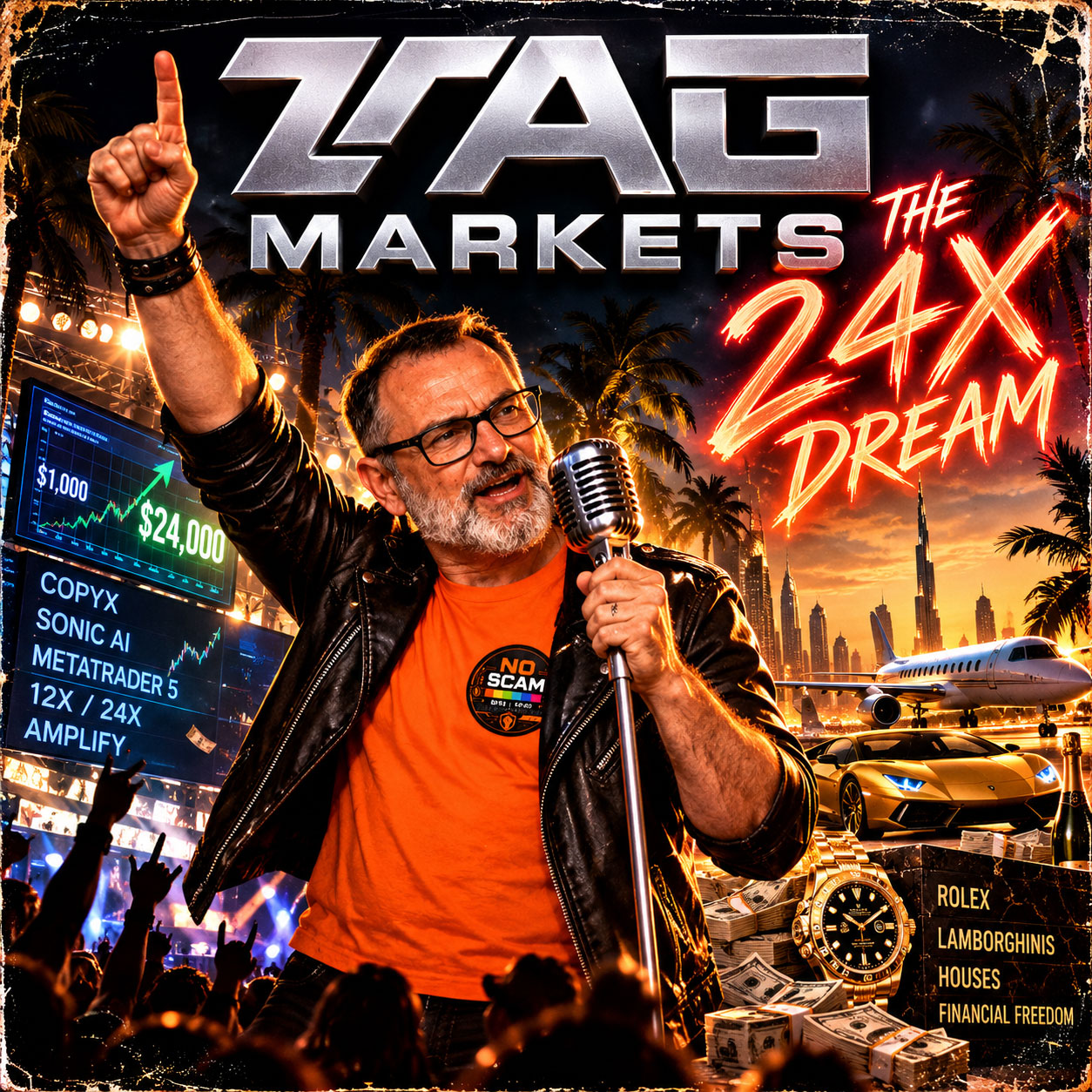
After following TAG Markets through Sonic AI, CopyX, Amplify, XFusion, JetUp, Zeus, BIX and the affiliate networks surrounding them, I am left with a strange mixture of things I can prove, things TAG itself claims, and things nobody has adequately explained yet.
I can establish that T.M. Financials Ltd presents itself as the Mauritius-regulated entity behind TAG Markets. I can establish that 12X and 24X Amplify are being marketed as providing substantially greater trading capacity than the customer’s original deposit. I can establish that Sonic, Neo FX and other strategies are being promoted through TAG-related infrastructure, and that multi-level affiliate compensation and extraordinary lifestyle incentives appear throughout this ecosystem. I also have evidence of TAG, BIX and CopyX being promoted together at an in-person event in the United States.
What I cannot yet independently establish is just as important.
I still don’t know who ultimately owns TAG Markets, who Freihofer’s unnamed founding partner is, or precisely how the Pure North Markets licence history resulted in T.M. Financials displaying the same licence number. I don’t know whether the extra $23,000 represented by a $1,000 customer’s 24X account is actual third-party money, credit, margin or notional trading capacity. TAG has not explained to me exactly what it has “effectively borrowed,” why Freihofer says approximately six weeks are required to recover that money, or whose capital ultimately absorbs an amplified-account loss.
I also haven’t been shown independent evidence demonstrating the enormous scale claims made around TAG — including hundreds of billions of dollars in monthly trading volume, nine figures associated with Sonic, eight figures in affiliate commissions or the extraordinary customer and support numbers described by Freihofer.
Some of these questions could be remarkably easy to resolve.
TAG has already offered potential access to information concerning its liquidity providers, banking and payment arrangements. I accepted that offer in principle and asked for the proposed framework. TAG has also referred my product questions to its Head of Product.
And the Mauritius licence question may soon have an answer from the regulator itself.
So I’m not closing this investigation by declaring that every allegation made about TAG Markets has been proven. It hasn’t. Nor am I prepared to treat spectacular marketing claims as established facts simply because they are repeated often enough in presentations, Telegram groups or glossy articles.
What I am saying is much simpler.
When a financial ecosystem asks ordinary people to deposit real money, multiplies their apparent trading capacity by as much as 24 times, restricts access to their principal, pays commissions through extensive affiliate networks and promotes extraordinary trading performance, the burden should not be on investors to guess how the machinery works.
TAG Markets has had the questions. Now it has the opportunity to provide the evidence.
Disclaimer: How This Investigation Was Conducted
This investigation relies entirely on OSINT — Open Source Intelligence — meaning every claim made here is based on publicly available records, archived web pages, corporate filings, domain data, social media activity, and open blockchain transactions. No private data, hacking, or unlawful access methods were used. OSINT is a powerful and ethical tool for exposing scams without violating privacy laws or overstepping legal boundaries.
About the Author
I’m DANNY DE HEK, a New Zealand–based YouTuber, investigative journalist, and OSINT researcher. I name and shame individuals promoting or marketing fraudulent schemes through my YOUTUBE CHANNEL. Every video I produce exposes the people behind scams, Ponzi schemes, and MLM frauds — holding them accountable in public.
My PODCAST is an extension of that work. It’s distributed across 18 major platforms — including Apple Podcasts, Spotify, Amazon Music, YouTube, and iHeartRadio — so when scammers try to hide, my content follows them everywhere. If you prefer listening to my investigations instead of watching, you’ll find them on every major podcast service.
You can BOOK ME for private consultations or SPEAKING ENGAGEMENTS, where I share first-hand experience from years of exposing large-scale fraud and helping victims recover.
“Stop losing your future to financial parasites. Subscribe. Expose. Protect.”
My work exposing crypto fraud has been featured in:
- Coffeezilla 2026): Featured in the investigation exposing the alleged $328M Goliath Ventures Ponzi scheme
- Bloomberg Documentary (2025): A 20-minute exposé on Ponzi schemes and crypto card fraud
- News.com.au (2025): Profiled as one of the leading scam-busters in Australasia
- OpIndia (2025): Cited for uncovering Pakistani software houses linked to drug trafficking, visa scams, and global financial fraud
- The Press / Stuff.co.nz (2023): Successfully defeated $3.85M gag lawsuit; court ruled it was a vexatious attempt to silence whistleblowing
- The Guardian Australia (2023): National warning on crypto MLMs affecting Aussie families
- ABC News Australia (2023): Investigation into Blockchain Global and its collapse
- The New York Times (2022): A full two-page feature on dismantling HyperVerse and its global network
- Radio New Zealand (2022): “The Kiwi YouTuber Taking Down Crypto Scammers From His Christchurch Home”
- Otago Daily Times (2022): A profile on my investigative work and the impact of crypto fraud in New Zealand





Leave A Comment