


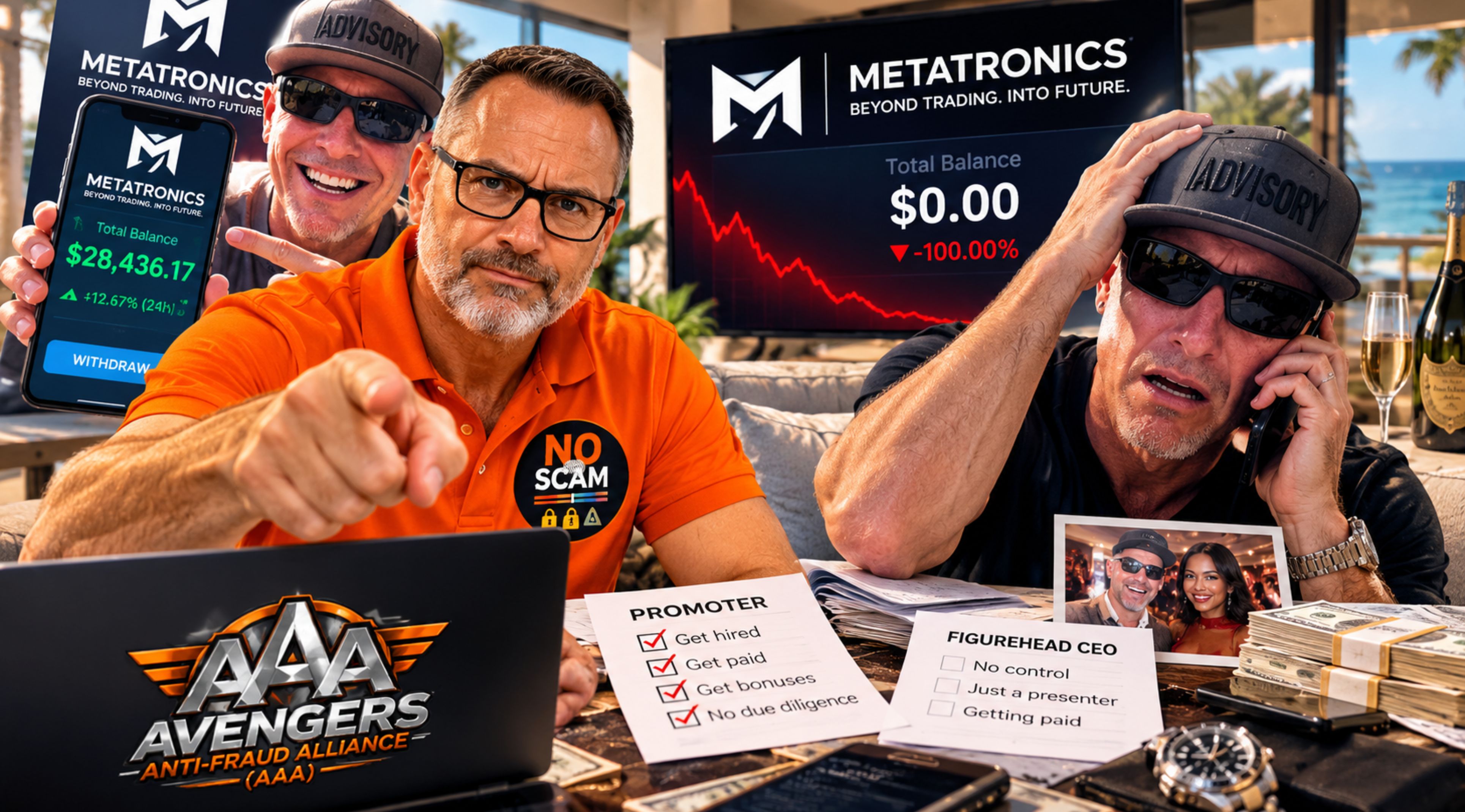
“I get hired to sell this stuff. I get paid to sell this stuff. I get bonuses to sell this stuff.” — Jan Gregory
I have investigated METATRONICS from the outside for months. I examined the extraordinary AI-trading claims, the supposed returns, the corporate structure, the people promoting it and the increasingly troubling reports from investors struggling to withdraw their money.
I contacted people involved, reached out to more than 1,400 METATRONICS users, collected documents and transaction records, and worked with members of the Avengers Anti-Fraud Alliance to follow the evidence wherever it led.
Then something happened I wasn’t expecting.
Jan Gregory called me.
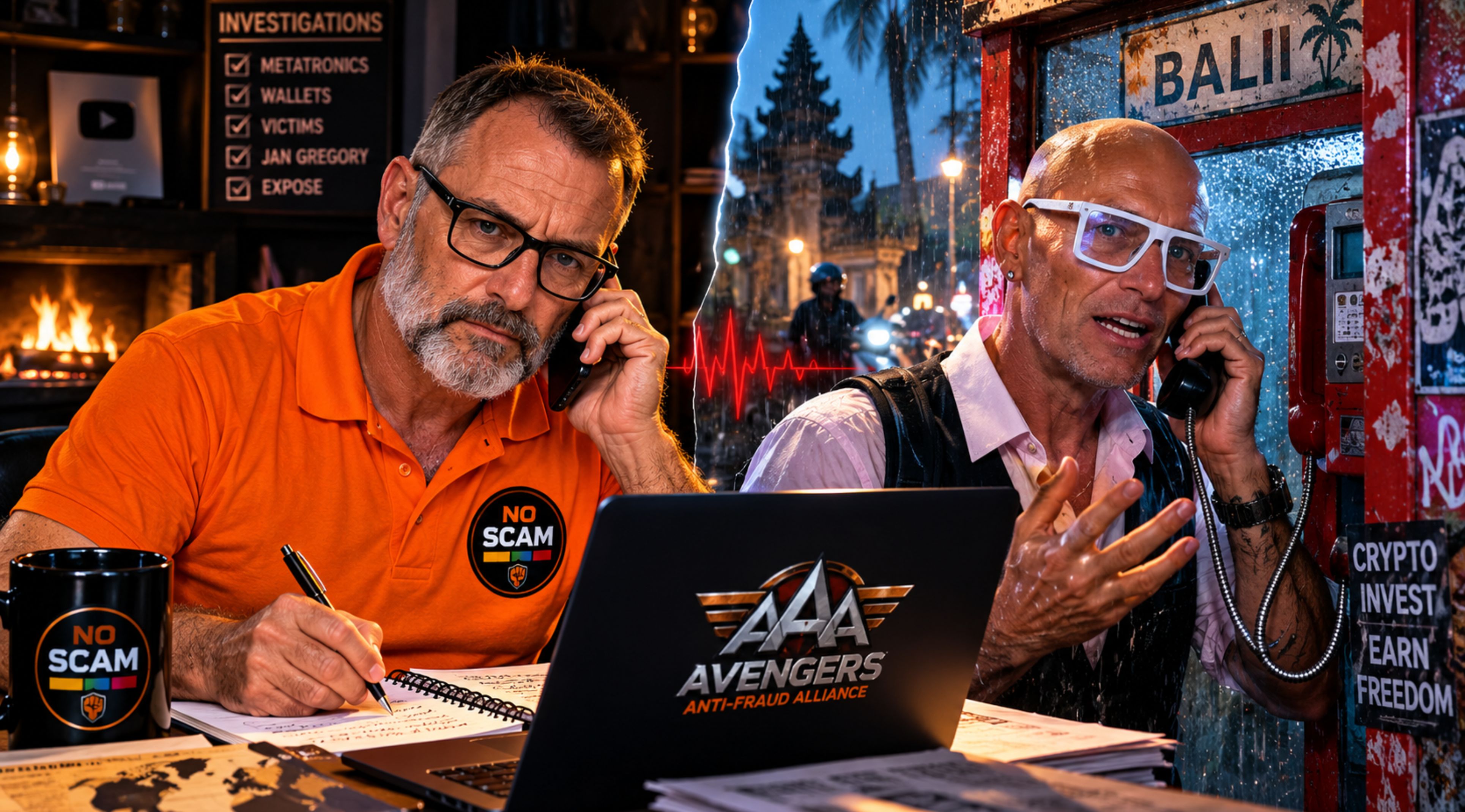 For more than 50 Minutes, the man who had spent months promoting METATRONICS spoke openly with me about what had happened behind the scenes. Gregory had presented himself as the platform’s Global Ambassador, publicly displayed what he described as trading profits and encouraged others to participate. Now he was telling me that he believed he had been scammed himself. More importantly, he made a series of admissions about his role as a paid promoter and what he says he did — and did not — verify before putting his name behind METATRONICS.
Then I spoke to the other public face of the operation.
Bradley Peak had been presented to investors as the CEO of METATRONICS. I had already watched him sit alongside Gregory in promotional interviews discussing the platform, its trading and its withdrawals with the authority you would expect from a chief executive. But during my own conversation with Peak, lasting more than 40 minutes, a remarkably different picture emerged. Peak described himself as essentially a public-facing figurehead: an English-speaking presenter working with people behind the project, appearing on Zoom calls, translating information, producing content and receiving payments for work he performed.
Suddenly I wasn’t investigating METATRONICS solely through websites, promotional videos and disgruntled investors. Two of the people who had helped give this operation credibility were explaining their roles to me in their own words.
That changed this investigation.
What follows is not based on one angry investor or an anonymous Telegram post. It draws on recorded conversations, promotional videos, internal material, cryptocurrency transactions, corporate records, trading reports, messages from people involved with METATRONICS and first-hand accounts from participants around the world. We also brought in independent blockchain expertise to examine where cryptocurrency actually moved.
Some of the people involved now blame each other. Some say they were deceived. Others maintain that legitimate trading existed. Those competing stories matter, but they are no longer the whole story.
Because once you put what these people were telling investors beside what they later told me, METATRONICS begins to look very different indeed.
How METATRONICS Sold The Illusion
METATRONICS did not present itself as another high-risk crypto opportunity asking people to throw money into an unknown wallet and hope for the best. It presented itself as a sophisticated AI-powered trading operation supposedly using high-frequency trading, hedging, trend strategies and arbitrage to generate consistent returns. Its marketing claimed more than 169,000 users, millions of dollars under management, a 98.7% success rate, withdrawals processed in under three hours and more than 300 days without incidents. Elsewhere, promotional material went even further, advertising +226.7% annual returns, 12 consecutive profitable months and more than 1,000 models supposedly working every one to three seconds.
For an ordinary investor, the presentation was deliberately simple. You could enter with as little as a few dollars, use the METATRONICS Telegram application, deposit cryptocurrency and watch what appeared to be trading income accumulating inside your account. The marketing repeatedly emphasised accessibility and liquidity: “Withdraw anytime”, “no locks” and, in some promotions, same-day withdrawals. Behind that apparent simplicity sat all the language people have come to associate with institutional trading — algorithms, AI models, risk management, OTC transactions, automated strategies and trading reports.
There was also a powerful recruitment machine underneath it. METATRONICS encouraged users to build structures, with referral rewards extending through multiple levels. Internal material I obtained showed a cashback system in which a genuine top-up by a recruit could generate rewards of 10% for the first upline, 5% for the second and 3% for the third. Those rewards remained frozen for 30 days and could be reduced or wiped out if the person who deposited withdrew early. In other words, the person who introduced you had a financial reason for your money to remain inside the system.
Then there were the people giving the operation credibility.
METATRONICS had Bradley Peak presented publicly as its CEO and Jan Gregory operating as its Global Ambassador. Gregory appeared in promotional material, ran campaigns offering enormous deposit boosts and publicly documented what he presented as his own experience earning and withdrawing money. Peak appeared in interviews explaining how the technology supposedly worked and discussing withdrawals and trading reports. To someone watching from the outside, these weren’t anonymous usernames hiding behind a Telegram bot. They were identifiable people putting their faces and reputations alongside the platform.
That mattered because the numbers METATRONICS displayed were extraordinary. Claims of consistent double-digit monthly performance and a 226.7% annual return require extraordinary evidence. Yet when I began digging beneath the presentation, the evidence supporting those claims was far less impressive than the marketing surrounding them.
The glossy dashboard was the easy part.
The real question was whether there was genuine trading behind the numbers investors were watching on their screens.
Jan Gregory: From Global Ambassador To “I Got Scammed”
Jan Gregory was not standing on the sidelines watching METATRONICS develop. He was actively selling the story. In the promotional material I preserved, Gregory was introduced as METATRONICS’ Global Ambassador and ran campaigns encouraging people to deposit money, build teams and take advantage of limited-time bonuses. His own YouTube thumbnails documented the journey: Day 7 showed “$200K METATRONICS ALGOTRADES PAYS OUT”; Day 39 advertised “$840 TODAY!”; Day 61 showed “$1,300 Today’s Earnings — PAID IN USDT”; and by Day 70 the message was still “Automated Trading — Real Results — A Brighter Tomorrow.”
On 11 July, Gregory interviewed Bradley Peak in a video presented as an opportunity to establish whether METATRONICS was legitimate. Gregory said he had put approximately $200,000 into the platform and was making and withdrawing around $1,000 a day. He described the software as straightforward and transparent and told Peak exactly what his role was supposed to be: “My job is to come in as a global ambassador and make this thing a household name. I’m going to make Metatronics famous, bro.” He also acknowledged being partially responsible for the platform’s growth. This wasn’t somebody quietly testing an opportunity with his own money. Gregory’s personal results were themselves part of the sales pitch.
Then METATRONICS began falling apart, and Gregory’s story changed dramatically.
When he eventually called me, we spoke for more than 50 minutes. Gregory told me he had actually put around $211,000 into METATRONICS and believed he and his family had been scammed. But one admission from that conversation cut straight through the usual excuses promoters make when an opportunity collapses. Gregory openly explained the commercial relationship he has with these companies: “I get hired to sell this stuff, I get paid to sell this stuff, I get bonuses to sell this stuff.”
There is nothing ambiguous about that statement. Gregory was describing himself as a paid promoter. The important question, therefore, becomes what he verified before using his reputation, audience and personal results to encourage other people to trust METATRONICS.
His answer creates one of the biggest contradictions in this entire investigation.
Gregory told me that he repeatedly asked the people behind METATRONICS to demonstrate the trading. He says he wanted blockchain results, dashboards, software, exchange information and evidence showing where the returns were actually coming from. In his later public denunciation of METATRONICS, he was even more direct: “Never ever showed me any proof… zero.”
Yet throughout the period in which he says that proof was missing, Gregory continued promoting what he described publicly as algorithmic trading returns.
That distinction matters. Gregory may genuinely believe today that he was deceived. He may also have lost a substantial amount of his own money; his claimed losses require their own supporting records. But losing money does not erase the promotional conduct that came before it. If a promoter is being paid and bonused to sell an investment opportunity, while simultaneously unable to verify the mechanism supposedly generating the returns, that is information prospective participants deserved to know before they deposited their cryptocurrency.
Gregory eventually reached essentially the same conclusion himself. Speaking after the collapse, he said he would never again believe claims of real trading until he could see it with his own eyes.
The problem is that this lesson appears to have arrived after he had already spent weeks convincing everybody else.
Bradley Peak: The CEO Who Says He Was Just The Face
If Jan Gregory’s explanation raised questions about the people promoting METATRONICS, my conversation with Bradley Peak raised an even more fundamental one: who was actually running the company?
Peak had been presented publicly as the CEO. On 11 July, Gregory interviewed him as the man at the top of METATRONICS. Peak spoke about withdrawals, the platform’s technology and trading reports, including the proposition that earnings could be verified using blockchain explorers. Gregory called him his “favourite CEO” and a “mastermind.” To anybody watching that interview, there was little reason to think Peak was merely an actor reading information supplied by somebody else.
By September, Peak was describing his position very differently.
I spoke with him for more than 40 minutes and continued communicating with him privately as he began questioning what was happening inside METATRONICS. Peak told me the people behind the project had originally asked him to become “the face of the project.” His explanation was that the people operating it were Russian speakers who needed somebody who could communicate publicly in English. Peak speaks Russian, so he says he became useful as a presenter and translator. He described doing scripted Zoom presentations, filming academy material, briefly managing social media and communicating updates from the people he regarded as the founders.
Eventually he used an even more extraordinary description himself: “figurehead CEO.”
Peak publicly resigned from METATRONICS and explained that while he had been the face of the company, he had “no control over any company operations whatsoever.” He also distanced himself from the biography METATRONICS had published about him, saying he was not responsible for what had been written on the company’s website. By that stage he told me he had become sufficiently concerned about how METATRONICS supposedly generated revenue that he had started demanding evidence from the people behind it.
The internal messages he provided support at least part of that account. Peak was asking other people to show him the trading mechanism, executed trades, technical evidence for the bots and algorithms, revenue documentation, deposits, withdrawals, liabilities, assets, legal structure and the identities of the people controlling user funds. He said he would stop producing promotional material while that verification was taking place.
Think about what that means.
The man presented to investors as the CEO was asking other people to explain to him how the company made its money and who controlled its funds.
Peak was not working for free. In our communications he acknowledged receiving contractor payments and described different work he performed for METATRONICS. That does not establish that he controlled investor funds or operated the trading system, and I have found no evidence that he did. But it does establish something important about the façade presented to the public: the title CEO conveyed a level of executive authority that Peak himself now says he never possessed.
His resignation therefore did more than remove a name from the METATRONICS website. It exposed a hole in the company’s public structure.
If Bradley Peak was only the English-speaking face, translator and paid contractor he now says he was, the real decision-makers were somewhere behind him.
So Who Was Actually Running METATRONICS?
Once Bradley Peak told me he had been the “figurehead CEO”, the organisational chart presented to the public became almost meaningless. A chief executive would normally be expected to understand how the business generated revenue, who controlled its assets and who had authority over withdrawals. Peak was instead asking those questions himself. In messages he provided, he referred to meeting the “founders” for due diligence only after Jan Gregory began raising concerns, and said they showed him what he described as trading contracts, bots and market-maker agreements.
Several names repeatedly surfaced as I worked backwards through the material. Vinor Zukhubaia became particularly important. Peak provided communications and documents that he said came through Vinor, including material offered to him as evidence of trading. One document purported to be a US$350,000 agreement between Nimbus Capital Group SA in Panama and MSQUARED FINTECH SOLUTIONS s.r.o. in the Czech Republic, represented in the document by Vinor Zukhubaia. It described an OTC purchase of VIRTUAL tokens at a 22% discount, paid in USDT. A contract on a screen, however, is not proof that US$350,000 changed hands or that the tokens were subsequently delivered. Those are events that should leave financial and, depending on the transaction, blockchain records.
Another document passed to Peak was presented as evidence of trading in PENGU. It claimed US$50,000 had produced US$23,602 in realised, unrealised and futures profits — a remarkable 47% return. Again, what I was looking at was a report describing trades, not the underlying exchange records proving those trades occurred. There is a fundamental difference between a document saying a position was opened and independently verifiable evidence showing the order, account, execution and settlement.
Other names emerged through the internal conversations. Shah, who described himself to me as an ambassador representing Eastern Europe and Russia, said his structure contained more than 20,000 people and acknowledged earning referral fees generated by people his organisation brought in. In communications supplied during the investigation, he described substantial activity involving OTC transactions and market-maker trading, while saying only a smaller component involved bots and algorithms. That description deserves attention because METATRONICS had been marketed around sophisticated automated and AI-driven trading.
I also obtained material connecting Valentyna Stasovska, publicly using the name “META WOMAN,” to METATRONICS promotion through its Telegram application. Other names, including people identified as being involved with trading, technology or the setting of returns, appeared throughout the information supplied by insiders. Some of the allegations surrounding those individuals remain exactly that — allegations — and I am not going to turn somebody else’s accusation into a proven fact simply because the company was coming apart.
What I can establish is that the public-facing CEO was not the person Peak says was exercising operational control. He was receiving information from others, presenting it to the community and, when he finally became sufficiently concerned, asking those same people to prove to him that the underlying business was real.
That left me with a much more useful question than who had the word “CEO” underneath their photograph.
Who controlled the money, the trading, the withdrawals and the numbers investors were seeing inside METATRONICS?
The Trading Story Starts Falling Apart
METATRONICS did not market itself as a company experimenting with a few speculative crypto trades. It sold the idea of a sophisticated technological engine: AI, high-frequency trading, more than 1,000 models operating every one to three seconds, multiple strategies and a claimed annual return of 226.7%. Its marketing even boasted of 12 profitable months out of 12 and described the performance as “No hype — only what the engine has actually done.”
If those claims were genuine, there should have been an enormous amount of evidence behind them.
Instead, I obtained METATRONICS trading reports containing impressive-looking tables of assets, entry and exit prices, volumes, operations and profits. One report covering 1–7 July 2026 claimed US$5.6 million under management, 224 operations and US$156,808.65 in net profit. Another covering 8–12 July claimed another 156 operations. Across those two reports alone, METATRONICS was presenting 380 purported trading operations.
What was missing was more important than what was printed on the pages.
There were no exchange account identifiers, order IDs, trade IDs, wallet addresses or transaction hashes that would allow me to independently connect those tables to the trades they supposedly represented. Some DOGE, SHIB and PEPE transactions even displayed entry and exit prices as 0.0000 while simultaneously reporting precise volumes and profits. These were reports about trading; they were not independently verifiable proof that the trading had occurred.
That becomes particularly uncomfortable when placed beside Bradley Peak’s July interview. As the supposed CEO, Peak told viewers that weekly trading reports could be downloaded and that earnings could be verified using blockchain explorers. But when concerns later erupted, Peak himself began asking internally for the underlying evidence: executed trades, the trading mechanism, technical information about the bots and algorithms, and proper financial accounting.
Then another allegation emerged from inside the operation that goes directly to the numbers investors were watching.
I was told that the daily ROI displayed to users was manually selected, generally somewhere between approximately 0.1% and 1%, rather than being automatically produced by genuine algorithmic trading performance. The person identified to me in connection with setting those figures was “Grisha.” I have not independently established that allegation, so I will not present it as fact. But it matters because METATRONICS had previously explained even its occasional 0% days as evidence of sophisticated risk management. If returns were being manually entered, that entire explanation would take on a very different meaning.
There was another mechanism I could establish from internal documentation. METATRONICS had built a referral cashback system around real deposits. When somebody topped up their account, three uplines could receive 10%, 5% and 3% respectively. Those rewards remained frozen for 30 days. If the depositor withdrew half of their money, the corresponding cashback was reduced; if they withdrew everything, the cashback could disappear.
That created a straightforward financial incentive: the recruiter benefited when the recruit left their money inside METATRONICS.
None of this, standing alone, proves that every number displayed by METATRONICS was fabricated. But by this stage of my investigation I had trading reports that did not independently verify the trading, a supposed CEO who later went looking for the underlying proof himself, a paid Global Ambassador who told me he had never been shown satisfactory proof, and an internal compensation system rewarding people when recruits kept their deposits inside the platform.
Then the issue stopped being theoretical.
People started trying to get their money out.
Then The Withdrawals Started Going Wrong
For months, liquidity had been part of the METATRONICS sales pitch. Promotional material told users “Withdraw anytime” and “No locks.” Jan Gregory reinforced that confidence by publicly documenting what he described as his own regular withdrawals. If somebody could supposedly put hundreds of thousands of dollars into an automated trading system and pull profits out whenever they wanted, it made the opportunity appear considerably safer than locking cryptocurrency into an unknown platform.
Then the messages began changing.
METATRONICS acknowledged that some users were experiencing “longer-than-usual withdrawal processing times,” attributing this to account reviews, additional AML checks and increased volume. Later came a technical-maintenance announcement saying access to user accounts was being restored and reassuring members that their funds remained securely recorded “under our control.” That wording was difficult to ignore after earlier marketing had emphasised user control and non-custodial characteristics.
The screenshots arriving during my investigation showed what those delays looked like from the user’s side. One METATRONICS account displayed two withdrawals dated 17 September — $10,317.59 and $22,458.02, a combined $32,775.61 — both marked “Withdrawal Pending.” On the same screen, the platform was still crediting $24 as “Trading Income.” That screenshot establishes what was displayed on that particular account at that moment; it does not establish that every METATRONICS user had the same experience or that those withdrawals were never subsequently paid.
But it wasn’t the only account I heard from.
I contacted approximately 1,400 people connected with METATRONICS, asking them to tell me what had happened and, where possible, provide transaction information rather than rumours. The responses were mixed. Some people were hostile towards my investigation. Others defended METATRONICS. And then there were people who described money they could see inside the platform but were struggling to withdraw.
As part of that evidence gathering, I also obtained a spreadsheet titled “Metatronics Canadian Branch External Withdrawals,” dated 21 September 2026. Rather than simply describe that material and expect readers to take my word for it, I am making the Excel file available with this investigation so researchers, participants and other investigators can examine the underlying data themselves.
DOWNLOAD THE EVIDENCE: Metatronics Canadian Branch External Withdrawals — 21 September 2026 (.xlsx)
 The spreadsheet should be treated for what it is: a source document supplied during this investigation, not independent proof that every entry represents a completed blockchain withdrawal. Where transaction records can be independently checked against the blockchain, that verification needs to be done separately. I am publishing the file because transparency matters, and because the underlying evidence should be available for scrutiny rather than hidden behind my interpretation of it.
Mohammed Choonawala told me he had been unable to withdraw since 14 September and supplied a wallet address and screenshots relating to pending and cancelled withdrawals. Another detailed statement came from Nigeria. That participant said he had been introduced through a person called Alive from Uganda and was told leaders could receive $1,000 for trading after introducing approximately 50 people. He described a team that eventually grew beyond 2,000 people. Returns initially appeared to work, he said, but when his displayed balance reached roughly $20,000, withdrawals began failing.
These accounts don’t magically prove every allegation made about METATRONICS. They do something more useful: they allow us to compare the company’s promises with the experiences of identifiable participants willing to provide supporting material.
And while users were trying to understand what was happening to their withdrawals, the people who had helped sell METATRONICS were beginning to turn on each other.
Jan Gregory was about to go from Global Ambassador to one of the company’s loudest accusers.
Everybody Starts Blaming Everybody Else
By mid-September, Jan Gregory was no longer selling METATRONICS. He was publicly calling it a scam.
In a video titled “Metatronics is a SCAM its OVER!! Get out before the Ship Sinks”, Gregory told the same community he had spent weeks encouraging that the operation was finished. He alleged withdrawals had been switched off, developers had gone unpaid and money arriving from his community had been used to satisfy withdrawal obligations owed to earlier participants. During our recorded conversation, he described the mechanism in even simpler terms: if genuine trading was not producing enough money to meet withdrawals, new deposits could be used to pay earlier participants — “robbing Peter to pay Paul.” He described METATRONICS as a “Ponzi engine.”
Those are serious allegations, and Gregory’s explanation of the mechanics should not be confused with proof that METATRONICS actually operated exactly as he describes. Establishing that requires financial records and tracing the cryptocurrency. But there was an extraordinary irony in hearing Gregory explain how such a scheme works after he had spent weeks helping bring new money and new participants into the same platform.
METATRONICS responded by turning on Gregory.
The company announced that it had terminated him, accused him of repeatedly spreading false information and claimed that more than $100,000 in company funds had been transferred to Gregory for distribution to people within his structure but had not reached the intended recipients. METATRONICS said affected accounts were being reviewed and reconciled. I have not independently established that Gregory misappropriated those funds, so the $100,000 claim remains exactly what it is: an allegation made by METATRONICS against its former Global Ambassador.
Then other leaders joined the fight. Shah, who told me he represented Eastern Europe and Russia and had a structure exceeding 20,000 people, alleged that Gregory had demanded substantial money and a large salary and had resorted to blackmail when other leaders opposed him. Gregory, meanwhile, accused people behind METATRONICS of lying to him, fabricating evidence and operating a scam. Again, these accusations cannot simply be promoted from allegation to fact because one side says them loudly enough.
Bradley Peak found himself caught in the middle. He told me Gregory’s concerns initially frightened him enough to start conducting his own due diligence. Peak says the people he regarded as the founders then showed him contracts and other material intended to demonstrate genuine trading activity, while also presenting their case that Gregory was attacking or blackmailing them. Peak initially considered staying. Days later, after continuing to investigate and consulting others, he resigned as METATRONICS’ “figurehead CEO” with immediate effect, saying he could not verify certain marketing claims or establish enough evidence either way to remain comfortable.
By this stage, the public structure of METATRONICS was disintegrating in front of its investors. Its Global Ambassador was calling it a scam. The company was accusing that ambassador of misconduct. Other leaders were accusing him of blackmail. And the man advertised as CEO was saying he had never controlled the operation and was walking away because he could not adequately verify what was happening behind it.
I wasn’t interested in choosing which of these people told the most convincing story.
There was a better way to test at least part of what they were telling me: follow the cryptocurrency.
Follow The Money

Once the competing stories started piling up, the Avengers Anti-Fraud Alliance brought in blockchain investigator Crypto G to examine the cryptocurrency trail independently. The objective was simple: stop relying on what METATRONICS, Jan Gregory, Bradley Peak or anybody else said was happening and see what could actually be established on-chain.
That work produced useful findings, but it also demonstrated why cryptocurrency investigations need to be handled carefully. A blockchain can show that cryptocurrency moved from one address to another. It can establish amounts, dates and transaction histories. What it cannot automatically tell you is who was sitting behind an exchange account, why a payment was made or what somebody intended when they made it.
The Investigation identified wallets associated in the evidence with the METATRONICS operation and followed payments into centralised exchanges and other destinations. Some transactions were consistent with payments described during our interviews and correspondence. Other activity helped us understand how cryptocurrency entering parts of the network was being moved, converted or off-ramped. Importantly, the analysis did not establish that every wallet encountered belonged personally to Bradley Peak, Jan Gregory or any other individual simply because their names appeared elsewhere in the investigation.
That distinction is important because blockchain analysis can easily be overstated. I am not going to publish private financial information, identify an exchange account holder without evidence, or turn an investigative lead into an accusation. Crypto G also supplied the AAA with restricted forensic material specifically for investigative purposes, and I am respecting that restriction.
What the blockchain work did give us was another independent layer of evidence to compare against the documents, interviews and promotional claims we had already collected. It confirmed that there were real cryptocurrency movements behind parts of the operation. What it did not suddenly reveal was the missing foundation of the METATRONICS sales pitch: independently verifiable evidence that a sophisticated AI trading operation was generating the returns displayed to investors.
And that is perhaps the most revealing outcome of following the money.
After months of claims about artificial intelligence, high-frequency trading, algorithms and extraordinary performance, the central mystery was never whether cryptocurrency was moving.
It was what was actually generating the money METATRONICS told its users they were earning.
Jan Gregory Has Already Moved On
Perhaps the most revealing part of this investigation is what happened after METATRONICS began imploding.
Jan Gregory did not disappear from the crypto opportunity world. He moved on.

While METATRONICS participants were still trying to understand pending withdrawals, conflicting announcements and accusations flying between former leaders, Gregory began promoting OxusTech — another crypto opportunity making extraordinary financial claims. Its presentation advertises autonomous arbitrage agents supposedly trading prediction markets including Polymarket, with claimed daily returns ranging from approximately 0.45% to 0.75%.
And once again, there is a recruitment structure wrapped around the investment proposition: firstline and downline rewards, a Trust Bonus, pools, 17 ranks, a Global Leader Pool and multiple advertised income streams.
That matters because of what Gregory told me during our conversation about his profession. He wasn’t vague about it. “I get hired to sell this stuff, I get paid to sell this stuff, I get bonuses to sell this stuff.” METATRONICS was therefore not simply an unfortunate investment he stumbled across. Promoting these opportunities is something Gregory himself describes as work.
There is also important regulatory history here. The Alberta Securities Commission previously found that Jan Gregory Cerato, also known as Jan Strzepka, illegally distributed securities through WhaleClub. He was ordered to pay a $40,000 administrative penalty and $125,000 in costs, with market-access bans imposed for at least eight years or until the amounts required by the order are paid.
During this investigation, I contacted the Alberta Securities Commission directly and provided information concerning my current communications with Gregory. On 25 September 2026, ASC Intelligence Analyst confirmed to me that Gregory has paid none of the amount owing to the ASC, is evading payment of that debt, and the matter is not under appeal. The Commission also confirmed that it remains interested in information that could assist with collecting the amount owing, including his address and whereabouts, as well as information indicating possible ongoing capital-market misconduct.
None of that automatically tells us what OxusTech will become, and that investigation is only beginning. But Gregory’s rapid transition from METATRONICS to another opportunity is relevant when assessing the wider pattern documented here.
 METATRONICS promised sophisticated AI trading, remarkable returns and easy access to people’s money. Jan Gregory promoted those claims while showing his audience what he described as his own successful results. Bradley Peak appeared publicly as CEO while later telling me he was really a “figurehead” without operational control. When the operation began coming apart, Gregory said he had never been shown satisfactory proof of the trading, Peak began demanding evidence himself, withdrawals became problematic for participants who contacted me, and the people around the operation started accusing each other.
That is the evidence this investigation leaves behind.
The lesson isn’t that investors should become better at choosing which charismatic promoter, polished dashboard or impressive-looking trading report to believe. It is much simpler.
Before anybody is trusted with your cryptocurrency, make them prove what they claim is happening with it.
Not screenshots. Not a CEO interview. Not numbers appearing inside a Telegram app. Not somebody showing you that they successfully withdrew yesterday.
If a company claims artificial intelligence and high-frequency trading are generating extraordinary returns, there should be independent evidence capable of demonstrating that trading actually exists.
METATRONICS had plenty of people willing to sell the story. What it never gave me was independently verifiable proof that the story was true.
Disclaimer: How This Investigation Was Conducted
This investigation relies entirely on OSINT — Open Source Intelligence — meaning every claim made here is based on publicly available records, archived web pages, corporate filings, domain data, social media activity, and open blockchain transactions. No private data, hacking, or unlawful access methods were used. OSINT is a powerful and ethical tool for exposing scams without violating privacy laws or overstepping legal boundaries.
About the Author
I’m DANNY DE HEK, a New Zealand–based YouTuber, investigative journalist, and OSINT researcher. I name and shame individuals promoting or marketing fraudulent schemes through my YOUTUBE CHANNEL. Every video I produce exposes the people behind scams, Ponzi schemes, and MLM frauds — holding them accountable in public.
My PODCAST is an extension of that work. It’s distributed across 18 major platforms — including Apple Podcasts, Spotify, Amazon Music, YouTube, and iHeartRadio — so when scammers try to hide, my content follows them everywhere. If you prefer listening to my investigations instead of watching, you’ll find them on every major podcast service.
You can BOOK ME for private consultations or SPEAKING ENGAGEMENTS, where I share first-hand experience from years of exposing large-scale fraud and helping victims recover.
“Stop losing your future to financial parasites. Subscribe. Expose. Protect.”
My work exposing crypto fraud has been featured in:
- Coffeezilla 2026): Featured in the investigation exposing the alleged $328M Goliath Ventures Ponzi scheme
- Bloomberg Documentary (2025): A 20-minute exposé on Ponzi schemes and crypto card fraud
- News.com.au (2025): Profiled as one of the leading scam-busters in Australasia
- OpIndia (2025): Cited for uncovering Pakistani software houses linked to drug trafficking, visa scams, and global financial fraud
- The Press / Stuff.co.nz (2023): Successfully defeated $3.85M gag lawsuit; court ruled it was a vexatious attempt to silence whistleblowing
- The Guardian Australia (2023): National warning on crypto MLMs affecting Aussie families
- ABC News Australia (2023): Investigation into Blockchain Global and its collapse
- The New York Times (2022): A full two-page feature on dismantling HyperVerse and its global network
- Radio New Zealand (2022): “The Kiwi YouTuber Taking Down Crypto Scammers From His Christchurch Home”
- Otago Daily Times (2022): A profile on my investigative work and the impact of crypto fraud in New Zealand





Leave A Comment