



“Scammers don’t just sell investments. They sell confidence, credibility, and the illusion that someone else has already done the hard work for you.”
For years I’ve watched the same formula repeat itself under different names. The branding becomes more sophisticated, the websites become more polished, the legal disclaimers become longer, and the marketing becomes more convincing.
Yet beneath the professional appearance, many of these opportunities rely on remarkably familiar promises: artificial intelligence, automated trading, passive income, complete transparency, and the claim that anyone can participate with almost no experience.
METATRONICS is the latest platform to emerge using that formula, and after spending days examining its website, legal documents, promotional material, public statements, company records, and the people promoting it, I believe there are serious questions every prospective investor should ask before depositing a single dollar.
 My interest in METATRONICS wasn’t accidental. The investigation began after I discovered that Jan Gregory had started enthusiastically promoting the platform to his audience. Long-time readers of this website will recognise that name immediately. Gregory has spent years promoting one collapsed crypto investment platform after another, including CoinMarketBull, CloudFi, Vortic United, Maxpread Technologies and several others. California regulators have previously named him in multiple enforcement actions connected to Securities Violations, while Canada’s Alberta Securities Commission fined him for securities fraud before he relocated overseas. When someone with that documented history suddenly begins promoting another AI-powered trading platform, experience tells me it’s worth paying very close attention.
What followed was one of the most comprehensive investigations I’ve undertaken into a newly launched opportunity. I examined every page of the METATRONICS website, downloaded its presentations, reviewed its legal documentation, analysed its company registration, investigated its claimed headquarters in Hong Kong, researched its publicly identified CEO Bradley Peak, reviewed hours of promotional content, compared the marketing with previous collapsed schemes, and looked closely at what is being promised versus what is actually being disclosed in the fine print. Along the way I found a platform that has invested heavily in appearances, transparency messaging, and sophisticated branding—but also one that raises a growing list of important questions that deserve careful examination.
This investigation is not about attacking cryptocurrency or algorithmic trading. Legitimate automated trading firms exist, just as legitimate fintech companies exist. Instead, this investigation asks a much simpler question: does the evidence support the marketing? Throughout this article I’ll walk you through exactly what I found, what can be independently verified, what remains unsupported, and why experienced scam investigators recognise patterns that newer investors often overlook. By the time you’ve reached the end, you’ll have the evidence needed to make your own informed decision.
Why Jan Gregory Immediately Caught My Attention
If there was one reason this investigation moved to the top of my list, it was Jan Gregory.
I’ve spent years documenting cryptocurrency investment schemes that promised passive income through automated trading, artificial intelligence, arbitrage, copy trading and other supposedly revolutionary technologies. While every platform has its own branding, one thing rarely changes—the promoters. Certain individuals appear time and time again, enthusiastically introducing what they describe as “the next big opportunity” before quietly moving on to the next platform when the previous one collapses. Jan Gregory has become one of the most recognisable names in that cycle.
Gregory’s history is well documented. In August 2023, California’s Department of Financial Protection and Innovation (DFPI) issued multiple enforcement actions naming him in connection with CoinMarketBull, CloudFi and Vortic United. According to the regulator, those companies were offering unqualified securities through high-yield cryptocurrency investment programs while promoting unrealistic returns to investors. CoinMarketBull advertised returns of up to 1.8% per day, while CloudFi promoted daily returns of 1.25%. Regulators concluded that investors were being offered securities in violation of California law, and Gregory himself was named in the respective enforcement orders.
His regulatory history extends beyond the United States. The Alberta Securities Commission in Canada previously sanctioned Gregory, ordering him to pay approximately CAD $165,000 after finding he had breached Alberta securities laws. The Commission noted that Gregory accepted little responsibility for his conduct and instead blamed others while showing contempt toward those harmed by his actions. Those findings were published well before METATRONICS ever appeared.
What makes this history particularly relevant is that Gregory hasn’t distanced himself from these failed ventures. Instead, he has continued promoting one investment platform after another. Following the collapse of CoinMarketBull, he quickly moved to InvesableAI, describing it publicly as a replacement. Since then, his promotional activity has continued across numerous crypto opportunities, each presented with remarkably similar language about automation, artificial intelligence, passive income and financial freedom.
That brings us to METATRONICS. Within hours of the platform launching its latest marketing campaign, Gregory was already producing enthusiastic YouTube videos encouraging viewers to join his own investment journey. In one recent video he showcased withdrawals, discussed his growing returns and promoted the platform’s AI trading system as though it represented another exciting opportunity. For experienced investigators, that alone doesn’t prove anything about METATRONICS itself—but it does provide a compelling reason to examine every claim with far greater scrutiny than glossy marketing materials might otherwise receive.
What Is METATRONICS?
At first glance, METATRONICS presents itself as exactly the kind of platform many cryptocurrency investors have been searching for. Rather than asking users to learn technical analysis, monitor charts or actively trade volatile markets, it promises something far simpler. Deposit your funds, connect to its Telegram Mini App, and allow its artificial intelligence to trade on your behalf. According to the company, the system automatically allocates capital across multiple algorithmic strategies, manages risk, executes trades around the clock and allows users to withdraw whenever they choose.
The platform describes itself as an AI-powered algorithmic cryptocurrency trading ecosystem, claiming more than 169,000 users, approximately US$6.13 million under management, operations across more than 45 countries, a 98.7% successful trade rate, and an average withdrawal time of less than three hours. Visitors are told the platform operates continuously using four independent trading strategies—including hedging, trend trading, arbitrage and high-frequency trading—with artificial intelligence constantly redistributing capital to maximise performance while limiting risk. Everything is presented through an attractive website filled with polished graphics, real-time counters and language designed to inspire confidence.
Perhaps the most appealing aspect of METATRONICS is how little effort it claims users need to make. There is no previous trading experience required, no complicated exchange accounts to manage, and no technical knowledge expected. Investors simply fund their account using USDT, Telegram Stars or other supported payment methods, transfer those funds into the trading balance, and the system supposedly handles everything else automatically. The website repeatedly reinforces the message that users no longer need to compete with professional traders because sophisticated algorithms are now doing the work on their behalf.
To strengthen that message, METATRONICS emphasises accessibility at every opportunity. Deposits can reportedly begin from as little as US$5, registration is completed through Telegram, and the company prominently advertises “No KYC,” “Unlimited Withdrawals,” and “Your Capital Always Stays Under Your Control.” These are powerful selling points, particularly for newcomers who may have been intimidated by traditional trading platforms or frustrated by exchanges that require extensive identity verification before allowing withdrawals.
On the surface, it is an impressive presentation. The branding is modern, the marketing feels professional, the educational content is extensive, and unlike many anonymous crypto projects, METATRONICS even introduces a public-facing CEO in Bradley Peak. For many potential investors, those factors alone may be enough to create confidence. However, as I’ve learned from investigating hundreds of investment opportunities over the years, a professional website is not evidence of a professional investment operation. The real test comes when you begin comparing the marketing claims with the underlying documents, company records and independently verifiable evidence. That’s where this investigation started to become far more interesting.
The First Red Flag: The Story Doesn’t Quite Add Up
One of the first things I do when investigating any investment opportunity is put the marketing to one side and start building a timeline. When was the company incorporated? When did the domain first appear? Who are the people behind it? When did they become involved? Most legitimate businesses can answer those questions with a straightforward, consistent history. With METATRONICS, however, the timeline quickly became far less clear.
The company behind the platform is VIENNA HOLDING LIMITED, a Hong Kong entity incorporated in December 2025. That immediately raised my attention because METATRONICS simultaneously presents itself as an established ecosystem with a long operating history. Throughout its website, the company refers to having more than 24 months of operating history, more than 300 days without incidents, and a mature platform that has supposedly been through multiple development phases before reaching its current stage. Those claims deserve careful scrutiny because they don’t sit comfortably alongside a company that appears to have only recently been incorporated.
Adding to the confusion is the platform’s own roadmap. According to METATRONICS, the project’s technological foundation, Telegram Mini App and first users were established during Phase I, which concluded in late 2025. Phase II supposedly introduced greater transparency, expanded reporting and a growing user base before the platform entered its current scaling phase. Yet elsewhere the company suggests the system has been operating for more than two years. Without identifying an earlier legal entity or predecessor company, those timelines are difficult to reconcile.
I also searched for historical evidence of the platform’s online presence. Surprisingly, the Wayback Machine contains no archived history for the METATRONICS website. While the absence of archived pages doesn’t prove anything by itself, it does remove one of the easiest ways to independently verify how long a company has been operating and how its claims have evolved over time. Established technology companies typically leave a digital trail through archived websites, announcements and earlier versions of their platforms. In this case, that trail is remarkably thin.
At this stage I wasn’t concluding that anything improper had occurred. New companies are launched every day, and websites don’t always get archived immediately. But when a business promotes itself as an experienced, mature operation while the publicly available corporate history appears relatively recent, that’s exactly the sort of inconsistency I believe deserves closer examination. As the investigation continued, I found that this wasn’t the only place where the public marketing and the underlying evidence seemed to tell different stories.
The Company Behind METATRONICS
METATRONICS identifies VIENNA HOLDING LIMITED as the company behind the platform. Its website lists the entity at 7/F MW Tower, 111 Bonham Strand, Sheung Wan, Hong Kong, under business registration number 79324768. On paper, that gives the operation a legal name, a registration number and a respectable commercial address. For many investors, that is enough to create the impression that a substantial Hong Kong fintech business sits behind the website.
I paid to obtain a business record search because Hong Kong company information is not always easy to access. The result was surprisingly thin. The report identifies VIENNA HOLDING LIMITED as a corporation established in 2025, but it lists no revenue, no employees, no key principal, no telephone number, no social-media presence and no active import or export activity. It also provides no leadership details and no evidence of a substantial operating business attached to the entity.
That does not prove the company is fraudulent. Many newly incorporated companies have little public information, particularly if they operate online. However, it matters when the same entity is presented as the operator of a platform claiming more than 169,000 users, over US$6 million in capital under management, 24-hour trading infrastructure, more than 20 AI trading agents, a global education business and activity across dozens of countries. The scale of the marketing and the scale of the visible corporate footprint appear very different.
The address also deserves context. MW Tower is a genuine commercial building, but the seventh-floor address is used by numerous unrelated companies as a registered office or correspondence address. That is legal and common in Hong Kong, where company secretaries and virtual-office providers offer registration services to overseas businesses. It does mean, however, that the address alone tells us very little about whether METATRONICS has an actual operational team, trading desk or technical infrastructure physically located there.
The careful conclusion is not that METATRONICS uses a fake address. It is that the Hong Kong registration provides far less evidence of substance than the website presentation may lead investors to believe. A company certificate proves incorporation. It does not prove trading activity, financial licensing, audited performance, staff, custody arrangements or the existence of the infrastructure being advertised.
How The METATRONICS Model Actually Works
Once I moved beyond the branding, the basic mechanics of METATRONICS became much clearer. This is not simply a software subscription where users connect their own exchange account and retain direct control over every trade. The official presentation describes METATRONICS as a deposit-based model designed for both passive participants and active partners. Passive participants are encouraged to deposit funds and earn from AI-driven trading activity, while active partners are encouraged to build teams and earn from referrals and performance bonuses.
The user journey is deliberately simple. Open the Telegram Mini App, fund the available balance, move money into the trading balance, and allow the system to allocate that capital across its strategies. Users are not choosing individual trades, products or algorithms. METATRONICS’ own legal terms state that capital allocation is performed automatically by the platform and that the user accepts its full discretion over those decisions. That matters because it moves the arrangement well beyond an informational trading tool. The platform is effectively deciding how deposited capital is deployed while presenting the resulting balance and returns through its own internal interface.
The company says its system operates across more than 20 exchanges using four principal strategies: high-frequency trading, hedging, trend trading and arbitrage. Its marketing describes a rebalancing process where capital is redistributed automatically depending on market conditions. Yet the platform does not publicly identify the exchanges, provide independent account statements, disclose the exact trading entities or show a verifiable separation between participant deposits and company-controlled funds. The website talks extensively about transparency, but the most important parts of the money flow remain hidden.
This distinction is critical. If a user keeps funds in an exchange account held in their own name and grants a restricted trading API permission, that can genuinely be described as non-custodial automation. If users transfer USDT into a pooled balance controlled by METATRONICS and later request withdrawals from the platform, that is a very different arrangement. The website appears to use both descriptions at once, claiming that capital remains in the user’s wallet while also admitting that funds are stored in a secure pool and returned upon request. That contradiction sits at the heart of the entire operation.
The Returns Being Advertised
METATRONICS repeatedly attempts to distance itself from the idea that it is guaranteeing profits. Its website includes risk warnings stating that returns are not guaranteed and that cryptocurrency trading can result in partial or complete loss. Yet those disclaimers sit alongside highly specific performance claims designed to persuade people that the system regularly produces substantial passive income.
The official pitch deck advertises a baseline monthly return of 4% or more, an average target of approximately 12%, and peak months reaching 20%. It presents those figures in a section titled “How Much Can Users Make?” and describes the range as the expected yield from its passive model. On the website, METATRONICS also claims a 98.7% successful trade rate, more than 300 days without incidents, strict drawdown limits and real-time performance tracking. None of those figures has been independently audited in the material I reviewed.
Jan Gregory goes even further in his own promotion. He tells viewers that METATRONICS has been delivering returns in the 15% to 20% monthly range, describes those returns as sustainable, and gives examples of earning 1% in a single day. He claims that a $100,000 balance can produce $1,000 on a 1% day and says the platform has recorded days of 1.1%, 1.2% and even 1.7%. He also claims to have deposited $200,000 and earned $6,800 during his first seven days. Those figures are displayed inside the platform’s own interface, but the video does not prove that the returns came from external trading rather than internal account credits or incoming participant deposits.
The mathematics alone should make any investor pause. A consistent 12% monthly return would more than triple capital in a year if compounded. A regular 1% daily return would produce results that no legitimate fund manager could describe as ordinary or low risk. Extraordinary performance is not impossible for short periods, but extraordinary claims require extraordinary evidence. In this case, the evidence currently consists of internal dashboards, company-generated statistics and promotional withdrawal videos.
METATRONICS says its profits can be verified through published trading reports and on-chain records. However, the table included in its own presentation is explicitly labelled “demonstration data.” That is not proof of real trading. A genuine verification package would include identifiable exchange accounts, read-only access, complete trade histories, realized and unrealized losses, fees, leverage, wallet movements and a reconciliation showing that trading profits—not later deposits—fund participant withdrawals. Until that evidence is produced, the advertised performance remains a marketing claim.
Meet The Public Face: Bradley Peak
 Unlike many cryptocurrency investment platforms that hide behind anonymous founders or stock photographs, METATRONICS has chosen to put a real person front and centre. That person is Bradley Peak, who is presented throughout the website as the company’s founder and Chief Executive Officer. His biography is prominently featured, he appears in promotional videos, participates in interviews, and has an established LinkedIn Profile documenting several years of professional activity in the cryptocurrency industry. On the surface, this level of transparency appears refreshing. After investigating countless schemes fronted by actors or completely fictional executives, finding a genuine individual willing to publicly represent the platform initially seemed like a positive sign.
Peak’s background is certainly more substantial than many crypto executives I’ve researched. He holds an MPhil in Theoretical and Applied Linguistics from the University of Cambridge and a Bachelor of Arts in Classics and Classical Languages from King’s College London. Before joining METATRONICS, he built a career around cryptocurrency journalism, research, business development and marketing. His LinkedIn profile documents roles with Sumsub, a respected identity verification and compliance company, as well as work with Cointelegraph, BeInCrypto, CoinsPaid and other Web3 businesses. His digital footprint stretches back years, includes videos, conference appearances and published articles, and appears entirely genuine.
However, as I compared Bradley Peak’s own published career history with the biography presented on the METATRONICS website, I began noticing significant differences. The company describes him as the former Head of Product at Sumsub, claiming that under his leadership the platform expanded to 24 million users across more than 220 countries. His LinkedIn profile tells a different story. It lists his positions at Sumsub as Sales Negotiator followed by Regional Sales Manager and Media Host. His profile also proudly mentions that the educational videos he hosted accumulated more than 24 million views, but it does not claim he personally led the company’s product strategy or scaled its global user base. Those are two very different achievements.
The discrepancies don’t stop there. METATRONICS repeatedly refers to Bradley Peak as having more than 12 years of fintech and digital product experience, a career spanning institutional market technology, and expertise building algorithmic trading systems. Yet his publicly available résumé is dominated by communications, journalism, sales, consulting and business development rather than quantitative trading, software engineering or fund management. There is nothing inherently wrong with that background—in fact, it’s an impressive career in its own right—but it is not the same career being described on the METATRONICS website. When a company begins embellishing the qualifications of its own CEO, it inevitably raises an important question: if investors are expected to trust the platform with their money, why exaggerate the credentials that are already publicly available?
A Founder Who Appears To Have Arrived Late
The timeline surrounding Bradley Peak’s role creates another problem. His LinkedIn profile lists him as Chief Executive Officer of METATRONICS from March 2026, yet the company presents him as its founder and simultaneously claims the platform has operated for more than 24 months. METATRONICS also says it had working infrastructure, first users and active trading cycles before the end of 2025. If Peak only became CEO in March 2026, then who created the platform, who operated it before his arrival, and who was responsible for accepting deposits during that earlier period?
There are several possible explanations. Peak may have been involved privately before updating his LinkedIn profile. He may have joined an existing platform and later been presented as the founder. He may be the public-facing executive for a business controlled by other people. Or the claimed operating history may simply be exaggerated. The problem is that METATRONICS provides no clear answer. The website repeatedly refers to a fully doxxed founding team, yet the rest of that team remains unidentified. Instead, investors are given anonymous headcounts—developers, traders and infrastructure specialists—without names, biographies, employment histories or qualifications.
That lack of transparency matters because Peak appears to be the only identifiable person carrying the platform’s public credibility. His face, Cambridge education, media experience and established LinkedIn profile are used to reassure potential investors that METATRONICS is different from the anonymous Telegram schemes that have come before it. Yet when the company’s history is examined closely, the person described as founder appears publicly connected only after the platform supposedly had already been operating for a significant period.
Peak’s established background also creates a particularly uncomfortable contradiction around compliance. He previously worked for Sumsub, a company specialising in KYC, AML and identity verification. He should therefore understand better than most why customer identification, sanctions screening and source-of-funds checks matter. METATRONICS, however, prominently advertises “No KYC” while accepting cryptocurrency deposits through Telegram and promoting itself globally. The legal terms later reserve the right to demand verification and freeze accounts if users refuse, but the public sales pitch uses the absence of verification as a benefit.
A genuine CEO does create accountability, but only if that person answers the difficult questions. Bradley Peak now needs to explain when he first became involved, whether he owns or controls VIENNA HOLDING LIMITED, who the other founders are, what trading systems he personally verified, and why the biography published under his name differs so substantially from his own professional record. Until those questions are answered, his public identity gives METATRONICS a face—but not the independent evidence needed to validate the business behind it.
The Man Promoting METATRONICS

While Bradley Peak gives METATRONICS a polished corporate face, Jan Gregory gives it access to the exact audience most likely to respond to promises of passive crypto income. Gregory is not presenting himself as a casual user. In his own words, he is the Global Brand Ambassador for METATRONICS, and his recent YouTube videos show him actively recruiting viewers, directing them to his referral link, explaining the affiliate structure and demonstrating what he claims are daily withdrawals from a $200,000 account.
In one video published only hours before I reviewed it, Gregory described METATRONICS as “ROI on autopilot” and told viewers that passive income was arriving every day while the software did the work. He claimed he had earned more in one week than many people earn in an entire month, then asked his audience whether they would rather go to work or “kick their feet back” while METATRONICS generated returns. He repeatedly encouraged viewers to use his link, accept the free $20 account credit, deposit $100 to activate the affiliate system and begin earning from both the trading side and the recruitment side.
Gregory also claimed the platform had 167,000 active members, operated across more than 20 exchanges and had been delivering monthly returns in the region of 15% to 20%. He described those returns as sustainable, said the platform often produced 1% days and showed an internal account balance that he said represented a personal $200,000 deposit. According to his own figures, the account had generated $6,800 over seven days. He then submitted a $600 withdrawal request while telling viewers that earlier withdrawals had arrived within minutes.
The problem is not simply that Gregory is enthusiastic. It is that his marketing language closely resembles the language used in previous crypto investment schemes linked to him. Passive income, AI trading, sustainable returns, fast withdrawals, referral commissions, low risk and social proof through selected payments are not new themes in his promotional history. They are the same themes regulators have already documented in connection with other platforms he helped promote. That history makes his role in METATRONICS impossible to treat as a minor detail.
Jan Gregory Has Been Here Before
One of the biggest mistakes investors make is looking at each new opportunity in isolation. They see a polished website, a persuasive presentation and a charismatic promoter, but they never stop to ask a simple question: what was that promoter saying about the last opportunity? That’s why history matters. It provides context that marketing deliberately leaves out.
 Jan Gregory’s history isn’t based on internet rumours or anonymous accusations. It has been documented by regulators. In 2023, California’s Department of Financial Protection and Innovation (DFPI) issued enforcement actions against CloudFi, CoinMarketBull and Vortic United, naming Gregory in connection with each of those operations. The regulator stated that these companies were soliciting funds from investors to purportedly trade cryptocurrency on their behalf while offering what it described as unqualified securities. In CloudFi’s case, Gregory was identified as the company’s Chief Executive Officer, while CoinMarketBull described him as its Global Leader and Corporate Brand Manager, and Vortic United listed him as Chief Marketing Officer.
The similarities between those earlier platforms and METATRONICS are difficult to ignore. Each promoted automated or professionally managed cryptocurrency trading. Each promised attractive passive returns while minimising the need for investors to understand the underlying markets. Each encouraged deposits in cryptocurrency, rewarded recruitment through referral commissions, and relied heavily on social media and online presentations to build confidence. While that alone does not prove METATRONICS operates the same way, it establishes a pattern that any reasonable investor should take seriously.
Perhaps the most significant finding came from the CloudFi enforcement order. California regulators concluded that CloudFi had failed to disclose that a significant portion of investor funds was being used to pay purported returns to other investors in the manner of a Ponzi scheme. That finding did not come from bloggers or critics—it came from a financial regulator after reviewing the evidence available to it. Gregory has denied wrongdoing in relation to various matters over the years, but the documented regulatory history remains part of the public record.
This is precisely why I believe Jan Gregory’s involvement deserves far more attention than it currently receives. If METATRONICS genuinely represents a completely different kind of business with independently verifiable trading, audited performance and sustainable external revenue, then its management should have anticipated that appointing Gregory as a Global Brand Ambassador would invite scrutiny. His track record means prospective investors are entitled to ask tougher questions, demand stronger evidence and expect a much higher level of transparency before accepting the platform’s claims at face value.

The Fine Print Few Investors Will Ever Read
One of the first things I do after reviewing the marketing material is download the Terms and Conditions. In my experience, the legal documents often tell a very different story from the sales presentation. Marketing is designed to attract deposits. Contracts are designed to protect the company. The real question is whether the two tell the same story. In the case of METATRONICS, they don’t.
The website repeatedly tells visitors they can withdraw anytime, that no KYC is required, that their capital remains under their control, and that the platform offers a transparent, automated investment experience. Those are powerful selling points. They create the impression that users remain firmly in control while the artificial intelligence simply performs the trading. However, once I started reading the legal terms, those reassuring promises quickly became far more qualified.
One of the most significant clauses appears in Article 3.3, where METATRONICS states that capital allocation is performed automatically by the Platform and that the user agrees to the full discretion of those decisions. That is an important admission. The platform isn’t simply providing software for users to operate themselves—it is deciding how deposited capital is allocated across its own trading strategies. That sits uneasily beside other parts of the website describing the service as merely informational or educational.
The withdrawal provisions are equally revealing. While the homepage advertises “Unlimited Withdrawals”, the Terms explain that withdrawals may be delayed or restricted because of technical limitations, security procedures, legal requirements, internal reviews, or any other circumstances determined by the Platform at its own discretion. The company also makes it clear that it does not guarantee processing times. Those qualifications fundamentally change the meaning of the marketing. Saying users can withdraw at any time is very different from saying the company can delay or restrict withdrawals whenever it considers it appropriate.
Another contradiction involves identity verification. METATRONICS prominently promotes “No KYC” as one of its competitive advantages, yet later in the Terms it reserves the right to request identification whenever transaction limits are exceeded, suspicious activity is detected or regulators require it. If a user refuses to comply, the Platform may restrict functions, suspend operations or block the account entirely. In other words, “No KYC” doesn’t actually mean KYC will never be required—it simply means the company decides when it becomes necessary.
Perhaps the most extraordinary clause appears in the limitation of liability section. METATRONICS attempts to limit its total legal responsibility to the lesser of the amount paid during the previous 30 days or just €100. Think about that for a moment. The platform encourages users to deposit significant amounts of cryptocurrency, with promoters discussing six-figure balances and substantial passive income. Yet if something goes seriously wrong, the company appears to be attempting to cap its legal liability at one hundred euros. Whether such a clause would ultimately be enforceable in every jurisdiction is another matter, but its inclusion tells investors a great deal about where the company believes the risk should sit.
The Terms continue in the same vein. METATRONICS reserves the right to change its conditions without notice, suspend or terminate accounts, discontinue the service altogether, determine which country’s laws apply to disputes, choose the jurisdiction where disputes must be heard, and even interpret its own Terms if disagreements arise. Individually, some of these provisions are common in online agreements. Taken together, however, they paint a very different picture from the simple, investor-friendly marketing presented on the homepage. The glossy website promises certainty, accessibility and control. The legal contract gives METATRONICS remarkably broad powers while significantly limiting the protections available to its users.
Transparency Or The Appearance Of Transparency?
Throughout the METATRONICS website, one word appears again and again: transparency.
The company says it has nothing to hide. It advertises real-time statistics, live dashboards, bi-weekly income reports, transparent trading logic and blockchain verification. It repeatedly contrasts itself with anonymous crypto projects by claiming that investors can independently verify what is happening behind the scenes. For anyone who has spent time investigating investment schemes, those are exactly the kinds of claims that deserve to be tested rather than simply accepted.
The first thing I noticed is that nearly all of the impressive numbers displayed throughout the website originate from METATRONICS’ own internal systems. User numbers, assets under management, successful trade percentages, withdrawal times and trading statistics are all presented as live data generated by the platform itself. That is not the same thing as independent verification. An internal dashboard can only ever tell visitors what the company chooses to display. Without access to the underlying exchange accounts, trading records and blockchain movements supporting those figures, investors are being asked to trust the platform’s own reporting.
The company also places significant emphasis on publishing trading reports and encouraging users to compare them against blockchain records. On the surface, that sounds reassuring. However, after reviewing the available material, I found no independently audited performance reports, no read-only exchange access, no third-party accounting verification and no complete reconciliation showing that reported profits originated from external market trading rather than internal accounting entries. Demonstration screenshots and selected trade examples may be useful marketing material, but they are not substitutes for independent financial verification.
Even the language surrounding custody creates confusion. In one part of the website, METATRONICS assures users that their capital always remains under their control. Elsewhere it explains that funds are held within a secure pool, that withdrawals are processed by the Platform, and that capital is automatically allocated across its own trading strategies. Those statements cannot all mean the same thing. If investors genuinely retain custody of their own assets, there should be no need for withdrawal requests or company-controlled processing. If funds are transferred into a platform-controlled trading pool, then the arrangement is fundamentally different from the non-custodial model repeatedly highlighted in the marketing.
This distinction matters because transparency is not measured by the number of statistics displayed on a homepage. It is measured by how easily independent people can verify those statistics without relying on the company making the claims. Genuine transparency means opening the books, not simply opening a dashboard. At this stage of my investigation, I found plenty of polished presentations, impressive-looking metrics and carefully designed interfaces—but very little independently verifiable evidence supporting the extraordinary performance being promoted.
The Questions METATRONICS Still Needs To Answer
By this point in the investigation, I wasn’t looking for more marketing material. I’d already read the website, watched the videos, downloaded the presentations, reviewed the legal documents, investigated the company registration and examined the backgrounds of the people publicly associated with the platform. What I was looking for was independent evidence capable of answering the obvious questions that naturally arise when a company asks the public to trust it with their money. Despite the polished presentation, many of those questions remain unanswered.
The first concerns the trading itself. METATRONICS says artificial intelligence trades across more than twenty exchanges using multiple strategies that generate consistent returns for participants. If that is true, demonstrating it should not be difficult. Where are the independently verifiable exchange accounts? Where are the complete trade histories? Where are the realised profit and loss statements? Which exchanges are being used? Who executes the trades? Who audits the performance? So far, investors are being asked to accept screenshots, internal dashboards and company-produced reports instead of independently verifiable trading records.
The second question concerns custody. Throughout the website, METATRONICS repeatedly assures users that their capital remains under their control, yet the legal terms explain that deposits and withdrawals are processed through the Platform, capital allocation is controlled by the Platform, and withdrawals may be delayed or restricted at its discretion. Those statements are difficult to reconcile. If the company genuinely operates a non-custodial model, it should clearly explain where participant funds are held, who controls the wallets, who holds the private keys, and precisely how users retain control throughout the trading process.
Corporate transparency also remains incomplete. The website states that the founding team is fully doxxed, yet Bradley Peak is the only senior individual prominently identified. Investors still do not know the identities of the developers responsible for the trading system, the traders overseeing the strategies, the infrastructure engineers maintaining the platform or the shareholders behind VIENNA HOLDING LIMITED. For a business claiming to manage millions of dollars on behalf of more than 169,000 users, those are not unreasonable questions—they are basic due diligence.
Finally, there is the question of accountability. Why appoint Jan Gregory as a Global Brand Ambassador despite his well-documented regulatory history? Was that history considered before the appointment? Did METATRONICS conduct due diligence on the people representing the company? If the platform genuinely believes it offers something fundamentally different from the investment schemes Gregory has promoted in the past, then management should welcome those questions rather than avoid them. Transparency is demonstrated most clearly when difficult questions receive clear answers, not when impressive marketing encourages investors to stop asking them.
The METATRONICS Trust Center
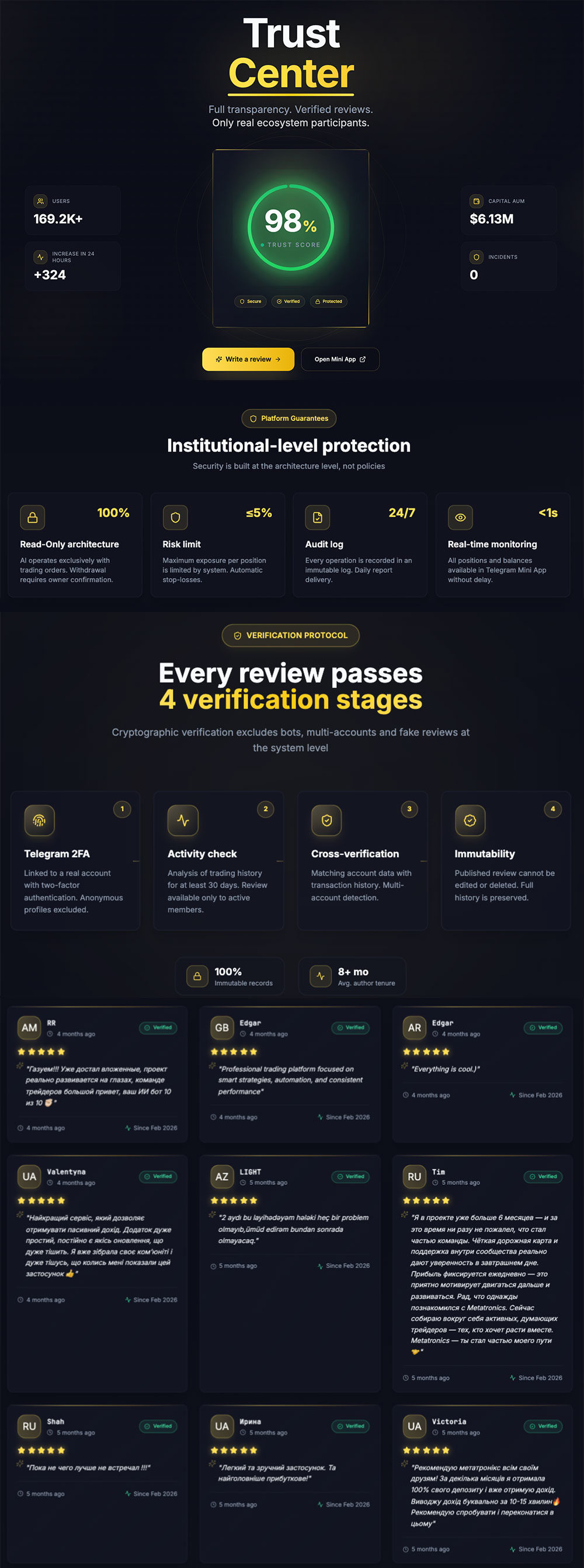 METATRONICS has gone a step further than most platforms by creating its own internal Trust Center. On that page, the company awards itself a 98% trust score, labels the platform secure, verified and protected, claims zero incidents, and describes its safeguards as institutional-grade. At first glance, it looks like an independent review or audit page. It isn’t. The Trust Center is created, controlled and populated by METATRONICS itself.
The company says every review passes four stages of verification, including Telegram authentication, trading-history checks, cross-verification and immutable publication. Yet no independent auditor, cryptographic proof, external review provider or publicly testable verification process is identified. METATRONICS is effectively asking investors to trust its assurance that the reviews are genuine because METATRONICS says it has verified them. That is not independent validation. It is self-certification presented in the language of technical assurance.
The review distribution is also unusually perfect. The page displays 42 five-star reviews, 12 four-star reviews and no reviews rated three stars or lower. Several names appear more than once, many of the English-language reviews use remarkably similar phrases, and some participation dates conflict with the words written by the reviewers themselves. One person claims to have joined in August 2025 while the page labels the same reviewer as being active only since February 2026. Another claims involvement since July 2025, again beneath metadata that suggests a later start.
METATRONICS also claims an average reviewer tenure of more than eight months, despite many visible accounts being marked as joining in January or February 2026. As of July 2026, those dates do not produce an eight-month average without a substantial number of earlier participants—and the website does not show enough supporting detail to explain the calculation. Once again, the platform supplies a confident statistic without giving outsiders the evidence required to reproduce it.
None of this proves every review is false. Some users may genuinely be receiving withdrawals and may sincerely believe the platform is performing exactly as advertised. Early payments are often the most powerful marketing tool in any high-yield investment operation. The concern is that METATRONICS presents an internally curated review system as though it were independent proof. A company reviewing, verifying and awarding a trust score to itself is not transparency. It is marketing dressed as due diligence.
Absolutely. I think this deserves its own section because it materially strengthens your investigation, but I’d be careful not to simply repeat Oz’s review. Instead, use it to show independent corroboration. One of the strongest things in investigative journalism is when two investigators working independently reach similar conclusions.
I’d place this immediately before “My Final Assessment.”
Independent Investigation Reaches Similar Conclusions
Since publishing my own investigation, BehindMLM founder Oz has also published an Independent Review of METATRONICS. While our investigations were conducted separately and from different perspectives, it is noteworthy how many of the same concerns emerged.
Oz’s investigation traces the public history of METATRONICS back to early 2026, pointing out that the project’s own social media timeline appears inconsistent with later claims that the business had already been operating for a full year. He also highlights that the Wayback Machine contains no historical archive of the current website prior to its recent launch, something I also encountered while researching the platform.
His review also examines the backgrounds of the two most recognisable public figures behind the project. Like my investigation, Oz questions the role of Bradley Peak, noting that although he appears to be a genuine individual with a legitimate professional history, his public emergence as CEO occurred months after METATRONICS had already begun promoting itself through Telegram. Oz also revisits the long history of Jan Gregory, documenting his promotion of multiple cryptocurrency investment schemes that later attracted regulatory action or collapsed, including BitHarvest, CoinMarketBull, Vortic United, CloudFi, SureX and MaxSpread Technologies.
One area where Oz’s investigation goes further than mine is the compensation structure. His review identifies what he describes as a traditional MLM recruitment model, complete with referral commissions, rank advancement based on investment volume, matching bonuses and incentive rewards tied to recruiting new investors. Those findings reinforce why I paid particular attention to Jan Gregory’s involvement. Although METATRONICS presents itself as an AI trading platform, the existence of a structured multi-level marketing compensation plan significantly changes the risk profile for prospective participants.
Oz also notes several additional observations that deserve attention, including METATRONICS’ use of Telegram as its primary operating platform, references to Yandex Metrica analytics on the website, and what he believes are similarities between METATRONICS and previous Russian-linked AI trading and Telegram-based investment schemes. Some of these observations remain matters of interpretation rather than established fact, but they contribute additional avenues for further investigation.
Perhaps the most important point is that two independent investigations, conducted using different sources and methodologies, identified many of the same unanswered questions. Neither investigation proves that METATRONICS is operating fraudulently. However, both conclude that investors are being asked to place considerable trust in claims that have yet to be independently verified. That alone should encourage anyone considering investing to slow down, ask difficult questions and demand evidence before committing their money.
I have linked Oz’s review as an additional resource for readers who wish to compare both investigations and reach their own conclusions.
My Final Assessment
After spending days investigating METATRONICS, I still haven’t reached the point where I can say the platform has proven its claims. Quite the opposite. The deeper I looked, the more I found a carefully constructed marketing machine built around confidence, simplicity and trust, but supported by surprisingly little independently verifiable evidence.
To be absolutely clear, I am not saying METATRONICS is a Ponzi scheme. I do not have evidence proving that investor withdrawals are being funded by new deposits rather than legitimate trading profits. That would require access to information that simply isn’t available publicly. What I am saying is that the company is asking people to trust an extraordinary number of claims without providing the level of independent verification those claims deserve.
Investors are being asked to believe that more than 169,000 users have entrusted over US$6 million to an AI-driven trading platform operated by a recently incorporated Hong Kong company with a remarkably limited public corporate footprint. They are being asked to accept claims of institutional-grade trading, hedge fund-level technology, more than twenty AI trading agents and consistently attractive monthly returns based largely on company-generated dashboards, internal statistics and promotional videos. At the same time, the legal terms reserve sweeping powers for the company while significantly limiting the protections available to its users.
The involvement of Jan Gregory cannot simply be dismissed as irrelevant background. His history of promoting cryptocurrency investment schemes that later attracted regulatory action means his endorsement should encourage investors to become more cautious, not less. Likewise, Bradley Peak appears to be a genuine individual with an established professional history, but the biography presented on the METATRONICS website contains several claims that do not comfortably align with his own published career record. Neither of those facts proves wrongdoing, but together they reinforce the need for much greater scrutiny.
Could METATRONICS genuinely be operating profitable algorithmic trading strategies? It’s possible. Could early users be receiving genuine withdrawals funded by successful trading? That’s also possible. But possibility is not proof, and history has taught us an important lesson: early withdrawals do not validate an investment model. Numerous investment schemes have paid participants successfully for months before eventually collapsing when liabilities overtook incoming deposits or the underlying business model failed. That is precisely why experienced investigators look beyond withdrawal screenshots and ask the harder question: where is the money actually coming from?
If METATRONICS wants to distinguish itself from the long list of AI trading platforms that came before it, the path is straightforward. Publish independently verifiable exchange accounts. Commission recognised third-party audits. Identify the complete founding team. Explain the corporate structure in detail. Clarify exactly how custody works. Reconcile the inconsistencies between the website, the legal terms and the public biographies. Most importantly, provide independently verifiable evidence that participant returns are being generated through genuine external trading activity rather than simply reported through internal dashboards.
After reviewing every piece of publicly available evidence I could obtain, I have reached one clear conclusion: I cannot recommend that anyone invest in METATRONICS. Throughout this investigation I’ve documented inconsistencies between the company’s marketing and its legal terms, unanswered questions surrounding its corporate structure, contradictory claims about its history, and a complete absence of independently verifiable evidence proving that the advertised returns are being generated through genuine external trading. Add to that the decision to appoint Jan Gregory—a promoter with a documented regulatory history involving multiple failed crypto investment schemes—as one of the public faces of the platform, and I believe any sensible investor should be asking far more questions than METATRONICS currently answers. The burden of proof does not sit with journalists, critics or prospective investors. It sits squarely with the company asking people to trust it with their hard-earned money. Until METATRONICS provides that proof through independent, verifiable evidence rather than polished marketing, I see no reason why anyone should risk a single dollar on this platform.
I’ll continue monitoring METATRONICS as new information becomes available. If the company responds to the questions raised in this investigation, publishes independently verifiable evidence or addresses the issues outlined above, I’ll update this article accordingly. Good investigative journalism doesn’t begin with a conclusion and work backwards—it follows the evidence wherever it leads. If METATRONICS can answer these questions with credible evidence, I’ll report that too. Until then, the evidence currently available leaves me with far more questions than confidence.
Update: Right Of Reply Offered
Following publication of this investigation, I contacted Bradley Peak using the support@metatronics.global email address published on the official METATRONICS website. I also copied Jan Gregory using jancerato@live.com and jan.brandwerx@gmail.com, whose promotion of the platform forms part of this investigation.
My email invited Bradley Peak to respond to the questions raised in this article, correct any factual inaccuracies, provide additional evidence, or participate in a recorded interview so viewers could hear his position directly before I publish my accompanying YouTube investigation.
Unfortunately, the email was returned with a “Delivery Status Notification (Failure)” stating that the address couldn’t be found or was unable to receive email. As a result, I was unable to deliver my request for comment through the contact details published on the company’s own website.
If METATRONICS, Bradley Peak, or Jan Gregory wish to respond, provide additional evidence, or correct any factual errors, I remain willing to review that information objectively and update this investigation where appropriate. My goal is to document the evidence as accurately and fairly as possible, and that includes publishing credible responses when they are provided.
Disclaimer: How This Investigation Was Conducted
This investigation relies entirely on OSINT — Open Source Intelligence — meaning every claim made here is based on publicly available records, archived web pages, corporate filings, domain data, social media activity, and open blockchain transactions. No private data, hacking, or unlawful access methods were used. OSINT is a powerful and ethical tool for exposing scams without violating privacy laws or overstepping legal boundaries.
About the Author
I’m DANNY DE HEK, a New Zealand–based YouTuber, investigative journalist, and OSINT researcher. I name and shame individuals promoting or marketing fraudulent schemes through my YOUTUBE CHANNEL. Every video I produce exposes the people behind scams, Ponzi schemes, and MLM frauds — holding them accountable in public.
My PODCAST is an extension of that work. It’s distributed across 18 major platforms — including Apple Podcasts, Spotify, Amazon Music, YouTube, and iHeartRadio — so when scammers try to hide, my content follows them everywhere. If you prefer listening to my investigations instead of watching, you’ll find them on every major podcast service.
You can BOOK ME for private consultations or SPEAKING ENGAGEMENTS, where I share first-hand experience from years of exposing large-scale fraud and helping victims recover.
“Stop losing your future to financial parasites. Subscribe. Expose. Protect.”
My work exposing crypto fraud has been featured in:
- Coffeezilla 2026): Featured in the investigation exposing the alleged $328M Goliath Ventures Ponzi scheme
- Bloomberg Documentary (2025): A 20-minute exposé on Ponzi schemes and crypto card fraud
- News.com.au (2025): Profiled as one of the leading scam-busters in Australasia
- OpIndia (2025): Cited for uncovering Pakistani software houses linked to drug trafficking, visa scams, and global financial fraud
- The Press / Stuff.co.nz (2023): Successfully defeated $3.85M gag lawsuit; court ruled it was a vexatious attempt to silence whistleblowing
- The Guardian Australia (2023): National warning on crypto MLMs affecting Aussie families
- ABC News Australia (2023): Investigation into Blockchain Global and its collapse
- The New York Times (2022): A full two-page feature on dismantling HyperVerse and its global network
- Radio New Zealand (2022): “The Kiwi YouTuber Taking Down Crypto Scammers From His Christchurch Home”
- Otago Daily Times (2022): A profile on my investigative work and the impact of crypto fraud in New Zealand






Leave A Comment