


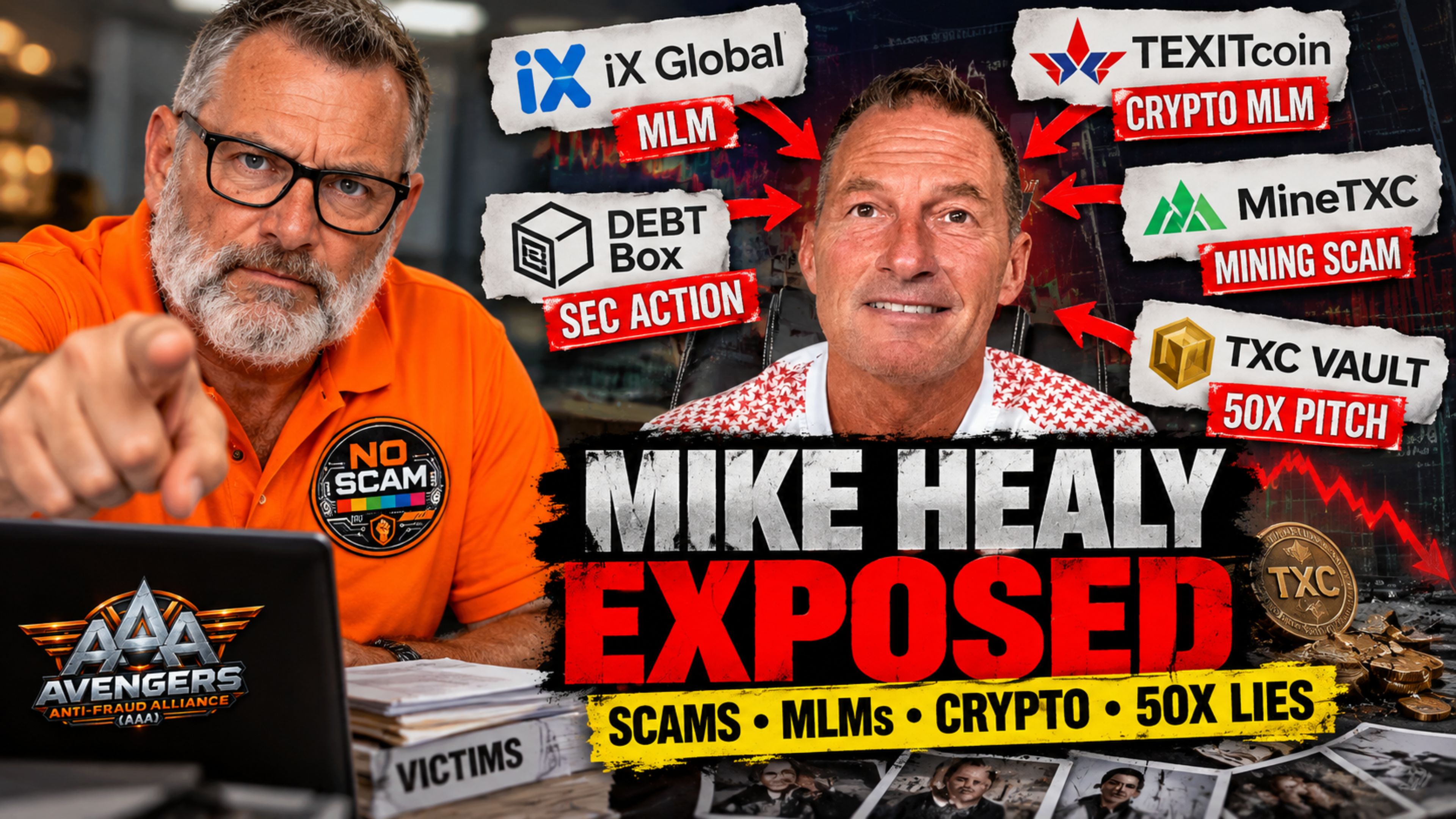
“I could see this, if it was all implemented properly, it could 10x, 50x in just a few months.” — Mike Healy
Those are the words that caught my attention while watching longtime network marketer Mike Healy explain his latest idea involving TEXITcoin. Healy wasn’t simply discussing cryptocurrency from the sidelines.
In his own presentation, he told viewers that he had put together TXCVault.com, a website proposing that TEXITcoin holders could use their TXC as collateral to borrow money without selling their coins. He then went considerably further, describing how people might use some of that borrowed money to buy even more TXC, potentially creating buying pressure while simultaneously locking existing coins away as collateral.
Healy repeatedly qualifies the presentation with phrases such as “not financial advice,” “hypothetical” and “not selling anything here.” But disclaimers don’t make the rest of the presentation disappear. He talks about “loan looping,” asks viewers whether they would buy more TXC, discusses creating scarcity and demand, and explains how a community of hundreds, thousands or even tens of thousands of participants could potentially move the price. At one point, he says he could see the token increasing 10x or even 50x within a few months if the concept were implemented properly.
That made me interested in something bigger than TXC Vault.
Who exactly is Mike Healy, and what else has he promoted?
His YouTube channel dates back to 2007 and contains hundreds of videos accumulated over nearly two decades. His own promotional material describes a long career in direct selling and network marketing, involving large organisations and thousands of recruits. More recently, that promotional history has moved through cryptocurrency, mining, passive-income opportunities and projects including iX Global and TEXITcoin.
I have investigated enough MLM, cryptocurrency and passive-income schemes to know that the latest presentation is only part of the story. When a promoter has spent years encouraging people to join financial opportunities, the important question isn’t simply whether today’s opportunity sounds convincing. What happened to yesterday’s opportunity?
So I started going backwards.
I reviewed Healy’s videos, podcasts, websites and promotional material. I looked at the companies he publicly associated himself with, the recruitment claims he made, the opportunities he encouraged people to join and, importantly, what subsequently happened to some of those businesses. I also examined his involvement with iX Global, which later became embroiled in the SEC’s DEBT Box litigation — a case with a complicated history that included serious allegations against iX Global but also extraordinary misconduct by the SEC itself.
Now Healy is back in front of an audience talking about TEXITcoin and a lending concept he calls TXC Vault.
Before publishing this investigation, I sent Mike Healy a detailed 40-question right of reply, asking him about his relationship with TEXITcoin, MineTXC and TXC Vault, how he is compensated, what due diligence he conducts, his involvement with iX Global, and what happened to previous opportunities he promoted.
Because when somebody makes money promoting opportunities to other people, their track record matters just as much as their disclaimer.
Who Is Mike Healy?
 Mike Healy isn’t somebody who stumbled into network marketing last year and started making cryptocurrency videos. He has built his public identity around recruiting people, building MLM organisations and teaching others how to do the same.
On his own website, Healy describes himself as a “direct selling seven figure earner” and estimates that organisations he has worked with, trained and deployed have generated more than $75 million in global sales.
His MLM Mastermind podcast makes the scale of his recruiting history even clearer. Its description states that Healy has personally enrolled more than 2,000 people and built multiple teams across multiple companies numbering in the tens of thousands. The entire premise of the podcast was teaching people how to recruit, duplicate and become what Healy called a “network marketing rock star.”
This matters because Healy isn’t simply an investor sharing his personal experience. Recruitment is his speciality. In one of his own training courses, he markets strategies for rapidly recruiting, creating “crazy duplication,” building massive teams and ultimately making more money through network marketing.
That gives Healy something most ordinary participants don’t have: reach and influence.
When someone with that experience puts an opportunity in front of an audience, people may reasonably give weight to his enthusiasm and claimed track record. And when that same person publicly teaches others how to recruit thousands of people, I believe there is a corresponding reason to examine the opportunities he has chosen to promote.
So rather than accepting the résumé, I started looking at the history behind it.
Which companies helped create those millions in sales? Which opportunities did Healy recruit people into? And, most importantly, what happened to them after the promotion stopped?
The Opportunities He Leaves Behind
Once I started working backwards through Mike Healy’s promotional history, one thing became obvious: TEXITcoin is not his first opportunity, and certainly not his first attempt at building a large organisation around somebody else’s business.
As far back as 2011, industry publication Business For Home listed Healy among the estimated top earners at Evolv Health, putting his estimated earnings at $10,000 per month. That doesn’t establish how much he actually earned, and I am not suggesting Evolv itself was a Ponzi scheme. What it does establish is that Healy was already deeply involved in network marketing more than a decade before cryptocurrency became central to his promotional activity.
His trail didn’t stop there. Healy’s own YouTube material later promoted APL Go, with a presentation inviting viewers to get more information and join. Other surviving promotional material places him alongside iBuumerang, describing Healy as a seven-figure earner and consultant while encouraging visitors to “JOIN OUR TEAM” and help build a global organisation.
This is where I have deliberately been careful.
Companies change names, merge, decline, disappear and sometimes simply lose momentum. A failed MLM is not automatically a fraud, and appearing in Mike Healy’s history does not automatically make a company a scam. I am not interested in padding this investigation with every company name I can find and pretending they are all equivalent.
What interests me is the recurring behaviour.
Healy has spent decades teaching people how to recruit quickly, build downlines and duplicate those recruitment methods through an organisation. In January 2022, for example, he published training titled “How to Build a Network Marketing Business Quickly,” describing himself as someone who had spent 25 years learning ways to shorten the curve and gain a competitive advantage. His biography on that same page again claimed more than 2,000 personal enrolments and teams numbering in the tens of thousands.
Then came an opportunity for which Healy left behind an unusually clear piece of evidence.
In December 2022, he published an episode of The MLM Mastermind titled “How I Recruited 30+ Personals in 30 Days in iX Global.” The description was remarkably straightforward: “The #1 skill to have in network marketing is being able to recruit.” Healy said he was breaking down the strategies he had used for years.
That matters because iX Global’s story didn’t end with a recruiting tutorial.
It eventually led directly into one of the most controversial cryptocurrency enforcement cases brought by the United States Securities and Exchange Commission — the DEBT Box litigation.
iX Global And DEBT Box
Mike Healy left very little ambiguity about his involvement with iX Global. In December 2022, he published an episode titled “How I Recruited 30+ Personals in 30 Days in iX Global.” This wasn’t somebody casually reviewing an opportunity. He was publicly teaching the methods he had used to recruit more than 30 people into it within a month.
Then the story became much more serious.
 In July 2023, the U.S. Securities and Exchange Commission filed a federal lawsuit involving DEBT Box and iX Global. According to the SEC‘s complaint, DEBT Box had partnered with iX Global around October 2022, using iX Global’s existing MLM network to market DEBT Box “node software licenses” to investors in the United States and internationally. The SEC alleged that iX Global representatives promoted those licences through websites, social media and the company’s MLM network and received transaction-based compensation for bringing investors into the scheme.
The timing immediately caught my attention. Healy’s “30+ Personals” iX Global recruiting episode appeared in December 2022 — during the period in which the SEC later alleged iX Global was being used to market DEBT Box node licences. That does not prove Healy personally sold DEBT Box products, and I have deliberately not made that claim without evidence. It does, however, raise an obvious question: what exactly was Healy recruiting those people into, what products were they subsequently exposed to, and what commissions did he receive?
There is also an important part of this story that anyone investigating DEBT Box responsibly needs to disclose.
The SEC’s case itself became engulfed in controversy. The federal judge later found that the Commission had engaged in bad-faith conduct while obtaining and defending the temporary restraining order used to freeze defendants’ assets and appoint a receiver. The court sanctioned the SEC and ordered it to pay attorney fees and costs arising from that improperly obtained emergency relief.
That misconduct matters. It means I am not going to take allegations from the SEC’s original complaint and rewrite them as proven facts.
But it doesn’t erase Mike Healy’s own promotional record either.
Healy publicly celebrated recruiting more than 30 people into iX Global. The SEC subsequently alleged that iX Global’s MLM network was being used to distribute DEBT Box node licences. So I have asked Healy directly whether he promoted those licences, how many people he introduced to them, whether he received commissions connected with their purchases, whether any of his recruits lost money, and whether he ever went back to those people after the DEBT Box controversy erupted.
Those are questions only Mike Healy can fully answer — and I have given him the opportunity to do exactly that.
Then Came TEXITcoin
By 2025, Mike Healy’s promotional attention had moved firmly into cryptocurrency, and TEXITcoin became one of the projects he was publicly putting in front of his audience.
Healy published presentations explaining TEXITcoin and MineTXC, directing viewers towards the mining opportunity and explaining how participants could acquire TXC. This wasn’t simply independent commentary about whether Bitcoin-style proof-of-work mining might succeed. TEXITcoin community material from December 2025 identified Healy as a “head community leader” alongside other prominent figures within the ecosystem.
TEXITcoin itself was being marketed with enormous expectations. In September 2025, official promotional material published “Phase 2 & The Path to $800 by 2027,” discussing a progression from approximately $16 to $80 and ultimately $800 per TXC. These were projections rather than guarantees, but numbers like that matter when people are being encouraged to mine, accumulate and hold a cryptocurrency.
And Mike Healy understood better than most people how powerful a financial story can become when combined with a network.
MineTXC incorporated a compensation structure around the mining ecosystem, allowing participants to build organisations and earn through activity connected with people they introduced. For an experienced network marketer who claims thousands of personal enrolments over his career, that structure was hardly unfamiliar territory.
But something particularly interesting happened as 2025 came to an end.
Material circulated from within the TEXITcoin community itself acknowledged that MineTXC had developed an MLM problem. The update said the compensation structure had “drifted from community-building into MLM behavior” and announced significant changes intended to move the ecosystem away from that direction.
That admission deserves more attention than it received.
Because once again, Mike Healy — a man whose professional speciality is recruiting people and building MLM organisations — had positioned himself inside an opportunity where the project’s own community leadership was acknowledging that its compensation system had drifted into MLM behaviour.
And that wasn’t the end of his involvement with TEXITcoin.
It was the beginning of the next idea.
Even The Community Admitted The MLM Problem
One of the more revealing pieces of evidence in this investigation didn’t come from a regulator, critic or disgruntled former member. It came from inside the TEXITcoin community itself.
In a December 2025 update discussing major changes to MineTXC, the compensation model was acknowledged to have “drifted from community-building into MLM behavior.” The proposed solution included restructuring the compensation plan and moving away from features that had encouraged the very network-marketing behaviour the project was now trying to correct.
That wording matters. It suggests the MLM characteristics weren’t merely something outsiders had imagined after looking at a compensation chart. People within the ecosystem were recognising the problem themselves.
For me, it also made Mike Healy’s involvement particularly relevant. This is somebody who has spent decades teaching recruitment, duplication and downline building. He has publicly claimed thousands of personal enrolments and organisations numbering in the tens of thousands. He wasn’t entering MineTXC without understanding how MLM compensation structures work.
That is why I asked Healy directly what role he played in designing, advising upon, promoting or operating the MineTXC compensation structure, and how much of his own compensation came from mining activity compared with commissions or rewards generated through people within his organisation.
I also asked the most important question whenever recruitment and financial rewards become intertwined: what underlying economic activity, independent of new participants, was actually funding those rewards?
Those questions become even more important when you look at what Mike Healy is proposing now.
Now Mike Healy Has Built TXC Vault
This is where the investigation becomes much more interesting, because Mike Healy is no longer simply promoting somebody else’s opportunity. In his latest video, he says he personally put together TXCVault.com.
“I put together a website that I want you to visit. It’s called txcvault.com.”
Healy explains a concept where TEXITcoin holders could place their TXC into collateral and borrow against it rather than selling it. He gives the example of somebody holding 500,000 TXC at around 17 cents, suggesting that position could potentially provide approximately $21,000–$22,000 in borrowing power. He then introduces what he calls “loan looping” — borrowing against the TXC and potentially using some of that borrowed money to purchase even more TXC.
That is where this stops being just a discussion about accessing liquidity.
Healy explains that if hundreds, thousands or even tens of thousands of people within the ecosystem obtained collateralised loans, existing TXC would effectively be pulled out of circulation and placed into escrow. At the same time, some borrowers could use their newly obtained capital to purchase additional TXC. In his own explanation, that combination could reduce selling pressure while creating new buying pressure.
He even asks viewers directly: if they owned TXC, believed in it and suddenly had the ability to borrow against it, “would you go get more?” He specifically mentions going to Swap TX to acquire additional coins.
Then comes the statement that really caught my attention.
Healy tells viewers that at TXC’s current market price, “it doesn’t take a lot of incoming capital” to move the price. He initially talks about the possibility of doubling or tripling, before going considerably further: “I could see this, if it was all implemented properly, it could 10x, 50x in just a few months.”
There is another layer to the proposal. Healy suggests participants could potentially take some of the borrowed money and become liquidity providers, describing this as “almost double dipping on the same money.” He talks about cryptocurrency creating cash flow, capital and lending ability, before describing a situation where “we become almost our own bank within the bank because then we can all start working together.”
But borrowing against an asset doesn’t magically create value. Somebody has to provide the capital. Somebody has to custody the collateral. Somebody carries the risk if TXC collapses in value or cannot be liquidated at the displayed market price. There need to be loan terms, loan-to-value limits, liquidation procedures and an identifiable legal counterparty.
Those are the parts of TXC Vault I want to see documented.
Who operates it? Who provides the money? Where will the collateral actually be held? What happens when the price falls? What regulatory framework applies? And perhaps most importantly, what happens when borrowed money is used to purchase more of the same asset securing the borrowing?
Healy’s video spends considerable time explaining what this idea might do for the price of TXC.
It provides considerably less information about who would be standing behind the loans when something goes wrong.
“Not Financial Advice” Doesn’t Erase The Promotion
Throughout the TXC Vault presentation, Mike Healy repeatedly tries to put distance between himself and the financial implications of what he is describing. He calls the concept hypothetical, says “this is not tax advice or financial advice,” and later tells viewers he is “not selling anything here.”
I understand why those disclaimers are there. But I also listened to everything Healy said between them.
He isn’t merely explaining what a crypto-backed loan is. He directs viewers to TXCVault.com, a website he says he created. He explains how holders could collateralise their TXC, borrow money against it and potentially use those proceeds to buy more TXC. He describes how widespread participation could remove coins from circulation, reduce selling pressure and create additional buying pressure. He asks viewers whether access to this borrowing facility would make them go out and acquire more TXC.
Then he talks about what could happen to the price.
He says relatively little incoming capital could potentially double or triple TXC before suggesting that, if implemented properly, “it could 10x, 50x in just a few months.” He also describes the possibility of using borrowed funds to become a liquidity provider, potentially generating additional returns while still retaining exposure to the original TXC.
I am not suggesting that saying “not financial advice” is somehow unlawful, nor am I making a legal determination about Healy’s presentation. The point is much simpler.
A disclaimer does not change what the audience has just been shown.
If you tell people how borrowing against a cryptocurrency could allow them to buy more of that cryptocurrency, explain how collective participation could create scarcity and buying pressure, and then discuss the possibility of the asset increasing 10x or 50x, those statements form part of the overall message viewers receive.
And there is another question that matters enormously here: what is Mike Healy’s own financial exposure to TXC?
If Healy owns substantial amounts of TEXITcoin, receives mining rewards, earns commissions connected with the ecosystem or stands to benefit financially from increased demand for TXC or adoption of TXC Vault, that context is directly relevant when assessing a presentation explaining how coordinated participation could potentially increase the token’s price.
That is why I have asked him.
Because after investigating hundreds of opportunities promoted online, I have learned to pay considerably more attention to how the money actually moves than to the disclaimer sitting beside it.
The Questions Mike Healy Needs To Answer
Before publishing this investigation, I contacted Mike Healy directly and gave him a detailed right of reply. I sent him 40 Questions covering TEXITcoin, MineTXC, TXC Vault, iX Global and his wider history of promoting network-marketing, cryptocurrency, mining and passive-income opportunities.
I didn’t send him a vague request asking whether he had any comments. I asked specific questions that should have specific answers.
Regarding TXC Vault, I asked Healy to identify the legal entity operating it, who owns and controls that entity, where the lending capital comes from, who will custody customers’ TXC, what licences or regulatory registrations exist, how the collateral will be valued, and what happens when the price or liquidity of TXC falls significantly. I also asked whether Healy receives, or expects to receive, any financial benefit from introducing people to TXC Vault.
I asked similar questions about his existing involvement with TEXITcoin and MineTXC: what his official role is, how much TXC he owns or receives, whether he earns mining rewards or recruitment-related commissions, how many people have entered the ecosystem through him or his organisation, and what independent due diligence he conducted before putting the opportunity in front of his audience.
Then I went backwards.
I asked Healy about iX Global, his “30+ Personals in 30 Days” recruitment claim, whether he promoted DEBT Box products, whether he received commissions connected with them and whether people he recruited subsequently lost money. More broadly, I asked him to provide a list of the MLM, cryptocurrency, investment, mining and passive-income opportunities he has promoted throughout his career — and identify which remain operational, which failed, which stopped paying participants, and which became subject to regulatory action.
One question, in particular, goes to the heart of this investigation:
Has Mike Healy ever refunded commissions or other income he received when people he introduced subsequently lost their money?
Promoters are very visible when an opportunity is launching. They make the videos, host the Zoom calls, teach the recruitment strategies and explain the potential upside. What I want to know is how visible they remain when things don’t work out.
Healy has been given the opportunity to answer all of this, correct anything I have wrong and provide supporting documentation rather than assurances.
His response — or lack of one — will become part of the record.
The Pattern That Matters
 This investigation isn’t about pretending that every company Mike Healy has ever worked with was fraudulent. That would be neither accurate nor useful. It is about accountability when somebody builds a career around persuading other people to join financial opportunities.
Healy’s own promotional history establishes that he has spent decades in network marketing. He says he has personally enrolled more than 2,000 people, built organisations numbering in the tens of thousands and helped generate more than $75 million in sales. We can document him recruiting aggressively into iX Global, promoting TEXITcoin and MineTXC, and now creating TXCVault.com and explaining how borrowing against TXC could potentially allow holders to buy even more of it.
The individual opportunities change, but the questions remain remarkably similar.
What did the promoter know before recruiting people? What due diligence was performed? How was the promoter compensated? What happened to the people who followed them? And when an opportunity fell apart, did the promoter stay around to help those people — or simply move on to the next one?
That is why I believe promotional history matters.
People watching the latest presentation usually see the opportunity sitting directly in front of them. They don’t necessarily see the previous company, the previous compensation plan, the previous cryptocurrency or the people who joined because somebody they trusted told them it was worth looking at.
I do.
After years investigating Ponzi schemes, MLMs and cryptocurrency investment schemes, I have repeatedly watched promoters reinvent themselves while their audiences absorb the losses. A failed opportunity disappears down the social-media timeline, another presentation replaces it, and suddenly everyone is talking about the next revolutionary product, token, mining operation or passive-income opportunity.
Mike Healy now wants people talking about TXC Vault.
He wants the TEXITcoin community considering collateralised loans. He has openly discussed using borrowed money to acquire additional TXC, reducing selling pressure, increasing buying pressure and the possibility that TXC could “10x, 50x in just a few months.”
Before anybody becomes excited about those possibilities, I believe they should do something much simpler.
Look backwards before putting money forward.
Look at the promoter. Look at what they promoted previously. Look at what they earned. Look at what happened to the people they recruited. Then ask whether the promises being made today sound familiar.
Because opportunities come and go.
The promoters have an extraordinary habit of surviving them.
Disclaimer: How This Investigation Was Conducted
This investigation relies entirely on OSINT — Open Source Intelligence — meaning every claim made here is based on publicly available records, archived web pages, corporate filings, domain data, social media activity, and open blockchain transactions. No private data, hacking, or unlawful access methods were used. OSINT is a powerful and ethical tool for exposing scams without violating privacy laws or overstepping legal boundaries.
About the Author
I’m DANNY DE HEK, a New Zealand–based YouTuber, investigative journalist, and OSINT researcher. I name and shame individuals promoting or marketing fraudulent schemes through my YOUTUBE CHANNEL. Every video I produce exposes the people behind scams, Ponzi schemes, and MLM frauds — holding them accountable in public.
My PODCAST is an extension of that work. It’s distributed across 18 major platforms — including Apple Podcasts, Spotify, Amazon Music, YouTube, and iHeartRadio — so when scammers try to hide, my content follows them everywhere. If you prefer listening to my investigations instead of watching, you’ll find them on every major podcast service.
You can BOOK ME for private consultations or SPEAKING ENGAGEMENTS, where I share first-hand experience from years of exposing large-scale fraud and helping victims recover.
“Stop losing your future to financial parasites. Subscribe. Expose. Protect.”
My work exposing crypto fraud has been featured in:
- Coffeezilla 2026): Featured in the investigation exposing the alleged $328M Goliath Ventures Ponzi scheme
- Bloomberg Documentary (2025): A 20-minute exposé on Ponzi schemes and crypto card fraud
- News.com.au (2025): Profiled as one of the leading scam-busters in Australasia
- OpIndia (2025): Cited for uncovering Pakistani software houses linked to drug trafficking, visa scams, and global financial fraud
- The Press / Stuff.co.nz (2023): Successfully defeated $3.85M gag lawsuit; court ruled it was a vexatious attempt to silence whistleblowing
- The Guardian Australia (2023): National warning on crypto MLMs affecting Aussie families
- ABC News Australia (2023): Investigation into Blockchain Global and its collapse
- The New York Times (2022): A full two-page feature on dismantling HyperVerse and its global network
- Radio New Zealand (2022): “The Kiwi YouTuber Taking Down Crypto Scammers From His Christchurch Home”
- Otago Daily Times (2022): A profile on my investigative work and the impact of crypto fraud in New Zealand





Leave A Comment