



“Don’t be fooled by what looks miraculous and glamorous.” — Mike Chmielewski
 Those are Mike Chmielewski’s own words, taken from a Private Recording I obtained while investigating his latest reinvention as True Money Mike.

In that conversation, Mike spoke openly about professional managers “building my brand for me,” the pressure to create content that goes viral and his determination to become somebody online. Away from the carefully constructed social-media image, he admitted something considerably less glamorous: “My life is hard. It’s not fucking easy. I’m trying my best to pull myself out of the fucking gutter.”
That recording becomes particularly interesting when you compare it with the image Mike now presents publicly.
Today, Mike portrays himself as a successful cryptocurrency trader living a luxury lifestyle in Dubai. His content features expensive-looking cars, luxury surroundings and the visual language we’ve seen repeatedly in online trading and investment marketing: wealth becomes evidence of expertise.
But while investigating Mike’s latest venture, I noticed something extraordinary.

The same luxury vehicles appearing in Mike’s content appear to have been used by another social-media influencer.
The Rolls-Royce. The modified Mercedes G-Class. The other vehicles positioned outside the same Dubai property. These aren’t simply similar models. From the material I reviewed, they appear to be the same vehicles, at the same location, being used to create luxury lifestyle content by different people.
That doesn’t prove Mike has never owned an expensive car, and I’m not going to pretend it does.
But it raises a very obvious question.
If these vehicles are being used by multiple influencers for social-media content, what exactly do photographs of Mike standing beside them prove about Mike’s personal wealth?
That question matters because Mike’s lifestyle isn’t disconnected from the business he is now building. He presents himself as True Money Mike, says he has years of cryptocurrency trading experience, claims trading made him wealthy and is building an ecosystem around Money Mike Academy, The True Trade and Mikey AI.
This comes after Mike’s substantial involvement with GOLIATH VENTURES, where records I have reviewed attribute more than US$35 million in investor funds to relationships connected with Mike before the operation collapsed.
But this investigation isn’t going to determine whether Mike can trade by looking at his Instagram account.
I have something considerably better than a photograph of a Rolls-Royce.
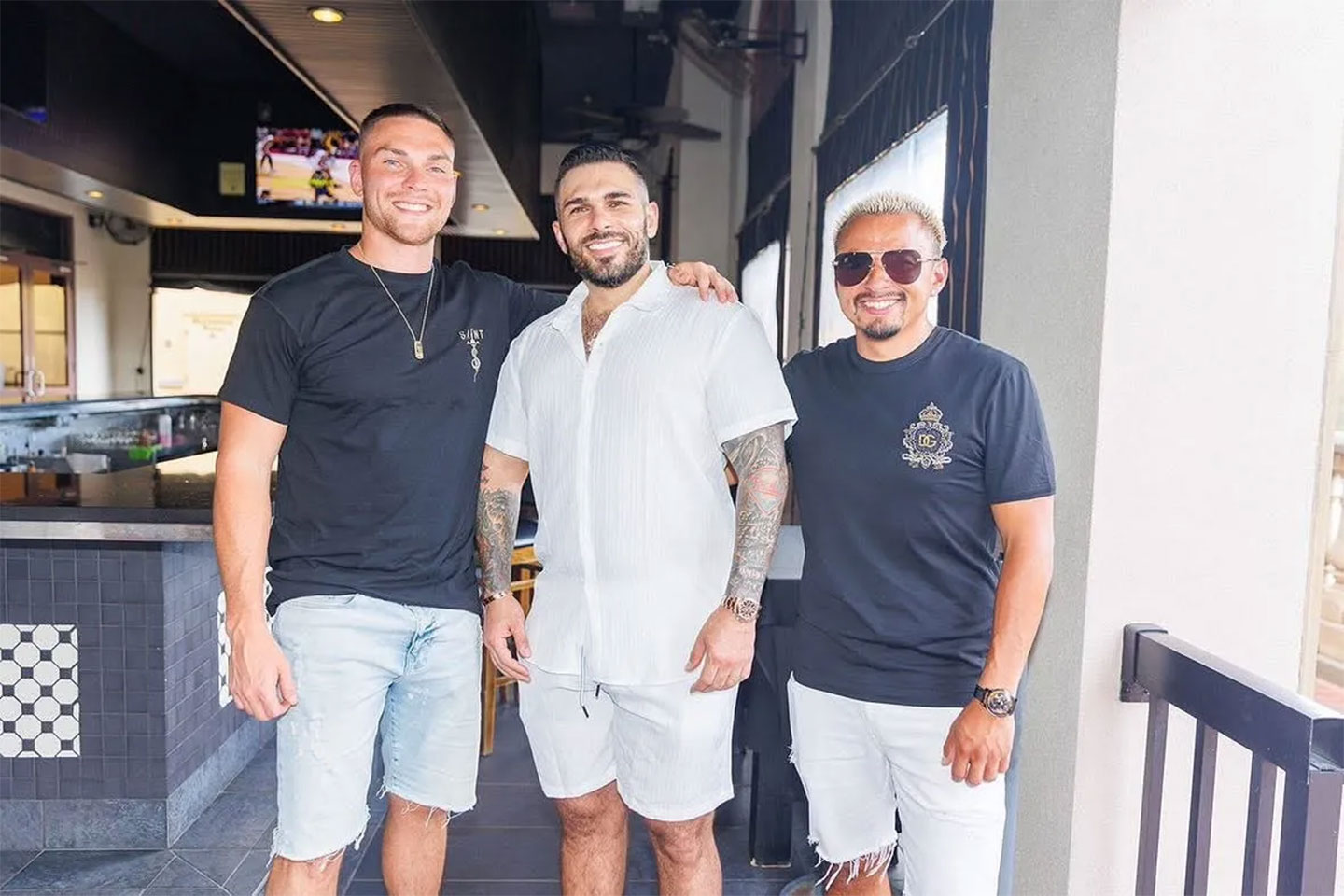
I have obtained Mike’s complete trading course — approximately two hours and 45 minutes of Mike Chmielewski teaching people how to trade in his own words.
I watched the entire thing.
Mike teaches support and resistance, trend lines, breakouts, chart patterns, EMA, VWAP, fair value gaps, market structure, confluence, leverage, stop-losses, risk-to-reward and the methodology he believes can help turn beginners into consistently profitable traders.
Some of what Mike teaches is perfectly legitimate technical analysis. His emphasis on controlling risk, for example, contains sensible advice.
But Mike goes considerably further than explaining how technical analysis works.
He tells students certain setups are “high probability.” He says a third test of support or resistance will “typically” break. He describes multiple indicators as confluences that increase his confidence about where price will move. He uses fair value gaps to help “verify” market movements. And he tells students that once they understand his framework, “it’s very easy to be a profitable trader.”
Those are testable claims.
If Mike has discovered a repeatable trading edge capable of producing the success behind True Money Mike, we should be able to find evidence of it: clearly defined rules, measurable probabilities, winners and losers, expectancy and a trading record demonstrating that the methodology works over time.
So forget the Rolls-Royce.
Forget the G-Wagon.
Forget Dubai.
Forget the carefully manufactured image of success.
For the next two hours and 45 minutes, Mike Chmielewski gets exactly what every self-proclaimed trading expert should get: his methodology tested against his claims.
The “Third Touch” Rule Is Where The Problems Begin
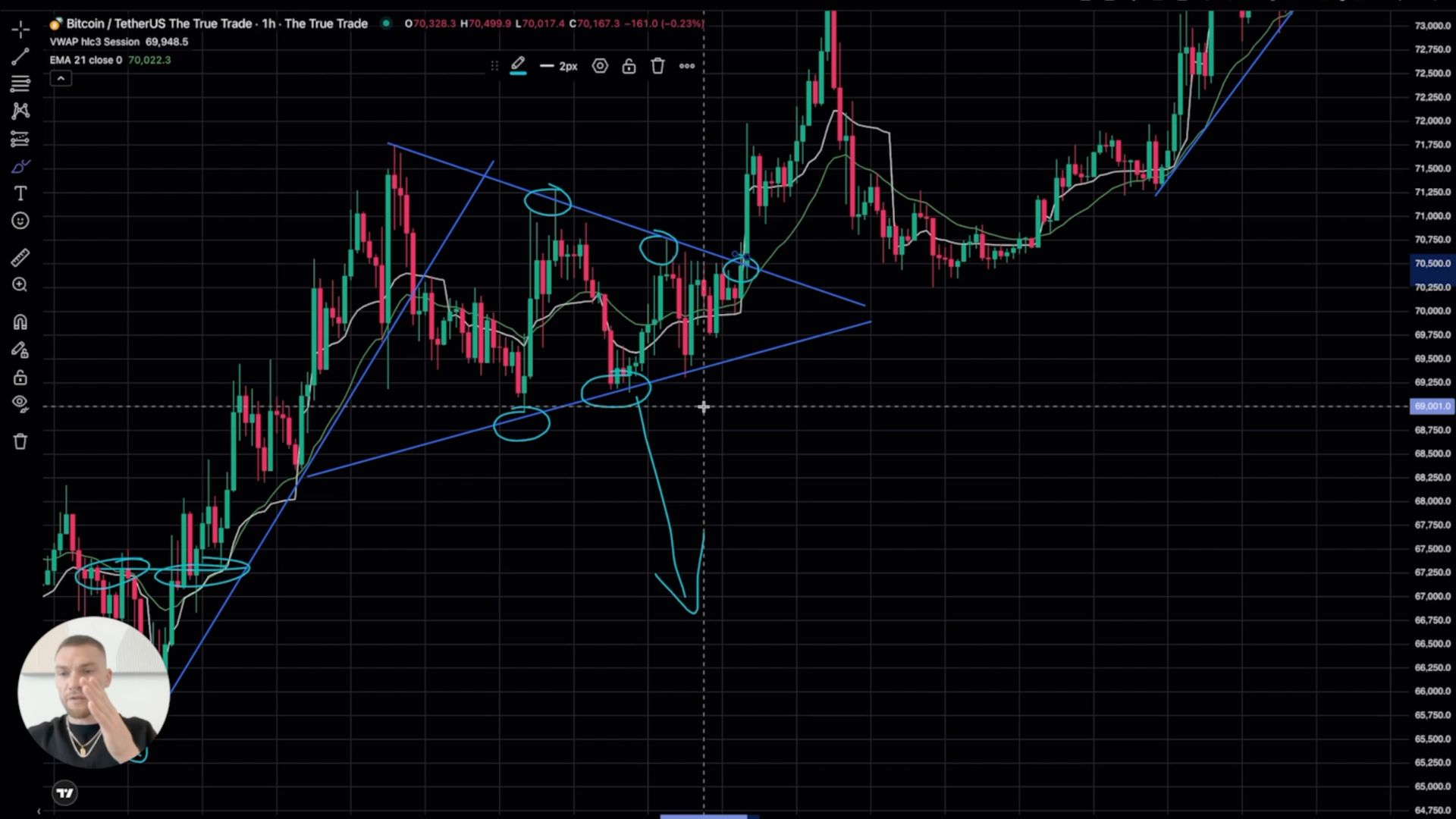
One of the first places Mike moves beyond basic technical analysis is his explanation of support and resistance.
Identifying areas where price has repeatedly reacted is standard chart analysis. Mike demonstrates this using Bitcoin and explains how traders can watch previous support and resistance when considering future trades.
Then he makes a much more specific claim.
Mike tells his students:
“Typically, when you hit a third time, it’s going to break that support or resistance.”
That is no longer simply an observation about a chart. It is a claim about probability.
Repeated tests can weaken a level. Buyers or sellers defending an area may become exhausted, and a breakout may eventually occur. But the fact that price has reached a level for the third time does not, by itself, establish what happens next. Price can break, reject again, briefly move through the level and reverse, or continue consolidating around it.
If Mike’s third-touch rule genuinely gives traders an advantage, it should be testable.
We would need a precise definition of what constitutes a “touch,” what timeframe is being traded, how the support or resistance level is drawn, what qualifies as a successful break and what invalidates the setup. Then the same rules would need to be applied across a sufficiently large sample.
If 500 qualifying third touches were tested, for example, we could determine how frequently they actually broke the level, how frequently they failed and whether trading those breakouts produced a profit after losses and trading costs.
Mike provides none of that evidence in the course.
Instead, he demonstrates the principle using completed historical charts where the breakout is already visible. The student can see the support, see the repeated tests and then see price eventually break through.
It looks convincing because we already know the answer.
The trader facing that third touch in real time does not.
This distinction is critical throughout Mike’s training. Finding a historical chart where a third touch was followed by a breakout demonstrates that the event can happen. It does not demonstrate that the third touch predicts the breakout often enough to constitute a trading edge.
Mike uses the word “typically.”
That word implies frequency.
Frequency can be measured.
The course never tells us what that measurement is.
The Charts Already Know What Happened
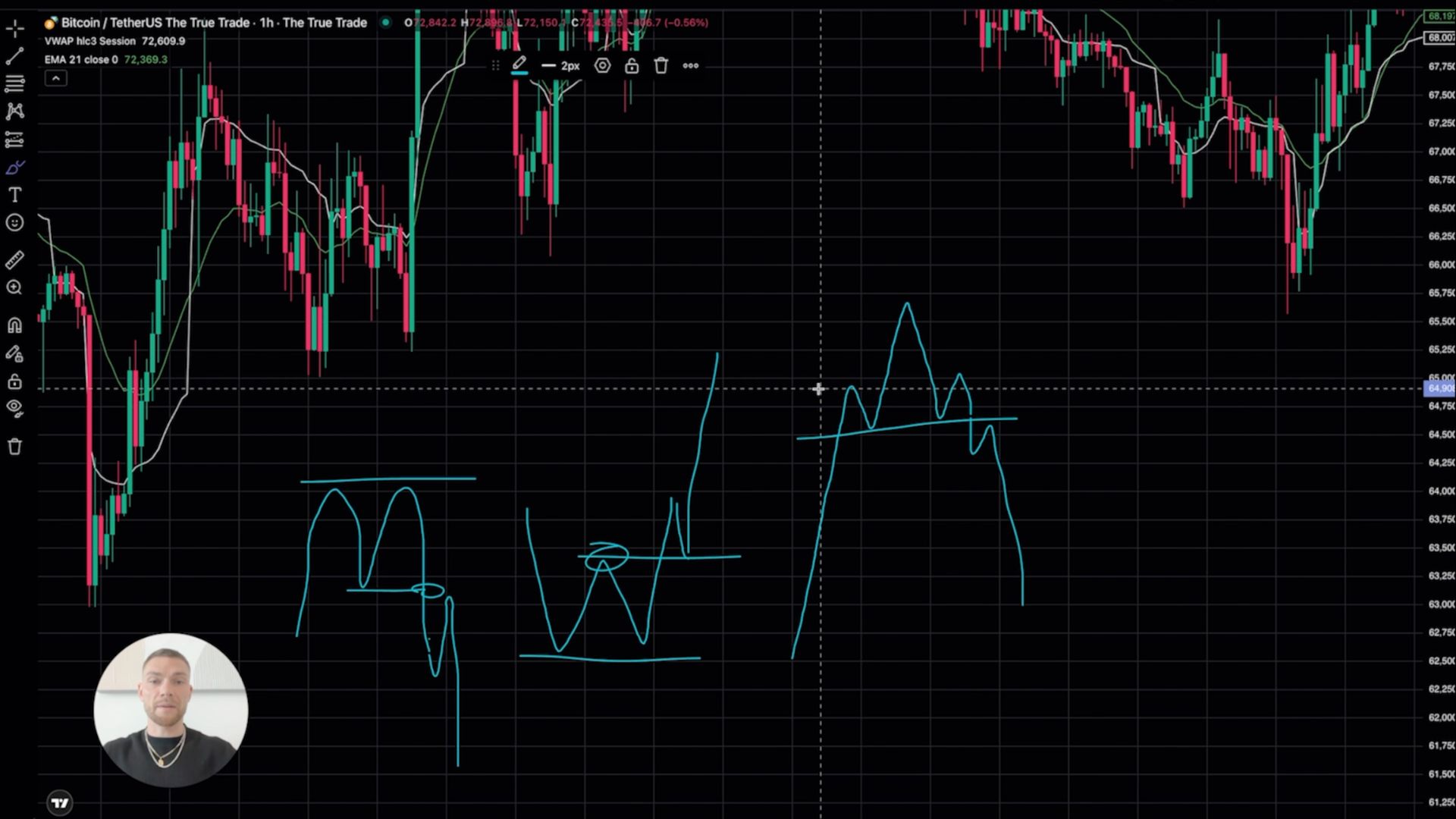
Mike then moves into trend lines, channels, flags, pennants, triangles and reversal patterns, using historical Bitcoin charts to demonstrate how these formations can identify potential trades.
Again, the concepts themselves are not the problem. These are familiar forms of technical analysis used by traders around the world.
The problem is how Mike uses completed charts to demonstrate their effectiveness.
In one example, Mike identifies a bearish pattern and explains how a trader could have entered Bitcoin at approximately $65,000 and followed the subsequent decline towards roughly $58,000–$59,000.
Looking backwards, it appears obvious.
The pattern formed. The breakdown occurred. Bitcoin moved in the expected direction. Mike can point directly to the entry and show students where the profitable move happened.
But at $65,000, the trader didn’t know any of that yet.
At that moment, the developing pattern could have broken down, broken upwards, continued sideways or produced a false breakout before reversing. What looks beautifully structured after the event can be considerably less obvious when the candles to the right of the entry haven’t happened yet.
This is hindsight bias, and it becomes particularly important when somebody is using historical examples as evidence of trading expertise.
Mike even encourages students to scroll backwards through historical charts and practise finding the patterns he teaches. That’s a perfectly reasonable way to learn how a flag, pennant or head-and-shoulders formation is supposed to look.
It is not a reliable way to establish whether trading those patterns is profitable.
To determine that, Mike would need objective criteria defining each setup and then apply those criteria consistently across every qualifying example — including the failures.
The beautiful bearish flag counts.
So does the identical-looking flag that breaks in the wrong direction.
The successful breakout counts.
So does the breakout that immediately reverses and hits the stop-loss.
Without those losing examples, we are not measuring a strategy. We are selecting examples from history that illustrate the lesson.
That is an important distinction because Mike increasingly builds the rest of his trading methodology around these patterns.
And his answer to their uncertainty is to start adding more “confirmation.”
Six Confluences That May Be Saying The Same Thing
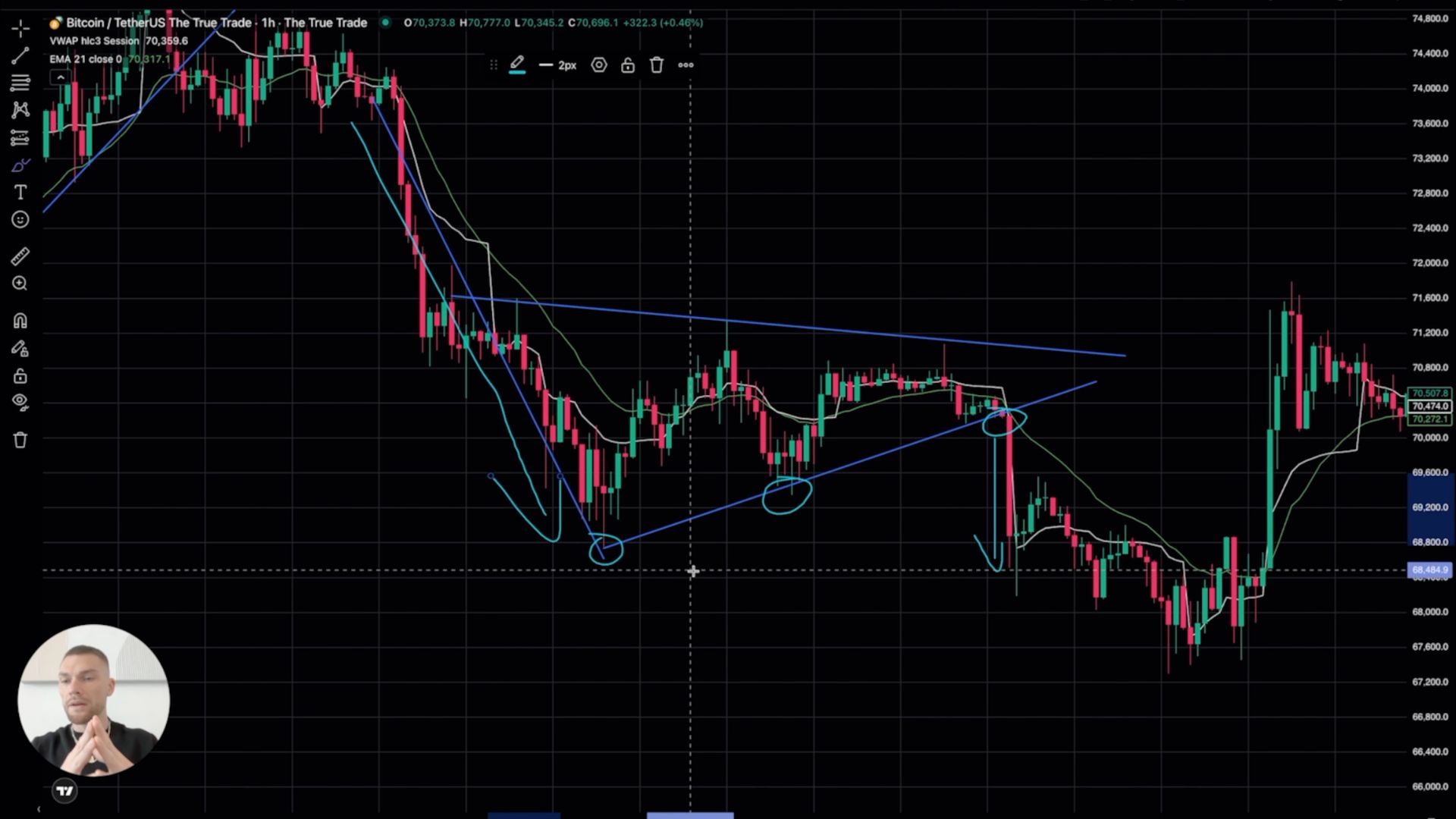
Mike’s solution to uncertainty is confluence. Rather than relying on one signal, he teaches students to combine several technical observations before entering a trade.
In one example, Mike identifies six confluences: support holding, a triple bottom, a broken downtrend line, a break of structure, a fair value gap, and price moving above EMA and VWAP. He then tells his students:
“Six confluences. We are very confident that this trade is going to go in our direction now.”
This sounds much more convincing than relying on a single indicator. But there is an important statistical problem with counting confluences this way.
They are not necessarily independent signals.
Suppose Bitcoin rallies strongly from support. That single movement can break the downtrend line. The same rise can push price above the EMA and VWAP. If it passes a previous swing high, Mike can identify a break of structure. The aggressive movement can also create what he identifies as a fair value gap.
Mike can now count several confirmations.
But several were produced by the same underlying movement in price.
That matters because adding more correlated indicators does not automatically add more predictive information. EMA is derived from price. VWAP uses price and volume. Trend-line breaks depend on price. Market structure is interpreted from price. Fair value gaps are identified from the relationship between price candles.
Mike later suggests students could create a checklist and require something like four out of six confluences before taking a trade.
But why four?
If four confluences genuinely produce a higher-probability trade, that should be measurable. Do setups containing four outperform those containing three? Does six outperform four? Which combinations work best? Does adding VWAP improve the results when EMA and a break of structure are already present?
The course provides no statistics answering those questions.
There is nothing inherently wrong with discretionary trading or looking for several reasons before entering a position. The problem arises when Mike converts the number of observations into statements about probability and confidence without demonstrating the relationship between them.
When Mike says six confluences make him “very confident” that the trade will move in his direction, the obvious question is: how confident should the evidence actually make him?
Probability is measurable.
Six labels on a chart do not automatically equal six pieces of independent evidence.
Fair Value Gaps Become Mike’s “Verification”
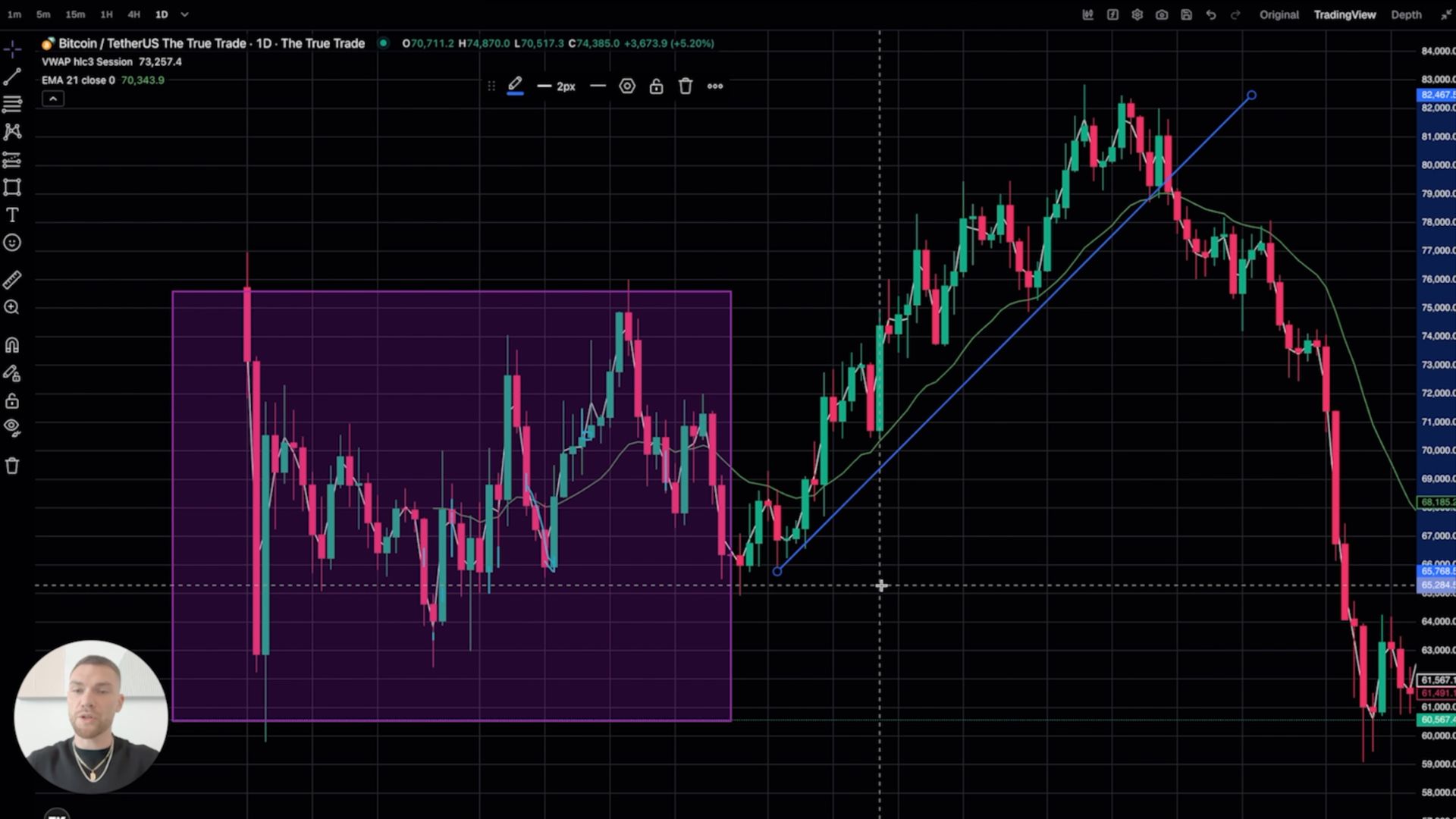
Mike then introduces fair value gaps (FVGs) as another way of strengthening a trading decision. He describes them as areas of price imbalance created during an aggressive move and tells students that price will “eventually” return to retest that displacement.
More importantly, Mike doesn’t present the FVG merely as another pattern to watch. He uses it to help “truly verify” a breakout and change in market structure.
That language matters.
If something is being used to verify a trading signal, we need to know how reliable that verification actually is.
Mike works backwards through historical Bitcoin charts identifying fair value gaps that were subsequently retested, sometimes acting as support before price continued higher. These examples make the concept appear compelling.
But Mike’s own examples also include a fair value gap that he acknowledges “never held” and another break in market structure where the type of FVG he was looking for did not appear.
This is exactly the information that needs to be measured.
How many qualifying FVGs held?
How many failed?
How often did price return to them?
How long did that take?
And most importantly, did trading Mike’s FVG setup actually improve the profitability of the strategy?
The course doesn’t answer those questions.
There is also an overlap with the confluence problem. The aggressive price movement creating Mike’s fair value gap can simultaneously produce a break of structure, cross EMA or VWAP and break a trend line. Mike can therefore count the FVG as another confirmation even though several of those signals originated from the same movement.
None of this establishes that fair value gaps are useless. A trader may find them valuable as part of a defined and tested methodology.
The problem is much more specific.
Mike uses FVGs as verification without demonstrating their verification rate.
He shows where they worked.
He acknowledges that they sometimes don’t.
What he never establishes is whether they work often enough to provide the trading edge he claims to be teaching.
Risk Management Is Where Mike Gets Something Right
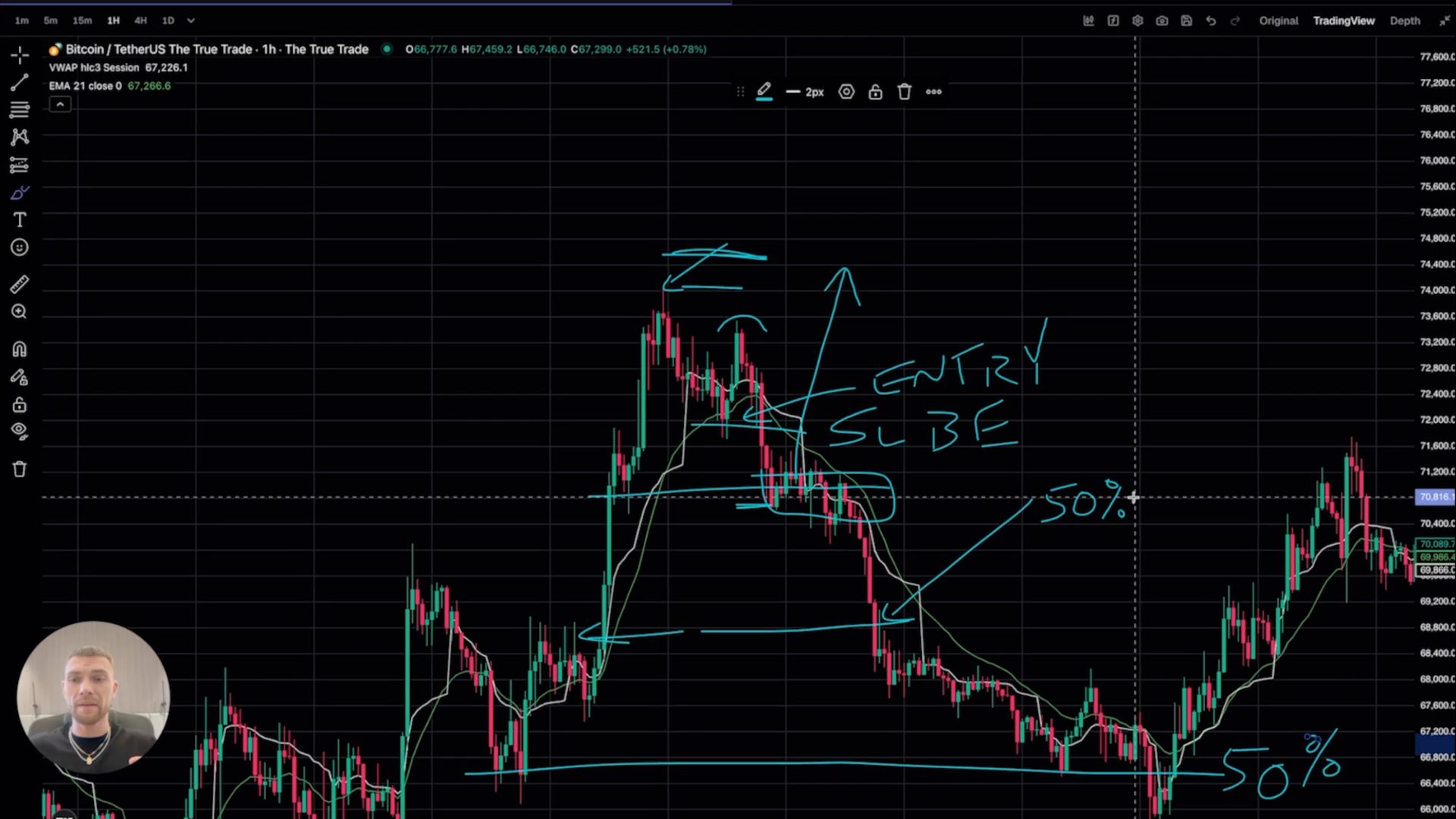
After spending much of the course teaching students how to identify trades, Mike eventually reaches risk management.
This is one of the stronger parts of his training.
He explains stop-losses, position sizing, leverage and risk-to-reward, and repeatedly tells students that protecting capital matters more than trying to be right on every trade. He also explains why traders should decide how much they are prepared to lose before entering a position, rather than reacting emotionally once the market moves against them.
That principle is sound.
A trader does not need to win every trade to make money. If losses are controlled and winning trades are sufficiently larger than losing trades, a strategy can remain profitable with a relatively modest win rate.
Mike also discusses taking partial profits and moving a stop-loss towards break-even as the trade develops. Again, these are sensible risk-management concepts.
Then he overstates what risk management can actually do.
Mike tells his students:
“You will never lose everything. You will never blow your account.”
He describes this as “the promise of proper risk management” and tells students their principal is protected.
That is too absolute.
Good risk management can reduce the probability of catastrophic loss, but it cannot make that outcome impossible. Stop-losses can suffer slippage. Leveraged positions can be liquidated. Fast-moving cryptocurrency markets can execute far away from an intended exit. Exchange problems, liquidity events and extreme volatility can all produce losses larger than expected.
Even The True Trade’s own disclosures warn that execution prices are not guaranteed and leveraged trading can result in the loss of deposited collateral.
So Mike starts with a legitimate principle and turns it into a guarantee the market simply cannot provide.
Risk management can control how much damage a losing strategy does. It cannot prove the strategy itself has an edge.
Where Is The Trading Edge?

By this point in the course, Mike has taught students how to identify support and resistance, chart patterns, trend lines, EMA, VWAP, fair value gaps, market structure and multiple confluences. He has also explained how to control risk once a position is opened.
What he still has not demonstrated is why these trades should make money over time.
That is the missing piece.
A profitable trading strategy ultimately needs positive expectancy. In simple terms, the money made from winning trades has to exceed the money lost from losing trades across a sufficiently large sample.
The basic relationship is:
Expectancy = (Win Rate × Average Win) − (Loss Rate × Average Loss)
Mike does discuss risk-to-reward, but he never connects the methodology he teaches to actual performance data.
If his third-touch setup is profitable, how many times has he tested it?
If four confluences create a high-probability trade, what is the win rate?
If six confluences make him “very confident,” how much better do those trades perform than setups containing three or four?
If fair value gaps provide verification, how much does adding an FVG improve expectancy?
Those numbers never appear.
Neither does a clearly defined ruleset that would allow somebody else to reproduce Mike’s strategy consistently.
One student could see support, VWAP, a double bottom and a trend-line break. Another could identify EMA, a fair value gap, a pennant and a break of structure. Both might satisfy Mike’s idea of multiple confluences, despite effectively trading two different systems.
That creates a serious testing problem.
If the rules are flexible enough to change depending on what appears on the chart, losing trades can always be explained afterwards: perhaps the support wasn’t strong enough, perhaps another confluence was needed, perhaps the pattern wasn’t quite valid.
A strategy that cannot be clearly defined cannot be properly tested.
What I expected from someone presenting himself as an experienced professional trader was a methodology with objective conditions: defined entries, defined invalidation, defined exits, fixed risk parameters and historical results showing what happened when those exact rules were applied repeatedly.
Instead, Mike gives students a toolbox of technical-analysis concepts and tells them to combine those tools into their own strategy.
There is nothing wrong with teaching beginners how to experiment with technical analysis.
But that is very different from demonstrating the profitable trading methodology that supposedly made the teacher successful.
Mike tells students that once they can identify the pattern, trend, support, resistance, entry, stop-loss and take-profit, “it’s very easy to be a profitable trader.”
The mathematics say otherwise.
Those things can tell somebody how to structure a trade.
They do not tell us whether that trade has positive expectancy.
And after nearly three hours of training, Mike still hasn’t demonstrated the edge that turns his analysis into consistent profitability.
Mikey AI Cannot Create An Edge That Hasn’t Been Proven
Mike then introduces Mikey AI, his artificial-intelligence trading assistant. He presents it as a tool capable of helping students analyse charts, calculate position sizes and leverage, answer trading questions and provide signals based around the methodology he teaches.
AI can certainly make some of those tasks faster.
But there is a fundamental distinction between automating a trading strategy and proving that strategy works.
If Mikey is analysing Mike’s third-touch rule, fair value gaps, EMA, VWAP, market structure and multiple confluences, the AI is still relying on the same underlying methodology we have just examined.
If that methodology has positive expectancy, automation could potentially make it faster and more consistent.
But where is the evidence that it does?
An AI system can recognise patterns, process large amounts of data and apply predetermined rules without becoming emotional. None of that means its predictions are profitable.
In fact, a computer can execute an unprofitable strategy with extraordinary efficiency.
Mike says AI has “fundamentally shifted the timeline” required to learn trading. That may be true in terms of education. An AI assistant can explain terminology instantly, perform calculations and help beginners understand what they are looking at.
But shortening the learning process is not the same as shortening the process required to validate a trading strategy.
Mikey could provide exactly the evidence Mike’s course is currently missing.
Timestamp every signal before the market moves.
Record every trade.
Publish the winners and losers.
Show the entry, stop-loss and take-profit.
Then calculate the win rate, average winner, average loser, expectancy and maximum drawdown across hundreds of signals.
That would allow us to evaluate Mikey scientifically rather than judging selected examples.
Mike provides no such verified performance record in the course I reviewed.
So Mikey does not solve the central problem with Mike’s trading methodology.
It simply moves that methodology into an AI assistant.
And no matter how sophisticated the technology sounds, artificial intelligence cannot turn an unproven trading edge into a proven one.
The Training Happens On TradingView — The Money Happens On The True Trade
 There is another reason Mike’s claimed trading expertise matters.
In my Previous Investigation into The True Trade, I documented how Mike’s Money Mike Academy and wider ecosystem direct people towards The True Trade using referral links. According to the platform’s published affiliate programme, affiliates can earn 20% to 35% of eligible trading fees generated by referred users for up to 365 days.
Now I’ve watched Mike’s entire training course, something about that relationship stands out.
Mike teaches the analysis using TradingView. But when it comes to getting people trading, his wider ecosystem directs them towards The True Trade.
That creates a straightforward commercial pathway:
Establish credibility as a successful trader → provide free trading education → encourage people to start trading → direct them to The True Trade → potentially earn commissions from their trading fees.
The course therefore doesn’t need to make money directly to have commercial value.
And this is precisely why Mike’s claimed expertise deserves scrutiny. I’m not claiming I can prove what Mike privately intends. What I can document is that his public identity as an experienced trader helps establish the trust required to introduce prospective traders to a platform with which he has an affiliate relationship.
My previous investigation examined that referral ecosystem in detail.
This investigation asks the question that logically comes before it:
Has Mike actually demonstrated the profitable trading expertise that gives people a reason to follow his recommendation in the first place?
What Mike’s Course Actually Proves

After analysing the entire course, the distinction is important.
Mike clearly understands retail technical analysis. He can explain support and resistance, identify chart patterns, draw trend lines, discuss market structure, use EMA and VWAP, identify fair value gaps and explain basic risk management. I am not going to pretend those concepts are worthless simply because Mike teaches them.
But that isn’t the claim I set out to test.
I wanted to find the evidence that Mike’s methodology predicts markets with sufficient reliability to produce consistent profits.
Instead, the course repeatedly moves from observation to conclusion without supplying the statistical bridge between them.
A third touch will “typically” break.
Multiple confluences create a “high probability” trade.
Six confluences make Mike “very confident.”
A fair value gap helps “verify” the move.
Once students understand the framework, Mike says “it’s very easy to be a profitable trader.”
Those statements sound authoritative, but words such as typically, probability, verification and profitability describe things that can be measured.
Mike doesn’t provide those measurements.
There is no dataset demonstrating the third-touch probability. No evidence establishing how much additional predictive value each confluence contributes. No quantified verification rate for fair value gaps. No defined strategy applied consistently across hundreds of trades. No demonstrated expectancy for the methodology. And no verified trading record within the course showing that these techniques produced Mike’s claimed consistent profitability.
That leads me to a much narrower conclusion than simply declaring that technical analysis doesn’t work.
Mike is teaching speculation as though he has established probabilities that his course never actually establishes.
He looks at price behaviour, interprets patterns and uses those observations to form an opinion about what the market may do next. Traders do that every day.
But an opinion supported by six indicators is still not a statistically demonstrated edge unless somebody tests it.
And after two hours and 45 minutes of Mike teaching me how he believes markets should be traded, that proof never arrives.
The Verdict After Two Hours And 45 Minutes

Mike Chmielewski presents himself as True Money Mike, an experienced trader whose knowledge can help other people become consistently profitable. After analysing his complete course, I don’t believe the course provides the evidence necessary to substantiate that level of expertise or those profitability claims.
What it provides is technical-analysis education.
Mike teaches established concepts, combines them using his own judgement and demonstrates them predominantly through historical examples. Some of the education is reasonable. Some of the risk-management advice is useful. But when Mike moves from explaining what might happen to telling students what will “typically” happen, what constitutes “high probability,” or what supposedly “verifies” a move, the evidence supporting those statements is missing.
That is the fundamental problem I found.
Mike repeatedly presents subjective market interpretation as though the probability behind it has already been established. It hasn’t — at least not anywhere in the two hours and 45 minutes of training I reviewed.
There is no demonstrated positive expectancy. No sufficiently defined strategy that I could independently reproduce and test. No complete dataset of winning and losing setups. No quantified evidence showing that four confluences are better than three, or six better than four. And no verified performance record demonstrating that the methodology being taught produced the wealth Mike attributes to trading.
That doesn’t allow me to conclude that Mike has never made a profitable trade. It doesn’t even establish that every technique he teaches is ineffective.
It establishes something more precise: the course does not prove the claims being built around it.
And that matters when the teacher’s authority is being reinforced by an online image of financial success.
Mike himself privately warned someone not to be fooled by what appears “miraculous and glamorous.” On that point, I agree with him completely.

Forget the cars. Forget Dubai. Forget the branding. Forget Mikey AI.
If Mike wants to demonstrate that he possesses the trading expertise he claims, there is a remarkably simple way to do it: publish the complete results produced by a clearly defined version of his strategy before the outcomes are known.
Not selected winners.
Not completed charts.
Not screenshots.
Not another Lamborghini.
Every trade.
Until that evidence exists, what I found inside Mike Chmielewski’s course is not proof of a consistently profitable trading system.
It is speculation dressed in the language of probability — without the numbers required to prove the probability.
Disclaimer: How This Investigation Was Conducted
This investigation relies entirely on OSINT — Open Source Intelligence — meaning every claim made here is based on publicly available records, archived web pages, corporate filings, domain data, social media activity, and open blockchain transactions. No private data, hacking, or unlawful access methods were used. OSINT is a powerful and ethical tool for exposing scams without violating privacy laws or overstepping legal boundaries.
About the Author
I’m DANNY DE HEK, a New Zealand–based YouTuber, investigative journalist, and OSINT researcher. I name and shame individuals promoting or marketing fraudulent schemes through my YOUTUBE CHANNEL. Every video I produce exposes the people behind scams, Ponzi schemes, and MLM frauds — holding them accountable in public.
My PODCAST is an extension of that work. It’s distributed across 18 major platforms — including Apple Podcasts, Spotify, Amazon Music, YouTube, and iHeartRadio — so when scammers try to hide, my content follows them everywhere. If you prefer listening to my investigations instead of watching, you’ll find them on every major podcast service.
You can WORK WITH ME for dedicated access to my time and investigative services — including private consultations, scam-risk reviews, sponsored investigations, support sessions, livestream scam breakdowns, and interviews. I’m also available for SPEAKING ENGAGEMENTS, where I share first-hand experience from years of exposing large-scale fraud, investigating scams, and supporting victims.
“Stop losing your future to financial parasites. Subscribe. Expose. Protect.”
My work exposing crypto fraud has been featured in:
- Coffeezilla 2026): Featured in the investigation exposing the alleged $328M Goliath Ventures Ponzi scheme
- Bloomberg Documentary (2025): A 20-minute exposé on Ponzi schemes and crypto card fraud
- News.com.au (2025): Profiled as one of the leading scam-busters in Australasia
- OpIndia (2025): Cited for uncovering Pakistani software houses linked to drug trafficking, visa scams, and global financial fraud
- The Press / Stuff.co.nz (2023): Successfully defeated $3.85M gag lawsuit; court ruled it was a vexatious attempt to silence whistleblowing
- The Guardian Australia (2023): National warning on crypto MLMs affecting Aussie families
- ABC News Australia (2023): Investigation into Blockchain Global and its collapse
- The New York Times (2022): A full two-page feature on dismantling HyperVerse and its global network
- Radio New Zealand (2022): “The Kiwi YouTuber Taking Down Crypto Scammers From His Christchurch Home”
- Otago Daily Times (2022): A profile on my investigative work and the impact of crypto fraud in New Zealand






Leave A Comment