


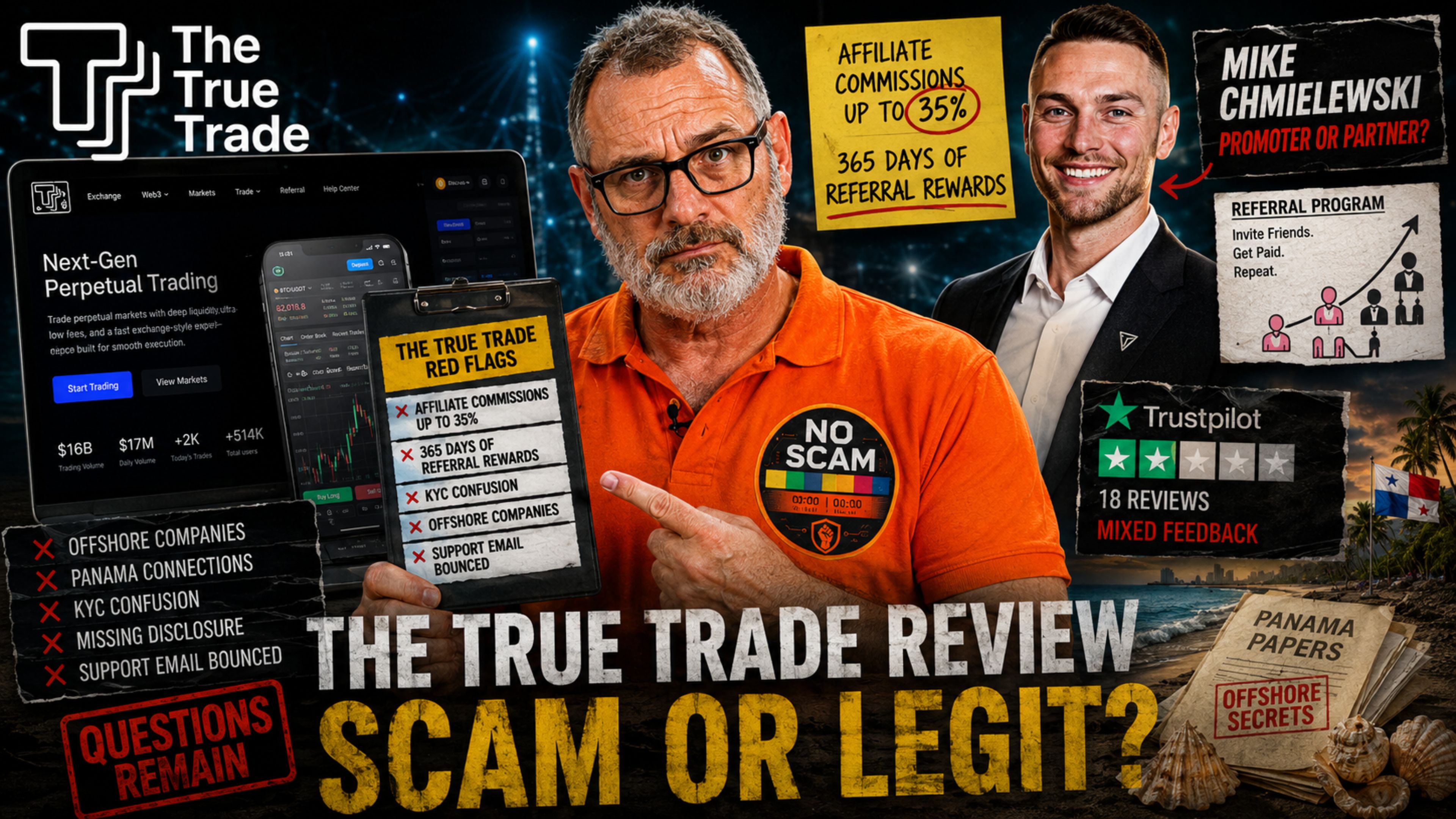
“The best scams don’t begin with someone asking for your money. They begin by asking for your trust.”
When I first began looking into The True Trade, I wasn’t investigating a collapsed investment scheme or a company accused of stealing millions of dollars.
On the surface, it appeared to be a modern cryptocurrency trading platform offering perpetual futures trading, Web3 integration, educational resources and an affiliate programme that rewarded users for introducing new traders.
None of those things are inherently suspicious on their own.
What caught my attention was one of the people promoting it.
 Mike Chmielewski was already familiar to me through my previous investigations into GOLIATH VENTURES. After discovering he was now directing people towards The True Trade, I decided to find out exactly what he was promoting.
What followed was far more than a simple platform review.
Over the following weeks I tested the platform myself, examined its referral programme, reviewed multiple versions of its websites, compared its published claims, analysed its corporate structure and even engaged directly with Mike after he challenged aspects of my research before this article was published.
The deeper I dug, the more questions emerged.
By the end of this investigation, I wasn’t simply reviewing a cryptocurrency exchange.
I was documenting an ecosystem built around affiliate marketing, multiple domains, offshore corporate structures and online promoters—and asking whether prospective users are being given enough independently verifiable information to make an informed decision before risking their money.
Following The Trail
My investigation began the same way many of them do—by examining the public face of the business.
I worked through The True Trade’s websites, reviewed its marketing material, examined its legal documents, tested the registration process and compared the features being promoted to prospective users. On the surface, the platform presents itself as a sophisticated cryptocurrency derivatives exchange offering perpetual futures trading, centralised (CEX) and decentralised (DEX) trading, low fees, high liquidity and professional-grade trading tools.
The more time I spent exploring the platform, however, the more I realised that trading wasn’t the only product being promoted.
Running alongside the exchange was a well-developed affiliate programme, complete with personalised referral links, commission tiers, performance targets and marketing tools designed to encourage users to recruit others. According to The True Trade’s own documentation, affiliates can earn between 20% and 35% of the trading fees generated by people who register through their referral links, with commissions continuing for up to 365 days after each referral joins. The platform even describes the process in remarkably simple terms: “Invite Friends. Get Paid. Repeat.”
There is nothing inherently improper about an affiliate programme.
What matters is how it is used.
Years of investigating online investment opportunities have taught me that when financial incentives are combined with educational content, influencers and personal branding, it can become increasingly difficult for prospective customers to distinguish between an independent recommendation and a commercial relationship.
That was the moment this investigation shifted.
I stopped looking solely at The True Trade and started looking at the people encouraging others to join it.
The Affiliate Engine Behind The Platform
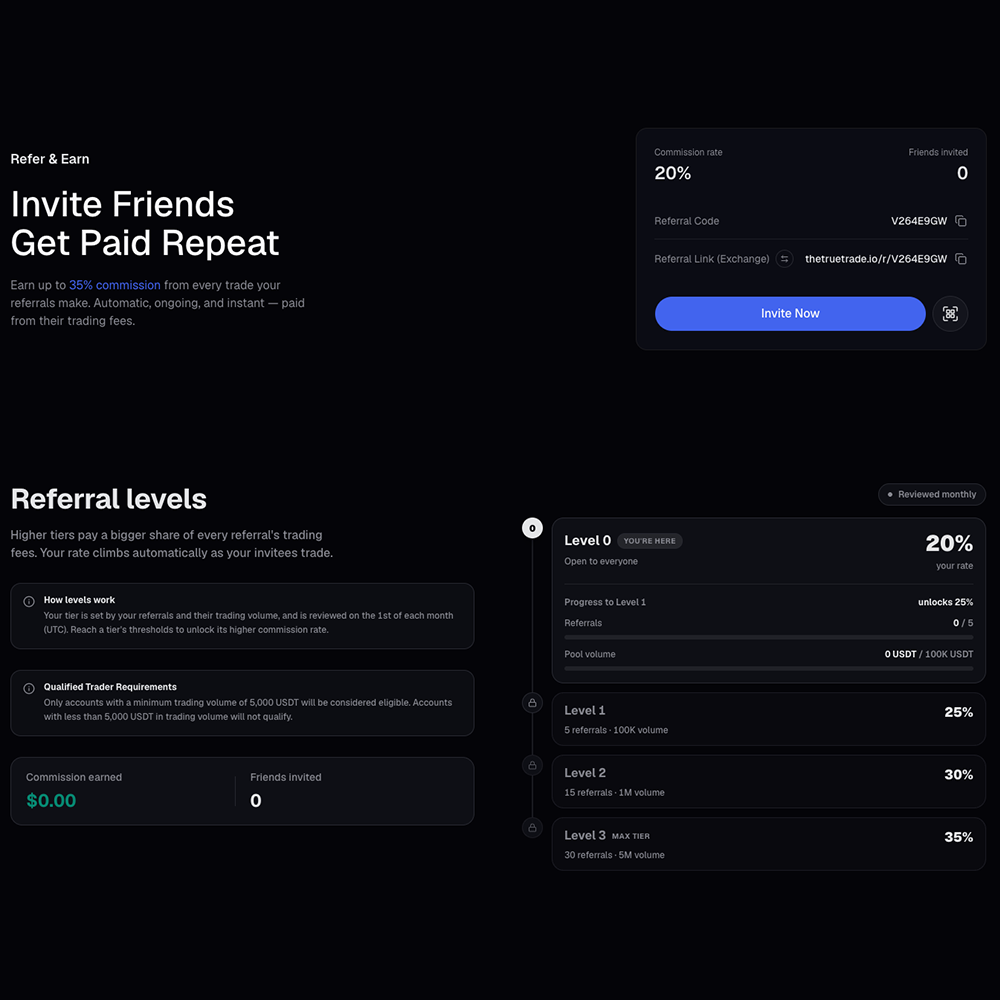
One of the first things I wanted to understand was how people were being introduced to The True Trade. Was the platform growing because experienced traders were independently recommending it, or was there a structured financial incentive encouraging people to recruit others? The answer was easy to find because The True Trade publishes the details of its own referral programme. Users receive a unique referral link, earn commissions from the eligible trading fees generated by the people they introduce, and can increase their commission rate as both the number of referrals and their cumulative trading volume grow. According to the platform, affiliates start at 20% and can progress to 35%, with commissions continuing for up to 365 days after a referred user registers.
The programme is designed to reward growth. As referral numbers and trading activity increase, affiliates automatically move through higher commission tiers. The platform actively encourages this behaviour with marketing phrases such as “Turn Friends Into Earnings” and “Invite Friends. Get Paid. Repeat.” That business model is not unusual within the cryptocurrency industry, and referral programmes are not inherently illegitimate. What matters is whether people following those referral links fully understand that the person recommending the platform has an ongoing financial incentive tied to their trading activity.
That distinction became increasingly important as I examined how The True Trade was being promoted across social media. Rather than relying on traditional advertising, much of the marketing appeared to come from individual personalities presenting themselves as traders, educators or mentors. Their audiences weren’t simply being introduced to an exchange; they were being invited into private communities, AI trading groups, educational academies and Telegram channels, all of which ultimately directed users towards The True Trade registration pages through personalised referral links. It was this ecosystem of education, community and affiliate marketing—not simply the exchange itself—that became the real focus of my investigation.
Mike Chmielewski’s Trading Academy
One name kept appearing throughout my research: Mike Chmielewski.
 Readers who have followed my previous investigations will already recognise Mike from GOLIATH VENTURES. According to documents and evidence gathered during that investigation, Mike introduced more than US$35 million of investor funds into GOLIATH before its collapse. He has not been charged with any criminal offence, and I make no allegation that he has committed one. However, bankruptcy court records show he was served with a Rule 2004 Subpoena, requiring him to produce financial records, communications and cryptocurrency-related information as investigators attempted to trace the movement of investor funds.
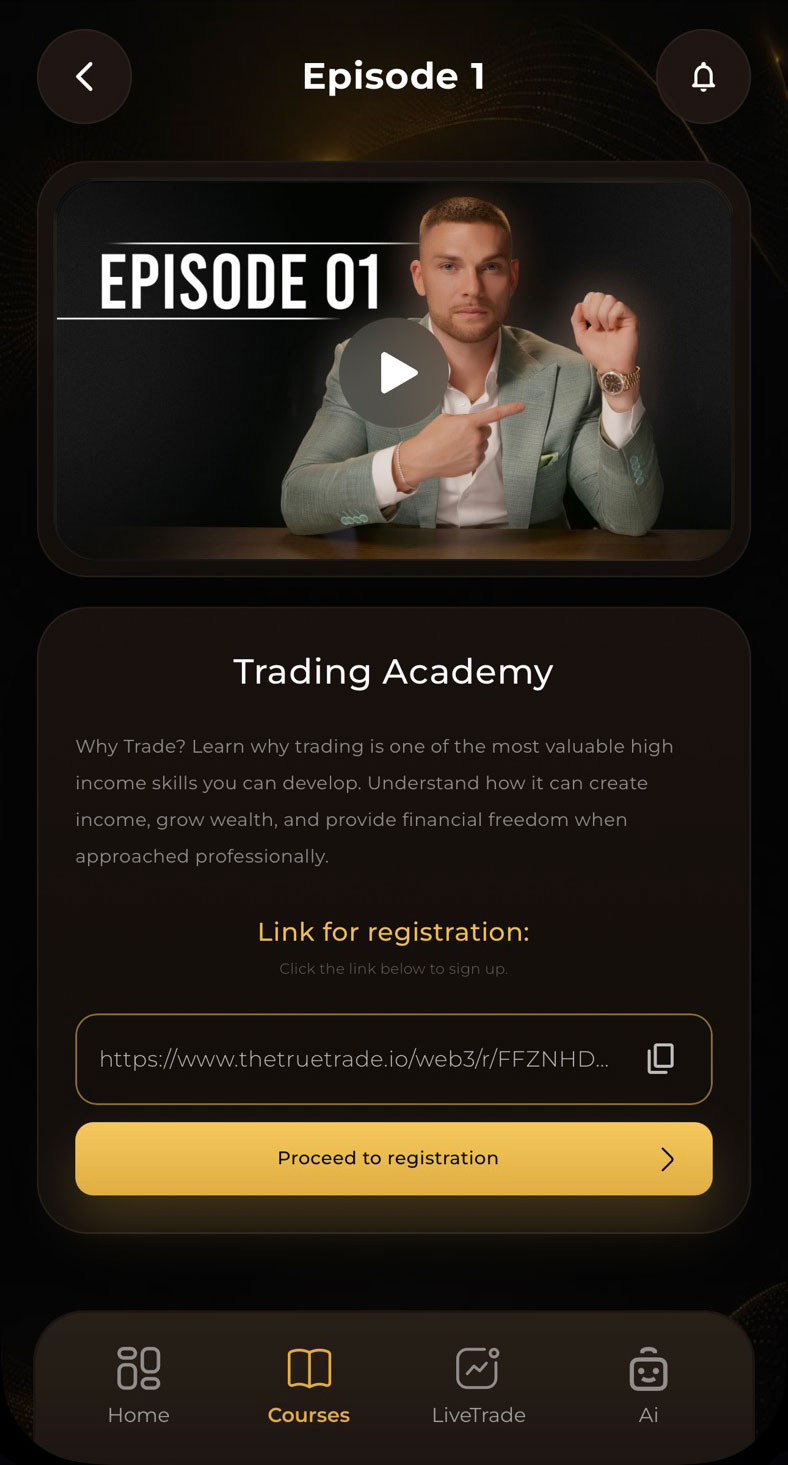
Today, Mike presents himself very differently. Through his Money Mike Academy, Telegram communities and AI-powered trading tools, he positions himself as an experienced trader helping others learn the markets. Rather than asking people to simply open a The True Trade account, he has built what appears to be a structured onboarding process that begins with free educational content and gradually guides users towards becoming active traders on the platform.
I worked through that onboarding process myself.
Across the Money Mike Academy, users are encouraged to progress through a series of training modules before reaching repeated prompts to register for The True Trade using Mike’s personalised referral link. They are then instructed to purchase USDT, create a trading account, maintain a balance, activate the AI tools and join the private community before continuing through the programme. The journey feels less like a single recommendation and more like a carefully designed funnel leading prospective traders towards one destination.
That, in itself, isn’t evidence of wrongdoing.
Many educators recommend products they genuinely use. Many businesses reward referrals. Those two facts can exist quite legitimately together.
What I found more interesting was what I couldn’t find.
Despite reviewing the academy, the onboarding process and the registration flow, I could not find any obvious disclosure explaining that the registration links being promoted were referral links capable of generating ongoing commissions for the promoter. The True Trade’s own referral programme states that affiliates can earn 20% to 35% of the eligible trading fees generated by referred users for up to 365 days after registration. Yet nowhere during the onboarding material I reviewed did I see a clear explanation informing prospective users of that continuing commercial relationship before they were encouraged to register and begin trading.
A Platform Older Than Its Owner?
One of the first checks I perform when investigating any online business is to see when its website first appeared. A company’s public history often reveals details that its marketing material does not.
Using the Wayback Machine, I found that thetruetrade.io had been archived 68 times between 12 August 2024 and 13 May 2026. That tells me the website was publicly accessible well before many of the legal documents now published on the platform.
That timeline immediately caught my attention.
Across the various versions of The True Trade’s websites, I found references to both THE REAL TRUE TRADE INC. and TheTrueTrade Ltd., alongside affiliated entities in Panama, Seychelles and Saint Lucia. That changing corporate presentation made it difficult to determine which legal entity was ultimately responsible for operating the platform. In other words, the website appears to have had a public presence for more than a year before the Panama company identified in the current documentation was incorporated.
There may be a perfectly legitimate explanation for this.
The platform may have operated under a different legal entity, existed as a beta project, undergone a corporate restructure or simply transferred ownership before the current company was established.
The point is not that the dates prove anything improper.
The point is that the publicly available documentation does not explain the timeline.
For prospective users, that creates a reasonable question.
Who was operating The True Trade before September 2025, and under which legal entity were those early activities conducted?
For a platform asking people to trust it with cryptocurrency, leveraged trading and potentially significant sums of money, understanding who has been responsible for the business over time is just as important as understanding who claims to operate it today.
On its own, the Wayback Machine timeline is simply another piece of evidence.
Viewed alongside the company’s corporate disclosures, however, it became another question that deserved a closer look.
Reading Between The Legal Lines
As I moved beyond the marketing and into The True Trade’s legal documentation, I expected to find clear answers about who was operating the platform and what protections users could expect.
Instead, I found a number of provisions that raised further questions.
The Terms and Conditions identify the website as being owned and operated by THE REAL TRUE TRADE INC. and explain that the platform provides both custodial (CEX) and non-custodial (Web3) trading services. The documents also state that the company reserves broad powers to suspend accounts, freeze access, require identity verification, request source-of-funds information and restrict users whenever it considers this necessary for security, compliance or regulatory purposes. None of those powers are unusual for a cryptocurrency exchange, but they become particularly important when users may initially be allowed to access parts of the platform without completing identity verification.
What I found more difficult to understand was the corporate structure itself.
Throughout the documentation I found references to THE REAL TRUE TRADE INC., while the website footer separately refers to TheTrueTrade Ltd. incorporated in Panama, an affiliated company in the Seychelles, and another affiliated company in Saint Lucia. The documents explain that these entities operate independently and retain rights to their respective brands and services, but they do not clearly explain which company is responsible for holding customer assets, operating the custodial exchange or contracting directly with users.
One clause in particular caught my attention.
Under Article 12 – Governing Law & Dispute Resolution, the Terms state:
“These Terms shall be governed by the laws of the jurisdiction selected by TheTrueTrade and finalized by legal counsel.”
That wording appears unusual because it does not actually identify the governing jurisdiction. Instead, it appears to leave that decision to be selected and finalised at a later stage. I cannot say whether this reflects an unfinished drafting provision, a placeholder that was never updated or a deliberate legal approach. However, for users considering depositing funds onto the platform, it raises a reasonable question: which country’s laws actually govern the agreement they are entering into?
Legal documents are often overlooked because they are lengthy and written in technical language.
In my experience, however, they frequently reveal far more about a business than the homepage ever will.
In the case of The True Trade, the legal documents answered some questions, but they also introduced several new ones about corporate responsibility, jurisdiction and accountability—questions that prospective users should understand before deciding which company they are ultimately placing their trust in.
No KYC, 1001x Leverage And Extraordinary Claims
During my investigation I discovered that The True Trade’s online presence had expanded across multiple domains, including thetruetrade.io, thetruetrade.net, thetruetrade.xyz and thetruetrade.ir. While many of the core marketing messages remain similar, each website introduces different claims, features and promotional material that prospective users should examine carefully before opening an account.
The platform repeatedly promotes itself as a decentralised exchange that allows users to trade without completing Know Your Customer (KYC) verification, describing privacy as one of its major advantages. Throughout the website it advertises:
- No KYC required
- Up to 1001x leverage
- Ultra-low trading fees
- Support for multiple cryptocurrency wallets
- Advanced Web3 technology
- 24/7 customer support
- Registration using Gmail, Telegram or a crypto wallet
The platform also states that users can earn money in two ways:
- By trading.
- By inviting other people through a personalised referral link.
One statement particularly caught my attention.
The website claims that The True Trade holds an “official Seychelles license” and describes itself as a legitimate and compliant platform. However, despite reviewing both public websites, I was unable to locate any licence number, regulator, or independently verifiable licensing documentation that would allow visitors to confirm that claim for themselves.
That does not automatically mean the claim is false.
It simply means that anyone relying on it should independently verify the licensing information before treating it as evidence of regulatory oversight.
The platform also promotes trading with leverage of up to 1001x, which is substantially higher than what many regulated exchanges permit. While high leverage can increase potential profits, it also dramatically increases the risk of rapid and significant losses.
Like many aspects of this investigation, the issue is not necessarily that these features exist.
It is whether prospective customers are being given enough independently verifiable information to properly assess the risks before depositing funds.
Multiple Domains, Multiple Stories
As this investigation progressed, I realised I wasn’t looking at a single website.
I was looking at an expanding network of domains, each presenting The True Trade in a slightly different way.
At the time of writing I identified four domains associated with the project:
- thetruetrade.io
- thetruetrade.net
- thetruetrade.xyz
- thetruetrade.ir (which now redirects visitors to the .io website)
Owning multiple domains is not unusual. Many legitimate companies do this to protect their brand or serve different regions.
What caught my attention was that these websites were not simply mirrors of one another.
Each promoted different features, different statistics, different promotional offers and, in some cases, completely different marketing messages.
The newer thetruetrade.xyz website, for example, heavily promotes:
- No KYC
- Leverage of up to 1001×
- Google, Telegram and wallet logins
- An Android application
- Self-custody and Web3 trading
- Orders processed in just 5 milliseconds
- 170,000 users
- Bonuses of both 100 USDT and 1,000 USDT
Meanwhile, thetruetrade.net focuses far more heavily on trading education, demo trading, Telegram communities and educational content, while also claiming users can trade without VPNs or sanctions affecting their accounts. The .ir domain appears to target Persian-speaking users before redirecting visitors back to the main .io platform.
Another inconsistency emerged when I tested the download links.
Several pages prominently advertise a mobile application for both Android and Apple devices. However, when I followed the App Store and Google Play buttons, they did not lead to an official The True Trade application. Instead, they redirected to the generic Apple App Store and Google Play homepages.
If an official mobile application exists, it was not accessible through the links promoted on the website.
Individually, none of these observations prove misconduct.
Collectively, however, they raise an obvious question.
When a financial platform operates across multiple domains, each presenting different claims, different user numbers, different promotional offers and different features, which version should prospective customers rely on before deciding to deposit their money?
Consistency builds confidence.
Constantly evolving marketing makes independent verification considerably more difficult.
The Iranian Connection And A Changing Story
While reviewing the newer thetruetrade.app website, I noticed another significant difference.
Unlike the main trading platform, the .app website openly markets itself toward Iranian users.
Throughout the site, it repeatedly states that Iranian traders can use the platform without worrying about sanctions, promotes cryptocurrency prices “in Iran,” and even answers the frequently asked question:
“Is The True Trade restricted for Iranian users?”
Its answer is unequivocal:
“No. As a decentralized exchange, The True Trade is not subject to sanctions-related restrictions, making it accessible to users from Iran and around the world.”
Elsewhere, the website states:
“In recent years, many traders have faced restrictions and challenges due to sanctions and limitations imposed by centralized exchanges. As a decentralized platform, The True Trade is not subject to these restrictions, allowing users from around the world, including Iranian traders, to trade freely and withdraw their profits without unnecessary limitations.”
The contact page raises further questions.
It lists an address in Tehran, Iran, displays an Iranian telephone number beginning with +98, promotes a Telegram support channel, and uses the email address support@truetrade.app.
None of this necessarily proves where the business is actually operated from.
However, it does present a noticeably different public image from the corporate information published on the trading platform, where The True Trade describes companies incorporated in Panama, Seychelles, and Saint Lucia.
Taken together, these different websites present a business with offshore corporate registrations, a platform heavily marketed toward Iranian users, and claims about avoiding sanctions by operating as a decentralised exchange.
For anyone considering depositing funds, those are important facts to understand before deciding who is actually operating the platform and which legal jurisdiction would ultimately apply if something went wrong.
Trust, Testimonials And A Changing Story
One of the questions I kept asking throughout this investigation was simple:
How much of The True Trade’s marketing can be independently verified?
The answer became more complicated the deeper I looked.
The platform doesn’t operate from a single website. During my investigation I identified thetruetrade.io, thetruetrade.net, thetruetrade.xyz and thetruetrade.ir, each presenting the project in slightly different ways. Some promote education, others focus on decentralised trading, while newer versions advertise Android apps, Web3 trading, 1001× leverage, bonus promotions and ever-increasing user numbers.
The marketing itself also changes over time.
Depending on which website you visit, The True Trade claims to have more than 145,000, 146,000 or 170,000 users. Promotional offers vary between 100 USDT and 1,000 USDT bonuses, while the platform describes itself as “the best decentralized exchange in the world” and advertises order execution in just 5 milliseconds.
None of these claims are necessarily impossible.
The challenge is that I could not find independent evidence verifying many of them.
The same issue applies to the testimonials.
Across the various websites, glowing endorsements are attributed to recognised figures including Johnny Lyu, identified as CEO of KuCoin, and Jackson Palmer, the creator of Dogecoin, alongside other traders praising the platform. Yet I could not locate any independent interviews, videos, public statements or social media posts confirming these endorsements. The websites simply present the quotations without supporting evidence.
I also reviewed Trustpilot.
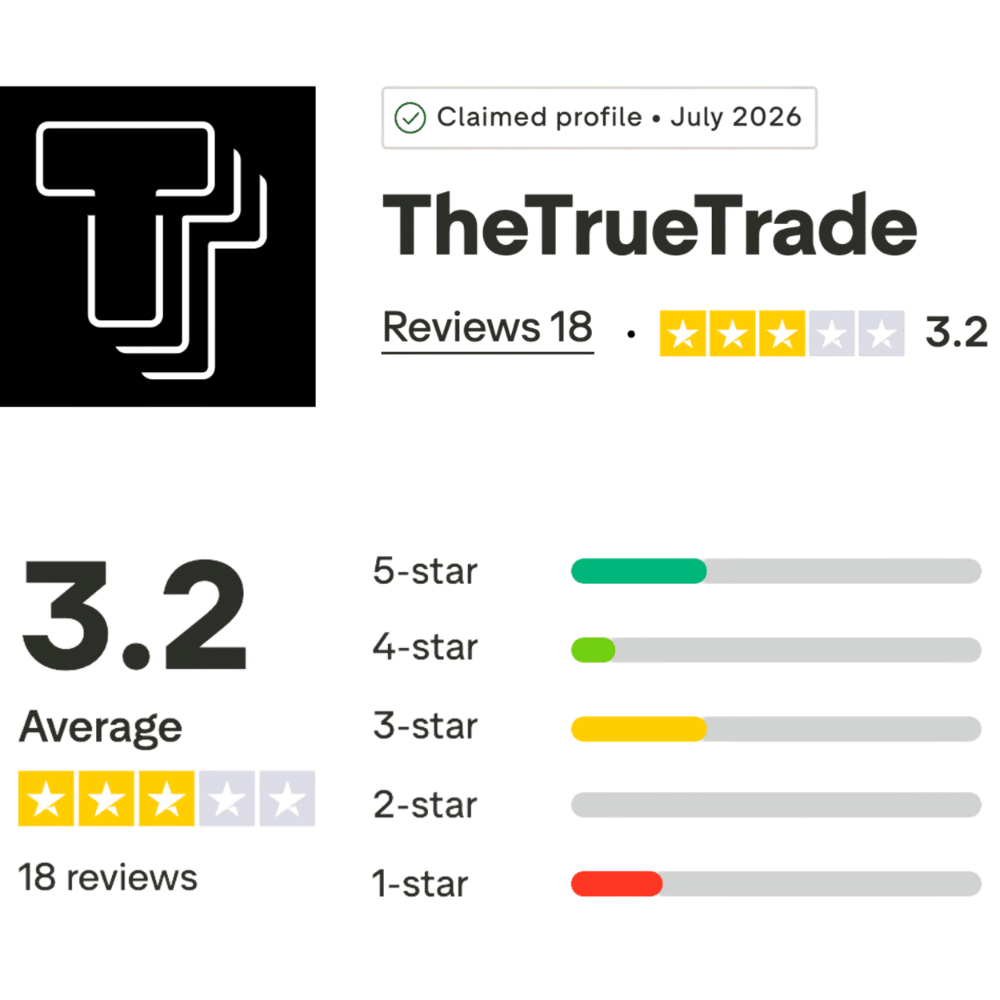 At the time of writing, the reviews paint a mixed picture. While some users praise the platform, others report concerns ranging from withdrawal problems and customer support issues to questions about the platform’s legitimacy. Online reviews should never be treated as definitive proof either way—they can be genuine, exaggerated or even manipulated—but they do provide another data point that prospective users should consider alongside the company’s own marketing.
Taken individually, none of these observations prove that The True Trade is operating improperly.
Taken together, however, they highlight a recurring pattern.
Multiple domains.
Changing marketing claims.
Changing user statistics.
Named testimonials without obvious supporting evidence.
Mixed customer reviews.
For anyone considering depositing cryptocurrency, those are all factors worth carefully weighing before deciding whether the platform has earned your trust.
The Referral Programme And The Missing Disclosure

As I continued my investigation, I wanted to answer a straightforward question: how are people like Mike Chmielewski incentivised to promote The True Trade?
The answer wasn’t hidden. It was published on The True Trade’s own referral pages.
The platform openly advertises that affiliates can earn between 20% and 35% of the trading fees generated by the people they introduce. Those commissions can continue for up to 365 days from the date a referred user registers. Affiliates progress through higher commission tiers by recruiting more traders whose combined trading volume reaches specific milestones.
Importantly, these commissions are generated from trading fees, not from a person’s initial deposit. Before this article was published, Mike Chmielewski challenged my understanding of this point. After reviewing The True Trade’s own referral documentation in detail, I concluded that he was correct. That distinction is important, but it does not change the broader issue I was investigating.
The more significant question is whether prospective users are being clearly informed that the person encouraging them to register may have a financial incentive to do so.
Throughout the onboarding process I documented, I encountered repeated referral links directing users to open The True Trade accounts. The Money Mike Academy embedded registration links beneath every lesson, while the Mikey AI Telegram bot repeatedly encouraged users to create an account, fund it with at least 500 USDT, and complete additional steps to begin trading.
What I did not observe during that onboarding process was a clear disclosure informing prospective users that the promoter providing the education and guidance could potentially earn referral commissions from their future trading activity.
That distinction matters because a referral relationship is more than just a hyperlink. It represents a commercial arrangement between the promoter and the platform. Even if commissions are paid from trading fees rather than deposits, users deserve to understand when recommendations may also benefit the person making them.
Whether readers ultimately consider that sufficient disclosure is a matter for them to decide. My role is simply to document what I observed, compare it with the platform’s published referral programme, and allow readers to reach their own informed conclusions.
A Promoter Responds
As this investigation was unfolding, I received an unexpected message.
It wasn’t from The True Trade.
It came from Mike Chmielewski, one of the platform’s most visible promoters.
After someone made him aware of my investigation, Mike contacted me directly via WhatsApp to challenge several aspects of my research. He argued that I had misunderstood how cryptocurrency exchange referral programmes operate, questioned my understanding of his trading background, and defended both his experience and the AI tools his team has developed.
Later that same day, while I was discussing this investigation during a live broadcast, Mike joined the YouTube chat under the handle @mikechmielewski8013 and encouraged me to read his WhatsApp message publicly. I welcomed his participation because investigations should always remain open to genuine scrutiny and correction where the evidence supports it.
Our discussion covered a wide range of topics, including his trading history, the development of his AI software, and the way cryptocurrency exchange referral programmes operate. His comments prompted me to revisit parts of my research and compare them against The True Trade’s own published documentation before this article was finalised.
Even after doing so, one question remained.
After reviewing the Money Mike Academy onboarding process, the Mikey AI registration flow and the referral links directing users to The True Trade, I found no obvious disclosure explaining that people registering through those links could generate ongoing referral income for the promoter.
I am not suggesting affiliate marketing is improper.
My concern is transparency.
If someone recommends a financial platform while standing to benefit financially from the ongoing trading activity of the people they introduce, I believe that relationship should be clearly disclosed before prospective customers decide whether to sign up.
The Conversation Continued
Publishing an investigation is rarely the end of the story.
In the 24 hours following publication, Mike Chmielewski and I exchanged a lengthy series of WhatsApp messages discussing both The True Trade and the investigation itself. Rather than disputing many of the questions raised throughout this article, much of our discussion centred on the way I conduct investigations, the use of the words “Scam Or Legit?” in my titles and thumbnails, and whether independent investigators should publicly scrutinise businesses before every question has been answered.
Mike argued that if someone investigated almost any cryptocurrency exchange thoroughly enough, they would inevitably find something that critics could portray as suspicious. He explained that he does not perform exhaustive due diligence on every exchange he uses or promotes, believing that every platform carries some degree of risk and that users must ultimately decide for themselves who they trust.
That exchange was revealing.
I don’t investigate businesses because I expect every one of them to be fraudulent.
I investigate them because history has repeatedly shown that investors often lose money after placing their trust in promoters who never asked the difficult questions themselves.
Throughout our conversation I noticed something else.
Despite several hours of discussion, the focus repeatedly shifted away from The True Trade itself and towards my journalism, my presentation and my investigative methods. Yet many of the underlying questions raised throughout this investigation remained unanswered.
That doesn’t make The True Trade illegitimate.
Nor does it make Mike wrong.
It simply reinforces why independent due diligence remains essential before committing money to any financial platform, regardless of who is recommending it.
Who Are You Really Trusting?
By the time I reached the end of this investigation, I realised it wasn’t really about leverage, perpetual futures or cryptocurrency trading.
It was about trust.
The True Trade presents itself as a professional trading platform with sophisticated technology, deep liquidity and a growing international community. It offers polished branding, detailed legal documents and an affiliate programme designed to accelerate growth. None of those things automatically make it illegitimate.
But trust isn’t earned because a website looks professional.
Trust is earned when a company is transparent about who owns it, how it operates, how its promoters are compensated and how it responds when legitimate questions are asked.
Throughout this investigation, I found multiple areas where that transparency was lacking.
I found offshore corporate structures with limited information about the people behind them. I found inconsistencies across different parts of the platform’s own documentation. I found an affiliate programme designed to reward ongoing trading activity for up to a year. I found promoters directing prospective traders through referral links without any obvious disclosure explaining the commercial relationship I observed during the onboarding process. And when I attempted to give the company a formal opportunity to respond using its published support email address, the mailbox rejected my message because it did not exist.
Mike Chmielewski deserves credit for engaging with my investigation when many promoters simply remain silent.
He corrected one important technical point, and I have reflected that correction in this article.
But the broader questions remain exactly where they were before he contacted me.
Who are the people ultimately responsible for The True Trade?
Why do different sections of the platform present different information?
Are referral relationships being disclosed clearly enough before prospective users register?
And if experienced traders genuinely believe this is the right platform for their audience, why not be completely transparent about every commercial relationship involved?
Those are not accusations.
They are questions.
After investigating hundreds of online investment opportunities over the years, I’ve learned that the questions companies choose not to answer are often just as revealing as the ones they do.
If The True Trade or Mike Chmielewski wishes to provide additional information, clarify any of the issues raised in this article or correct anything supported by evidence, I remain willing to review it and update this investigation accordingly.
Until then, I encourage readers to do what every investor should do before committing a single dollar.
Look beyond the marketing.
Follow the evidence.
And ask yourself one simple question:
Who are you really trusting?
Due Diligence Works Both Ways
One part of my conversation with Mike stood out more than anything else.
He explained that he does not investigate every platform he promotes in the same way I investigate businesses before publishing an article. In his view, if someone looked closely enough, they could probably find something negative about almost every cryptocurrency exchange.
There is some truth in that observation.
Every financial platform carries risk.
Every exchange has critics.
Every business deserves scrutiny.
But that is precisely why due diligence matters.
The purpose of an investigation is not to prove a business is fraudulent.
It is to separate ordinary commercial risk from claims that cannot be independently verified.
As someone who publicly encourages others to use a platform through personalised referral links, I believe promoters have a responsibility to understand the businesses they recommend, ask reasonable questions and be transparent about any financial relationship they have with the platforms they promote.
That standard is higher than simply opening an account for personal use.
When people place their trust in a promoter, they are often placing their trust in that promoter’s judgement.
That judgement deserves scrutiny too.
Throughout my conversation with Mike, I found myself returning to one simple question.
If a promoter hasn’t carried out detailed due diligence before recommending a platform, how can prospective users rely on that recommendation with confidence?
That isn’t an accusation.
It’s a question every investor should ask before following anyone’s referral link.
UPDATE – The Investigation Continues
One thing I’ve learned after investigating hundreds of online investment opportunities is that the first publication is rarely the final chapter.
Since publishing this investigation, Mike Chmielewski has contacted me directly and challenged both my findings and my investigative methods. One of his central criticisms was that he had not been given a proper opportunity to respond before publication.
The record shows otherwise.
On 14 September 2025, during my earlier investigation into GOLIATH VENTURES, I sent Mike a detailed right of reply to his Prime Ledger Capital email address. That correspondence contained a comprehensive series of questions covering his role with GOLIATH VENTURES, Prime Ledger Capital, investor referrals, compensation, compliance procedures and the evidence he relied upon when promoting the company.
I did not receive a response at the time.
Since then, I have continued investigating Mike’s public activities, attempted to contact him by telephone on numerous occasions and publicly invited him to participate in my livestream discussing The True Trade. It was only after this investigation was published that Mike chose to engage with me directly through WhatsApp.
When he did, I listened.
In fact, after Mike demonstrated that I had misunderstood one technical aspect of The True Trade’s affiliate commission structure, I reviewed the evidence, accepted the correction and amended this article accordingly.
That is exactly how responsible investigative journalism should work.
The purpose is not to defend an opinion.
It is to follow the evidence, correct genuine errors and continue asking the questions that remain unanswered.
Disclaimer: How This Investigation Was Conducted
This investigation relies entirely on OSINT — Open Source Intelligence — meaning every claim made here is based on publicly available records, archived web pages, corporate filings, domain data, social media activity, and open blockchain transactions. No private data, hacking, or unlawful access methods were used. OSINT is a powerful and ethical tool for exposing scams without violating privacy laws or overstepping legal boundaries.
About the Author
I’m DANNY DE HEK, a New Zealand–based YouTuber, investigative journalist, and OSINT researcher. I name and shame individuals promoting or marketing fraudulent schemes through my YOUTUBE CHANNEL. Every video I produce exposes the people behind scams, Ponzi schemes, and MLM frauds — holding them accountable in public.
My PODCAST is an extension of that work. It’s distributed across 18 major platforms — including Apple Podcasts, Spotify, Amazon Music, YouTube, and iHeartRadio — so when scammers try to hide, my content follows them everywhere. If you prefer listening to my investigations instead of watching, you’ll find them on every major podcast service.
You can WORK WITH ME for dedicated access to my time and investigative services — including private consultations, scam-risk reviews, sponsored investigations, support sessions, livestream scam breakdowns, and interviews. I’m also available for SPEAKING ENGAGEMENTS, where I share first-hand experience from years of exposing large-scale fraud, investigating scams, and supporting victims.
“Stop losing your future to financial parasites. Subscribe. Expose. Protect.”
My work exposing crypto fraud has been featured in:
- Coffeezilla 2026): Featured in the investigation exposing the alleged $328M Goliath Ventures Ponzi scheme
- Bloomberg Documentary (2025): A 20-minute exposé on Ponzi schemes and crypto card fraud
- News.com.au (2025): Profiled as one of the leading scam-busters in Australasia
- OpIndia (2025): Cited for uncovering Pakistani software houses linked to drug trafficking, visa scams, and global financial fraud
- The Press / Stuff.co.nz (2023): Successfully defeated $3.85M gag lawsuit; court ruled it was a vexatious attempt to silence whistleblowing
- The Guardian Australia (2023): National warning on crypto MLMs affecting Aussie families
- ABC News Australia (2023): Investigation into Blockchain Global and its collapse
- The New York Times (2022): A full two-page feature on dismantling HyperVerse and its global network
- Radio New Zealand (2022): “The Kiwi YouTuber Taking Down Crypto Scammers From His Christchurch Home”
- Otago Daily Times (2022): A profile on my investigative work and the impact of crypto fraud in New Zealand




Leave A Comment