


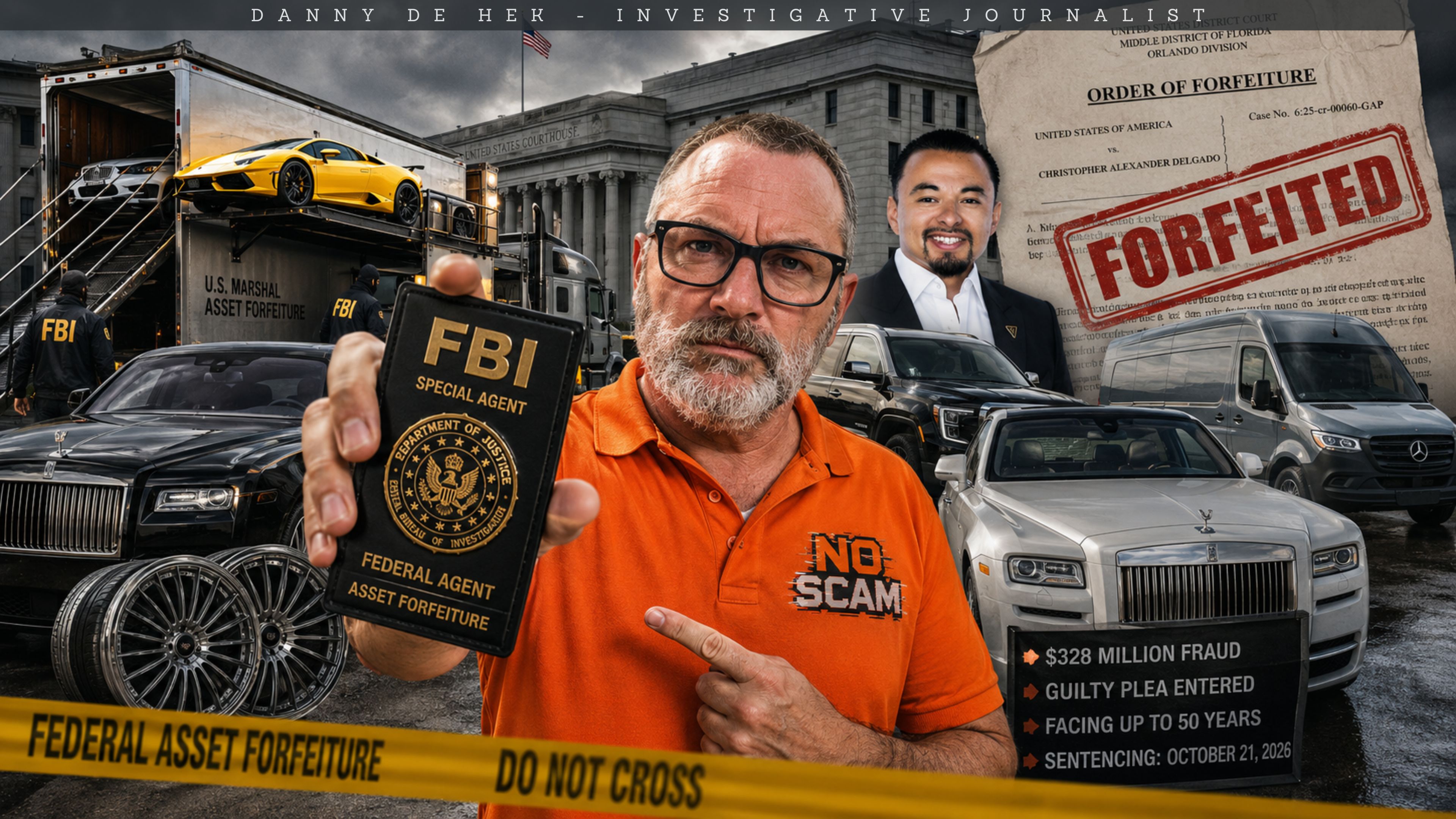
“The luxury cars were never the story. They were the marketing.”
For years, Goliath Ventures Inc. sold more than an investment opportunity. It sold an image of extraordinary success.
Social media was saturated with Rolls-Royces, Lamborghinis, Bentleys, yachts, private jets and exclusive events, creating the impression that Christopher Delgado and his inner circle had discovered a formula for limitless wealth. For many prospective investors, those luxury assets became proof that the business was thriving.
I’ve followed the Goliath Ventures investigation from the beginning, reviewing thousands of pages of court filings, bankruptcy records and criminal proceedings, watching hours of interviews, speaking with victims and documenting how one of the largest cryptocurrency fraud cases in recent years unfolded. Throughout that process, one thing has become increasingly clear: the luxury lifestyle wasn’t simply a by-product of the business—it was one of its most effective marketing tools.
The latest federal forfeiture filings pull back the curtain on what happened after the illusion collapsed. They reveal what became of the luxury vehicles that helped sell the dream and, more importantly, expose the financial reality behind them. Far from representing unlimited wealth, many of these assets were heavily financed, carried little recoverable equity and, in some cases, generated almost nothing once the lenders had been paid. It’s a powerful reminder that the appearance of success can be manufactured, while the underlying financial position tells a very different story.
The Luxury Lifestyle That Sold The Dream

When Goliath Ventures Inc. began attracting investors, it wasn’t simply selling the promise of monthly returns. It was selling a lifestyle that appeared to validate those returns.
Luxury vehicles, waterfront mansions, private jets, superyachts and exclusive networking events became powerful visual endorsements of the business. For many prospective investors, these weren’t just displays of wealth. They were presented as proof.
Christopher Delgado became the public face of that image.
Across social media, he regularly appeared alongside Rolls-Royces, Lamborghinis, Bentleys and other high-end vehicles, often surrounded by successful entrepreneurs, influencers and business associates. Every photograph reinforced the same message without needing to say a word.
Success was visible. Wealth looked effortless. Opportunity appeared real.
It’s a marketing strategy I’ve encountered repeatedly while investigating investment frauds. Before investors examine audited financial statements or ask difficult questions, they’re encouraged to believe the lifestyle itself is evidence that the opportunity must be legitimate.
Then everything changed.
Following his arrest, Delgado sat down for an extensive interview with WFTV investigative reporter Daralene Jones, where he openly discussed many of these vehicles as though they were simply part of everyday business.
He spoke about purchasing exotic cars, customising them and building what appeared to be an extraordinary collection, with little indication that those same assets would later become the subject of federal forfeiture proceedings.
Looking back today, the interview feels almost surreal.
The luxury fleet that once symbolised success has become evidence in one of the largest cryptocurrency fraud prosecutions in the United States. Vehicle by vehicle, the Government is now selling those same assets in an effort to recover whatever value remains for the forfeiture estate.
When The Government Started Selling The Assets
Once Christopher Delgado was arrested, the investigation entered a new phase. The focus shifted from identifying assets to selling them.
Federal forfeiture proceedings gave the United States Government the authority to begin liquidating luxury vehicles connected to Goliath Ventures Inc., with the goal of recovering whatever value remained after secured lenders had been paid. Any remaining proceeds could then be directed towards the forfeiture estate and, ultimately, victims.
As I worked through the court filings, I expected to see a collection of high-value assets capable of returning significant sums. Instead, the paperwork revealed something quite different.
Behind the Lamborghinis, Rolls-Royces and Bentleys was a recurring pattern. Many of the vehicles carried substantial finance obligations. In some cases, the outstanding debt absorbed almost the entire sale price. Others had so little equity that there was virtually nothing left once the lender exercised its legal rights.
That discovery fundamentally changed the way I looked at Goliath’s luxury fleet.
Throughout my investigations into investment fraud, I’ve seen expensive cars used repeatedly to create the appearance of credibility and success. Investors naturally assume that someone driving a collection of exotic vehicles must have accumulated enormous wealth. Yet these court records demonstrate that owning an expensive car and controlling meaningful equity in that car are two very different things.
As the Government began selling the vehicles, the carefully curated social media image started to unravel. The marketing projected unlimited wealth, but the financial records told a far less glamorous story—one built on finance agreements, secured creditors and surprisingly little recoverable equity.
The Lamborghini That Produced Very Little
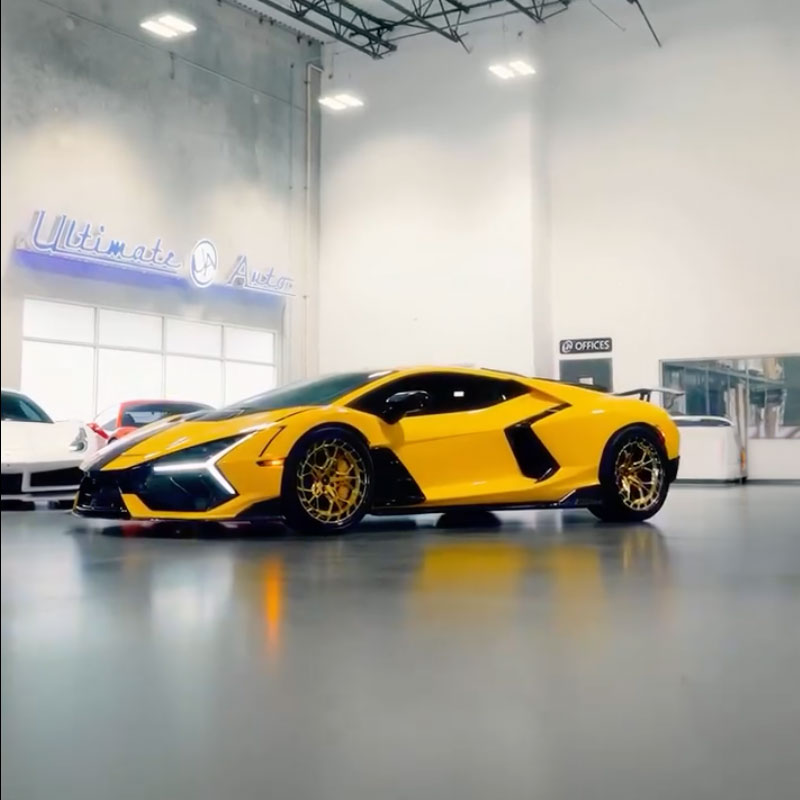
If there was one vehicle that embodied the Goliath Ventures brand, it was Christopher Delgado’s 2025 Lamborghini Revuelto. It wasn’t simply an expensive supercar. It became part of the company’s public image, appearing throughout promotional material that suggested Goliath had unlocked extraordinary financial success.
When I reviewed Delgado’s post-arrest interview with WFTV investigative reporter Daralene Jones, it was striking how casually he discussed the Lamborghini. He explained that the vehicle had originally cost around US$600,000 before extensive customisation, claiming an aftermarket body kit alone added another US$300,000 in value. According to Delgado, the work was carried out by Ultimate Auto, and he believed the finished car could be worth between US$700,000 and US$800,000.
The court records tell a very different story.
 According to the Federal Forfeiture Filing, the Government accepted an offer of US$625,000 for the Lamborghini. Ironically, the successful purchaser was Ultimate Auto — the very same company that had reportedly completed the vehicle’s extensive custom build. The business that transformed the Lamborghini into one of Goliath Ventures’ most recognisable status symbols ultimately became its new owner after the Government seized and sold it.
The problem was the finance.
Lamborghini Financial Services was still owed US$604,438.87 under its secured interest. Once the lender had been paid, only US$20,561.13 remained before storage, seizure and administrative costs were deducted.
That is an astonishingly small recovery for one of the most recognisable symbols of the Goliath lifestyle. It also reinforces one of the biggest lessons from this investigation. The value of an asset and the amount of equity in that asset are not the same thing.
For years, the Lamborghini projected wealth, success and credibility. When the Government eventually sold it, the paperwork revealed something very different. Despite hundreds of thousands of dollars reportedly being spent transforming the car into a one-of-a-kind showpiece, there was almost no equity left once the secured lender was paid. The Lamborghini looked like an extraordinary asset, but in reality, it generated very little for the victims it was supposed to help compensate.
The Rolls-Royce And The Missing Wheels

While reviewing the Forfeiture Filings, one detail immediately caught my attention. It wasn’t the sale price or the outstanding finance—it was a brief footnote explaining why one prospective buyer had walked away from Christopher Delgado’s 2024 Rolls-Royce Ghost.
By the time the Government moved to sell the vehicle, the IRS had already incurred storage and maintenance costs, while BMW Financial Services remained owed approximately US$242,914.69 under its secured interest. The objective was straightforward: obtain the best available price so the lender could be repaid and any remaining equity preserved for the forfeiture estate.
Several dealerships expressed interest in purchasing the vehicle. Three submitted formal offers, while a fourth initially appeared ready to proceed before unexpectedly withdrawing.
The reason was surprisingly simple.
According to the court filing, the dealership lost interest after discovering the Rolls-Royce no longer had its original factory wheels. The document doesn’t speculate about when the wheels were changed, why they were replaced or what became of the originals. It simply records that the missing factory wheels affected the buyer’s willingness to proceed.
The Government ultimately accepted the highest remaining offer of US$260,000 from an Orlando broker, who was also prepared to transport the vehicle from North Carolina. Once BMW Financial Services received payment of US$242,914.69, only US$17,085.31 remained before storage, transport and other administrative costs were deducted.
On its own, the missing wheels might seem like an insignificant detail. Yet investigations are often built on details exactly like this. A single sentence buried in a court filing can explain why a vehicle sold for less than expected or why one buyer walked away while another stepped in. These are the kinds of observations that rarely make the headlines but often provide valuable insight into what happened behind the scenes.
The Cars That Produced Nothing
While reviewing the forfeiture filings, one discovery stood out more than any other. Some of the most prestigious vehicles in Goliath Ventures’ luxury fleet weren’t sold at all.
After examining the court records, I found the Government had abandoned its forfeiture claims because there was no meaningful equity left to recover once the secured lenders’ interests had been taken into account.
The vehicles included:
- 2024 Bentley Bentayga
- 2023 Lamborghini Huracán EVO Spyder
- 2023 Rolls-Royce Cullinan
Rather than being auctioned, each vehicle was returned to its respective finance company because the outstanding debt exceeded any remaining recoverable value. From a financial perspective, there was little or nothing left that could benefit the forfeiture estate or, ultimately, the victims.
That finding completely changes how the luxury fleet should be viewed.
For years, these vehicles helped project an image of extraordinary wealth. The reality revealed by the court filings was very different:
- The vehicles looked valuable.
- The finance companies held most of the financial interest.
- There was no meaningful equity left to recover.
- The Government abandoned forfeiture because selling them would not produce a meaningful return.
I’ve seen this pattern before while investigating investment fraud. Luxury cars are often used as visual proof of success, encouraging prospective investors to believe they’re looking at genuine wealth. These forfeiture records demonstrate why appearances can be misleading. Until you know who actually owns the asset and how much debt is attached to it, it’s impossible to judge someone’s true financial position.
The Remaining Fleet
Not every vehicle in the Goliath Ventures fleet was heavily financed.
The forfeiture proceedings also identify several vehicles that, according to the court records, were not subject to recorded liens. That means any proceeds from their eventual sale should contribute more directly to the forfeiture estate rather than being absorbed by finance companies.
The remaining vehicles include:
- 2025 Cadillac Escalade V
- 2024 Lincoln Navigator L
- 2022 Mercedes-Benz Sprinter
- 2017 Mercedes-Benz C300
- 2022 GMC Sierra HD
- 1951 Mercury
According to the Court Filings, the Cadillac Escalade, Lincoln Navigator, Mercedes Sprinter and Mercedes C300 were registered to Goliath Ventures Inc., while the GMC Sierra HD and 1951 Mercury were registered to David Stuart, who consented to their forfeiture. The Chapter 11 bankruptcy trustee likewise consented to the forfeiture of the vehicles owned by Goliath Ventures.
Unlike the Lamborghini Revuelto and Rolls-Royce Ghost, these vehicles do not appear to carry recorded secured interests. That doesn’t necessarily mean every dollar from their sale will be available for victims, but it does increase the likelihood that a greater proportion of the proceeds will remain in the forfeiture estate after sale-related costs have been deducted.
At the time of writing, the Government has not disclosed the final sale prices or recovery values, so it remains to be seen how much these vehicles will ultimately contribute to the recovery process.
What The Numbers Actually Reveal
Stepping back and looking at the figures as a whole, a consistent pattern begins to emerge.
The Lamborghini Revuelto and Rolls-Royce Ghost sold for a combined US$885,000, yet once the secured lenders had exercised their legal rights, only about US$37,646 remained before storage, transport and other Government costs were deducted. Meanwhile, three additional luxury vehicles generated no recoverable proceeds at all because the outstanding finance exceeded their remaining value.
Those figures tell a story that social media never could.
Throughout Goliath Ventures’ rise, the luxury fleet projected an image of extraordinary wealth and financial success. Investors saw exotic cars, assumed they were owned outright and naturally concluded the business must be highly profitable. The forfeiture records expose a different reality. Many of those same vehicles were heavily financed, leaving little or no equity once the lenders were repaid.
For me, this is one of the most important lessons to emerge from the investigation. Luxury assets should never be mistaken for proof of financial strength. Without knowing who owns an asset, how it was financed and how much equity actually exists, it’s impossible to judge someone’s true wealth. In the case of Goliath Ventures, the court records reveal that much of the lifestyle which helped attract investors was built on assets that ultimately produced very little when the illusion came to an end.
From Seizure To Sentencing
The sale of Goliath Ventures’ luxury assets is only one chapter in a much larger story. While the Government continues recovering and liquidating property connected to the scheme, the criminal proceedings against Christopher Alexander Delgado are now approaching their conclusion.
On 23 June 2026, Delgado pleaded guilty to conspiracy to commit wire fraud, wire fraud and money laundering, admitting his role in what prosecutors say was a scheme that raised approximately US$328 million from investors. Under the offences to which he pleaded guilty, he faces up to 50 years in federal prison, although the final sentence will ultimately be determined by the Court after considering the advisory sentencing guidelines and all relevant factors.
Since then, the Court has rescheduled Delgado’s sentencing hearing from 8 October 2026 to 21 October 2026 at 9:00 a.m., before U.S. District Judge Gregory A. Presnell in Orlando. Court records indicate the parties expect the hearing to last approximately three hours, suggesting the Judge will have substantial matters to consider before imposing sentence.
As the sentencing date approaches, the forfeiture process continues in parallel. Luxury vehicles are being auctioned, real estate is being sold and financial records continue to be examined as investigators work to trace investor funds and recover whatever assets remain.
For the thousands of people affected by the collapse of Goliath Ventures, these proceedings represent far more than the disposal of expensive cars. They mark the final stages of an investigation that transformed social media images of extraordinary success into evidence presented before a federal court. Whatever sentence is ultimately imposed, the outcome will bring one of the largest cryptocurrency fraud prosecutions in recent years a significant step closer to its conclusion.
The Difference Between Image And Reality
After investigating hundreds of investment opportunities over the years, I’ve noticed a pattern that repeats itself with remarkable consistency.
The lifestyle almost always arrives before the legitimacy.
Long before investors see audited financial statements or independently verified performance, they’re shown the rewards. Exotic cars, luxury homes, private jets, expensive holidays and exclusive events become part of the sales presentation. Whether intentional or not, those images encourage people to believe they’re looking at the results of a successful business rather than asking how that success was actually achieved.
Goliath Ventures followed that same pattern. The luxury vehicles became powerful marketing tools, helping to create an image of financial strength that attracted confidence and, ultimately, investment. Yet the forfeiture records reveal that appearances can be deceptive. Some of the most recognisable assets in the company’s luxury fleet carried significant debt, while others generated little or no recoverable value once the finance companies had been paid.
That’s why I encourage people to look beyond the lifestyle and ask the questions that really matter:
- Who actually owns the asset?
- Is it financed or owned outright?
- How much equity is really there?
- Where did the money originally come from?
- Can the claimed success be independently verified?
Those are the questions that protect investors.
They’re also the questions that rarely appear in promotional videos.
The Story Behind The Cars
When I first began investigating Goliath Ventures Inc., the luxury vehicles seemed almost incidental to the broader story. My attention was focused on the investment model, the promised returns, the growing number of victims and the mounting regulatory and legal action.
As the investigation progressed, however, those vehicles took on a much greater significance.
They weren’t simply expensive possessions. They became part of the company’s public identity, reinforcing the impression that Goliath Ventures had achieved the kind of financial success most investors could only dream about. Every Lamborghini, Rolls-Royce and Bentley helped create an image that was difficult to question because it appeared to be backed by visible wealth.
The federal forfeiture proceedings tell a very different story.
Rather than uncovering a fleet of unencumbered luxury assets, the court records reveal vehicles carrying substantial finance obligations, limited equity and, in some cases, no recoverable value at all. What appeared on social media as extraordinary wealth often proved to be far less valuable once the lenders had exercised their legal rights.
Today, many of those same vehicles are being sold by the United States Government as part of the ongoing asset recovery process. Christopher Alexander Delgado has pleaded guilty to conspiracy to commit wire fraud, wire fraud and money laundering, and is scheduled to be sentenced on 21 October 2026, where he faces up to 50 years in federal prison. The luxury fleet that once helped attract investors has become evidence in one of the largest cryptocurrency fraud prosecutions in the United States.
For me, this investigation reinforces an important lesson that extends far beyond Goliath Ventures. A luxury lifestyle should never be mistaken for proof of legitimacy. Expensive cars, designer watches and exclusive events can all be purchased, financed or leased. What cannot be manufactured so easily are independently verified financial records, transparent business operations and honest answers to difficult questions.
In the end, the Lamborghinis and Rolls-Royces were never the real story.
They were simply the props.
The real story was what they persuaded people to believe.
Disclaimer: How This Investigation Was Conducted
This investigation relies entirely on OSINT — Open Source Intelligence — meaning every claim made here is based on publicly available records, archived web pages, corporate filings, domain data, social media activity, and open blockchain transactions. No private data, hacking, or unlawful access methods were used. OSINT is a powerful and ethical tool for exposing scams without violating privacy laws or overstepping legal boundaries.
About the Author
I’m DANNY DE HEK, a New Zealand–based YouTuber, investigative journalist, and OSINT researcher. I name and shame individuals promoting or marketing fraudulent schemes through my YOUTUBE CHANNEL. Every video I produce exposes the people behind scams, Ponzi schemes, and MLM frauds — holding them accountable in public.
My PODCAST is an extension of that work. It’s distributed across 18 major platforms — including Apple Podcasts, Spotify, Amazon Music, YouTube, and iHeartRadio — so when scammers try to hide, my content follows them everywhere. If you prefer listening to my investigations instead of watching, you’ll find them on every major podcast service.
You can WORK WITH ME for dedicated access to my time and investigative services — including private consultations, scam-risk reviews, sponsored investigations, support sessions, livestream scam breakdowns, and interviews. I’m also available for SPEAKING ENGAGEMENTS, where I share first-hand experience from years of exposing large-scale fraud, investigating scams, and supporting victims.
“Stop losing your future to financial parasites. Subscribe. Expose. Protect.”
My work exposing crypto fraud has been featured in:
- Coffeezilla 2026): Featured in the investigation exposing the alleged $328M Goliath Ventures Ponzi scheme
- Bloomberg Documentary (2025): A 20-minute exposé on Ponzi schemes and crypto card fraud
- News.com.au (2025): Profiled as one of the leading scam-busters in Australasia
- OpIndia (2025): Cited for uncovering Pakistani software houses linked to drug trafficking, visa scams, and global financial fraud
- The Press / Stuff.co.nz (2023): Successfully defeated $3.85M gag lawsuit; court ruled it was a vexatious attempt to silence whistleblowing
- The Guardian Australia (2023): National warning on crypto MLMs affecting Aussie families
- ABC News Australia (2023): Investigation into Blockchain Global and its collapse
- The New York Times (2022): A full two-page feature on dismantling HyperVerse and its global network
- Radio New Zealand (2022): “The Kiwi YouTuber Taking Down Crypto Scammers From His Christchurch Home”
- Otago Daily Times (2022): A profile on my investigative work and the impact of crypto fraud in New Zealand
Leave A Comment