


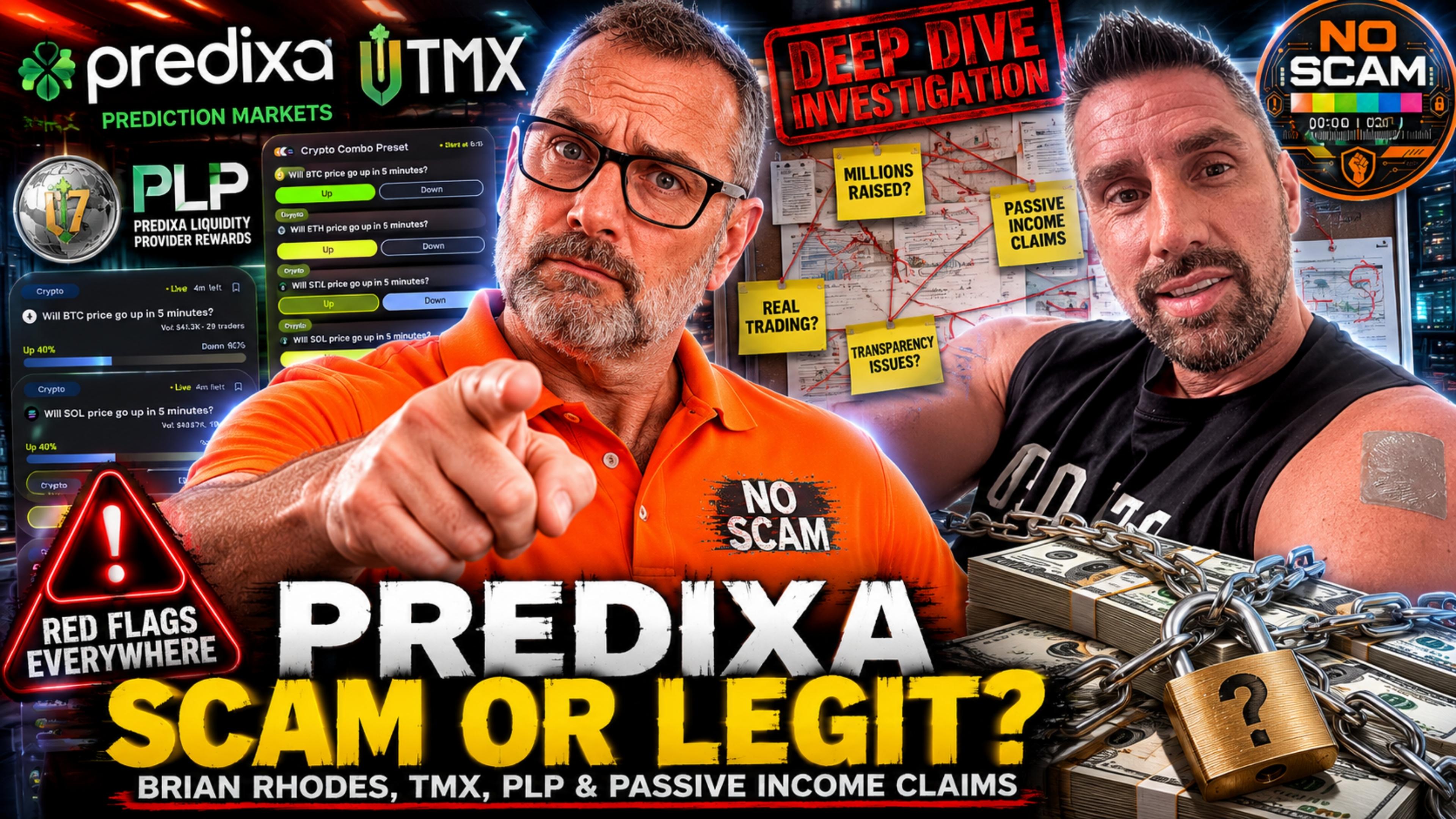
“Whenever someone promises passive income from a platform that hasn’t yet proved itself, the first question isn’t how much you might make. The first question is where the money is really coming from.”
I’ve spent years investigating cryptocurrency schemes, MLM opportunities and investment programmes that promised ordinary people extraordinary returns. The branding changes. The technology evolves.
The buzzwords move from crypto mining to AI trading, from staking to decentralised finance, and now to prediction markets. But the underlying questions never change. Who controls the money? How are returns actually generated? And do the public claims stand up to scrutiny?
Those questions led me to Predixa, a prediction market operating within the wider TMX Ecosystem. At first glance, everything appears polished and professional. The websites are modern, the documentation is extensive, the branding is consistent and the marketing is filled with the kind of technical language that gives the impression of a mature decentralised finance project. But as I began digging deeper, reviewing hours of promotional presentations, analysing the project’s documentation, comparing public statements with its own Terms of Service and reading months of discussions inside the official Discord community, a very different picture started to emerge.
This investigation isn’t based on rumours or anonymous tips. It is built on Predixa’s own website, its own legal documents, its own promotional material, its own community discussions, and the public statements made by those promoting the project. Along the way I found contradictions, unanswered questions and marketing claims that deserve much closer scrutiny before anyone decides to transfer their cryptocurrency into the TMX ecosystem.
What Is Predixa?
Predixa describes itself as a decentralised prediction market built on the Arbitrum blockchain, where users can speculate on the outcome of real-world events. Rather than buying or selling cryptocurrencies directly, participants stake USDT on questions with a simple YES or NO outcome. These markets range from cryptocurrency price movements and financial indicators through to politics, sport and other current events. If your prediction is correct, you receive a share of the losing side’s pool. If you’re wrong, your stake is redistributed to those who picked the winning outcome.
On the surface, there is nothing inherently unusual about that business model. Prediction markets have existed for years, and decentralised versions have become increasingly popular as blockchain technology has matured. Predixa presents itself as the next step in that evolution, promoting features such as wallet-native trading, no mandatory KYC, low transaction fees, one-click predictions, and smart contracts that automatically settle markets using on-chain oracle data.
As I worked through the website, however, it became obvious that the prediction markets were only part of the story. Almost every road eventually led back to another product called PLP. The website repeatedly encouraged visitors to become part of the ecosystem before the opportunity closed, while promoters spent far more time discussing passive income, fee sharing and future rewards than they did explaining how prediction markets actually worked. That immediately raised another question in my mind: was Predixa really being marketed as a platform for making predictions, or was it being marketed as an investment opportunity wrapped around a prediction platform?
Following The Money Leads To PLP
The more time I spent examining Predixa, the more I realised the prediction markets weren’t the primary focus of the promotional material. Again and again, presenters steered the conversation towards PLP, a fundraising mechanism that was promoted as giving contributors access to a share of the platform’s future success. Rather than encouraging people to simply use Predixa as a trading platform, the emphasis shifted towards becoming an early participant before the opportunity closed.
According to the presentations I reviewed, contributors purchase PLP using USDT on the Arbitrum network. In return, they are told they will participate in a share of the fees generated by Predixa. Promotional material repeatedly describes PLP as a way of benefiting from the activity of other users rather than relying solely on your own predictions. In simple terms, the message being delivered was that other people would use the platform, generate fees, and PLP holders would receive a portion of that revenue. Unsurprisingly, that narrative proved far more attractive than simply inviting people to place bets on market outcomes.
That distinction matters because it fundamentally changes the conversation. Someone using Predixa to speculate on whether Bitcoin will rise over the next hour is taking part in a prediction market. Someone contributing thousands of dollars into PLP because they expect ongoing passive income is making a very different decision. Throughout my investigation, I found that promoters devoted considerably more time to discussing future fee distributions, passive income, buybacks, token appreciation and ecosystem growth than they did explaining the practical risks of prediction markets themselves.
At that point, I stopped thinking of PLP as just another token inside the ecosystem. Instead, I started asking a much simpler question.
What exactly are people buying?
The answer wasn’t nearly as straightforward as I expected.
How TMX Explains The Opportunity

To understand how Predixa was being promoted, I stopped reading the marketing material and started watching the presentations. That’s often where you discover how an opportunity is actually being sold. Websites are carefully worded by lawyers and marketing teams. Live presentations are different. That’s where promoters explain the opportunity in plain language, answer questions and reveal what they believe will persuade people to participate.
One of the most prominent presenters I reviewed was Brian Rhodes. Across multiple webinars, he speaks about Predixa and the wider TMX Ecosystem as someone closely involved with the project. Rather than referring to the platform from the outside, he repeatedly uses phrases like “we’ve built,” “our platform,” “our ecosystem,” and “we raised.” He discusses fundraising progress, development milestones, tokenomics and future plans in a way that suggests he has direct knowledge of the project rather than simply acting as an independent affiliate promoting someone else’s product.
What struck me most wasn’t the technical explanation of prediction markets. It was how quickly the conversation shifted towards passive income. Again and again, the emphasis returned to the same central message: contribute to PLP, allow the platform to grow, and share in the fees generated by everyone else using the ecosystem. The prediction markets themselves almost became secondary. The real attraction being presented was the possibility of building an income stream from the activity of future users.
That distinction became even clearer when I began comparing Brian Rhodes’ presentations with Predixa’s own documentation. As the investigation progressed, I found that some of the most confident public claims made during webinars sat uncomfortably alongside what the project’s own legal documents actually said. Those inconsistencies became one of the most important parts of this investigation.
The Promise Of “Forever Passive Income”
One presentation, in particular, caught my attention. It wasn’t just because of what was said, but because of how it was framed. The title alone set the tone:
“Predixa Overview – Forever Passive Income.”
Those three words immediately raised a red flag. In my experience investigating cryptocurrency projects and MLM opportunities, phrases like “forever passive income” deserve careful scrutiny. They create an expectation that a single contribution today could continue generating income indefinitely. That’s an extraordinary promise, and extraordinary promises deserve equally extraordinary evidence.
As I watched the presentation, Brian Rhodes explained that PLP contributors weren’t expected to actively trade prediction markets themselves. Instead, the opportunity was presented as a way to benefit from the activity of everyone else using the platform. The more trading that occurred, the greater the fees generated. The more fees generated, the greater the potential distributions to PLP holders. Throughout the presentation, the emphasis wasn’t on becoming a skilled predictor—it was on becoming an early participant in what was described as a growing ecosystem.
At various points, Brian walked viewers through earnings illustrations based on projected trading volumes. One example suggested that a significant PLP contribution could potentially recover its original cost within a matter of weeks under favourable assumptions. Other scenarios projected daily passive income that would far exceed what many people earn from full-time employment. Although these were presented as examples rather than guarantees, they painted a compelling picture of financial independence built on the future success of the platform.
That immediately led me to another question.
What evidence existed that these projections were realistic?
At that stage of my investigation, I still hadn’t seen independently verified trading volumes, audited fee distributions or historical financial data demonstrating that the platform had ever generated anything close to the revenue required to support those illustrations. The projections were certainly attractive, but they depended almost entirely on assumptions about future growth rather than proven performance.
When The Numbers Started Changing
Promotional projections are one thing. Whether they remain consistent over time is another. As I continued reviewing the evidence, I moved beyond the presentations and into the project’s official Discord community. That’s often where polished marketing gives way to candid conversations between members, moderators and promoters discussing what is actually happening behind the scenes.
One discussion immediately stood out. Community members were comparing the PLP earnings calculator used during Brian Rhodes’ presentations with a newer version that had later appeared. Several people questioned why the projected returns had fallen so dramatically. One member commented that an allocation which had previously been estimated to generate around US$46 per day was now showing closer to US$5 per day under the updated calculator. It wasn’t a small adjustment—it represented a substantial reduction in the income expectations being discussed within the community.
The response from moderators wasn’t that the earlier figures had been wrong. Instead, they explained that the assumptions had been revised to produce a more conservative model. While there is nothing inherently improper about updating financial projections as new information becomes available, it does highlight an important issue. If early participants made decisions based on one set of projected returns, and those projections later changed significantly, they deserve a clear explanation of what changed and why.
What also caught my attention was the reaction from some community members. The conversation wasn’t centred on prediction markets or trading strategies. It revolved around passive income, return on investment and whether the revised figures still justified contributing to PLP. That reinforced an observation I’d already made from the presentations: for many people engaging with TMX, the primary attraction wasn’t making predictions—it was the expectation of earning ongoing income from the platform itself.
Inside The Discord Community
The Discord archive gave me something the public website could not: a record of how prospective participants were actually interpreting the opportunity. Members repeatedly discussed PLP allocations, projected earnings, fundraising totals, fee distributions and launch dates. There was comparatively little discussion about whether Predixa’s individual markets were attractive, whether the odds were competitive or whether the platform had enough genuine trading activity to sustain the returns being promoted.
One member referred directly to Brian Rhodes’ webinar and calculated that a US$1,000 PLP contribution could potentially generate around US$1,000 per month. He then asked whether a US$10,000 contribution could therefore produce roughly US$10,000 each month. The conversation quickly moved into life-changing territory, including jokes about selling a car and no longer needing to work. Another member responded that “the sky’s the limit.” These were not people discussing a modest loyalty reward. They were interpreting PLP as a possible route to financial freedom.
That matters because promoters often protect themselves by saying examples are only illustrations. But when multiple community members begin discussing whether they can replace their salaries, recover their capital within weeks or restructure their lives around projected income, the effect of the marketing becomes impossible to ignore. The wording may stop short of a formal guarantee, but the impression being created is still powerful.
The Discord discussions also showed that the project had reportedly raised approximately US$5.77 million for the PLP liquidity pool. Moderators explained that the contributed capital would become part of the platform’s liquidity base, while fees generated through activity would be distributed separately. Yet members were still waiting for clear public reporting showing how much real trading was taking place, how many fees were being generated and whether the platform’s early performance could support any of the income projections circulating within the community.
The Launch That Wasn’t Quite A Launch
As I pieced together the timeline, another inconsistency emerged. Public announcements celebrated the arrival of Predixa, describing it as a live platform ready for users. Yet at the same time, the website continued promoting a limited-time PLP presale, complete with a countdown encouraging people to participate before the opportunity closed.
That immediately struck me as unusual. Most technology companies launch a product first and allow the market to determine its success. Here, the product launch and the fundraising campaign appeared to overlap. The prediction market was presented as operational, while contributors were still being encouraged to buy into the ecosystem before the fundraising window expired.
The Discord discussions reflected that uncertainty. Members asked when PLP distributions would actually begin, and moderators explained that although Predixa had launched, fee distributions would not commence until the fundraising process had been completed. In other words, the platform could be considered live, but one of its most heavily promoted features—the passive income stream for PLP contributors—remained dependent on future milestones.
That raised another important question. If the platform was already operational, why did the fundraising still need to continue? And if millions of dollars had already reportedly been committed to PLP, what additional capital was required before contributors could begin receiving the fee distributions that had featured so prominently throughout the promotional presentations?
Those questions became even more significant when I looked for evidence of actual trading activity. Despite the confident marketing surrounding Predixa’s launch, community members were asking for basic statistics such as trading volume, market activity and public dashboards. The responses suggested those figures were either not yet available or had not yet been made public. For anyone trying to independently assess the health of the ecosystem, that absence of transparent performance data made it difficult to evaluate whether the platform was growing in line with the ambitious projections being presented
Then I Read Predixa’s Terms Of Service
Whenever I’m investigating a cryptocurrency project, I always read the Terms of Service. That’s where the marketing stops and the legal obligations begin. Companies can promise almost anything in a webinar or promotional video, but the legal documents often tell a very different story.
At first glance, Predixa’s Terms looked fairly standard. They explained that users must be over 18, prediction markets involve financial risk, and participants could lose their money. There was nothing surprising about that. But as I kept reading, several statements immediately caught my attention because they didn’t seem to match what I’d heard during the promotional presentations.
The biggest surprise came from one sentence.
“Predixa does not act as a counterparty to any prediction.”
That stopped me in my tracks.
During Brian Rhodes’ presentations, he explained the business model very differently. He described Predixa as taking the opposite side of many trades and suggested the platform could achieve a 90–95% win rate because most traders lose money over time. If that’s an accurate description of how the platform operates, it raises an obvious question.
Who is taking the other side of the trade?
Because according to Predixa’s own Terms of Service, it isn’t Predixa.
The Legal Documents Raise More Questions Than They Answer
Reading through Predixa’s Terms of Service, Privacy Policy and public documentation, I wasn’t expecting to find proof of a scam. That’s not how investigations work. What I was looking for was something much simpler: clarity. If a project has reportedly raised millions of dollars, I would expect the legal documents to explain exactly who is operating it, who is responsible for it, and what rights participants actually have.
Instead, I finished reading them with more questions than answers.
One of the biggest gaps relates to PLP itself. Throughout the promotional material, PLP is presented as a way to share in the platform’s future success. Investors are encouraged to contribute USDT, with the expectation that a percentage of platform fees will eventually be distributed back to them. Yet when I searched the legal documents, I struggled to find a detailed explanation of what legal interest a PLP holder actually owns. Is it simply access to a rewards programme? Is it a contractual entitlement? Can it be revoked? Can the terms be changed? The documents don’t appear to explain those points in any meaningful detail.
The same issue applies to the company behind the platform. I looked for a clearly identified legal entity, a registered company, a governing jurisdiction and the laws that would apply if a dispute ever arose. These are fairly standard details for businesses asking people to commit substantial sums of money. Yet I couldn’t find a straightforward explanation identifying exactly who participants are entering into an agreement with. For anyone considering contributing thousands—or even tens of thousands—of dollars, that’s an important question.
None of this proves wrongdoing. Absence of information is not evidence of fraud. But it does increase uncertainty. Good due diligence isn’t just about asking whether a platform looks exciting; it’s about understanding who is accountable if things don’t go as planned. Before committing money to any project, especially one built around future fee distributions and passive income, those are questions every investor should be asking—and questions that deserve clear, unambiguous answers.
The Ambassadors Are Told Not To Say What The Promoters Are Saying
One document I found particularly interesting wasn’t aimed at investors at all. It was the TMX Ambassador Brand Kit. This was guidance provided to people promoting the project, setting out what they should and shouldn’t say when speaking to potential participants.
On the surface, it reads exactly as you would expect. Ambassadors are instructed to avoid making income guarantees, avoid promising specific returns and avoid suggesting that Predixa is a risk-free opportunity. They’re also told not to invent statistics or make claims that can’t be supported. From a compliance perspective, that’s sensible advice.
The problem is that some of the public presentations I reviewed painted a much more optimistic picture. Brian Rhodes repeatedly spoke about “Forever Passive Income,” illustrated how quickly participants might recover their initial contribution, and used examples showing substantial ongoing monthly earnings. He may well have intended those figures as illustrations rather than promises, but it’s easy to see how listeners could walk away believing those returns were realistic expectations rather than hypothetical scenarios.
That disconnect is important. What a company tells its promoters privately, and what prospective participants actually hear publicly, should broadly align. If ambassadors are warned not to create unrealistic expectations, yet webinars are dominated by discussions about passive income, rapid capital recovery and long-term earnings, there is a risk that the overall message becomes muddled.
I’m not suggesting anyone deliberately ignored the guidance. What I am saying is that, after reviewing the marketing, webinars and community discussions together, the emphasis appeared to shift away from prediction markets and towards the financial opportunity surrounding PLP. That distinction matters because people don’t invest based solely on legal disclaimers—they invest based on the impression they take away.
As I continued digging, another question emerged.
If Predixa is intended to succeed because people enjoy using its prediction markets, then the obvious metric should be user activity. How many active traders are there? What is the daily trading volume? How much revenue is actually being generated through platform fees?
Surprisingly, finding clear answers to those questions proved much harder than finding presentations about passive income. And that, for me, became one of the biggest unanswered questions in the entire investigation.
Where Is The Trading Volume?
Predixa says it charges a flat 3% fee on activity taking place through the platform. That fee is important because the entire PLP opportunity appears to depend on people continuing to use Predixa in sufficient numbers. Without meaningful trading volume, there are fewer fees. Without enough fees, there is less revenue available for PLP distributions, buybacks or anything else connected to the ecosystem.
This is why I went looking for the most basic performance figures. I wanted to see daily trading volume, active user numbers, total fees collected and the amount actually distributed to PLP participants. Those figures would allow anyone to test the promotional claims against real platform activity. Instead, the Discord discussions showed members asking for the same information, while moderators indicated that a public dashboard was not yet available.
That is difficult to ignore. Predixa was already being described as launched, millions of dollars had reportedly been raised, and the PLP opportunity was being promoted around the income that future platform fees might generate. Yet the public still appeared unable to see the numbers needed to judge whether those expectations were realistic. Early Discord comments referred to only a small number of trades taking place after launch, which made the lack of transparent reporting even more important.
The platform also promotes a system where part of its fees may be used for buybacks and then permanently locked. According to the website, 20% of fee revenue is allocated towards this process. That may sound attractive in marketing material, but it creates another question. If part of the revenue is being used for buybacks, another portion is being distributed to PLP holders, and the platform still needs money for operating costs, development and administration, how exactly is the 3% fee divided?
This should not require guesswork. A project built around fee sharing should clearly show:
- How much fee revenue has been collected
- What percentage goes to PLP holders
- What percentage funds buybacks
- What percentage remains with the platform
- When and how distributions are calculated
At the time of my review, I could find promotional explanations, calculators and estimates. What I could not find was an independently verifiable public record showing that Predixa had generated enough genuine trading activity to support the income expectations being discussed around PLP. That is not a minor detail. It is the foundation the entire opportunity appears to rest upon.
Following The Money
Whenever I investigate a project like this, I always ask the same question:
If I send money today, where does it actually go?
It sounds like a simple question, but it’s often one of the hardest to answer.
In the case of PLP, contributors purchase their allocation using USDT, with the understanding that the funds will help grow the Predixa ecosystem. The promotional material talks about expanding liquidity, supporting the platform and creating an environment where future trading fees can generate ongoing distributions. On paper, that sounds straightforward.
But as I dug deeper, I struggled to build a complete picture of the money flow.
For example, millions of dollars were reportedly raised through the PLP programme. That’s a significant amount of capital. Yet I couldn’t find a detailed explanation showing exactly how those funds were allocated. How much was reserved for liquidity? How much was spent on software development? How much covered salaries, marketing, legal costs or day-to-day operations? Was any of it held in treasury? Were there independent audits showing how those funds had been managed?
Those are not hostile questions. They are the same questions any sensible investor should ask before committing substantial sums of money.
The same applies to governance. Predixa promotes itself as being decentralised, but decentralisation exists on a spectrum. Someone still has to build the software, maintain the infrastructure, market the platform, manage updates and make strategic decisions. During my research, I found plenty of discussion about the technology and the opportunity, but comparatively little explaining who ultimately controls those decisions and what accountability exists if participants disagree with them.
This investigation isn’t about proving that money has been misused. I have seen no evidence to support that conclusion. Rather, it highlights an absence of publicly available information that would allow contributors to make a fully informed decision. When people are being encouraged to contribute thousands of dollars based on the future success of an ecosystem, transparency isn’t a luxury—it’s an expectation.
As I continued reviewing the evidence, I realised the unanswered questions weren’t limited to the finances. There was another issue that kept surfacing throughout the webinars, Discord discussions and marketing material.
The language itself.
The Language Deserves A Closer Look
One thing became increasingly apparent as I reviewed the presentations, website, Discord discussions and promotional material. Words matter. They shape expectations, influence decisions and often reveal how a project wants to be perceived.
Throughout the webinars, Brian Rhodes regularly used phrases like “we,” “our platform,” “our ecosystem,” and “we’ve raised over US$5 million.” To an ordinary viewer, that language naturally creates the impression that he is speaking from inside the project rather than as an independent affiliate or enthusiastic supporter. I am not suggesting he owns Predixa or controls TMX—I have seen no evidence to support that. But the language he uses gives the impression of someone closely involved in the project’s development and strategy.
That distinction is important because people tend to place greater weight on statements made by someone they believe has inside knowledge. When someone says, “we’re building this,” or “we’ve achieved that,” listeners often assume they’re hearing information directly from the source. Whether intentional or not, that can add credibility to claims about future growth, projected adoption and passive income opportunities.
I also noticed another recurring theme. The language frequently focused on what Predixa could become, rather than what it had already achieved. There were discussions about future trading volume, future adoption, future buybacks and future fee distributions. There’s nothing inherently wrong with optimism—every start-up talks about its vision—but there is an important difference between describing current performance and describing future potential.
As an investigator, I always try to separate those two things.
It’s perfectly reasonable to say a platform hopes to attract thousands of traders. It’s another thing entirely if prospective contributors begin making investment decisions as though those traders already exist.
By the end of my research, I found myself coming back to the same question again and again:
Is PLP being valued on what Predixa has already demonstrated… or on what everyone hopes it will eventually become?
For anyone considering contributing their own money, that may be the single most important question in this entire investigation.
Questions Every Potential Investor Should Be Asking
By this point in my investigation, I wasn’t looking for more marketing videos. I wasn’t looking for another webinar explaining how exciting the future might be. I simply wanted straightforward answers to straightforward questions.
If someone is asking the public to contribute money to a project—whether it’s US$100 or US$100,000—those questions shouldn’t be controversial.
For example:
- Who is the legal entity behind Predixa?
- Who owns and controls the PLP funds?
- How are those funds safeguarded?
- Has an independent audit been conducted?
- What are the actual daily trading volumes?
- How much fee revenue has been generated since launch?
- How much has been distributed to PLP holders?
- What happens if the platform fails to attract enough users?
These aren’t “gotcha” questions. They’re the sort of questions any prudent investor should ask before parting with their money.
One thing I’ve learnt after investigating countless cryptocurrency projects is that good businesses usually welcome difficult questions. They understand that transparency builds confidence. If a project has solid foundations, evidence becomes its greatest marketing tool. You don’t need exaggerated projections when the numbers speak for themselves.
That’s why I found myself searching for objective evidence rather than promotional material. I wanted to see real usage, real statistics and independently verifiable performance. If Predixa is genuinely building a successful prediction market, those metrics should become increasingly compelling over time.
Instead, much of the material available to prospective participants still appeared to focus on what could happen in the future. The recurring themes were growth, expansion, adoption and passive income. They painted an ambitious vision, but a vision is not the same as evidence.
Ultimately, this investigation isn’t about telling people what they should do with their money. That’s not my job. My job is to present the information I’ve found, highlight the questions that remain unanswered, and encourage readers to carry out their own due diligence.
Because once you transfer your money, it’s your risk—not the promoter’s.
My Right Of Reply
One thing I always try to do before publishing an investigation is give the people involved an opportunity to respond. It’s only fair. If I’ve misunderstood something, overlooked an important piece of evidence or reached the wrong conclusion, I’d much rather correct it before publication than after.
For that reason, I will be sending TMX, Predixa and any individuals directly connected with the project a detailed Right of Reply. Rather than asking vague questions, I’ll be inviting them to respond to the specific issues raised throughout this investigation.
Among other things, I’ll be asking them to clarify:
- Who is the legal entity operating Predixa?
- What legal rights does a PLP holder actually receive?
- How are PLP funds managed and protected?
- Can they provide independently verifiable trading statistics?
- How much revenue has the platform generated since launch?
- How are platform fees allocated between PLP holders, buybacks and operating expenses?
- Can they reconcile the differences between the promotional presentations and the legal documentation?
These aren’t accusations. They’re questions. And if there are straightforward answers supported by evidence, I’ll happily publish them.
In fact, I would welcome it.
I’ve changed my opinion before when credible evidence has been presented, and I’ll do it again if the facts justify it. My goal isn’t to “win” an argument. My goal is to ensure that people considering investing their hard-earned money have access to as much reliable information as possible before making that decision.
If TMX or Predixa can provide documentation that answers these questions, strengthens transparency or corrects any factual errors I’ve made, I’ll update this investigation accordingly. That’s how responsible investigative journalism should work.
Until then, the questions raised throughout this investigation remain exactly that—unanswered questions that every prospective participant should consider carefully before deciding whether this opportunity is right for them.
I’d simply change the heading. The body is strong.
I think this is the strongest option because it reflects the entire investigation rather than sounding like a school essay.
The Questions That Still Need Answers
After spending countless hours reviewing the website, legal documents, webinars, Discord discussions and promotional material, I came away with one overriding impression.
Predixa may well be building an interesting prediction market. Prediction markets are not inherently problematic, and blockchain technology continues to produce innovative ideas. If the platform succeeds in attracting a large and active community of traders, it could develop into something significant.
But PLP is a different question altogether.
The opportunity being promoted isn’t simply about making predictions on future events. It’s about contributing money today based on the expectation that future platform activity will generate ongoing passive income. That expectation relies on a series of assumptions: that traders will arrive, that trading volume will grow, that fee revenue will be sufficient, and that the distribution model will work exactly as described.
Those assumptions may prove correct.
They may also prove overly optimistic.
What concerned me throughout this investigation wasn’t a single piece of evidence. It was the combination of factors: strong passive income messaging, millions reportedly raised, limited publicly available performance data, legal documents that leave important questions unanswered, and community discussions focused more on projected returns than actual trading activity.
None of those points, on their own, prove misconduct.
Taken together, however, they are enough to make me pause.
As someone who has spent years investigating investment fraud, I’ve learnt that transparency is earned, not assumed. The more money a project asks people to commit, the higher the standard of disclosure should be. Investors shouldn’t have to piece together how an opportunity works by watching webinars, reading Discord messages and comparing them against legal documents.
The answers should be obvious.
Until they are, I believe anyone considering PLP should proceed with extreme caution, ask difficult questions, and insist on independently verifiable evidence before making any financial commitment.
If TMX or Predixa responds to my Right of Reply, provides additional documentation or corrects any factual errors identified in this investigation, I will publish that response in full and update this article accordingly.
Because that’s the difference between promotion and investigation.
One asks you to believe.
The other asks for evidence.
Disclaimer: How This Investigation Was Conducted
This investigation relies entirely on OSINT — Open Source Intelligence — meaning every claim made here is based on publicly available records, archived web pages, corporate filings, domain data, social media activity, and open blockchain transactions. No private data, hacking, or unlawful access methods were used. OSINT is a powerful and ethical tool for exposing scams without violating privacy laws or overstepping legal boundaries.
About the Author
I’m DANNY DE HEK, a New Zealand–based YouTuber, investigative journalist, and OSINT researcher. I name and shame individuals promoting or marketing fraudulent schemes through my YOUTUBE CHANNEL. Every video I produce exposes the people behind scams, Ponzi schemes, and MLM frauds — holding them accountable in public.
My PODCAST is an extension of that work. It’s distributed across 18 major platforms — including Apple Podcasts, Spotify, Amazon Music, YouTube, and iHeartRadio — so when scammers try to hide, my content follows them everywhere. If you prefer listening to my investigations instead of watching, you’ll find them on every major podcast service.
You can WORK WITH ME for dedicated access to my time and investigative services — including private consultations, scam-risk reviews, sponsored investigations, support sessions, livestream scam breakdowns, and interviews. I’m also available for SPEAKING ENGAGEMENTS, where I share first-hand experience from years of exposing large-scale fraud, investigating scams, and supporting victims.
“Stop losing your future to financial parasites. Subscribe. Expose. Protect.”
My work exposing crypto fraud has been featured in:
- Coffeezilla 2026): Featured in the investigation exposing the alleged $328M Goliath Ventures Ponzi scheme
- Bloomberg Documentary (2025): A 20-minute exposé on Ponzi schemes and crypto card fraud
- News.com.au (2025): Profiled as one of the leading scam-busters in Australasia
- OpIndia (2025): Cited for uncovering Pakistani software houses linked to drug trafficking, visa scams, and global financial fraud
- The Press / Stuff.co.nz (2023): Successfully defeated $3.85M gag lawsuit; court ruled it was a vexatious attempt to silence whistleblowing
- The Guardian Australia (2023): National warning on crypto MLMs affecting Aussie families
- ABC News Australia (2023): Investigation into Blockchain Global and its collapse
- The New York Times (2022): A full two-page feature on dismantling HyperVerse and its global network
- Radio New Zealand (2022): “The Kiwi YouTuber Taking Down Crypto Scammers From His Christchurch Home”
- Otago Daily Times (2022): A profile on my investigative work and the impact of crypto fraud in New Zealand






Leave A Comment