


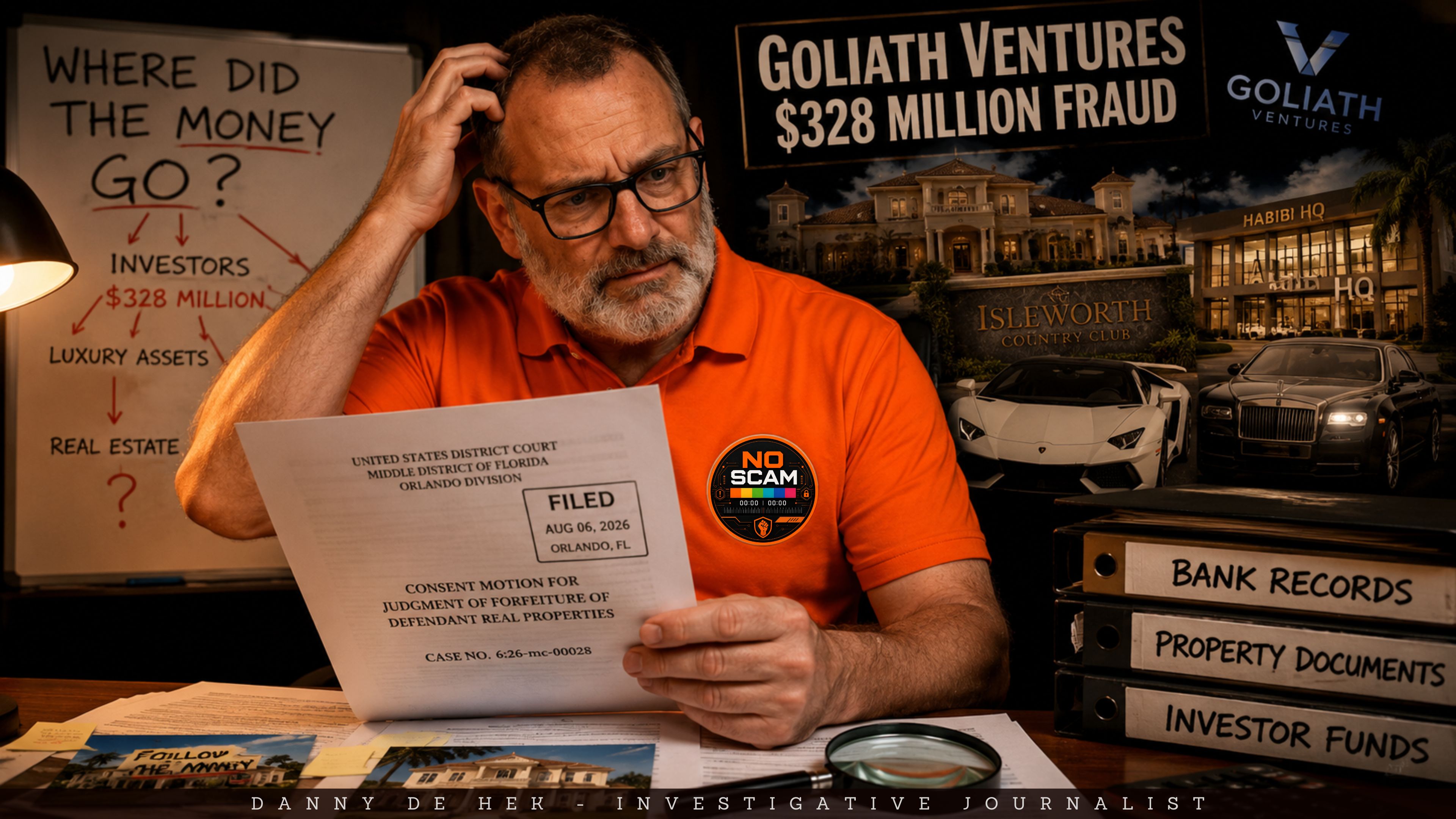
“The Defendant Properties were paid for with proceeds of the wire fraud scheme.”
For months, I have been following the collapse of Goliath Ventures, tracing the money, reviewing federal court filings and bankruptcy records, examining seized luxury vehicles, documenting properties and spending countless hours working through interviews with former CEO Christopher Alexander Delgado and the people who helped build the Goliath story.
Much of that investigation happened before the public had access to the evidence federal investigators were gathering behind the scenes.
I could see the Lamborghini. I could see the Rolls-Royce. I could identify the multimillion-dollar Isleworth mansion, the downtown Orlando corporate offices, the private jets, expensive parties and carefully cultivated lifestyle surrounding Goliath Ventures. I could interview investors, examine corporate records, follow social-media trails and compare what promoters were saying with what was actually happening.
What I couldn’t do was subpoena bank accounts, obtain private financial records or follow every dollar through the financial system.
Federal investigators could.
 On August 6, 2026, the United States filed a Consent Motion for Judgment of Forfeiture of Defendant Real Properties in the U.S. District Court for the Middle District of Florida. The 17-page filing seeks forfeiture of six pieces of real estate connected to Delgado and his companies, including his Isleworth property, residential homes across Central Florida and commercial office units in downtown Orlando.
It is an important new document in the Goliath Ventures investigation because it allows us to do something we could not have done when this story first began.
We can start comparing what I discovered from the outside with what federal investigators eventually uncovered from the inside.
And some of those comparisons are remarkable.
The government alleges that the properties covered by the filing were “paid for with proceeds of the wire fraud scheme.” It identifies mortgages, unpaid property taxes, homeowners’ association debts, condominium fees and other financial obligations attached to assets that once formed part of the extraordinary image of wealth surrounding Goliath Ventures.
That matters because wealth was never merely a background detail in this story.
Throughout my investigation, I kept returning to the same question: how much of what investors were seeing represented genuine financial success, and how much of it was helping create the appearance of success?

Delgado himself would later provide an extraordinary insight into that question. During his lengthy Post-arrest Interviews with WFTV investigative reporter Daralene Jones, he spoke openly about perception, wealthy investors and the importance of appearing successful. He described how people judged where you lived, what you drove and whether you travelled privately. He also acknowledged that Goliath had developed an exclusivity around itself — what he described as the “cool kids club” — where simply being associated with him could make people more comfortable handing over their money.
At the time, I was investigating many of those same symbols.
Now federal court records are beginning to show us the financial reality underneath them.
The Isleworth mansion wasn’t simply an impressive house anymore. There was a purchase trail, taxes and recoverable equity.
The corporate headquarters wasn’t simply a spectacular office designed to impress investors. There was an ownership company, financial history and outstanding condominium obligations.
The other properties weren’t simply evidence that somebody had become extraordinarily wealthy. Some were carrying hundreds of thousands — and in one case more than $2 million — in mortgage debt.
This is where the latest federal filing becomes particularly valuable.
Rather than simply reporting that the government wants to take Christopher Delgado’s properties, I went back through what we had already investigated. I compared the new forfeiture information with Delgado’s own interviews, the assets we previously examined and the lifestyle Goliath presented while hundreds of millions of dollars were flowing into the operation.
The result is a very different way of looking at this latest development.
This isn’t simply a story about six properties being forfeited.
It is an opportunity to place two investigations side by side: what could be discovered independently in real time, and what federal investigators were eventually able to establish after gaining access to the money trail.
For the victims of Goliath Ventures, there is also a much more practical question.
Once the mansions, houses and corporate offices are stripped of their mortgages, taxes, association fees, legal obligations and selling costs, how much of the wealth that everyone saw will actually be left?
That is the trail I am following now.
INDEX – FOLLOW THE INVESTIGATION
This investigation covers a lot of ground, from the federal forfeiture action and Christopher Delgado’s Isleworth mansion to the debts behind the property portfolio, Goliath HQ, the luxury lifestyle and the unanswered question of how much money will ultimately be recovered for victims. Use the index below to jump directly to any section of the investigation, or read from the beginning to follow the evidence as it unfolds.
- The Government Moves Against The Real Estate
- The Isleworth Mansion Comes Back Into Focus
- The Other Properties Tell A Different Story
- The Goliath Headquarters Comes Back Into Focus
- The Luxury Lifestyle Wasn’t Just Decoration
- What I Could See From The Outside
- What Federal Investigators Could See
- What Happens To The Money Now
- The Property That Has Not Been Resolved
- Christopher Delgado Has Already Agreed To Give Them Up
- The Investigation Has Come Full Circle
The Government Moves Against The Real Estate
The latest development arrived on August 6, 2026, when the United States filed its Consent Motion for Judgment of Forfeiture of Defendant Real Properties in the U.S. District Court for the Middle District of Florida, Orlando Division.
This distinction is important.
The document is not the final judgment ordering the properties forfeited. It is a motion filed by the United States asking the Court to enter that judgment. According to the filing, the relevant titled owners have consented to forfeiture of the properties covered by the motion, while legitimate interests held by mortgage lenders, homeowners’ associations, condominium associations and tax authorities will be recognised before the remaining proceeds are dealt with.
The government is seeking forfeiture of six pieces of real estate connected to Christopher Delgado and companies he controlled.
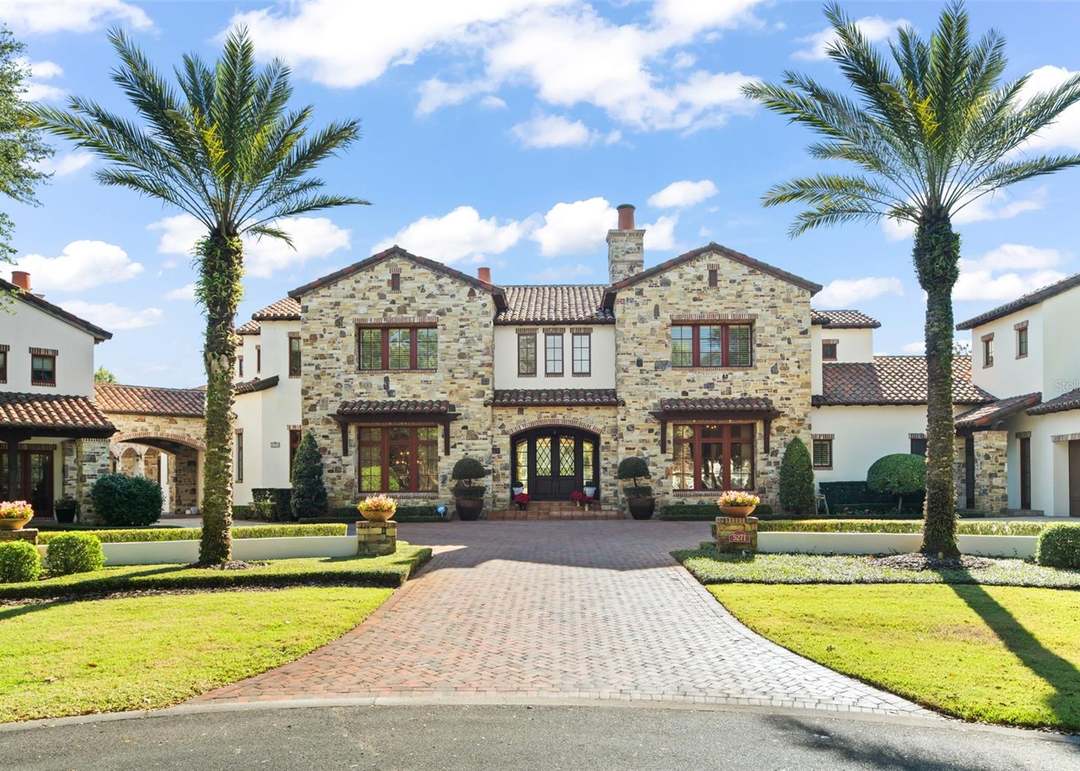
They include 5271 Isleworth Country Club Drive in Windermere, titled directly to Delgado; 141 S. Phelps Avenue in Winter Park, owned by Christopher and Andie Delgado; 17416 Bal Harbour Drive in Winter Garden, held through Habibi Holdings LLC; 222 Pawnee Trail in Kissimmee, titled to Delgado; four commercial condominium units at 189 S. Orange Avenue in downtown Orlando, held through Habibi HQ LLC; and 7333 Bella Foresta Place in Sanford, also titled to Delgado.
On the surface, it reads like an inventory of an extraordinary Central Florida property portfolio.
But that isn’t how I read it.
After spending so much time investigating the Goliath lifestyle, I was far more interested in what appeared alongside those addresses: who legally owned each property, whether it had been mortgaged, what debts remained against it, who was making claims against it and what might actually be left when everything was eventually sold.
That is where the latest filing starts pulling the Goliath story apart in a way photographs of mansions never could.
The government’s position is that these properties were not simply assets Delgado happened to own while operating Goliath Ventures. Prosecutors allege they were purchased with proceeds of the wire fraud scheme and that the monetary transactions used to acquire them involved criminally derived property connected to the underlying fraud.
That takes this story into very different territory.
Throughout my investigation, I could identify the assets and document how they were being presented. I could examine what Delgado said about them, look at when they appeared, research the companies holding them and question how a business supposedly generating investment returns had produced such an extraordinary concentration of personal wealth.
What I could not independently establish from public records alone was exactly where the purchase money came from.
The federal investigation now gives us its answer.
And that answer makes it worth going back through these properties individually, because several of them were already familiar to me long before this forfeiture motion appeared.
The first is probably the most recognisable of them all: Christopher Delgado’s Isleworth mansion.
The Isleworth Mansion Comes Back Into Focus
Of all the properties listed in the government’s latest forfeiture filing, 5271 Isleworth Country Club Drive in Windermere immediately stood out to me.
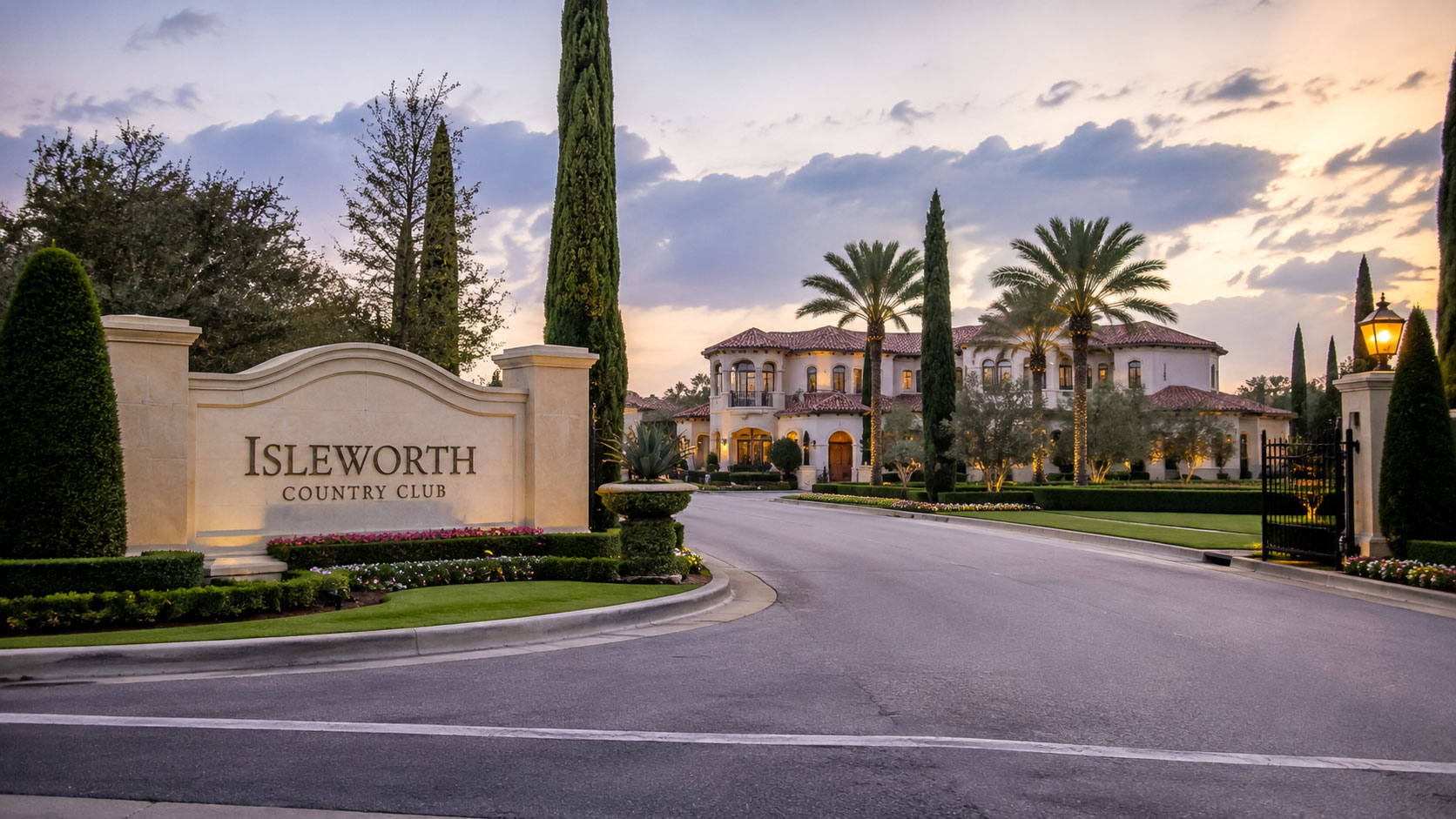
I had already spent considerable time looking at this property because it became one of the most visible symbols of the wealth surrounding Christopher Delgado. This wasn’t simply another expensive Florida home. It was inside Isleworth, one of Central Florida’s most exclusive gated communities, and Delgado himself later took WFTV investigative reporter Daralene Jones through the property during his post-arrest interviews.
During that interview, Delgado said he had paid approximately $8.5 million for the property. He talked about the house, its value and the lifestyle surrounding it with remarkable openness. By then, however, I was no longer interested in simply admiring the marble, swimming pool or impressive surroundings.
I wanted to know where the money came from.
The latest federal filing provides an important part of that answer.
According to the government, Delgado purchased the Isleworth property in cash. There is no mortgage. That is significant because, unlike several other properties covered by the forfeiture action, there isn’t a multimillion-dollar lender standing ahead of the government waiting to be repaid from the sale proceeds.
But the filing goes considerably further than confirming how the house was financed.
The government’s position is that the defendant properties covered by this action were “paid for with proceeds of the wire fraud scheme.” Prosecutors allege the properties are forfeitable because they were acquired with money traceable to wire fraud and through monetary transactions involving criminally derived proceeds.
That creates an extraordinary contrast with the way this house originally appeared from the outside.
When investors saw a successful businessman living in an $8.5 million Isleworth mansion, the obvious conclusion was that they were looking at evidence of financial success. Goliath Ventures was handling enormous amounts of money, its CEO appeared extraordinarily wealthy, and everything surrounding the company reinforced that impression.
Now consider what the government is alleging.
If prosecutors are correct that the properties were purchased using proceeds of the wire fraud scheme, the mansion wasn’t evidence that the investment operation was successful. It was potentially evidence of where some of the money went.
That distinction goes to the heart of what I have been investigating from the beginning.
Luxury assets can create an incredibly powerful feedback loop in investment schemes. Investors see the mansion, cars, offices and private travel and interpret those things as proof that the person controlling their money knows how to generate wealth. That apparent success creates credibility, and that credibility can make the next investor more comfortable handing over their money.
Delgado’s own interviews later provided some remarkable context around this.
He spoke openly about perception and the way wealthy people judged success. He described how the people around him noticed where someone lived, what they drove and whether they travelled privately. Elsewhere in those interviews, he described Goliath becoming something resembling a “cool kids club”, where people wanted access and association with him carried its own social value.
That is why I don’t regard the Isleworth property as simply another asset on a federal forfeiture list.
It was part of the Goliath image.
And there is another detail in the new filing that strips away some of that image.
Despite the property having no mortgage, the government says approximately $86,725.28 in unpaid 2025 property taxes and assessments were owing to the Orange County Tax Collector. The Isleworth Community Association was also owed approximately $12,380.07, including past-due assessments, interest, 2026 assessments and attorney’s fees.
Those amounts are expected to be paid from the eventual sale proceeds.
They are relatively small compared with the apparent value of an Isleworth mansion, but they matter because this is where the investigation stops being about appearances and starts becoming about net recoverable value.
We saw exactly the same thing when I investigated Delgado’s Luxury Vehicles. The headline value of a Lamborghini or Rolls-Royce sounded spectacular until liens, finance and other obligations were taken into account. What mattered to victims wasn’t what the vehicle once cost or what Delgado believed it was worth.
It was what remained after everyone else had been paid.
The Isleworth property now faces the same test.
This time, however, the absence of a mortgage could make the result considerably more significant.
If the property is ultimately forfeited and sold, the sale price, government expenses, unpaid taxes, association obligations and other recognised costs will tell us what this extraordinary symbol of the Goliath lifestyle was actually worth to the people who lost their money.
For months, we could see the mansion.
Now we are beginning to see the money behind it.
The Other Properties Tell A Different Story
The Isleworth mansion may have been purchased without a mortgage, but once I moved through the government’s filing property by property, the financial picture began to change.
Several of the other homes associated with Christopher Delgado and his companies were carrying substantial debt. This is where the distinction between owning expensive real estate and actually having equity in it becomes important.
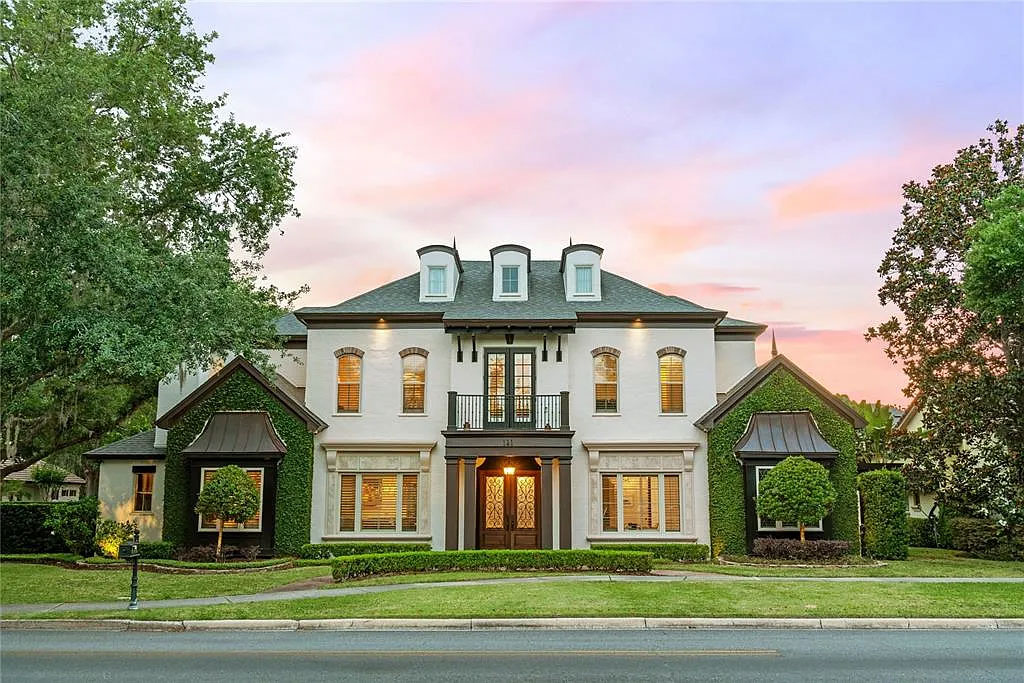
The clearest example is 141 S. Phelps Avenue in Winter Park, a property owned by Christopher and Andie Delgado. According to the government’s filing, the mortgage interest being recognised against that property totals approximately $2.052 million.
That figure includes approximately $1.984 million in unpaid principal, more than $66,000 in interest and additional charges. Interest was also continuing to accumulate at approximately $400.91 per day after August 14, 2026.
In other words, whatever this property eventually sells for, more than $2 million may already have somewhere else to go before we even begin talking about money potentially available for victims.
And Phelps Avenue isn’t alone.
The property at 17416 Bal Harbour Drive in Winter Garden, held through Habibi Holdings LLC, carries another substantial mortgage obligation. The government recognises approximately $533,996.69 owing against that property, including more than $513,000 in principal, accrued interest and additional advances and fees.
Interest continues accumulating there as well.
Then there is 222 Pawnee Trail in Kissimmee, titled directly to Delgado. The recognised mortgage obligation on that property is approximately $896,949.40, including more than $854,000 in principal, interest and other fees.
By the time I reached these figures, the pattern was becoming difficult to ignore.
The public-facing story was a portfolio of expensive properties.
The federal filing shows us a portfolio containing millions of dollars in debt.
That doesn’t mean the properties have no value. The government itself indicates that it believes there is sufficient equity in the defendant properties to satisfy legitimate third-party interests. What it does mean is that we cannot look at a property worth, for example, $2.5 million and simply add $2.5 million to some imaginary recovery fund.
The mortgage lender gets paid.
Taxes may need to be paid.
Homeowners’ association debts may need to be paid.
There are costs associated with maintaining, marketing and selling the property.
Only then do we discover what was actually there.
This is something I had already encountered while investigating Delgado’s luxury vehicles. Looking at a Lamborghini with a six-figure price tag tells you almost nothing about how much money will ultimately be recovered from it. Once finance, liens and selling costs are removed, the number that matters can be dramatically different from the number that helped create the original impression of wealth.
The latest federal filing now allows us to apply the same scrutiny to the real estate.
There is also a fourth residential property, 7333 Bella Foresta Place in Sanford, where the picture remains incomplete. The government confirms that Change Lending LLC holds a mortgage, but the filing does not provide the outstanding balance.
That is important to acknowledge.
I can tell you from the federal record that the mortgage exists. I cannot responsibly tell you from this document how much equity remains in Bella Foresta because the number needed to make that calculation simply isn’t provided.
And that distinction matters to the way I approach these investigations.
There have been plenty of opportunities throughout the Goliath story to take an expensive asset, attach the largest possible number to it and create an impressive headline. But that isn’t following the money.
Following the money means asking who really owns the equity, who gets paid first and what remains when the asset is converted back into cash.
The government’s latest filing is finally giving us some of those answers.
But the next property takes us somewhere even more interesting, because it wasn’t simply part of Christopher Delgado’s personal lifestyle.
It was the place where Goliath Ventures presented itself to the world.
The Goliath Headquarters Comes Back Into Focus

The commercial units at 189 S. Orange Avenue in downtown Orlando are particularly interesting because this wasn’t simply another property sitting quietly inside Christopher Delgado’s portfolio.
This was Goliath HQ.
I had already investigated the offices because they formed an important part of the image Goliath Ventures presented to investors. Delgado later discussed the property extensively during his interviews with WFTV investigative reporter Daralene Jones, describing a high-end corporate environment that was intended to bring investors into the Goliath world.
The headquarters occupied four commercial condominium units — 1800S, 1810S, 1820S and 1870S — together with rights associated with approximately 30 parking spaces. According to the latest federal filing, the property is titled to Habibi HQ LLC, a company controlled by Delgado.
But one detail immediately caught my attention.
There is no mortgage.
The government’s filing states that Habibi HQ LLC did not mortgage the Orange Avenue property. That puts the headquarters in a similar position to the Isleworth mansion and makes it potentially much more valuable from an asset-recovery perspective than properties carrying enormous outstanding loans.
That finding also takes me back to something Delgado himself said.
During his post-arrest interviews, Delgado discussed the Goliath headquarters and said approximately $3.2 million had been paid in cash for the offices. He described his vision for the space as something much bigger than desks, computers and meeting rooms. It was intended to become an investor hub where people could experience the businesses, products and lifestyle associated with Goliath.
That context matters.
Throughout this investigation, I have repeatedly looked at how Goliath established credibility. It wasn’t achieved through a single presentation or investment contract. Investors were surrounded by an ecosystem that appeared to demonstrate success.
There were luxury vehicles.
There was private travel.
There were expensive events.
There was the Isleworth mansion.
And then there was a multimillion-dollar corporate headquarters in downtown Orlando.
When someone walked into an operation surrounded by those things, they weren’t simply being told Goliath was successful. They were being shown what appeared to be the evidence of that success.
That is why the government’s allegation concerning the source of the money becomes so important.
The United States now alleges that the defendant properties were paid for with proceeds of the wire fraud scheme. If that allegation is established through the forfeiture process, it fundamentally changes how we should look at assets such as Goliath HQ.
Instead of the office proving that Goliath’s investment strategy was producing extraordinary wealth, the government is alleging that the money flowing through the underlying fraud helped purchase the very property that could then reinforce the appearance of success.
That creates a potentially powerful cycle.
Investor money helps create the appearance of wealth. The appearance of wealth creates credibility. Credibility makes the operation easier to believe.
And more money follows.
I could see parts of that cycle while investigating Goliath from the outside. What I couldn’t see was the complete financial trail connecting investor money to individual purchases.
That is the gap federal investigators are now beginning to fill.
There are still debts attached to the headquarters, although they are nothing like the multimillion-dollar mortgages sitting against some of the residential properties.
The Plaza South Tower Commercial Condominium Association filed a claim covering all four units. According to the government’s motion, approximately $74,889.52 is owed in unpaid condominium association dues, interest, fees and attorney’s costs.
Broken down across the four units, the recognised amounts are approximately $18,187 for Unit 1800S, $17,216 for Unit 1810S, $19,708 for Unit 1820S and $19,779 for Unit 1870S.
Those obligations will have to be dealt with from the proceeds if the properties are forfeited and sold.
But compared with a property carrying a $2 million mortgage, the absence of mortgage debt makes the Orange Avenue headquarters particularly interesting.
The question is no longer what Goliath spent creating the office or what Delgado believed it represented.
The question is what those commercial units will sell for and how much will remain after legitimate obligations and selling costs are removed.
That is the number victims should ultimately care about.
There is also something deeply revealing about seeing Goliath HQ appear in a federal forfeiture document.
During the height of the operation, the office helped communicate permanence, legitimacy and success. It was a physical place investors could visit and point to. It made Goliath tangible.
Now the same offices have become something entirely different.
They are assets the United States wants converted back into money.
The Luxury Lifestyle Wasn’t Just Decoration

By the time the federal filing reached the houses and corporate offices, I found myself returning to something that had bothered me throughout this investigation: the extraordinary lifestyle surrounding Goliath Ventures was not separate from the investment story.
It was part of the story.
I had already spent months examining Delgado’s luxury vehicles, including his 2025 Lamborghini Revuelto and Rolls-Royce. I looked at what he said the vehicles cost, what he claimed they were worth, the finance sitting behind them and, eventually, what some of those assets actually produced when they were sold.
The numbers were revealing.
The Lamborghini was perhaps the clearest example. Delgado had discussed a vehicle costing around $600,000 before extensive customisation, including what he described as an aftermarket body kit costing another $300,000. He believed the finished car could be worth somewhere between $700,000 and $800,000.
When the federal forfeiture process eventually reached the vehicle, the government accepted an offer of $625,000.
But $625,000 was not what was recovered.

After the secured lien and other recognised obligations were dealt with, the Lamborghini produced only about $20,561 in net proceeds for the government. The Rolls-Royce Ghost produced roughly $17,085.
That investigation taught me an important lesson about the Goliath assets.
The photograph and the balance sheet can tell two completely different stories.
The same principle is now playing out across the real estate portfolio.
An $8.5 million mansion sounds extraordinary until you start examining taxes, associations, maintenance and selling costs. A multimillion-dollar house can look like enormous recoverable wealth until you discover a $2 million mortgage sitting behind it. A corporate headquarters can project success while simultaneously carrying unpaid condominium obligations.
None of this means the assets were worthless. Quite the opposite. Some of them may ultimately produce substantial recoveries.
But their importance to the Goliath story went beyond their resale value.
They helped create an image.
During his post-arrest interviews, Delgado provided an unusually candid explanation of how he understood that image. He spoke about dealing with wealthy people and the importance they placed on where somebody lived, what they drove and whether they flew privately. His comments suggested that outward displays of success mattered when operating in circles where people were being asked to trust someone with significant amounts of money.
That observation becomes particularly important when placed beside another admission Delgado made about Goliath.
He described the company as having developed something resembling a “cool kids club” around it. In his telling, people in affluent Orlando circles wanted to be involved. Being seen with Delgado mattered. Being invited into Goliath mattered. Knowing that influential people were already participating provided another layer of reassurance.
I had been documenting that ecosystem from the outside.
The cars, properties, parties, private travel, high-profile associations and elaborate headquarters weren’t proof that a fraud was occurring. Luxury itself is not evidence of criminal conduct, and it would be irresponsible to suggest otherwise.
But in an investment operation, those things can become extraordinarily persuasive social proof.
Someone considering handing over $100,000 isn’t necessarily looking at audited financial statements when they see the CEO living in Isleworth, arriving in a Lamborghini, travelling privately and operating from multimillion-dollar offices surrounded by other wealthy investors.
They may simply think:
This must be working.
That is why the government’s latest allegation changes the significance of these assets.
Federal prosecutors are now telling the Court that the defendant properties were paid for with proceeds of the wire fraud scheme. If the money investors were handing over helped finance assets that subsequently reinforced the appearance that Goliath was enormously successful, then the lifestyle becomes more than an interesting side story.
It becomes part of understanding how the illusion could sustain itself.
And this is where my investigation and the federal investigation approach the same story from different directions.
I spent considerable time examining what investors could see.
Federal investigators were able to examine where the money actually went.
Those two perspectives are now beginning to meet.
The mansion, Lamborghini, Rolls-Royce and corporate headquarters once communicated one message: success.
The forfeiture records are beginning to tell us what that success actually cost, how much debt sat behind it and, most importantly, whose money the government alleges helped pay for it.
What I Could See From The Outside
There is an important distinction I want to make at this point, because it explains why this latest federal filing is so valuable to me.
When I began investigating Goliath Ventures, I did not have access to Christopher Delgado’s bank accounts. I couldn’t subpoena cryptocurrency exchanges, demand records from financial institutions or compel employees and business associates to hand over private communications. I didn’t have search warrants or a team of federal agents following transactions through the financial system.
What I had was open-source intelligence, public records, people willing to talk, and a lot of questions.
So I approached Goliath the same way I approach other investment operations that don’t make sense to me. I looked at what investors were being told and compared it with what I could independently verify. I examined the people promoting it, the companies connected to it, the lifestyle being presented, the assets appearing around the operation and the relationships that seemed to give it credibility.
Then I started following the inconsistencies.
As the investigation developed, I spoke with investors and people connected to Goliath. I watched presentations and meetings. I documented the promoters and introducers surrounding the operation. I examined social-media posts, corporate information, properties, vehicles and the increasingly elaborate lifestyle associated with Delgado.
What interested me wasn’t simply whether Christopher Delgado owned an expensive car or lived in an expensive house.
I wanted to understand how Goliath could generate the returns being represented to investors while simultaneously supporting everything I could see happening around it.
That question became more important as the numbers grew.
Goliath wasn’t presenting itself as a small speculative cryptocurrency project operating from someone’s spare bedroom. Hundreds of millions of dollars were eventually involved. There were substantial investor distributions, commissions, salaries, corporate expenses, luxury purchases and an increasingly expensive public image.
Something had to be generating enough genuine profit to support all of that.
Or something else was happening.
At the time, there were limits to how far I could take that question. I could identify contradictions and warning signs. I could document behaviour. I could compare statements made at different times and challenge people directly about what they were promoting.
But there is a line between suspecting where money came from and proving where money came from.
That line matters.
It is one reason I have always tried to distinguish between what I can document, what a source alleges, what somebody says in an interview and what has actually been established through court records or regulatory action.
The federal investigation had tools I didn’t.
Investigators could obtain banking records. They could trace transactions. They could examine financial accounts that were invisible to the public. They could identify the source of funds used to purchase individual assets and then put those findings before a federal court.
That is why one sentence in this latest filing carries considerably more weight than months of speculation ever could:
“The Defendant Properties were paid for with proceeds of the wire fraud scheme.”
I didn’t have the evidence required to make that statement when I first started looking at the mansions and offices.
The United States now has.
And that is precisely why I find this stage of the investigation so fascinating.
I can go back through the things I questioned from the outside and compare them with what investigators eventually found once they got inside the financial records.
Sometimes the federal evidence confirms the direction my research was already taking.
Sometimes it provides information I could never have obtained independently.
And occasionally my investigation went somewhere the criminal case was never designed to go — examining how the operation was promoted, who helped create its credibility, how the lifestyle was presented and why ordinary investors believed what they were seeing.
Those are different forms of investigation.
The government ultimately has to establish evidence capable of surviving in court.
My job was to keep asking the questions that people handing over their money should have been asking much earlier.
Now, for the first time, we can put some of those answers side by side.
What Federal Investigators Could See
The federal investigation could go where mine couldn’t.
Once investigators gained access to the financial records behind Goliath Ventures, they were no longer trying to work backwards from photographs of Lamborghinis, property records, social-media posts, investor accounts and public statements. They could examine the transactions themselves and begin establishing where the money originated, where it moved and what it was ultimately used to purchase.
The August 6 forfeiture motion gives us another glimpse into the results of that work.
According to the government, the properties were purchased using proceeds traceable to the wire fraud scheme. Prosecutors are seeking forfeiture under federal laws covering property derived from wire fraud and property involved in monetary transactions using criminally derived proceeds.
But the document also reveals something else that is important.
Christopher Delgado has consented to the forfeiture.
The filing records that Delgado signed a plea agreement agreeing to plead guilty to conspiracy to commit wire fraud, substantive wire fraud and money laundering. It states that on June 30, 2026, he entered his guilty plea and that the Court accepted the plea and adjudicated him guilty.
As part of that agreement, Delgado consented to forfeiture of the assets included in the civil forfeiture proceeding.
That consent extends beyond properties held personally in his name. According to the filing, Delgado also consented in his capacity as manager of Habibi HQ LLC and Habibi Holdings LLC, the entities holding the downtown Orlando commercial units and the Bal Harbour Drive property.
This matters because earlier in my investigation, corporate entities were another layer that had to be researched individually.
A property might be associated publicly with Christopher Delgado or Goliath Ventures, but the name appearing on the title could be something entirely different. That meant following LLCs, addresses, corporate records and the people controlling them to understand how the pieces connected.
Federal investigators were able to go much further.
The latest filing doesn’t simply identify who appears on the title. It starts resolving what happens to the ownership interests themselves.
There is a good example involving Andie Delgado.
The property at 141 S. Phelps Avenue is jointly owned by Christopher and Andie Delgado. According to the motion, Andie consented on July 13, 2026 to forfeiture of her interest in that property.
But another property tells us why we need to be careful about assuming every asset has reached the same stage.
The government specifically says this consent motion does not include 746 Cavan Drive because co-owner Andie Delgado has not consented to its forfeiture.
That doesn’t mean the government has abandoned Cavan Drive, nor does this document establish what will ultimately happen to it.
It means exactly what the filing says: this particular motion does not resolve that property.
That distinction is important because forfeiture isn’t simply a matter of federal agents identifying an expensive house and taking it. Ownership interests, mortgages, taxes, associations and third-party claims all have to be addressed through a legal process.
The government has been doing exactly that.
According to the filing, notice of the forfeiture action was published on the government’s official forfeiture website for at least 30 consecutive days beginning May 24, 2026. The deadline for filing claims expired on July 23.
Mortgage lenders and associations were identified. Some filed formal claims. Others missed the deadline, but the government has nevertheless agreed to recognise legitimate interests where appropriate rather than attempt to eliminate them on a procedural technicality.
That approach tells us something about the objective of this stage of the case.
The government isn’t simply trying to accumulate houses.
It wants to clear the legal obstacles, sell the properties and determine the genuine equity remaining inside them.
The filing says there appears to be “ample equity” in the properties to satisfy recognised third-party interests and explains that moving the assets through forfeiture and sale will help “maximize the potential recovery for victims.”
Those words matter.
For months, investors could only look at the assets surrounding Goliath Ventures and wonder how much money might still be there.
Federal investigators can now start answering that question with actual numbers.
But even now, the headline value of the property portfolio is not the number victims should be watching.
The number that matters comes after everyone else with a legitimate claim has been paid.
And that is where the next part of the investigation begins.
What Happens To The Money Now
This is the point where the impressive property values become much less important than the numbers sitting underneath them.
If the Court grants the government’s motion and the properties are forfeited and sold, the headline sale prices will not represent what is ultimately available for victims. Before we get anywhere near that figure, mortgages, taxes, homeowners’ association claims, condominium fees and the costs associated with maintaining and selling the properties have to be dealt with.
The August 6 filing makes that process remarkably clear.
The government is asking for authority to pay expenses associated with the seizure, maintenance, custody, publication, marketing and sale of the properties. It also recognises the interests of mortgage lenders, tax authorities and property associations. In several instances, the government has even agreed to recognise legitimate debts where the creditor failed to file a timely formal claim.
That means the calculation victims should be watching is not complicated in principle:
Sale price minus legitimate debts and costs equals the equity that can actually be recovered.
The difficulty is that we don’t yet know all of those final numbers.
Take 141 S. Phelps Avenue. Before considering selling costs or other recognised obligations, approximately $2.052 million is already claimed under the mortgage. At Pawnee Trail, approximately $896,949 is recognised. Bal Harbour carries approximately $533,997 in mortgage obligations.
Interest continues accumulating on those debts until they are resolved.
Then compare those properties with the Isleworth mansion and the Orange Avenue commercial units, which the filing identifies as having no mortgage.
Those assets immediately become much more interesting.
Isleworth still has approximately $86,725 in unpaid property taxes and assessments, together with roughly $12,380 owed to the community association. The Orange Avenue units have approximately $74,890 in condominium association obligations. There will also be expenses associated with holding and eventually selling the properties.
But there isn’t a multimillion-dollar mortgage sitting in front of the remaining equity.
That potentially makes these two assets particularly important to victim recovery.
It also takes me straight back to what happened when I investigated Delgado’s luxury vehicles.
When I first looked at the Lamborghini Revuelto, the numbers surrounding it sounded enormous. Delgado had talked about hundreds of thousands of dollars in modifications and believed the finished vehicle could be worth between $700,000 and $800,000.
The government eventually accepted $625,000 for it.
Yet after the secured financial interests and other obligations were dealt with, only about $20,561 remained in net proceeds for the government.
That experience completely changed the way I look at the asset recovery side of this investigation.
I don’t care what somebody says a mansion is worth.
I don’t care what a Lamborghini originally cost.
I don’t care how impressive a corporate headquarters looked when investors walked through the doors.
I want to know what is left when it is sold.
That is the only number that ultimately matters to victims.
The federal government appears to be approaching the properties from the same practical direction. In its motion, prosecutors say there appears to be “ample equity” to satisfy the recognised third-party interests and explain that resolving those interests without unnecessary litigation will allow the properties to be sold, “thereby maximizing the potential recovery for victims.”
That wording is important because it tells us what this stage of the case is really about.
The government isn’t collecting Christopher Delgado’s property portfolio to make a point.
It is attempting to convert physical assets back into money.
And for the people who invested in Goliath Ventures, that creates another part of this story that I intend to follow closely.
When these properties eventually sell, I want to compare what they appeared to be worth during the height of Goliath Ventures with what they actually return after the financial reality is stripped away.
We have already done that with the cars.
Now we get to do it with the houses and offices.
Only then will we begin to understand how much of the extraordinary wealth surrounding Goliath Ventures was actually recoverable wealth — and how much of it was simply an expensive appearance.
The Property That Has Not Been Resolved
There is one property mentioned in the August 6 filing that deserves its own attention precisely because the government is not asking the Court to deal with it in this motion.
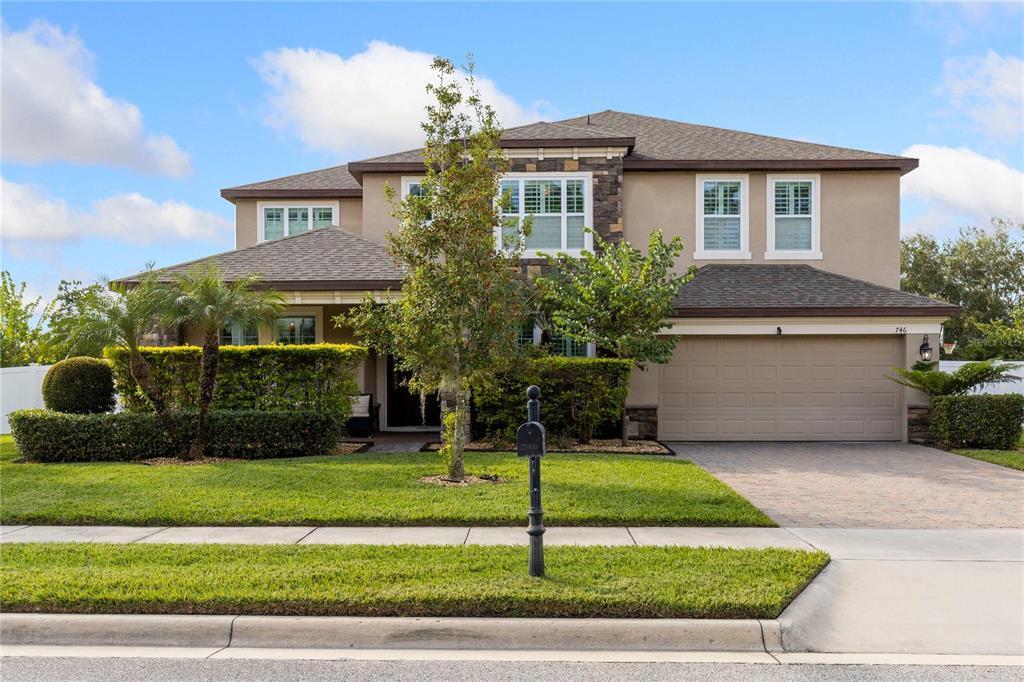
That property is 746 Cavan Drive.
The government specifically states that its Consent Motion for Judgment of Forfeiture does not include Cavan Drive because Andie Delgado, a co-owner of the property, has not consented to its forfeiture.
That immediately separates it from 141 S. Phelps Avenue, another property jointly owned by Christopher and Andie Delgado. According to the filing, Andie signed a consent on July 13, 2026 agreeing to forfeiture of her interest in the Phelps Avenue property.
Cavan Drive is different.
And this is where I need to be careful not to read more into the document than it actually says.
The filing does not tell us why Andie Delgado has not consented. It does not establish that she is challenging the government’s underlying allegations, and it does not tell us what ultimately happens to the property.
It simply establishes that Cavan Drive remains outside this particular consent motion because one of its owners has not agreed to forfeiture.
That makes it an unresolved part of the asset story.
Throughout the Goliath investigation, I have learned that these distinctions matter. It is very easy to look at a long list of seized or targeted assets and assume they all occupy the same legal position. They don’t.
Some properties are owned personally by Christopher Delgado. Others sit inside companies he controlled. Some have mortgages. Some were purchased without mortgages. Some have substantial third-party claims. Some owners have consented to forfeiture.
And in the case of Cavan Drive, one co-owner has not.
The government will therefore have to deal with that property separately if it intends to continue pursuing forfeiture.
That is something I will be watching.
There is also a broader reason this matters.
As the Goliath Ventures case moves from criminal prosecution into forfeiture, bankruptcy and victim recovery, some of the most important developments may no longer arrive with dramatic announcements. They may appear in paragraphs like this one — a property excluded from a motion, an ownership interest that remains contested, a mortgage balance that changes or an asset that eventually sells for far less or far more than expected.
Those details will determine the final recovery.
So while six properties are now moving through this consent forfeiture process, 746 Cavan Drive remains an open question.
And until another court filing answers it, that is exactly how I intend to describe it.
Christopher Delgado Has Already Agreed To Give Them Up
There is another important reason this August 6 filing carries more weight than an ordinary government attempt to seize disputed assets.
Christopher Delgado has consented to the forfeiture.
The filing traces that consent back to his criminal case. According to the government’s motion, Delgado signed a plea agreement in which he agreed to plead guilty to conspiracy to commit wire fraud, substantive wire fraud and money laundering. As part of that agreement, he also consented to forfeiture of the assets included in this civil forfeiture proceeding.
The document states that Delgado appeared before the Court on June 30, 2026, entered his guilty plea, and that “the Court has accepted the plea and adjudicated him guilty.”
That changes the context considerably.
When I first began investigating Goliath Ventures, almost everything had to be approached as a question. Where was the money being invested? How were the returns being generated? Who was receiving commissions? What role did the people surrounding Delgado actually play? How were the luxury assets being funded? And, perhaps most importantly, what would happen if the money stopped flowing?
Those questions became progressively more serious as the operation unravelled.
Now we are reading federal court documents after Delgado has pleaded guilty to the offences at the centre of the case and agreed to surrender assets the government says were purchased with proceeds of the wire fraud scheme.
There is an important distinction here.
A consent to forfeiture is not the same thing as Delgado individually admitting every factual allegation the government has made about every property. But it does mean he is no longer fighting to retain the assets covered by this motion. His plea agreement and subsequent consent allow the government to ask the Court to move those properties towards forfeiture and eventual sale.
His consent also reaches beyond property held directly in his own name.
The filing says Delgado executed the consent both personally and as manager of Habibi HQ LLC and Habibi Holdings LLC. Those companies hold two significant parts of the portfolio we have just examined: Habibi HQ LLC owns the downtown Orlando commercial units, while Habibi Holdings LLC owns the Bal Harbour Drive property.
That corporate structure is something I would have had to piece together from public records during an independent investigation.
The federal process can now cut through it.
The government is asking the Court to extinguish the existing ownership interests in the six properties, recognise the legitimate interests of lenders, tax authorities and associations, and ultimately vest clear title in the United States so the assets can be sold.
For me, this is another point where the story has come a long way from the investigation I was conducting while Goliath Ventures was still presenting an image of extraordinary success.
Back then, I was trying to understand who owned what.
Now the question is becoming what will be left once it is all sold.
And there is an even bigger reason that matters.
The government says these sales are intended to maximise the potential recovery for victims. That means the mansions, offices and other properties are gradually being transformed from symbols of Christopher Delgado’s wealth into something much more measurable.
They are becoming numbers on a recovery ledger.
For the victims of Goliath Ventures, that is where the value of this latest filing really lies.
The Investigation Has Come Full Circle
When I first started investigating Goliath Ventures, I was looking at the operation from the outside.
I could see the wealth. I could document the people surrounding Christopher Delgado. I could follow the companies, properties and luxury vehicles, listen to what investors were being told, examine what promoters were saying and compare those claims with information available through public records.
What I couldn’t see was the complete money trail.
That is what makes this latest federal filing so significant.
The August 6, 2026 Consent Motion for Judgment of Forfeiture of Defendant Real Properties doesn’t simply give us another list of assets. It allows us to revisit things I had already investigated and look at them with information that simply wasn’t available to me at the time.
The Isleworth mansion is no longer simply the extraordinary home I watched Delgado walk through while explaining his lifestyle to Daralene Jones. We now know from the government’s filing that it was purchased in cash, carried no mortgage and had accumulated unpaid taxes and association obligations.
The downtown Orlando headquarters is no longer simply the multimillion-dollar office Delgado said had been purchased for approximately $3.2 million in cash and designed as an investor hub. The government confirms the commercial units held by Habibi HQ LLC were not mortgaged, while identifying almost $75,000 in condominium association obligations.
Other properties reveal a different reality.
Phelps Avenue carries approximately $2.052 million in mortgage obligations. Pawnee Trail carries approximately $896,949. Bal Harbour carries approximately $533,997. Bella Foresta has a mortgage whose outstanding balance isn’t disclosed in this filing.
Piece by piece, the image becomes a balance sheet.
But the most important development isn’t the debt.
It is what the government says about the money used to acquire the properties in the first place.
“The Defendant Properties were paid for with proceeds of the wire fraud scheme.”
That is something I could never have established conclusively from the outside.
I could question how the wealth was being generated. I could document the extraordinary spending. I could investigate the corporate structures and ownership records. I could examine whether the image being presented to investors was consistent with what I was discovering elsewhere.
Federal investigators could follow the money.
That difference is worth acknowledging because independent investigations and criminal investigations serve different purposes. The government had access to evidence I could never obtain through open-source intelligence: banking information, financial records and the ability to trace funds through transactions.
But there was another side to this story that I was able to investigate in considerable depth.
I could watch how Goliath presented itself while it was happening.
I could see the Lamborghini being used as a symbol of success. I could examine the mansion, the headquarters, the parties and private travel. I could document the people promoting the opportunity and the social circles surrounding Delgado. I could listen to investors explain why they trusted Goliath and examine how credibility was being created around the operation.
That evidence helps explain something a bank transaction cannot.
Why did people believe it?
The federal records can show where money moved. The interviews and evidence gathered during my investigation help show why people were willing to hand that money over in the first place.
When those two perspectives are placed together, the Goliath story becomes much clearer.
The luxury lifestyle wasn’t proof of financial success simply because it existed. Some assets were heavily financed. Others were purchased without mortgages. Some ultimately produced surprisingly little after secured creditors were paid.
And now the United States alleges that the real estate covered by this forfeiture action was purchased with proceeds from the wire fraud scheme itself.
That creates an uncomfortable possibility at the centre of the entire story.
The things that appeared to demonstrate Goliath’s success may have been financed by the very money investors believed those things proved Goliath was capable of generating.
That is the circle I couldn’t completely close when this investigation began.
Federal investigators are now closing parts of it.
There are still questions to answer. Properties have to be sold. Final mortgage balances and expenses have to be calculated. The unresolved Cavan Drive property remains outside this particular consent motion. Other forfeiture and bankruptcy proceedings continue to matter, and the ultimate amount recovered for victims is still unknown.
So I am not treating this filing as the end of the Goliath Ventures investigation.
I see it as something much more useful.
It is the point where we can finally start measuring what we discovered against what the financial evidence ultimately revealed.
For months, I followed the image.
The government followed the money.
Now those two investigations are meeting in the same court records.
And as these properties are eventually sold, I will be following one number more closely than any other: how much money actually comes back.
Because after hundreds of millions of dollars flowed through Goliath Ventures, after the luxury cars, mansions, corporate offices, parties and promises, that is the number the victims deserve to know.
Disclaimer: How This Investigation Was Conducted
This investigation relies entirely on OSINT — Open Source Intelligence — meaning every claim made here is based on publicly available records, archived web pages, corporate filings, domain data, social media activity, and open blockchain transactions. No private data, hacking, or unlawful access methods were used. OSINT is a powerful and ethical tool for exposing scams without violating privacy laws or overstepping legal boundaries.
About the Author
I’m DANNY DE HEK, a New Zealand–based YouTuber, investigative journalist, and OSINT researcher. I name and shame individuals promoting or marketing fraudulent schemes through my YOUTUBE CHANNEL. Every video I produce exposes the people behind scams, Ponzi schemes, and MLM frauds — holding them accountable in public.
My PODCAST is an extension of that work. It’s distributed across 18 major platforms — including Apple Podcasts, Spotify, Amazon Music, YouTube, and iHeartRadio — so when scammers try to hide, my content follows them everywhere. If you prefer listening to my investigations instead of watching, you’ll find them on every major podcast service.
You can WORK WITH ME for dedicated access to my time and investigative services — including private consultations, scam-risk reviews, sponsored investigations, support sessions, livestream scam breakdowns, and interviews. I’m also available for SPEAKING ENGAGEMENTS, where I share first-hand experience from years of exposing large-scale fraud, investigating scams, and supporting victims.
“Stop losing your future to financial parasites. Subscribe. Expose. Protect.”
My work exposing crypto fraud has been featured in:
- Coffeezilla 2026): Featured in the investigation exposing the alleged $328M Goliath Ventures Ponzi scheme
- Bloomberg Documentary (2025): A 20-minute exposé on Ponzi schemes and crypto card fraud
- News.com.au (2025): Profiled as one of the leading scam-busters in Australasia
- OpIndia (2025): Cited for uncovering Pakistani software houses linked to drug trafficking, visa scams, and global financial fraud
- The Press / Stuff.co.nz (2023): Successfully defeated $3.85M gag lawsuit; court ruled it was a vexatious attempt to silence whistleblowing
- The Guardian Australia (2023): National warning on crypto MLMs affecting Aussie families
- ABC News Australia (2023): Investigation into Blockchain Global and its collapse
- The New York Times (2022): A full two-page feature on dismantling HyperVerse and its global network
- Radio New Zealand (2022): “The Kiwi YouTuber Taking Down Crypto Scammers From His Christchurch Home”
- Otago Daily Times (2022): A profile on my investigative work and the impact of crypto fraud in New Zealand






Leave A Comment