


Every era produces its own kind of spiritual danger.
In the past, it lived in temples and compounds, hidden behind robes and rituals. Today, it lives on YouTube. It streams on Discord. It speaks in borrowed accents, wears borrowed costumes, and sells borrowed wisdom to people who don’t yet realize they’re being groomed.
The modern guru does not need a lineage. He does not need a tradition. He does not need a community. He needs only a camera, a costume, and the confidence to declare himself enlightened. And the internet — hungry, lonely, searching — will give him an audience.
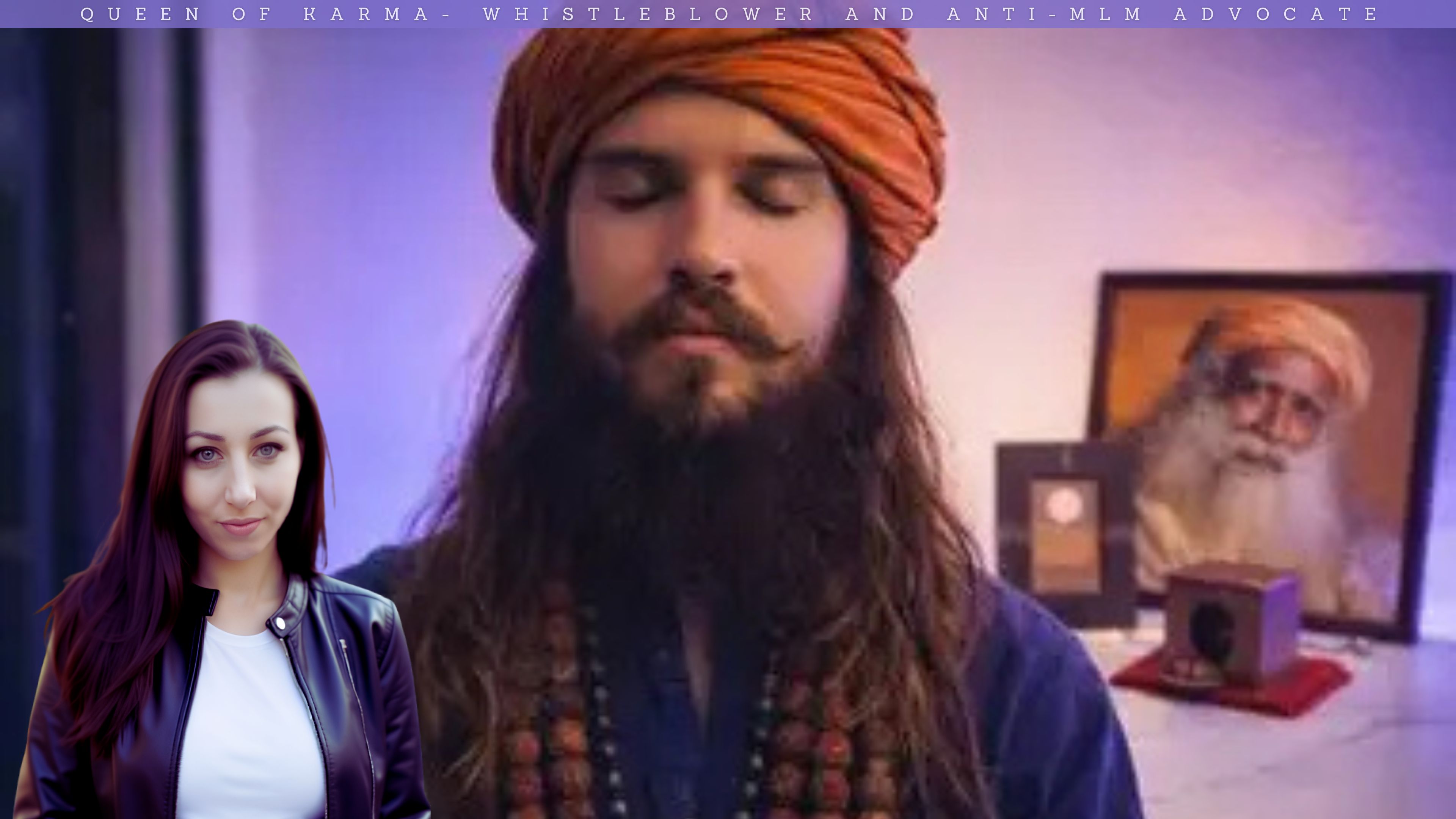
This is the environment where a man named Yuri reinvented himself as Shiva Kailash Shambho, a self-created spiritual persona stitched together from Sadhguru imitation, pick-up artist culture, purity ideology, religious appropriation, and the chaotic attention economy of livestreams.
He did not rise through spiritual discipline. He rose through algorithmic visibility. He did not earn authority. He manufactured it. He did not inherit a tradition. He borrowed one — piece by piece, symbol by symbol, robe by robe — until he could convince strangers that he was a holy man.
But behind the robes, behind the cadence, behind the name change, lies a pattern that is not mystical, not divine, and not enlightened. It is a pattern of exploitation, sexual control, manipulation, and chaos repackaged as spiritual growth.
This investigation is not about tearing down a man. It is about exposing a system, a digital ecosystem where vulnerable people are pulled into the orbit of someone who performs holiness while practicing harm. It is about understanding how a modern fake guru is built, how he maintains power, how he monetizes shame, and how he uses borrowed spiritual imagery to mask predatory behavior. It is about protecting people who reach out to journalists like myself — people who have been hurt, confused, manipulated, or financially exploited by someone who promised them transformation.
This is not a story about enlightenment. This is a story about manufactured mystique, sexualized authority, Discord-based control, and the dangerous ease with which a self-appointed guru can gather followers online.
This is The Shiva Files.
The Birth of a Persona
Before the robes, before the turbans, before the name change, there was a young man named Yuri. Born in Ukraine, raised in Canada, living with his mother and younger brother, he was not a spiritual seeker. He was a young man drifting through online spaces — pick-up artist forums, right-wing sexual politics, Discord servers — searching for identity in the same way many lonely men do.
During the pandemic, he discovered Sadhguru videos. Something in the aesthetic appealed to him. Not the philosophy, not the discipline, not the tradition — but the performance. The cadence. The pauses. The breathy rhythm. The way a spiritual figure could command attention simply by slowing down his voice.
He began to imitate it. He slowed his speech until it resembled a robotic echo of a man he had never met and a tradition he had never studied. He wrapped himself in robes he bought online. He adopted a new name — Shiva Kailash Shambho — not given to him by any teacher, but chosen by himself, for himself, to transform himself.
This was not spiritual awakening. This was identity cosplay.
His aesthetic became a collage of borrowed traditions. Hindu robes. Muslim robes. Turbans. Beads. Sacred-looking clothing purchased from Amazon. He used these symbols not as expressions of devotion, but as props — a costume designed to appear holy, exotic, disciplined, elevated.
He openly admitted he had never read foundational Hindu texts. He said he “only listened to Sadhguru.” His spiritual name was self-created. His authority was self-created. His persona was self-created. Nothing about his presentation came from lineage, study, or tradition. It came from aesthetic mimicry. He was not practicing Hinduism. He was cosplaying it.
When he encouraged people to search for him as “the White Yogi,” it became clear that this was not a spiritual identity, it was a brand. A marketing hook. A way to turn his race, his costume, and his borrowed imagery into a searchable identity. This was not devotion. This was SEO optimization.
The Religious Landscape Shiva Draws From
Before examining Shiva’s fixation on Sadhguru, it’s important to understand the religious traditions he claims to represent. His persona is built from fragments of several South Asian spiritual systems — primarily Shaivism, but also modern neo-Hindu interpretations, New Age mysticism, and the globalized yoga movement. These traditions are complex, ancient, and deeply rooted in cultural context. Shiva’s use of them is not.
Shaivism is one of the major branches of Hinduism, centered on the worship of Shiva as the supreme deity. It emphasizes meditation, asceticism, devotion, and the cyclical nature of destruction and rebirth. Mount Kailash, believed to be Shiva’s mythological home, is a sacred site for Hindus, Buddhists, Jains, and practitioners of Bon. Pilgrimage to Kailash is traditionally an act of humility, discipline, and spiritual surrender.
Shaivism teaches that Shiva is both the destroyer and the transformer — not in a negative sense, but as the force that clears away illusion, ego, and stagnation so that new growth can occur. In Shaivite philosophy, destruction is purification. Stillness is power. Meditation is a path to recognizing the divine within oneself. The tradition emphasizes discipline, devotion, and inner transformation, often through practices like mantra recitation, yogic techniques, and ritual worship.
Modern globalized yoga culture adds another layer. Over the last few decades, teachers like Sadhguru have blended classical Hindu philosophy with contemporary self-help language, corporate wellness rhetoric, and accessible metaphors designed for Western audiences. This hybrid system is not traditional Shaivism, but a modern spiritual framework that uses ancient symbols to communicate universal ideas about inner transformation. It is structured, organized, and supported by institutions like the Isha Foundation.
Shiva Kailash Shambho positions himself inside this ecosystem without belonging to it. He adopts Shaivite language but without the theological grounding, cultural context, or lineage that gives those symbols meaning. He borrows the aesthetics of modern guru culture. He blends them with New Age concepts like “Christ Consciousness,” “energy activation,” and “ascension,” creating a patchwork belief system that looks spiritual but lacks coherence.
This is not unusual in the influencer-guru world. Many online spiritual figures construct identities borrowed from traditions, mixing Hinduism, Buddhism, yoga philosophy, and Western metaphysics into a single persona. But Shiva’s version is particularly unstable because it relies entirely on performance. There is no lineage, no training, no community, no institution, no theological consistency. His “religion” is not a religion — it is a collage of symbols chosen for their aesthetic power.
Understanding this context is essential before examining his devotion to Sadhguru. Shiva does not follow Shaivism in any formal sense. He follows the idea of Shaivism as presented by modern guru influencers. He does not practice the disciplined path of a yogic tradition. He performs the aesthetics of one. His spiritual identity is constructed from borrowed language, borrowed imagery, and borrowed authority — all of which set the stage for why he clings tightly to Sadhguru as a source of legitimacy.
This is the religious landscape Shiva claims to inhabit: ancient traditions reduced to branding, sacred symbols repurposed as context, and a modern guru culture he imitates without belonging to. Only within this context does his fixation on Sadhguru make sense because without borrowed lineage, his persona has nothing to stand on.
The Guru Blueprint
To understand Shiva Kailash Shambho’s persona, you have to understand the blueprint he’s copying. His entire identity is built on a template perfected long before he appeared online. That template belongs to Sadhguru.
Sadhguru, born Jaggi Vasudev, is one of the most recognizable modern spiritual figures in the world. Through the Isha Foundation, he has cultivated a global brand that blends yoga, mysticism, environmental activism, and corporate-friendly self-help messaging. His research is enormous: millions of followers, international speaking engagements, celebrity endorsements, and a media presence that rivals mainstream influencers. He is not simply a spiritual teacher; he is a polished product of the modern guru economy.
This matters because Shiva positions himself directly beneath that brand. He refers to Sadhguru as his guru, not because of documented personal relationship, but because aligning himself with a powerful spiritual figure gives him instant legitimacy. In the digital guru ecosystem, lineage is currency. Claiming a connection to Sadhguru allows Shiva to borrow authority he has not earned.
The influence is visible everywhere. Sadhguru’s signature blend of Shaivism, Mount Kailash symbolism, and “inner transformation” rhetoric appears throughout Shiva Kailash Shambho’s content. Even his chosen name — Shiva Kailash Shambho — is constructed from devotional language Sadhguru frequently uses in chants and teachings. It is branding through imitation.
But the connection also places Shiva inside a controversial system. Sadhguru’s public image is carefully curated, yet the environment around him includes land-use disputes, criticism of Isha Foundation’s environmental claims, and scrutiny over howthe organization handles allegations involving staff. Courts have intervened in misinformation battles involving Sadhguru, ordering platforms to remove defamatory or unverified content. The result is a polarized landscape where devotion and criticism collide.
By aligning himself with Sadhguru, Shiva inherits both the prestige and the controversy. He adopts the aesthetic, the language and the authority — but he also steps into a space defined by power, secrecy, and high-control group dynamics. Whether he understands that or not, his audience deserves to know the context.
In the end, his devotion to Sadhguru is less about spiritual lineage and more about strategic identity construction. It is the foundation of his persona, the source of his borrowed authority, and the lens through which his entire online presence must be understood.
Borrowed Legitimacy and Manufactured Authority
Shiva Kailash Shambho’s authority was never built on training, lineage, or recognized spiritual standing. It was built on proximity — or the illusion of it.
His trip to the Ishla Yoga Center in India is the clearest example. He traveled there as a self-declared disciple of Sadhguru, presenting himself as someone spiritually aligned with the organization. But once inside the center, he attempted to bring in a knife. Security intervened. He was banned for six months. Isha emailed him directly, stating he had no right to represent him, no affiliation, no standing, and no permission to use their name or teachings as part of his brand.
He leaked the email. He turned the ban into content. He made a video titled “Shiva Reflects On Being Banned From Isha Yoga Center.” He reframed rejection as persecution, as if spiritual institutions were threatened by his “power.” The ban became a badge of honor. The reprimand the storyline. His persona depended on borrowed legitimacy from a tradition that explicitly rejected him.
This pattern continued with Mount Kailash. Mount Kailash is sacred in Hinduism, Buddhism, Jainism, and Bon. It is not a brand, not a logo, not a marketing asset. It is a pilgrimage site revered for thousands of years. But Shiva turned it into one. His pilgrimage was funded by followers, including members of his Discord. He claimed spiritual powers because a bird landed on his head. He used the trip to elevate himself, to claim mystical significance, to sell products.
His Website advertises “consecrated” items infused with “Kailash energy.” The mountain becomes a logo. The pilgrimage becomes a sales funnel. Sacred geography becomes checkout page copy. What should be a deeply personal spiritual experience becomes a marketing pipeline designed to convert awe into revenue.
Even his voice — slowed, breathy, rhythmic — became another tool of authority. When questioned, he claimed he was imitating Barack Obama. But the cadence was unmistakably modeled on Sadhguru. The pauses, the softness, the hypnotic rhythm designed to signal authority even when the content was hollow. The voice became a weapon of influence, a hypnotic rhythm that signaled authority even when the content was hollow.
This is the architecture of manufactured authority. Borrow symbols. Borrow aesthetics. Borrow lineage. Borrow legitimacy. And when institutions reject you, reframe the rejection as proof of your spiritual importance. In Shiva’s Kailash Shambho’s world, every boundary becomes persecution, every criticism becomes jealousy, and every sacred tradition becomes a branding opportunity.
The Marketplace Behind the Mysticism
His website sells porn recovery courses, semen retention challenges, “sexual mastery,” private message access, chakra activation sessions costing hundreds, spiritual readings, pilgrimage-linked products, and one-on-one calls priced like therapy. This is not guidance. It is high-ticketed spiritual grift.
He monetizes sexual shame, loneliness, insecurity, purity culture, and spiritual confusion. He sells access to himself as though he were a sacred resource.
His Discord community includes minors. His sexual ideology includes semen retention, purity culture, porn abstinence, “sexual mastery,” fixation on female virginity, and questioning women about their sexual histories. He gives intimate sexual advice while positioning himself as a spiritual authority. This is a dangerous mix of authority, sexuality, and access.
Women become props in his content — proof of desirability, proof of access, proof of spiritual magnetism. He pulls women into Discord and YouTube, asks personal questions, and uses their presence as validation.
In Bali, he livestreamed himself approaching backpackers, presenting himself as enlightened, trying to bring women back to his Airbnb. Women were visibly uncomfortable. His own chat noticed. The pick-up artist mentality was not replaced by spirituality. It was absorbed into it.
He teaches that women are too emotional for authority, that women should not hold power, that women’s sexual history determines their worth. This is misogyny dressed in Sanskrit.
His moral branding is equally hollow. He berates people over veganism while soliciting money for honey-producing beehives. He raises money for tree planting and produces overwhelming results. The pattern is consistent: declare a moral cause, attach spiritual significance, ask followers for money, produce vague results, move on to the next cause.
Every month he declares a new “truth.” He cycles through veganism, Islam, semen retention, rudraksha, purity culture. He wears Muslim robes while sharing anti-Muslim bigotry. This is not critique. It is hypocrisy.
Chaos as Content, Drama as Enlightenment
He platformed unstable spiritual figures, including Maryam Magdaleina — a woman who claimed Christ Consciousness, Pranic Living, and extreme spiritual beliefs. Her content blended starvation-based “light eating,” apocalyptic prophecy, and self-declared divinity. Instead of recognizing the danger, he amplified it. He treated her claims as sacred revelation, not as signs of psychological distress. He hyped a “New Earth” retreat until it collapsed under its own instability. He traveled to Bali with Discord followers to meet her. They found him strange, erratic and disconnected from reality. They expelled him. Online authority does not translate to real life.
He platformed a former monk who spiraled publicly, engaging in disturbing livestream behavior — manic speech, breakdowns, erratic claims of spiritual warfare. Instead of distancing himself, he turned the chaos into content. He framed the monk’s unraveling as “purification,” as though mental instability were a spiritual event. He used another person’s crisis as a storyline, a spectacle, a way to position himself as the calm center of a storm he helped create.
His real community is not an ashram. It is Discord and YouTube. His “sangha” is a chat server. His “disciples” are usernames. He reframes chaos as enlightenment, drama as practice, instability as spiritual growth. His channel titles celebrate “Discord chaos” as though it were a spiritual path. He encourages emotional volatility, then calls it awakening. He fosters conflict, then claims it is karmic cleansing. He creates instability, then markets himself as the one who can interpret it.
He cycles through offensive behavior, apology videos, resets, and repeats. He insults followers, then returns with a soft-spoken video about “learning and growing.” He threatens critics, claims he can delete their channels, and reframes criticism as persecution. He positions himself as a victim of jealousy, misunderstanding, or spiritual attack. This is not accountability. It is coercive control — a pattern of harm disguised as humility, a cycle of manipulation framed as transformation.
He uses instability as a stage. He uses vulnerable people as props. He uses spiritual language as a shield. And he uses his audience as a testing ground for behavior that would never survive outside the internet.
A Case Study in Manufactured Spiritual Drama
To understand the instability surrounding Shiva’s online presence, you have to look at his long-running feud with a man known online as Dr. Rob. Their conflict isn’t just personal; it’s a window into how modern spiritual influencers weaponize authority, create enemies, and use drama to maintain relevance.
Dr. Rob, whose name is often presented with a self-assigned “doctor” title, operates in the same digital space as Shiva. He positions himself as an ex-Monk, a healer, a guide, and a practitioner of alternative wellness. His content appeals to the same audience Shiva targets: people seeking spiritual answers, emotional relief, or a sense of belonging. In other words, they occupy overlapping territory — and neither of them likes competition.
Their relationship began with mutual admiration. Shiva publicly referred to Dr. Rob as a respected figure, someone he saw as aligned with his own spiritual mission. But as both men grew their online followings, the tone shifted. What started as a collaboration turned into rivalry, then into open hostility. Each began accusing the other of deception, ego, and spiritual misconduct. Their audiences were pulled into the conflict, encouraged to choose sides, and fed a steady stream of vague warnings, cryptic posts, and spiritualized accusations.
This is a familiar pattern in the guru-influencer world. When authority is self-constructed rather than earned, it becomes fragile. Any perceived threat — a competing healer, a rival teacher, a critic — is treated as an existential danger. Instead of addressing disagreements privately, influencers like Shiva turn them into public spectacles. Drama becomes content. Conflict becomes currency. And the audience becomes collateral.
Shiva’s feud with Dr. Rob reveals several key behaviors:
- He frames criticism as spiritual persecution.
Shiva often suggests that those who question him are “lost,” “misguided,” or “spiritually blind,” positioning himself as the enlightened victim. - He uses guru language to delegitimize rivals.
By invoking Sadhguru and Shaivism, Shiva implies that his authority is divinely sanctioned, while Dr. Rob’s counterfeit. - He escalates conflict to maintain engagement.
Periods of low activity in Shiva’s content often coincide with renewed attacks or cryptic posts about Dr. Rob. - He relies on ambiguity to avoid accountability.
Accusations are rarely specific, allowing Shiva to stir tension without providing evidence.
The feud is not about spiritual truth. It is about control — control of narrative, control of audience, and control of perceived legitimacy. In the absence of formal training, recognized lineage, or institutional accountability, influencers like Shiva and Dr. Rob build their authority through performance. Conflict becomes part of the performance.
For followers, this dynamic is dangerous. It creates an environment where emotional manipulation is normalized, where loyalty is tested through drama, and where spiritual language is used to justify personal vendettas. The Shiva-Dr. Rob conflict is not an isolated incident; it is a symptom of a larger problem within the digital guru ecosystem.
In the end, their feud tells us more about Shiva Kailash Shambho than it does about Dr. Rob. It exposes the instability beneath his persona, the fragility of his authority, and the lengths he will go to maintain the illusion of spiritual dominance. It is a case study in how modern guru influencers manufacture enemies to reinforce their own mythology.
The Cult Tactics of Shiva
Shiva Kailash Shambho’s behavior follows a recognizable pattern seen in high-control groups, coercive control spiritual communities, and modern guru-influencer ecosystems. His tactics are not accidental; they are structural. They create dependency, destabilize followers, and elevate his authority by eroding everyone else’s. What looks like chaos is actually a system — one built on manipulation, borrowed legitimacy, and emotional control.
He begins by manufacturing spiritual authority. Shiva presents himself as a mystic, a chosen figure, a conduit for divine energy. He claims visions, powers, and “Kailash energy” without evidence. Ordinary events become cosmic signs. His personal interpretations become universal truths. This creates an aura of inevitability around his leadership — as though questioning him is questioning the universe itself.
He then reinforces this authority through borrowed legitimacy. Shiva attaches himself to established spiritual traditions and figures — Shaivism, Mount Kailash, Sadhguru — even when those institutions reject him. He uses their symbols to elevate himself. He uses their language to appear authentic. He uses their authority to mask his lack of training, lineage, or accountability. His persona depends on proximity to traditions he does not belong to.
Emotional manipulation is central to his method. His content cycles through vulnerability, anger, spiritual softness, victimhood, cryptic warnings, and dramatic revelations. This emotional volatility keeps followers off-balance. When the leader’s mood becomes the weather system of the community, followers learn to adapt rather than to question. They become attuned to his emotional state instead of their own.
Crisis becomes content. Shiva repeatedly platforms unstable individuals such as spiritual extremists, unraveling monks, distressed followers and frames their breakdowns as enlightenment. He turns their instability into spectacle. He uses their chaos to position himself as the calm center, the interpreter, the guide. Instead of protecting vulnerable people, he exploits them for narrative value.
Isolation is another tactic. His “community” is not ashram. It is Discord and YouTube, digital spaces he controls completely. These platforms allow him to moderate dissent, elevate loyal followers, remove critics instantly, and create a bubble where he is the unquestioned authority. Isolation doesn’t require physical walls. Digital ones work just as well.
Criticism is reframed as persecution. Any challenge becomes an attack. Any question becomes betrayal. Any boundary becomes “negativity.” He claims he can delete critics’ channels. He threatens retaliation. He positions himself as a victim of jealousy, misunderstanding, or spiritual warfare. This discourages followers from speaking up and encourages them to defend him instead of evaluating him.
He also relies on cycles of harm and reset. Shiva engages in offensive behavior, faces backlash, releases a soft-spoken apology video, resets his persona, and begins again. Each cycle erodes followers’ ability to recognize patterns. Each reset encourages them to forgive, forget, and recommit. The instability becomes part of the spiritual journey — a feature, not a flaw.
Finally, he reframes chaos as a spiritual path. His channel titles celebrate “Discord chaos” as though it were awakening. He encourages emotional volatility and then interprets it as transformation. He destabilizes followers and then claims the instability is enlightenment. This is not guidance. It is coercive control disguised as mysticism.
The harm created by these tactics is not abstract. It is direct, measurable, and deeply personal. Shiva’s behavior creates a closed system where his authority is absolute and followers’ autonomy is gradually eroded. The harm does not stay online. It follows people into their homes, their relationships, their mental health, and their sense of self.
Who Is Shiva Kailash Shambho?
A modern fake guru does not need a temple. He needs a camera, a Discord server, a donation link, a sexual ideology, a costume, and vulnerable followers. He gains authority over sexuality, masturbation, porn, virginity, diet, purity, women’s worth, and private guidance. This is especially dangerous when minors are involved.
He uses religious imagery, shame, drama, and spectacle to extract money, attention, emotional energy, sexual vulnerability, and spiritual trust. He borrows sacred symbols from traditions he does not understand, then uses them to manipulate people who trust him.
Women and young seekers should be cautious. Do not buy his products, join his Discord, pay for private guidance, donate to his livestreams, join his trips, purchase his sexual mastery course, or treat him as a spiritual authority.
A legal name change is not enlightenment. Robes are not enlightenment. Fake accents are not enlightenment. Tourism is not enlightenment. Pseudoscience is not enlightenment. Misogyny is not enlightenment. Donation begging is not enlightenment. Chaos is not enlightenment.
Shiva Kailash Shambho is what happens when right-wing sexual politics, pick-up artist entitlement, Sadhguru imitation, religious appropriation, Discord loneliness, new-age fantasy, e-begging, misogyny, anti-Muslim bigotry, and livestream donation culture merge into one self-created spiritual persona.
The result is not enlightenment. It is exploitation. It is a pattern of coercive control disguised as mysticism, wrapped in borrowed legitimacy, and delivered through the aesthetics of a guru he never was and will never be.
By Beth Gibbons (Queen of Karma)
Beth Gibbons, known publicly as Queen of Karma, is a whistleblower and anti-MLM advocate who shares her personal experiences of being manipulated and financially harmed by multi-level marketing schemes. She writes and speaks candidly about the emotional and psychological toll these so-called “business opportunities” take on vulnerable individuals, especially women. Beth positions herself as a survivor-turned-activist, exposing MLMs as commercial cults and highlighting the cult-like tactics used to recruit, control, and silence members.
She has contributed blogs and participated in video interviews under the name Queen of Karma, often blending personal storytelling with direct confrontation of scammy business models. Her work aligns closely with scam awareness efforts, and she’s part of a growing community of voices pushing back against MLM exploitation, gaslighting, and financial abuse.




Leave A Comment