


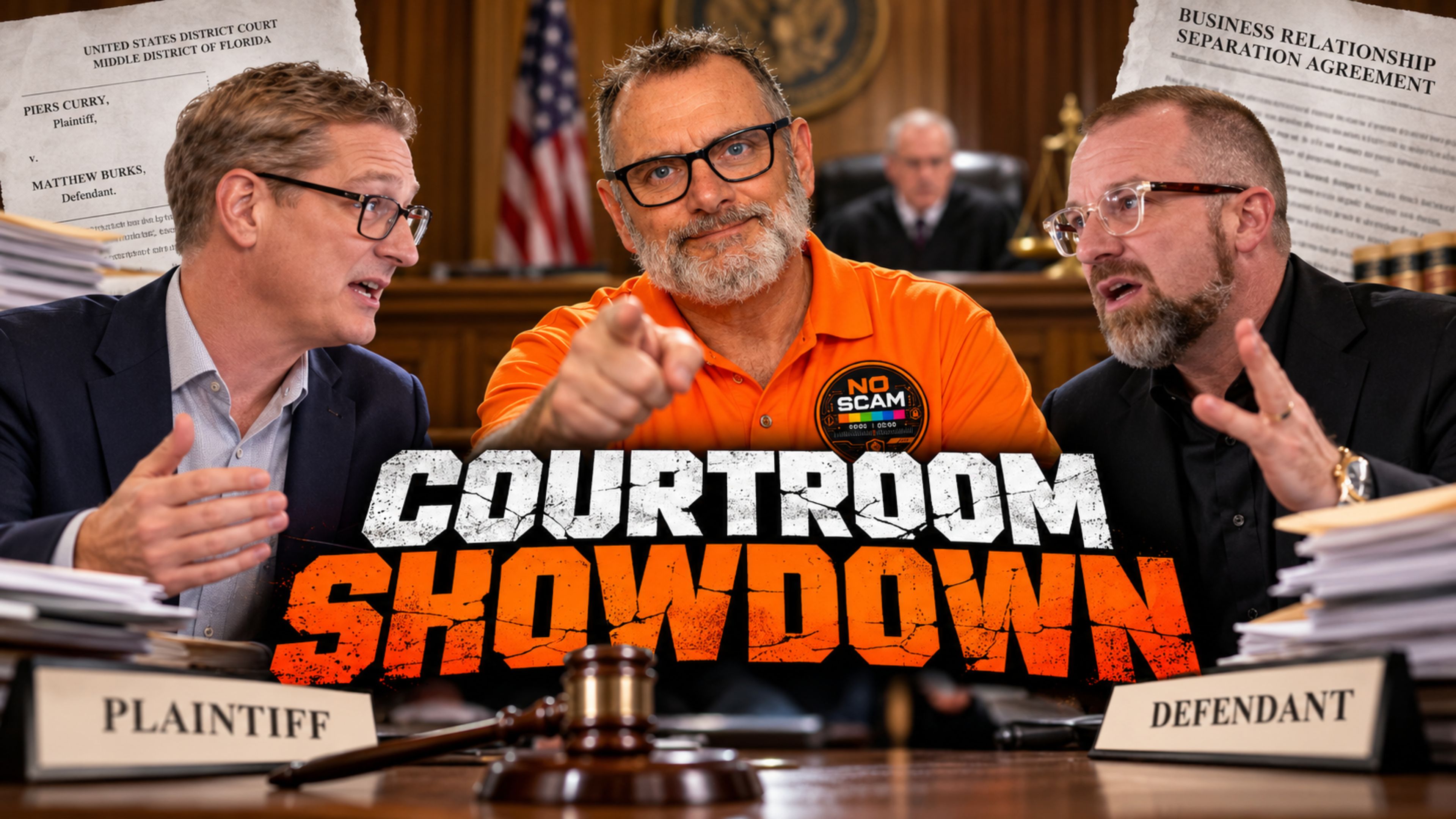
“We are you. We started by investing our own money with Chris, then looking out towards helping other clients of ours invest their money.” – Piers Curry, BlackBlock presentation, February 2025
A $20 million business separation agreement between two men involved in Goliath Ventures has become a central issue in a legal battle unfolding in Hillsborough County, Florida.
The agreement was signed on 1 April 2025, months before Goliath’s collapse exposed the devastating consequences of an investment operation that had attracted hundreds of millions of dollars.

The two men are Piers Curry and Matthew Burks, former business partners behind BlackBlock Management Solutions. Both were actively involved in promoting Goliath, presenting themselves as experienced financial professionals who could provide regulatory compliance, investor protection and greater transparency.
Now Curry is suing Burks.
 In Hillsborough County Circuit Court, case 26-CA-006148, Curry alleges fraud, misrepresentation, concealed financial information and breaches of fiduciary duties. His amended complaint, filed on 11 August 2026, sets out seven civil claims against Burks, including allegations concerning their business separation and the financial assurances provided to people involved with Goliath.
But there is another side to this story.
Curry wasn’t simply an investor who handed over money and trusted the people running Goliath. He helped introduce others to the opportunity, promoted the compliance arrangements and publicly reassured participants about the protections supposedly being established. Burks subsequently became Goliath’s Head of Compliance while maintaining other business interests connected to the operation.
Their separation agreement provided for $200,000 in cash and a $19.8 million secured promissory note. That establishes the agreed consideration, not whether the full amount was ever paid. The agreement also contained provisions intended to restrict certain legal claims between the former business partners.
What makes this lawsuit particularly revealing is the timing. Their business relationship ended in April 2025, yet the allegations concerning financial assurances, disputed compliance reviews and investor withdrawals extend into the months immediately preceding Goliath’s collapse.
The central question is no longer simply what happened to Christopher Delgado’s Goliath Ventures. It’s what the people helping promote and oversee the operation knew, what they told investors and whether their actions matched those assurances.
The court proceedings offer an opportunity to examine those questions through the competing accounts of two former business partners whose involvement extended well beyond that of ordinary investors.
The Men Who Helped Sell Goliath
By December 2024, Piers Curry and Matthew Burks had moved beyond being ordinary Goliath Ventures investors. Through their company, BlackBlock Management Solutions, they were positioning themselves as financial compliance professionals responsible for strengthening investor relations, reviewing agreements and introducing safeguards that would supposedly protect people placing substantial amounts of money into Goliath.
In a letter dated 11 December 2024, Curry introduced himself as the leader of BlackBlock and informed investors that his company had been engaged to provide regulatory compliance, client verification and investor relations services. He assured them that BlackBlock would improve transparency and help ensure their agreements met appropriate standards. These representations mattered because Goliath was offering unusually high monthly returns through purported cryptocurrency liquidity operations. Professional oversight could make an extraordinary investment proposition appear considerably more credible.
The Presentation That Helped Establish Trust

The relationship became more visible during a recorded Goliath presentation in February 2025. Christopher Delgado introduced Curry and Burks to the assembled directors, praising BlackBlock for bringing additional value and credibility to the operation. The two men then described their experience in traditional finance and discussed the compliance safeguards they said were being developed.
The presentation went considerably further than explaining administrative procedures. It covered insurance and fidelity bonds, investor accreditation, retirement funds, referral arrangements and new contractual structures. Participants were told about protections that could be discussed with prospective investors, including claims about insurance coverage and financial oversight.
One particularly revealing aspect was the emphasis on using compliance and insurance to build confidence. The recorded discussion included explanations of how directors should present those protections, even while acknowledging that insurance did not necessarily protect investors against investment losses.
For anyone considering placing $100,000 or more into Goliath, that distinction mattered enormously.
What Was BlackBlock Actually Verifying?
The August 2026 Amended Complaint introduces a serious contradiction. Curry alleges that Burks had access to financial information, cryptocurrency wallet records and internal Goliath operations that Curry himself could not independently examine. According to the complaint, Burks made representations about personally reviewing wallets, transaction logs and segregated investor funds.
Yet federal authorities subsequently alleged that Goliath was not operating the cryptocurrency investment strategy represented to investors. Instead, substantial investor funds were used to pay earlier participants and meet other expenses.
If BlackBlock was providing compliance oversight, how had it established that Goliath’s investor money was being used as promised?
The February presentation is important because it establishes what Curry and Burks publicly represented to Goliath’s network. It does not establish that either man knew the true condition of Goliath’s finances at the time. But it provides a record against which their later explanations, and the financial protections they promoted, can be examined.
The compliance structure that helped reassure investors would eventually become a central source of accusations between the two men responsible for promoting it.
The $20 Million Deal and Allegations Of Deception
By February 2025, the relationship between Piers Curry and Matthew Burks was beginning to unravel. According to Curry’s Amended Complaint, concerns had emerged about Burks’s spending, financial management and the lack of transparency within BlackBlock Management Solutions. Curry alleges that when he requested access to the company’s accounting records, Burks refused to provide the information and gradually excluded him from meaningful involvement in the business.
What followed was an extraordinary financial arrangement.
On 1 April 2025, the former business partners entered into a Business Relationship Separation Agreement. Court documents subsequently filed by Burks’s lawyers describe $20 million in consideration, comprising $200,000 in cash and a $19.8 million promissory note secured by a collateral assignment. The agreement also contained confidentiality provisions, restrictions on disparaging one another and mutual releases intended to limit future legal claims.
The documents establish the agreed consideration, but not whether Curry received the entire amount. They also leave important questions about the promissory note, its security and the source of any payments.
What Curry Says Was Concealed
In his Amended Complaint, Curry alleges that Burks induced him to sign the separation agreement through misleading representations about Goliath’s financial condition and BlackBlock’s business dealings. He claims Burks concealed information that would have materially affected his decision to surrender his ownership interest and release legal claims against his former partner.
The complaint goes considerably further. Curry alleges that Burks had access to Goliath’s internal financial information and cryptocurrency wallets, while Curry was prevented from independently examining those records. Burks allegedly reassured him that investor funds were segregated and that Goliath possessed the financial resources necessary to meet its obligations.
Those allegations are particularly significant when compared with what subsequently emerged about Goliath’s finances. Federal authorities alleged that the company was operating a Ponzi scheme in which new investor money was used to fund earlier distributions rather than being invested as represented.
If Burks was personally verifying Goliath’s financial position, what exactly was he examining?
The Conflicts Of Interest
Curry’s complaint also identifies overlapping business interests involving BlackBlock, WealthMD and Goliath Ventures. He alleges that Burks used WealthMD to promote Goliath investments, received financial benefits through those arrangements and subsequently became Goliath’s Head of Compliance while continuing to control BlackBlock.
These allegations raise questions about independence. A compliance professional responsible for scrutinising an investment operation should be able to identify and address conflicts between investor protection and personal financial interests. Curry’s complaint suggests those boundaries became increasingly blurred.
However, there is an uncomfortable issue in Curry’s own account. He acknowledges investing in Goliath, assisting with participant onboarding and encouraging friends and family to invest. His December 2024 letter and February 2025 presentation also establish that he publicly promoted BlackBlock’s compliance credentials.
Curry now alleges he was deceived by the business partner with whom he helped build that credibility.
In Count VII of the Amended Complaint, Curry seeks to rescind the separation agreement on the grounds of fraudulent inducement. Burks has relied on the agreement’s release provisions in challenging the claims.
The dispute therefore extends beyond whether a $19.8 million promissory note was paid. It concerns what representations secured the agreement, what information was allegedly concealed and whether the legal protections negotiated between these former partners should remain enforceable.
Inside The Florida Court Battle
The legal dispute between Piers Curry and Matthew Burks is documented in Hillsborough County Circuit Court, Florida, under case 26-CA-006148. Curry’s Amended Complaint, filed on 11 August 2026, contains seven civil claims, including fraudulent misrepresentation, breach of fiduciary duty, civil conspiracy, unjust enrichment and fraudulent inducement.
Burks has challenged the lawsuit. His legal position centres partly on their 1 April 2025 Business Relationship Separation Agreement, which contained mutual releases intended to restrict certain future claims. He has relied on those provisions in seeking dismissal, while Curry alleges that Burks obtained the agreement through deception and is asking the court to rescind it.
That creates an important legal conflict. Can Burks rely on an agreement to protect himself from allegations of misconduct when Curry claims he was misled into signing that same agreement?
The Fight Over Financial Records
The court documents assembled for this investigation include requests for production, requests for admission, discovery disclosures, a motion to compel and Burks’s Motion for Protective Order. The latter, filed on 27 August 2026, sought to prevent discovery from proceeding while the court considered his motion to dismiss. The available records also include an order denying a motion to dismiss, although that procedural ruling must not be confused with a finding that Curry’s allegations are true.
These developments matter because discovery is the process through which the parties seek documents and information relevant to their competing claims. Potentially important evidence includes BlackBlock’s accounting records, Goliath-related financial reviews, cryptocurrency wallet information, communications between Burks and Delgado, and records concerning payments to associated businesses.
The existence of discovery requests does not establish that the requested records have been produced or that they support Curry’s allegations. Nor do the filings examined establish the latest procedural status of every motion.
The Alleged Preferential Withdrawals
One of the more troubling allegations concerns what happened shortly before Goliath’s collapse. Curry claims Burks submitted numerous full-exit requests for investors associated with him during September and October 2025, before wider withdrawal restrictions became apparent in November.
The timing is significant. If some investors were being helped to leave while others remained exposed, investigators need to establish whether anyone possessed information about Goliath’s deteriorating financial position that was not available to ordinary participants.
There is an equally important distinction between submitting an exit request and receiving payment. The complaint does not, by itself, prove that Burks’s investors successfully withdrew their money or received preferential treatment. That would require transaction records, payment confirmations and evidence establishing when the relevant individuals became aware of Goliath’s difficulties.
Curry also alleges that Burks continued providing reassurances about Goliath’s financial condition, including during an October 2025 meeting in Lakeland. Those claims need to be tested against communications, financial records and contemporaneous statements.
Accountability Goes Beyond The Plaintiff
There is a danger in treating this lawsuit as a straightforward confrontation between an innocent victim and a dishonest business partner. Curry’s own complaint acknowledges his involvement in Goliath’s investor network, and the earlier BlackBlock presentation demonstrates that he participated in promoting its compliance arrangements.
Burks’s legal challenge does not establish that Curry’s accusations are false, just as Curry’s complaint does not establish that Burks committed the alleged misconduct.
What the proceedings may eventually reveal is how much each man knew about Goliath’s finances, what they earned from their involvement and whether the assurances given to investors were supported by genuine financial verification.
For people who lost money in Goliath Ventures, those questions are considerably more important than which former business partner ultimately wins this private civil lawsuit.
The Businesses Left Behind and The Unanswered Questions
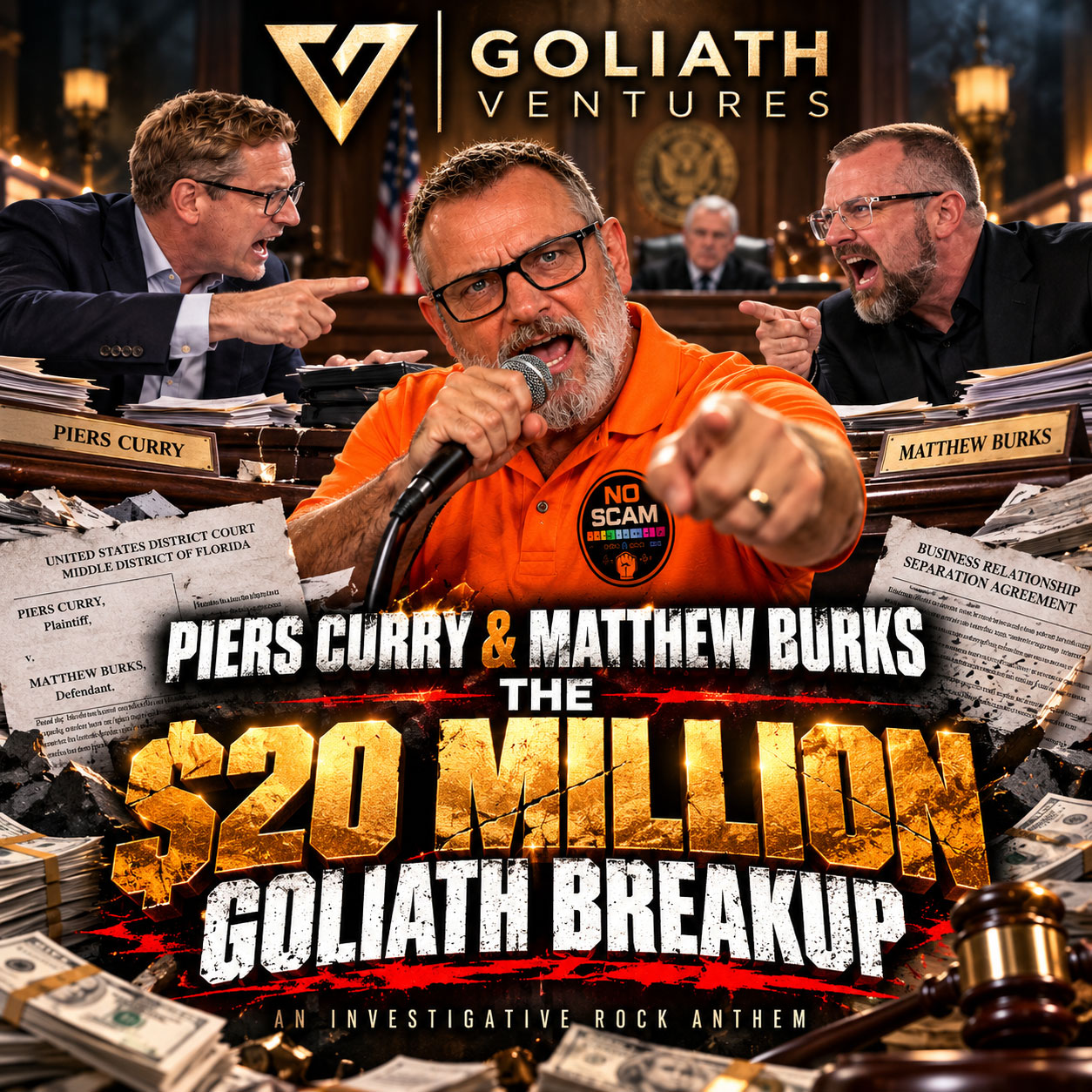
Beyond the dispute between Piers Curry and Matthew Burks, another part of the investigation concerns the businesses associated with Burks and whether any of their financial activities overlapped with Goliath Ventures.
The corporate trail is worth examining, but it is important to distinguish documented relationships from companies that have merely been identified as potential leads.
The Florida Business Connections
Among the companies identified for further examination are Camden Capital Group LLC, BlackBlock Management Solutions LLC, Wealth MD LLC, J&M Swift Transport LLC, Sound House Publishing LLC, Prime Chain Holdings LLC, Equisend LLC, Orange Street Ventures LLC and Burks Financial Group Inc. Their individual ownership histories, connections to Burks and corporate statuses require examination rather than assuming every company was involved in Goliath or engaged in misconduct.
One business with a verified connection is Wealth MD LLC. Florida’s Division of Corporations identifies Matthew A. Burks as a manager and records that the company was administratively dissolved on 25 September 2026 for failing to file its annual report.
That finding matters because Curry’s lawsuit separately alleges that Burks used WealthMD to promote Goliath investments and obtain financial benefits through those arrangements. The corporate record confirms an identifiable business connection; it does not independently establish the financial transactions alleged in the complaint.
Administrative dissolution is also not evidence of fraud or insolvency. Companies can lose their active registration status for administrative reasons without having committed financial misconduct.
The Wyoming Connection
Another company warrants particular attention: Ten4 Reserve LLC.
Florida corporate records establish that Ten4 Reserve was registered as a foreign limited liability company on 19 December 2025, identifying Wyoming as its state of formation. The filing names Ten4 Reserve Management LLC as its manager.
The timing is notable. The Florida registration occurred during the period when Goliath investors were experiencing serious problems receiving promised distributions. But timing alone does not establish that Ten4 Reserve received Goliath funds or was connected to the collapse.
Curry’s Amended Complaint alleges that Burks created Ten4 Reserve and had connections to another operation called Onyx Reserve, where he allegedly served as Director of Operations. The complaint also raises questions about a liquidity-pool algorithm and possible overlapping financial activities.
Those allegations require further evidence. The records examined do not establish that Ten4 Reserve operated a Ponzi scheme, accepted investor money or received funds originating from Goliath. Its financial activities, beneficial ownership and any relationships with former Goliath participants remain important questions.
Who Benefited From Goliath?
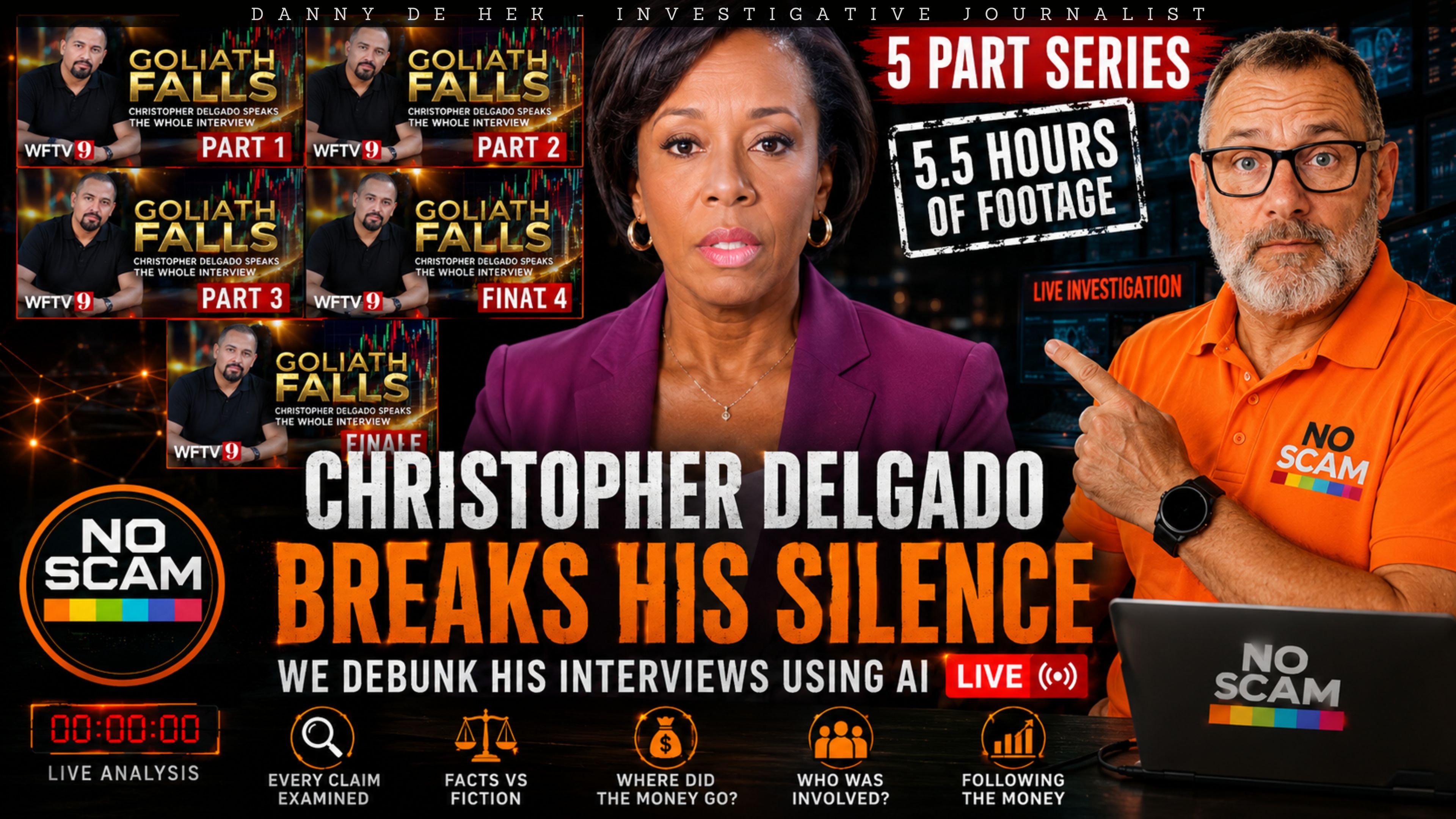
The wider significance of the Curry–Burks lawsuit becomes clearer when considered alongside Christopher Delgado’s recorded interview with WFTV investigative reporter Daralene Jones.
During that interview, Delgado acknowledged that investor money had been used to make distributions to other investors, cover company expenses and fund personal spending. When discussing responsibility for decisions within Goliath, he named himself, Nick Petrillo and Matthew Burks, saying they knew what was happening.
This was a statement by Delgado, who subsequently pleaded guilty in the federal criminal case. It is not an independent criminal finding against Burks, and his account must be considered in light of his own involvement in the scheme.
Nevertheless, it is a significant allegation because it comes from the person who ran Goliath Ventures. It also raises questions about the difference between Burks’s publicly presented compliance responsibilities and the role Delgado attributed to him.
And Curry cannot be overlooked.

His lawsuit describes a former partner who allegedly concealed information, controlled financial records and provided misleading assurances. Yet Curry was himself involved in promoting Goliath, encouraging others to invest and presenting BlackBlock as a source of professional oversight.
Both men’s conduct deserves examination, regardless of who ultimately succeeds in their private legal dispute.
For investors, the unanswered questions remain substantial. How much money flowed through BlackBlock, WealthMD and other associated businesses? Who received commissions or other financial benefits? Were any investors given preferential access to withdrawals? What did the people responsible for compliance know about Goliath’s actual financial position, and when did they know it?
These questions cannot be answered simply by examining company registrations or accepting either party’s allegations. They require financial records, communications, transaction histories and evidence capable of establishing who controlled the money.
The collapse of Goliath Ventures was not simply the failure of an investment opportunity. It exposed the consequences of an operation in which extraordinary returns, influential promoters and assurances of professional oversight encouraged people to place their trust in a business whose financial activities were fundamentally different from what investors had been led to believe.
Christopher Delgado’s criminal case is only part of that story. The responsibility of those who helped build, promote and maintain confidence in Goliath remains an important question of accountability.
Disclaimer: How This Investigation Was Conducted
This investigation relies entirely on OSINT — Open Source Intelligence — meaning every claim made here is based on publicly available records, archived web pages, corporate filings, domain data, social media activity, and open blockchain transactions. No private data, hacking, or unlawful access methods were used. OSINT is a powerful and ethical tool for exposing scams without violating privacy laws or overstepping legal boundaries.
About the Author
I’m DANNY DE HEK, a New Zealand–based YouTuber, investigative journalist, and OSINT researcher. I name and shame individuals promoting or marketing fraudulent schemes through my YOUTUBE CHANNEL. Every video I produce exposes the people behind scams, Ponzi schemes, and MLM frauds — holding them accountable in public.
My PODCAST is an extension of that work. It’s distributed across 18 major platforms — including Apple Podcasts, Spotify, Amazon Music, YouTube, and iHeartRadio — so when scammers try to hide, my content follows them everywhere. If you prefer listening to my investigations instead of watching, you’ll find them on every major podcast service.
You can BOOK ME for private consultations or SPEAKING ENGAGEMENTS, where I share first-hand experience from years of exposing large-scale fraud and helping victims recover.
“Stop losing your future to financial parasites. Subscribe. Expose. Protect.”
My work exposing crypto fraud has been featured in:
- Coffeezilla 2026): Featured in the investigation exposing the alleged $328M Goliath Ventures Ponzi scheme
- Bloomberg Documentary (2025): A 20-minute exposé on Ponzi schemes and crypto card fraud
- News.com.au (2025): Profiled as one of the leading scam-busters in Australasia
- OpIndia (2025): Cited for uncovering Pakistani software houses linked to drug trafficking, visa scams, and global financial fraud
- The Press / Stuff.co.nz (2023): Successfully defeated $3.85M gag lawsuit; court ruled it was a vexatious attempt to silence whistleblowing
- The Guardian Australia (2023): National warning on crypto MLMs affecting Aussie families
- ABC News Australia (2023): Investigation into Blockchain Global and its collapse
- The New York Times (2022): A full two-page feature on dismantling HyperVerse and its global network
- Radio New Zealand (2022): “The Kiwi YouTuber Taking Down Crypto Scammers From His Christchurch Home”
- Otago Daily Times (2022): A profile on my investigative work and the impact of crypto fraud in New Zealand




Leave A Comment