


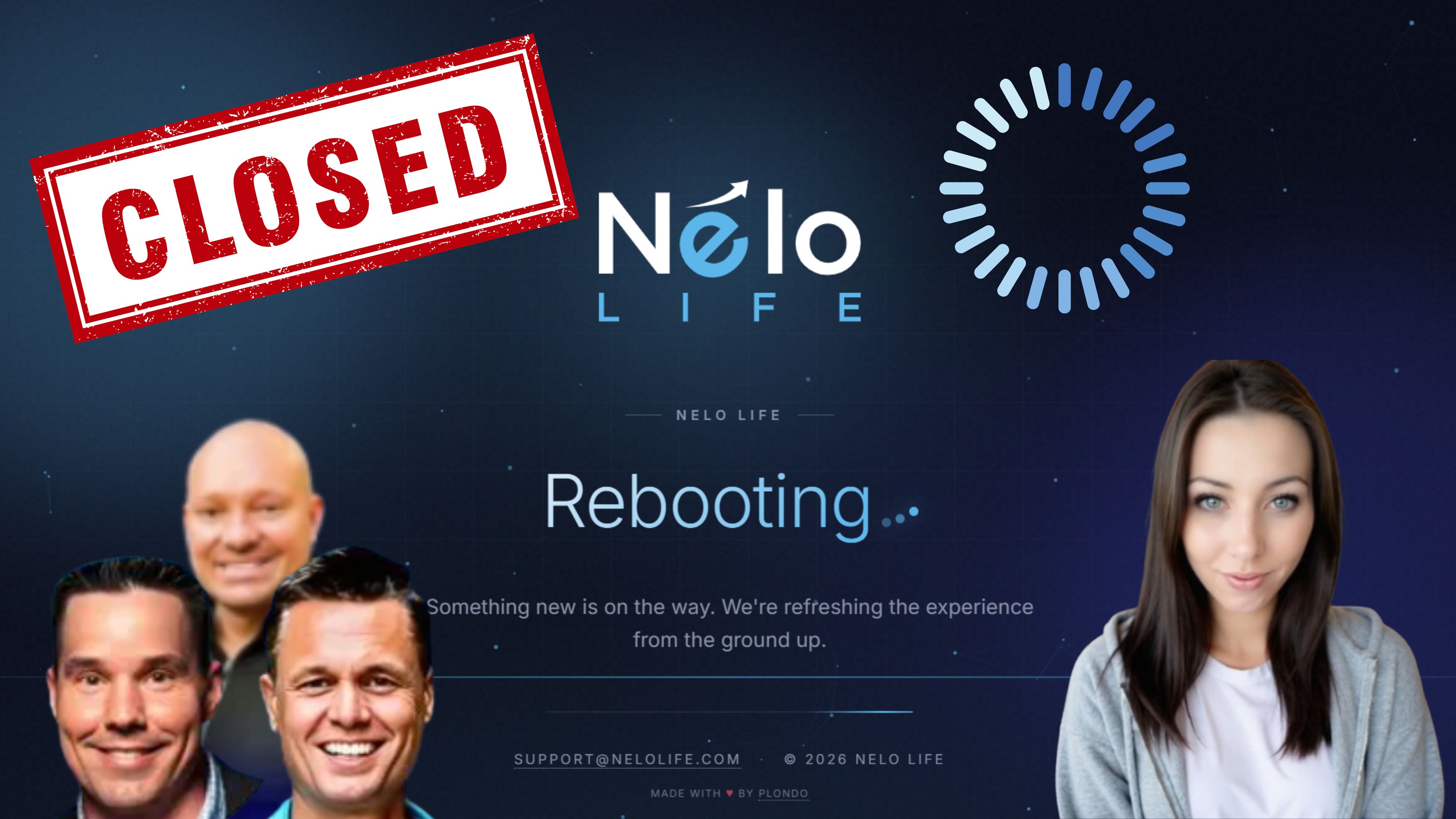
For anyone who’s been following the Nelo Life saga, the ending won’t come as a shock — but it still deserves to be documented. Nelo Life has quietly shut down. No announcement. No explanation. No accountability. Just a slow fade into silence while the people who ran it moved on to their next “big thing.”
Let’s talk about what Nelo Life actually was, who was behind it, the red flags that piled up, and why this shutdown fits the same MLM‑to‑tech‑to‑wellness pattern we’ve seen over and over again.
What Nelo Life Claimed to Be
Nelo Life came onto the scene with big promises. They branded themselves as:
- an “AI‑powered financial wellness platform,”
- a personal development community,
- a wellness movement,
- and a business opportunity all rolled into one.
If that sounds like a lot of hats for one company to wear, that’s because it was.
The “AI” was never clearly defined. The financial tools were generic. The wellness claims were vague enough to avoid scrutiny but bold enough to hook people looking for a fresh start.
It was the same formula we see constantly: wrap basic content in shiny tech buzzwords, call it a movement, and hope people don’t look too closely.
Who Ran Nelo Life
Nelo Life was run and promoted by four key figures:
- 1. Eric Allen: A central promoter and leadership voice. He positioned himself as a mentor, a wellness advocate, and a business strategist. He was heavily involved in recruitment and community calls.
- 2. Orkan Arat: Another core leader. He was part of the motivational messaging, the “movement building,” and the hype machine behind Nelo Life’s identity.
- 3. Nick Sorensen: A visible promoter and recruiter. Nick was part of the leadership circle pushing Nelo Life’s “financial empowerment” narrative.
- 4. Larry Lane: Larry was involved in the motivational and personal development side of the company. He contributed to the culture, the messaging, and the “community empowerment” angle.
These four men were the faces of Nelo Life. They were the ones encouraging people to trust the process, stay plugged in, and believe in the “AI wellness movement.”
And when things started falling apart? They didn’t stay and explain. They pivoted.
The Red Flags The Built Up Over Time
People inside Nelo Life started noticing problems long before the shutdown.
- Vague, Unverifiable Claims: Everything was “AI-powered,” “transformational,” or “next-level,” but nothing was ever shown.
- Recruitment Over Products: The business model depended on bringing in new members. Classic MLM structure.
- Leadership Instability: As soon as things got tough, leadership became less visible. Calls slowed down. Updates became vague. Promises replaced progress.
- Support Issues: Members reported missed payouts, inactive dashboards, unanswered support tickets, and features that were “coming soon” for months.
- Constant Pivots: Every time something didn’t pan out, leadership teased new direction. That is not innovation but it is stalling.
Nelo Life didn’t collapse overnight, it fizzled out.
The Nelo Life Shut Down
There is a well-known pattern with these pyramid shaped businesses when they shut down. Here’s the pattern:
- Payout delays started.
- The back office stopped updating.
- Leadership communication dropped off.
- Support became nonexistent.
- The website went quiet.
- Social media activity stopped.
- Leadership quietly moved on to their next venture.
No announcement, no closure statement, and no accountability. Just a slow, silent exit, leaving members confused and out of pocket.
Let’s be honest though: Nelo Life was never built to last.
There was no real product foundation. The “AI” wasn’t real. The tools weren’t unique. The wellness claims were generic.
Once recruitment slowed, the money dried up. We call this recruitment-dependent revenue. That’s the Achilles heel of every MLM-adjacent company.
Leadership always seemed to focus on hype, not infrastructure. They spent more time promoting “the movement” than building a sustainable platform.
In my opinion, the compensation structure they were using was completely unsustainable. This is not just because I am antiMLM. Subscription-based MLMs collapse fast when retention drops.
This was the classic MLM to technology to wellness pivot. That’s right, it happens so often, I can refer to it as “the classic!” This is the big one we need to discuss further.
The MLM to Tech to Wellness Cycle
This pattern that these types of MLMs fall into is so predictable, it’s almost fomulaic:
- Launch an MLM with motivational branding: Talk about community, empowerment, and transformation.
- Rebrand as a tech company: Add buzzwords like “AI,” “blockchain,” “digital coaching,” or “financial literacy.”
- Pivot into wellness: When the tech claims fall apart, shift into supplements, longevity, or holistic health.
- Quietly collapse: No announcement, no refunds, just silence.
- Leadership launches a new venture: Same people, same tactics, new name.
This cycle allows leaders to avoid accountability, retain their downline, rebrand losses as “new beginnings,” and continue profiting from vulnerable people looking for hope or community.
Nelo Life followed this pattern to the letter.
Where the Nelo Life Leaders Went After the Collapse
When Nelo Life went silent, the leadership didn’t stick around to explain anything. They didn’t address member losses, they didn’t offer refunds, and they didn’t take responsibility. Instead, they scattered into new ventures — each one following the same pattern of hype, reinvention, and “new opportunity” branding.
Here’s where they landed:
Eric Allen — Now pushing Vital Health
Eric didn’t waste any time. As Nelo Life was falling apart, he pivoted straight into Vital Health, a wellness‑longevity company using the same motivational language and community‑driven recruitment style he used at Nelo Life. The messaging is nearly identical: “Join the movement,” “transform your life,” “build your future.” Different company, same playbook.
Nick Sorensen — Also moved into Vital Health
Nick followed the exact same path as Eric. He resurfaced inside Vital Health almost immediately, promoting supplements, wellness claims, and “health optimization” products. This is the classic MLM → tech → wellness pivot. When the tech claims fall apart, they retreat into wellness — because wellness is vague, unregulated, and easy to market.
Larry Lane — Now involved in Global Gold Coin
Larry didn’t go the wellness route. He pivoted into Global Gold Coin, another hype‑driven opportunity with its own set of red flags. Danny and I have covered GGC extensively, and Larry’s involvement fits the same pattern: when one venture collapses, he simply attaches himself to the next “big thing.”
Orkan Arkat — Current activities unknown
Orkan was part of the leadership circle at Nelo Life, but unlike Eric, Nick, and Larry, he hasn’t resurfaced publicly in a new venture yet. There’s no clear information on what he’s doing now, which is its own kind of red flag — because silence after a collapse usually means someone is either regrouping or quietly building the next pivot.
This isn’t just trivia — it’s part of the MLM → tech → wellness → crypto → new‑opportunity cycle that keeps repeating:
- Launch a hype‑driven company
- Recruit aggressively
- Sell vague “value”
- Momentum slows
- Company collapses quietly
- Leadership pivots into a new venture
- Repeat the cycle with a fresh audience
Nelo Life’s shutdown fits this pattern perfectly, and the leadership’s new ventures prove it.
The Bottom Line: Nelo Life Didn’t Just Fail — It Followed a Pattern
Nelo Life didn’t collapse because of bad luck or a tough market. It collapsed because it was built on hype, vague promises, and a leadership team that has a long history of jumping from one “life‑changing opportunity” to the next.
And the moment Nelo Life started to fall apart?
They didn’t stay and explain. They didn’t take responsibility. They didn’t help the people they recruited.
They left.
Eric Allen and Nick Sorensen slid straight into Vital Health, pushing wellness and longevity products with the same recycled motivational language they used at Nelo Life. Larry Lane pivoted into Global Gold Coin, another high‑risk “opportunity” already raising red flags. And Orkan Arkat? He vanished into the background — which is its own kind of answer.
Nelo Life is just one more example of how these personality‑driven “movements” operate. They promise transformation, empowerment, and community — but the moment the money slows down, the leaders disappear and reinvent themselves somewhere else.
Consumers deserve better than this. They deserve transparency, accountability, and real products — not recycled buzzwords and motivational speeches wrapped in a new logo.
And if you see any of these men promoting their next “big thing,” remember what happened here. Remember Nelo Life. And remember that the people who ran it didn’t stay to clean up the mess — they simply moved on.
By Beth Gibbons (Queen of Karma)
Beth Gibbons, known publicly as Queen of Karma, is a whistleblower and anti-MLM advocate who shares her personal experiences of being manipulated and financially harmed by multi-level marketing schemes. She writes and speaks candidly about the emotional and psychological toll these so-called “business opportunities” take on vulnerable individuals, especially women. Beth positions herself as a survivor-turned-activist, exposing MLMs as commercial cults and highlighting the cult-like tactics used to recruit, control, and silence members.
She has contributed blogs and participated in video interviews under the name Queen of Karma, often blending personal storytelling with direct confrontation of scammy business models. Her work aligns closely with scam awareness efforts, and she’s part of a growing community of voices pushing back against MLM exploitation, gaslighting, and financial abuse.



Leave A Comment