


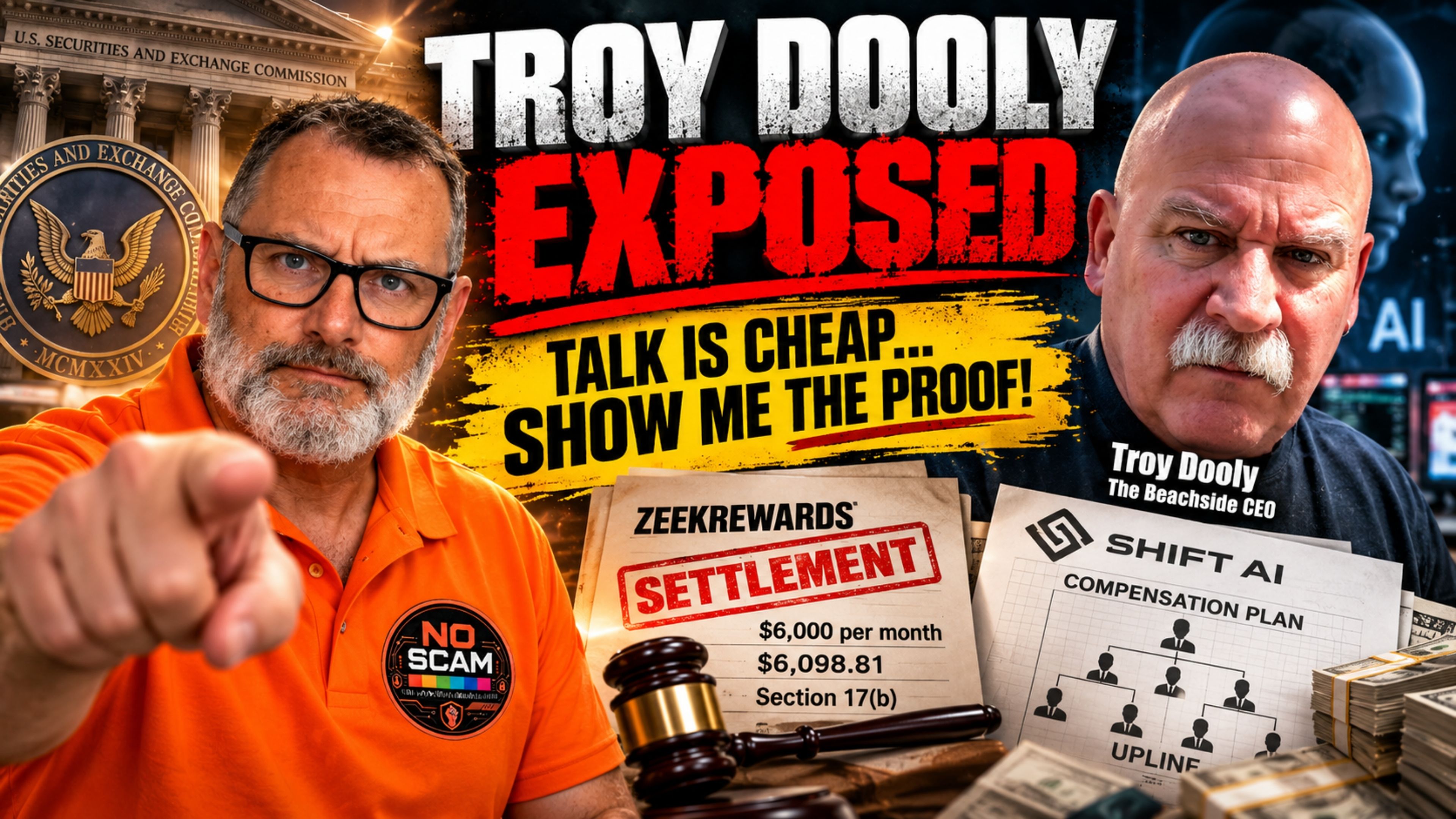
“I did something the critics have not. I reached out to Marty Hale and talked with him at length, off the record.”
That statement appeared in a Facebook post by Troy Dooly, an American network-marketing commentator who had decided to enter the growing controversy surrounding SHIFT AI and its founder, Marty Hale.
His post specifically named MLM attorney Kevin Thompson, Oz from BehindMLM and me as three people raising concerns about the business. Thompson had reportedly assessed the opportunity as high risk and warned people not to touch it. Dooly, however, wanted his audience to know he had taken a different approach.
I came across his accompanying video, which runs for just under seven minutes, and what caught my attention wasn’t simply that he had spoken to Marty. It was the way he questioned other investigators while presenting his own private conversations as something more meaningful. Dooly suggested that outside critics sometimes don’t know where to look for information and merely follow one another. He described his conversations with Hale as productive and claimed to have obtained information other investigators didn’t have.
But where was the evidence?
My SHIFT AI investigation has examined material attributed to Marty Hale himself, including internal documents describing a network-marketing ecosystem, an upline compensation structure and substantial markups on AI credits. There are also documented concerns surrounding the company’s payment processing, promotional financial claims and Hale’s previous legal history. These aren’t questions that disappear because somebody has enjoyed a private conversation with the founder.
Dooly acknowledged several of those concerns in his video. He discussed the possibility of money being paid from new participants rather than genuine product usage, questioned whether SHIFT AI was a software subscription or an investment contract, and raised the termination of its Stripe merchant account. Yet he provided no independently verifiable answers. Instead, he promised an exclusive interview with Hale and said he would examine the AI product himself.
The comments beneath his Facebook post added another dimension. Dooly acknowledged knowing Marty for years and said he hadn’t previously regarded him as someone who operated questionable businesses. He also acknowledged that some SHIFT AI marketing appeared seriously problematic. In another exchange, he stated that all the packages he had reviewed were commissionable. These were significant observations, but they made the absence of a detailed examination of the compensation structure in his video even more noticeable.
That prompted me to look more closely at the man presenting himself as an experienced voice on network-marketing regulation and investigative journalism.
What emerged was a documented history involving ZeekRewards, an operation shut down by the United States Securities and Exchange Commission in 2012. In September 2013, the SEC issued a cease-and-desist order against Dooly concerning undisclosed paid promotional activities connected with that business. He settled the civil proceedings without admitting or denying the regulator’s findings and now publicly acknowledges the settlement on his own website.
 The original regulatory document is available here: SEC Administrative Order No. 33-9460 — 30 September 2013.
That history doesn’t establish that Dooly is being paid by SHIFT AI, and I have no evidence of such an arrangement. He also explicitly states in his video that he is neither declaring SHIFT AI a scam nor clearing it. Both facts matter if we’re going to assess his commentary fairly.
But his previous regulatory history, his current public-relations and consulting activities, and his willingness to criticise other investigators make his own credibility a legitimate subject of scrutiny.
Troy Dooly says he knows what questions to ask. I want to know whether the answers he is giving his audience deserve their trust.
Who Is Troy Dooly?
Troy Dooly is an American network-marketing commentator, business consultant and public-relations professional who has spent years discussing multi-level marketing companies, compensation plans, regulatory compliance and businesses facing legal scrutiny. Through TroyDooly.com, he presents himself as an experienced industry adviser and identifies his role as CEO and Chief Communications Strategist of Deep South Companies Inc.
That background helps explain why people listen to him. Dooly speaks confidently about pyramid schemes, securities regulation and the distinction between legitimate direct selling and questionable investment opportunities. In his SHIFT AI Facebook video, he claimed to have read more than 225,000 court documents and watched tens of thousands of hours of material involving Ponzi schemes, pyramid schemes and unregistered securities. Those are his own claims, not independently verified measures of his experience, but they contribute to the authority he presents to his audience.
What interests me is that Dooly is not simply an outside commentator reporting on the network-marketing industry. His professional activities also involve advising businesses operating within that same industry. His website promotes communications, consulting and regulatory-related services, meaning his commercial work can involve the kinds of companies he publicly discusses. There is nothing inherently improper about that arrangement, but it makes transparency about professional relationships particularly important.
In his SHIFT AI video, Dooly questioned the investigative methods of other critics, suggesting that some follow one another rather than conducting sufficiently independent research. He contrasted that approach with his decision to contact Marty Hale directly, describing their private conversations as an example of what real journalism should involve.
But speaking with a company founder is not, by itself, proof of a thorough investigation. Independent journalism also involves examining original documents, testing financial claims, checking court records and identifying contradictions between promotional statements and verifiable evidence.
Dooly has every right to challenge my reporting or the work of Oz at BehindMLM. If he can identify factual errors, those findings deserve attention. What matters is whether his criticism is supported by evidence rather than simply his confidence, industry experience or access to the people being investigated.
That distinction becomes especially important when examining Dooly’s own regulatory history. In 2013, the United States Securities and Exchange Commission issued an enforcement order concerning his paid promotional activities connected with ZeekRewards. The original government record provides an opportunity to examine how the regulator assessed his conduct, rather than relying on reputation or opinion.
The ZeekRewards Scandal and SEC Enforcement Action
In August 2012, the United States Securities and Exchange Commission (SEC) took action against ZeekRewards, an online investment programme operated by Rex Venture Group LLC. The regulator alleged that the business was operating a massive Ponzi and pyramid scheme, attracting participants with promises of profits associated with an online penny-auction platform. According to the SEC, the operation relied heavily on money contributed by new participants rather than sufficient revenue from genuine business activity.
One of the individuals subsequently named in a separate SEC enforcement proceeding was Troy Dooly.
On 30 September 2013, the SEC issued an administrative cease-and-desist order against Dooly concerning his promotional activities connected with ZeekRewards. The order described a consulting agreement under which he was to receive US$6,000 per month for public-relations services involving Rex Venture Group. The SEC found that Dooly had publicised ZeekRewards without adequately disclosing his financial relationship with the business.
The regulator determined that his conduct violated Section 17(b) of the Securities Act of 1933, which requires disclosure of compensation received for certain publicity involving securities. This was a civil administrative enforcement action, not a criminal prosecution. The order did not establish that Dooly operated ZeekRewards or participated in running its alleged Ponzi scheme.
Dooly settled the proceedings without admitting or denying the SEC’s findings. The settlement required him to cease and desist from further violations of Section 17(b), pay US$3,098.81 in disgorgement and prejudgment interest, and pay a US$3,000 civil penalty. The total financial amount was US$6,098.81.
Original Government Evidence: SEC Administrative Order No. 33-9460 — In the Matter of Troy Dooly, 30 September 2013 (PDF)
 Oz at BehindMLM also covered the enforcement action at the time: SEC Fines Troy Dooly for Pimping Zeek Rewards.
The significance of this record is not simply that Dooly was previously sanctioned by a financial regulator. The SEC findings concerned the disclosure of a financial relationship while publicising a controversial business opportunity. That is directly relevant when considering the independence of commentary about companies operating in the network-marketing industry.
Dooly now publicly acknowledges his SEC settlement, including on his own website. That is an important distinction, and there is no evidence presented here that he has received undisclosed compensation from SHIFT AI or Marty Hale.
Nevertheless, the original SEC order establishes why questions about disclosure and commercial relationships are legitimate. When someone with this regulatory history publicly questions investigative journalists while discussing another controversial business opportunity, their own transparency deserves the same scrutiny they expect from others.
The Business Behind Troy Dooly’s Commentary
Troy Dooly’s professional activities extend well beyond publishing opinions about network-marketing companies. Through TroyDooly.com, he promotes services involving public relations, business communications, regulatory compliance and reputation management. His website identifies him as CEO and Chief Communications Strategist of Deep South Companies Inc, positioning him as someone businesses can approach for advice when facing regulatory questions or reputational challenges.
There is nothing inherently improper about providing those services. However, when a commentator also earns money advising businesses within the industry he covers, transparency about commercial relationships becomes particularly important. Dooly’s website includes an FTC disclosure page and an income disclosure page, acknowledging the importance of financial disclosures and potential affiliate compensation. General disclosures are useful, but they do not establish whether a particular video involves a paid relationship.
Another venture associated with Dooly is Millionaire Man Cave, a membership and coaching platform advertising a US$97 monthly subscription, affiliate opportunities and promotional tools. Dooly is publicly identified in its leadership material as Guardian of The Fight. The platform illustrates his continuing involvement in businesses combining coaching, marketing and affiliate opportunities. Its existence does not establish wrongdoing or any connection with SHIFT AI.
Perhaps the clearest explanation of how Dooly’s consulting and publishing activities overlap came from his own Facebook comments. When Asif Basheer questioned him about promoter Jenna Zwagil, Dooly acknowledged that his agency had previously been hired to conduct a risk assessment involving a potential business partner. He also described working with her executive team as a regulatory and compliance adviser, introducing her to legal advisers, and providing publishing services that included articles and magazine coverage. Dooly stated that he was no longer engaged with Zwagil or her projects. These are his descriptions of professional services, not proof of the separate allegations made against her.
The SHIFT AI discussion revealed another relationship worth examining. Responding to Kelly Isom Tolar, Dooly wrote:
“In my case, I have known Marty for years, and I haven’t seen him as a man who launched or ran fringe companies.”
That admission provides important context for his Facebook video. Dooly presented his direct access to Marty Hale as an advantage over other investigators, but he was not approaching an unfamiliar founder. He was speaking with someone he already knew and whose previous business activities he viewed favourably. That does not invalidate their conversations, but readers should understand the relationship when assessing his commentary.
What remains unanswered is whether Dooly has received, been offered or expects to receive any consulting fees, promotional payments, affiliate commissions or other commercial benefits connected with SHIFT AI, Marty Hale or their associates. I have no evidence that such an arrangement exists, and his previous SEC settlement cannot be used as proof of a new undisclosed financial relationship.
The relevant issue is transparency. Dooly’s consulting experience, publishing activities and longstanding acquaintance with Hale are documented reasons to ask about independence, not grounds to presume misconduct. With those relationships established, the next question is whether his SHIFT AI commentary withstands examination against the company’s own business documents and the concerns he publicly acknowledged.
What Troy Said About SHIFT AI — and What the Evidence Shows
In his Facebook video, Troy Dooly suggested that outside investigators were following one another rather than conducting independent research. He questioned whether some of the information being connected to SHIFT AI was relevant and suggested that attracting views and clicks could be a motivation. Yet he did not identify a specific court document I had misrepresented, a financial figure I had calculated incorrectly or a statement from Marty Hale that had been falsely reported.
Instead, Dooly emphasised that he had spent two days speaking privately with Hale, obtaining information other investigators supposedly did not possess. He described their conversations positively but made it clear that the details would remain off the record. That leaves viewers with Dooly’s account of a private conversation rather than evidence they can independently examine. Speaking directly with a founder can be valuable, but meaningful investigative journalism also requires testing what that person says against documents and independently verifiable facts.
One of the most important issues missing from his video was a detailed examination of SHIFT AI’s own business plan and compensation structure. Internal documents examined in my investigation describe a network-marketer-facing ecosystem, refer to an upline and a compensation plan, and discuss CrowdPay’s ability to track upline genealogy. Other material describes substantial markups on AI credits obtained through third-party providers. These details matter because SHIFT AI has been promoted as something other than conventional multi-level marketing, despite offering paid packages, recruitment incentives and commissionable positions.
Dooly recognised part of this problem himself. When Robert Proctor questioned whether purchases were required to participate in the business opportunity and whether commissions were paid on those purchases, Dooly responded:
“From reviewing the site, all packages are commissionable.”
That is a significant admission. If packages generate commissions, the critical questions are who purchases them, whether they are being purchased primarily for genuine AI usage or income opportunities, and where the money used to pay commissions originates. A functioning AI product does not, by itself, establish that the compensation structure is legitimate or financially sustainable.
But Dooly’s Facebook comments went further than his video. Responding to Keith Chaisson, who described SHIFT AI as questionable, Dooly wrote:
“If the marketing draws someone in, it is one of the sketchiest ones I’ve seen since TEXITCoin.”
He then suggested that the underlying project might still be sound if favourable early reviews proved reliable. This distinction between a potentially useful product and questionable marketing is worth considering. However, the marketing and compensation arrangements are not separate from the business opportunity being sold. If commissions depend substantially on participants purchasing packages rather than genuine retail demand, the existence of useful software does not resolve that concern.
Another revealing exchange involved BehindMLM. When commenter Michael Sander dismissed the website as unreliable, Dooly responded that regulators quoting an individual or website in official filings was a reason to take that source seriously. Despite criticising BehindMLM’s investigative methods, he also acknowledged that the majority of its published information was accurate. That is a more measured position than the impression created by his criticism of outside investigators in the video.
Dooly also referred to Stripe’s termination of SHIFT AI’s payment processing, asking where the money was going following the loss of that service. It was a legitimate question, but the answer requires more than assurances from Marty Hale. Relevant evidence includes payment-provider correspondence, records showing how customer funds were handled and independently verifiable information about replacement payment arrangements.
The same applies to Hale’s legal history. Dooly acknowledged questions about a 2008 federal plea, a bank judgment and omissions from Hale’s public biography. These matters should be assessed against the original court records, including the actual findings and outcomes, rather than dismissed because the information is publicly available.
To be fair, Dooly explicitly stated that he was neither declaring SHIFT AI a scam nor clearing it. He acknowledged Kevin Thompson’s high-risk assessment and promised an on-the-record interview with Hale. His comments also demonstrate that he recognised several serious warning signs.
That is precisely why his criticism of other investigators deserves scrutiny. Dooly acknowledged commissionable packages, described SHIFT AI’s marketing as exceptionally questionable and recognised the importance of tracing the money. Yet his video provided no independently verifiable answers to those concerns.
He may have asked Marty Hale additional questions privately. We cannot establish otherwise. But until the relevant financial records, compensation arrangements and court documents are examined publicly, his access to the founder does not outweigh the documentary evidence already available.
The real test of Troy Dooly’s commentary is not how long he spoke with Marty Hale. It is whether the information he publishes allows viewers to determine what SHIFT AI is actually selling, how its compensation system operates and whether its financial claims withstand scrutiny.
Fifteen Questions for Marty Hale — Will Troy Dooly Get the Answers?
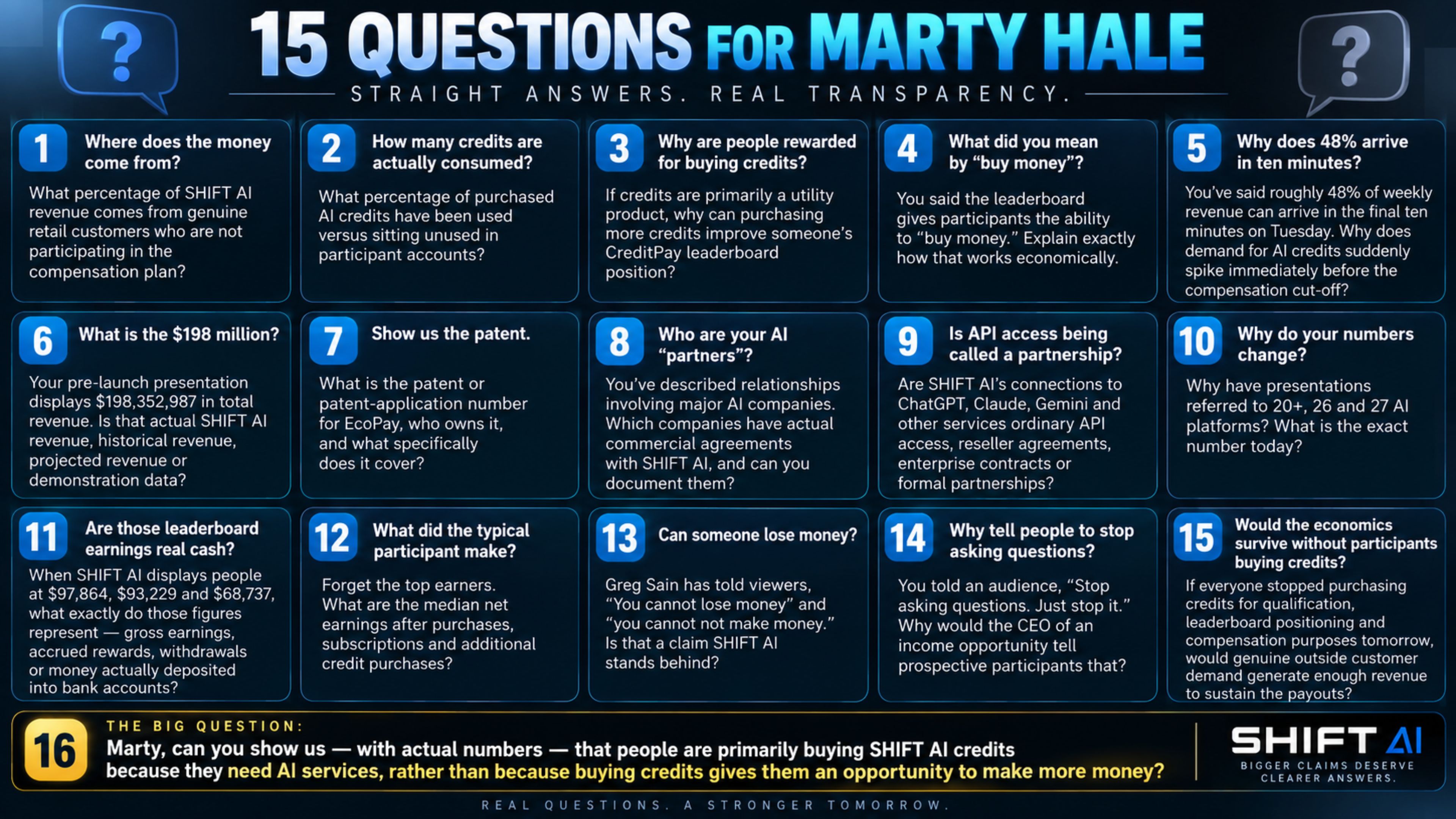
Troy Dooly says he intends to conduct an on-the-record interview with SHIFT AI founder Marty Hale. I welcome that. In fact, I have already prepared 15 questions that Dooly is welcome to put directly to Hale, because these are the questions I have been trying to get answered about SHIFT AI’s finances, compensation structure, AI credits and promotional claims.
On 22 September 2026, I published a recording of my own encounter with Hale during a Zoom call. He did not initially know he was speaking with me until I introduced myself. I began asking about SHIFT AI’s revenue, genuine retail customers and how many purchased AI credits were actually being consumed. Hale claimed the company had corporate customers spending more than US$100,000 per month, but did not identify them. When I challenged him about statements from earlier presentations, he disputed my characterisation and told me to review the video.
That is exactly what I did. My published video places excerpts from Hale’s earlier presentations alongside our exchange, allowing viewers to compare his statements. In those presentations, Hale described participants holding AI credits “kind of like a stock”, discussed people purchasing credits without consuming them, and said someone might purchase another US$1,000 in credits to make US$3,000 more cash. He also claimed that 48% of SHIFT AI’s weekly revenue arrived during the final ten minutes on Tuesday night, when participants were competing for leaderboard positions.
These are statements attributed to Hale in the recorded material, not independently verified financial results. But they raise obvious questions about whether customers are primarily purchasing AI services to use them or purchasing credits because they expect financial rewards.
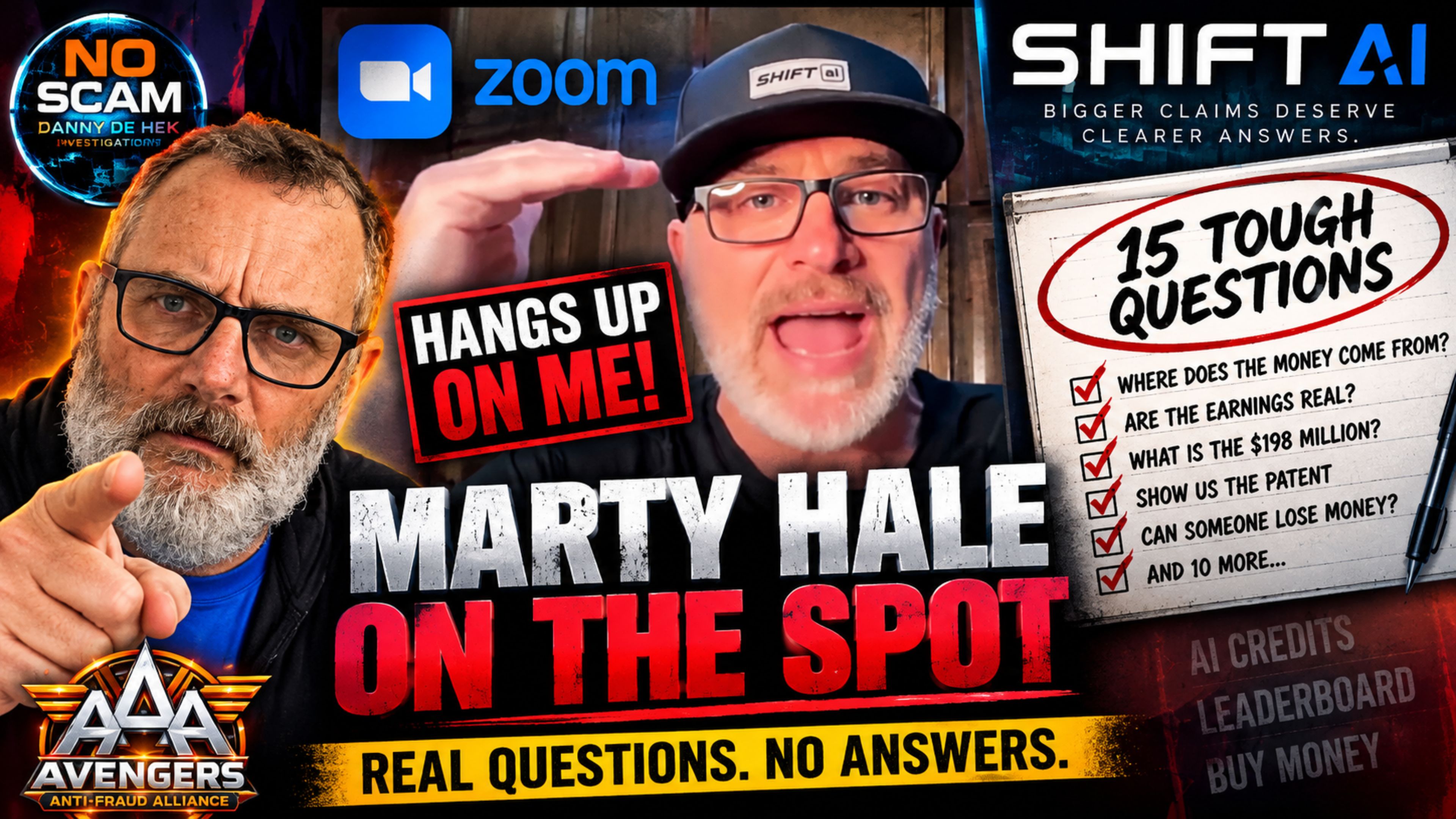
Watch my recorded encounter with Marty Hale: Marty Hale HANGS UP On Me! SHIFT AI CEO Confronted With His Own Words
Unfortunately, the conversation ended before I could work through my prepared questions. According to my account of the encounter, Hale disconnected while I was still questioning him. I cannot establish why he left the call, and I will not pretend to know his motives. What I can establish is that the questions remained unanswered.
Dooly now has an opportunity to obtain those answers. Rather than criticising investigators for supposedly failing to speak with the founder, he can put the following questions to Hale and allow viewers to assess the responses.
1. Where Does the Money Come From? What percentage of SHIFT AI’s revenue comes from genuine retail customers who are not participating in its compensation plan?
2. How Many AI Credits Are Actually Consumed? What percentage of purchased credits have been used to access AI services, compared with credits remaining unused in participant accounts?
3. Why Are People Rewarded for Buying Credits? If credits are primarily a utility product, why can purchasing additional credits improve a participant’s position on the CreditPay leaderboard?
4. What Did You Mean by “Buy Money”? Hale described leaderboard participants having the ability to “buy money”. What does that mean in practice, and how does the underlying economics work?
5. Why Does 48% Arrive in Ten Minutes? Hale claimed that roughly 48% of weekly revenue could arrive during the final ten minutes on Tuesday night. Why would genuine demand for AI services suddenly increase immediately before a compensation deadline?
6. What Is the US$198 Million Figure? A pre-launch presentation displayed US$198,352,987 in total revenue. Was that actual SHIFT AI revenue, historical revenue, projected revenue or demonstration data?
7. Where Is the Patent? What is the patent or patent-application number for EcoPay, who owns it, and what specific technology does it cover?
8. Who Are SHIFT AI’s AI Partners? Which major AI companies have actual commercial agreements with SHIFT AI, and can those relationships be documented?
9. Is Ordinary API Access Being Called a Partnership? Are SHIFT AI’s connections to ChatGPT, Claude, Gemini and other services standard API access, reseller arrangements, enterprise contracts or formal commercial partnerships?
10. Why Do the Platform Numbers Keep Changing? SHIFT AI presentations have referred to 20-plus, 26 and 27 AI platforms. What is the current verified number, and which services are actually available?
11. Are the Leaderboard Earnings Real Cash? When SHIFT AI displays figures such as US$97,864, US$93,229 and US$68,737, do they represent gross earnings, accrued rewards, withdrawals or money actually deposited into participants’ bank accounts?
12. What Did the Typical Participant Earn? What are the median net earnings after initial purchases, subscriptions and additional credit purchases? The results of a typical participant matter far more than the highest figures displayed on a leaderboard.
13. Can Participants Lose Money? Promoter Greg Sain has reportedly told viewers that they cannot lose money and cannot fail to make money. Does SHIFT AI endorse those claims, and what financial risks do participants actually face?
14. Why Tell People to Stop Asking Questions? Hale was recorded telling an audience, “Stop asking questions. Just stop it.” Why would the founder of a business offering an income opportunity discourage prospective participants from seeking explanations?
15. Would the Business Survive Without Participants Buying Credits? If participants stopped purchasing credits for qualification, leaderboard positioning and compensation purposes, would genuine outside customers generate sufficient revenue to sustain the payouts?
There is also one overarching question that brings the entire investigation into focus:
Marty Hale, can you demonstrate with independently verifiable financial records that people are primarily buying SHIFT AI credits because they need AI services, rather than because purchasing credits gives them an opportunity to make more money?
That is the distinction I want established. SHIFT AI may provide functioning AI tools, but the existence of a product does not answer questions about the source of compensation payments, the proportion of genuine retail revenue or the financial motivations behind purchasing credits.
I am not asking Dooly to accept my conclusions. I am asking him to put these questions to Hale, request documentary evidence and publish the answers so everyone can examine them. If Hale can substantiate his claims, that evidence deserves to be reported fairly. If he cannot, viewers deserve to know which questions remain unresolved.
Troy Dooly has said that speaking directly with the founder is an essential part of responsible journalism. He now has a practical opportunity to demonstrate what that means.
The questions are ready. Marty Hale has already had an opportunity to answer some of them. Troy Dooly says he can get the interview. Now let’s see whether he can get the evidence.
The Questions Troy Dooly Still Needs to Answer

Troy Dooly has spent years discussing network-marketing regulation, questionable compensation plans and the warning signs associated with Ponzi and pyramid schemes. His experience should make him well equipped to recognise the concerns surrounding SHIFT AI. Yet after watching his Facebook video and examining his responses to commenters, I am still waiting to see what his conversations with Marty Hale have established that can be independently verified.
The questions surrounding SHIFT AI are not complicated, although answering them properly may require substantial financial documentation. How much revenue comes from genuine retail customers who purchase AI services without participating in the income opportunity? Where does the money used to pay commissions originate? Why do internal documents describe an upline compensation structure when the business has been promoted as something other than conventional MLM? What evidence supports the value assigned to its AI credits, and what happened to customer funds following Stripe’s termination of payment processing?
These questions cannot be resolved by demonstrating that SHIFT AI’s software works or by obtaining reassuring explanations from its founder. They require transaction records, an examination of the compensation plan and evidence that the business can sustain its obligations through genuine demand for its services. Dooly has acknowledged several of these concerns himself, making it reasonable to expect his promised interview with Hale to address them directly.
There is also an important question about Dooly’s independence. His 2013 SEC settlement involved inadequate disclosure of paid promotional activities connected with ZeekRewards. Today, he operates businesses offering consulting, communications and publishing services within the network-marketing industry, and he has publicly acknowledged knowing Marty Hale for years.
Given that background, I believe Dooly should disclose whether he has received, been offered or expects to receive any consulting fees, promotional payments, affiliate commissions or other commercial benefits connected with SHIFT AI, Hale or their associates. I have no evidence that such an arrangement exists. His previous SEC settlement is a reason to ask about transparency, not proof that he has repeated the conduct identified by the regulator.
Dooly is equally entitled to question my reporting and the work of Oz at BehindMLM. But meaningful criticism requires specifics. Which court record is inaccurate? Which internal SHIFT AI document has been misrepresented? Which financial claim has been misunderstood? If he can identify genuine errors and support his findings with evidence, those corrections deserve to be examined and published.
What I find particularly revealing is that Dooly’s own Facebook comments acknowledge many of the warning signs investigators have raised. He recognised that SHIFT AI’s packages were commissionable, described its marketing as exceptionally questionable and accepted that transparency around money was essential. Those observations do not establish that SHIFT AI is operating unlawfully, but they demonstrate why independent scrutiny is warranted.
I did not investigate Troy Dooly simply because he disagreed with me. I investigated him because he publicly questioned the credibility of journalists examining SHIFT AI while presenting his private access to Marty Hale as a more informed approach. His professional background, regulatory history and published statements deserve the same examination he expects others to withstand.
If Dooly’s promised interview produces credible documents that answer the outstanding questions, I will examine them fairly. If he identifies inaccuracies in my reporting, I will assess the evidence and correct anything that is demonstrably wrong.
Until then, a private conversation with Marty Hale is not a substitute for documentary evidence. Troy Dooly’s credibility should be judged by the accuracy, independence and transparency of his reporting — not simply by his industry experience or his access to the founder.
Disclaimer: How This Investigation Was Conducted
This investigation relies entirely on OSINT — Open Source Intelligence — meaning every claim made here is based on publicly available records, archived web pages, corporate filings, domain data, social media activity, and open blockchain transactions. No private data, hacking, or unlawful access methods were used. OSINT is a powerful and ethical tool for exposing scams without violating privacy laws or overstepping legal boundaries.
About the Author
I’m DANNY DE HEK, a New Zealand–based YouTuber, investigative journalist, and OSINT researcher. I name and shame individuals promoting or marketing fraudulent schemes through my YOUTUBE CHANNEL. Every video I produce exposes the people behind scams, Ponzi schemes, and MLM frauds — holding them accountable in public.
My PODCAST is an extension of that work. It’s distributed across 18 major platforms — including Apple Podcasts, Spotify, Amazon Music, YouTube, and iHeartRadio — so when scammers try to hide, my content follows them everywhere. If you prefer listening to my investigations instead of watching, you’ll find them on every major podcast service.
You can BOOK ME for private consultations or SPEAKING ENGAGEMENTS, where I share first-hand experience from years of exposing large-scale fraud and helping victims recover.
“Stop losing your future to financial parasites. Subscribe. Expose. Protect.”
My work exposing crypto fraud has been featured in:
- Coffeezilla 2026): Featured in the investigation exposing the alleged $328M Goliath Ventures Ponzi scheme
- Bloomberg Documentary (2025): A 20-minute exposé on Ponzi schemes and crypto card fraud
- News.com.au (2025): Profiled as one of the leading scam-busters in Australasia
- OpIndia (2025): Cited for uncovering Pakistani software houses linked to drug trafficking, visa scams, and global financial fraud
- The Press / Stuff.co.nz (2023): Successfully defeated $3.85M gag lawsuit; court ruled it was a vexatious attempt to silence whistleblowing
- The Guardian Australia (2023): National warning on crypto MLMs affecting Aussie families
- ABC News Australia (2023): Investigation into Blockchain Global and its collapse
- The New York Times (2022): A full two-page feature on dismantling HyperVerse and its global network
- Radio New Zealand (2022): “The Kiwi YouTuber Taking Down Crypto Scammers From His Christchurch Home”
- Otago Daily Times (2022): A profile on my investigative work and the impact of crypto fraud in New Zealand




Leave A Comment