



“At the moment, I’m representing about 7,500 victims from more than 100 countries all over the world.” — Lars Olofsson, Jubilee/Jenco recovery presentation, 02:52
Thousands of people who lost money in investment scams have spent years searching for answers, accountability and some hope of recovering their savings.
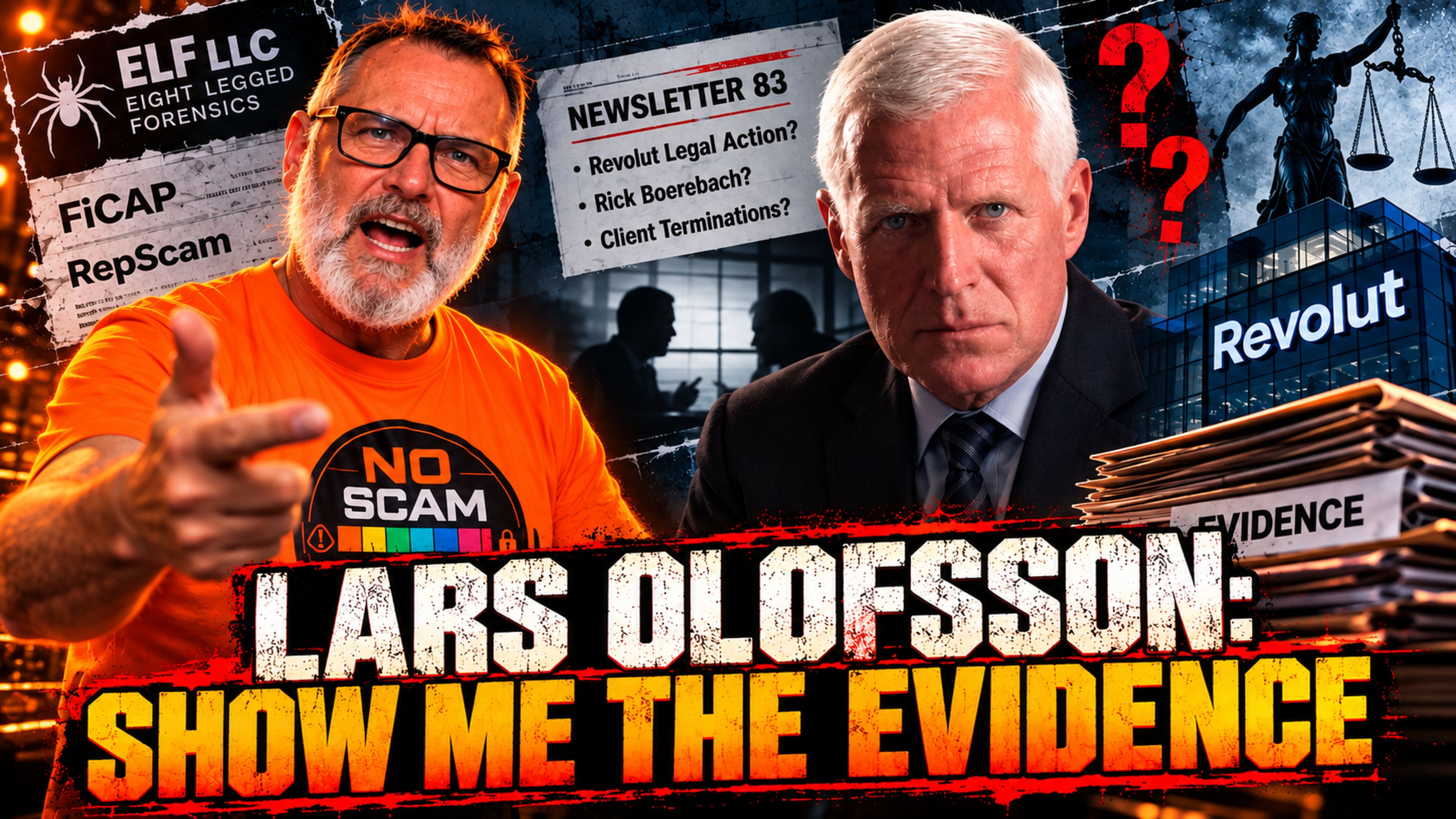
For many victims of JuicyFields, that search eventually led them to a Swedish law graduate named Lars Olofsson, a man who presented himself as an experienced international fraud investigator with the knowledge, legal expertise and connections needed to take on the banks, financial institutions and corporations he believed had helped facilitate these schemes.
His message was persuasive. Rather than chasing criminals who may have disappeared with the money, Olofsson proposed pursuing the financial institutions and other businesses that had enabled the fraud. He spoke of international legal teams, cooperation with police agencies, negotiations with banks and substantial compensation claims.
For people who had already lost thousands, sometimes hundreds of thousands, of euros, it offered something they desperately needed: the possibility that their money wasn’t gone forever.
But more than four years after Olofsson began attracting attention within JuicyFields victim communities in 2022, serious questions remain about his representations, the outcomes of his legal activities and what his clients have actually received. Behind the newsletters, ambitious announcements and promises of international action lies a growing collection of dissatisfied former associates, concerned clients, disputed business arrangements and court records that deserve closer examination.

I’m no stranger to investigating people who make extraordinary financial promises. My reporting into GOLIATH VENTURES INC, alongside investigations into numerous investment frauds and Ponzi schemes, has brought me into contact with victims, whistleblowers, lawyers and financial crime investigators around the world. My work has also featured in international media, including Bloomberg’s documentary (Dubai’s Billion-Dollar Crypto Underworld) reporting on the HyperVerse scandal. I regularly assist journalists and researchers examining financial fraud, sharing evidence and helping establish how these operations attracted investors and maintained their credibility.
One lesson I’ve learnt is that victims of financial fraud are particularly vulnerable to anyone offering a convincing route to recovery. After losing their savings, many are prepared to trust someone who appears knowledgeable, speaks confidently about legal procedures and claims to have powerful international connections.
That trust deserves to be earned through transparency and demonstrable results, not simply impressive presentations.
For this investigation, I’ve obtained access to an extensive archive of Telegram discussions from the JuicyFields English Backup community, historical newsletters distributed by Olofsson, investment prospectuses, corporate agreements, Swedish court documents, correspondence from former associates and a recorded presentation in which Olofsson personally explained his recovery strategy to German-speaking victims of the Jubilee/Jenco investment scheme.
The material provides an opportunity to examine his claims against a documentary record stretching back to 2022. It also raises questions about the evolution of his activities, from representing people who had already suffered financial losses to promoting ELF LLC and an artificial intelligence investigation platform known as RepScam, accompanied by substantial business valuations and investment projections.
Among the most important questions is whether Olofsson can demonstrate the results behind his representations. How much money has actually been recovered for victims? Which legal proceedings have produced successful outcomes? What evidence supports his claims of negotiations with major banks and cooperation with international law enforcement? And why have people who once believed in his mission become so concerned about the way he operates?
These are not questions that can be answered by assuming every complaint is true. Disagreements between former business partners, allegations circulating in Telegram groups and promotional statements all require careful examination. A court filing does not establish that a claim succeeded, and a former associate’s accusation does not become a proven fact simply because it appears in a detailed dossier.
What matters is the evidence.
This investigation will examine the promises, the people who believed them, the legal record and the financial opportunities that followed. It will distinguish what Olofsson claimed from what can be independently established, while giving appropriate weight to evidence that supports or challenges the concerns raised.
People who have already lost money to investment fraud deserve more than another set of promises. They deserve clear answers about who is representing them, what is being done with their money and whether the results justify the trust they have placed in someone claiming to fight on their behalf.
How Lars Olofsson Became A Voice For JuicyFields Victims
In July 2022, the collapse of JuicyFields left thousands of investors searching for answers. The cannabis investment platform had attracted people from around the world with promises of profits from growing and selling medicinal cannabis. When withdrawals stopped and the operation unravelled, investors found themselves trying to understand where their money had gone, who was responsible and whether there was any realistic chance of recovering their savings. Telegram groups became gathering places for victims sharing documents, comparing experiences and looking for someone capable of taking legal action.
 It was during this period that Lars Olofsson began establishing himself within the JuicyFields recovery movement. The historical material assembled by former associates traces his involvement to July and August 2022, when he began presenting himself as someone with the legal knowledge and international experience to pursue those responsible. His proposed approach was different from simply trying to locate the missing criminals. He wanted to pursue banks, payment providers and other organisations he believed had facilitated the fraud.
For victims who had already been told their money might never be recovered, that distinction mattered. Olofsson was offering a potential route to compensation even if the original fraudsters and their money could not be found.
His credibility depended heavily on the professional background he presented. In public appearances and communications, Olofsson described extensive business experience, legal qualifications and international connections. He positioned himself as someone who understood complex financial crime and knew how to challenge powerful institutions. These were compelling credentials for investors facing an unfamiliar legal process, particularly those living in different countries who had little experience dealing with international fraud investigations.
By 1 January 2023, Olofsson was distributing newsletters through juicyfieldscase.com, addressing recipients as clients and updating them on his campaign. In that New Year’s message, he described how journalists had questioned his motivation for becoming involved in investment fraud cases. He also claimed to have helped thousands of victims obtain justice and recover lost money in the past.
That was a significant representation. Helping thousands of people recover their money is a measurable achievement, one that should be supported by identifiable proceedings, settlements or documented payouts. The newsletter establishes that Olofsson made the claim; it does not independently establish that those recoveries occurred.
As the months passed, the newsletters became an important part of how Olofsson maintained contact with his audience. His 2023 archive records announcements concerning legal proceedings, banks, meetings, negotiations and developments involving the Swedish courts. Individual updates carried encouraging titles suggesting progress, including a May newsletter about the fight getting results and a September newsletter concerning negotiations.
For clients following these communications, the impression was of a substantial international effort moving through different stages. But there is an important distinction between announcing an intended legal action, filing proceedings, obtaining a favourable judgment and actually recovering money for a client. Those are four very different outcomes.
The investigation must therefore examine what was achieved behind the announcements, rather than accepting the language of progress at face value.
One former associate, Rick Boerebach, subsequently raised serious questions about that distinction. In a termination email dated 27 June 2025, he challenged Olofsson’s representations concerning law-enforcement relationships, legal actions and negotiations with banks. Rick alleged that important claims made to clients had not accurately reflected the work taking place behind the scenes. These allegations remain his account of events and require comparison with the original correspondence and legal records.
What makes this history important is how trust developed. Olofsson did not approach people who were casually considering an investment. He was addressing an audience that had already experienced financial loss and was searching for someone credible enough to fight on its behalf. His professional biography, regular communications and proposed legal strategy gave people reasons to believe that progress was being made.
The question is whether that confidence was justified by the results — or whether the appearance of progress became a substitute for evidence of recovery.
The Recovery Promises: Banks, Police and Millions in Compensation
“At the moment, of these 100 and more than 150 banks, I have now discussions about settlements with more than 15 banks.” — Lars Olofsson, Jubilee/Jenco presentation, 18:08

 One of the most revealing pieces of evidence in this investigation is a recorded, approximately 50-minute presentation in which Lars Olofsson addressed German-speaking victims of the Jubilee/Jenco investment scheme. Assisted by a German translator, he outlined his international recovery operation, described his relationships with law enforcement and explained how victims could become paying clients. The presentation offers something more substantial than second-hand allegations. It records the claims Olofsson himself made while attempting to persuade another group of financially harmed investors that his organisation could help them recover their money.
At the beginning, Olofsson described an operation with approximately 30 associates and employees across Europe, including what he described as a five-person legal team, investigators and three people dedicated to client communications. He claimed to represent around 7,500 victims from more than 100 countries, including approximately 600 German clients. At 03:55, he described close cooperation with German police investigating JuicyFields, followed by claims of extensive relationships with European and American law enforcement. At 10:45, he went further, saying he had visited Washington, DC, because his organisation had a close working relationship with the FBI.
These were not minor details. Olofsson was using the apparent scale of his organisation and its claimed relationships with law enforcement to establish credibility with prospective clients. Yet the presentation itself supplied no independently verifiable confirmation of those institutional relationships or the results attributed to them.
The proposed recovery strategy was equally ambitious. At approximately 17 minutes, Olofsson said his team had identified more than 300 businesses that allegedly helped facilitate investment fraud, including over 150 banks. He told participants that settlement discussions were already taking place with more than 15 banks. When the translator asked whether he meant fifteen or fifty, Olofsson specifically confirmed fifteen. He also described prospective legal actions against Facebook and proceedings he said were being initiated in London against the Malaysian government and the government of Dubai.
At 21:12, he suggested that money could potentially be seized from government bank accounts in London. Such an extraordinary proposition raises obvious questions about jurisdiction, sovereign immunity and whether any proceedings had actually been commenced. Discussing legal action is not the same as filing a claim, securing a judgment or obtaining an enforceable recovery order. For each of these representations, the relevant evidence would include court filings, case numbers, correspondence from authorised legal representatives and, where applicable, settlement agreements.
The most significant part of the presentation came when Olofsson explained what victims might recover.
At 22:37, he claimed his organisation was finalising several settlements and that hundreds of Jubilee victims could potentially benefit. He described compensation consisting of three elements: the original investment loss, additional damages for having been a victim of crime, and further damages relating to alleged improper business conduct. At 25:35, he claimed that previous results had included approximately €5,000 under each of the two additional damages categories, suggesting a potential €10,000 in compensation beyond the original investment loss.
For someone who had already lost their savings, these figures would understandably attract attention. But they were claims about possible compensation and previous results, not evidence that the people attending the presentation would receive those amounts.
Olofsson then explained the commercial arrangement. His organisation would retain 20% of money successfully recovered, leaving 80% for the client. However, each person was also required to pay a €150 administration fee when signing up, supposedly to cover investigations, legal expenses and related services. At 23:59, he said his organisation would not be paid unless it succeeded, before subsequently explaining the upfront administration charge. The distinction matters: the success commission depended on recovery, but the administration fee was payable regardless of the eventual outcome.
There is nothing inherently improper about a legitimate recovery business charging disclosed fees for genuine services. The concern arises when substantial numbers of financially distressed people are being asked to pay based on representations about professional resources, ongoing negotiations and anticipated recoveries that have not been independently substantiated.
If all 7,500 people Olofsson claimed to represent had paid the €150 administration fee, that would represent €1,125,000 in administration fees alone. This is an illustrative calculation, not evidence of actual receipts. We do not yet know how many clients paid that particular fee, whether alternative arrangements existed or how much revenue Olofsson’s organisations actually received.
What makes the presentation particularly important is the combination of these claims. Olofsson presented a sizeable international team, close police relationships, extensive banking investigations, active settlement discussions, potentially substantial damages and a relatively modest joining fee. Each element reinforced the others, creating the impression of a professional recovery operation already producing meaningful progress.
The central unanswered question is whether the documented results match the scale of the promises.
The recorded presentation establishes what Olofsson told prospective clients. It does not establish that the representations were false, but neither does it prove that the claimed negotiations, settlements or recoveries took place. Those distinctions are fundamental to this investigation.
For victims deciding whether to trust him with another payment, the difference between a persuasive recovery presentation and a successful recovery operation could be worth far more than €150.
What the Swedish Courts Actually Reveal
While Lars Olofsson was presenting himself as an experienced legal professional capable of recovering millions for investment fraud victims, Swedish courts were producing records that raised serious questions about both his professional activities and his own financial conduct. These are not anonymous accusations circulating through Telegram groups. They are official court documents, containing judgments, procedural decisions and findings that can be examined independently. Some concern Olofsson personally, while others involve proceedings in which he represented people attempting to recover money from the JuicyFields collapse.
 One of the earliest examples involves an ambitious attempt to hold Mark Zuckerberg personally responsible for losses associated with JuicyFields. In January 2023, a case was brought before Luleå District Court under reference B 297-23, with Olofsson acting as legal representative for investor Fredrik Åberg. The argument was that Facebook and Instagram had facilitated the alleged investment fraud by allowing JuicyFields to advertise and attract investors. The filing also described hundreds of other affected investors and substantial collective financial losses.
The strategy was unusual, but pursuing a major technology company was not inherently improper. The decisive question was whether the claim had a sufficient legal foundation.
On 31 January 2023, Luleå District Court rejected the private prosecution and associated damages claim without issuing a summons to Zuckerberg. The court concluded that it was apparent from the application that neither claim could succeed. The decision was upheld by the Court of Appeal for Upper Norrland on 12 May 2023, in case B 171-23.
That distinction is important. This was not a successful prosecution that eventually produced compensation. The court documents establish that the original claim failed at an early stage and that the appeal did not overturn that outcome.
The significance became greater when another court examined how those proceedings had subsequently been described.
In 2024, applications for group proceedings against Facebook Sweden AB and Ernst & Young came before Nacka District Court. The cases, T 2457-24 and T 2463-24, involved Thomas Delbåge, with Olofsson acting as his legal representative. A central procedural difficulty was that Swedish law ordinarily requires a qualified advokat to represent a private group action unless the court permits an exception.
Olofsson held a Swedish law degree, but he was not an advokat. That distinction is not merely a matter of terminology. It was directly relevant to whether he could act as the representative in these particular proceedings.
The court gave Delbåge an opportunity to appoint an advocate or explain why an exception should be made. Delbåge defended Olofsson, describing extensive work on behalf of hundreds of victims, an international network of volunteers and a legal strategy that he believed justified allowing Olofsson to continue.
However, the Nacka court examined more than his qualifications.
In its decision dated 3 May 2024, the court considered correspondence in which Olofsson had described the earlier Zuckerberg proceedings to Estonian authorities. According to the court, his description created an impression that the Swedish courts had referred an important legal question upwards through the judicial system for consideration by the highest court.
The Nacka judges compared that account with the original decisions from Luleå and the Court of Appeal. They found that the earlier claim had actually been rejected without a summons and that the appeal had upheld the rejection. The court expressly described Olofsson’s account to the Estonian authorities as incorrect.
This is particularly significant because the contradiction was identified by a Swedish court after examining the underlying judicial record. It was not simply one former associate disagreeing with another.
The court’s examination of Olofsson’s legal experience raised further concerns. Although it acknowledged an educational certificate showing that he had obtained a law degree from Lund University in 1983, the material submitted did not establish how extensively he had practised law during the following four decades, what experience he had conducting proceedings in Swedish courts or whether he had handled substantial damages claims. The court also identified serious deficiencies in the group-action applications, including inconsistent descriptions of the claimants’ legal arrangements, uncertainty about who was being represented and contradictions in the amounts being claimed. These findings are particularly relevant because Olofsson had been presented as a highly experienced legal professional with the expertise and international resources necessary to represent hundreds of fraud victims.
The Nacka court also found that the evidence submitted did not adequately establish the legal experience claimed on Olofsson’s behalf or justify an exception to the requirement for an advocate. “The applications for the group proceedings were therefore rejected as inadmissible on procedural grounds.” without the substantive compensation claims being determined.
That does not mean the underlying victims had no legitimate grievances against Facebook or other businesses. It means the particular proceedings did not get past the requirements necessary for the court to consider those claims.
For clients following newsletters about litigation and legal progress, the difference between pursuing a case and having a court refuse to hear it is fundamental.
But there was another court case involving Olofsson that was considerably more personal.
On 25 June 2024, Malmö District Court delivered judgment in criminal case B 6025-22, concerning Olofsson’s management of Prio Startup AB. The court convicted him of three accounting offences and three offences involving obstruction of tax controls, relating to failures in the company’s financial records across accounting periods between September 2017 and December 2020.
The court imposed a suspended sentence and 60 day-fines totalling SEK 6,600. Prio Startup AB was separately ordered to pay a corporate fine of SEK 50,000.
Olofsson had disputed criminal responsibility and maintained that the company’s accounting records had been taken during a conflict with another organisation. The court nevertheless found the statutory requirements for the offences satisfied. The judgment was reached without Olofsson attending the hearing, after the court recorded that he had been notified and had indicated he did not intend to appear. The available judgment establishes the District Court convictions; their final appeal status still requires confirmation.
The Malmö judgment also records that this was not Olofsson’s first conviction for bookkeeping offences. The court referred to earlier judgments from 2007 and 2011, noting that the 2011 case involved aggravated bookkeeping offences and resulted in imprisonment. The associated probationary period had expired in 2015. Although the court considered those earlier convictions, it determined that a conditional sentence and financial penalties were appropriate for the offences before it in 2024. This history is relevant when assessing Olofsson’s financial governance and professional representations, but the earlier convictions should not automatically be treated as evidence of wrongdoing in ELF LLC, RepScam or his subsequent recovery activities.
A conviction for accounting offences connected to an earlier company does not establish that ELF LLC, RepScam or Olofsson’s recovery activities are fraudulent. It does, however, raise legitimate questions about financial governance and disclosure, particularly when the same individual is asking financially vulnerable clients and potential investors to trust his commercial representations.
These cases reveal three separate concerns: an unsuccessful high-profile legal action, a judicial finding that Olofsson had incorrectly described its progress, and criminal convictions relating to accounting and tax controls.
The record also shows that people genuinely trusted Olofsson. Delbåge’s submissions to the Nacka court defended his experience, described extensive investigative work and explained why affected investors believed he was the right person to represent them. That support deserves recognition, even though the court ultimately rejected the applications.
There is a difference between someone working hard on behalf of victims and someone obtaining legally enforceable results. Both can be examined without assuming that one proves the other.
The Swedish court documents establish that Olofsson participated in legal proceedings and that some of those efforts failed. They also establish matters concerning his professional standing and personal criminal record that prospective clients would reasonably consider relevant.
What they do not establish is the successful recovery of the substantial sums described in his promotional presentations. That requires a different kind of evidence: completed settlements, enforceable judgments, verified payments and confirmation from the people who actually received the money.
Inside the Telegram Groups: Frustration, Questions and Missing Answers
For thousands of JuicyFields victims, Telegram became more than a place to exchange information. It was where people shared their losses, followed legal developments, compared documents and tried to understand whether anyone was making meaningful progress towards recovering their money. The JuicyFields English Backup archive preserves years of these conversations, including the optimism surrounding early recovery efforts and the growing frustration expressed by some participants as time passed. What makes this material particularly valuable is that it captures reactions as events unfolded, rather than relying entirely on people reconstructing their experiences years later.
 The archive also demonstrates how complicated the situation became for victims. Alongside discussions about JuicyFields itself were warnings about impersonators, suspicious recovery offers and people claiming they could retrieve stolen funds. As early as October 2022, members were warning one another about Telegram accounts offering refunds and requesting sensitive information. These warnings were not necessarily directed at Lars Olofsson, and it would be misleading to present them that way. They demonstrate something equally important: victims were already aware that losing money to one investment scam could expose them to further financial exploitation.
Against that background, Olofsson’s legal recovery operation offered an apparently more credible alternative. His professional presentation, organised newsletters and descriptions of international legal proceedings distinguished his approach from anonymous Telegram accounts promising instant refunds. But that credibility also created expectations. People were not simply subscribing to interesting updates about financial crime. Some had paid for representation and were expecting concrete action on their behalf.
By October 2026, the tone of several conversations had become sharply critical.
One of the clearest examples appears in a message posted by a participant using the name Bruno. Responding to material about the JuicyFields investigation, he questioned what had actually been achieved after years of work.
“If you’ve been putting time into this for four years, I can see why we haven’t seen a red cent yet.”
Bruno went further, questioning the usefulness of continuing to publish research about the original fraudsters while the promised action against financial facilitators appeared, from his perspective, to have produced no compensation. He alleged that victims had collectively paid substantial fees and accused those involved in the recovery effort of repeatedly moving from one initiative to another.
His frustration was unmistakable, but the distinction between his allegations and independently established facts matters. His message documents dissatisfaction; it does not establish the total amount of fees collected or prove that no client anywhere received a recovery. Those figures must be checked against payment records, contractual arrangements and verifiable settlements.
Nevertheless, the complaint strikes at the heart of Olofsson’s original proposition. His stated strategy had been to pursue banks and other facilitators rather than concentrate exclusively on identifying the criminals behind JuicyFields. Years later, at least some participants were questioning why they were still receiving information about the original perpetrators instead of evidence that the promised financial institutions were being held accountable.
Another participant, Craig V, raised concerns about Olofsson’s more recent announcements involving Revolut. In October 2026, Craig referred to plans for a dedicated website documenting a proposed case against the financial institution. He questioned the relevance of that initiative to existing clients, observing that Revolut had also been used to transfer money to Olofsson.
Craig’s comment was not proof of wrongdoing by either Olofsson or Revolut. It was a pointed question about priorities. If victims were still waiting for results from earlier recovery initiatives, how would a new campaign against another financial institution advance their existing claims?
That question becomes more significant when considered alongside the historical newsletters. Over several years, Olofsson communicated about different banks, court proceedings, international investigations and opportunities to pursue compensation. Some announcements described anticipated developments or negotiations. Others referred to initiatives that had not yet produced publicly verifiable outcomes.
The concern expressed by these Telegram participants was therefore not simply that a complicated legal case had taken a long time. International litigation can be expensive, slow and unsuccessful even when pursued competently and in good faith. The concern was whether clients had been given a sufficiently accurate picture of what had actually been achieved, rather than what was planned or anticipated.
There is also an important limit to what can be concluded from an archive containing thousands of messages. Active critics may contribute repeatedly, while satisfied clients may remain silent or leave the group. Some members had never engaged Olofsson’s services at all. Others were discussing unrelated recovery schemes. The presence of numerous critical messages cannot automatically be converted into a reliable count of dissatisfied clients.
But those limitations do not make the complaints irrelevant.
They identify questions that can be tested. People who say they paid Olofsson can provide receipts, agreements and dates. Those who were promised particular legal actions can identify the newsletters or correspondence containing those promises. Clients who received recoveries can provide settlement documents and evidence of payment, with sensitive information protected.
That is where an online complaint becomes something more valuable to an investigation: a claim capable of being independently verified.
What emerges from the Telegram correspondence is a community that began with a shared financial disaster and eventually developed disagreements about the people offering to help. Some participants continued discussing possible routes towards compensation, while others increasingly questioned the credibility and effectiveness of the recovery operation itself.
For those who had already lost money to JuicyFields, the consequences of misplaced trust could be particularly serious. They had entered these groups searching for justice, not another commercial proposition they would later struggle to understand.
And the concerns were no longer confined to anonymous or pseudonymous Telegram participants. People who had worked directly alongside Olofsson were also beginning to challenge his representations, his business decisions and the information being provided to clients. Their correspondence would introduce another dimension to the investigation: what was happening behind the public newsletters.
The Partnership Breakdown and Questions about ELF LLC
“What breaks my heart is thinking about those 600+ CATF clients I brought to you when I still believed in you.” — Rick Boerebach, Partnership Termination Email, 27 June 2025

The growing dissatisfaction surrounding Lars Olofsson was not limited to victims discussing their experiences on Telegram. By June 2025, serious concerns were emerging from within his own business relationships. One of the most revealing documents in the evidence archive is a termination email written by Rick Boerebach, a former associate who had worked alongside Olofsson and helped bring additional fraud victims into his recovery operation. Unlike an anonymous online complaint, this correspondence identifies specific representations that Rick believed were misleading, describes disagreements over how clients were being treated and explains why he decided their partnership could no longer continue.
On 27 June 2025, Rick informed Olofsson that their partnership was terminated with immediate effect. The final disagreement concerned an announcement about providing clients with free shares. According to Rick, Olofsson had presented the proposal as something already agreed between the business partners, when it had only been an undeveloped idea discussed privately. Rick accused him of announcing a decision without the necessary agreement, potentially creating expectations among clients that the business was not yet in a position to fulfil.
The importance of this disagreement goes beyond an argument between business partners. Offering shares to existing clients introduces a financial relationship that is fundamentally different from providing legal recovery services. A person who initially paid for assistance recovering stolen funds could find themselves being offered an ownership interest in a business whose value, assets and future prospects they might not fully understand.
Rick’s email also challenged several of the professional and institutional relationships Olofsson had described publicly. Among the examples were claims about formal cooperation with the FBI, an alleged agreement involving authorities in Hawaii, a proposed presentation at a United Nations summit in Vienna and legal proceedings against Swedish newspaper Svenska Dagbladet.
Rick disputed whether these developments had reached the stages Olofsson represented. In the case of the FBI, he claimed that preliminary and confidential discussions about obtaining feedback had been presented as formal cooperation. That is Rick’s account, and the underlying communications would need to be examined before establishing exactly what relationship existed.
Nevertheless, the allegation is significant because Olofsson had repeatedly used claims of international law-enforcement cooperation to reinforce his credibility with victims. There is a substantial difference between speaking with an agency, providing information to investigators and having an established operational partnership with that agency.
Those distinctions matter when professional credibility is being used to persuade financially vulnerable people to become clients.
Rick also questioned the status of the legal work itself. His termination correspondence referred to Olofsson’s earlier announcements about pursuing banks involved in the JuicyFields transactions. Rick alleged that clients had repeatedly been told correspondence was being sent to financial institutions, while receiving little independently verifiable information about the number of letters actually delivered or the responses obtained.
He raised a similar concern about the proposed litigation involving Svenska Dagbladet, questioning whether the public announcements accurately reflected the progress of the proceedings. The appropriate way to resolve these disputes is through dated correspondence, court records and evidence of action taken, rather than accepting either man’s interpretation.
Perhaps the most serious allegation concerned the victims Rick said he had personally introduced to Olofsson’s operation.
In his termination email, Rick claimed that more than 600 CATF clients had been brought into the recovery initiative and that Olofsson had collected nearly €100,000 from them. He questioned what had been achieved on their behalf and expressed regret that people who had already suffered financial losses might have placed further trust in an organisation that, in his assessment, had failed to deliver meaningful results.
These figures are allegations from Rick’s correspondence, not independently audited financial findings. The client agreements, payment records and services provided would need to be reconciled before establishing how much money was actually collected and where it went.
But the allegation identifies a specific group of people whose experiences could help establish whether the organisation delivered the services it promised.
The breakdown also raises questions about the ownership and control of ELF LLC. The evidence archive contains a signed shareholder agreement dated September 2024, identifying an earlier arrangement in which Rick held an 80% interest and Olofsson held 20%. The agreement described responsibilities relating to management, ownership and company operations.
That document establishes an ownership arrangement recorded at a particular point in time. It does not, by itself, establish who subsequently controlled the company or whether later transfers were properly authorised. Those questions require the relevant membership records, amendments, transfer agreements and corporate filings.
This distinction becomes particularly important when considering later announcements about distributing shares to clients and raising additional investment. Before anyone can reasonably assess the value of an ownership interest, they need to know what legal entity is issuing it, who controls that entity, what assets it owns and whether the proposed shares can lawfully be transferred.
A dispute over company ownership does not automatically establish fraud. Business partnerships break down for many reasons, including disagreements over management, finances and strategy. Rick’s termination email is also written from the perspective of someone who had become deeply disillusioned with his former partner. His allegations deserve investigation, not automatic acceptance. Olofsson’s competing explanations must be assessed against the same documents.
What makes this correspondence especially relevant is that Rick was describing concerns similar to those later expressed by some victims: ambitious announcements, disputed claims of progress, unanswered questions about the legal work and uncertainty about what clients were receiving.
The investigation was no longer simply about whether Olofsson could recover money. It was becoming a question of whether the business built around those recovery promises was itself sufficiently transparent and accountable.
And while those disagreements remained unresolved, Olofsson’s operation was moving towards something potentially much larger: an investment proposition built around ELF LLC and a proposed artificial intelligence platform called RepScam.
From Legal Recovery to RepScam: A New Investment Proposition
What began as an effort to help victims recover money from collapsed investment schemes had developed into something considerably more ambitious. Lars Olofsson was no longer simply promoting legal action against banks and other businesses allegedly responsible for facilitating fraud. Through ELF LLC and a proposed artificial intelligence platform called RepScam, he was presenting an opportunity for people to invest in a business he claimed could transform financial crime investigations worldwide. The shift is particularly important because the organisation’s existing client base consisted largely of people who had already suffered financial losses and had turned to Olofsson seeking assistance.
 In an ELF LLC investment prospectus, Olofsson described himself as Managing Partner of ELF LAW, which he called the world’s first hybrid law firm combining traditional litigation with artificial intelligence. The prospectus presented three interconnected business concepts: RepScam, an AI-driven fraud investigation and victim onboarding platform; Multi Application, offering automated claims and compliance services; and the Global Information Center, a proposed international fraud intelligence network. Together, these services were described as a new justice enforcement ecosystem capable of reaching millions of customers.
The investment figures were extraordinary.
The ELF prospectus assigned the company a US$391 million valuation, calculated using a discounted cash flow model based on expected future performance. It proposed offering 500,000 shares, representing 5% of the stated 10 million shares, at a discounted price of US$27.35 per share. Investors were offered packages ranging from five shares for US$136.75 to 100 shares for US$2,461.50 under the largest advertised discount.
Olofsson went further, projecting that the company’s valuation could increase 10 to 15 times within one or two years, while identifying a possible public listing or acquisition by a major technology company as potential exit routes. Companies such as Microsoft, Google, Palantir and OpenAI appeared as examples of potential future acquirers. Their inclusion in the prospectus does not establish any interest, negotiations or commercial relationship with those businesses.
A discounted cash flow valuation is not inherently improper. However, its reliability depends on the assumptions supporting projected revenue, customer growth, expenses and profitability. A US$391 million valuation is not evidence that a company has US$391 million in assets, revenue or independently established market value. The underlying financial statements, valuation methodology and supporting commercial records are therefore essential.
The prospectus claimed that ELF had approximately 9,000 paying clients, that its AI technology had been operational since November 2025 and that one dollar spent on sales and marketing generated US$120 in revenue. It also claimed operational costs of just 0.02% of revenue, leaving a 99.8% net profit margin, with annual fixed technology costs of approximately US$12,000.
Those are remarkable numbers for a business claiming to operate internationally, handle sensitive personal information and provide legal and investigative services. Yet the prospectus itself does not independently establish those financial results. It does not replace audited accounts, banking records, tax filings or evidence showing how costs have been allocated.
The separate RepScam investment prospectus makes the commercial proposition even clearer. It describes the platform as an organisation in which specialised AI agents perform functions normally handled by investigators, including document examination, identity verification, social-media research and tracing financial transactions. Prospective clients would first interact with an automated interview agent called Nina, supplying information and documents about their losses.
According to the prospectus, a victim interview would typically take one to two hours, after which the system could produce a structured investigation report in just three to four minutes. Olofsson claimed that each completed AI investigation cost approximately US$0.14, an amount he contrasted with the considerably higher cost of conventional investigations.
The proposed service had two levels. A basic interview and report would be free, while additional services involving police representation or bank refund claims would cost US$150 each. The prospectus stated that these processes could be automated without manual labour.
For victims unfamiliar with the limitations of artificial intelligence, the promise of obtaining a police-style investigation in minutes could sound revolutionary. But a computer-generated report is not equivalent to an independent forensic investigation. Its value depends on the reliability of the source material, the methods used to verify evidence, the accuracy of its findings and whether relevant authorities or financial institutions will accept it.
The ability to produce a professional-looking report does not establish that the underlying investigation is accurate or legally effective.
There is also a contradiction within the RepScam prospectus that deserves attention. Its opening statement declares that the AI technology is fully developed, paid for and operational. Elsewhere, the same document describes the core system as 75–80% complete, with additional customisation still required. Those statements may refer to different components or stages of development, but the prospectus does not clearly reconcile them.
The financial projections raise further questions. RepScam’s prospectus claimed that approximately 8,500 victims had been recruited and onboarded since summer 2022, with US$150 charged per client. It also reported 1,324 users during a seven-week period from December 2025 to January 2026. These are company-supplied figures; the underlying customer records, receipts and revenue data have not been independently established by the prospectus.
Using its proposed charge of US$150 per paying customer and its claimed investigation cost of US$0.14, the company projected approximately US$74.9 million in annual profit before sales costs if it attracted 500,000 customers annually. Other scenarios projected substantially larger profits as customer numbers increased.
But subtracting an AI usage charge from the price paid by a customer does not establish true net profit. Payment processing, legal services, technical development, data protection, compliance, customer support, insurance, marketing and other operating expenses may all be relevant. The prospectus lists additional annual fixed costs, but does not provide independently verified financial statements demonstrating that the advertised margins have been achieved.
Despite stating that its existing operation was already successful and profitable, the RepScam prospectus sought US$13.6 million in additional financing to accelerate international expansion. It proposed spending on marketing, conferences, media production, brand development and customer acquisition, with the ambition of attracting hundreds of thousands of additional clients.
The prospectus also asserted that US$1.27 million had already been invested in developing RepScam’s AI technology from ELF’s own funding. Establishing that expenditure would require development contracts, invoices, payment records and evidence identifying who legally owns the resulting software and intellectual property.
That last point becomes particularly important when considered alongside the earlier breakdown between Olofsson and Rick Boerebach. Where ownership, control and technology rights have been disputed, prospective investors need clear evidence that the company offering shares actually owns or has enforceable rights to the assets on which its valuation depends.
There is nothing inherently suspicious about developing technology to help fraud victims. Properly designed AI systems could assist with organising evidence, identifying patterns and preparing information for qualified investigators. Nor is raising investment automatically improper.
The concern is whether the commercial claims are supported by the underlying business reality — particularly when prospective customers and investors may include people who have already lost money to fraudulent financial opportunities.
Olofsson’s proposals combine a powerful social mission with extraordinary commercial projections. Victims are told the system could deliver investigations that conventional institutions struggle to provide, while investors are presented with exceptional margins, enormous potential demand and the prospect of substantial future gains.
The available prospectuses establish what ELF LLC and RepScam promoted. They do not independently establish the claimed valuation, customer numbers, profitability, technology expenditure or investment returns.
For a business built around exposing financial deception, the standard of transparency should be especially high. Before accepting the projections, the essential evidence would include independently verified financial accounts, demonstrable customer activity, proof of technology ownership and working systems, and a clear explanation of how the company intends to meet its legal and regulatory obligations.
Until those records substantiate the claims, the impressive figures remain what they are: projections and representations made by the business seeking the investment.
The Questions Lars Olofsson Still Needs to Answer

After examining the historical newsletters, Swedish court records, Telegram discussions, business agreements and investment prospectuses, one question remains at the centre of this investigation: how much money has Lars Olofsson actually recovered for the people who trusted him to pursue their losses? Since 2022, Olofsson has promoted an international operation involving thousands of clients, legal proceedings against major corporations, negotiations with banks and cooperation with law-enforcement agencies. Those representations helped establish his credibility among people who had already lost money to investment fraud. Yet the documents examined so far do not provide an independently verified accounting of successful recoveries, completed settlements or money distributed to victims.
That does not establish that no recoveries have occurred. It means that the available evidence does not substantiate the scale of the results implied by Olofsson’s public representations. The distinction is essential. A legitimate recovery operation may pursue difficult cases for years without success, and clients need to understand that risk. But when someone claims to have helped thousands of fraud victims, describes negotiations with more than 15 banks and tells prospective clients that substantial settlements are approaching, those claims should be capable of verification.
The questions become more pressing when we compare those statements with the Swedish court record. Proceedings brought on behalf of JuicyFields victims against Mark Zuckerberg were rejected, while later group-action applications encountered difficulties concerning Olofsson’s qualifications to represent the claimants. Nacka District Court also expressly identified an incorrect description he had provided of the earlier proceedings. Separately, Malmö District Court convicted him in June 2024 of accounting offences and offences involving obstruction of tax controls connected to Prio Startup AB. Those convictions concern an earlier company and should not be misrepresented as findings that his recovery operation defrauded clients. Nevertheless, they are relevant facts when evaluating the financial and professional representations of someone asking victims and investors to trust him.
The newsletters offer another insight into how developments were communicated. In Special Newsletter 78, dated 15 September 2026, Olofsson discussed a decision in his litigation involving Swedish newspaper Svenska Dagbladet Case T 16571-25. He acknowledged that the company he had targeted was not the correct entity to hold responsible and said the claim would need to be directed towards another company within the corporate group. He presented this as an example of the administrative difficulties involved in pursuing large organisations.
That explanation may describe a genuine procedural obstacle, but it also illustrates why independent court records are important. A procedural setback does not become a legal victory simply because it is presented as evidence of determination or continuing progress. Readers and clients need to know precisely what a court decided, what remains before it and whether any compensation has actually been awarded.
The same standard should apply to Olofsson’s claimed relationships with law enforcement. His presentations refer to the FBI, German police and international agencies, while the RepScam prospectus describes technology supposedly developed with assistance from senior representatives of British law-enforcement bodies. Providing information to investigators, discussing an idea with an official and entering a formal institutional partnership are not interchangeable activities. Olofsson should be able to identify the nature of those relationships and provide appropriate confirmation without compromising legitimate investigations.
There are equally important financial questions surrounding ELF LLC and RepScam. The investment prospectuses present substantial valuations, exceptional profit margins, thousands of paying customers and an AI system supposedly capable of completing complex investigations in minutes. They also describe plans for considerable additional financing and future expansion. Those claims should be supported by financial statements, corporate ownership records, verifiable customer figures, evidence of actual software capabilities and documentation showing how the advertised business valuation was calculated.
For investors, a financial projection is not a profit statement, a claimed valuation is not independently established market value, and a proposed acquisition is not evidence that any buyer exists.
The breakdown between Olofsson and former associate Rick Boerebach adds another layer of concern. Rick’s June 2025 correspondence directly challenged representations about law-enforcement relationships, proposed legal proceedings and promises made to clients. He also alleged that hundreds of people he had introduced to the recovery operation had paid significant fees without receiving meaningful results. Those allegations require corroboration through client agreements, payment records and testimony. They cannot simply be accepted because they came from someone who previously worked with Olofsson.
At the same time, they cannot reasonably be dismissed without examining the evidence.
The Telegram archive demonstrates why these questions matter to the people involved. Some participants have expressed growing dissatisfaction with the lack of visible recovery outcomes and the appearance of successive initiatives. Others have defended Olofsson or continued to believe in his strategy. Not every group member is a client, and criticism within a Telegram discussion does not establish misconduct. What those conversations provide is a record of concerns that deserve examination against actual contracts, communications and financial results.
The strongest evidence would come from the clients themselves. Those who paid administration fees can establish what they were promised and what services were delivered. Those who received compensation can demonstrate that recoveries occurred. Court records can confirm successful claims, while settlement documentation and independently verified payment records can establish whether victims benefited financially.
This is not about demanding that every legal case succeed. No credible investigator or legal professional can guarantee that. It is about the obligation to represent progress accurately, disclose material risks and distinguish genuine achievements from anticipated outcomes.
Olofsson has presented his work as a mission to protect people harmed by financial crime. That mission is worthwhile, and any legitimate effort to help victims recover their money deserves fair consideration. But the seriousness of the mission cannot substitute for accountability, particularly when the organisation also asks vulnerable individuals to pay fees or consider investment opportunities.
After years of newsletters, litigation announcements and ambitious commercial projections, the central questions remain straightforward. Which victims have received money? From which institutions? Through what proceedings or settlements? How much has been recovered in total? What fees were collected, and what services were delivered in return?
These are questions that can be answered with documents, not publicity.
I have spent years examining investment schemes that attracted people through convincing presentations, impressive credentials and promises of future financial success. The lesson is not that every ambitious promise is dishonest. It is that the greater the promise, the greater the need for independent evidence.
For the people who lost money in JuicyFields and other investment schemes, this investigation is about more than Lars Olofsson’s professional reputation or the future of ELF LLC. It concerns their right to know whether the person offering to fight for them has delivered what he represented, whether their money has been used for the purposes they understood and whether the latest business opportunities are supported by verifiable facts.
Victims who have already paid a heavy price for trusting the wrong people should not have to rely on trust alone a second time.
Disclaimer: How This Investigation Was Conducted
This investigation relies entirely on OSINT — Open Source Intelligence — meaning every claim made here is based on publicly available records, archived web pages, corporate filings, domain data, social media activity, and open blockchain transactions. No private data, hacking, or unlawful access methods were used. OSINT is a powerful and ethical tool for exposing scams without violating privacy laws or overstepping legal boundaries.
About the Author
I’m DANNY DE HEK, a New Zealand–based YouTuber, investigative journalist, and OSINT researcher. I name and shame individuals promoting or marketing fraudulent schemes through my YOUTUBE CHANNEL. Every video I produce exposes the people behind scams, Ponzi schemes, and MLM frauds — holding them accountable in public.
My PODCAST is an extension of that work. It’s distributed across 18 major platforms — including Apple Podcasts, Spotify, Amazon Music, YouTube, and iHeartRadio — so when scammers try to hide, my content follows them everywhere. If you prefer listening to my investigations instead of watching, you’ll find them on every major podcast service.
You can BOOK ME for private consultations or SPEAKING ENGAGEMENTS, where I share first-hand experience from years of exposing large-scale fraud and helping victims recover.
“Stop losing your future to financial parasites. Subscribe. Expose. Protect.”
My work exposing crypto fraud has been featured in:
- Coffeezilla 2026): Featured in the investigation exposing the alleged $328M Goliath Ventures Ponzi scheme
- Bloomberg Documentary (2025): A 20-minute exposé on Ponzi schemes and crypto card fraud
- News.com.au (2025): Profiled as one of the leading scam-busters in Australasia
- OpIndia (2025): Cited for uncovering Pakistani software houses linked to drug trafficking, visa scams, and global financial fraud
- The Press / Stuff.co.nz (2023): Successfully defeated $3.85M gag lawsuit; court ruled it was a vexatious attempt to silence whistleblowing
- The Guardian Australia (2023): National warning on crypto MLMs affecting Aussie families
- ABC News Australia (2023): Investigation into Blockchain Global and its collapse
- The New York Times (2022): A full two-page feature on dismantling HyperVerse and its global network
- Radio New Zealand (2022): “The Kiwi YouTuber Taking Down Crypto Scammers From His Christchurch Home”
- Otago Daily Times (2022): A profile on my investigative work and the impact of crypto fraud in New Zealand





Leave A Comment