


“When someone shows you how $1,000 could become $5 million, the first question shouldn’t be how quickly you can invest. It should be who’s going to pay you that $5 million, and where the money is supposed to come from.” — Danny de Hek
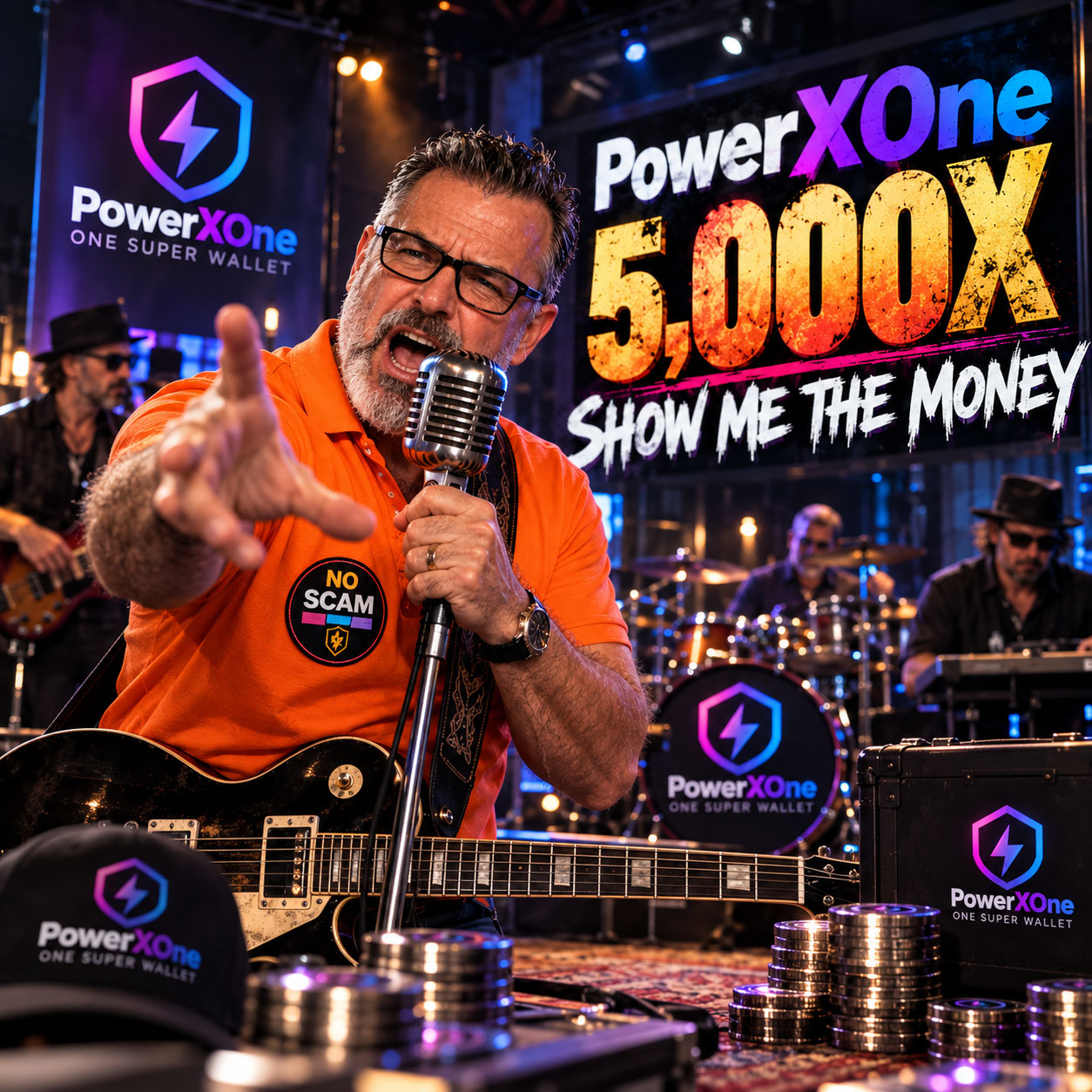
That is the message presented in PowerXOne’s promotional price-scenario material, where fractions of a cent are transformed into illustrations of extraordinary potential wealth.
The exact wording of the quotation should be checked against the original promotional graphic, but the underlying marketing message is clear: early purchasers are being shown what their tokens might theoretically be worth if PX1 reaches dramatically higher prices.

When I first came across PowerXOne, it was through Ryan “Ryzn” Conley, a cryptocurrency and Web3 promoter I have been tracking for years. Operating under the name King of Web3, Conley promotes emerging technologies and cryptocurrency opportunities through his YouTube channel and associated websites. His involvement caught my attention because I have followed his promotional activities over an extended period. However, a promoter’s history is not evidence that a new opportunity is fraudulent. What matters is what is being offered, what prospective participants are being told and whether the underlying claims can be substantiated.
PowerXOne presents itself as a global social super wallet, combining self-custodial cryptocurrency storage with video calls, tipping, social networking and an expanding Web3 ecosystem. Alongside these technological ambitions, the project has been promoting its PX1 token presale, organising events across the United States and encouraging supporters to spread its message through social media. One promotional graphic illustrates how a hypothetical increase in the token price could turn a $1,000 purchase into $5 million. The graphic explicitly describes these figures as mathematical scenarios rather than predictions or guarantees. Nevertheless, placing such extraordinary figures before prospective buyers raises legitimate questions about how financial expectations are being shaped.
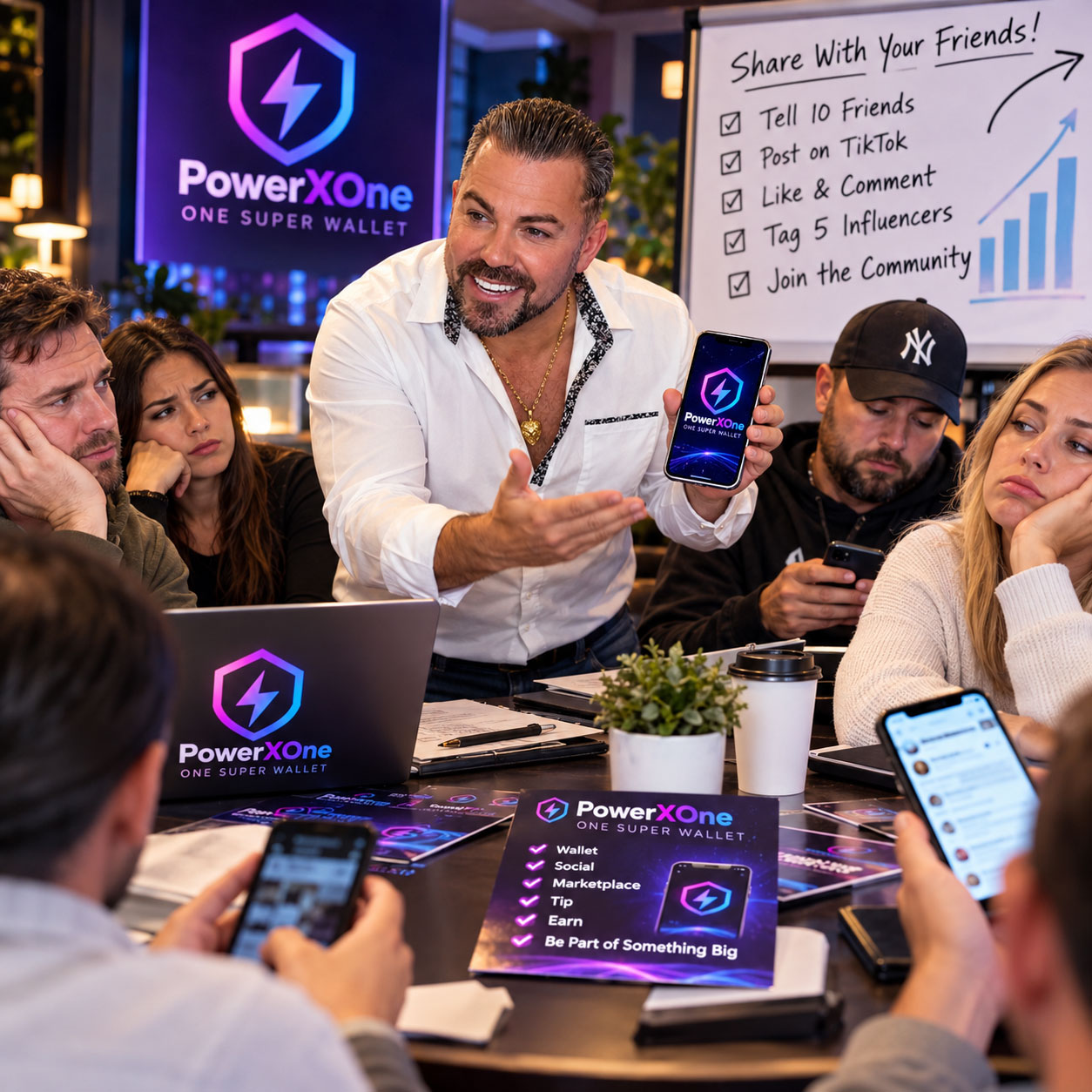
The promotional operation is particularly interesting. Supporters are encouraged to produce TikTok testimonials, participate in community training, introduce new users and help expand the network. One training graphic illustrates how an initial group of 153 volunteers could theoretically grow into more than one million wallet users in eight weeks. Another presents a separate hypothetical scenario in which one million participants purchasing $10 each would generate $10 million in token purchases. These are illustrations rather than evidence of actual participation or revenue, but they reveal how closely community growth and potential token sales feature in the promotional strategy.
Then there is the CertiK security assessment, which provides evidence of technical scrutiny. The report documents 14 security findings, including two medium-severity vulnerabilities that were subsequently marked as resolved. However, the assessment covered specified wallet components, not the project’s entire business, token economics, financial position or ability to deliver its promised ecosystem. That distinction matters when a technical audit is used to build confidence in an opportunity involving people’s money.
My investigation examines who is behind PowerXOne, how its token sale operates, what promoters are telling prospective participants and whether the available evidence supports the project’s claims. An operating wallet application, a security assessment and an enthusiastic community may demonstrate that development and promotion are taking place. They do not, by themselves, establish that a cryptocurrency token is a sound investment or that its proposed ecosystem will become commercially sustainable.
PowerXOne is asking people to believe in an ambitious future. My investigation is concerned with what exists today, who is accountable for the promises being made and what risks participants may be taking before that future arrives.
Who Is Really Behind PowerXOne?
Behind the ambitious promises of PowerXOne is a question every prospective token purchaser should be asking: who actually owns and operates the business, and who is legally responsible for the money being collected? The project’s promotional material introduces two men identified as James and Kalil, described as co-founders, alongside a growing collection of founding members and community leaders. Names such as Mark Roofe, Al Medina and Lisa Christman appear in promotional material, while supporters are encouraged to attend presentations, participate in training and help introduce the platform to new audiences. However, being presented as a founder, founding member or community leader does not necessarily establish legal ownership, executive authority or responsibility for the token sale.
One of the more interesting leads concerns Origen Naturals Company Limited, reportedly registered in Hanoi, Vietnam, in November 2023 under tax code 0110546465. Research leads identify the company as a business associated with Moroccan cosmetics and argan oil products, while information attributed to the PowerXOne Android application reportedly identifies Origen Naturals as its developer. The names Riad Idaoumahmoud and Khalil Idaoumahmoud have also emerged in connection with the Vietnamese business.
These details require confirmation through original company registration records and the application’s official developer listing. In particular, it has not yet been independently established whether Khalil Idaoumahmoud is the person introduced to PowerXOne audiences as “Kalil”, whether Origen Naturals is the legal issuer of PX1 or whether it receives and controls presale funds.
The reported cosmetics connection is not evidence of wrongdoing. Businesses can diversify, establish new divisions or develop technology outside their original industry. What matters is whether the legal and operational arrangements are transparent. If Origen Naturals is responsible for PowerXOne, prospective participants deserve to know how a company associated with importing beauty products became involved in developing a multi-chain cryptocurrency wallet, operating a social platform and issuing a proposed 100-billion-token cryptocurrency.
That raises several questions about the structure of the operation. Who developed the technology? Who controls the token treasury and the wallets receiving presale payments? Are the founders acting through Origen Naturals, another registered entity or a separate contractual arrangement? Who is legally responsible for delivering purchased tokens, and what happens if the project fails to meet its proposed milestones?
The promotional network introduces another distinction worth examining. PowerXOne has advertised presentations across the United States, with community figures introducing the wallet and its proposed financial ecosystem to prospective participants. These events can help establish confidence, particularly when attendees are introduced to people described as founders or founding members. But the people selling the vision are not necessarily the people legally accountable for delivering it.
For now, the evidence identifies a promotional leadership group and a potentially significant Vietnamese corporate connection, but it does not establish a complete, independently verified ownership structure. That gap matters in an opportunity involving cryptocurrency purchases and promises of future utility and revenue.
Before prospective participants can properly assess the opportunity, they need to know what they are buying, who is selling it and what enforceable rights they receive in return.
The PX1 Presale and the Money Being Raised
Once we move beyond the people promoting PowerXOne, the next question is where the money comes into the picture. Although the project presents itself primarily as a self-custodial cryptocurrency wallet with social networking and communication features, it is also selling access to its proposed PX1 utility token before the token has established an independently observable trading market. According to PowerXOne’s published token information, the total supply is intended to be 100 billion PX1 tokens, with allocations reserved for community activities, founders, public purchasers, treasury operations, and the team and advisers. This means the financial opportunity being promoted is not simply about downloading and using a wallet. Participants are being invited to exchange existing cryptocurrency for tokens whose future market value, liquidity and practical utility remain uncertain.
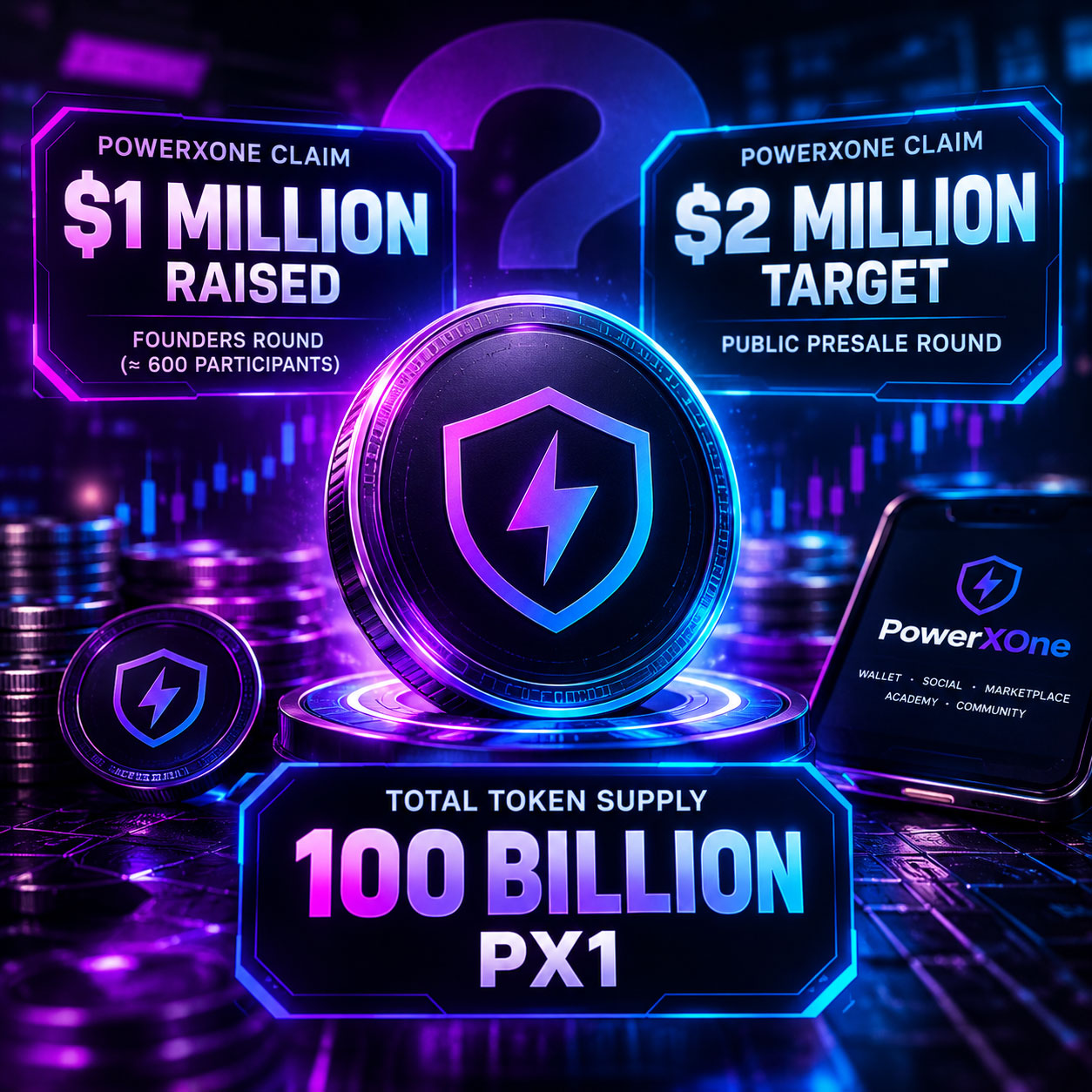 PowerXOne’s published fundraising claims describe a founders round involving approximately 600 participants and $1 million raised, followed by a public round with a stated fundraising target of $2 million. Promotional information has referred to founders-round pricing as low as $0.0001 per PX1, with a public-round price of $0.0002. However, another promotional graphic collected during this investigation presents founders and public prices of $0.0002 and $0.0004 respectively. These figures may reflect different stages, packages or changes in pricing, but the available material does not establish a complete explanation. That discrepancy matters because the price someone pays determines how many tokens they receive and how much the token would need to appreciate before they could recover their purchase price or make a profit.
The fundraising figures also require careful interpretation. A company announcing that it has raised $1 million is making a financial claim; it is not providing independent proof that the money was received, how it was held or how it has been spent. The reported sale arrangements involve cryptocurrency payments, including USDT, but establishing the actual amount collected would require verified receiving-wallet addresses, transaction records and a clear explanation of whether funds are controlled by the issuing company, individual founders or another entity. Equally important are the purchase agreements. Prospective buyers should be able to identify the legal seller, the applicable jurisdiction, refund conditions, token-delivery obligations and what happens if the planned token launch is delayed or never takes place.
Another important feature is vesting, which determines when purchasers can access their tokens. PowerXOne’s published public-round arrangements describe a six-month cliff following the token generation event, followed by ten monthly releases of 10% of the purchased allocation. In practical terms, even if the token launches and begins trading, a purchaser subject to these conditions would not immediately have access to their full allocation. This can be presented as a mechanism to discourage rapid selling, but it also creates a significant risk: the market price could change substantially while participants are waiting for their tokens to become available. A displayed token value is not the same as money someone can withdraw, particularly when their holdings remain locked or when there is insufficient demand from independent buyers.
This brings us to a distinction that is frequently overlooked in cryptocurrency presales. Raising money, distributing tokens and creating genuine market value are three entirely different things. A project can successfully sell tokens to early participants without establishing a sustainable business or a liquid market for those tokens. PowerXOne’s promotional material describes ambitious plans for transaction fees, creator payments, staking, governance and other services, but the existence of those plans does not establish future demand for PX1. What ultimately matters is whether people will have a genuine reason to acquire and use the token beyond the expectation that someone else will purchase it later at a higher price.
There is also a wider accountability question. If the project has already collected substantial funds, purchasers deserve a transparent explanation of how much was raised, who controls those funds, what development milestones have been completed and what financial resources remain available to deliver the promised ecosystem. These are reasonable due-diligence questions for any early-stage venture, particularly one selling cryptocurrency to the public across international borders.
The presale establishes the financial foundation of PowerXOne’s opportunity. The next part of the investigation examines how that relatively small initial token price is being transformed into promotional illustrations involving potentially life-changing sums of money — and why those calculations deserve much closer scrutiny.
The 5,000X Dream: When Token Mathematics Becomes a Marketing Tool
One of the most revealing pieces of PowerXOne promotional material is a presentation titled “PX1 Price Scenario Mathematics”, published under the PowerXOne Super Wallet branding. It takes the relatively small price of the proposed PX1 token and demonstrates what could happen if its value increased dramatically. The presentation identifies a founders price of $0.0002 and a public-round price of $0.0004, then introduces hypothetical future prices of $0.10 and $1 per token. At $0.10, the founders price would represent a 500-fold increase. At $1, it would represent a 5,000-fold increase. The arithmetic is straightforward, but the figures become considerably more persuasive when presented to people who may have little experience with cryptocurrency valuations.
 The presentation goes further by showing what those price scenarios could mean for individual purchasers. One example illustrates how $1,000 could purchase five million PX1 tokens, which would have a theoretical value of $5 million if the token eventually reached $1. Another example uses a $25,000 purchase allocation, including bonus tokens, to illustrate a hypothetical future value of $140 million. The material contains disclaimers explaining that these are mathematical examples rather than price predictions or guaranteed returns. That distinction is important, and there is no basis for claiming the project has explicitly guaranteed those outcomes. Nevertheless, placing extraordinary dollar figures alongside relatively modest initial purchases can encourage readers to imagine the wealth they might accumulate rather than examine the economic conditions required to achieve it.
The missing context is the relationship between token price and total supply. PowerXOne describes a fixed maximum supply of 100 billion PX1 tokens. At a hypothetical price of $0.10, that supply would imply a fully diluted valuation of $10 billion. At $1 per token, the corresponding valuation would be $100 billion. Fully diluted valuation is calculated by multiplying the token price by the maximum supply; it does not mean that amount of money has entered the project or that every holder could sell at that price. Nevertheless, it provides a useful measure of the scale of the valuation being illustrated. For an early-stage project still working towards delivering much of its proposed ecosystem, these figures deserve far more explanation than a multiplication table.
A token reaching $1 on paper does not mean there are enough buyers willing to purchase billions of tokens at that price.
This is where the difference between promotional mathematics and actual market economics becomes critical. Cryptocurrency prices are determined by transactions between willing buyers and sellers, not by multiplying an initial purchase by an imagined future price. Liquidity, circulating supply, exchange access, selling pressure, token unlocks and genuine demand all influence whether holders can realise a quoted valuation. PowerXOne’s vesting arrangements introduce another complication because presale participants may be unable to sell much of their allocation immediately after launch. A person could theoretically see a high quoted market price while holding tokens that remain locked, only to find that the price has changed by the time those tokens become available.
There is also an important distinction between utility and speculation. PowerXOne promotes potential uses for PX1 within its proposed ecosystem, including payments, tipping, subscriptions, transaction fees and other services. If those services become widely used, they may create reasons for people to acquire the token. But the promotional material examined so far does not demonstrate that the level of demand needed to support a $10 billion or $100 billion fully diluted valuation exists. Nor does it establish how much token demand would come from genuine use of the platform rather than purchases motivated by expectations of future price appreciation. These are different sources of demand, and confusing them can give prospective buyers an unrealistic impression of the opportunity.
The pricing discrepancy identified earlier also becomes more significant in this context. The project’s published information has described founders-round entry prices as low as $0.0001 and public-round pricing at $0.0002, while the separate price-scenario graphic uses $0.0002 and $0.0004. Without a complete explanation of the different rounds and their dates, prospective participants may struggle to establish the true relationship between earlier purchases, current offers and the promotional multipliers being displayed. The distinction is not merely technical. It affects how purchasers calculate potential gains and understand the advantages offered to those who entered before them.
What concerns me is not the use of hypothetical calculations in isolation. Financial projections and scenario modelling can be legitimate educational tools when their assumptions, limitations and risks are clearly explained. The concern arises when spectacular hypothetical returns become a prominent part of promoting an asset that has yet to establish a functioning, liquid market. PowerXOne’s disclaimers acknowledge uncertainty, but they do not answer the underlying economic questions.
The result is a promotional narrative in which a fraction-of-a-cent token is associated with the possibility of extraordinary wealth, while the evidence required to assess that possibility remains limited. Understanding how those expectations are communicated is only part of the story. The next question is who is carrying that message to prospective participants, and what role do experienced cryptocurrency promoters play in building confidence around PowerXOne?
Ryan Conley and the PowerXOne Promoters

One of the first people I encountered promoting PowerXOne was Ryan “Ryzn” Conley, who operates online under the name King of Web3. Conley was already familiar to me long before PowerXOne appeared. I have been tracking his involvement in cryptocurrency and passive-income opportunities for years, which is why his promotion of another early-stage project caught my attention. His YouTube channel, @RyanKingofWeb3, has built an audience around emerging technologies, cryptocurrency and opportunities presented as part of the future of Web3. He also directs followers towards KINGOFWEB3.com and associated social-media accounts.
One PowerXOne-related video identified during this investigation is available at: youtube.com/watch?v=3RHw3OCpmoA
That video provides a starting point for documenting Conley’s involvement. However, establishing exactly what he told viewers about PX1 requires examining the recording and identifying the relevant statements and timestamps. His financial relationship with PowerXOne, if any, has not been established through the material currently available. I am therefore distinguishing his documented association with the promotion from any suggestion that he receives commissions, controls project funds or is responsible for representations made by the founders.
Conley’s involvement matters because experienced promoters can introduce unfamiliar projects to audiences that already know and follow them. Someone encountering PowerXOne through a familiar online personality may be more inclined to investigate the opportunity than someone seeing an advertisement from an unknown company. That does not mean Conley has acted dishonestly. Promoting a cryptocurrency project is not, by itself, evidence of fraud. The relevant questions are what he has told prospective participants, whether he has encouraged token purchases, what financial interests he may have in the project and whether material risks or promotional incentives have been disclosed.
PowerXOne’s promotional network extends well beyond Conley. Material collected during this investigation identifies Mark Roofe, Al Medina and Lisa Christman as founding members appearing alongside the project’s advertised co-founders, James and Kalil. Other community figures include Christie Tran, Jodi Pleitez, Gale Gajardo and a presenter using the name Ephraim, Son of Africa. Their names appear in event advertisements, community activities and promotional announcements, although their precise contractual relationships with PowerXOne have not been established.
Some may be organisers, educators, supporters or independent promoters rather than employees or company officers. That distinction matters when assessing who created particular claims, who repeated them and who had authority to speak on behalf of the project.
The scale of the promotional activity is particularly noticeable in the project’s advertised October–November 2026 United States tour. The published itinerary includes Salt Lake City, Los Angeles, Las Vegas, Dallas, Austin, Atlanta, Orlando, Miami, Pennsylvania, New York, New Jersey and Ohio. Additional promotional material advertised meetings in Irvine, California, and a Las Vegas pre-launch gathering on 17 October. Florida events featuring James and Kalil were also advertised for 25 and 26 October.
These announcements establish that an organised series of presentations was being promoted, although an advertised event is not proof that it took place or that the expected speakers attended. The tour nevertheless demonstrates how PowerXOne is attempting to establish a physical presence alongside its online community.
For someone considering an unfamiliar cryptocurrency opportunity, these gatherings can be influential. Meeting people face to face, hearing presentations from individuals described as founders and seeing an enthusiastic community can create a sense that the project is established and progressing. Yet attendance, enthusiasm and promotional visibility are not substitutes for independently verified financial information. A presentation can explain what the developers intend to build, but it cannot establish that token purchasers will make money, that future services will generate sufficient revenue or that the proposed token valuation is economically sustainable.
Another important part of the investigation is understanding whether the people promoting PowerXOne receive any direct or indirect financial benefit. The project has advertised community participation, referral activities and competitions, including initiatives connected with token purchases and wallet downloads. However, the available evidence does not establish that every named promoter receives commissions, holds discounted tokens or is paid to recruit purchasers. These arrangements need to be examined individually.
A promoter who receives compensation for generating token sales occupies a different position from an unpaid community volunteer, particularly when prospective buyers may rely on that person’s apparent independence.
Conley’s previous promotional history also deserves examination, but it must be documented carefully. I have followed his activities for years, and a chronological record of his earlier opportunities, the claims he made about them and what subsequently happened could help establish whether there is a recurring promotional pattern. It would not be reasonable to attribute the failure of an earlier project to Conley merely because he promoted it, nor would that history prove PowerXOne is destined to fail.
What matters is whether the promotional record reveals a consistent approach to presenting speculative opportunities, particularly where extraordinary financial expectations are involved.
The wider picture is of a project using recognisable online personalities, community leaders, organised presentations and international promotional events to attract attention to a wallet and its associated token sale. Some of that activity may be ordinary product marketing. The important question is whether prospective participants are receiving a balanced explanation of the technology, the financial risks and the uncertainty surrounding PX1’s future value.
To understand how PowerXOne is attempting to expand its audience, however, we need to look beyond individual promoters. Its community training material reveals a structured programme designed to turn existing supporters into people who actively introduce the project to others. That programme deserves examination because it shows how PowerXOne hopes to transform enthusiasm into rapid growth.
The Recruitment and Social-Media Machine
While PowerXOne’s promoters have been travelling across the United States introducing people to the project, another operation has been developing within its online community. Promotional material from the PowerXOne Titans training programme reveals a structured approach to turning ordinary supporters into active participants in the project’s marketing. Rather than relying entirely on paid advertising or established cryptocurrency influencers, the programme encourages members to create their own content, introduce new people to the wallet and help build an expanding network of users. On its own, community education is nothing unusual. What makes this programme worth investigating is the combination of organised promotional assignments, ambitious growth calculations and an ongoing token presale.
One example comes from Day 11 of the Titans training programme, dated 16 October 2026. Participants were instructed to create a 30-second TikTok video explaining why they liked or believed in PowerXOne, with the completed video to be posted and shared with the group the following day. The instructions encouraged participants to keep their message personal rather than promotional, even providing an example involving PowerX Call and the ability to tip people directly through the wallet. Another assignment encouraged participants to prepare podcast questions and practise interviewing someone using PowerX Call. These exercises could help people become familiar with the platform, but they also have a clear marketing benefit: they generate a growing collection of apparently personal recommendations that can reach audiences outside the project’s existing community.
The distinction between a genuine personal recommendation and organised promotional content matters. Someone scrolling through TikTok may encounter an enthusiastic testimonial without realising that the person appearing in the video was following an assignment distributed through a project’s community training programme. That does not automatically make the testimonial dishonest. Participants may genuinely believe in the technology and may receive no compensation whatsoever. However, understanding how those messages originated helps readers assess whether they are seeing independent enthusiasm or content produced as part of a coordinated campaign.
 The programme becomes more interesting when we examine the material distributed under Stage 2: Two-Person Weekly Education Goal, covering 2 October to 20 November 2026. The illustration begins with 153 trained volunteers, each encouraged to educate or support two additional people every week. The projected number of new users grows from 306 in the first week to 918 in the second, then 2,754, 8,262 and 24,786 as the process continues. By the eighth week, the model reaches 669,222 new users in that week alone, producing a cumulative total of 1,003,833. The material explicitly describes this as a mathematical illustration rather than a forecast, and it should not be mistaken for evidence that PowerXOne has attracted anything approaching one million actual users.
The same material introduces a separate hypothetical purchasing scenario: if one million participants each purchased $10 worth of PX1, the result would be $10 million in token purchases. This is particularly significant because it connects the scale of potential community growth with the amount of money that could theoretically enter the token sale. The presentation states that purchases are optional, that participation does not depend on buying tokens and that volunteers receive no compensation for recruitment or purchases. Those disclaimers must be acknowledged. Nevertheless, the inclusion of a purchasing calculation within community growth material demonstrates that the financial implications of expanding the network are part of the project’s promotional narrative.
PowerXOne also circulated a Stage 3 Community Education Volunteers Wanted announcement, inviting participants to guide beginners through the application, host Zoom sessions, answer questions and share official safety information. The programme uses the progression “Learn it • Use it • Teach it • Share it • Lead it”, presenting community involvement as a pathway towards greater responsibility. It specifically states that no purchase or previous experience is required and that participants are not compensated for recruiting others. Those statements distinguish the advertised volunteer programme from a conventional paid recruitment arrangement, although the separate referral competitions and any undisclosed promoter incentives still require examination.
Beyond the Titans programme, another circulated social-media instruction encouraged supporters to like and comment on PowerXOne posts, share them with their own commentary, tag five influencers with at least one million followers and forward a post each day to ten friends or family members. The campaign directed participants towards promotional material associated with powerxone.carrd.co and the project’s social-media channels. This provides evidence of coordinated engagement efforts, but not evidence that accounts are automated, that interactions are purchased or that participants are being paid. The important point is that PowerXOne is actively encouraging its supporters to amplify its message across multiple platforms.
The distinction matters because online popularity can be difficult to interpret when a community is deliberately mobilised to generate attention. A large number of posts, comments and testimonials may reflect genuine enthusiasm, organised participation or a mixture of both. None of those activities independently establishes the number of paying customers, the amount of genuine demand for PX1 or the commercial success of the underlying wallet. Likewise, a growing Telegram or WhatsApp community does not necessarily translate into active wallet users or sustainable revenue.
PowerXOne’s marketing strategy appears to combine several reinforcing elements: in-person presentations introduce the opportunity, community training gives supporters a role in promoting it, social-media campaigns expand its visibility, and token-price illustrations demonstrate the extraordinary financial outcomes that could theoretically follow widespread adoption. Each element can be explained as ordinary marketing or community development. The concern emerges when they are considered together, particularly while the project is accepting money for a token whose future market value remains unproven.
The evidence does not establish that PowerXOne operates an illegal multilevel marketing scheme or pays commissions through the Titans education programme. What it does establish is an organised effort to expand the audience for a cryptocurrency project through personal recommendations, volunteer participation and exponential growth illustrations. The next question is whether the underlying technology has received the independent scrutiny that prospective participants may assume it has — particularly given the prominence of CertiK’s security assessment in the project’s credibility story.
The CertiK Audit: What It Actually Proves
One of the strongest credibility signals available to PowerXOne is its published security assessment by CertiK, a company specialising in blockchain and cryptocurrency security. For someone considering a project involving digital assets, seeing the name of an established security firm can provide reassurance that the technology has undergone independent examination. Unlike projects that offer little more than promotional promises, PowerXOne has an identifiable wallet application and a documented technical assessment. That is a meaningful distinction, but it is also where prospective participants need to understand precisely what was examined. A security audit is not an endorsement of a cryptocurrency investment, its founders or its financial promises.
The CertiK report covers PowerX OneWallet version 1.0.0, examining specified components of the Android and iOS applications. The assessment began in August 2026, with the final report dated 21 September 2026. Across the reviewed software, CertiK identified 14 findings: two medium-severity, eight low-severity and four informational. No critical or high-severity vulnerabilities were reported. By the final assessment, 12 findings were marked as resolved, while two were acknowledged. Those results show that identifiable security issues were investigated and that remediation was reported during the review process. They do not establish that the application is free from vulnerabilities, that every fix has been independently tested in the production environment or that systems outside the audit scope are secure.
The two medium-severity findings are particularly worth understanding because they involved the protection of sensitive wallet information. One concerned the application’s handling of screenshots while displaying a recovery phrase or private key. Allowing screenshots of this information can expose the credentials needed to control a cryptocurrency wallet, particularly if images are subsequently stored, synchronised or accessed by another application. The second finding concerned Android Keystore authentication protections. During controlled testing on a rooted and instrumented device, CertiK demonstrated a method of recovering an encryption password and decrypting stored wallet information without successfully completing the application’s intended PIN or biometric authentication process. This was a technical proof of concept under test conditions, not evidence that users’ wallets had actually been compromised or that cryptocurrency had been stolen.
Both medium-severity findings were subsequently marked as resolved. That is an important part of the record and should not be overlooked. However, the original findings demonstrate why independent security testing matters, particularly for software that may eventually hold substantial amounts of users’ cryptocurrency. A self-custodial wallet places responsibility for protecting recovery phrases and private keys largely on the individual user. If those credentials are exposed, transactions made by an attacker may be irreversible, and there may be no bank or central administrator capable of restoring the funds.
The remaining findings covered several other areas of application security and user protection. These included sensitive information potentially appearing in operating-system previews, the handling of recovery phrases during wallet creation, third-party keyboard access, insufficient root-detection protections, sensitive information remaining in application memory, tapjacking risks and weaknesses involving PIN attempts. CertiK also documented concerns involving clipboard handling, certificate pinning and aspects of transaction verification or numeric processing. Two issues — recovery-phrase copying to the clipboard and the absence of SSL certificate pinning — were acknowledged rather than marked as resolved. Their severity and practical significance depend on the circumstances in which the application is used, but acknowledgement should not be confused with remediation.
The most important limitation, however, is what CertiK did not audit.
The assessment did not provide a comprehensive security review of PowerXOne’s backend infrastructure, including services associated with Cloudflare Workers and Supabase. It also excluded important parts of the wider ecosystem, including PowerX Call, referral systems, airdrops, tipping, the PX1 ledger and backend business logic. Smart contracts, tokenomics, third-party infrastructure and the underlying cryptographic implementation provided by Trust Wallet Core were outside the defined scope. The report also identified wallet functions, including swapping and purchasing PX1, that were unavailable for testing at the time. Consequently, the assessment cannot be used to establish the security or reliability of those untested services.
This distinction becomes particularly important when we consider the financial claims surrounding PX1. CertiK’s assessment does not verify the reported fundraising totals, confirm the ownership of cryptocurrency receiving addresses, establish the existence of financial reserves or determine whether token purchasers will receive what they have been promised. It does not independently validate the project’s proposed revenue-sharing arrangements, future token liquidity or the commercial viability of its planned ecosystem. Nor does the absence of critical findings mean the broader operation has been approved by a financial regulator.
There is a substantial difference between auditing software for vulnerabilities and auditing a business for financial accountability. Both forms of scrutiny can be valuable, but they answer entirely different questions. PowerXOne can legitimately refer to the existence of its CertiK assessment and the findings reported within it. What would be misleading is allowing prospective participants to believe that this assessment establishes the legitimacy or future value of PX1.
The CertiK report therefore provides evidence that PowerXOne has subjected defined wallet components to external technical review. It also establishes that vulnerabilities were found, remediation was reported and significant parts of the proposed ecosystem remained outside the assessment. For prospective participants, the practical lesson is straightforward: the existence of an audited wallet does not remove the financial risks of purchasing an unlaunched cryptocurrency token.
That leaves the wider business model to examine. PowerXOne is promoting far more than secure cryptocurrency storage, including social communication, creator payments, token-based services and potential revenue-sharing arrangements. The next question is which parts of that ecosystem can be independently demonstrated today, which remain plans for the future and how the business intends to generate enough genuine economic activity to support its promises.
The Wallet, the Ecosystem and the Unanswered Questions
By this stage of the investigation, one thing is becoming clear: PowerXOne is attempting to build far more than a cryptocurrency wallet. Its promotional material describes an ambitious ecosystem combining digital asset storage, communication, entertainment, payments and financial incentives. The central product, PowerX OneWallet, is presented as a self-custodial application supporting multiple blockchain networks, including Ethereum, BNB Chain, TRON and XRP Ledger. Self-custody means users are intended to control their own private keys rather than surrendering their cryptocurrency to a centralised exchange. That is a legitimate and increasingly familiar approach to digital asset management. However, having a functioning wallet application is only the starting point when the same project is also raising money through a token presale and promoting an extensive collection of future services.
One of the more prominent features is PowerX Call, which is advertised as a communication platform allowing users to participate in live conversations and send cryptocurrency tips. Community material from October 2026 promoted live podcast sessions where participants could supposedly send and receive PX1 and USDT tips during broadcasts. Other proposed features include social networking, creator subscriptions, music streaming, direct payments to artists, usernames that simplify cryptocurrency transfers and third-party applications operating within the wider platform. These ideas have potential commercial applications, particularly if they make cryptocurrency easier for ordinary people to use. But the evidence needs to distinguish between a feature being advertised, demonstrated in a controlled presentation and independently verified as functioning reliably for ordinary users. Those are three different stages of development.
The project also promotes PX1 as the economic foundation of its ecosystem. According to its published descriptions, the token is intended to support transaction fees, tipping, subscriptions, governance and other services. Some promotional material refers to token burning associated with transactions, while other descriptions introduce staking and revenue-sharing benefits. These claims deserve particular attention because they move the conversation beyond the technical usefulness of a wallet. If token holders are being encouraged to expect a financial benefit from the activities of the business, the precise contractual arrangements, sources of revenue and applicable financial regulations become important. Calling PX1 a utility token does not, by itself, determine how regulators would classify an offering or whether particular promotional claims create additional legal obligations.
Another unusual element is the proposed connection between the token ecosystem and hospitality businesses, including an initiative described as PowerX One Coffee. Published project material has referred to potential benefits associated with profits from real-world hospitality operations. This raises questions that cannot be answered by examining the wallet application or its security assessment. Does PowerX One Coffee exist as an operating business, or is it still a proposal? Which legal entity would own the business and its assets? How would profits be calculated, independently verified and distributed? Would PX1 holders have enforceable rights to any revenue, or would distributions remain entirely at the discretion of the operators? Until the underlying agreements and business records are available, these remain promotional proposals rather than independently established sources of income.
The difference between a proposed revenue stream and an operating, profitable business is fundamental.
PowerXOne’s ambitions also create a question about the relationship between the wallet and the token itself. A cryptocurrency wallet can provide a useful service without requiring users to purchase a newly issued token. People can already store and transfer established cryptocurrencies through numerous competing applications. For PX1 to develop sustainable demand, the project would need to demonstrate why its token is necessary or sufficiently attractive within the ecosystem, what advantages it offers over existing payment methods and whether users would continue purchasing it for practical reasons rather than speculation. The presence of social features, live calls and community events does not automatically create demand for billions of tokens.
This is where the project’s promotional strategy and its business model begin to intersect. The Titans programme encourages supporters to educate new users, create social-media content and expand the community, while the token presale offers participants an opportunity to acquire PX1 before its anticipated wider launch. PowerXOne has stated that its community education programme does not require purchases or provide compensation for recruitment. That distinction is important. Nevertheless, the wider operation still depends on attracting attention, encouraging adoption and establishing confidence in a token whose future value remains uncertain. The challenge is determining whether growth is being driven primarily by genuine demand for the technology or by expectations that early token purchases could eventually become extraordinarily valuable.
There are several important pieces of evidence still missing from the public picture. A complete understanding of PowerXOne would require independently verified corporate ownership records, the applicable token-purchase agreements, confirmed fundraising wallet addresses, detailed token allocation records, information about treasury controls and evidence supporting any proposed revenue distributions. Technical verification would also need to extend beyond the audited wallet components to the services, infrastructure and token mechanisms that underpin the wider business. These are not unreasonable demands. They are the kinds of disclosures that help prospective participants distinguish a commercially credible venture from an attractive presentation built around future possibilities.
The material examined in this investigation establishes that PowerXOne has developed identifiable software, commissioned a limited independent security assessment, advertised a token presale and organised an extensive promotional campaign. It also establishes that the project is presenting ambitious growth models, extraordinary hypothetical token valuations and plans for services whose commercial performance has not been independently demonstrated. What the available evidence does not establish is that PowerXOne is operating a Ponzi scheme, that its founders have misappropriated funds or that its promoters have knowingly misled purchasers. Those would be serious allegations requiring substantially stronger evidence.
That distinction is essential to the investigation. The purpose is not to label every ambitious cryptocurrency project a scam simply because its marketing resembles opportunities that have failed in the past. It is to examine whether the promises being made are supported by independently verifiable facts, whether participants understand the risks and whether the people controlling the operation can be held accountable.
PowerXOne has chosen to promote an ambitious vision of the future. The responsibility now rests with those behind the project to demonstrate that the business, the finances and the technology can support that vision.
PowerXOne: The Gap Between the Promises and the Evidence
After examining PowerXOne, its PX1 token presale, promotional network, community training programme and CertiK security assessment, the central concern is not that the project has failed to produce anything tangible. There is an identifiable wallet application, documented development activity and evidence of independent security testing. These are meaningful differences from cryptocurrency schemes built entirely around fabricated technology. However, the existence of a product does not establish the legitimacy of every financial claim associated with it. PowerXOne is asking people to purchase a token before its future trading conditions, commercial demand and wider ecosystem have been established.
The first unresolved issue concerns financial transparency. PowerXOne has reported substantial fundraising activity, including approximately $1 million raised during its founders round, but that remains a company claim rather than an independently verified financial finding. Establishing how much money has actually been collected would require verified receiving-wallet addresses, transaction records and an explanation of who controls those funds. Prospective purchasers also need to understand the legal entity responsible for the sale, the applicable purchase agreements, refund conditions and the obligations surrounding token delivery.
The second concerns ownership and accountability. The reported connection to Origen Naturals Company Limited in Vietnam requires independent confirmation, particularly regarding the legal issuer of PX1, the ownership of the wallet platform and the people controlling presale funds. The project has introduced James and Kalil as co-founders and identified several founding members and community figures, but promotional titles do not establish legal responsibility. Those arrangements should be supported by company records, contracts and clear disclosures rather than assumptions based on public presentations.
Then there is the question of genuine demand for PX1. PowerXOne has described potential uses involving transaction fees, tipping, subscriptions, staking, governance and other services. It has also referred to possible revenue-sharing arrangements and future hospitality activities, including PowerX One Coffee. These proposals need to be supported by clear legal agreements, identifiable operating businesses and independently verifiable financial information before prospective purchasers can reasonably assess their value.
The description of PX1 as a utility token does not automatically resolve the regulatory questions raised by marketing that encourages expectations of financial returns. Whether particular arrangements fall within securities or other financial-services laws depends on their actual structure, the representations made and the jurisdictions involved. This investigation has not established a regulatory finding against PowerXOne.
The project’s marketing also deserves continued scrutiny. Its promotional material has illustrated extraordinary hypothetical token valuations, while its community programme encourages supporters to create testimonials, share social-media content and educate new users. PowerXOne has included disclaimers explaining that price scenarios are not guaranteed and that community education does not require purchases or recruitment compensation. Those qualifications matter. Nevertheless, prospective participants should understand that online enthusiasm, organised promotional activity and projected community growth are not independent evidence of commercial success.
One of the most important unresolved issues is the relationship between the token’s proposed utility and its potential market value. A wallet can provide useful services without requiring users to purchase a newly issued cryptocurrency. For PX1 to establish sustainable demand, PowerXOne would need to demonstrate why the token is necessary or sufficiently attractive within its ecosystem and whether users would continue acquiring it for practical reasons rather than expectations of future price appreciation.
That question becomes particularly significant when promotional material illustrates a hypothetical $1 PX1 price, equivalent to a fully diluted valuation of approximately $100 billion based on the project’s stated maximum supply. The arithmetic is straightforward, but the available evidence does not establish the market demand, liquidity or commercial activity required to support such a valuation.
A hypothetical token price is not evidence that holders will ever be able to sell their tokens at that price.
The CertiK assessment provides another reminder of the importance of understanding the limits of evidence. It documents technical scrutiny of defined wallet components, including vulnerabilities that were identified and subsequently addressed or acknowledged. It does not verify the token sale, the financial condition of the business or the commercial viability of the proposed ecosystem. A security assessment should not be confused with a financial audit, regulatory authorisation or guarantee against investment losses.
At this stage, I have not established that PowerXOne is a Ponzi scheme, that its founders have committed fraud or that its promoters are knowingly deceiving purchasers. Those would be serious allegations requiring substantially stronger evidence. What the available material does establish is an early-stage cryptocurrency project combining identifiable software with speculative token marketing, ambitious expansion plans, organised community promotion and financial claims that require further independent verification.
The questions that remain are straightforward. Who legally controls PowerXOne and the PX1 token sale? How much money has actually been collected? Where are those funds held? What enforceable rights do token purchasers receive? What independently verifiable demand exists for PX1, and how will the promised ecosystem generate sustainable revenue?
These are questions the project’s operators should be able to answer with documents, transaction records and clear explanations rather than promotional projections.
My investigation into PowerXOne will remain open as further evidence emerges. If the founders can substantiate their claims, establish transparent financial accountability and demonstrate genuine commercial progress, those findings deserve to be reported. Equally, if evidence emerges of misleading representations, undisclosed financial incentives, misuse of purchaser funds or other misconduct, that must be examined and documented.
For now, the most important distinction is between what PowerXOne has demonstrated and what it is asking people to believe. A functioning wallet is not proof of a profitable token economy. A growing promotional community is not proof of genuine market demand. And a mathematical illustration showing millions of dollars in hypothetical gains is not evidence that those gains can ever be realised.
Until the financial claims can be independently verified, prospective participants should treat PX1 as a highly speculative purchase and be prepared for the possibility of losing everything they contribute.
Disclaimer: How This Investigation Was Conducted
This investigation relies entirely on OSINT — Open Source Intelligence — meaning every claim made here is based on publicly available records, archived web pages, corporate filings, domain data, social media activity, and open blockchain transactions. No private data, hacking, or unlawful access methods were used. OSINT is a powerful and ethical tool for exposing scams without violating privacy laws or overstepping legal boundaries.
About the Author
I’m DANNY DE HEK, a New Zealand–based YouTuber, investigative journalist, and OSINT researcher. I name and shame individuals promoting or marketing fraudulent schemes through my YOUTUBE CHANNEL. Every video I produce exposes the people behind scams, Ponzi schemes, and MLM frauds — holding them accountable in public.
My PODCAST is an extension of that work. It’s distributed across 18 major platforms — including Apple Podcasts, Spotify, Amazon Music, YouTube, and iHeartRadio — so when scammers try to hide, my content follows them everywhere. If you prefer listening to my investigations instead of watching, you’ll find them on every major podcast service.
You can BOOK ME for private consultations or SPEAKING ENGAGEMENTS, where I share first-hand experience from years of exposing large-scale fraud and helping victims recover.
“Stop losing your future to financial parasites. Subscribe. Expose. Protect.”
My work exposing crypto fraud has been featured in:
- Coffeezilla 2026): Featured in the investigation exposing the alleged $328M Goliath Ventures Ponzi scheme
- Bloomberg Documentary (2025): A 20-minute exposé on Ponzi schemes and crypto card fraud
- News.com.au (2025): Profiled as one of the leading scam-busters in Australasia
- OpIndia (2025): Cited for uncovering Pakistani software houses linked to drug trafficking, visa scams, and global financial fraud
- The Press / Stuff.co.nz (2023): Successfully defeated $3.85M gag lawsuit; court ruled it was a vexatious attempt to silence whistleblowing
- The Guardian Australia (2023): National warning on crypto MLMs affecting Aussie families
- ABC News Australia (2023): Investigation into Blockchain Global and its collapse
- The New York Times (2022): A full two-page feature on dismantling HyperVerse and its global network
- Radio New Zealand (2022): “The Kiwi YouTuber Taking Down Crypto Scammers From His Christchurch Home”
- Otago Daily Times (2022): A profile on my investigative work and the impact of crypto fraud in New Zealand





Leave A Comment