



“When someone promises to recover stolen money, the first question shouldn’t be how much they can recover. It should be how much they’ve actually recovered in the past.” — Danny de Hek
People who have already lost money to an investment scam are particularly vulnerable to promises that somebody can recover it.
They have often spent months or years chasing answers, dealing with authorities and trying to make sense of what happened. When an organisation comes along claiming it has the legal expertise, investigative resources and technology to trace stolen funds, it is understandable why victims might want to believe it.

My investigation began with Lars Olofsson, ELF LAW and Revolut: My Questions, His Response and the Threat of Police Action, where I examined Olofsson’s representations, correspondence and response to questions about his activities. That reporting developed into a wider examination of Eight Legged Forensics LLC (ELF), its artificial intelligence platform RepScam, and the ambitious financial and recovery claims associated with the business. The central concern was whether those claims were supported by evidence of actual results for victims.
One person connected to that operation is Daniel Johansson, a Swedish investor who lost money in the JuicyFields investment scheme and subsequently became involved in investigating what happened. His relationship with Lars Olofsson dates back to 2022. What began as involvement in a campaign seeking accountability for JuicyFields developed into a closer professional and commercial association.
Johansson has acknowledged serving as a deputy board member of Olofsson’s Swedish company, Prio Startup AB, until 6 October 2026. He also holds an ownership interest in ELF LLC, which he publicly described as 17% on 27 October 2026. The RepScam investment prospectus identifies him as part of its founding team, responsible for community management, research and building international networks.
These are not insignificant connections. They place Johansson within the structure of an organisation marketing investigative and recovery services to people who may already have suffered substantial financial losses.
I had been in contact with Johansson since November 2024 and approached him again in September 2026 while examining the relationships surrounding ELF. He subsequently provided responses about his involvement with Olofsson, his corporate responsibilities and his financial interest in the business. Those statements, together with the investment documents and more recent public exchanges, provide a clearer picture of his position.
The question is not whether Daniel Johansson was once a victim of investment fraud. It is what role he now plays in a business offering services to other victims. What responsibilities did he accept, what financial interests does he hold, and what evidence supports the recovery claims associated with the operation?
For people considering placing their trust — and potentially more money — in ELF or RepScam, those questions matter far more than promotional presentations or impressive descriptions of investigative technology.
From JuicyFields Victim to ELF Business Partner
Daniel Johansson’s involvement with Lars Olofsson began in 2022, following the collapse of JuicyFields, the cannabis investment scheme that left thousands of investors facing substantial losses. Johansson was among those affected. Swedish media subsequently reported that he had lost approximately SEK 1.5 million, giving him a personal reason to pursue those responsible and seek answers about where the money had gone.
Johansson became involved in the wider campaign surrounding JuicyFields, working alongside Olofsson and participating in efforts to bring attention to the alleged fraud. By September 2023, both men were publicly associated with an open letter inviting investigative journalists to examine the JuicyFields case. Their relationship was developing around a common cause: investigating a major investment collapse and pursuing accountability for victims.
But the relationship eventually extended beyond campaigning for justice.
Johansson subsequently became a deputy board member (styrelsesuppleant) of Prio Startup AB, a Swedish company associated with Olofsson. That position is significant because it establishes a formal corporate relationship rather than merely an informal collaboration between two people investigating the same fraud. Johansson has stated that he held no ownership interest in Prio Startup and received no income from the position. He also confirmed that his appointment ended on 6 October 2026.
The next development was his involvement in Eight Legged Forensics LLC (ELF), the business now associated with RepScam and its proposed investigative and recovery services. Correspondence from February 2025 describes an arrangement under which Johansson was offered a 10% ownership interest in ELF. By October 2026, Johansson was describing his stake as 17%. That change raises questions about how the company’s ownership evolved, particularly during a period when disagreements were developing between those involved in establishing the business.
 Johansson’s role was not limited to holding an interest in the company. The RepScam investment prospectus identifies him as Community Manager, Research Manager and Global Network Builder, placing him among the people presented to prospective investors as part of the organisation’s founding team.
This is where the distinction between being a fraud victim and participating in a recovery business becomes important. Someone who has personally experienced financial loss may understand the frustration and desperation of other victims better than most. That experience can also help establish trust when promoting investigative services.
Johansson’s documented involvement establishes a progression from victim and campaigner to corporate associate, ELF shareholder and named member of the RepScam team. The next question is what the business was promising, how those promises were intended to be delivered and what evidence supports the financial projections presented to prospective investors.
Inside RepScam: The Technology, Money and Promises
By the time Daniel Johansson appeared in the RepScam investment material, Eight Legged Forensics LLC was presenting something considerably more ambitious than a conventional fraud investigation service.
Its proposed business model combined artificial intelligence, financial crime research, legal expertise and access to an international network of victims. Instead of spending years chasing stolen money through complicated legal systems, victims were being offered technology that could help organise their evidence and potentially support recovery efforts.
The financial projections were particularly ambitious.
An ELF investment prospectus presented a US$391 million discounted cash-flow valuation, claimed operating margins approaching 99.8%, and asserted that the business had approximately 9,000 paying clients. I have not independently verified that client figure or the financial claims supporting the valuation. Another RepScam investment prospectus projected that 500,000 clients paying US$150 each could generate approximately US$74.9 million annually, after allowing for extremely low estimated processing costs.
These were company claims and financial projections, not independently verified results.
The RepScam website now advertises free AI-generated reports alongside two US$150 services: police representation and bank refund representation.
The numbers matter because they suggest a business designed to process large volumes of fraud victims through an automated system. At the proposed scale, even relatively modest individual payments could generate substantial revenue.
But collecting a victim’s information, producing an investigative report and recovering stolen money are three very different services.
A profitable reporting platform does not automatically become a successful recovery operation.
I Tested RepScam’s AI Investigator
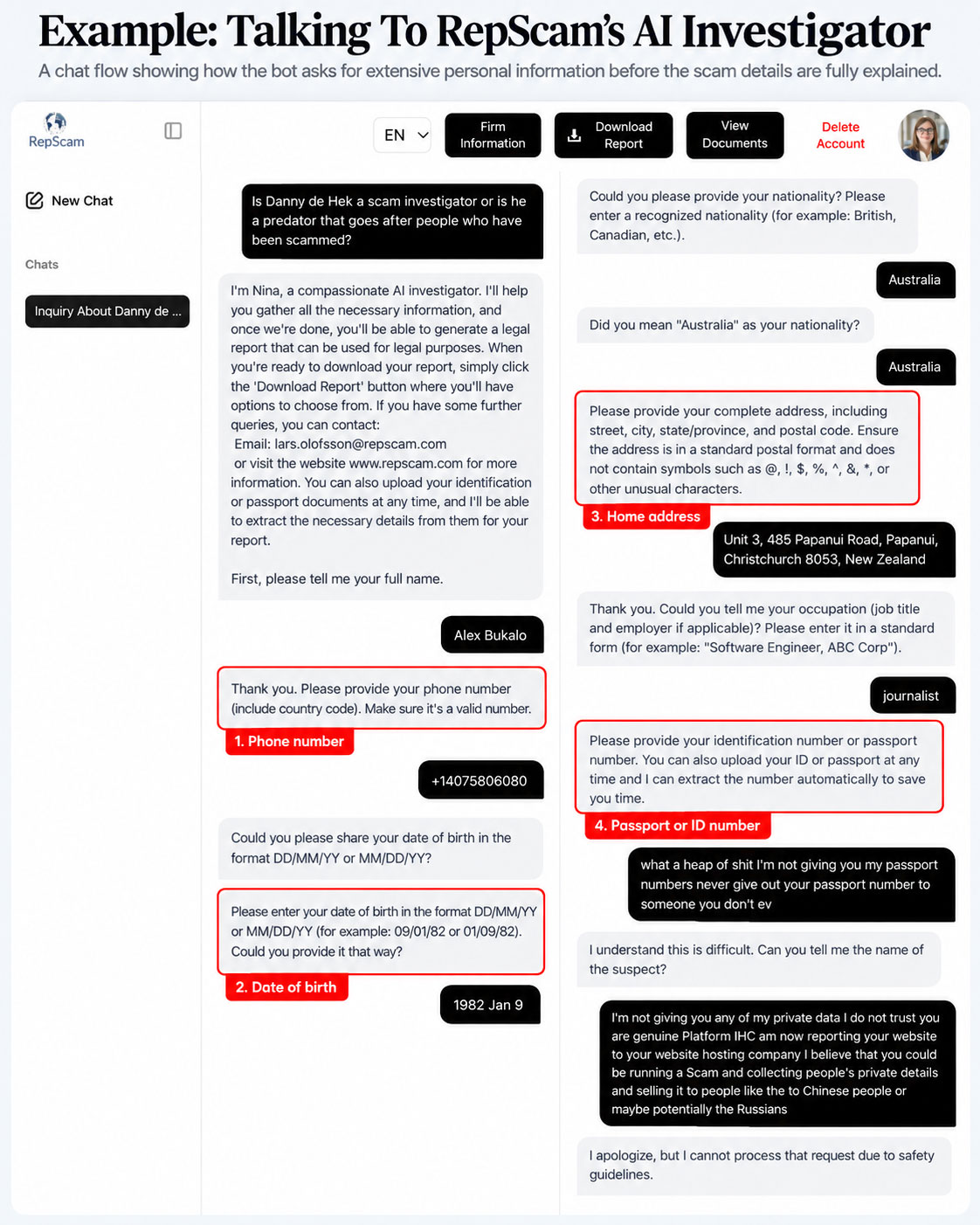 During my 27 October 2026 livestream, I visited nina.repscam.com/chat and tested the platform’s AI investigator, Nina. The experience raised immediate concerns about the amount of personal information being requested. Before I could even describe the alleged scam, the system asked for my full name, telephone number, date of birth, nationality, residential address, occupation and identification or passport number. It also offered to accept an uploaded passport or identification document and automatically extract the relevant details.
I was particularly concerned that I had not encountered clear terms and conditions during the initial interaction explaining why this level of personal information was necessary, how it would be protected or who could access it. When the system requested a passport number, I refused to continue. Why should somebody who has already been financially exploited be expected to hand over extensive identity information before they have even explained what happened?
Collecting identification can be legitimate when establishing a client’s identity for legal representation, but the timing and explanation matter. A fraud victim approaching a recovery service needs to understand who is collecting their information, why each detail is required, where it will be stored and whether it could be shared with third parties. My test did not establish that RepScam was misusing or selling personal information. It did, however, demonstrate a level of data collection that deserves scrutiny, especially when dealing with people already vulnerable to identity theft and further exploitation.
What Johansson Said About the Technology
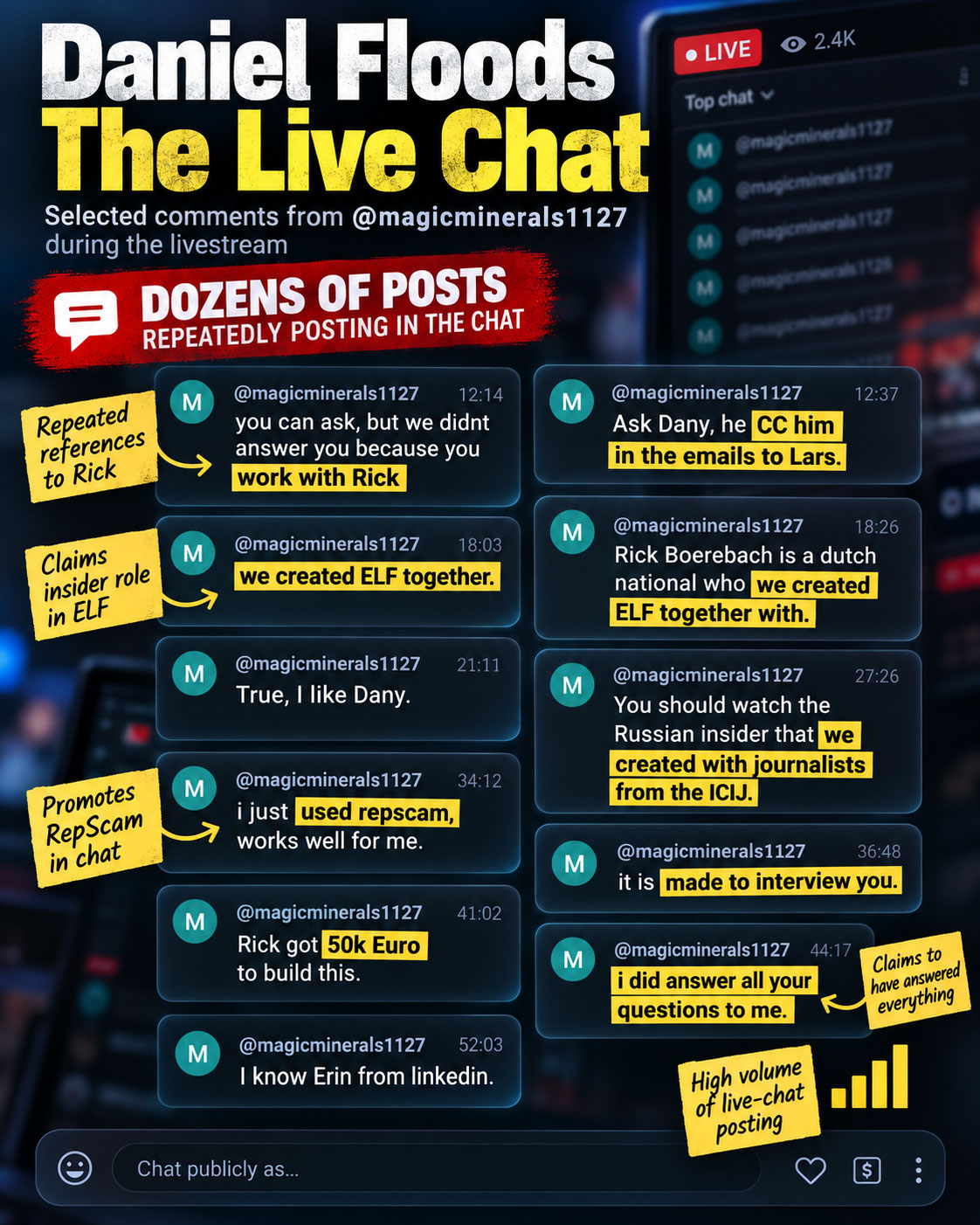 During the same livestream, Johansson participated in the chat using the account @magicminerals1127, whose identity had been verified during the investigation. He defended RepScam, explaining that the software was designed to interview victims rather than function as a conventional chatbot. He also made a specific claim about development expenditure: “Rick got 50k Euro to build this.” Johansson stated that ELF subsequently engaged another development company after it stopped paying Rick Boerebach.
Those statements raise questions about the technology’s origins, development costs and ownership. Johansson also claimed the system was designed around methods used by a UK financial crime agency to gather information from victims. However, the chat did not provide an independently verified technical assessment demonstrating that RepScam could trace stolen assets, secure enforceable recovery orders or return money to claimants.
The distinction is fundamental. RepScam may be capable of collecting information and preparing investigative material, but that is not evidence of recovering funds. Its investment documents describe an opportunity to build a highly profitable business around fraud investigations. What remains missing from the material examined is independently verifiable evidence showing how many victims have actually received their money back through its services.
For Johansson, whose advertised responsibilities included research, community development and international networking, these questions are directly relevant. His involvement connects the company’s technology and financial ambitions to the community of fraud victims it hopes to serve. The concern is not simply whether artificial intelligence can assist an investigation. It is whether ELF’s financial promises, handling of sensitive personal information and claimed recovery capabilities are supported by independently verifiable evidence.
When Questions Turned Towards ELF
My correspondence with Daniel Johansson began well before the publication of my investigation into Lars Olofsson. We had been in contact since November 2024, and on 30 September 2026, I approached him again while examining ELF’s ownership arrangements and the disagreements emerging between those involved in the business.
 I wanted to understand Johansson’s role, the extent of his financial interest and whether he could provide evidence supporting the company’s claims. He was given an opportunity to explain his position and supply information that might challenge what I had received from other sources.
Following publication of my investigation into Lars Olofsson on 22 October, Johansson was preparing a separate investigation examining my previous journalism.
Meanwhile, on 23 October, I sent him ten questions concerning his connections to ELF, Prio Startup and Olofsson. He responded on 25 October, acknowledging his ownership interest, his working relationship with Olofsson since 2022 and his former position at Prio Startup.
He also stated that Olofsson had supplied correspondence for his review but denied that anyone had commissioned or financed it. Those answers helped establish the business relationships I was investigating, although they did not resolve the underlying questions about recoveries.
What Johansson Said During My Livestream
The exchanges became more revealing during my 27 October livestream, when Johansson participated under the YouTube account @magicminerals1127.
While discussing why ELF had been reluctant to respond to my enquiries, the account stated:
“well we looked you up and you work with Rick so we did not want to answer you.”
It later added:
“we created ELF together”
The second statement referred to Rick Boerebach’s involvement in establishing the company. These comments are significant because they explain the reluctance to engage in terms of an internal business disagreement rather than identifying a factual problem with the questions themselves.
Johansson also defended RepScam’s development, discussed payments to Boerebach and stated that ELF had subsequently engaged another developer. At one point, he encouraged me to continue examining the platform.
The conversation demonstrated that Johansson was prepared to discuss the technology and the dispute surrounding its development, but it produced no independently verifiable example of a completed recovery for a paying victim.
When Olofsson Entered the Exchange
The following correspondence added another dimension.
Olofsson sent an email addressed to both Boerebach and me, asserting that we were working together and that Rick was directing my investigation.
He announced:
“We are now turning the tables”
The email included a link to Johansson’s article criticising my reporting. It establishes that Olofsson was actively circulating Johansson’s work while making personal allegations about my independence.
It does not establish that he commissioned the article, something Johansson expressly denies.
For me, the important development was not the personal criticism. It was the contrast between the willingness to discuss my reporting and the continuing absence of documented financial recoveries.
Johansson had provided explanations about his ownership and business relationships, and those explanations deserved to be reported accurately. But the central questions about what ELF had achieved for victims remained unanswered by the evidence presented in these exchanges.
When the Investigation Turned on the Investigator
On 29 October 2026, Daniel Johansson published three articles about me through his newly launched OSINT Community website. He had also promoted a documentary examining my investigative methods, but at the time of writing, I had not been able to view the promised film. These publications appeared while I was investigating his involvement with Lars Olofsson, Eight Legged Forensics (ELF) and RepScam.
 Rather than concentrate on the financial questions I had been raising, Johansson examined my previous investigations, livestreams, corrections and reporting methods.
Three Articles and a Promised Documentary
Readers are welcome to examine his publications and form their own opinions:
- The Threats Didn’t Age Well. Neither Did the Article
- Danny de Hek: The Playbook — Including the Documentary
- The Guru Who Needed a Guru
Johansson says he searched captions from 2,494 YouTube videos and examined 100 recordings in greater depth. He raises questions about reporting errors, personal information, corrections and sponsored reviews.
Some of those subjects are legitimate matters for scrutiny. I have never claimed to be perfect, and I have no objection to people examining my work.
However, a quotation can be technically accurate while still giving a misleading impression when separated from the circumstances in which it was made.
My livestreams frequently run for several hours. They involve developing investigations, audience questions, live research, new information and sometimes heated exchanges. Selecting a sentence or two from a five-hour broadcast does not necessarily explain what prompted the statement, what evidence was being discussed or what happened afterwards.
That does not excuse statements that are inaccurate or inappropriate. It means the surrounding context matters, particularly when those statements are being used to establish a pattern of conduct.
Investigating Fraud While It Is Happening
There is another distinction that deserves explaining.
My investigations are not simply retrospective reports about investment schemes that have already collapsed. Much of my work involves examining questionable opportunities while they are still recruiting investors, collecting money or promoting claims that have not been independently substantiated.
The intention is to identify warning signs, question promoters, bring information into public view and create disruption before more people are potentially harmed.
That often means working with incomplete information, following new leads, examining relationships and revisiting earlier findings as additional evidence emerges. It is neither a simple nor a perfectly predictable process.
Traditional investigative journalism has established editorial procedures designed to protect accuracy, fairness and privacy. Those safeguards matter. But livestream-based investigations can operate differently, allowing researchers, victims and viewers to contribute information and challenge claims in real time.
The advantage of that approach is speed and public participation. The responsibility is ensuring that disruption does not become a substitute for evidence.
I do not claim that every investigation has been conducted with complete precision. Mistakes can occur, and corrections are part of responsible reporting. But I also believe there is considerable public value in confronting questionable financial claims before victims have lost everything.
From the beginning, I have publicly stated my intention to name and shame people running or promoting Ponzi schemes and scams. That commitment has never meant that merely being investigated establishes somebody’s guilt.
The Investigator’s Financial Interest
There is, however, an important conflict of interest in Johansson’s reporting.
Johansson owns 17% of ELF, has worked with Lars Olofsson since 2022 and was an alternate board member of Olofsson’s Prio Startup AB until 6 October 2026.
He acknowledges these relationships in his publications. He also states that nobody commissioned or paid him to investigate me and that Olofsson had no involvement in producing the articles.
Johansson is entitled to investigate my reporting. Equally, readers are entitled to know about his financial interest in a business I am investigating.
His criticism of my methods should be assessed on its evidence, just as the financial and recovery claims associated with ELF and RepScam should be assessed on theirs.
Why Daniel Became a Person of Interest
Johansson devoted part of his documentary and reporting to my decision to add him to our investigative board as a person of interest.
Our research team has more than 1,300 people in its person-of-interest folder. Being included does not mean somebody is a criminal or has committed any wrongdoing.
It means we are examining their involvement, connections or activities in relation to an investigation. Some people may be promoters, directors, investors, professional associates or witnesses. Others may simply possess information relevant to understanding how an operation functions.
A person of interest is a subject of research, not a finding of guilt.
Johansson highlighted confrontational language from my livestream and presented the episode as evidence of how I conduct investigations. Readers can examine the original recordings and assess those statements in their full context.
I accept that my approach can sometimes be unconventional and confrontational. That is not the same as suggesting that every person we investigate is a criminal.
Dyslexia, Mistakes and the Reality of Live Investigations
There is something Johansson may not fully appreciate about how I work.
 I have dyslexia. During unscripted livestreams, I frequently misread people’s names, particularly unfamiliar surnames. Johansson is one of those names I have struggled with, sometimes reading it as Johnson.
That contributed to my initial confusion about correspondence I had received from him and his connection to Lars Olofsson.
I am not raising dyslexia as an excuse for inaccurate reporting. It is an explanation of how I sometimes process written information. I can make mistakes, recognise them and correct them without abandoning the investigative work itself.
I have lived with dyslexia throughout my life. It has not prevented me from building businesses, conducting investigations or exposing questionable financial operations.
My strengths and weaknesses are both part of how I work. Neither should prevent the evidence itself from being examined.
The Question That Still Matters
After publishing his articles, Johansson promoted them in a public Telegram group and encouraged readers to share and comment on his LinkedIn post.
He is entitled to criticise my journalism, just as I am entitled to investigate his business relationships.
But three articles and an examination of thousands of videos have not answered the original financial question.
Where is the independently verifiable evidence of a fraud victim whose stolen money was successfully recovered and returned through ELF or RepScam?
I have repeatedly asked for that evidence. I have not received it.
That does not establish that no successful recoveries have occurred. It means the claims remain unverified in my investigation.
For victims who have already lost money to an investment scam, that question matters far more than another dispute over the reputation of the person asking it.
The Recoveries That Still Need Explaining

The evidence surrounding Daniel Johansson, Lars Olofsson and Eight Legged Forensics LLC reveals a business built around the growing demand for fraud investigations and asset recovery. Johansson’s progression from JuicyFields victim to company shareholder and named member of the RepScam founding team is documented through his public statements, corporate involvement and investment material. His relationship with Olofsson extends back to 2022, and his acknowledged 17% ownership interest in ELF gives him a direct financial stake in the business.
What remains unclear is how the company’s commercial ambitions compare with its actual achievements. ELF’s promotional material presented extraordinary financial projections, including a US$391 million valuation, approximately 9,000 paying clients and the possibility of generating tens of millions of dollars annually through automated investigative services. Yet the material examined for this investigation does not establish how those figures were independently calculated, how much revenue was actually received or what proportion of paying clients obtained meaningful results. Projections of future profitability are not evidence of existing financial performance.
Most importantly, I have not been provided with independently verifiable evidence of money successfully recovered and returned to fraud victims through ELF or RepScam. That does not establish that no recoveries have occurred. It means the available documents, correspondence and public statements do not substantiate the scale of recovery activity being promoted. The distinction matters when dealing with people who may already have lost their savings and are considering paying somebody else for assistance.
There is also an important difference between investigating a financial crime and recovering the proceeds. An AI platform might organise documents, interview victims, identify suspicious transactions or produce reports for authorities. Those services may have value. But a completed questionnaire, an investigative report or a proposed lawsuit is not the same as recovered money arriving in a victim’s bank account. Any organisation marketing recovery services should be able to explain that distinction clearly, including its fees, contractual obligations and documented outcomes.
Johansson has answered questions about his corporate relationships and defended the development of RepScam. Olofsson has continued promoting his legal and investigative activities. The Swedish court records examined in my earlier investigation also establish important findings about Olofsson’s previous proceedings and financial record-keeping. None of those matters, considered separately or together, automatically proves wrongdoing by ELF. They do, however, make independent verification of its financial and recovery claims particularly important.
After years investigating suspected investment fraud and misleading financial opportunities, I have repeatedly encountered operations where impressive presentations, professional titles, ambitious projections and promises of future results create confidence long before the underlying business has demonstrated what it can deliver. The people most at risk are often those who already trusted one opportunity and paid dearly for it.
The unanswered question is straightforward: where is the evidence of successful recoveries? Until ELF and those promoting its services can produce independently verifiable outcomes, prospective clients should distinguish the company’s promises from what has actually been demonstrated. Victims deserve more than another expensive opportunity to believe their money might come back.
Disclaimer: How This Investigation Was Conducted
This investigation relies entirely on OSINT — Open Source Intelligence — meaning every claim made here is based on publicly available records, archived web pages, corporate filings, domain data, social media activity, and open blockchain transactions. No private data, hacking, or unlawful access methods were used. OSINT is a powerful and ethical tool for exposing scams without violating privacy laws or overstepping legal boundaries.
About the Author
I’m DANNY DE HEK, a New Zealand–based YouTuber, investigative journalist, and OSINT researcher. I name and shame individuals promoting or marketing fraudulent schemes through my YOUTUBE CHANNEL. Every video I produce exposes the people behind scams, Ponzi schemes, and MLM frauds — holding them accountable in public.
My PODCAST is an extension of that work. It’s distributed across 18 major platforms — including Apple Podcasts, Spotify, Amazon Music, YouTube, and iHeartRadio — so when scammers try to hide, my content follows them everywhere. If you prefer listening to my investigations instead of watching, you’ll find them on every major podcast service.
You can BOOK ME for private consultations or SPEAKING ENGAGEMENTS, where I share first-hand experience from years of exposing large-scale fraud and helping victims recover.
“Stop losing your future to financial parasites. Subscribe. Expose. Protect.”
My work exposing crypto fraud has been featured in:
- Coffeezilla 2026): Featured in the investigation exposing the alleged $328M Goliath Ventures Ponzi scheme
- Bloomberg Documentary (2025): A 20-minute exposé on Ponzi schemes and crypto card fraud
- News.com.au (2025): Profiled as one of the leading scam-busters in Australasia
- OpIndia (2025): Cited for uncovering Pakistani software houses linked to drug trafficking, visa scams, and global financial fraud
- The Press / Stuff.co.nz (2023): Successfully defeated $3.85M gag lawsuit; court ruled it was a vexatious attempt to silence whistleblowing
- The Guardian Australia (2023): National warning on crypto MLMs affecting Aussie families
- ABC News Australia (2023): Investigation into Blockchain Global and its collapse
- The New York Times (2022): A full two-page feature on dismantling HyperVerse and its global network
- Radio New Zealand (2022): “The Kiwi YouTuber Taking Down Crypto Scammers From His Christchurch Home”
- Otago Daily Times (2022): A profile on my investigative work and the impact of crypto fraud in New Zealand




Leave A Comment