


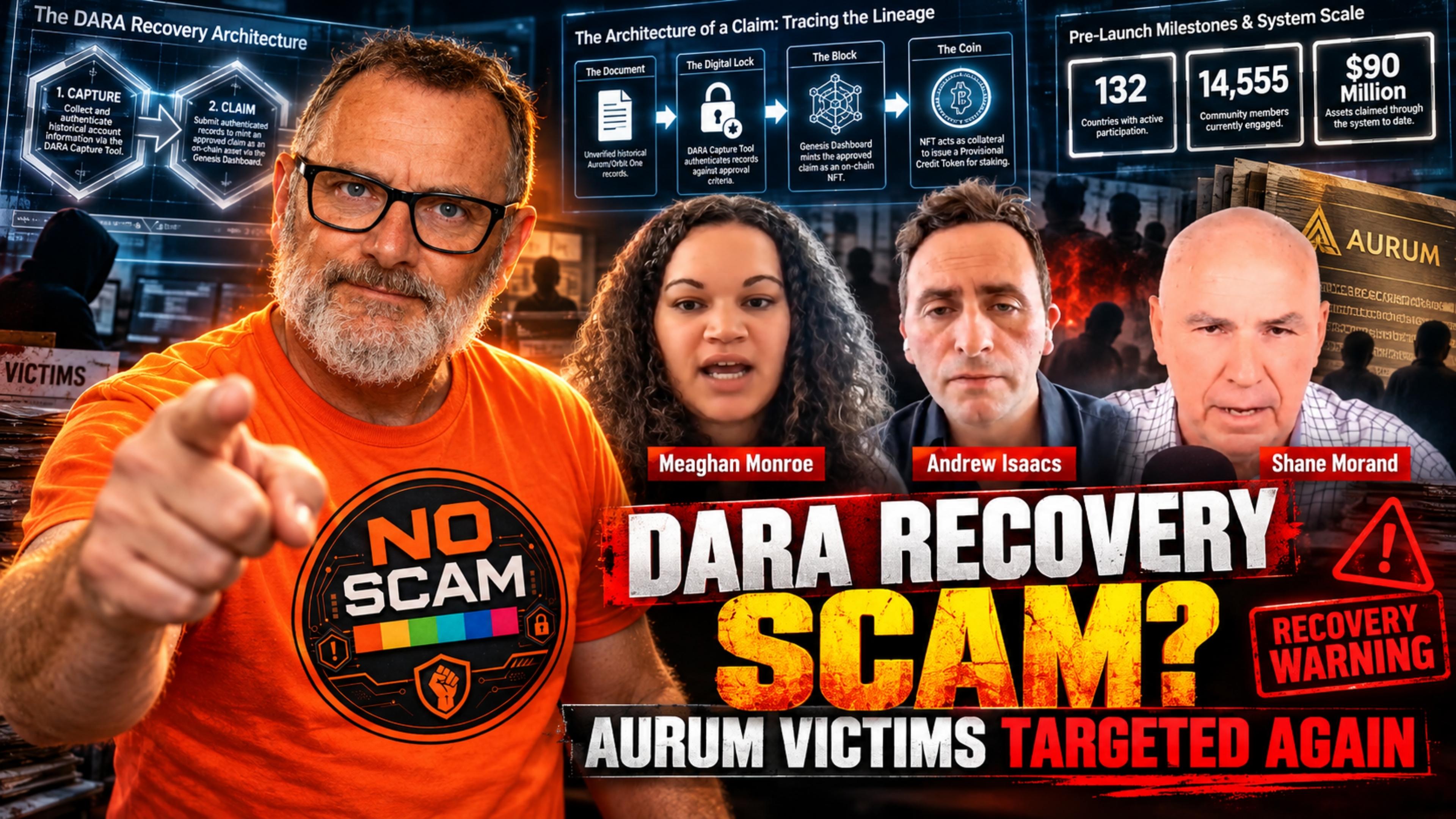
“What I know to be true as I speak today is through this initiative, you will be able to recover your funds.”
Those were the words of Andrew Isaacs during a 23 October 2026 presentation introducing the Digital Asset Recovery Alliance (DARA), a new recovery opportunity being promoted to people who have already lost access to their money through AURUM Foundation.
After five years investigating suspected Ponzi schemes, I’ve seen this pattern repeatedly. An investment operation stops paying, its promoters offer explanations, and eventually another opportunity appears promising to recover what investors have lost. The people who trusted the first scheme are encouraged to trust again, often by familiar faces.
This is how victims risk getting scammed twice.
The DARA presentation featured Meaghan Monroe, Shane Morand and Andrew Isaacs, promoting a proposed recovery system involving NFTs, provisional credit tokens, staking and another trading operation. Monroe claimed approximately 14,555 members across 132 countries, representing US$90 million in submitted claims, were already participating. She discussed the possibility of recovering 100% of losses within three to six months.
But those US$90 million in claims are not US$90 million sitting in a recovery fund. DARA’s own PowerPoint presentation acknowledges that distinction.
Meanwhile, New Zealand’s Financial Markets Authority (FMA) issued a formal warning on 12 October 2026, confirming that AURUM Foundation was not registered to provide financial services or products in New Zealand. The regulator also reported receiving a complaint from a New Zealand investor unable to withdraw funds. Its warning referenced overseas regulators that had identified characteristics associated with pyramid or Ponzi-type schemes.
Investigative journalist Oz at BehindMLM had already raised the alarm about DARA on 14 October, documenting how AURUM promoters were directing investors towards the new recovery initiative. His reporting identified a newly registered DARA website and described a proposal to generate recovery payments through fresh trading profits rather than simply returning investors’ original money.
Now we have the subsequent 77-minute launch presentation and its 12-slide PowerPoint deck, giving us a much clearer picture of what these people are offering.
And my concern is straightforward.
If AURUM cannot account for the original investors’ money, another trading scheme cannot simply manufacture the missing capital. Turning losses into digital tokens, charging for additional memberships and rebuilding the same recruitment network is not evidence of recovery.
I have yet to see a successful recovery of this kind emerge from the collapsed investment operations I’ve investigated. What I have seen is victims losing more money because they desperately wanted to believe somebody had found a solution.
Before another AURUM investor pays for an NFT, connects a cryptocurrency wallet or encourages friends and family to participate in DARA, they need to understand exactly what is being offered — and who stands to benefit.
Meaghan Monroe and the DARA Recovery Pitch
Meaghan Monroe is central to the new DARA operation. During the 23 October 2026 presentation, she explained that the initiative began through discussions involving herself, senior AURUM leaders and a former CEO. What supposedly started as a way to document investor losses has developed into another financial opportunity involving blockchain technology, trading and recruitment commissions.
 Accompanying the video presentation was a 12-page PowerPoint pitch deck titled “Digital Asset Recovery Alliance (DARA)”. The slides outline the proposed recovery process, NFT memberships, staking arrangements and the financial infrastructure supposedly being developed to compensate AURUM investors. I’ve included the complete pitch deck below so readers can examine the promotional claims themselves rather than simply relying on what was said during the presentation.
Monroe outlined three steps: Capture, Claim and Credit. Investors are instructed to retrieve their AURUM account records, convert their claimed balances into NFTs and then qualify for provisional credit tokens that can participate in a proposed recovery fund.
On page 5 of DARA’s PowerPoint, the process is presented as a straightforward path from recording a loss to receiving credit. But there is a fundamental distinction between documenting money owed and actually having the funds available to repay it.
The US$90 Million Question
Monroe claimed that 14,555 participants from 132 countries had registered approximately US$90 million in AURUM balances. Those figures have not been independently verified, and the presentation itself acknowledges that submitted claims do not represent cash held by the recovery fund.
At approximately 41:26, Monroe described an unidentified trader with 25 years of investment banking experience who supposedly handles US$1 billion in daily settlements. She also claimed that wealthy investors were prepared to provide capital for the recovery operation.
Yet the presentation provided no independently verifiable proof that sufficient money was available to compensate the victims.
An NFT representing a US$100,000 loss is not US$100,000 in recoverable funds.
From Free Registration To Paid Memberships
DARA promotes a free registration process, but Monroe subsequently introduced paid membership options, including a US$20 Genesis Pass and a US$100 Sovereign Pass. These were presented alongside tools for restoring partner networks, accessing additional functions and potentially earning commissions.
That is a serious warning sign. People who have already lost access to their investments are being offered another system in which purchasing memberships and rebuilding recruitment organisations become part of the proposed route forward.
Monroe also suggested that participants could achieve full recovery within three to six months, while encouraging leaders to bring their existing teams into DARA before access to the old AURUM systems disappeared.
The urgency, the promises and the familiar recruitment structure deserve scrutiny.
Investors do not need another opportunity to make money. They need an independently verified accounting of where their original money went and whether any recoverable assets remain.
Shane Morand and Andrew Isaacs – Selling Hope Again
One of the most disturbing aspects of DARA’s launch presentation was the involvement of Shane Morand and Andrew Isaacs, two familiar faces from AURUM. Both acknowledged that investors had been left without answers, yet both were now encouraging the same community to embrace another financial opportunity.
Morand explained that he joined AURUM in October 2025, met its CEO privately in Slovenia and subsequently helped expand the operation internationally. He spoke at the Dubai launch conference and represented AURUM at events in France and the Maldives.
But during the DARA presentation, Morand admitted something extraordinary. Despite his involvement in promoting AURUM internationally, he claimed he had never met the ultimate ownership group and had no access to the people controlling the operation.
He said he resigned on 14 August 2026, after repeatedly failing to obtain answers about the withdrawal problems and alleged cyberattack.
That raises a question about the due diligence carried out before encouraging others to invest.
Andrew Isaacs Makes Another Extraordinary Promise
Isaacs described joining AURUM shortly before its collapse and claimed he never controlled investor accounts or company funds. He explained that he remained involved because he wanted to maintain communication between management and investors.
But what he said about DARA was particularly concerning.
At approximately 29:32, Isaacs told the audience:
“What I know to be true as I speak today is through this initiative, you will be able to recover your funds.”
He insisted this was not simply something he believed. He claimed to know that investors would recover their money, describing DARA as the most reliable route to recovery.
Where is the evidence supporting that certainty?
The presentation did not establish that DARA possessed sufficient independently verified capital to honour the losses. Nor did Isaacs explain how a recovery fund dependent on future trading activity could guarantee repayment.
The Same Community Becomes The Opportunity
Morand made another revealing statement when discussing what AURUM had left behind. He told participants that the company’s greatest asset was never its technology, trading systems or compensation plan.
It was the community.
Isaacs expressed a similar view, describing the possibility of monetising AURUM’s existing customer base once the initial recovery phase was underway.
This is precisely why I am concerned. The thousands of people who trusted AURUM are now being presented as the foundation of another commercial operation. Their existing relationships, recruitment networks and desire to recover their losses are being used to generate momentum for DARA.
Morand and Isaacs describe themselves as victims who want to help others. Their personal losses and intentions have not been independently established, but their public endorsements are documented.
They should understand the responsibility that comes with those endorsements.
People trusted these leaders once and lost access to their money. Encouraging them into another financial operation without independently verifiable evidence of recovery funding risks exposing those same people to further losses.
The Money is Gone – Don’t Pay to Recover It
The biggest question surrounding DARA remains unanswered. Where is the money coming from? Meaghan Monroe claims wealthy investors have committed funding, while Andrew Isaacs insists victims will recover their losses. Yet the 23 October presentation provided no independently verified financial statements, identifiable source of sufficient recovery capital or evidence that investors could actually withdraw the amounts being promised.
Even DARA’s own PowerPoint acknowledges the problem. On page 10, beneath its claim of US$90 million in registered assets, a disclaimer explains that these figures represent submitted claims, not cash held by the recovery fund or money already returned.
That distinction is crucial. AURUM investors are being invited to convert balances from a failed investment operation into digital tokens, with recovery supposedly generated through another trading programme. If the original money is missing, an NFT cannot replace it. And if the new trading operation loses money, victims could find themselves facing further financial consequences.
The Recovery Scam Warning
This is where my experience investigating suspected Ponzi schemes becomes particularly relevant. Over five years, I’ve watched promoters move from one opportunity to another, often taking the same investors and recruitment networks with them. When an operation collapses, the promised rescue can become another way of extracting money from people who have already suffered losses.
I’ve encountered repeated recovery promises during my investigations, but I have never personally verified a successful recovery through one of these replacement investment schemes. That does not mean money can never be recovered through legitimate legal proceedings, receiverships or enforcement action. It means investors should not confuse those processes with joining another speculative financial opportunity.
DARA’s paid NFT passes, provisional credit tokens, staking arrangements and proposed restoration of recruitment commissions raise precisely that concern. The presentation also encourages participants to connect cryptocurrency wallets and authenticate their historical AURUM records.
My advice is simple: do not pay another dollar into this recovery opportunity.
Protect Yourself Before You Lose More
New Zealand’s Financial Markets Authority has already warned about AURUM Foundation, including concerns involving investors who cannot withdraw their money. Oz at BehindMLM has separately investigated DARA and identified the danger of AURUM victims being redirected into another questionable financial operation.
Investors should preserve their original transaction records, cryptocurrency addresses, screenshots and communications. They should not disclose wallet recovery phrases, grant unfamiliar applications access to their funds or assume that purchasing a membership improves their chances of recovering anything.
Anyone genuinely offering to repay investors should be able to demonstrate where the money is held, who controls it, what legal obligations exist and how repayments will be funded. Those are basic questions, not unreasonable demands.
I also want to address the promoters encouraging their teams to participate. You have already introduced people to an operation that has failed to honour withdrawals. Before promoting another opportunity, consider the responsibility you carry towards those who trusted your judgment.
Doing something is not automatically better than doing nothing. Sometimes the most important decision is refusing to participate in another financial scheme until the evidence supports its claims.
For AURUM victims, the immediate priority should be preserving evidence, reporting losses and protecting whatever money they still have.
You have already lost enough. Don’t let the promise of getting everything back become the reason you lose even more.
Disclaimer: How This Investigation Was Conducted
This investigation relies entirely on OSINT — Open Source Intelligence — meaning every claim made here is based on publicly available records, archived web pages, corporate filings, domain data, social media activity, and open blockchain transactions. No private data, hacking, or unlawful access methods were used. OSINT is a powerful and ethical tool for exposing scams without violating privacy laws or overstepping legal boundaries.
About the Author
I’m DANNY DE HEK, a New Zealand–based YouTuber, investigative journalist, and OSINT researcher. I name and shame individuals promoting or marketing fraudulent schemes through my YOUTUBE CHANNEL. Every video I produce exposes the people behind scams, Ponzi schemes, and MLM frauds — holding them accountable in public.
My PODCAST is an extension of that work. It’s distributed across 18 major platforms — including Apple Podcasts, Spotify, Amazon Music, YouTube, and iHeartRadio — so when scammers try to hide, my content follows them everywhere. If you prefer listening to my investigations instead of watching, you’ll find them on every major podcast service.
You can BOOK ME for private consultations or SPEAKING ENGAGEMENTS, where I share first-hand experience from years of exposing large-scale fraud and helping victims recover.
“Stop losing your future to financial parasites. Subscribe. Expose. Protect.”
My work exposing crypto fraud has been featured in:
- Coffeezilla 2026): Featured in the investigation exposing the alleged $328M Goliath Ventures Ponzi scheme
- Bloomberg Documentary (2025): A 20-minute exposé on Ponzi schemes and crypto card fraud
- News.com.au (2025): Profiled as one of the leading scam-busters in Australasia
- OpIndia (2025): Cited for uncovering Pakistani software houses linked to drug trafficking, visa scams, and global financial fraud
- The Press / Stuff.co.nz (2023): Successfully defeated $3.85M gag lawsuit; court ruled it was a vexatious attempt to silence whistleblowing
- The Guardian Australia (2023): National warning on crypto MLMs affecting Aussie families
- ABC News Australia (2023): Investigation into Blockchain Global and its collapse
- The New York Times (2022): A full two-page feature on dismantling HyperVerse and its global network
- Radio New Zealand (2022): “The Kiwi YouTuber Taking Down Crypto Scammers From His Christchurch Home”
- Otago Daily Times (2022): A profile on my investigative work and the impact of crypto fraud in New Zealand



Leave A Comment