


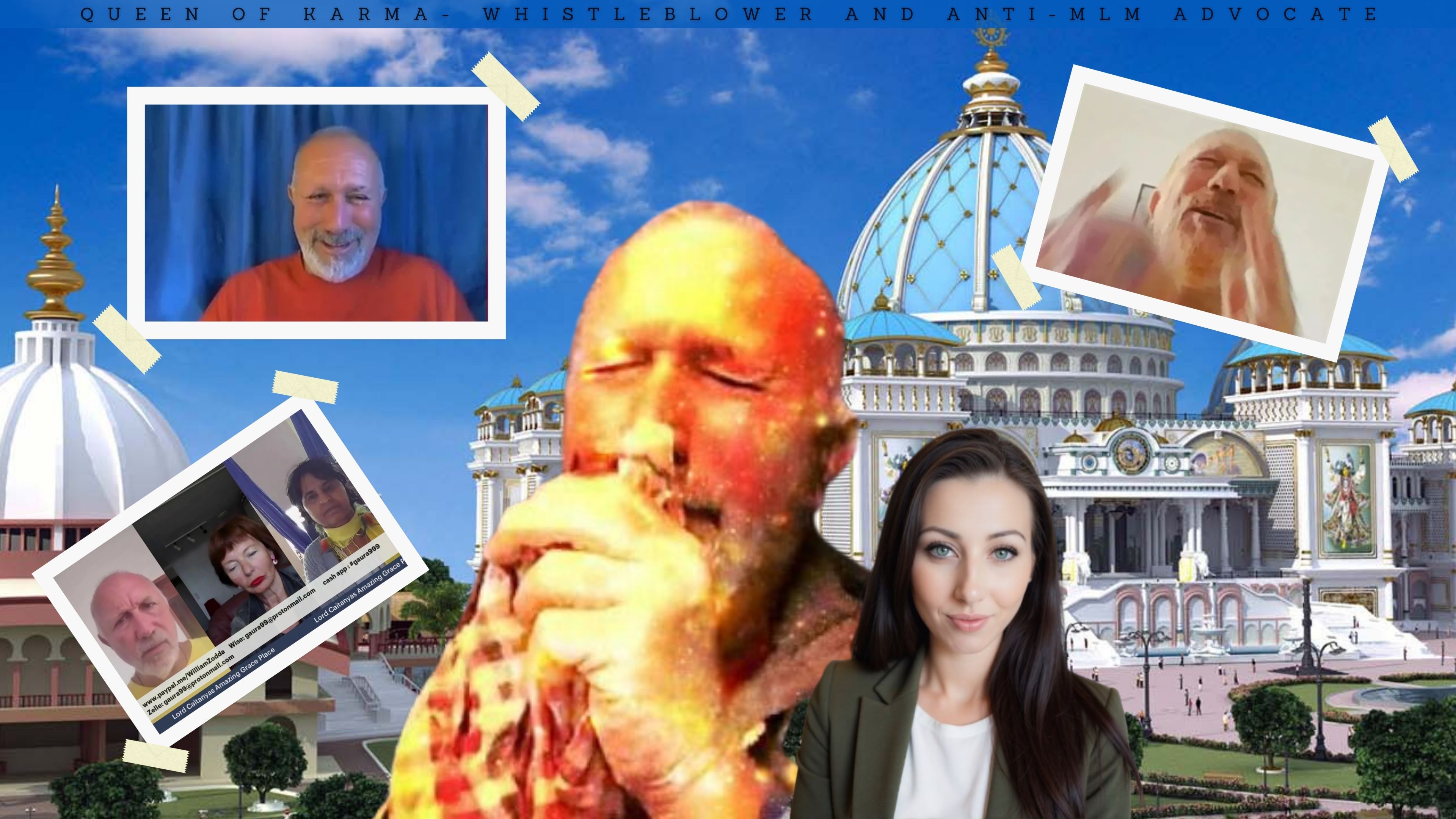
For months, I have been investigating a man who calls himself Gaurahari Das, a self-styled Hare Krishna teacher who operates under multiple names, multiple channels, and multiple identities. He has quietly built a small but intensely loyal group of followers who treat him not as a mentor, but as a spiritual authority, a successor, a profit. A man who claims to complete the Hare Krishna disciple line.
And when people begin to question him? He humiliates them publicly. His followers dogpile them. And he retreats into secrecy.
Recently, after a former Hare Krishna devotee Mike Sandoval began exposing his behavior, Guarahari privated his entire YouTube channel, wiping away years of content overnight. His current channel, @gura99, now displays nothing but empty space — a digital ghost town where a self-proclaimed spiritual leader once preached daily.
People don’t hide their teachings unless they have something to hide.
This exposé is not about theology. It is about power, control, and the creation of a micro-cult inside a vulnerable spiritual community. It is a warning to the public, especially spiritual seekers, about a man whose behavior matches known patterns of coercive control.
This is the story of who he is, his own words, and why people need to be warned.
Before The Guru: The Making of William Zodda
His Facebook profile lists him as “from East New York, New York,” a neighborhood known for its rough edges and transient population. Public records confirm this origin, placing him squarely in a part of the city where reinvention is often a matter of survival. Later, he relocated to California — specifically Desert Hot Springs, a region long associated with alternative spirituality, New Age experimentation, and fringe religious communities. Eventually, he settled in Tucson, Arizona, where he continues to live today.
Nothing in these early records suggests formal religious training, academic study, or mentorship under any recognized spiritual tradition. His education is listed only as “studied at some collage,” a vague and misspelled entry that underscores the absence of structured schooling. His high school is listed as “Wilson High School”, but he holds no college degree, no seminary, no Sanskrit study, no theological certification. The man who would later claim to teach “higher truths” and “complete the disciplic line” began his adult life with no documented scholastic foundation.
But the most revealing aspect of his early identity is not his education — it is his first spiritual persona, one that predates his Hare Krishna involvement by decades.
In 1997, at the age of 44, William Zodda founded Temple of the Heart, a self‑created spiritual organization with no affiliation to ISKCON, Gaudiya Math, or any established lineage. His public records list him as:
Founder Acharya at Temple of the Heart (1997–present)
This title — “Acharya” — is traditionally reserved for teachers recognized by lineage, training, and community. Yet Zodda adopted it for himself, without institutional recognition, long before he ever entered the Hare Krishna sphere. This early self‑appointment is the first clear sign of a pattern that would later define his guru persona: identity as construction, not inheritance.
The JesusTrueVine blog, which documents fringe spiritual figures and self‑appointed religious leaders, includes references to individuals who blend Christian mysticism, New Age concepts, and self‑declared spiritual authority. Zodda’s early spiritual activities fit neatly into this ecosystem. While the blog does not provide a full biography, its inclusion of his name places him among a broader network of independent spiritual experimenters who operate outside traditional structures, often creating their own micro‑movements and adopting titles without oversight.
By the time he encountered the Hare Krishna movement, he was not a blank slate. He was a man who had already:
- Founded his own spiritual organization
- Adopted the title “Acharya”
- Presented himself as a spiritual teacher
- Operated outside institutional oversight
- Experimented with alternative religious frameworks
- Built a small circle of followers
- Constructed a spiritual identity rooted in personal revelation
- ISKCON did not create his guru persona. It merely became the next stage of it.
His move to Tucson, Arizona — confirmed by both his Facebook profile and public records — placed him in a region known for desert mysticism, alternative spirituality, and fringe religious experimentation. It is here that his identity as “Gaura” and later “Gaurahari Das” began to take shape, merging his earlier self‑created authority with the aesthetics and language of Gaudiya Vaishnavism.
The Biography He Doesn’t Want Scrutinized
In a 2023 interview on the Hare Krishna Project Podcast, Gaurahari describes his early life with striking simplicity. He was born in New York, raised in California, and grew up in a household he calls “pretty crazy.” His parents moved constantly, leaving him with no stability and no formal education foundation.
“I quit school when I was 15…I don’t have any scholastic abilities much.”
He recounts drifting through adolescence and early adulthood: working odd jobs, drinking in bars, dating, and “having no real sense of direction.” There is no mention of religious training, theological study, or mentorship. Nothing in his biography resembles the foundation of a spiritual teacher, let alone the “successor” he later claims to be.
This absence of formal grounding becomes important later, when he begins presenting himself as a spiritual authority capable of “completing” the Hare Krishna tradition.
The turning point in his story is not scripture, lineage, or spiritual discipline — but four hits of LSD given to him by a psychologist in San Francisco.
“Everything started there…this energy started to manifest in my body…they call it in India the Kundalini energy.”
He describes a series of intense, drug-induced experiences:
- Hot and cold flashes
- Anxiety and fear
- “Energy moving in my body”
- A “blocked chakra”
- A yogi who “opened” the chakra
- A vision of Moses carrying tablets
- An out-of-body experience
- “Thousands of needles” in his head
Later, while reading the Gospel of John from the Bible, he claims:
“Every cell of my body went into like had an orgasm…I felt one with God.”
These experiences, all psychedelic or spontaneous, become the foundation of his spiritual authority. He repeatedly states that these events gave him the ability to “see the deep inner meanings” of scripture.
This is not a minor detail. It is the cornerstone of his self-appointed guru identity.
Gaurahari describes discovering Hare Krishna through Science of Self-Realization, a book by A.C. Bhaktivedanta Swami Prabhupada. He says he immediately surrendered everything he owned.
“Here’s my money, here’s my car, here’s my trailer…I want to join.”
He lived in an ISKCON temple for five years, describing intense emotional experiences while chanting. But he refused structure, discipline, and accountability.
“They gave me the most troubles…’you gotta follow the program’…it was a big no.”
He describes ISKCON as oppressive:
“I left and I felt so good…like I got out of prison.”
This moment becomes his pivot: He rejects discipline, rejects authority, and rejects any system that requires accountability.
This rejection becomes the foundation of his own movement.
The Creation of His Own Spiritual Empire
The Inner Circle: A High-Control Micro-Cult
Cultic Dynamics: Humiliation, Dogpiling, and Control
As Gaurahari’s teachings grew more extreme, so did the behavior inside his inner circle. Public livestreams and archived discussions reveal a pattern of collective enforcement, where dissent is not merely discouraged, it is punished.
Followers who express doubt or attempt to leave are routinely subjected to public shaming, often framed as spiritual failure. In multiple livestreams, Gaurahari responds to questioning with condescension, labeling concerns as “ego,” “maya,” or evidence of insufficient devotion. This rhetorical strategy places all fault on the follower, never on the leader.
The group’s reaction is immediate and coordinated. Viewers in the chat echo his criticisms, amplifying the humiliation. This dogpiling serves two functions: it reinforces loyalty among remaining members and demonstrates the consequences of disobedience. The dynamic mirrors patterns documented in high-control religious groups, where public correction is used to maintain conformity and suppress dissent.
These behaviors are not isolated incidents. They appear consistently across his online presence, forming a recognizable pattern of coercive group control. The message is clear: questioning the leader is not permitted, and those who attempt to leave will be met with collective hostility.
This pattern aligns with concerns raised in the Krishna1008 Watchdog Blogs, which have documented Gaurahari’s behavior since 2018. The blog describes him as a “controversial figure” who “misuses Gaudiya Vaishnava aesthetics” and adopts titles without recognition. A later entry notes his tendency to elevate himself while diminishing others, calling him “a self-appointed spiritual authority” whose behavior has caused confusion within the community.
Together, these sources paint a picture of a leader who maintains control through emotional pressure, public correction, and group conformity which are hallmarks of a micro-cult structure.
A Multitude of Identities: Rebranding As a Strategy
One of the most striking aspects of Gaurahari’s online presence is the sheer number of identities he has adopted. Over the years, he has appeared under:
- Gaura
- Gaurahari Das
- Acharya Srila Gaurahari Das Babaji
- @gaura992000
- @gauraharidas3959
- UCX6FXO-L00tADbZA_zWV_vg
- @gura99
Each identity corresponds to a different channel, era, or persona. Some channels contain early teachings; others show attempts at rebranding; still others appear abandoned after criticism. This pattern of reinvention is common among self-appointed spiritual leaders who seek to escape past controversies or cultivate new audiences.
The Krishna1008 Blog entries document earlier iterations of these identities, noting his use of titles such as “Acharya,” “Srila,” and “Babaji” — titles traditionally reserved for lineage-recognized teachers. The blog’s authors highlight the lack of institutional recognition behind these titles, raising concerns about self-elevation and misrepresentation.
The multiplicity of identities serves a strategic purpose. It allows Gaurahari to shed criticism, reframe his narrative, and present himself as a fresh authority to new followers. It also complicates accountability, making it difficult for outsiders to track his teachings across platforms.
The Sandoval Factor: When a Former Devotee Speaks Out
The most significant external challenge to Gaurahari’s authority comes from ItsMikeSandoval, a former Hare Krishna devotee with two decades of experience inside the movement. Sandoval’s YouTube channel, dedicated to exposing abuse and manipulation within Hare Krishna institutions, has repeatedly highlighted Gaurahari’s teachings and behavior.
Sandoval’s critiques are grounded in insider knowledge. He recognizes the theological distortions, the misuse of devotional terminology, and the psychological tactics employed to maintain control. His commentary frames Gaurahari not as a misunderstood teacher, but as a problematic figure whose methods resemble those of other high-control leaders he encountered during his twenty years in the movement.
Gaurahari’s response has been defensive and hostile. In multiple livestreams, he dismisses Sandoval’s concerns, mocks his experiences, and encourages followers to view him as an enemy of “real devotion.” This adversarial framing positions positions Sandoval as a threat to the group’s spiritual progress, reinforcing the us-vs-them mentality common in insular religious communities.
The most telling moment in this investigation occurred when Gaurahari’s current YouTube channel, @gura99, was suddenly emptied. Every video, every livestream, every sermon — gone. The channel now stands as a blank slate, devoid of the content that once defined his online presence.
This erasure occurred immediately after public scrutiny intensified. As Sandoval’s videos circulated, as news became public I would be looking into Gaurahari and questions about Gaurahari’s behavior grew louder, the leader chose not to clarify, defend, or contextualize his teachings. Instead, he removed them from public view.
Digital disappearance is a familiar tactic among high-control leaders. When confronted with evidence of manipulation, many choose to erase their tracks rather than face accountability. The removal of content prevents outsiders from analyzing teachings, identifying patterns, or verifying claims. It also protects the leader from having his own words used against him.
In this case, the timing is impossible to ignore. The disappearance of content coincided directly with increased public criticism, suggesting a deliberate attempt to avoid scrutiny.
A Pattern Of Control: The Cult Framework
When viewed collectively, the behaviors documented across interviews, blog posts, livestreams, and public interactions form a coherent pattern. This pattern aligns with established frameworks used to identify high-control religious groups.
The elements include:
- Charismatic Authority
Gaurahari positions himself as a successor to Prabhupada, claiming to “complete” the tradition and teach “beyond” established authority. - Mystical Validation
His spiritual legitimacy is rooted in LSD visions, ecstatic experiences, and claims of supernatural insight. - High-Demand Environment
Followers attend multi-hour classes twice daily forming an insular community centered around his teachings. - Emotional Manipulation
Public shaming, dogpiling, and framing dissent as spiritual failure create psychological pressure. - Isolation from External Voices
Critics such as Sandoval are portrayed as threats, reinforcing group cohesion through fear. - Identity Fragmentation
Multiple names and channels allow him to reinvent himself and evade accountability. - Secrecy and Erasure
Making the content on his entire channel private removes evidence and prevents external analysis.
These elements form a consistent structure, one that mirrors the dynamics of a micro-cult operating within the broader Hare Krishna ecosystem.
The Quiet Danger of a Man Who Calls Himself “Guru”
In the end, the story of Gaurahari Das is not the story he tells. It is the story revealed in the spaces between his words — in the silences, the disappearances, the sudden erasures, ad the way his followers bend themselves around him like orbiting moons around a borrowed sun.
It is the story of a man who built a spiritual identity from visions born in chemical storms, who rejected every structure that asked him to be accountable, and who fashioned himself into a successor of saints without ever standing in their lineage. It is the story of a leader who gathered a small circle close enough to touch, close enough to shape, close enough to keep — and who taught them that devotion meant proximity, obedience, and surrender.
It is the story of a community where questioning becomes betrayal, where doubt becomes sin, where leaving becomes a spectacle. A place where humiliation is dressed as guidance, where dogpiling is framed as protection, and where the leader’s voice becomes the final authority on what is real, what is holy, and what is allowed.
And it is the story of what happens when scrutiny arrives. When former devotees speak. When outsiders begin to watch. When patterns become visible. When the façade begins to crack. The sermons vanish. The livestreams disappear. The channels go dark. The teachings retreat into private archives, sealed away from the very public he once courted.
A true teacher does not hide his lessons.
A true guide does not fear transparency.
A true spiritual leader does not erase himself when the world begins to look closely.
What remains is a pattern — unmistakable, undeniable, and deeply familiar to anyone who has studied coercive control. A pattern of charisma without accountability, authority without lineage, devotion without freedom, and secrecy without explanation.
This exposé is not a condemnation. It is a lantern held up to a dimly lit corner of the spiritual world — a reminder that not every smile is benevolent, not every teacher is trustworthy, and not every path leads where it promises.





Leave A Comment