


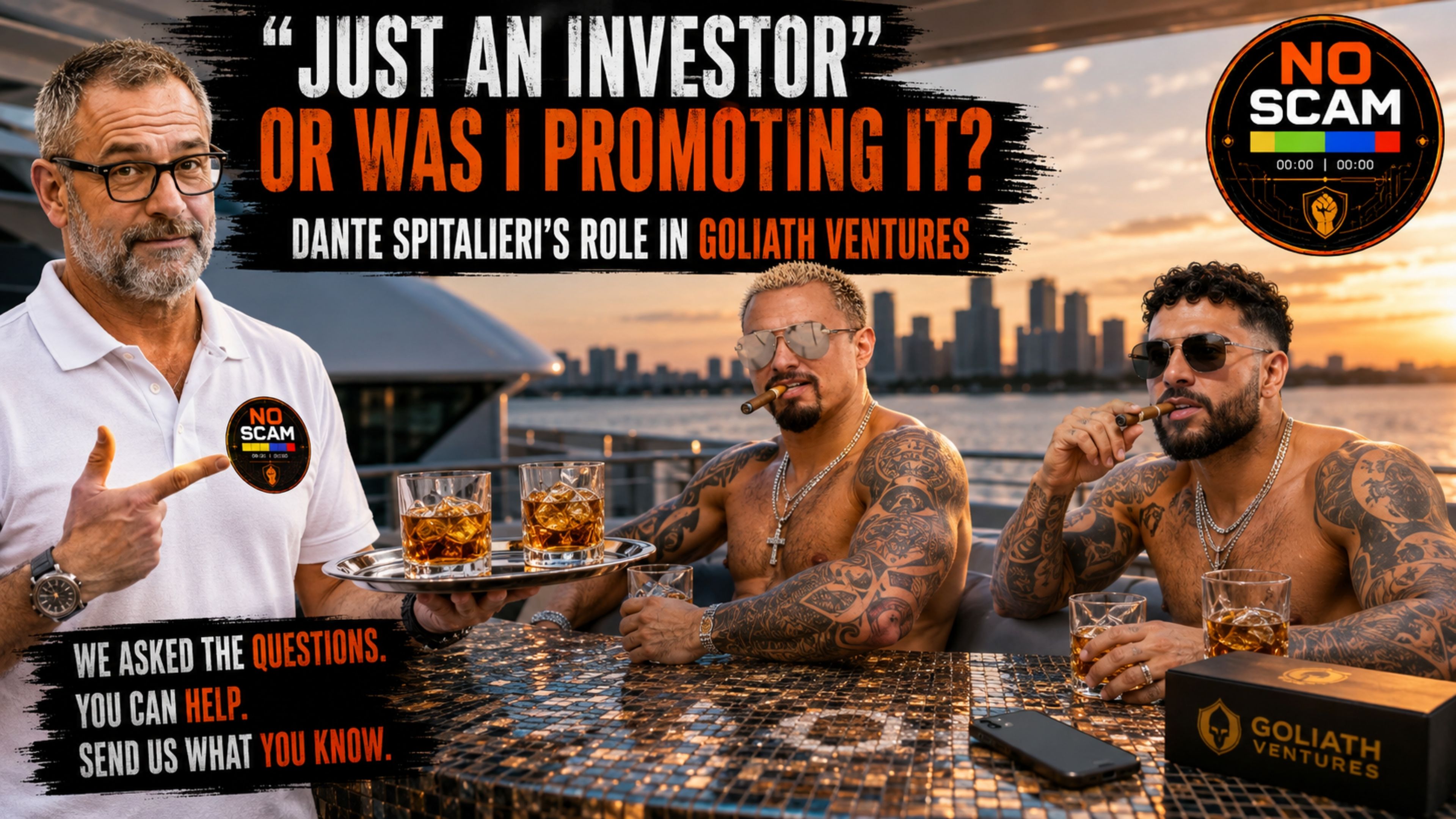
“As I would have no direct intel of any person who is actually an employee or investor… I was nothing more than an investor.”
— Dante Spitalieri
For months, one name kept surfacing throughout my investigation into GOLIATH VENTURES INC.
It wasn’t Christopher Delgado. It was Dante Spitalieri.
I first noticed him appearing alongside Delgado in photographs, luxury lifestyle posts, investor events and social media content that projected success, confidence and wealth. As I dug deeper into what prosecutors now allege was a cryptocurrency investment fraud involving hundreds of millions of dollars, his name continued to emerge in places I couldn’t ignore.
Then something else happened.
While publicly insisting he was “nothing more than an investor,” Dante began using social media to question the conduct of other people connected to GOLIATH. Watching those events unfold raised an obvious question:
Rather than investigating the allegations Dante was making about others, shouldn’t I first investigate Dante himself?
That decision led me down an unexpected path.
Over several weeks, I exchanged dozens of WhatsApp messages with Dante, giving him every opportunity to explain his role in his own words. At the same time, I reviewed bankruptcy filings, federal court records, corporate registrations, archived videos, social media posts and public documents that painted a far broader picture than our conversations alone.
This investigation is not about guilt by association. It is about following the evidence wherever it leads.
Who exactly is Dante Spitalieri? What role did he play in the rise of GOLIATH VENTURES? Why did the bankruptcy estate later subpoena his communications and financial records? And does the documentary evidence support his repeated claim that he was “nothing more than an investor”?
Who Is Dante Spitalieri?
 Before examining Dante Spitalieri’s own account, it’s important to explain why he attracted my attention in the first place.
During my investigation into GOLIATH VENTURES INC, I categorised people according to their observable role, not whether they had been charged with a crime or officially employed by the company. There were founders, employees, recruiters, public promoters, business associates and investors. As the investigation expanded, I also maintained a working list of individuals whose conduct warranted closer examination as potential co-conspirators. That list wasn’t a declaration of guilt. It was an investigative tool used to prioritise the people whose public conduct appeared to have contributed to GOLIATH’S credibility and growth.
Dante Spitalieri was one of those individuals.
His name surfaced repeatedly throughout my investigation. I found him standing beside Christopher Delgado in photographs, appearing at investor events, featuring in videos and maintaining an active social media presence that publicly endorsed both GOLIATH and the luxury lifestyle surrounding it. Based on the evidence available at the time, I believed those public associations justified a closer look.
As my investigation progressed, however, the picture became more nuanced.
Dante consistently maintained that he was “nothing more than an investor.” He denied being an employee, denied receiving commissions and denied actively recruiting people into GOLIATH. I also found no evidence that he appeared on the company’s official website as a representative or held any formal position within the business.
Rather than accepting either narrative at face value, I decided to do what I always do.
I followed the evidence.
Following The Evidence
 Rather than relying on rumours, anonymous tips or social media speculation, I contacted Dante directly and gave him every opportunity to explain his involvement in his own words.
Over several weeks, we exchanged dozens of WhatsApp messages covering his relationship with Christopher Delgado, his involvement with GOLIATH VENTURES and his public activity before and after the company’s collapse.
I wasn’t interested in creating sensational headlines.
I wanted answers.
Throughout every investigation, I ask the same questions.
What did you personally witness?
What can you prove?
What documents support your claims?
Those questions matter because, once an investment scheme collapses, hindsight often replaces firsthand knowledge. Rumours spread quickly, opinions harden and memories become influenced by everything that happened afterwards. My job is to separate documented fact from personal belief.
To Dante’s credit, he answered many of my questions and eventually acknowledged the limits of his own knowledge. He told me he had never been an employee of GOLIATH, had no access to the company’s internal records, ownership documents or investor lists, and possessed no insider knowledge of how the business was operated behind the scenes.
That admission changed the direction of my investigation.
Instead of asking what Dante knew about GOLIATH’S internal operations, I began asking a different question.
If he was “nothing more than an investor,” why did his name continue appearing alongside Christopher Delgado throughout my investigation, and why did the bankruptcy estate later seek access to his communications and financial records?
The Bankruptcy Estate Wanted Answers Too
As my investigation gathered momentum, I discovered something that reinforced why Dante had attracted my attention in the first place.
It wasn’t something I uncovered through social media.
It came from the United States Bankruptcy Court.
 On 25 June 2026, the Chapter 11 bankruptcy estate for GOLIATH VENTURES issued Dante Spitalieri with a Rule 2004 subpoena, requiring him to produce a broad range of documents relating to his dealings with the company. The production request covered communications with GOLIATH, communications with Christopher Delgado, cryptocurrency accounts, bank statements, brokerage accounts, financial records and documents relating to transfers of funds or digital assets involving GOLIATH or its affiliates. It also sought blockchain transaction records, wire transfers and supporting receipts.
That immediately caught my attention.
A Rule 2004 subpoena is one of the broadest investigative tools available in a United States bankruptcy proceeding. Its purpose is to help the bankruptcy estate identify assets, trace transactions and understand what happened before a company’s collapse.
The subpoena doesn’t accuse Dante of wrongdoing.
Nor does it establish liability.
What it does demonstrate is that the bankruptcy estate believed he possessed information or documents relevant to its investigation into GOLIATH VENTURES.
For me, that was significant.
It confirmed that I wasn’t the only person asking questions about Dante’s relationship with Christopher Delgado and GOLIATH. While I was independently examining his public conduct and interviewing him about his role, the bankruptcy estate was also seeking documentary evidence to better understand what had taken place behind the scenes.
A Criminal Conviction That Predates GOLIATH
As I continued researching Dante Spitalieri’s background, I uncovered a federal criminal case that predates his association with GOLIATH VENTURES by several years.
Court records from the United States District Court for the Middle District of Florida show that Dante pleaded guilty to Conspiracy to Distribute a Controlled Substance. The case was filed in March 2022 and proceeded through multiple hearings, including sentencing continuations, the filing of a sentencing memorandum, and several sealed court proceedings before a final sentence was imposed.
On 4 October 2022, the Court sentenced Dante to 10 months’ imprisonment, followed by four years of supervised release. The Court also imposed a mandatory special assessment, while waiving any fine.
The case attracted my attention not simply because a conviction existed, but because it formed part of a broader timeline that was largely absent from Dante’s public profile. When someone later becomes associated with a company at the centre of one of the largest crypto frauds in recent history, understanding their earlier history becomes an important part of the overall picture.
A criminal conviction does not prove involvement in unrelated conduct, and I make no such suggestion. However, it is part of the public record and, in my view, a relevant piece of background information when assessing credibility, public representations and subsequent business activities.
By the time GOLIATH VENTURES was attracting investors from around the world, Dante had already served a federal prison sentence and was subject to a lengthy period of supervised release. That chronology forms an important part of understanding the wider context surrounding his later association with Christopher Delgado and GOLIATH VENTURES.
The Name That Almost Hid The Record
While researching Dante’s background, I noticed something unusual.
Across different public records, his surname doesn’t always appear the same way.
Some records identify him as Dante Spitalieri, while others record his name as Dante Spitaleri, with one “I” missing. At first glance, that might seem like a minor typographical error. In practice, however, it can make a significant difference when searching court databases, prison records and other public sources.
That discrepancy became apparent while tracing Dante’s federal criminal case. Had I searched only one spelling of his surname, I could easily have missed important records that helped build a more complete picture of his background.
It also serves as a reminder that effective due diligence often requires searching multiple variations of a person’s name rather than relying on a single spelling. Small inconsistencies in public records can sometimes hide significant information in plain sight, making thorough investigative research all the more important.
Bella Resorts: Earlier Litigation Raises More Questions
As I continued researching Dante’s background, I discovered that GOLIATH VENTURES wasn’t the first time his name had appeared in public court records connected to a business dispute.
In a civil lawsuit filed in the Superior Court of New Jersey, Shelby Resorts LLC brought legal action against Bella Resorts LLC, naming both Dante Spitalieri and his mother, Carrie Spitalieri, as defendants.
According to the complaint, Shelby Resorts had entered into a business relationship with Bella Resorts to obtain access to Wyndham Vacation Ownership points that were used to book accommodation for customers. Shelby alleged that, after the relationship had been operating for some time, the defendants demanded US$100,000 and threatened to block Shelby’s access to Wyndham accounts if the payment was not made.
The lawsuit further alleged that, after Shelby refused to pay, Bella Resorts blocked access to those accounts and cancelled existing reservations, causing significant financial losses and forcing Shelby to find replacement accommodation for affected customers. The claims included breach of contract together with allegations that the defendants used their position to pressure Shelby during the commercial dispute.
These were allegations contained in civil court filings, and I make no finding as to whether they were ultimately proven. However, they form part of Dante’s Publicly Documented Litigation History.
Since then, my research has identified additional public court matters involving Dante, including civil litigation and criminal proceedings in Florida spanning a number of years. Those records show that Bella Resorts was not an isolated appearance in the public record but one of several legal matters involving Dante that are available through court filings.
Standing alone, a civil lawsuit proves very little. But when viewed alongside Dante’s federal criminal conviction for conspiracy to distribute a controlled substance, the Rule 2004 bankruptcy subpoena issued during the GOLIATH VENTURES proceedings, his continuing association with former GOLIATH promoter Mike Chmielewski, and his subsequent launch of Young Rich Trades, it becomes another documented chapter in a much larger story—one that I believe deserves careful examination.
A Pattern Worth Examining
One lawsuit doesn’t define a person.
Neither does one criminal conviction, one subpoena or one business venture.
Each event should be considered on its own merits.
However, one of the most important principles of investigative journalism is to examine the broader pattern, not simply isolated incidents.
As I assembled the timeline, I found myself looking at a series of documented events spanning more than a decade. There was the Bella Resorts litigation, followed by Dante’s federal criminal conviction, the Rule 2004 subpoena issued during the GOLIATH VENTURES bankruptcy proceedings, and then the launch of Young Rich Trades, where he now presents himself as someone capable of teaching others how to become consistently profitable in the financial markets.
None of those events, taken individually, prove misconduct in another matter.
Collectively, however, they provided sufficient reason for me to ask more questions, examine more documents and test more public claims against the available evidence.
That is why Dante Spitalieri became a person of interest in my GOLIATH VENTURES investigation.
Not because of a single allegation.
Not because of a single court case.
But because, when viewed as a whole, the public record revealed a sequence of events that I believed warranted closer scrutiny.
From GOLIATH to Trading Influencers?
One of the more surprising developments during this investigation has been seeing Dante Spitalieri re-emerge on social media alongside former GOLIATH promoter Mike Chmielewski.
Readers may remember Mike Chmielewski from earlier chapters of this investigation. Through documents and evidence supplied to investigators, I understand Mike was responsible for introducing more than US$35 million of investor funds into GOLIATH VENTURES. Those materials have already been provided to the relevant authorities.
Mike has not been charged with any offence, and I make no allegation that he has committed a crime. However, bankruptcy records show he was served with a Rule 2004 Subpoena requiring him to produce extensive financial records, communications, cryptocurrency accounts and documents relating to GOLIATH, Christopher Delgado and any transfers of funds between them.
Today, Mike appears to be living in Dubai, where he has reinvented himself as a day-trading educator. Through his social media accounts he encourages followers to join Telegram groups, download the “Mikey” application and learn trading strategies using The True Trade platform.
Dante now appears to be following a remarkably similar path.
On social media, Dante has publicly commented on Mike’s content, referring to himself as an investor while interacting with Mike’s trading promotions. The two continue to appear connected online despite everything that has unfolded surrounding GOLIATH.
That alone would not necessarily be remarkable.
What makes the situation noteworthy is the marketing style.
Luxury Lifestyle Marketing

Earlier this year I published evidence showing Mike using luxury vehicles in his social media content that appeared to be the same vehicles, with the same Dubai registration plates, used by another self-described crypto influencer during almost identical promotional photo shoots. The evidence included the same BMW motorcycle, the same Brabus G-Wagon, matching licence plates, identical locations and even photographs taken during trips together.
The obvious question is whether these vehicles actually belonged to either influencer or whether they were simply being used as props to project wealth. I cannot answer that question definitively, but the similarities were difficult to ignore.
That imagery becomes even more significant when viewed alongside what happened inside GOLIATH.
Christopher Delgado promoted an extraordinary luxury lifestyle built around supercars and exotic vehicles. Yet the bankruptcy records tell a very different story. The Lamborghini Revuelto and Rolls-Royce Ghost sold for a combined US$885,000, but after secured lenders exercised their legal rights, only about US$37,646 remained for the bankruptcy estate before storage, transport and other government costs were deducted. Three additional luxury vehicles produced no recoverable proceeds at all because the outstanding finance exceeded their value.
In other words, the luxury lifestyle that attracted investors generated remarkably little value once the financial reality was examined.
Now I find two people connected to that same ecosystem promoting themselves as successful traders while encouraging followers to join online trading communities.
Following The Money
There is another financial incentive worth mentioning.
 After creating my own account with The True Trade, I reviewed the platform’s affiliate dashboard and referral terms firsthand. Rather than paying a simple sign-up bonus, the platform rewards affiliates with a percentage of the trading fees generated by the people they introduce.
The program begins at a 20% commission and increases through several referral tiers, reaching as high as 35% once affiliates recruit enough active traders who collectively generate sufficient trading volume. According to The True Trade’s published terms, those commissions can continue for up to 365 days after a referred user registers.
To be clear, The True Trade does not pay commissions on trading profits or on customer deposits. The commissions are generated from the trading fees paid by referred users.
There is nothing inherently improper about an affiliate program like this. Many cryptocurrency exchanges and trading platforms operate similar referral systems.
However, it does create a clear financial incentive for influencers to encourage their followers not only to join the platform, but to remain active traders. Someone promoting Telegram groups, AI trading tools, trading education or daily market commentary can simultaneously earn ongoing referral commissions whenever their audience continues trading through their referral link.
Viewed individually, none of these facts proves wrongdoing.
Taken together, however, they illustrate a recurring pattern that readers should consider carefully: luxury lifestyle marketing, claims of trading expertise, affiliate incentives and aggressive online recruitment.
After everything that happened with GOLIATH VENTURES, I believe potential investors should approach these promotions with a healthy degree of skepticism.
A Different Story Emerged
When I first contacted Dante, I expected our conversations to either reinforce or challenge what I had already uncovered.
Instead, they did both.
Throughout our exchanges, Dante consistently maintained that he was “nothing more than an investor.” He denied being an employee of GOLIATH, denied receiving commissions and denied building a recruitment organisation beneath him. He explained that he publicly supported Christopher Delgado because he genuinely believed in the opportunity and wanted to share his own investment journey.
As our conversations continued, I found no evidence that Dante appeared on GOLIATH’S official website as a company representative or held a formal management position.
That distinction matters.
Promoting an investment opportunity and operating one are not necessarily the same thing.
Equally, someone doesn’t need an employment contract or official title to influence the decisions of others. Throughout my investigations into investment fraud, I’ve repeatedly found that public confidence is often built by the people standing around the founder just as much as by the founder himself.
Photographs.
Videos.
Investor events.
Luxury lifestyles.
Social media posts.
Individually, they may appear insignificant.
Collectively, they can create the impression that an opportunity has already been vetted by successful people, encouraging others to trust what they see before carrying out their own due diligence.
That became one of the central questions of this investigation.
Not whether Dante considered himself “just an investor,” but whether his public association with Christopher Delgado helped build trust in GOLIATH VENTURES while new investors were still deciding whether to hand over their money.
Young Rich Trades
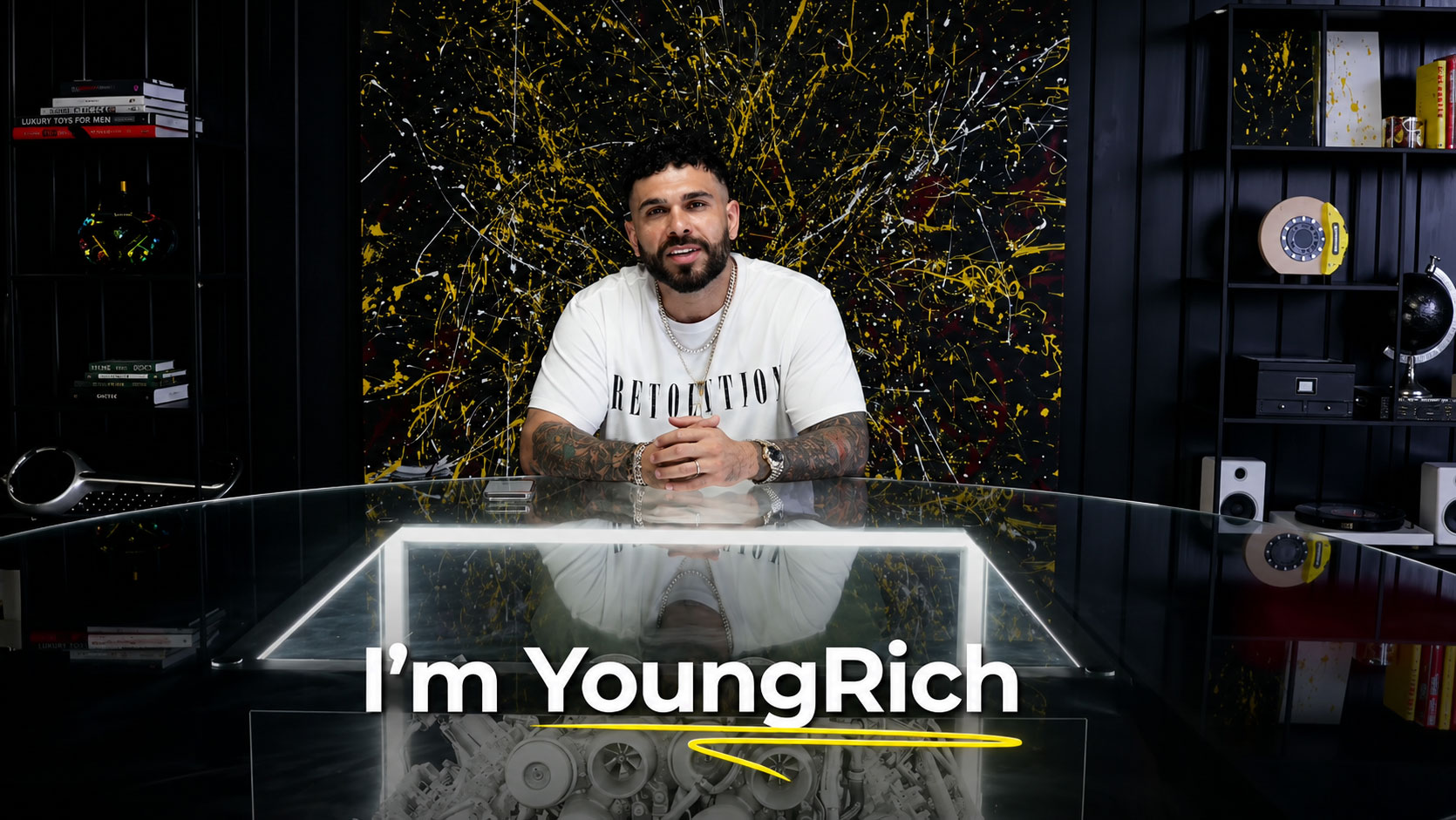
While I was still interviewing Dante, I discovered something I hadn’t been expecting.
He had quietly launched a new business called Young Rich Trades (YRT).
The business operates through two websites—yrftrades.com and youngrichtrades.com—which together form a complete sales funnel. One website invites prospective customers to apply for access, while the other functions as a members-only portal containing trading lessons, live sessions, trade journals, certificates and community features.
There is nothing inherently wrong with teaching people how to trade.
However, after spending years investigating cryptocurrency investment schemes, I’ve learned that the marketing surrounding financial education often deserves just as much scrutiny as the product itself.
Before reaching any conclusions, I examined both websites, reviewed the promotional material and compared the public sales messages with the legal documents, including the Terms of Service, Privacy Policy and Risk Disclaimer.
What immediately stood out wasn’t the course itself.
It was the contrast between the marketing and the fine print.
That was enough to justify taking a much closer look.
The Sales Pitch
The first thing I examine in any financial opportunity is what people are told before they hand over their money.
That is where expectations are created.
In Dante’s promotional video, viewers are introduced to what he describes as a “proven strategy” capable of turning $500 into $10,000 in less than ten minutes. He goes on to suggest that students can become profitable within weeks by following his blueprint.
Those are bold claims.
They also create a very specific expectation before a prospective customer has read a single legal disclaimer.
As I continued reviewing the Young Rich Trades websites, I noticed something interesting.
The current messaging is considerably more conservative than the earlier promotional material. The emphasis has shifted towards discipline, risk management, psychology, journalling and structured learning, while repeatedly warning that trading carries substantial risk, profits are never guaranteed and users can lose all of their invested capital.
On the surface, that’s a much more balanced message.
The obvious question, however, is which message best reflects what prospective customers are actually being sold today?
Throughout my investigations into investment schemes, I’ve seen this pattern before. A bold promise attracts attention, while the legal documents quietly explain that outcomes can never be guaranteed.
That doesn’t automatically mean anything improper is taking place.
It does, however, make the earlier marketing material an important part of the story.
Looking Beyond The Marketing
As I dug deeper, I found myself asking the same questions I ask whenever I investigate a new investment opportunity or financial education platform.
What is actually being sold?
How does the business make its money?
What happens after someone applies?
The public-facing websites are professionally presented, but they leave several important questions unanswered. There is no publicly advertised course price, no explanation of who the instructors are, and no clear identification of the legal entity operating the business.
The application process also caught my attention.
Before prospective students are told what the programme costs, they’re asked a series of qualifying questions about their goals, their availability and how much money they’re prepared to commit to their trading journey.
That information may simply be used to determine whether an applicant is suitable for the course.
It may also be used to shape the sales conversation that follows.
I don’t know which is the case here.
What I do know is that prospective customers are asked to disclose information about their financial capacity before they’re told what the product costs.
I also found repeated references to live trading sessions, verified certificates, trade journals and structured learning, yet very little publicly available information explaining who delivers the training, how the certificates are verified or whether members are eventually introduced to specific brokers, charting platforms, proprietary trading firms or affiliate programmes.
None of those observations prove wrongdoing.
They simply highlight areas where greater transparency would help prospective customers make a more informed decision before committing their time or money.
The Story Isn’t Over
Christopher Delgado has admitted his role in what prosecutors describe as one of the largest cryptocurrency frauds ever prosecuted in Central Florida. Thousands of investors have been left fighting through bankruptcy proceedings, while the courts continue tracing assets and untangling years of financial records.
But this investigation has never been solely about one man.
As I followed the evidence, I repeatedly encountered the same names, the same faces and, in many cases, the same marketing techniques. Some individuals have been subpoenaed. Others have appeared in civil litigation, bankruptcy proceedings or previous criminal cases. Several continue promoting themselves as successful entrepreneurs, traders or financial mentors despite their close association with a collapsed investment scheme that caused hundreds of millions of dollars in losses.
That does not mean everyone connected to GOLIATH committed a crime. Association alone is not proof of wrongdoing. However, when public records, court filings, corporate registrations, social media activity and financial evidence all begin pointing in the same direction, they deserve careful examination.
Throughout this investigation I have relied on public records, court documents, bankruptcy filings, corporate registrations and firsthand evidence supplied by victims and other sources. Where allegations remain unresolved, I have identified them as such. Where facts are supported by official documentation, I have presented the evidence for readers to examine themselves.
The question posed by this investigation remains the same as the title of this article:
Was Dante Spitalieri simply an investor, or did he play a broader role in helping build confidence and trust in GOLIATH VENTURES?
Only the ongoing investigations and future court proceedings may provide a definitive answer.
For now, the public record continues to grow, and so does the evidence available for anyone willing to examine it carefully. My investigation will continue following that evidence wherever it leads.
Where Does That Leave Dante Spitalieri?
When I first added Dante Spitalieri to my list of people of interest, I had no idea where the investigation would lead.
Months later, after reviewing court records, bankruptcy filings, corporate registrations, archived videos, social media activity and public statements, I have a much clearer picture of both Dante’s account and the documentary evidence surrounding him.
Based on the evidence currently available, I have found no evidence that Dante was an employee of GOLIATH VENTURES, held a formal executive position or controlled the company.
What I did find, however, was someone who publicly associated himself with Christopher Delgado, attended investor events, promoted GOLIATH on social media, appeared alongside key figures connected to the scheme and helped project an image of success while investors continued placing their trust—and their money—into the business.
The public record also reveals a broader picture. Dante has a previous federal felony conviction, later faced separate criminal charges in Florida, became the subject of a Rule 2004 bankruptcy subpoena seeking extensive financial records and communications relating to GOLIATH, and has now re-emerged online promoting trading-related content alongside former GOLIATH promoter Mike Chmielewski.
None of those facts, on their own, prove that Dante committed fraud in connection with GOLIATH. Equally, they cannot simply be ignored.
This investigation has never been about guilt by association. It has been about following the evidence, documenting what the public record shows and comparing public claims with verifiable facts.
Dante has consistently maintained that he was “only an investor.” Whether that description fully reflects his role is a question that readers, investigators and the courts will continue to examine as additional evidence emerges.
As always, if Dante provides new information or documentary evidence that materially changes the facts presented here, I will update this investigation accordingly.
The story of GOLIATH VENTURES is far from over, and I suspect this will not be the last chapter involving many of the people connected to it.
UPDATE: Dante Spitalieri’s Response After Publication
When I published this investigation, I expected Dante Spitalieri might disagree with my conclusions.
What I didn’t expect was what happened next.
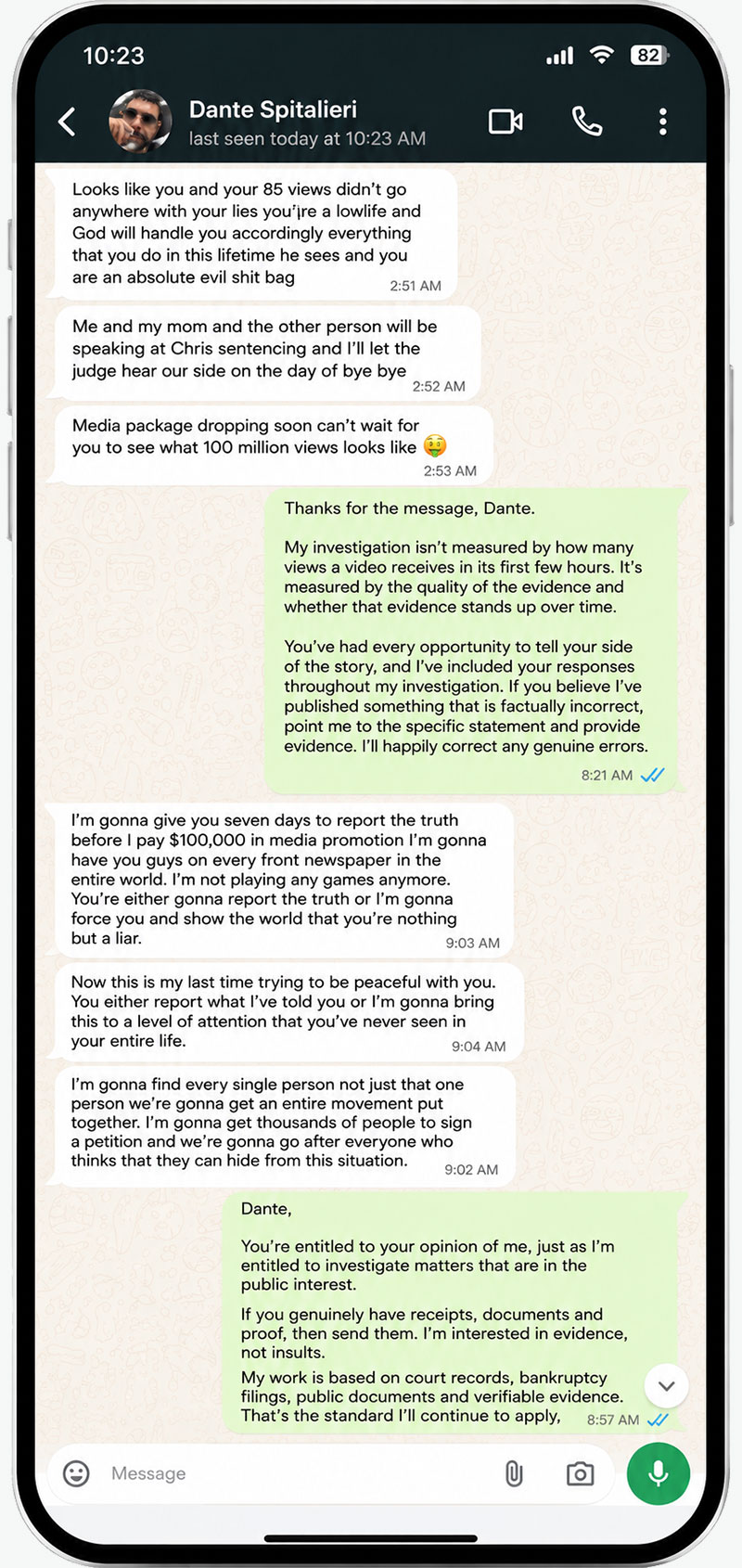
Rather than identifying factual inaccuracies, providing documents that contradicted the evidence, or answering the outstanding questions raised throughout this investigation, Dante began sending me a sustained series of WhatsApp messages over several hours.
Those messages have now become part of the investigation.
Instead of addressing the documentary record, Dante repeatedly accused me of being “paid” to target him, claimed I was deliberately hiding unnamed individuals, threatened to launch a public campaign to “discredit” me, claimed he would spend US$100,000 on media promotion against me, warned that I had “seven days” to change my reporting, and repeatedly stated that he would expose me if I did not publish his allegations.
He also wrote that he would:
- “bring this to a level of attention that you’ve never seen in your entire life”;
- make sure “the world will know”;
- recruit “thousands of people” against me;
- and “do everything in my power to discredit everything you’ve done from the beginning.”
Those are his words.
Not mine.
What struck me most was not the criticism.
Every investigative journalist expects criticism.
What concerned me was that almost none of his messages actually addressed the evidence presented in this investigation.
Throughout our conversations over many weeks, I repeatedly invited Dante to explain his involvement with GOLIATH VENTURES and to provide documents that contradicted the public record.
He had every opportunity to do so.
After publication, instead of providing verifiable evidence, the conversation became increasingly focused on personal attacks, intimidation and demands that I publish allegations about other individuals.
That is not how I conduct investigations.
If somebody tells me another person committed misconduct, I ask one simple question:
Where is the evidence?
Not screenshots taken out of context.
Not opinions.
Not rumours.
Not “trust me.”
Evidence.
Court records.
Financial records.
Corporate documents.
Bankruptcy filings.
Contracts.
Communications that can be independently verified.
If someone provides evidence that materially changes the facts, I will happily amend or even rewrite an investigation.
I have done so before, and I will do so again.
What I will not do is publish serious allegations simply because someone demands that I do so.
That would be irresponsible journalism.
Ironically, Dante repeatedly accused me of refusing to “tell the whole story.”
The reality is quite different.
I offered him a right of reply.
I spent weeks communicating with him.
His explanations are included throughout this investigation.
His perspective has been heard.
But a right of reply is not a right to dictate what gets published.
It is certainly not a right to pressure a journalist into repeating allegations that cannot be substantiated.
If Dante provides documentary evidence that materially changes any of the facts presented in this investigation, I will review it objectively and update this article accordingly.
Until then, this investigation will continue to be guided by the same principle it always has:
I don’t publish accusations.
I publish evidence.
Disclaimer: How This Investigation Was Conducted
This investigation relies entirely on OSINT — Open Source Intelligence — meaning every claim made here is based on publicly available records, archived web pages, corporate filings, domain data, social media activity, and open blockchain transactions. No private data, hacking, or unlawful access methods were used. OSINT is a powerful and ethical tool for exposing scams without violating privacy laws or overstepping legal boundaries.
About the Author
I’m DANNY DE HEK, a New Zealand–based YouTuber, investigative journalist, and OSINT researcher. I name and shame individuals promoting or marketing fraudulent schemes through my YOUTUBE CHANNEL. Every video I produce exposes the people behind scams, Ponzi schemes, and MLM frauds — holding them accountable in public.
My PODCAST is an extension of that work. It’s distributed across 18 major platforms — including Apple Podcasts, Spotify, Amazon Music, YouTube, and iHeartRadio — so when scammers try to hide, my content follows them everywhere. If you prefer listening to my investigations instead of watching, you’ll find them on every major podcast service.
You can WORK WITH ME for dedicated access to my time and investigative services — including private consultations, scam-risk reviews, sponsored investigations, support sessions, livestream scam breakdowns, and interviews. I’m also available for SPEAKING ENGAGEMENTS, where I share first-hand experience from years of exposing large-scale fraud, investigating scams, and supporting victims.
“Stop losing your future to financial parasites. Subscribe. Expose. Protect.”
My work exposing crypto fraud has been featured in:
- Coffeezilla 2026): Featured in the investigation exposing the $328M Goliath Ventures Ponzi scheme
- Bloomberg Documentary (2025): A 20-minute exposé on Ponzi schemes and crypto card fraud
- News.com.au (2025): Profiled as one of the leading scam-busters in Australasia
- OpIndia (2025): Cited for uncovering Pakistani software houses linked to drug trafficking, visa scams, and global financial fraud
- The Press / Stuff.co.nz (2023): Successfully defeated $3.85M gag lawsuit; court ruled it was a vexatious attempt to silence whistleblowing
- The Guardian Australia (2023): National warning on crypto MLMs affecting Aussie families
- ABC News Australia (2023): Investigation into Blockchain Global and its collapse
- The New York Times (2022): A full two-page feature on dismantling HyperVerse and its global network
- Radio New Zealand (2022): “The Kiwi YouTuber Taking Down Crypto Scammers From His Christchurch Home”
- Otago Daily Times (2022): A profile on my investigative work and the impact of crypto fraud in New Zealand




Leave A Comment