


“Scams don’t begin with victims losing money. They begin with extraordinary promises that nobody stops to question.”
Every investigation has to start somewhere. Sometimes there are thousands of victims, court documents, regulatory warnings and criminal charges waiting to be examined.
Other times, there is almost nothing beyond a website, a Telegram channel, a few promotional videos and social media graphics filled with ambitious promises.
That is exactly where ONET Global currently sits.
Over the past few days, I have begun documenting the company after members of my community brought it to my attention. At the time of writing, there is very little independent information available online. I have not located media investigations, regulatory warnings, court proceedings or any meaningful historical record explaining who is behind the company or how its business operates.
That does not automatically make ONET Global legitimate, and it does not prove it is a scam. It simply means the investigation is still in its earliest stages. When reliable information is limited, the responsible approach is to document what can be verified, separate evidence from marketing and ask the questions every potential participant should consider before risking their money.
First Impressions Raise Immediate Questions
The first thing that struck me when I began looking at ONET Global was just how polished everything appeared. Professionally designed graphics, AI-generated presenters, futuristic animations and repeated promises of financial freedom all combine to create the impression of an established global business preparing for a major launch. At first glance, it certainly looks impressive.
Unfortunately, I’ve seen this pattern many times before.
Some of the largest investment scams I’ve investigated have invested heavily in creating a professional image. They produced high-quality videos, glossy presentations and convincing marketing campaigns that inspired confidence, yet when I started digging beneath the surface, there was very little evidence of a genuine underlying business. That’s why I’ve learned never to judge an opportunity by its branding alone.
There’s nothing wrong with professional marketing. Legitimate businesses use it every day. The problem arises when polished advertising becomes the primary evidence people rely on when deciding whether to invest. Attractive graphics and slick videos can create trust, but they don’t prove a company is transparent, financially sound or capable of delivering the returns being advertised.
As I worked through ONET Global’s promotional material, I kept coming back to the same question. Can the claims behind the marketing be independently verified? That’s the question this investigation aims to answer.
The Telegram Channel Is Heavy On Marketing
As part of my investigation I located an official-looking Telegram channel operating under the name “ONET Global Team India”, using the handle @onetglobalteam. At the time I viewed it, the associated community displayed 247 members, with 14 members online. The branding matched the promotional material found elsewhere online and repeatedly referenced the company’s planned launch on 1 August 2026.
The posts themselves are almost entirely promotional. One announcement, which appears to have been shared multiple times, states:
“One Platform. Unlimited Possibilities.”
It goes on to advertise:
- Smart E-Commerce
- Global Business Network
- Secure & Transparent Platform
- Endless Growth Opportunities
before encouraging readers to join ahead of the advertised activation date.
What I didn’t find was equally interesting.
There were no detailed explanations describing how the business generates revenue, no independent evidence supporting the advertised income opportunities and no technical information explaining what makes the platform unique. Instead, the channel currently functions as a marketing broadcast designed to build excitement before launch.
The repeated use of broad phrases like “Unlimited Possibilities”, “Global Business Network” and “Endless Growth Opportunities” sounds attractive, but they are slogans rather than evidence. As the project develops, this Telegram channel may become one of the most valuable sources of information about how ONET Global is promoted and whether the messaging changes over time.
A Website With Almost No History
Whenever I begin investigating a company, one of the first places I look isn’t the marketing material—it’s the company’s digital footprint. Most legitimate businesses gradually build an online history over time. Their websites evolve, new pages are added, old content is updated, press releases are published, and independent reviews or media articles begin to appear. Even if a business is relatively new, there is usually some evidence showing how it has developed from one point in time to the next.
That simply wasn’t the case with ONET Global.
One of my first stops was the Wayback Machine, an online archive that regularly captures snapshots of websites so researchers can see how they have changed over time. It’s an invaluable tool during investigations because it often reveals previous claims, deleted pages, abandoned products or changes in marketing that companies would rather people forgot. In ONET Global’s case, however, there was nothing to review. At the time of my investigation, the Wayback Machine had no archived copies of the website, leaving no historical record of how the site had evolved or whether its messaging had changed since it first appeared online.
I also searched for independent information beyond the company’s own promotional material. Once again, the results were surprisingly limited. Aside from ONET Global’s own marketing, Telegram announcements and promotional graphics, there was very little evidence documenting the company’s history, ownership or business activities. That absence doesn’t prove misconduct—every company has to start somewhere—but it does mean prospective members are being asked to place their trust in a business that currently has very little independently verifiable history. As an investigator, that lack of transparency doesn’t allow me to reach conclusions, but it certainly gives me another reason to keep asking questions as more information becomes available.
The Marketing Makes Extraordinary Income Claims
One of the first things I examine during any investigation is what the company is actually promising. Marketing material often provides valuable insight into how an opportunity is being presented to prospective members and what expectations are being created before anyone decides to join.
ONET Global’s promotional graphics contain a number of ambitious financial claims, including:
- Daily Promote Income: 0.50% to 2% daily
- Power Booster Income: 1% to 3%
- 5% Invitation Bonus
- Generation Income across up to 20 levels
- Team Momentum Bonus
- Winza Income of US$5 to US$20,000 daily
- A US$10,000 Capital Protection Fund
- Fast or Instant Withdrawals
- Claims of being Trusted By Thousands
- References to an AI Powered Smart Platform
These promotional graphics form an important part of the evidence because they show exactly how the opportunity is being marketed. At this stage of my investigation, I am simply documenting the claims being made. Whether those claims can be independently verified, achieved in practice or supported by a sustainable business model is an entirely separate question—one that deserves careful scrutiny before anyone considers investing.
When The Mathematics Doesn’t Add Up
One of the most useful things about investigating investment opportunities is that the mathematics cannot be distracted by branding, polished videos or promises of financial freedom. A return of 1% per day may sound modest when it is presented in a colourful promotional graphic, but once that figure is carried across weeks and months, the scale of the claim becomes much clearer. Even without compounding, 1% per day amounts to approximately 365% over a year, meaning the original investment would need to generate more than three times its value in profit within twelve months.
The figures become even more dramatic when daily compounding is taken into account. If someone started with US$1,000 and genuinely earned 1% every day, with each day’s return added back into the balance, the amount would theoretically grow to approximately US$37,800 after one year. At the upper end of ONET Global’s advertised range, a return of 2% compounded daily would turn that same US$1,000 into more than US$1.3 million within twelve months. The small percentage shown in the marketing may look harmless, but the long-term mathematical result is extraordinary.
These calculations are not based on assumptions I have created to make the opportunity appear worse than it is. They are simply the natural result of applying ONET Global’s own advertised percentages over time. Any business claiming it can produce returns at that level should be able to provide a clear, independently verifiable explanation of the revenue source, the risks involved and the mechanism that supposedly makes those payments sustainable. Until that evidence is produced, the most important question remains unanswered: where is the money actually coming from?
Where Is The Underlying Business?
One of the most important questions I ask during any investigation is also one of the simplest: where does the money actually come from? Every legitimate investment has an identifiable economic engine that can be examined and understood. Property funds generate income from real estate. Retail businesses sell products to customers. Manufacturers produce goods. Licensed investment firms explain their strategies, publish audited financial information and operate within established regulatory frameworks. Even if an investment carries significant risk, there should still be a logical and transparent explanation of how profits are generated.
As I worked through ONET Global’s website, promotional graphics and Telegram posts, I looked for that explanation. Instead, I found repeated references to AI, Smart Technology, Smart Automation, Global Opportunities, Unlimited Possibilities and Financial Freedom. These are attractive marketing terms that create excitement and optimism, but they don’t explain what the company actually does to generate the income it claims can be distributed to members. Marketing language may help sell an opportunity, but it is not a substitute for a genuine business model.
At this stage of the investigation, I have not located independently verifiable evidence explaining how ONET Global intends to consistently produce the daily returns advertised in its promotional material. That doesn’t mean such an explanation doesn’t exist—it simply hasn’t been made available through the public information I’ve reviewed so far. Until the company provides clear evidence showing where its revenue comes from, how profits are generated and why those returns should be considered sustainable, those questions remain unanswered. For anyone considering joining, understanding the underlying business should be far more important than believing the promises printed on the marketing material.
Recruitment Appears To Be Central To The Opportunity
As I worked through ONET Global’s promotional material, another pattern quickly began to emerge. While the marketing talks extensively about technology, innovation and financial growth, a significant portion of the advertised income appears to revolve around bringing other people into the business. The graphics promote Invitation Bonuses, Generation Income across multiple levels, Team Momentum Bonuses and rewards for building an expanding network. Those features are presented alongside the daily income claims, suggesting that recruitment plays an important role in the overall compensation structure.
On their own, referral commissions are not unusual. Many legitimate businesses reward customers for introducing new clients. What matters is where the majority of the money comes from. If a business earns its revenue by selling genuine products or services to retail customers, referral commissions are simply one part of the marketing strategy. However, if participants are primarily rewarded for recruiting new members who also pay to join, the business begins to resemble a very different type of model. That distinction is one of the first things I look for whenever I investigate MLMs, cryptocurrency platforms and investment opportunities.
At this stage, I haven’t seen enough publicly available information to determine exactly how ONET Global’s compensation plan operates or whether retail sales play a meaningful role in the business. That is why I believe it is far too early to draw definitive conclusions. However, the strong emphasis on recruitment incentives means this will remain one of the key areas I’ll continue investigating as the platform launches. Understanding who is paying whom, why they are being paid, and where that money originates will ultimately tell us far more about the business than any promotional video or glossy marketing brochure ever could.
The Curious Case Of The Disappearing Logo
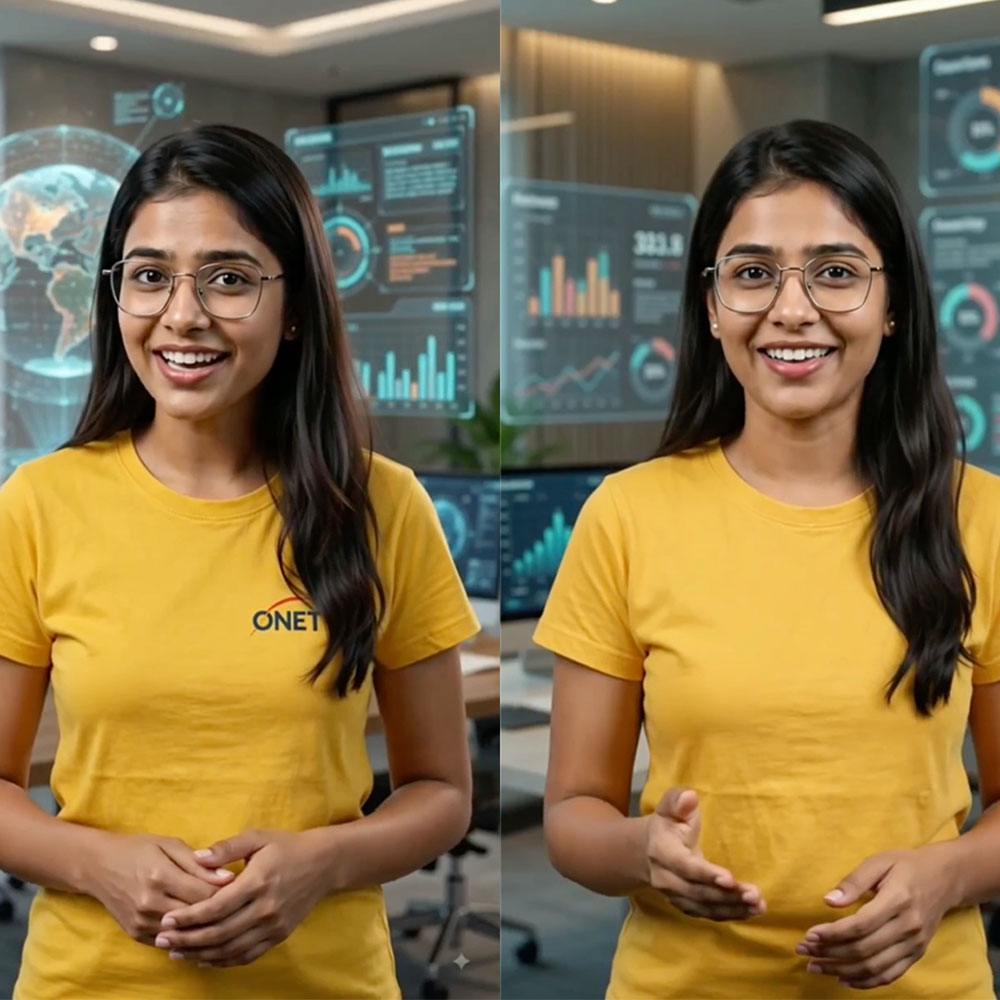
One of the more unusual discoveries during my investigation didn’t come from analysing financial claims or company records. It came from watching one of ONET Global’s promotional videos frame by frame. At first glance, the video appears professionally produced, featuring a smiling presenter wearing a bright yellow ONET-branded T-shirt while promoting the opportunity. However, part way through the animation something unexpected happens. The ONET logo on her shirt simply disappears, only to reappear again later in the video.
On its own, this might seem like nothing more than a humorous production mistake, but it immediately caught my attention because it’s a tell-tale sign of modern AI-generated video technology. Artificial intelligence has advanced rapidly and can now create convincing presenters without the need for cameras, actors or production crews. The trade-off is that AI still struggles with consistency between frames. Logos can vanish, clothing can subtly change, jewellery appears and disappears, hands become distorted and objects unexpectedly shift position. Once you’ve seen these artefacts a few times, they become surprisingly easy to recognise.
I want to be clear about what this observation does and does not prove. The disappearing logo does not demonstrate that ONET Global is operating fraudulently. Many legitimate businesses are beginning to experiment with AI-generated marketing because it is faster and cheaper than traditional video production. What it does demonstrate is that professional-looking promotional material should never be mistaken for evidence that a business itself is credible. Scammers have access to the same AI tools as legitimate companies, making it easier than ever to create polished marketing that appears convincing at first glance.
In many of my previous investigations, I’ve found that people often equate production quality with legitimacy. They assume that because a company has impressive videos, attractive presenters and expensive-looking graphics, it must be well established. That’s no longer a safe assumption. Today’s AI tools can produce highly convincing marketing in a matter of hours, even for businesses with little or no operating history. The disappearing logo may only be a small visual glitch, but it serves as a timely reminder that appearances should never replace evidence when evaluating an investment opportunity.
The Claimed US$10,000 Capital Protection Fund
One claim that immediately stood out during my review of ONET Global’s promotional material was the repeated reference to a US$10,000 Capital Protection Fund. On the surface, it sounds reassuring. After all, who wouldn’t feel more comfortable joining an opportunity that claims to protect their investment? It’s exactly the kind of statement that can help build confidence among prospective members, particularly those who may already have concerns about the risks involved.
As I looked more closely, however, I found that the marketing raises far more questions than it answers. Promotional graphics mention the existence of the fund, but I have not yet found publicly available documentation explaining who provides the money, who administers the fund, what legal entity is responsible for honouring claims, or under what circumstances participants would actually qualify for compensation. I also haven’t located any independent evidence showing whether the fund is insured, audited or supported by a third-party financial institution.
These are not minor details. If a company advertises a capital protection fund as part of its marketing, potential participants should be able to examine the terms and understand exactly how that protection works before making a financial commitment. Without that transparency, it becomes difficult to determine whether the fund represents a genuine financial safeguard or simply an attractive marketing feature designed to reduce perceived risk.
At this stage of my investigation, I am not suggesting the claim is false. I am simply pointing out that I have been unable to independently verify it using the information currently available. Until ONET Global publishes detailed documentation explaining how the US$10,000 Capital Protection Fund operates and provides evidence that it genuinely exists, readers should treat it as an unverified promotional claim rather than an independently substantiated guarantee. In my experience, extraordinary assurances deserve the same level of scrutiny as extraordinary investment returns. Both should be supported by evidence, not simply repeated in advertising.
Transparency Still Appears Limited
As I reached the end of this first phase of the investigation, one theme kept resurfacing. There is no shortage of marketing, but there is a shortage of independently verifiable information. Almost everything I’ve been able to review so far originates from ONET Global itself or from people promoting the opportunity. That’s an important distinction because good due diligence relies on evidence that can be independently checked, not simply repeated by those with an interest in attracting new participants.
I have spent time examining the website, reviewing the promotional graphics, watching the videos and monitoring the Telegram channel, looking for information that would help explain who is behind the company and how the business operates. So far, I have not located audited financial statements, independently verified performance records, detailed ownership information, regulatory registrations covering the advertised investment activities, or documentation capable of substantiating the ambitious daily income claims appearing throughout the marketing material. That doesn’t mean those documents don’t exist, but if a company expects people to trust it with their money, I believe that information should be readily available rather than hidden behind promotional slogans.
It is also worth remembering that this investigation is taking place before the official launch. The company may publish additional information in the coming weeks, and if it does, I’ll review it with the same level of scrutiny I’ve applied to everything else. Good investigations are not about reaching conclusions as quickly as possible—they are about following the evidence wherever it leads.
At this stage, I am not suggesting that ONET Global has committed fraud or that it is operating unlawfully. What I am saying is that the level of transparency currently falls well short of the level of marketing. Until independently verifiable evidence is produced explaining the ownership, business model, source of revenue and justification for the advertised returns, I believe anyone considering joining should proceed with caution. In my experience, genuine businesses have nothing to lose by being transparent, whereas questionable opportunities often rely on excitement, urgency and unanswered questions to drive momentum.
This Investigation Is Only Beginning
Unlike many of my investigations, this story doesn’t currently end with arrests, court cases or regulatory enforcement.
Instead, it begins with a company making ambitious promises while leaving many important questions unanswered.
This investigation will continue as more information becomes available.
If ONET Global genuinely has a sustainable business capable of producing the returns it advertises, the evidence should emerge. If the advertised capital protection fund is genuine, there should be documentation explaining exactly how it operates. If the company is driven by legitimate commercial activity rather than recruitment, that should also become increasingly clear over time.
For now, I believe the responsible approach is to document what can be independently verified, challenge the claims being made and encourage people to ask difficult questions before investing.
If you’ve attended an ONET Global Zoom presentation, joined the Telegram community, invested funds, successfully withdrawn money, or have access to internal presentations, compensation plans or other documentation, I’d be very interested in reviewing it.
As always, my goal isn’t to attack legitimate businesses. My goal is to follow the evidence wherever it leads, document what I find and help people make informed decisions before they risk their hard-earned money.
This keeps your original message intact but reads a little smoother and ends on a strong line.
Disclaimer: How This Investigation Was Conducted
This investigation relies entirely on OSINT — Open Source Intelligence — meaning every claim made here is based on publicly available records, archived web pages, corporate filings, domain data, social media activity, and open blockchain transactions. No private data, hacking, or unlawful access methods were used. OSINT is a powerful and ethical tool for exposing scams without violating privacy laws or overstepping legal boundaries.
About the Author
I’m DANNY DE HEK, a New Zealand–based YouTuber, investigative journalist, and OSINT researcher. I name and shame individuals promoting or marketing fraudulent schemes through my YOUTUBE CHANNEL. Every video I produce exposes the people behind scams, Ponzi schemes, and MLM frauds — holding them accountable in public.
My PODCAST is an extension of that work. It’s distributed across 18 major platforms — including Apple Podcasts, Spotify, Amazon Music, YouTube, and iHeartRadio — so when scammers try to hide, my content follows them everywhere. If you prefer listening to my investigations instead of watching, you’ll find them on every major podcast service.
You can WORK WITH ME for dedicated access to my time and investigative services — including private consultations, scam-risk reviews, sponsored investigations, support sessions, livestream scam breakdowns, and interviews. I’m also available for SPEAKING ENGAGEMENTS, where I share first-hand experience from years of exposing large-scale fraud, investigating scams, and supporting victims.
“Stop losing your future to financial parasites. Subscribe. Expose. Protect.”
My work exposing crypto fraud has been featured in:
- Coffeezilla 2026): Featured in the investigation exposing the alleged $328M Goliath Ventures Ponzi scheme
- Bloomberg Documentary (2025): A 20-minute exposé on Ponzi schemes and crypto card fraud
- News.com.au (2025): Profiled as one of the leading scam-busters in Australasia
- OpIndia (2025): Cited for uncovering Pakistani software houses linked to drug trafficking, visa scams, and global financial fraud
- The Press / Stuff.co.nz (2023): Successfully defeated $3.85M gag lawsuit; court ruled it was a vexatious attempt to silence whistleblowing
- The Guardian Australia (2023): National warning on crypto MLMs affecting Aussie families
- ABC News Australia (2023): Investigation into Blockchain Global and its collapse
- The New York Times (2022): A full two-page feature on dismantling HyperVerse and its global network
- Radio New Zealand (2022): “The Kiwi YouTuber Taking Down Crypto Scammers From His Christchurch Home”
- Otago Daily Times (2022): A profile on my investigative work and the impact of crypto fraud in New Zealand



Leave A Comment