


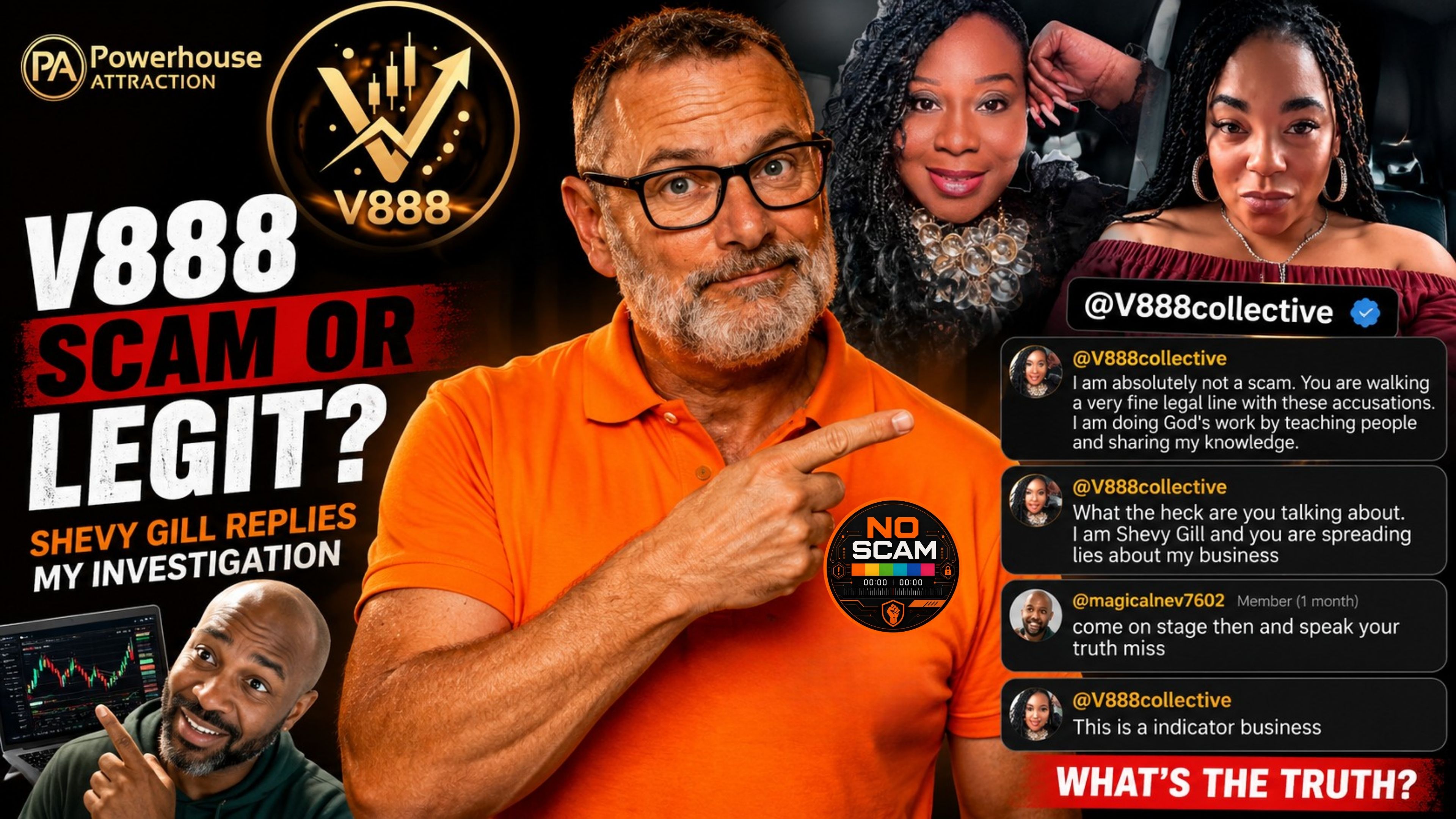
“Trust isn’t earned by having an affiliate link. It’s earned by doing the research before asking other people to spend their money.”
I didn’t set out to investigate another trading platform. This investigation began after several members of my community sent me a YouTube video from Earl “Batman” Stringer, documenting what he described as his journey to becoming a successful day trader.
On the surface, it looked like another creator sharing his experiences and recommending the tools he was using. But the moment I clicked the link beneath his video, I realised I wasn’t being taken to the official V888 website. Instead, I landed inside a personalised sales funnel promoting recurring monthly subscriptions through Earl’s own affiliate link. That was the moment I stopped watching as a viewer and started investigating as a journalist.
I’ve spent years exposing cryptocurrency scams, Ponzi schemes, MLM opportunities and misleading investment promotions. One lesson I’ve learned is that you don’t always have to find criminal activity to uncover an important story. Sometimes the real story is how products are marketed, how affiliates earn commissions and whether enough due diligence has been carried out before asking others to trust them with their money. That became the focus of this investigation. Rather than starting with assumptions, I followed the evidence wherever it led.
Over the course of my research, I reviewed the V888 website, analysed its source code, traced the sales funnel, examined the checkout process, joined the members’ area, compared the marketing claims with the legal disclosures and documented how new customers are encouraged to move from free educational tools into paid subscriptions. I also looked at the business behind the product, the people publicly associated with it and the language used to promote what is described as a proprietary algorithmic trading system. At every stage I asked the same question: does the evidence support the marketing?
This article is not about telling you what to buy or what to avoid. It’s about documenting what I found, highlighting the questions I believe every prospective customer should ask and showing you exactly how I reached those observations. Whether you’re considering subscribing to V888, following a YouTube affiliate recommendation or evaluating any other trading software, my hope is that this investigation helps you make a more informed decision before committing to a recurring monthly fee or sharing your personal information.
How A Simple YouTube Recommendation Became An Investigation
Like many of my investigations, this one didn’t begin with a victim contacting me after losing money. It started with a recommendation. Earl “Batman” Stringer published a video titled “Day Trading Made EASY?“, where he shared his progress learning to trade the financial markets. Throughout the video, Earl was upfront about being a beginner, explaining that he was still practising with a demo account rather than risking real money. There is nothing wrong with that. Every experienced trader started somewhere. What caught my attention wasn’t his willingness to learn—it was the personalised affiliate link sitting beneath the video, inviting viewers to follow the same path he had taken.
Curious to see where that link led, I clicked it expecting to arrive at the official V888 website. Instead, I landed on a personalised sales page built around Earl himself. His video was embedded at the top, visitors were encouraged to join him on his journey to becoming a successful day trader, and two subscription options were prominently displayed: one for US$44.44 per month and another for US$88.88 per month, with the more expensive tier including what was described as the V888 PowerHouse Auto-Bot. Near the bottom of the page, in much smaller text, was an affiliate disclosure confirming that Earl may receive a commission if visitors purchased through his referral link.
At that point, the investigation stopped being about a TradingView indicator and became something much broader. I wanted to understand the entire ecosystem surrounding V888. Who created the software? What exactly were subscribers paying for? Were the marketing claims consistent with the legal disclosures? What information were customers required to provide before gaining access? Most importantly, how much due diligence had been carried out before affiliates began encouraging their audiences to sign up? Those questions became the roadmap for everything that followed.
Following The Affiliate Trail
The more I investigated, the clearer it became that the V888 website wasn’t simply advertising trading software—it had been built to move visitors through a carefully structured sales journey. The public-facing website introduces visitors to the PowerHouse Attraction V888 System with bold claims about institutional market structure, predictive analysis and algorithmic trading tools. From there, prospective customers are encouraged to explore a free Traders Hub containing risk calculators, trade journals and position-sizing tools before eventually reaching the same destination: a paid monthly subscription.
I want to be fair here because there is nothing inherently wrong with offering free educational resources. In fact, some of the calculators encourage sensible trading habits such as managing risk, calculating position size and avoiding emotional decision-making. Those are concepts every trader should understand. However, the free tools also serve another purpose—they build confidence in the V888 ecosystem before directing users towards paid memberships. As an investigator, I always pay close attention to where a customer journey begins, where it ends and what information is presented along the way.
Following Earl’s affiliate link demonstrated exactly how that journey works. Rather than taking visitors directly to a checkout page, the funnel is personalised with Earl’s own branding and YouTube video. It presents him as someone successfully progressing through his trading journey while inviting viewers to do the same by subscribing through his referral link. The page even encourages visitors to return to that specific link when they’re ready to purchase, helping ensure the referral remains attached to Earl’s account. That immediately establishes something readers deserve to know: the person recommending the product has a financial interest in people signing up.
There is nothing improper about affiliate marketing when it is transparent and accompanied by genuine due diligence. The concern arises when enthusiasm begins to replace independent research. Before recommending any financial product, software subscription or investment-related service, I believe affiliates should be able to answer basic questions about the company they’re promoting, the risks involved, the customer protections available and the evidence supporting the claims being made. Those were the questions I set out to answer as I continued digging into V888.
What Is Really Selling
When I first landed on the V888 website, I assumed I was looking at another TradingView indicator. After spending hours reviewing the public website, joining the private Facebook community, examining the onboarding material and following the marketing trail, I came to a different conclusion. V888 isn’t presented as a single charting tool. It’s marketed as an entire trading ecosystem. Subscribers are encouraged to believe they’re joining a community that combines proprietary indicators, AI-powered automation, live trade rooms, educational challenges, onboarding sessions, trading psychology, risk calculators and a recurring stream of market analysis. That distinction matters because prospective customers aren’t simply paying for software—they’re buying into the promise of a complete trading experience.
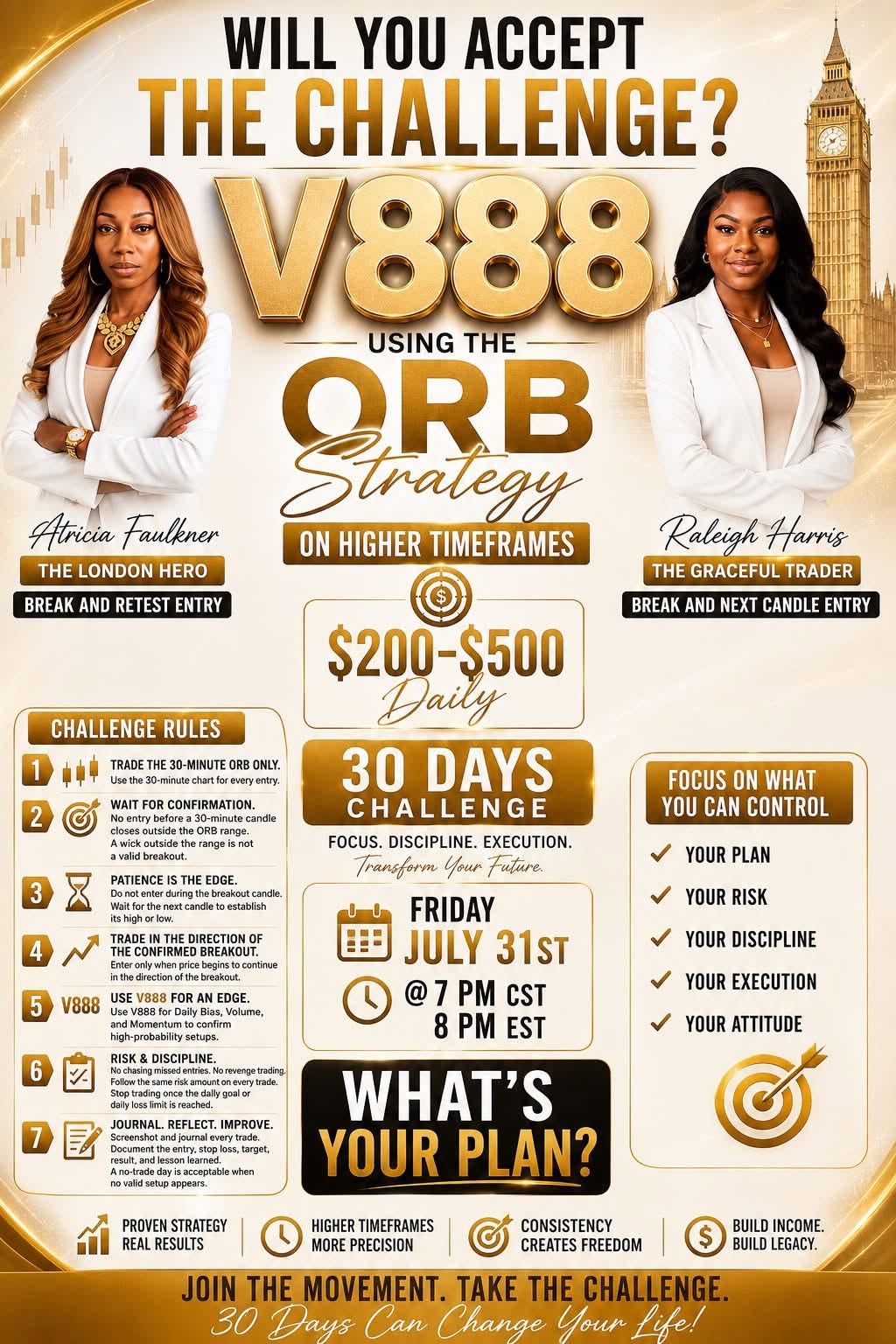
The marketing material reinforces that message repeatedly. Members are introduced to a “PowerHouse Trade Companion,” an “AI Powered Automatic Day Trading Bot,” a “Sniper Bot System,” live Zoom trade rooms, beginner Q&A sessions and structured trading challenges. Promotional graphics describe an “Original Money Maker” bot with the “highest potential,” while other materials invite members to join a 30-Day Challenge promoting a disciplined approach that references potential daily trading goals of US$200 to US$500. Additional graphics describe “A+ Buy” and “A+ Sell” setups as high-probability entries, encouraging traders to “trade with confidence” by following the system’s signals.
Individually, none of these marketing pieces proves the software is effective or ineffective. However, taken together they paint a very deliberate picture. The emphasis is no longer just on chart analysis; it is on creating the impression that V888 provides an institutional-level edge through proprietary technology, structured education and automated decision support. As an investigator, I wasn’t interested in whether the graphics looked impressive. I wanted to know what evidence exists to support those marketing claims, whether those claims are independently verifiable and how they compare with the legal disclaimers customers agree to before handing over their credit card details. That comparison became one of the most important parts of my investigation.
Who Is Behind The V888 Brand?

As I continued documenting the V888 ecosystem, two names appeared repeatedly across the website, Facebook community, Zoom promotions and YouTube content: Shervernon “Shevy” Gill and Angela Williams. Unlike Earl “Batman” Stringer, who appears to be promoting the platform as an affiliate, these two individuals present themselves as the people responsible for developing, operating and growing the V888 brand.
According to the V888 website and public profiles, Shervernon Gill describes himself as the Founder & Lead Developer of the PowerHouse Attraction V888 System. His public TradingView biography states that he specialises in Pine Script automation and institutional market structure, while his LinkedIn profile describes V888 as “more than an indicator” and instead positions it as a teaching machine designed to provide institutional clarity through automation. Throughout my investigation I found Gill’s name attached to the software itself, the trading indicators, the educational material and the overall technical direction of the platform.

The second prominent figure is Angela Williams, who appears throughout the V888 marketing as a presenter, educator and strategic consultant. She features extensively in promotional graphics advertising live Zoom sessions, onboarding events, New York Opening Bell trade rooms and trading challenges. Her own YouTube channel describes her as a Certified Professional Life Coach, Day Trading Mentor and Tax Strategist, while promoting trading education across forex, futures, cryptocurrencies and stock options. Long before V888, however, Williams built much of her online presence around myEcon, a multi-level marketing company focused on financial education, tax strategies and business opportunities. Her YouTube archive contains years of webinars, business presentations and recruitment-focused content relating to myEcon, demonstrating a long history of working within the financial education and network marketing space.
By itself, that history proves very little about V888. People move between industries and businesses throughout their careers. However, it does provide valuable context for prospective customers. Rather than viewing V888 as a standalone software product that appeared overnight, I believe it’s important to understand the professional backgrounds of the people presenting the opportunity, the experience they bring and the marketing methods they’ve used throughout their careers. Those backgrounds become especially relevant when evaluating how the V888 platform is promoted today.
The Marketing Promises An Edge
One of the first things that stood out during my investigation wasn’t the software itself—it was the language used to promote it. Throughout the V888 website, private Facebook community and promotional graphics, members are presented with an increasingly ambitious collection of marketing messages. The platform is described as delivering “institutional clarity,” “high-probability A+ setups,” “predictive auto-structures,” “AI-powered automatic day trading,” and an “institutional edge.” The recurring theme is that V888 removes much of the uncertainty from trading by identifying opportunities that ordinary retail traders might otherwise miss.
As I documented more of the promotional material, the messaging became even more ambitious. One advertisement introduces the PowerHouse Sniper Bot System, comparing three different automated bots based on their profit potential, risk level, trade frequency and ideal market conditions. The flagship bot is described as the “Original Money Maker”, claiming the highest profit potential while also carrying the highest level of risk. Other promotional graphics encourage members to take part in a 30-Day Trading Challenge, referencing potential daily trading goals of US$200 to US$500, while emphasising discipline, consistency and following the V888 strategy. Separate graphics advertise live trade rooms, onboarding sessions and educational Zoom meetings designed to help members use the system more effectively.
None of these advertisements proves that the software performs as advertised, just as they do not prove that it doesn’t. Marketing material is designed to present a product in the best possible light. What matters from an investigative perspective is whether the underlying evidence supports the promotional claims. For example, when a system is described as having high-probability trade setups, an institutional edge, or an “Original Money Maker” capable of identifying exceptional opportunities, a reasonable prospective customer might ask what objective testing supports those descriptions. Are the results based on independently verified live trading, historical back-testing, simulated trading, or simply the developers’ own experience? During my review of the public marketing material, I found bold claims about capability, but I did not find independently published performance data explaining how those claims had been measured.
This distinction becomes even more important because many of the promotional graphics are highly polished, professionally designed and appear to depict experienced traders, sophisticated trading environments and premium software products. Whether those images were created using traditional graphic design, AI-assisted tools or a combination of both is ultimately secondary. Their purpose is clear: to project professionalism, confidence and expertise. As an investigator, my interest lies not in how impressive the marketing looks, but whether the evidence behind the marketing is as robust as the presentation itself. That question would become even more significant once I compared these promotional messages with the legal disclaimers that every customer agrees to before subscribing.
Reading The Fine Print
One of the most revealing parts of this investigation came after I stopped looking at the marketing and started reading the legal disclaimers. Throughout the V888 website, checkout process and private Facebook community, I found repeated statements explaining that the platform is not providing financial advice, that the software is intended for educational and informational purposes only, and that users are 100% responsible for every trading decision they make. Customers are also reminded that they could lose their entire investment and that past performance is no guarantee of future results.
Those disclaimers are common within the trading industry and, on their own, are not unusual. What interested me was the contrast between the legal language and the promotional language. On one hand, customers are shown phrases such as “Original Money Maker,” “High Probability A+ Setups,” “Institutional Edge,” and graphics promoting trading challenges and automated bots. On the other hand, the legal documents make it clear that the software does not guarantee profits, does not execute trades on the customer’s behalf and should not be relied upon as financial advice. That contrast deserves careful consideration by anyone thinking about subscribing.
As an investigator, I always encourage people to read the marketing and the legal terms side by side. Marketing is designed to persuade you to subscribe. The legal disclaimer explains what the company is actually prepared to stand behind if something goes wrong. Understanding the difference between those two documents is often one of the most important steps a prospective customer can take before committing to a recurring monthly payment.
Following The Sign-Up Process
Rather than relying solely on the marketing material, I decided to experience the customer journey for myself. I clicked through the affiliate funnel, followed the checkout process and documented each step exactly as a prospective customer would see it. This is something I do in almost every investigation because the sign-up process often reveals details that never appear in the promotional videos.
The checkout itself appeared professionally presented, offering payment by credit card and Google Pay while collecting the customer’s name, email address, billing information and phone number. Customers are also told they will need to provide their TradingView username so access to the indicator can be granted. As I continued through the onboarding process, I discovered that members are also expected to join a private Facebook community where training, updates and support are delivered.
That immediately raised another question. Before providing personal information, payment details and social media identifiers, I wanted to understand exactly how that information would be collected, stored and protected. During my review of the public website, I found extensive trading disclaimers and a strict no-refund policy, but I struggled to locate clearly accessible documents explaining the platform’s privacy practices, customer terms or data handling. Those are documents I believe every consumer should look for before subscribing to any online service, particularly one involving recurring payments and multiple online platforms.
Inside The Private Facebook Community
After joining the private Facebook community, it became clear that V888 extends well beyond the software itself. The group serves as the central hub for member communication, onboarding, live trading sessions, educational content and product announcements. Rather than simply providing access to an indicator, members are encouraged to become part of an ongoing community where support, coaching and updates are delivered on a regular basis.
The community also reinforces the branding around V888. Posts regularly feature Angela Williams and Shevy Gill, along with promotional graphics advertising live Zoom calls, market analysis sessions, trading challenges and new software features. The overall message is that success comes not only from using the indicators, but from actively participating in the training, following the strategy and engaging with the wider V888 community.
One post in particular caught my attention because it set out the group’s legal position in plain language. Members are reminded that V888 is a software company, not a financial advisory service, and that all information shared within the group is for educational purposes only. The post explains that the software does not place trades automatically, that users remain solely responsible for every trading decision they make, and that there are no guarantees of profit. Once again, I found myself comparing the legal messaging with the promotional material. The two are not necessarily inconsistent, but they do present very different perspectives on what prospective customers should expect from the platform.
For anyone considering a subscription, I believe it’s just as important to understand the culture and expectations of the community as it is to understand the software itself. After all, this isn’t simply a product that you download and use independently. It’s an ecosystem built around education, coaching, live events and ongoing member engagement, all of which form part of the value proposition being offered to subscribers.
Looking Behind The Website
Part of every investigation I conduct involves looking beyond the public-facing marketing to understand how a website has been put together. While source code doesn’t tell you whether a business is legitimate, it can often reveal useful information about the technology being used, third-party services, analytics, hidden pages and other clues that aren’t immediately visible to visitors.
I examined the V888 website using browser developer tools, reviewed the HTML source, analysed network requests and inspected the site’s publicly accessible code. I also looked for comments, metadata and anything that might identify the developers or reveal how the platform had been built. The website appears to be professionally developed, using modern web technologies behind Cloudflare, with TradingView integration and custom functionality throughout. However, I found no evidence identifying an external development agency or revealing who actually wrote the code.
One interesting discovery was a hidden /hub section that isn’t immediately obvious from the main navigation. This area contains several free trading resources, including position sizing calculators, drawdown recovery tools, capital planning worksheets and trading journals. These resources appear to be designed as value-added educational material while also encouraging visitors to explore the paid subscriptions.
Despite spending considerable time examining the site, some questions remained unanswered. While I found detailed marketing material and extensive trading disclaimers, I was unable to easily locate the kind of consumer documentation I normally expect to see, such as clearly accessible privacy information, customer terms and policies explaining how member data is handled. For a platform collecting payment information, TradingView usernames and access to private communities, I believe those documents are an important part of a customer’s due diligence before subscribing.
Questions Every Prospective Customer Should Ask
By this stage of my investigation, I wasn’t trying to prove that V888 works or that it doesn’t. My focus had shifted to something much simpler: Would I have enough independently verifiable information to make an informed purchasing decision? That’s the same standard I apply to every investment platform, software subscription and trading service I investigate.
Before committing to any recurring monthly subscription, I believe prospective customers should ask a number of straightforward questions. Has the software’s performance been independently verified? Are there audited trading results available to the public? What evidence supports claims such as “institutional edge,” “high-probability setups,” or “AI-powered automation”? What level of customer support is provided after payment, and what happens if the software doesn’t meet a subscriber’s expectations? These are not accusations—they are the kinds of questions any careful consumer should ask before spending their money.
It’s also worth considering the subscription model itself. V888 is designed around recurring monthly payments rather than a one-time purchase. That means customers aren’t simply evaluating whether the software is worth buying today—they’re deciding whether it will continue delivering enough value to justify paying month after month. The higher the ongoing cost, the more important it becomes to understand exactly what is being provided in return.
Ultimately, due diligence isn’t about proving someone wrong. It’s about making informed decisions based on evidence rather than enthusiasm. Whether you’re completely new to trading or have years of market experience, asking difficult questions before subscribing is always easier than asking them after you’ve handed over your credit card details.
My Overall Assessment
After completing this investigation, I don’t believe the most important question is whether V888 is a scam or whether it’s the greatest trading system ever created. The more important question is whether a prospective customer has enough reliable, independently verifiable information to make an informed decision before committing to a recurring subscription.
Throughout my research, I found a professionally presented platform offering trading indicators, educational resources, live community support and automated trading tools. I also found experienced marketers, an active Facebook community and founders who have built a recognisable brand around the software. At the same time, I documented bold marketing claims, recurring subscription fees and legal disclaimers reminding customers that no profits are guaranteed and that every trading decision remains the sole responsibility of the individual user.
None of those observations proves that V888 will or won’t help someone become a better trader. Trading is inherently risky, and even the best tools cannot eliminate that risk. What this investigation demonstrates is the importance of looking beyond YouTube videos, affiliate links and polished marketing before making a financial commitment. Read the legal documents. Ask difficult questions. Look for independently verifiable evidence. Understand exactly what you’re paying for before entering your credit card details.
If you’re already a V888 subscriber and you’ve had a positive or negative experience, I’d genuinely like to hear from you. First-hand experiences—supported by evidence wherever possible—help build a clearer picture than marketing material alone. My goal has never been to tell people what to think. It’s to present the evidence and provide the information people need so they can make informed decisions for themselves.
Evidence Before Investment
If there’s one lesson I hope readers take away from this investigation, it’s that evidence should always come before investment. Whether you’re considering trading software, an investment opportunity or simply clicking an affiliate link recommended by someone you trust, take the time to research the people behind the platform, understand exactly what is being sold and read the legal documents before reaching for your credit card.
This investigation wasn’t written to tell you whether you should or shouldn’t subscribe to V888. It was written to document the evidence I found, ask the questions I believe every prospective customer should ask and encourage people to make decisions based on independently verifiable information, not marketing alone.
As with all of my investigations, this article remains open to new evidence. If Shevy Gill, Angela Williams, Earl “Batman” Stringer, or anyone associated with V888 believes I’ve misunderstood something or wishes to provide additional information, I welcome the opportunity to review it and update this investigation where appropriate. Likewise, if you’re a current or former subscriber and can support your experience with evidence, I’d genuinely like to hear from you.
The best investigations don’t end when they’re published—they improve as more evidence comes to light. If new information becomes available, I’ll continue to follow it wherever the facts lead.
This is actually a good outcome for your investigation.
She has now provided a substantive right of reply, and as an investigative journalist I think you should publish it—or at least publish a fair summary with a link or appendix containing her full statement. That strengthens your credibility because readers can see that you’ve given her an opportunity to respond.
Update: Clarification From Shevy Gill
Following publication of this investigation, Shevy Gill, Founder of V888 Collective LLC, contacted me to clarify several aspects of her business.
According to Ms Gill, V888 Collective LLC is a single-member limited liability company solely owned by her. She explained that Angela Williams is an independent collaborator who provides community education and coaching, while Ms Gill focuses on developing and maintaining the software.
Ms Gill also stated that V888 operates as a Software-as-a-Service (SaaS) business providing technical analysis indicators and TradingView tools. She said the company does not provide financial advice, manage client funds or operate as a financial advisory business.
Regarding the affiliate programme, Ms Gill explained that commissions are administered through the Whop platform as a single-tier affiliate programme, rather than a multi-level marketing compensation structure.
She further advised that customer purchases, legal agreements and payment processing are handled through Whop, where customers accept the applicable Terms of Service, End-User Licence Agreement (EULA) and No-Refund Policy during the checkout process.
I appreciate Ms Gill taking the time to provide these clarifications, and I have incorporated them into this investigation where appropriate.
However, some questions remain unanswered. During my investigation, I was unable to locate publicly accessible Terms and Conditions or a Privacy Policy on the V888 website before entering the checkout process. I also did not receive independently verifiable evidence supporting some of the platform’s marketing claims, including references to an “Institutional Edge,” “AI Powered Automatic Day Trading Bot,” and “High Probability A+ Setups.”
As with all of my investigations, this article remains open to further evidence. If additional factual information becomes available, I will continue to update this article to ensure it remains as accurate and balanced as possible.
Disclaimer: How This Investigation Was Conducted
This investigation relies entirely on OSINT — Open Source Intelligence — meaning every claim made here is based on publicly available records, archived web pages, corporate filings, domain data, social media activity, and open blockchain transactions. No private data, hacking, or unlawful access methods were used. OSINT is a powerful and ethical tool for exposing scams without violating privacy laws or overstepping legal boundaries.
About the Author
I’m DANNY DE HEK, a New Zealand–based YouTuber, investigative journalist, and OSINT researcher. I name and shame individuals promoting or marketing fraudulent schemes through my YOUTUBE CHANNEL. Every video I produce exposes the people behind scams, Ponzi schemes, and MLM frauds — holding them accountable in public.
My PODCAST is an extension of that work. It’s distributed across 18 major platforms — including Apple Podcasts, Spotify, Amazon Music, YouTube, and iHeartRadio — so when scammers try to hide, my content follows them everywhere. If you prefer listening to my investigations instead of watching, you’ll find them on every major podcast service.
You can WORK WITH ME for dedicated access to my time and investigative services — including private consultations, scam-risk reviews, sponsored investigations, support sessions, livestream scam breakdowns, and interviews. I’m also available for SPEAKING ENGAGEMENTS, where I share first-hand experience from years of exposing large-scale fraud, investigating scams, and supporting victims.
“Stop losing your future to financial parasites. Subscribe. Expose. Protect.”
My work exposing crypto fraud has been featured in:
- Coffeezilla 2026): Featured in the investigation exposing the alleged $328M Goliath Ventures Ponzi scheme
- Bloomberg Documentary (2025): A 20-minute exposé on Ponzi schemes and crypto card fraud
- News.com.au (2025): Profiled as one of the leading scam-busters in Australasia
- OpIndia (2025): Cited for uncovering Pakistani software houses linked to drug trafficking, visa scams, and global financial fraud
- The Press / Stuff.co.nz (2023): Successfully defeated $3.85M gag lawsuit; court ruled it was a vexatious attempt to silence whistleblowing
- The Guardian Australia (2023): National warning on crypto MLMs affecting Aussie families
- ABC News Australia (2023): Investigation into Blockchain Global and its collapse
- The New York Times (2022): A full two-page feature on dismantling HyperVerse and its global network
- Radio New Zealand (2022): “The Kiwi YouTuber Taking Down Crypto Scammers From His Christchurch Home”
- Otago Daily Times (2022): A profile on my investigative work and the impact of crypto fraud in New Zealand



Leave A Comment