


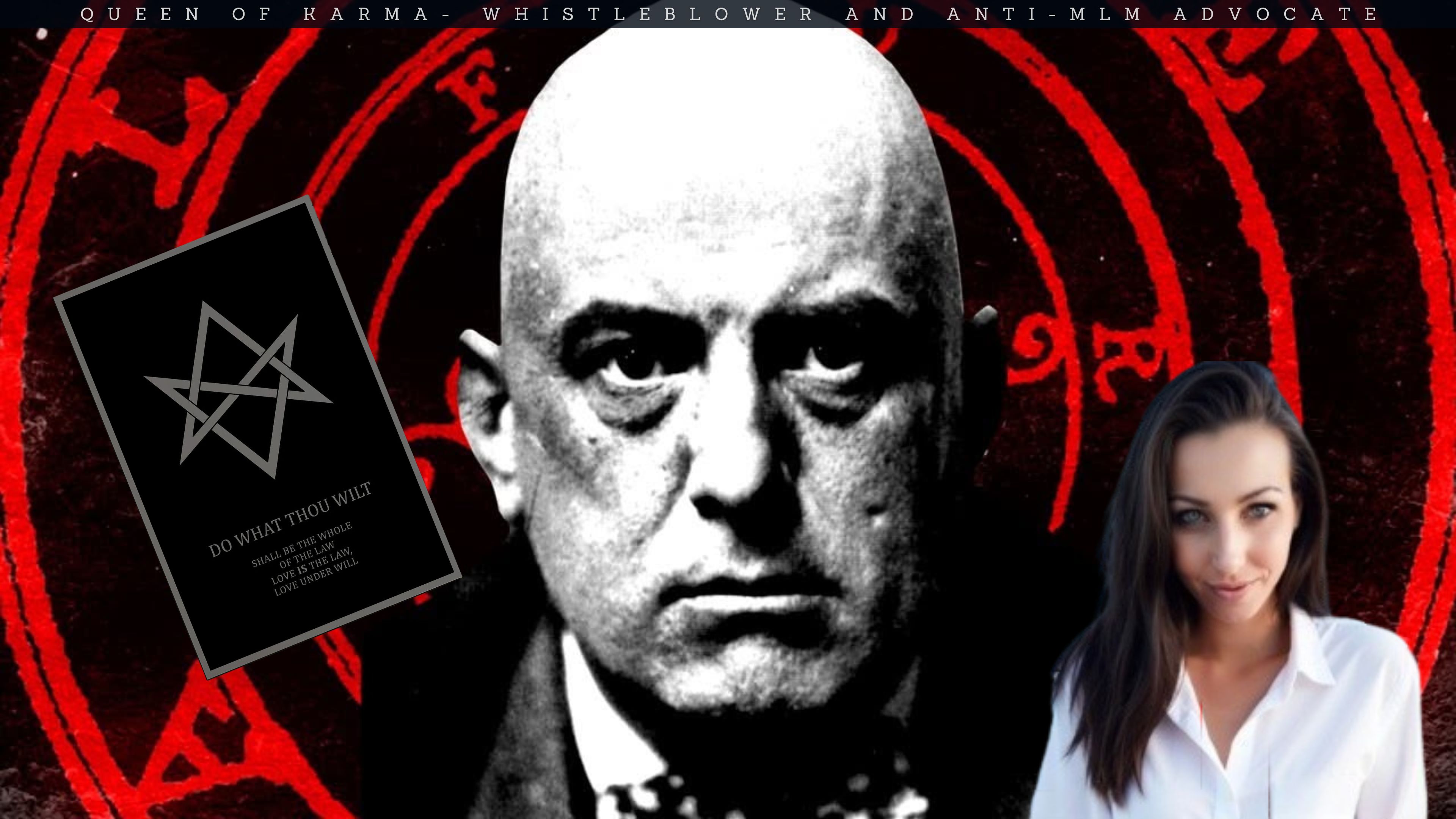
“Do what thou wilt shall be the whole of the Law”
I didn’t set out to investigate Aleister Crowley. Years ago, when I first began looking into Wiccan and Pagan cults, his name appeared like a footnote in the margins — a historical oddity, a flamboyant occultist, a man whose shadow stretched across the early 20th-century esoteric revival. At the time, I treated him as background noise. But as the years passed and I studied more high-control groups, more MLMs masquerading as empowerment, more spiritual scams dressed up as liberation, I kept circling back to Crowley.
Not because I was drawn to him, but because the patterns were familiar.
There was something in the tone of his writing — the absolutism, the contempt, the grandiosity — that felt eerily similar to the rhetoric I’d seen in modern cult leaders. Something in the structure of his orders reminded me of the hierarchical secrecy of Scientology. Something in the way he framed obedience as enlightenment echoed the dynamics of every coercive system I’ve ever studied.
Crowley wasn’t just eccentric. He was building something.
The deeper I dug, the more I realized that Thelema (the religion he founded, the philosophy he claimed was dictated by a supernatural entity) wasn’t just an esoteric curiosity. It was a cultic system, built on the same architecture of control, secrecy, and manipulation that underpins every high-control group I’ve ever investigated.
This is the story of how I came to that conclusion. The conclusion that Thelema is a cult…
Aleister Crowley: The Making of a Prophet
I first encountered Aleister Crowley not as a mythic figure, but as a name that kept surfacing in the footnotes of occult history — a man described alternately as a genius, a monster, a visionary, a fraud. The more I learned about him, the more I realized that his life story reads like the origin tale of every charismatic leader I’ve ever investigated: a childhood steeped in absolutism, a young adulthood defined by rebellion, and a lifelong hunger for power, attention, and control.
Crowley was born Edward Alexander Crowley on October 12, 1875 in Leamington Spa, Warwickshire, England into a wealthy, deeply religious family. The Crowleys were a Plymouth Brethren family — a strict, fundamentalist Christian sect that preached moral purity, obedience, and the literal imminence of the apocalypse. His father was a preacher; his mother reportedly called him “the Beast” when he misbehaved. Crowley later embraced the nickname as a badge of identity, a symbol of his rejection of the faith that raised him.
His childhood was a study in extremes: rigid religious discipline on one side, inherited wealth on the other. When his father died, Crowley inherited a fortune that allowed him to pursue whatever obsession seized him — mountaineering, poetry, sex, drugs, and eventually the occult. He attended Cambridge, where he reinvented himself as a decadent poet and provocateur, cultivating a persona that thrived on shock and transgression.
But beneath the theatrics was a pattern I recognized immediately: a young man shaped by authoritarian religion, reacting not by rejecting authoritarianism but by reversing it. Crowley didn’t escape the structure he grew up in — he simply replaced the Christian God with himself.
His entry into the occult came through the Hermetic Order of the Golden Dawn, a secretive magical society that blended ritual, symbolism, and esoteric philosophy. Crowley rose quickly, clashed with leadership, and eventually broke away — a pattern that would repeat throughout his life. He was brilliant, charismatic, and impossible to control. He wanted to lead, not follow.
By the early 1990s, Crowley began writing his own magical texts, developing his own rituals, and cultivating his own students. He traveled widely, experimented with drugs and sex magick, and surrounded himself with people who were drawn to his intensity. He was already living like a prophet before he ever claimed to receive a revelation.
When The Book of the Law appeared in 1904, it didn’t create Crowley’s ego — it confirmed it. It gave him divine justification for the authority he already believed he possessed. It turned a charismatic occultist into a self-declared messiah.
Understanding Crowley’s childhood, his psychology, and his early life isn’t just biographical context. It’s the foundation for understanding how Thelema became what it is: a belief system built around a man who spent his entire life oscillating between rebellion and domination, between rejecting authority and demanding it.
Crowley didn’t escape the authoritarianism of his upbringing. He inherited it, inverted it, and weaponized it.
Thelema: The Belief System Behind the Cult
Before I could analyze Thelema as a cult, I had to understand what it actually teaches — not the romanticized version passed around in occult circles, but the doctrine as Crowley wrote it, the worldview he constructed, and the psychological impact it has on those who adopt it.
At it’s core, Thelema is built around a single phrase from The Book of Law:
“Do what thou wilt shall be the whole of the Law.”
This line is often misunderstood, sometimes intentionally. Outsiders read it as hedonism, a license to do whatever you want. Practitioners insist it means discovering your “True Will,” a kind of spiritual destiny or higher purpose. But in practice, the ambiguity is the point. It allows Crowley — and later, those in positions of authority — to define what “True Will” means for the follower.
Thelema teaches that humanity has entered a new Aeon, the Aeon of Horus, in which old moral systems must be discarded. Crowley framed this as liberation, but the rhetoric of liberation is a common tool in high-control groups. When you strip away the mystical language, Thelema’s core beliefs include:
- A divinely revealed law
- A hierarchal spiritual universe
- A division between the enlightened (“kings”) and the unenlightened (“slaves”)
- A mandate to transcend conventional morality
- A belief that Crowley was the prophet of a new age
Thelema also incorporates ritual magick, sexual practices, and a cosmology that blends Egyptian symbolism, Kabbalah, and Crowley’s own inventions. it is intentionally esoteric, intentionally opaque, and intentionally difficult to interpret without guidance.
And that’s where the danger lies.
Because if “Do what thou wilt” requires discovering your “True Will,” and if discovering your “True Will” requires initiation, ritual, and guidance, then the person who controls the rituals controls the Will. The person who interprets the doctrine controls the destiny. The person who defines the symbols defines the truth. In Thelema, that person was Crowley.
And after Crowley, it became whoever inherited his authority — the leaders of A∴A∴, O.T.O., and the splinter groups that followed.
Thelema presents itself as philosophy of freedom. But its structure creates dependency. Its doctrine creates hierarchy. It’s ambiguity creates control.
Understanding Thelema’s beliefs isn’t separate from understanding its cultic nature. It’s the doorway into it.
The Cairo Revelation and the Birth of a Prophet
Crowley’s transformation from a rebellious occult enthusiast into a self-declared prophet began in Cairo in April of 1904, an event that Thelemites romanticize but cult analysts recognize as the classic origin story of a high-control system. Crowley was already restless, disillusioned with the Golden Dawn, and searching for a new source of authority. He had lost his place in the British occult hierarchy, and Cairo became the stage where he reinvented himself.
According to Crowley, the revelation began when Rose, who had no prior interest in magic, entered a trance-like state and told him, “They are waiting for you.” Crowley interpreted this as a supernatural summons. Over the next several days, he performed rituals in the Egyptian Museum, focusing on the Stele of Ankh-ef-en-Khonsu, which he later called “The Stele of Revealing.” Rose insisted that the god Horus wanted to speak to him. Crowley, primed for significance and hungry for validation, accepted this immediately.
A voice, Aiwass, dictated a text to him over three days, April 8, 9, and 10. That text became Liber AL vel Legis, The Book of the Law, the foundational scripture of Thelema. Crowley described Aiwass as a “minister of Hoor-paar-kraat,” a form of Horus, and said the voice came from over his left shoulder, speaking with authority and urgency. The dictation occurred at exactly the same hour each day, from noon to 1pm, which Crowley later used as evidence of its supernatural origin.
When I examine the revelation through a cult-analysis lens, the revelation looks less like divine intervention and more like a psychological and situational convergence. The Cairo revelation didn’t come out of nowhere. It came out of a man who desperately wanted to be chosen. And the text itself reinforces that dynamic.
Because The Book of Law was published in 1904, it is public domain in many jurisdictions. A few lines illustrate its tone:
“Do what thou wilt shall be the whole of the Law.”
“The slaves shall serve.”
“Every man and every woman is a star.”
These lines are often romanticized, but when you read them through a cult-analysis lens, they are chilling. They divide humanity into “kings” and “slaves.” They frame obedience as cosmic destiny. They establish a hierarchy where some people are inherently superior.
These are not gentle spiritual musings. They are declarations of hierarchy, destiny, and obedience. The voice of the text is commanding, authoritarian, and self-validating. It speaks not as a metaphor but as a lawgiver.
Crowley didn’t present himself as the author. He presented himself as the prophet. He alone understood the text. He alone could interpret it. He alone could usher humanity into the “Aeon of Horus,” a new era he claimed was dawning. He declared himself the new Aeon of Horus and this is the moment where Crowley stopped being a participant in occult circles and became the architect of a new religious system, one centered entirely on himself.
This is the first red flag in any cult investigation: a charismatic founder claiming exclusive access to divine revelation.
The Cairo revelation also established the core mechanisms of Thelema’s later cultic culture:
- Prophetic authority — Crowley alone understood the Law.
- Revealed scripture — the text was unquestionable and divinely mandated.
- Hierarchical elitism — humanity was divided into “kings” and “slaves.”
- Obedience through mystique — the text’s opacity created interpretive dependency.
- Myth-making — Crowley’s personal narrative became sacred history.
This is the same pattern seen in the founding moments of other high-control groups: a charismatic leader receives a revelation that elevates them above all others, creates a new cosmology, and establishes a structure where their authority becomes absolute.
Crowley’s Cairo experience wasn’t just a spiritual event — it was the birth of a prophet, the creation of doctrine, and the foundation of a system that would shape every exploitative, hierarchical, and coercive element of Thelema that followed.
The Rhetoric of Control: How Crowley Spoke to His Followers
Crowley’s power didn’t come from physical force or organizational discipline, it came from language. His rhetoric was the engine of Thelema, the glue that held followers in place, and the mechanism through which he reframed exploitation as enlightenment. When I studied his writings, diaries, letters, and instructions, I saw the same linguistic patterns used by modern high-control leaders: absolutism, mystification, elitism, and the strategic use of contradiction. These patterns appear consistently across his published works and personal communications, and they form the backbone of how he maintained authority over his followers.
Crowley also uses absolutist language. He rarely suggests. He declares. His writings are filled with imperatives, cosmic proclamations, and statements framed as universal law. this is most visible in The Book of Law, where the voice of Aiwass speaks in commands rather than teachings. Crowley adopted this tone in his own commentary, positioning himself not as a teacher but as a revealer of truth.
This absolutism served several functions:
- It shuts down debate by framing disagreements as spiritual ignorance.
- It created a sense of urgency and inevitability.
- It elevated Crowley’s words above ordinary human discourse.
Crowley’s writing is intentionally opaque. He used riddles, paradoxes, symbolic language, invented terminology, and references to obscure mythologies. This wasn’t literary flourish, it was a control mechanism. When doctrine is difficult to understand, followers become dependent on the leader for interpretation.
Crowley’s writings are full of contempt for those who don’t accept his law. He frames dissent as weakness, ignorance, or spiritual blindness. He positions Thelema not as one path among many, but as the inevitable religion of the new Aeon.
This is what cult analysts call sacred science — doctrine framed as absolute truth, beyond question, beyond critique. Crowley didn’t just write a book. He wrote a worldview that divided humanity into the worth and the unworthy, the awakened and the enslaved. This is the same identity manipulation used by Scientology (“clears” vs “Suppressive Persons” or “SPs”), Heaven’s Gate (“the class” vs “humans”), and even the MLM NXIVM (“integrated” vs “unintegrated”). Elitism is a coersion mechanism. It binds the in-group together and dehumanizes the out-group.
Crowley’s elitism appears throughout his writings and is central to Thelemic cosmology. It creates a psychological reward system where followers see themselves as part of a chosen elite — a classic cult mechanism that boosts loyalty and discourages dissent.
Crowley didn’t just speak with authority, he performed it. He adopted grandiose titles such as The Great Beast 666, Frater Perdurabo, To Mega Therion. these personas weren’t just theatrics; they were rhetorical tools that signaled supernatural authority. By presenting himself as a mythic figure, Crowley elevated his teachings beyond ordinary critique. Followers weren’t just listening to a man, they were listening to a cosmic emissary.
Crowley often contradicted himself and sometimes even within the same text. This wasn’t sloppiness, it was strategy. Contradiction destabilizes followers’ sense of certainty and forces them to rely on the leader to reconcile the paradox. This is a known tactic in coercive systems to keep followers off-balance, prevent independent interpretation, and reinforce the leader’s role as he sole arbiter of truth. Crowley’s contradictions weren’t bugs, they were features.
Crowley’s rhetoric oscillated between flattery (“Every man and every woman is a star”), degradation (“The slaves shall serve”), seduction (“Love is the law, love under will”), and intimidation (“I am the Beast 666”). This emotional whiplash creates a psychological push-pull dynamic that deepens attachment. Followers seek approval, fear rejection, and internalize the leader’s worldview. Crowley understood how to use language to create dependency long before psychology had a name for it.
Crowley’s rhetoric built the psychological architecture of Thelema. And once you see the mechanisms, the parallels to other high-control groups become impossible to ignore.
A∴A∴ and O.T.O.: Hierarchy, Secrecy, and the Architecture of Control
When I began examining the structure of Crowley’s orders (A∴A∴ and O.T.O.) the parallels in modern cults became impossible to ignore.
Both A∴A∴ and O.T.O. use:
- graded initiations
- secret rituals
- oaths of obedience
- inner and outer circles
- knowledge withheld until the member “earns” it
This is the same architecture used by Scientology’s OT levels, by Heaven’s Gate inner teachings, by countless esoteric cults that rely on secrecy to maintain control. Secrecy isolates members from outside critique and binds them to the group.
In A∴A∴, each student is assigned a superior — a mentor who controls their access to teachings, evaluates their progress, and determines when they are ready to advance. This creates a vertical chain of authority where the student is always reaching upward, always dependent on someone above them (similar to downlines in MLM companies).
This is not spiritual exploration. This is informed asymmetry, a known mechanism of undue influence. It mirrors:
- Scientology’s auditor system
- Golden Dawn’s grade system
- guru-disciple structures in high-control yoga cults (Hare Krishna)
The superior is always the gatekeeper.
In O.T.O., the degrees function like a ladder of enlightenment, each rung promising deeper truth, more power, more access. But the truth is always just out of reach, always one initiation away.
This resembles:
- Scientology’s OT levels
- Freemasonry’s degree system (but with more coercive elements)
- modern esoteric cults that monetize “ascension”
The structure is not spiritual exploration. It is controlled access. This is textbook cult architecture.
Sex, Drugs, and Ritual: Crowley’s Tools of Manipulation
Crowley’s use of sex, drugs, and ritual wasn’t spiritual experimentation, it was a behavioral control system. When you take a deeper look, you see the same mechanisms used by modern high-control groups: breaking down autonomy, creating dependency, and reframing vulnerability as enlightenment.
Crowley’s system incorporates sex magick — ritualized sexual acts framed as magical operations — and drug-induced altered states. In theory, these were spiritual techniques. In practice, they created vulnerability. Crowley used these rituals to override personal boundaries, test loyalty, create emotional dependency, and reinforce his authority as the only one who could interpret the “meaning” of the ritual.
He positioned himself as the spiritual gatekeeper of sexual experience. Followers were told that their desires, discomfort, or hesitation were not personal feelings but “ego resistance” which is a classic tactic used in coercive control groups.
When a leader controls:
- your sexual behavior
- your access to altered states
- your interpretation of those states
- your sense of spiritual progress
…they control you.
Crowley used sex and drugs not just as rituals, but as tools of influence. Crowley’s rituals often involved substances such as hashish, mescaline, cocaine, and opiates. He believed altered states were essential for magical work but he also believed he alone could interpret those states.
Followers were pressured into acts they might not have chosen outside of the group. Experiences were reframed through Thelemic doctrine. Dependency was created and reinforced.
The use of drugs also creates:
- lowered critical thinking
- heightened suggestibility
- dependency on the leader for interpretation
- the leader’s authority became reinforced through every ritual
This is the same pattern seen in psychedelic cults, shamanic abuse cases, and communes that use drugs to break down resistance. Crowley required daily rituals, strict schedules, magical diaries and obedience to assigned tasks. This is behavioral conditioning — the same techniques used in Scientology auditing and other high-control groups. Ritual is not neutral. Ritual is control.
Crowley believed that the ego had to be destroyed for spiritual advancement. In practice this meant:
- pushing followers past their physical limits
- encouraging exhaustion
- reframing distress as “initiation”
- demanding obedience during vulnerable states
- isolating followers from outside influence
This is identical to:
- the “ego death” rhetoric in psychedelic cults
- the “purification” rhetoric in high-control yoga groups
- the “breaking point” tactics used in military-style cults
When the leader controls the interpretation of suffering, they control the person experiencing it.
Sex, drugs, and ritual aren’t inherently harmful. But in a high-control system, they become tools of obedience, dependency, identity breakdown, emotional vulnerability, behavioral conditioning, and exploitation. Crowley didn’t use these practices to liberate followers. He used them to bind them.
This is a pattern I have seen in every coercive spiritual system I’ve studied, used by every major cult of the 20th century. These tactics are the makings of coercive control.
Crowley the Scammer: Financial Exploitation and Manufactured Mystique
The more I read Crowley’s letters and biographies, the more I recognized another familiar pattern: the charismatic scammer.
Crowley exaggerated his magical rank, his influence, his achievements and even his lineage. He rewrote his history, a large red flag in cult leaders. This wasn’t harmless, it was authority manufacturing, designed to make followers believe he possessed supernatural insight and worldly power.
Crowley routinely claimed spiritual “lineages” and initiatory authority he did not possess. He declared himself the world’s highest-ranking Rosicrucian, the true successor of the Golden Dawn, and the prophet of a new Aeon — none of which were recognized by the groups he claimed to represent. Charismatic leaders inflate themselves to inflate their authority. They manipulate their importance. Crowley used these titles to recruit followers, solicit money, and justify obedience.
In 1911, Crowley published attacks on rival occultists and then positioned himself as the only “authentic” Rosicrucian authority, a move that helped him sell initiations and magical instruction. His writings framed others as frauds while elevating himself as the sole legitimate source of esoteric truth. This was less about truth and more about cornering the market on occult authority.
Crowley lived off wealthy followers, solicited money under spiritual pretenses, and pressured students to support him financially. Crowley charged followers for initiations, rituals, magical instruction, access to “secret” teachings, and even personal guidance. A∴A∴ and O.T.O. both functoined as pay-to-progress systems. This mirrors the financial structure of modern high-control groups: the deeper you go, the more you pay.
Crowley framed financial support as a spiritual duty, a pattern identical to modern cult leaders who rely on followers to fund their lifestyles.
The Abbey of Thelema — his commune in Cefalù — was marketed as a spiritual utopia. In reality, it was a site of unsanitary conditions, ritualized sex and drug use, and financial exploitation. The Abbey wasn’t just a commune, it was a laboratory for Crowley’s experiments in power. Followers lived in an environment where Crowley controlled food, ritual, sex, sleep, drug access, and the interpretation of every experience. This is the same totalistic environment seen in Jonestown, Rajneeshpuram, Heaven’s Gate compound, and Scientology’s Sea Org bases. The Abbey was smaller, but the mechanisms were the same.
The unsanitary, chaotic conditions at The Abbey of Thelema contributed to the death of a follower Raoul Loveday and the loss of his and his wife Betty May’s unborn child. Loveday became violently ill after drinking contaminated water during a ritual Crowley insisted upon, and instead of seeking medical help, Crowley dismissed the illness as weakness and framed suffering as part of “magical development.”
Betty May, pregnant and already malnourished, was left to watch her husband deteriorate in an environment with no clean water, no medical care, and no structure beyond Crowley’s whims. Loveday died at the Abbey, and Betty miscarried shortly after fleeing. This wasn’t an unfortunate accident — it was the predictable outcome of a leader who rejected medicine, ignored basic safety, and placed doctrine above human life, a pattern that mirrors the harm seen in many high-control groups.
Due to this scandal, in 1923, Mussolini expelled Crowley from Italy. This incident triggered intense media coverage in Britain, portraying Crowley as a depraved, immoral cult leader running a “black magic” commune. Mussolini’s government, which was aggressively policing “moral corruption” and foreign influence, viewed Crowley as a destabilizing, scandalous presence and ordered him to leave the country for good.
Crowley sold objects he claimed were magically empowered, often at high prices. These items were marketed as tools for protection, power, or spiritual advancement. This wasn’t just eccentricity, it is a cult-leader pattern. This wasn’t just exploitation. This was a classic spiritual-commodification scam. He left a trail of people who were financially ruined, psychologically damaged, or socially isolated.
Crowley wasn’t just a prophet. He was a man who built a spiritual hierarchy around himself and monetized it.
Comparing Thelema to Scientology, Heaven’s Gate, and Other Cults
When I applied cult-analysis framework to Thelema, the parallels were unmistakable. They weren’t just present, they were structural. The deeper I went, the more I realized that Thelema shares the same psychological architecture as the most well-documented high-control groups of the 20th century. The aesthetics differ (robes instead of jumpsuits, Egyptian symbolism instead of UFO cosmology) but the underlying mechanisms of control are nearly identical.
Every high control group begins with a founder who claims special access to truth.
- L. Ron Hubbard claimed to have discovered the universal science of the mind and later declared himself the sole authority on spiritual advancement.
- Marshall Applewhite claimed extraterrestrial beings had chosen him to lead a select group to salvation.
- Aleister Crowley claimed a supernatural being dictated The Book of Law to him and positioned himself as the prophet of a new Aeon.
In each case, the founder’s authority is self-generated, self-validated, and insulated from critique. The leader becomes the lens through which all truth is interpreted.
Crowley’s Book of Law functions the same way Hubbard’s bulletins or Heaven’s Gate’s doctrine functions: as a closed, self-referential system that cannot be questioned without spiritual consequences.
- Hubbard’s bulletins define “suppressive persons” and “entheta,” creating a moral universe where dissent is pathology.
- Heaven’s Gate doctrine framed outsiders as “humans” who were spiritually dead.
- Crowley’s text divides humanity into “kings” and “slaves,” framing obedience as cosmic destiny.
In all three systems, the text is not a metaphor — it is law, and the leader is the only legitimate interpreter.
Thelema’s interior systems mirror the secrecy-based hierarchies of other cults.
- Scientology uses a pay-to-progress model where higher levels reveal “secret” cosmology.
- Heaven’s Gate used inner teachings accessible only to the most committed members.
- A∴A∴ uses one-on-one mentorship, withholding teachings until the student “earns” them.
- O.T.O. uses degrees that promise deeper truth, mirroring Scientology’s OT levels.
Secrecy creates dependency. Dependency creates control.
Crowley’s use of sex magick and ritual obedience is not outlier, it is part of a long pattern of leaders using sexuality and ritual to break down autonomy.
- Hubbard used auditing to extract confessions and control behavior.
- Applewhite enforced celibacy and even castration among followers.
- Crowley directed sexual behavior under the guise of “magical operations.”
Different methods, same outcome: the leader controls the body to control the mind.
Crowley’s rhetoric divides the world into “kings” (the enlightened) and “slaves” (the unenlightened). Scientology divides the worlds into “clears” vs. “SPs.” Heaven’s Gate divides the world into “the class” vs. “humans.” This elitism is not philosophical — it is functional. It isolates members, inflates identity, and justifies obedience.
Hubbard used space opera instead of magick. Applewhite used UFO salvation instead of Aeonic prophecy. Crowley used Egyptian gods instead of aliens. But the architecture — the control mechanisms — are identical.
Splinter Groups: The Cultic Legacy of Thelema
A movement’s offshoots often reveal its DNA.
Thelema produced:
- Kenneth Grant’s Typhonian Order — darker, more secretive, more extreme. Grant was actually one of Crowley’s followers and he created a system that was more ritual-intensive, more sexually coercive, and more obsessed with “forbidden” entities and energies. Grant claimed revelations and new magical transmissions — the same prophetic pattern Crowley used. His order became known for its extreme rituals and opaque hierarchy, mirroring the most coercive elements of Crowley’s system.
- The left-hand-path micro-cults built around charismatic interpreters. Thelema inspired numerous small groups built around charismatic interpreters who claimed special access to Crowley’s “true” teachings, used sexual ritual as a control mechanism, demanded loyalty and secrecy, and isolated members from outside influence. These groups often operated in private homes, occult shops, or small temples, making them harder to track but no less harmful.
- The ritual-heavy esoteric groups with cult-like dynamics. Many modern occult groups borrow Thelema’s structure: graded initiation, secret teachings, ritual obedience, charismatic leadership, sexualized ritual, and magical hierarchy. Some of these groups have been implicated in psychological manipulation, financial exploitation, sexual coercion, and even ritual abuse.
The pattern is consistent: systems built on Crowley’s architecture tend to reproduce Crowley’s harm. Healthy religions don’t usually spawn dangerous splinter groups. High-control systems do.
Splinter groups are diagnostic. They reveal the underlying structure of the parent system. Healthy systems produce diversity. High-control systems produce micro-cults.
Thelema splinter groups are not accidents — they are the predictable outcome of a belief system built on secrecy, hierarchy, elitism, sexualized ritual, prophetic authority, ambiguous doctrine, and charismatic interpretation.
The DNA of Thelema is cultic. Its offshoots simply make that DNA easier to see.
Why Thelema Escapes the Cult Label and Why I Call Thelema a Cult
Crowley’s life didn’t end in triumph or transcendence. It ended in the way so many charismatic manipulator’s lives do: quietly, painfully, and broke. Aleister Crowley died on December 1, 1947, in a boarding house in Hastings, East Sussex. He was 72 years old, addicted to heroin, financially ruined, and living off the charity of the few followers who still believed in him. The man who once declared himself the prophet of a new Aeon — the herald of a cosmic transformation, the voice of a supernatural intelligence — died broke, sick, and largely forgotten by the world he claimed he was destined to reshape.
That ending matters. It matters because it reveals the gap between the myth and the man, between the persona he constructed and the reality he lived. It matters because it exposes a pattern I’ve seen in every high-control system I’ve ever investigated: charismatic leaders burn through people, money, and goodwill until there is nothing left but the mythology they leave behind. Crowley was no exception. His final years weren’t the tragic decline of a misunderstood genius — they were the predictable collapse of a man who built his life on manipulation, exploitation, and self-mythologizing.
And yet, despite all of this, Thelema is rarely labeled a cult.
Part of that is timing. Crowley died before the modern vocabulary of cult analysis existed. He died before Jonestown, before Heaven’s Gate, before the public learned to recognize the architecture of coercion. There were no televised raids, no mass casualties, no courtroom spectacles. His death was quiet, almost mundane. And because he died in 1947 — before the media learned how to expose charismatic manipulators — his movement slipped into the cultural category of “esoteric religion” rather than being scrutinized as a high-control group.
Part of it is aesthetics. Thelema is wrapped in robes, symbols, Latin mottos, and occult theatrics. People romanticize Crowley as a counterculture icon, a literary curiosity, a rebel against Victorian morality. His excesses are reframed as eccentricity. His abuses are minimized. His manipulations are dismissed as performance art. When a leader becomes a legend, the harm they caused becomes harder to see.
And part of it is that many modern Thelemites are independent adults who practice symbolically, psychologically, or casually. They aren’t living in communes. They aren’t being isolated from their families. They aren’t being financially drained by a living guru. That makes it easy to overlook the structure beneath the surface.
But structure is what matters.
And when I look at the structure of Thelema — it’s prophetic founder, its revealed scripture, its hierarchal secrecy, its ritualized control, its sexual and psychological manipulation, its financial exploitation, its us-vs-them worldview, and its legacy of cult-like splinter groups — I see the same architecture I’ve seen in every cult I’ve ever investigated.
I don’t call Thelema a cult to provoke or sensationalize. I call it a cult because it meets the criteria. Because the patterns are there. Because the mechanisms are there. Because the harm is there. Because the legacy is there.
Crowley’s death doesn’t absolve the system he built. It exposes it. He died the way many cult leaders do — isolated, addicted, and financially ruined —while the structure he created continued to shape, influence, and in some cases harm people long after he was gone. The prophet vanished, but the machinery of control remained.
And that is why, after years of studying high-control groups, scams, and coercive systems, I can no longer pretend that Thelema is simply an esoteric philosophy or a misunderstood spiritual path.
Thelema is a cult.
And it’s time we start calling it one.
By Beth Gibbons (Queen of Karma)
Beth Gibbons, known publicly as Queen of Karma, is a whistleblower and anti-MLM advocate who shares her personal experiences of being manipulated and financially harmed by multi-level marketing schemes. She writes and speaks candidly about the emotional and psychological toll these so-called “business opportunities” take on vulnerable individuals, especially women. Beth positions herself as a survivor-turned-activist, exposing MLMs as commercial cults and highlighting the cult-like tactics used to recruit, control, and silence members.
She has contributed blogs and participated in video interviews under the name Queen of Karma, often blending personal storytelling with direct confrontation of scammy business models. Her work aligns closely with scam awareness efforts, and she’s part of a growing community of voices pushing back against MLM exploitation, gaslighting, and financial abuse.



Leave A Comment