


ARVE error: No attachment with ID 132638
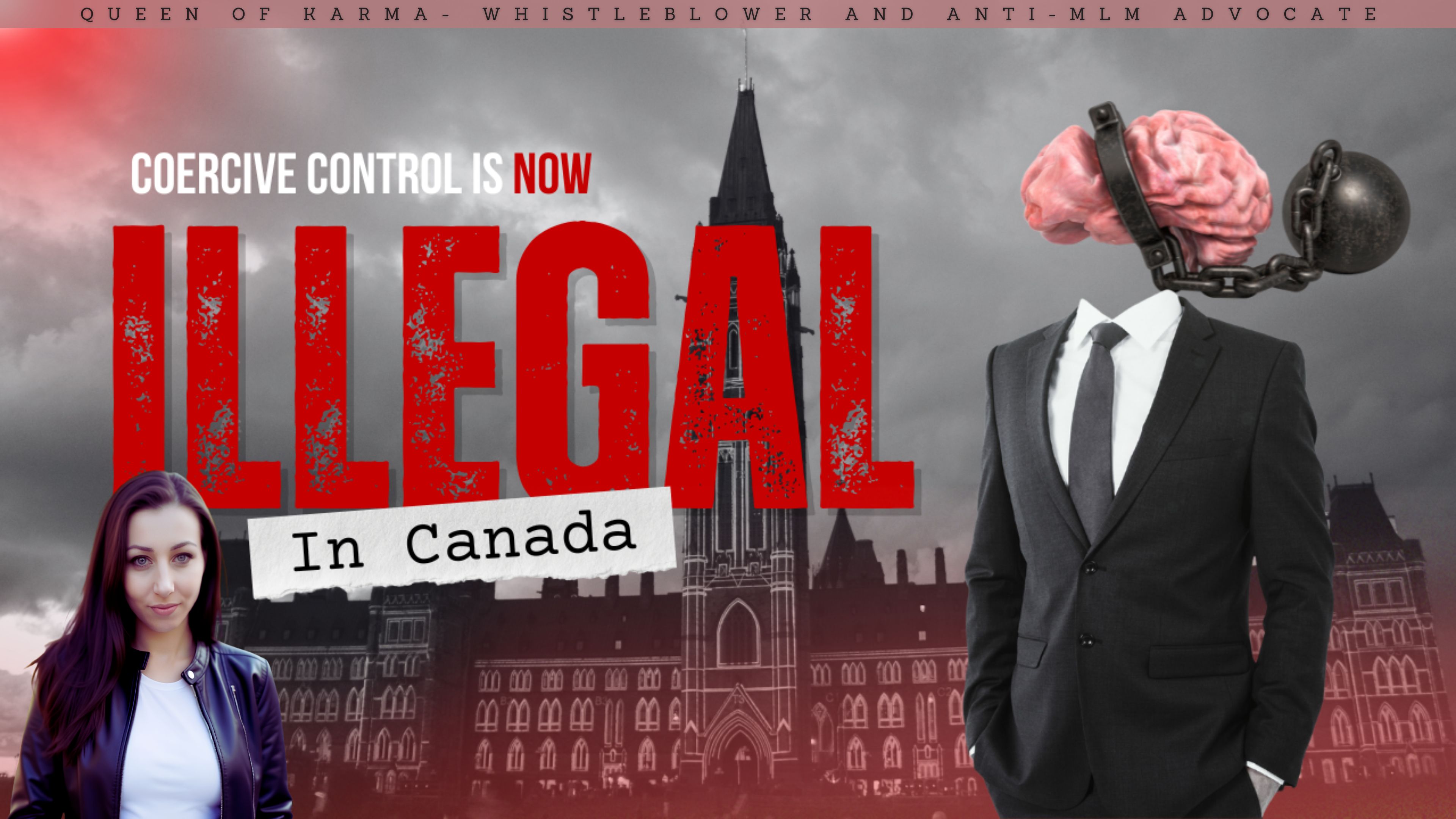
Canada is preparing to introduce a criminal offence for coercive control, and for many survivors, advocates, and frontline educators, this moments feels long overdue. For decades, people trapped in abusive relationships, high-control groups, cults, and multi-level marketing companies have been describing the same patterns of domination — patterns that rarely left bruises but always left deep psychological scars.
ARVE error: No attachment with ID 132638
As someone who speaks out about cults and MLMs on YouTube, I’ve seen firsthand how coercive control operates far beyond intimate partner relationships. It shows up in spiritual movements, commercial cults, influencer-led coaching programs, and the endless parade of “financial freedom” schemes that prey on vulnerable people. And no, for the first time, Canada is acknowledging that these patterns are not just harmful, they can be criminal.
But with this progress comes a new set of questions, concerns, and responsibilities for advocates.
Understanding Coercive Control: The Psychology Behind the Pattern
Coercive control is not about one argument, one threat, or one bad moment. It is a system — a sustained pattern of behaviors designed to dominate another person’s autonomy. Psychologically, coercive control works by reshaping the victim’s internal world. It creates fear, dependency, confusion, and a gradual erosion of self-trust.
Common tactics include:
- isolation from friends, family, or support
- surveillance, monitoring, or “checking in”
- financial restriction or forced dependency
- manipulation, guilt, and gaslighting
- threats, intimidation, or punishment
- love-bombing followed by withdrawal
- rules that shift unpredictably
- emotional highs and lows that create trauma bonds
These tactics are not random. They are deliberate tools used to destabilize a person’s sense of reality and make them easier to control.
Victims often describe feeling like they are “walking on eggshells,” constantly adjusting their behavior to avoid conflict. Over time, they internalize the abuser’s rules and lose confidence in their ability to make independent decisions. This is not weakness, it is conditioning.
Why This Matters for Cult and AntiMLM Advocacy
Coercive control is the backbone of every high-control group. Whether it’s a spiritual cult, a commercial cult, or an MLM disguised as a “business opportunity,” the psychological mechanisms are identical.
Cults and MLMs rely on:
- isolation from “negative influences”
- love-bombing to create belonging
- financial dependency disguised as empowerment
- punishment and reward cycles
- language engineered to shut down critical thinking
- leaders who cannot be questioned
- fear of leaving or speaking out
- manipulation framed as mentorship
These groups don’t need physical violence to destroy lives. They use psychological domination to keep people compliant, loyal, and financially exploited.
For advocates, Canada’s new coercive-control offence provides something we’ve never had before: a legal vocabulary that matches the lived experiences of survivors. It validates what we’ve been saying for years — that psychological abuse is real, measurable, and dangerous.
Canada’s New Coercive Control Law: Bill C-16 Explained
Canada’s federal government has introduced Bill C-16, a landmark piece of legislation that formally recognizes coercive control as a criminal offence. This bill represents one of the most significant updates to Canada’s approach to intimate partner violence in decades, shifting the focus from isolated incidents of physical harm to the ongoing patterns of domination that create the conditions for abuse long before violence occurs.
Bill C-16 amends the Criminal Code to create a new standalone offence for coercive control within intimate partner relationships. The offence targets patterns of behavior that cause a partner to fear for their safety, lose autonomy, or experience significant psychological distress.
The law acknowledges that abuse is often non-physical, cumulative, and deeply psychological. It recognizes that victims can be trapped long before any physical assault occurs and that these patterns are dangerous in their own right.
The coercive control offence created by Bill C-16 is scheduled to come into effect by June 2028.
This long implementation period is intentional. The federal government has stated that police, prosecutors, judges, and frontline agencies need time to:
- develop trauma-informed training
- learn how to identify patterns of psychological abuse
- update investigative practices
- understand how to gather evidence for non-physical offences
- coordinate with provincial and territorial partners
Advocates agree that rushing implementation would lead to misapplication but many are also concerned about whether this time will be used effectively.
Bill C-16 targets patterns, not isolated incidents. Examples of behaviors that may form part of a coercive control pattern include:
- monitoring or restricting movements, communications, or online activity
- isolating a partner from friends, family, or community
- controlling access to money or essential resources
- dictating daily routines, decisions, or personal choices
- repeated manipulation, gaslighting, or humiliation
- threats, intimidation, or coercion
- damaging property as a form of intimidation
- creating forced dependency
- unpredictable rules or punishments
The offence focuses on the impact of the behavior — fear, distress, loss of autonomy — rather than specific tactics used.
To prevent misuse, Bill C-16 clearly does not criminalize:
- mutual arguments
- ordinary parenting
- setting boundaries
- emotional conflict without domination
- breakups or relationship changes
- single incidents without a pattern
- consensual power dynamics
- normal relationship dysfunction
The law is narrowly focused on domination, fear, and loss of autonomy, not everyday human behavior.
Because the offence is not yet in force, Canada is in the preparation stage.
The Promise of the New Law and the Problems Advocates See Coming
While the introduction of coercive control legislation is a major step forward, advocates have legitimate concerns about how this law will be implemented.
Will police and prosecutors understand coercive control?
Coercive control is subtle, patterned, and psychological. It requires training in trauma, manipulation tactics, and high-control group dynamics. Without proper education, authorities may misinterpret cases or fail to recognize the pattern.
Will victims be believed?
Many survivors of cults and MLMs already struggle to be taken seriously. Their experiences are often dismissed as “bad decisions,” “buyer’s remorse,” or “relationship drama.” Coercive control requires authorities to understand nuance and nuance is not always the justice system’s strong suit.
Will the law be applied consistently across Canada?
Different provinces have different resources, priorities, and training standards. Advocates worry that coercive control may be recognized in one region but ignored in another.
Who will train the people enforcing this law?
This is one of the biggest questions. Coercive control is not something you can learn from a two-hour seminar. It requires deep expertise in trauma psychology, cult dynamics, MLM manipulation tactics, financial exploitation, grooming and indoctrination, power structures, survivor behavior, and long-term psychological harm.
As advocates, we want to know:
Will experts be involved?
Will survivors be consulted?
Will cult researchers, antiMLM educators, and trauma-informed professionals be part of the process?
Or will training be rushed, superficial, and delivered by people who have never worked with victims of high-control groups?
Coercive control cases are complex. They require investigators who understand:
- why victims stay
- why victims recant
- why victims minimize abuse
- how trauma bonding works
- how abusers manipulate narratives
- how cults and MLMs use group pressure
- how financial dependency traps people
- how isolation destroys autonomy
- how psychological abuse leaves no physical evidence
Without proper training, coercive control laws risk becoming symbolic rather than effective.
We want to ensure that doesn’t happen.
A Call to Action for Canadian Advocates
As Canada moves forward with coercive control legislation, advocates have a crucial role to play.
We must:
- push for trauma-informed training
- demand involvement from experts in cults and MLMs
- educate the public about psychological abuse
- support survivors in documenting patterns
- hold institutions accountable for implementation
- ensure coercive control is recognized beyond intimate partner relationships
- advocate for future expansion of the law to include high-control groups
This is a turning point. For the first time, Canada is acknowledging the reality of psychological domination. But laws alone won’t protect people, proper understanding does.
Advocates, survivors, educators, and researchers must work together to ensure coercive control is recognized, understood, and taken seriously across the country.
Legal Disclaimer: This article is for educational purposes only. I am not a lawyer and this is not legal advice. I am discussing Canadian laws and how they relate to advocacy against coercive control, cults, MLMs, and high-control groups. For legal guidance specific to your situation, please consult a qualified professional. Thank you.
By Beth Gibbons (Queen of Karma)
Beth Gibbons, known publicly as Queen of Karma, is a whistleblower and anti-MLM advocate who shares her personal experiences of being manipulated and financially harmed by multi-level marketing schemes. She writes and speaks candidly about the emotional and psychological toll these so-called “business opportunities” take on vulnerable individuals, especially women. Beth positions herself as a survivor-turned-activist, exposing MLMs as commercial cults and highlighting the cult-like tactics used to recruit, control, and silence members.
She has contributed blogs and participated in video interviews under the name Queen of Karma, often blending personal storytelling with direct confrontation of scammy business models. Her work aligns closely with scam awareness efforts, and she’s part of a growing community of voices pushing back against MLM exploitation, gaslighting, and financial abuse.



Leave A Comment