


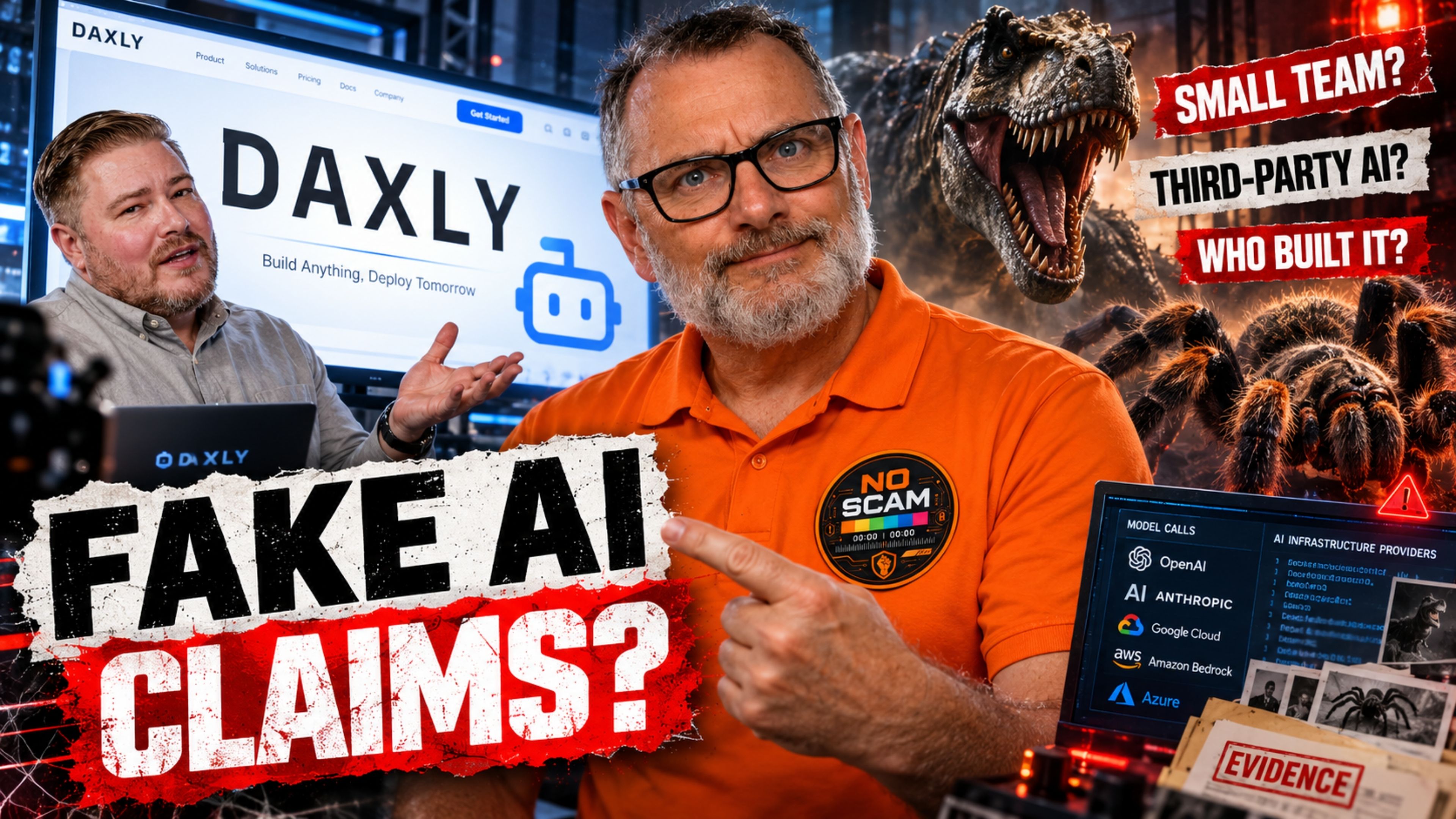
“Daxly is live. When I say live, it is absolutely out there for the masses to use.” — Stephen McCullah, AMA 54
Stephen McCullah has launched another technology project.
 This one is called Daxly, and the claims are extraordinary. The website presents it as far more than another AI chatbot or coding assistant. Daxly is being promoted as an autonomous development platform capable of doing the work of a founding CTO, principal architect, senior engineer, security auditor and DevOps lead, while also claiming the ability to build production-ready applications, fix its own errors, deploy software and tackle projects ranging from websites and payment systems to Layer-1 blockchains, game engines and institutional trading platforms.

If that is genuinely what Stephen McCullah and his team have built, then it is a remarkable achievement.
The problem is that I have heard this type of language from him before.
I have spent years following McCullah’s projects, watching his presentations, archiving his claims and comparing what was promised with what was eventually delivered. His history stretches from a Kickstarter campaign to search for alleged living dinosaurs in the Congo, through gold-backed currencies, Apollo, Knox Wire and LunaOne, and more recently into GRAPE and Grapeology, where I have documented dozens of AMAs filled with claims about blockchains, artificial intelligence, token migrations, exchanges, enormous liquidity, Free Zones, banking systems and technology repeatedly described as being close to completion.
The names change. The ambitions rarely get smaller.
Daxly matters because it has not appeared in isolation. Throughout the GRAPE AMAs, McCullah repeatedly referred to developers, development work, upcoming integrations and technology being built behind the scenes. New products were regularly positioned as future catalysts for GRP and GGT, and in AMA 54 Daxly finally became the latest one. McCullah announced that the platform was live, described it as something they had been waiting for and specifically called it a demand driver for GRP and GGT.
That was enough for me to start looking immediately.
I did not want to wait another six months while the story changed, the promises evolved or the goalposts moved. If Daxly is live now, then its claims can be examined now.
And once I started reading the website closely, the central question became obvious.
Daxly gives impressive proprietary-sounding names to its technology, including Dax 2.1, Dax Build, Dax Design, Dax Research, Dax Chain and Dax Intel, alongside image, video, voice and music capabilities. To an ordinary visitor, that creates the impression of a substantial proprietary AI ecosystem.
But elsewhere on the same website, Daxly acknowledges that customer prompts and context are sent to outside AI infrastructure providers, while its Terms refer to model calls and describe its own proprietary technology in narrower terms such as the Skill system, agent orchestration and workbench interface.
That distinction matters.
There is nothing unusual about building software on top of third-party AI models. Much of the industry works that way. Existing platforms already make it possible for developers to connect multiple AI models, route different tasks to different providers, manage usage and wrap the whole experience inside a branded interface.
So this investigation is not about whether Daxly uses APIs.
It is about something much more important:
What did Stephen McCullah and his team actually build?
Did Daxly develop the underlying artificial intelligence being marketed under these names, or are the “Dax” engines orchestration layers sitting on top of models created by other companies? Who are the developers? What parts of the system are genuinely proprietary? What technology can be independently demonstrated? And how much of the impressive branding is being applied to capabilities that already existed elsewhere?
Those questions become even more important because the newly launched website says almost nothing about the people supposedly responsible for creating this technology. There is no named CTO, no identified AI research team, no blockchain engineers, no security specialists and no detailed technical biographies. The explanation offered publicly is simply that Daxly was built by a “small team.”
For a platform claiming to perform the work of an entire senior technical department, that is a remarkable lack of transparency.
This investigation is therefore not about whether Stephen McCullah managed to publish another polished website. Clearly, he did.
It is about whether the technology behind that website matches the scale of the claims now being made.
Has Stephen McCullah genuinely delivered a revolutionary autonomous development platform, or are we looking at another layer of impressive branding, enormous promises and technical language built around technology that somebody else created?
Given the history, that is a question worth asking now rather than later.
What Has Stephen McCullah Actually Built?
The central claim behind Daxly is much bigger than simply launching another AI website.
Daxly says it has created an autonomous development platform capable of taking a user’s idea through architecture, coding, testing, error correction and deployment. The website presents Dax 2.1 as the intelligence coordinating specialised systems including Dax Build, Dax Design, Dax Research, Dax Chain and Dax Intel, alongside image, video, voice, music and 3D capabilities.
The language is deliberately ambitious.
“Every other AI tells you what to build. Dax builds it.”
According to Daxly, the system can create full-stack applications from a single prompt, handling frontend development, backend systems, databases, authentication, payments and deployment. It is also claimed to run code autonomously, test its own output, identify errors, make corrections and continue working until the project is completed or a spending limit is reached.
Those claims move Daxly well beyond the category of a normal chatbot.
Elsewhere, the website says the platform can effectively perform the work of a founding CTO, principal architect, senior engineer, security auditor and DevOps lead, while also claiming the ability to tackle technically complex projects such as Layer-1 blockchains, 3D game engines and institutional trading platforms.
If that is genuinely what has been built, then Stephen McCullah should have no difficulty showing us what sits behind it.
That is where the investigation starts to become uncomfortable.
Daxly’s own legal documents acknowledge that prompts and context are being sent to external AI infrastructure providers. Its Terms also refer to the cost of model calls, while describing Daxly’s proprietary technology in much narrower terms, including its Skill system, agent orchestration and workbench interface.
Those words matter because they suggest there may be a significant difference between the intelligence actually producing the work and the software Daxly has built around it.
Modern AI products do not need to train their own foundation models to appear extremely powerful. A company can connect existing language models, coding models, image generators, video systems and voice services through APIs, then build its own interface, workflows and routing logic around them. The result can still be useful software, but it is not the same thing as inventing the underlying AI.
That is why names such as Dax Build Engine, Dax Research Engine and Dax Design Engine need to be examined carefully.
An “engine” could mean a genuinely proprietary AI model developed and trained by Daxly. It could also mean a workflow, prompt structure or routing system that decides which external model should perform a particular task. Those are two very different technical achievements, and the branding does not tell us which one we are looking at.
At this stage, I have seen no public evidence demonstrating that Daxly trained its own large-language model, built its own foundational image or video models, or created the underlying artificial intelligence being presented beneath these branded names.
What Daxly does openly claim ownership of is the system surrounding those models: the orchestration, Skills and workbench environment.
That may still represent genuine software development. A good orchestration layer can coordinate models, manage context, run tools, execute code, retry failed tasks and provide a much easier user experience. But it is a considerably narrower claim than presenting an ecosystem of Dax-branded engines capable of replacing an entire senior technical team.
This is why I am not particularly interested in whether Stephen McCullah can point to a functioning website and say, “Look, Daxly exists.”
Of course the website exists.
What needs to be demonstrated is whether the technology behind that website exists in the form being implied, and whether the public can clearly distinguish between what Daxly genuinely developed and what is being supplied by outside companies.
Show us the proprietary technology. Show us what Daxly created that did not already exist. Show us the systems that belong to Daxly, and show us which parts are simply calling somebody else’s models through an API.
Until that distinction is made clear, the website tells us a great deal about what Daxly claims to have built, but considerably less about what Stephen McCullah’s team actually invented.
From “Autonomous CTO” To Prompt-To-App Builder
The more I looked at Daxly’s Facebook advertising, the more the product began to look very different from the grander claims on the main website.
On Daxly.ai, the platform is described as something capable of acting like a founding CTO, principal architect, senior engineer, security auditor and DevOps lead. That language suggests a highly advanced autonomous engineering system, the kind of technology that could potentially replace large parts of a senior development team.
But the Facebook marketing is much more familiar.
There, Daxly is repeatedly promoted as a tool where a user types an idea into a prompt and the system turns that idea into a working website, booking app, dashboard, food ordering platform, fitness app, online store or other business tool.
One advertisement says:
“Create websites, apps and dashboards with a plain-English prompt.”
Another says:
“If you can explain it, Build it with Daxly.”
And another goes further:
“Describe it in plain English. Daxly designs, codes, tests and deploys it.”
That is still a useful proposition, but it places Daxly in a very different and much more established category.
One of the clearest Facebook graphics makes that explicit by comparing Daxly with Base44, Lovable and Replit under the heading “Other AI builders.” That comparison is important because Daxly itself is telling us which market it believes it is competing in.
It is not presenting itself there as a completely new category of artificial intelligence.
It is presenting itself as an AI app builder.
That distinction matters because the market already contains products that allow users to describe an application in plain English, generate code, preview the result, continue editing through chat and deploy the finished product without setting up traditional development infrastructure.
Daxly’s own advertising reinforces that positioning. It promotes features such as “no API keys,” “no cloud setup,” “hosting included,” “keep editing by chat,” “build, test, fix,” and “watch your idea come to life.”
Those are useful selling points, especially for people who cannot code.
But they are not evidence, by themselves, that Daxly has invented a new form of artificial intelligence.
They are features increasingly associated with AI-assisted development platforms and no-code or low-code software builders.
That is where Daxly’s legal disclosures become much more important. The public-facing advertising gives the impression that Daxly is doing all of the building, while the company’s own Privacy Policy acknowledges that prompts and context are sent to external AI infrastructure providers and its Terms refer to model calls.
So the real question is not whether Daxly can turn a sentence into a booking app.
The more important question is what part of that process Daxly actually owns.
If a user types “build me a booking app,” is Daxly generating the intelligence and code through technology it created itself, or is its orchestration layer sending that request to existing third-party models, managing the response, running the code in a sandbox and presenting the finished result through Daxly’s own interface?
Those are very different achievements.
The Facebook advertising also introduces a commercial question through its repeated promotion of 5,000 free credits. If Daxly is relying on outside model providers, what do those credits actually represent? Are they simply internal units used to pay for third-party model calls? Do different services consume credits at different rates? And what relationship will eventually exist between the cost of those underlying services and what Daxly charges its users?
That becomes even more relevant because Stephen McCullah has already described Daxly as a demand driver for GRP and GGT.
So the economics of Daxly matter just as much as the technology.
The Facebook campaign also repeatedly declares “WE ARE LIVE.” That is useful because it removes the argument that Daxly should still be treated as a concept, prototype or future development. Stephen says it is live, the advertising says it is live, and users are being encouraged to start building with it now.
That means the product can now be judged against what actually exists.
And when the enormous claims on the main website are placed beside the much simpler Facebook pitch, Daxly starts to look less like a revolutionary new category of autonomous intelligence and more like a prompt-to-app platform competing in an already crowded market, with the most important technical details still hidden behind the branding.
What I Found Inside Daxly
After publishing the first version of this investigation, I signed up for Daxly myself and went inside the platform.
The backend immediately confirmed that there is a functioning product behind the marketing, but it also made Daxly’s structure much clearer. The platform is built around projects, templates, deployments, cloud storage, credits and a large collection of external connectors, including services such as Supabase, Cloudflare, Vercel, Netlify, Stripe, Shopify, Google services, Slack, Notion and others.
That does not reveal which underlying AI model Daxly is using, but it does reinforce what Daxly’s own documentation already says about outside AI infrastructure providers, model calls and orchestration.
The Billing page also gives the credits a real dollar value. Daxly currently charges $3 per 1,000 credits, and says those credits are used for builds, sandboxes, AI calls and deployments.
The most interesting discovery, however, was the Earnings section.
Daxly offers standard users 20% commission on credit top-ups, subscriptions and renewals generated through their referral links, while approved influencers can receive 25%. Those commissions can be paid as PayPal cash, Daxly Credits or GRP Tokens.
That is important because Stephen McCullah has repeatedly described Daxly as a demand driver for GRP and GGT.
I can now confirm that GRP is directly built into Daxly’s compensation system.
That does not prove normal Daxly usage creates open-market buying pressure for GRP, and it does not tell us where the payout tokens come from. But it does establish a direct financial connection between Daxly and GRP that I could not previously verify.
I also followed Daxly’s own advice and tried to test some of its bigger claims.
After Dax criticised my investigation for not testing the product, I asked it to create a smart contract on a testnet and then a genuine 3D game prototype.
Neither test began.
Daxly responded:
“The Free plan includes one project. Upgrade to build another, or delete the one you have.”
That does not prove those advertised capabilities do not work. It does mean the free credits come with a practical limitation that prevented me from testing multiple headline features without deleting my existing project or upgrading.
So the backend has clarified one thing.
Daxly appears to be a cloud-based agentic platform combining external services, AI calls, templates, deployment tools and its own interface, with a referral system that also connects commissions to GRP.
The central question therefore remains unchanged:
What part of that stack did Stephen McCullah’s team actually build themselves?
Meet The Invisible Development Team
For months, Stephen McCullah has spoken in his AMAs about developers, development progress, integrations and technology supposedly being built behind the scenes. Daxly is now being presented as the result of that work — a platform capable of doing the job of an entire senior technical department.
So I went looking for the people who built it.
What I found was surprisingly little.
On Daxly’s own About page, beneath claims that the system can act as a founding CTO, principal architect, senior engineer, security auditor and DevOps lead, the company gives an extraordinarily brief explanation of who is responsible for creating this technology:
“Daxly is built by a small team.”
That is essentially the entire public explanation.
There is no named CTO. No lead developer. No artificial-intelligence researchers. No blockchain engineers. No security specialists. No technical biographies explaining who designed the architecture, wrote the orchestration system or built the underlying infrastructure.
That becomes difficult to ignore when Daxly claims it can build production-grade Layer-1 blockchains, DeFi protocols, institutional trading platforms, multiplayer gaming infrastructure, machine-learning systems and custom 3D engines.
These are not minor development tasks. A team genuinely capable of building all of this from scratch would require extraordinary expertise across AI, distributed systems, cybersecurity, blockchain, game development, cloud infrastructure and DevOps.
Then I started looking at Stephen McCullah’s public development activity.

A draft GitHub pull request under McCullah’s account proposes merging 49 commits across 175 files, adding more than 36,000 lines of code, from a branch called claude/dag-code-dev-dcaxo4.
The pull request explicitly states:
“Generated with Claude Code.”
GitHub attributes dozens of commits to Claude covering substantial engineering work including persistence, tip selection, validator consensus, quorum certificates, wallets, fees, rewards, load testing and node operation.
This does not prove Claude powers Daxly itself. What it does establish is that McCullah is already using AI coding tools to perform substantial development work elsewhere in his technology ecosystem.
But then I found something directly inside Daxly.
While examining JavaScript delivered by the live Daxly website, I found code that recognises familiar third-party AI names and converts them into Dax-branded engine names.
The code checks for claude or fable and returns “Dax Build Engine.” It checks for gpt, openai, o1, o3, o4 and related identifiers and returns “Dax Design Engine.” gemini or google becomes “Dax Research Engine,” while grok or xai becomes “Dax Intel Engine.” It also maps blockchain-related identifiers to “Dax Chain Engine.”
That is a significant discovery.
It does not, by itself, prove that every request labelled “Dax Build Engine” is routed to Claude or that every “Dax Research Engine” request goes to Gemini. The actual server-side routing still needs to be established.
But it does prove that Daxly’s own frontend knows about Claude, OpenAI/GPT, Gemini/Google and Grok/xAI, and contains explicit logic for presenting those recognisable provider or model names under proprietary-sounding Dax labels.
That makes Daxly’s own statement particularly relevant:
“We would rather say nothing about ourselves than say something that is not true.”
Nobody is asking Daxly to exaggerate.
I am asking them to explain what is underneath the branding.
Who built Daxly’s orchestration system? Which models power each Dax engine? Why does the frontend translate names such as Claude, OpenAI, Gemini and Grok into Dax-branded engine names? What technology was actually developed by McCullah’s team, and what comes from third-party AI providers?
Those questions matter because Daxly’s own legal documentation already acknowledges outside AI infrastructure providers and model calls.
We now have something more concrete than that.
We have public evidence of Claude Code performing substantial engineering work in McCullah’s other technology projects, and we have Daxly’s own browser-delivered code explicitly associating well-known AI provider names with branded Dax engines.
That does not mean Daxly is fake.
But it makes the central question much sharper:
Are the Dax engines genuinely proprietary artificial intelligence, or are they Daxly-branded interfaces sitting over third-party models such as Claude, GPT, Gemini and Grok?
Stephen McCullah has spent years asking people to believe what is happening behind the scenes.
With Daxly, we are finally starting to see behind the curtain.
Could This Be Built With Technology That Already Exists?
This is where Daxly’s marketing needs to be stripped back to first principles.
The website gives its tools proprietary-sounding names such as Dax 2.1, Dax Build, Dax Design, Dax Research, Dax Chain and Dax Intel, and presents them as parts of a unified autonomous system. But giving a feature a branded name does not prove that Daxly created the underlying artificial intelligence.
Today, developers can access hundreds of established AI models through aggregation and routing platforms without training a single foundation model themselves. Services such as OpenRouter make it possible to connect multiple providers through one API, route different tasks to different models, manage fallbacks, use tools, track usage and build agent-style workflows on top of technology developed by other companies.
That matters because the collection of capabilities Daxly advertises — coding, research, image generation, video, voice, reasoning and other specialised tasks — does not necessarily require a company to invent all of those systems from scratch.
The infrastructure to assemble that kind of product already exists.
That does not prove Daxly uses OpenRouter, and I am not claiming that it does. OpenRouter is simply a useful example of what is already available to developers today.
A relatively small team can build a polished branded platform around existing models, add its own interface, orchestration, workflows and deployment tools, and present the result as a unified AI product. That can still be legitimate software development, but it is very different from creating the underlying models themselves.
Daxly’s own documentation tells us that outside providers are involved somewhere in the process. Its Privacy Policy says prompts and context are sent to AI infrastructure providers, while its Terms refer to model calls and describe proprietary elements such as the Skill system, agent orchestration and workbench interface.
That wording is important because it points towards the layer Daxly may actually own.
An orchestration system can be useful. It can decide which model handles a task, manage context, run tools, execute code, retry failed operations and combine results from several providers. But orchestration is not the same thing as inventing the intelligence underneath it.
If I connect an existing language model to an existing image generator, an existing video model and an existing voice service, then build software that decides which one should be called, I may have created a useful product. What I have not done is create all of those AI systems myself.
That is why the branding matters.
When a visitor sees Dax Build Engine, Dax Research Engine or Dax Design Engine, what are they actually looking at? Is there a proprietary Daxly model underneath those names, or are these workflows and routing configurations using models developed elsewhere?
The current website does not make that distinction clear enough.
There is also a commercial angle that deserves attention. If Daxly is paying outside providers for model usage and then charging customers through its own credits, the public should understand how that system works. What is the cost of the underlying model calls? How are Daxly credits calculated? Are different models priced differently? And what margin, if any, sits between the cost of the outside service and what the customer ultimately pays?
There is nothing inherently wrong with adding a margin. Software businesses do it every day.
What matters is transparency.
If Daxly’s real innovation is the workflow, interface and orchestration, then say so clearly.
If it has trained proprietary models and created technology that competitors do not possess, then demonstrate that.
And if much of the capability being sold beneath Daxly branding comes from external AI providers connected through APIs, then the public deserves to understand that too.
Stephen McCullah is not advertising Daxly as a simple dashboard that connects users to other companies’ technology. He is presenting it as an autonomous system capable of taking over the work of an entire senior engineering team.
That is a much bigger claim.
And after years of watching Stephen make major technology promises, the evidence needs to show exactly where somebody else’s AI ends and Daxly’s technology begins.
Daxly And SHIFT AI — Different Branding, Similar Underlying Proposition
While investigating Daxly, I kept coming back to another project I have been examining closely: SHIFT AI.
The two businesses are not the same, and I have found no evidence that Stephen McCullah and Marty Hale are working together or that Daxly is using SHIFT AI’s underlying platform. But when the public claims are placed side by side, the similarities in the business proposition are difficult to ignore.
SHIFT AI openly promotes a collection of AI studios for chat, translation, images, video, music, avatars and voice. Its material makes it clear that these tools rely on established external providers such as OpenAI, Claude, HeyGen, ElevenLabs, FLUX and Kling, brought together behind one login and one credit system.
Daxly presents a more technically ambitious version of a similar idea.
Its platform advertises Dax Build, Dax Design, Dax Research, Dax Intel, Daxly Video, Daxly Image, Daxly Voice and Daxly Music, while describing a central routing system that selects the appropriate engine for the task.
One of the slogans says:
“One prompt. Every capability. Zero switching.”
That is an important line.
It describes a model where multiple capabilities sit behind one branded interface and the system decides which engine should handle each task. In concept, that is very similar to what modern AI aggregation and orchestration platforms already do.
SHIFT AI is now relatively open about that structure. Its own material names external providers and presents the convenience as having those technologies gathered together in one place.
Daxly is less specific.
Its Privacy Policy acknowledges that prompts and context are sent to AI infrastructure providers, but it does not publicly identify those providers in the same way. Instead, users see Daxly-branded names such as Dax Build, Dax Research and Daxly Video.
That creates an important distinction in the marketing.
SHIFT AI tells users whose technology is underneath the platform. Daxly gives the capabilities new Daxly names.
That does not mean the two products are technologically identical. Daxly claims additional capabilities around autonomous coding, sandbox execution, deployment, testing, long-running tasks and software architecture. If those systems are genuinely proprietary and technically advanced, that could make Daxly substantially different from a simple AI aggregator.
But that difference needs to be demonstrated rather than assumed.
My SHIFT AI investigation became particularly revealing when internal material described AIOS as a white-label engine connecting existing services such as ChatGPT, Claude, HeyGen and ElevenLabs through APIs into a single user experience. The same material also discussed the economics of purchasing underlying API usage and reselling credits at a margin.
That gave me a very simple question to ask Marty Hale:
What did SHIFT AI actually invent?
Now I am asking Stephen McCullah the same thing.
If Daxly Video is using an external video-generation model, identify it. If Daxly Voice relies on a third-party speech provider, explain that. If Dax Research routes work into Claude, GPT, Gemini or another established model, tell users. And if Dax 2.1 is not a foundation model trained by Daxly but instead the name given to an orchestration and routing system sitting above multiple outside providers, then that distinction should be made clear.
None of this means orchestration has no value. A good orchestration layer can be technically sophisticated and commercially useful.
The issue is how the product is represented.
SHIFT AI calls its tools Studios.
Daxly calls its tools Engines.
Both use credits. Both bring multiple AI capabilities into one branded environment. Both offer users the convenience of avoiding separate accounts and separate technical setups. And both depend, at least in part, on technology developed outside their own organisations.
The difference is that SHIFT AI is increasingly open about where those underlying capabilities come from.
Daxly still leaves that question largely unanswered.
And that is why the comparison matters.
It shows how easy it is for an AI business to look like a broad technological ecosystem when much of the actual intelligence may be coming from established model providers behind the scenes.
So the question for Stephen is not whether Daxly has built a polished interface around AI.
The question is whether Daxly has created the revolutionary proprietary technology its branding appears to suggest, or whether it has built a more sophisticated orchestration layer around the same third-party AI economy that other companies are already using.
Stephen McCullah Has Made Big Technology Claims Before
Daxly does not arrive with a blank history.
Stephen McCullah has spent years attaching himself to projects built around enormous claims: revolutionary technology, advanced blockchain infrastructure, major financial systems and products that were always close to the next breakthrough. That history matters because Daxly is now asking the public to accept another extraordinary technical story, and this time there is a long record of previous promises to compare against what has actually been delivered.
Long before Daxly, McCullah had already become known for ventures that attracted attention because of the scale of their claims. One of the strangest was a Kickstarter campaign connected to an expedition to search for alleged living dinosaurs in the Congo. Later came cryptocurrency and blockchain projects including Apollo, Knox Wire and LunaOne, each promoted with ambitious technology narratives and promises about what was supposedly being built.
The gold-backed claims deserve particular attention because they show how far those promises were prepared to go.
Through Apollo Fintech, McCullah promoted Gold Secured Currency, or GSX, which was presented as being connected to gold mines, precious metals and property. The project was promoted as asset-backed and positioned as something with the stability and growth potential that supposedly came from those underlying assets. My investigation at the time raised serious questions about whether those backing claims could actually be independently verified, whether the assets were being represented accurately and whether there was any credible third-party evidence proving that GSX was genuinely pegged to the value being described.
Apollo later published material that was supposed to demonstrate ownership or control of mining interests, but the documents themselves raised further questions. Coordinates presented as mining claims did not always correspond cleanly with the locations being promoted, and some of the information appeared to confuse different mapping and grid-reference systems. For somebody claiming experience in precious metals and mining, those were not minor details. They went directly to the question of whether the assets supposedly backing the currency were being represented accurately.
The gold narrative became even more ambitious through the United Allied States, or UAS, another McCullah-linked project that presented itself with the language and appearance of a sovereign government. Apollo material promoted the idea of a gold-backed digital currency, while McCullah also spoke about physical banknotes that supposedly incorporated 24K gold and were linked to the Apollo blockchain. At the same time, grand claims were being made about banking, government infrastructure, tax treatment and financial systems that would supposedly operate through this new jurisdiction.
This was not simply another cryptocurrency being launched.
It was a story about gold, banks, sovereign-style infrastructure, digital currencies, blockchain technology and financial independence, all wrapped together into something that sounded far larger than what could be independently demonstrated.
That pattern is important when looking at Daxly today.
Before the “Dax 2.1 Neural Engine,” before autonomous CTO claims and before Dax-branded AI engines, Stephen was already using large technical and financial narratives to make projects sound more advanced, more valuable and more established than the evidence available to the public could comfortably support.
LunaOne became another clear example of why that history cannot simply be ignored.
The project was promoted as a major metaverse ecosystem with commercial partnerships, token utility and a future economy that was supposed to reward early participants. Investors were sold the idea that they were getting into something large before it became mainstream. But the eventual outcome was very different from the vision that had been presented, with investors reporting delayed tokens, collapsing value and promised developments that did not materialise in the way they had been led to expect.
That pattern did not end with LunaOne.
It continued into GRAPE and Grapeology, where Stephen began making another long series of technical and financial claims through his AMAs. I followed those presentations closely and archived them because the same language kept appearing: a launch was close, a migration was underway, a major integration was coming, liquidity was expected, another technical milestone was nearly complete and the next development would supposedly create demand for the ecosystem.
The technology claims became increasingly ambitious.
Across the AMAs there were repeated references to mainnets, AI-generated smart contracts, enterprise-grade infrastructure, token migrations, exchange activity, banking systems, Free Zones and enormous future liquidity. At various points, Stephen also made strong statements about future GRP values, including claims around levels such as $100, long before an open market had established anything remotely comparable.
The problem was not simply that ambitious projects take time.
The problem was the recurring gap between the scale of the promise and the amount of independently verifiable evidence available when those promises were made.
That is exactly why Daxly deserves scrutiny now.
Stephen has already used the same style of presentation around GRAPE: developers are working, systems are being completed, integrations are coming and the next product will create demand. In AMA 54, Daxly became the latest development positioned as the breakthrough they had been waiting for.
He described it as live, and he described it as a demand driver for GRP and GGT.
Once again, the public is being asked to believe that highly advanced technology has been built behind the scenes.
That does not mean Daxly must fail because previous projects disappointed people. It means Stephen no longer gets the luxury of making enormous technical claims without being challenged to prove them.
If Daxly genuinely represents a major technological achievement, then the evidence should be visible in the product, the team, the architecture, the technical documentation and the results.
Because history has already shown us what happens when the marketing arrives first and the proof is expected to come later.
Daxly Meets The Same Test
If Daxly is genuinely different from the projects that came before it, this is where Stephen McCullah has the opportunity to prove it.
The website now makes very specific technical claims. Daxly says Dax 2.1 can autonomously build and deploy software, while specialised engines handle coding, design, research, blockchain, intelligence, image, video, voice and music. It presents the platform as capable of carrying a project from idea to production with minimal human intervention, while also claiming expertise across architecture, security, DevOps and blockchain development.
Those are measurable claims, which means they should be backed by measurable evidence.
If Daxly has proprietary models, identify them. If Dax 2.1 is a model trained by Daxly, explain how it was trained, where it runs, what benchmarks support its performance and who developed it. If Dax Build, Dax Research or Dax Chain are orchestration layers sitting on top of Claude, GPT, Gemini or other third-party models, then that should be made clear.
The same applies to the blockchain claims. If Daxly can genuinely create Layer-1 blockchains, Layer-2 systems, validator networks, bridges, DeFi infrastructure and production-grade smart contracts, there should be examples that can be independently inspected. Repositories, deployed contracts, test networks, transaction histories, technical documentation and audits would all help demonstrate whether these capabilities exist in the form being advertised.
Security is another area where the evidence needs to catch up with the language. Daxly promotes itself as capable of acting as a security auditor and building production systems, while its own security material referred to SOC 2 Type II certification as being in progress, with a projected completion date in Q3 2026. That date has now passed. If certification has been completed, the evidence should be published. If it has not, the claim should be updated.
That is not nit-picking.
A company claiming to automate security-sensitive development and institutional-grade software should be especially precise about its own security and compliance status.
The branded “Dax engines” also need a straightforward explanation. The public deserves to know whether Dax Research, Dax Build, Dax Video, Dax Voice and Dax Chain are genuinely proprietary models, specialised agents built around external models, or workflows that route tasks through third-party providers.
The names alone do not answer that question.
Then there is the GRP and GGT connection.
Stephen has already described Daxly as a demand driver for the token ecosystem, which means Daxly is not simply an unrelated software experiment. It is being positioned as something that should create economic activity around assets he has already spent years promoting.
That claim also needs evidence.
How exactly does Daxly usage create demand for GRP or GGT? Do users need those tokens to access the platform? Are they burned, spent, locked or otherwise consumed? Is there a published economic model showing how usage translates into measurable demand, or is “demand driver” simply another forward-looking phrase attached to a product before the mechanics have been demonstrated?
This is the same test I have applied to Stephen’s claims for years:
What is being promised, what exists now, and what can be independently verified?
Daxly may yet prove that it has built something substantial.
But the burden is now on Stephen McCullah to demonstrate that the extraordinary claims match the technology that actually exists.
Stephen McCullah Was Given Two Rights Of Reply

 Before publishing this investigation, I contacted Stephen McCullah through the support address listed on the Daxly website and gave him a formal Right of Reply.
At that stage, my questions were based on Daxly’s public claims, the material published on its website and Stephen’s own statements about the technology he says has been developed.
I wanted to give him a fair opportunity to explain what Daxly had actually built, which parts of the platform were proprietary, what outside technology it relied upon and who was responsible for the development work.
That first Right of Reply is being published in full alongside this investigation so readers can see exactly what I asked and exactly how the questions were put to him.
Then The Investigation Changed
After sending that first correspondence, I continued investigating.
I signed up for Daxly myself, went inside the platform, tested its tools, examined the backend, looked at the credit system, reviewed publicly available development material and inspected JavaScript being delivered by the live website.
That work produced information I did not have when the original Right of Reply was sent.
Most importantly, I found Daxly frontend code that recognises names associated with major third-party AI providers and models and then presents them under Dax-branded engine names.
I also uncovered Stephen McCullah’s public GitHub development activity showing substantial use of Claude Code within another of his current technology projects.
Those findings changed the nature of the investigation.
The question was no longer simply whether Daxly used outside AI infrastructure. Daxly’s own code now provided a much clearer indication of how recognisable third-party AI names were being translated into proprietary-sounding Dax engine labels.
At the same time, the GitHub material showed that AI coding tools were already performing substantial development work elsewhere in Stephen’s technology ecosystem.
My own testing also raised questions about Daxly’s credit system, including the amount of credits consumed performing relatively straightforward AI tasks and what customers were actually receiving for those credits.
At that point, I did not think it would be fair to publish the investigation relying only on the questions contained in my original Right of Reply.
A Further Right Of Reply
I therefore sent Stephen a Further Right of Reply based on what had been discovered during the investigation.
That second correspondence gave him an opportunity to address the new technical evidence, explain the relationship between the Dax-branded engines and third-party AI providers, clarify how extensively AI coding tools had been used in development, identify what his own team had actually engineered and substantiate some of the much larger claims being made about Daxly.
I also gave him the opportunity to explain the commercial side of the platform, including the way credits are calculated and what additional value Daxly provides when an underlying task may ultimately be carried out by an external AI model or service.
Again, I am publishing that Further Right of Reply in full.
There is no need for readers to take my summary of those questions at face value. They can read both documents themselves and see exactly what Stephen was asked.
Why I Sent Him A Second Opportunity To Respond
I think this distinction matters.
The first Right of Reply was based primarily on what Stephen and Daxly were publicly claiming.
The second was based on what I found after actually getting inside the platform and investigating the technology more closely.
That is an important difference.
I did not want to discover additional evidence, add it to the investigation and then criticise Stephen for failing to respond to questions he had never been asked.
He has therefore been given two separate opportunities to provide evidence, correct the record and explain what Daxly has actually built.
If Stephen provides information that demonstrates I have misunderstood something, I will correct it. If he provides technical evidence supporting the claims being made about Daxly, I will include that evidence so readers can assess it for themselves.
This investigation is not about objecting to the use of third-party artificial intelligence.
There is nothing inherently wrong with building software around technology supplied by companies such as Anthropic, OpenAI, Google or xAI. Some very successful technology companies do exactly that.
The issue is what is being represented as proprietary, what customers are being charged for, what has genuinely been developed by Daxly and whether the extraordinary capabilities being promoted can actually be demonstrated.
That is why the Right of Reply process matters.
For years, Stephen McCullah has spoken about developers, roadmaps, integrations and technology being built behind the scenes.
Daxly is different because it is no longer being presented as something that is coming later.
Daxly is live. Stephen McCullah said so himself.
Customers can sign up. They can purchase credits. They can use the platform.
That means the claims can now be tested against the product that actually exists.
And Stephen has now been given two opportunities to explain exactly what he built.
Disclaimer: How This Investigation Was Conducted
This investigation relies entirely on OSINT — Open Source Intelligence — meaning every claim made here is based on publicly available records, archived web pages, corporate filings, domain data, social media activity, and open blockchain transactions. No private data, hacking, or unlawful access methods were used. OSINT is a powerful and ethical tool for exposing scams without violating privacy laws or overstepping legal boundaries.
About the Author
I’m DANNY DE HEK, a New Zealand–based YouTuber, investigative journalist, and OSINT researcher. I name and shame individuals promoting or marketing fraudulent schemes through my YOUTUBE CHANNEL. Every video I produce exposes the people behind scams, Ponzi schemes, and MLM frauds — holding them accountable in public.
My PODCAST is an extension of that work. It’s distributed across 18 major platforms — including Apple Podcasts, Spotify, Amazon Music, YouTube, and iHeartRadio — so when scammers try to hide, my content follows them everywhere. If you prefer listening to my investigations instead of watching, you’ll find them on every major podcast service.
You can BOOK ME for private consultations or SPEAKING ENGAGEMENTS, where I share first-hand experience from years of exposing large-scale fraud and helping victims recover.
“Stop losing your future to financial parasites. Subscribe. Expose. Protect.”
My work exposing crypto fraud has been featured in:
- Coffeezilla 2026): Featured in the investigation exposing the alleged $328M Goliath Ventures Ponzi scheme
- Bloomberg Documentary (2025): A 20-minute exposé on Ponzi schemes and crypto card fraud
- News.com.au (2025): Profiled as one of the leading scam-busters in Australasia
- OpIndia (2025): Cited for uncovering Pakistani software houses linked to drug trafficking, visa scams, and global financial fraud
- The Press / Stuff.co.nz (2023): Successfully defeated $3.85M gag lawsuit; court ruled it was a vexatious attempt to silence whistleblowing
- The Guardian Australia (2023): National warning on crypto MLMs affecting Aussie families
- ABC News Australia (2023): Investigation into Blockchain Global and its collapse
- The New York Times (2022): A full two-page feature on dismantling HyperVerse and its global network
- Radio New Zealand (2022): “The Kiwi YouTuber Taking Down Crypto Scammers From His Christchurch Home”
- Otago Daily Times (2022): A profile on my investigative work and the impact of crypto fraud in New Zealand






Leave A Comment