


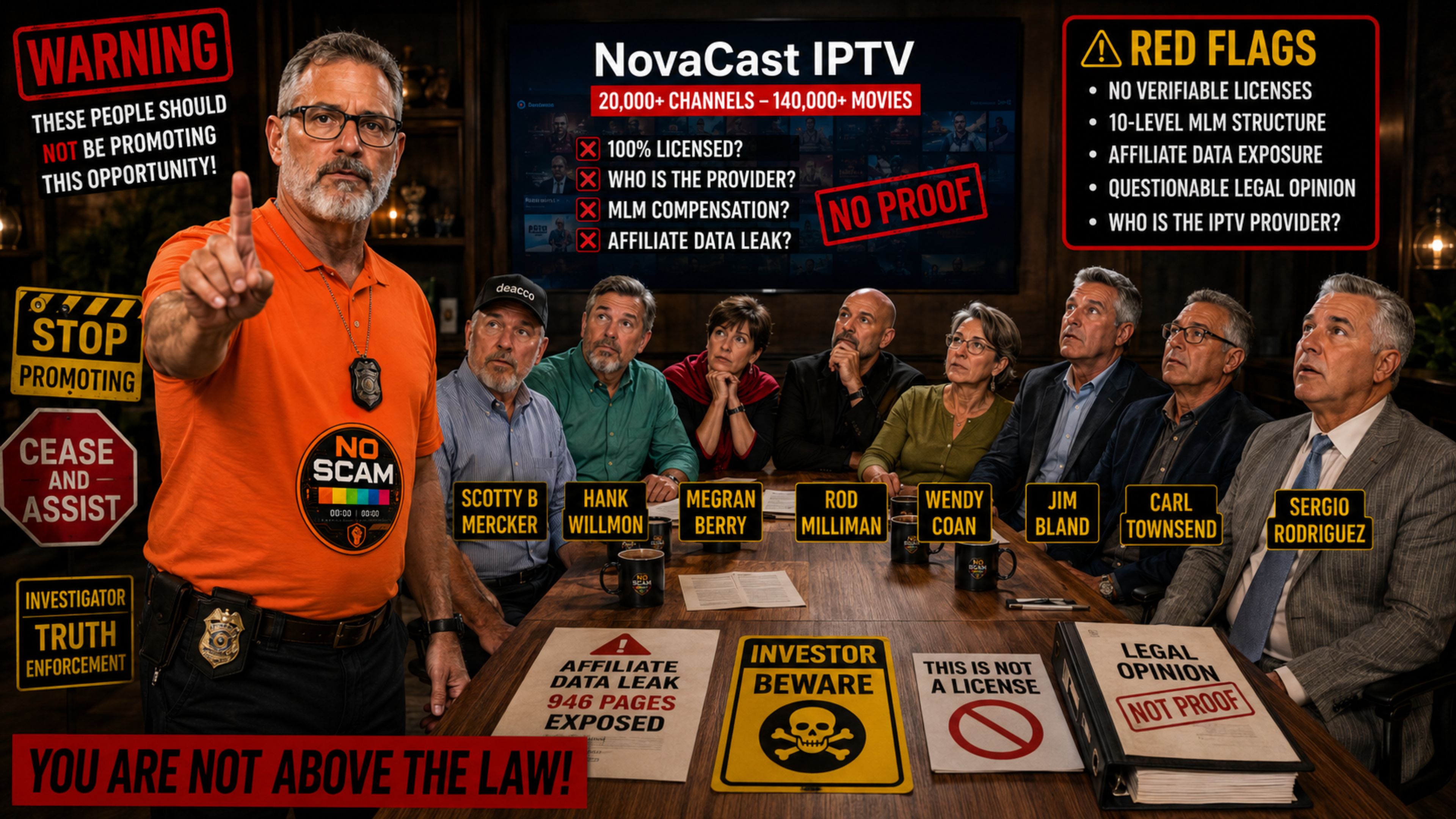
“I have a question, does Danny like any programs or services out there at all???”
That question appeared in my live chat while I was sitting inside another NovaCast presentation, listening to claims I had already spent months trying to verify.
Around it came the predictable noise that follows investigations like this. I was called a scammer and a fraud, accused of making money by “bashing” businesses, challenged to produce an investigator’s licence and asked why anybody would spend so much time investigating what other people were doing.
 Underneath the insults, however, was a legitimate question worth answering
What would convince me that NovaCast IPTV is legitimate?
The answer is remarkably simple: evidence.
I first investigated NovaCast because I wanted to understand how a $49.95-a-month IPTV service could offer an enormous catalogue of television, movies, premium entertainment and sport while assuring customers and affiliates that the content was “100% Licensed.” I followed the corporate trail into ACZ Media Group LLC, examined the affiliate structure, watched presentations, documented the people promoting it and started asking the question that should have been relatively easy to answer: who actually holds the rights allowing this content to be distributed through NovaCast?
Months later, that question has not disappeared. Instead, the investigation has grown.

Since my original article, NovaCast has become more transparent about its leadership. Affiliates continue defending the service. A legal opinion attributed to California entertainment attorney Lawrence Paul Mortorff has been circulated as reassurance. I have listened to affiliates explain why they believe NovaCast is legitimate and heard admissions showing that at least some of those promoting it have not independently verified the underlying licences or even fully researched who owns the business.
Then I discovered something completely different.
NovaCast’s affiliate system was exposing individual affiliate pages through predictable URLs. These weren’t passwords, leaked files or information obtained by breaking into a private database. They were publicly accessible webpages displaying information affiliates had provided, including names, telephone numbers and email addresses. Once I recognised the pattern, I documented what the system was exposing.
 By 13 August 2026, I had preserved a snapshot containing 946 consecutive affiliate records, running from Nc15 through Nc960. Suddenly I wasn’t looking at isolated promoters appearing in Zoom meetings. I could see a substantial part of the affiliate network itself.
I began contacting people.
Some engaged with me. Others became defensive. One affiliate told me he was unwilling to provide information because of a confidentiality clause in his affiliate agreement. Inside NovaCast groups, participants began discussing my outreach and encouraging people to delete, block, report or ignore it. Another internal message acknowledged that affiliate names, telephone numbers and emails had been collected and advised members that they could apparently alter the information displayed on their affiliate pages by submitting a support ticket.
That discovery opened another line of investigation: what did ACZ Media’s own Privacy Policy promise, and how did those promises compare with what I had actually found?
Meanwhile, during my livestream covering a NovaCast meeting, supporters and critics argued in real time. Some comments made by people supporting my investigation included allegations that I cannot establish merely because somebody typed them into a chat room. I don’t intend to treat those claims as facts any more than I intend to accept NovaCast’s claims simply because a promoter repeats them.
The same evidential standard has to apply to both sides.
I now have corporate documents, privacy policies, recorded presentations, promoter activity, affiliate testimony, payment-system clues, the preserved affiliate infrastructure and a legal opinion being invoked to defend the service. I have also documented prominent promoters including Scotty B Mercker, Hank Willmon, Rod Milliman, Megran Berry, Wendy Coan, Gary Klasnic, Sergio Rodriguez and Shannon Simecek.
Their roles will be examined according to what the evidence shows they actually said and did—not simply because their names appear in my files.
This investigation is therefore no longer about whether I personally “like” NovaCast. It is about separating what can be independently established from what hundreds of people may simply have been told.
If NovaCast has the rights it says it has, those rights should ultimately be capable of verification. If its compensation model has been mischaracterised, the current documentation should establish that. If affiliates knowingly agreed to have their personal contact information published through publicly accessible pages, NovaCast should be able to demonstrate that. And if the legal opinion proves the underlying content is properly licensed, its scope should withstand scrutiny beyond the affiliate network using it as reassurance.
A legitimate business does not become illegitimate because I investigate it. And an illegitimate business does not become legitimate because hundreds of people believe what they were told.
This time, I wanted to go further than the marketing, arguments and personalities.
I wanted to find out what NovaCast can actually prove.
What NovaCast Is Claiming Now
 When I first started looking at NovaCast, the attraction was easy to understand. The service was being presented as an alternative to the increasingly fragmented world of streaming subscriptions: one monthly payment, an enormous catalogue of entertainment, live television and sport, without having to maintain multiple subscriptions. On paper, it sounds like exactly the product many consumers would want.
NovaCast’s current marketing has made that proposition even clearer. The service is advertised at $49.95 per month, with claims of more than 15,000 live television channels, 130,000 movies and 30,000 television series. Its website promotes access to major sporting content including the NFL, NBA, MLB and NHL, alongside entertainment associated with household names such as Netflix, HBO, Prime, Paramount and Showtime.
There is nothing inherently suspicious about IPTV technology. IPTV is simply a method of delivering television through internet protocol, and perfectly legitimate companies use it every day. The question has never been whether IPTV itself is legal.
The question is whether NovaCast has the necessary rights to distribute what it is selling.
That distinction becomes particularly important because NovaCast doesn’t market its licensing position cautiously. It makes the unequivocal claim “100% Licensed Content.” For an affiliate trying to sell the service, that statement provides enormous reassurance. For a consumer wondering how so much premium entertainment can apparently be assembled into one comparatively inexpensive subscription, it appears to answer the most obvious concern before it is even raised.
There is another unusual feature to the way NovaCast reaches those consumers. Rather than operating solely like a conventional streaming platform where customers discover the service, visit the website and purchase directly, NovaCast has deliberately built distribution around affiliates and what it calls Marketing Partners. Prospective subscribers are directed back toward the person who introduced them to the service, turning individual promoters into an important part of the customer-acquisition process.
That helps explain what I kept seeing in Zoom presentations and promotional material. NovaCast wasn’t simply selling television. It was selling an opportunity to sell television to other people, with a compensation structure sitting behind the subscription.
The company has also added considerable perceived value around the core product. Current promotional material connects an active NovaCast subscription with access to the Five Diamond Lifestyle & Vacation Club, presenting a membership it values at a $999 initiation fee plus $299 per month, with those costs reportedly waived while the NovaCast customer or affiliate remains active. That creates an increasingly ambitious proposition: entertainment, sport, thousands of channels, an enormous on-demand library, an affiliate income opportunity and lifestyle benefits wrapped around a $49.95 monthly service.
None of those claims should be dismissed simply because they sound generous.
But the bigger the promise, the more important the documentation behind it becomes.
That is where my second investigation began to diverge from the first. I wasn’t interested in arguing with affiliates about whether $49.95 represented good value, or whether somebody enjoyed using the service. A functioning television stream proves that a stream exists; it does not establish who owns the rights to distribute it.
NovaCast had now placed the central claim in plain sight: 100% licensed.
So I started there.
NovaCast Has Finally Named Its Leadership
One of the criticisms surrounding NovaCast during my earlier investigation was how difficult it was to establish exactly who stood behind the operation. NovaCast has now publicly provided two names.
NovaCast’s current public-facing material identifies Jim Bland and Carl Townsend as Co-Founders and Co-CEOs. That is an important development and one I want to acknowledge rather than continue describing the company using information that has since changed. Transparency should be recognised when it improves, even when the business itself remains under investigation.
However, I am now independently attempting to verify those identities and the roles NovaCast attributes to them. I have located individuals whose professional backgrounds appear consistent with the biographies published by NovaCast, but I do not intend to simply assume that I have identified the correct people because NovaCast has placed their names on a webpage.
I have therefore begun contacting them directly and publicly seeking confirmation. If Jim Bland and Carl Townsend are indeed the individuals identified by NovaCast, I want to hear that from them and give them an opportunity to answer the questions raised by this investigation.
Putting names and biographies on an About page is certainly more transparent than providing no identifiable leadership at all. But it doesn’t answer the underlying questions. It simply gives us names and professional histories that can now be independently investigated.
That matters because NovaCast isn’t being promoted as an experimental streaming project. Affiliates are presenting it as an established, legitimate service capable of delivering an extraordinary catalogue of licensed entertainment. NovaCast itself has promoted a “10-Year Excellent Track Record,” despite the NovaCast operation I have been documenting emerging much more recently. If that ten-year claim refers to an underlying provider, technology platform or previous business, then identifying exactly what possesses that track record becomes important.
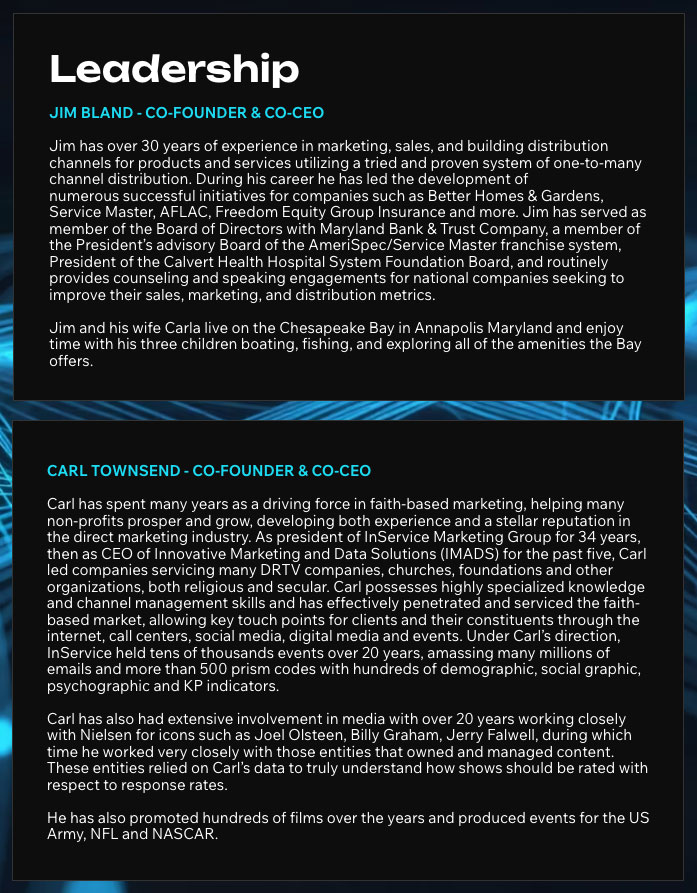
The corporate structure also deserves clarification. Throughout this investigation I have encountered several names connected to the operation, including NovaCast, NovaCast Television Network, Nova-Cast LLC and ACZ Media Group LLC. ACZ Media is particularly important because its own customer Terms and Conditions state that it provides the associated NovaCast subscription and charges $49.95 per month. Its Privacy Policy likewise describes NovaCast as an ACZ Media product or affiliated service.
In other words, there is the brand consumers see, the people NovaCast now publicly identifies as leading it, and the corporate/payment infrastructure operating around it.
I wanted to understand how those pieces fit together.
The affiliate network adds another layer. While NovaCast now publicly identifies Bland and Townsend as occupying its leadership positions, NovaCast’s growth depends heavily on people further down the distribution chain. During my monitoring I repeatedly encountered promoters including Scotty B Mercker, Hank Willmon, Rod Milliman, Megran Berry, Wendy Coan, Gary Klasnic, Sergio Rodriguez and Shannon Simecek. I have accumulated presentations, discussions and other material connected with these individuals because prominent promoters matter when a business relies on people to carry its claims into Zoom meetings, social media and private communities.
I am not placing every person in that group on the same footing, nor am I suggesting that appearing in an affiliate network automatically makes somebody responsible for everything NovaCast does. Their individual conduct has to be assessed from the evidence.
What interests me is what happens when those promoters are challenged.
Do they produce licensing documentation? Do they explain the corporate relationships? Do they understand who supplies the content? Or are they simply repeating assurances passed down from somebody further up the organisation?
I would eventually get an unusually clear glimpse of that process from inside the affiliate network.
But first I needed to deal with the claim sitting above everything else.
Who actually licensed the content?
The “100% Licensed” Claim Is The Question That Matters
 NovaCast’s strongest reassurance is also the easiest claim to understand: “100% Licensed Content.” It is not vague wording about working with providers or attempting to comply with copyright law. It is a direct representation to prospective customers that the content being sold through the service is licensed.
That distinction matters enormously when the offering includes thousands of live channels, movies, television series and major sporting events. Somebody must possess the legal authority to distribute that content. There may be wholesalers, aggregators, intermediaries and technology providers between NovaCast and the original rights-holder, but somewhere along that chain there should be documentation establishing the right to deliver the content being sold.
So that is what I have repeatedly tried to verify.
I am not suggesting NovaCast needs to publish commercially sensitive contracts on the internet. Nor am I claiming that every affiliate should possess copies of confidential licensing agreements. But there is a substantial difference between protecting confidential commercial terms and providing no independently verifiable evidence whatsoever that the advertised licensing arrangements exist.
If NovaCast is genuinely distributing licensed programming through an upstream provider, some basic questions should be answerable: Who is that provider? What rights does it hold? What territories are covered? Does the agreement permit NovaCast or ACZ Media to redistribute the programming commercially to subscribers? Most importantly, can any relevant party in the licensing chain independently confirm the relationship?
Those questions become even more significant when affiliates use the phrase “100% licensed” to overcome precisely the concern a reasonable consumer might have about an IPTV service offering this volume of premium content for $49.95 a month.
During my investigation, I heard explanations. I heard assurances. I heard affiliates tell each other that the licensing had been dealt with.
What I did not receive was the evidence that would allow me to independently verify the central claim.
This is an important distinction because absence of publicly available proof is not, by itself, proof of piracy. I cannot responsibly jump from “NovaCast hasn’t shown me the licences” to “therefore every stream is illegal.” That would go beyond the evidence I currently have.
But the burden does not belong to the investigator to prove NovaCast’s advertising claim for them.
If a company chooses to market itself using the categorical statement “100% Licensed Content,” then it should have a reasonable basis for making that representation. And when serious questions are raised about those rights, repeatedly pointing back to promoters, internal assurances or a legal opinion is not the same thing as independently establishing the underlying licences.
That legal opinion became particularly important because affiliates appeared to regard it as one of the strongest answers to the licensing question.
So I tracked down the attorney whose name was being used.
The Lawyer’s Letter Affiliates Keep Relying On
When questions about NovaCast’s licensing began circulating, one document repeatedly surfaced as reassurance: an “Independent Legal Opinion” dated March 12, 2026, attributed to California attorney Lawrence Paul Mortorff.
Mortorff is not a fictional lawyer or somebody whose credentials are difficult to establish. California State Bar records identify Lawrence Paul Mortorff, Bar #57851, as an active attorney admitted in December 1973. His profile lists Entertainment & Sports as a self-reported practice area, and he is associated with the Intellectual Property Law section of the California Lawyers Association.
That makes the document worth taking seriously.
But it also makes understanding exactly what Mortorff was asked to examine considerably more important.
The opinion being circulated among NovaCast promoters reportedly identifies Mortorff as counsel to NovaCast Television Network LLC and refers to his review of an agreement involving an underlying IPTV partner, NovaCast’s business model and documentation provided by his client. Affiliates have subsequently pointed to the existence of this legal opinion when challenged about whether NovaCast is operating legitimately.
There is an important evidential distinction here.
A lawyer reviewing documents supplied by a client is not necessarily the same thing as that lawyer independently verifying every underlying content licence with the original rights-holders. The scope of the engagement matters. The documents reviewed matter. The assumptions and qualifications contained in the complete opinion matter.
During one recorded conversation I reviewed, NovaCast affiliate Sergio Rodriguez referred to the document when the licensing issue arose:
“They’ve shown us affiliates, a letter from a supposedly well-known Hollywood lawyer.”
That answer caught my attention because Sergio was relying on the existence of the letter, but he did not appear able to explain what had actually been independently verified.
The conversation became even more interesting when another participant said the attorney behind the letter had previously been contacted and apparently did not recognise NovaCast or some of the individuals being discussed. Sergio responded by suggesting that perhaps another associated business had hired the lawyer.
That is not evidence that Mortorff disavowed his opinion, and I am not going to report somebody else’s recollection of a conversation as though it were Mortorff’s own words.
So I went directly to Lawrence Mortorff.
I sent him a formal right of reply asking whether he authored the March 12 opinion, whether he was acting as counsel to NovaCast Television Network LLC, who retained him, and—critically—whether he independently verified the underlying content rights or relied upon agreements and documentation supplied by his client.
I also asked him to identify the “IPTV partner” referenced in the opinion, whether his review established the rights necessary to distribute the specific programming NovaCast advertises, whether he authorised his opinion to be circulated to affiliates as reassurance of “100% Licensed Content,” and whether the March 2026 opinion still represents his professional position today.
I have also requested the complete opinion rather than relying upon extracts or interpretations circulated through the affiliate network.
That is important because I am not trying to prove the lawyer wrong.
I am trying to establish what the lawyer actually proved.
Until Mortorff answers those questions—or the underlying licensing chain is independently verified—the existence of a legal opinion should not be confused with independently verified evidence that every channel, movie, television series and sporting event advertised by NovaCast is properly licensed for the manner in which it is being distributed.
Inside A Conversation With Sergio Rodriguez
One of the most useful moments in this investigation did not come from a corporate filing, privacy policy or marketing presentation. It came from listening to NovaCast affiliate Sergio Rodriguez explain why he believed the service was legitimate when somebody actually challenged him on the evidence.
The conversation is important because Sergio did not present himself as somebody running NovaCast. Quite the opposite. He repeatedly distanced himself from responsibility for the company, describing himself as an “independent affiliate.” That makes his answers useful for understanding what at least one person inside the distribution network had been given—and what he had independently verified—before associating himself with the service.
When licensing came up, Sergio pointed to the attorney’s letter:
“They’ve shown us affiliates, a letter from a supposedly well-known Hollywood lawyer.”
But as the questioning continued, something revealing happened. Sergio wasn’t able to bridge the gap between being shown reassurance and independently establishing that NovaCast possessed the rights it claimed.
At one point he acknowledged:
“I’m not qualified to answer any of these questions.”
Later, discussing the people behind the business, he made another important admission:
“I haven’t researched who owns—who actually owns NovaCast.”
I don’t quote those statements to ridicule Sergio. They demonstrate something much more important about the mechanics of affiliate marketing. A person can become sufficiently confident in a business to promote it without independently verifying some of the most fundamental claims behind the product.
The conversation repeatedly returned to trust. Sergio reasoned that people associated with NovaCast had other businesses they presumably would not want to jeopardise. He referred to what affiliates had been shown. He discussed what the company claimed. And when the prospect of larger organisations becoming involved was raised, his reasoning effectively shifted the due-diligence burden further downstream.
“Eventually one of these big companies is also going to hire their own big, expensive legal team to verify whether they have a license or not.”
That sentence gets to the heart of a problem I have seen repeatedly during investigations.
One person assumes somebody upstream checked. Another assumes the lawyer checked. An affiliate assumes management checked. A prospective customer assumes the affiliate wouldn’t be selling it without checking. And eventually everybody believes that somebody, somewhere, must have performed the verification.
But who actually did?
Sergio also repeatedly returned to his position as an independent affiliate when potential consequences were discussed:
“They are. Not me. I’m just an independent affiliate.”
That raises a separate issue from whether Sergio himself has done anything wrong. NovaCast’s marketing model places independent people between the company and consumers. Those people can repeat claims such as “100% Licensed Content” while simultaneously regarding the underlying licensing arrangements as the company’s responsibility.
That is why I became less interested in arguing with individual affiliates and more interested in the information NovaCast gives them.
What evidence are affiliates supplied before they repeat the licensing claim? What training are they given about representations they can make to prospective customers? Are they told who the upstream content provider is? Are they given anything independently verifiable beyond the legal opinion? And if an affiliate cannot answer those questions, who inside NovaCast can?
There were plenty of accusations thrown around during this conversation, including claims about previous IPTV operations, possible enforcement action and what might happen to affiliates if the service were ever found to be unauthorised. I am deliberately not treating those statements as established facts simply because they appeared in a recorded discussion.
The valuable evidence is what Sergio himself demonstrated.
He had been shown a letter. He had accepted assurances. He believed there were reasons the people involved would not risk operating an unlawful service.
But when the conversation reached the underlying evidence, belief and verification turned out to be two very different things.
The Promoters Keeping NovaCast Moving
Sergio Rodriguez is only one part of a much larger distribution network. Throughout this investigation, I have repeatedly encountered a core group of people publicly promoting, presenting, defending or otherwise helping move NovaCast through affiliate communities: Scotty B Mercker, Hank Willmon, Rod Milliman, Megran Berry, Wendy Coan, Gary Klasnic, Sergio Rodriguez and Shannon Simecek.
These are not names I am including simply because they appeared somewhere in the affiliate database. By August 2026, I had documented hundreds of people connected to the system. Being an affiliate is not automatically the same thing as being a significant promoter. I am interested in the people who repeatedly put themselves forward around the opportunity and help carry NovaCast’s claims to prospective customers and affiliates.
What promoters say matters because most people joining something like NovaCast are unlikely to begin by researching corporate structures, content-rights agreements or IPTV distribution law. They attend a Zoom. They listen to somebody they trust. They see a presentation explaining the product, hear assurances about legitimacy and licensing, and are shown how they can participate.
That human layer is what turns a website into a network.
Scotty B Mercker deserves particular scrutiny because he has become one of the most visible personalities I have documented around NovaCast. I have watched his promotional activity, documented his involvement and repeatedly encountered his name while following the people helping move this opportunity through affiliate communities.
His history also matters. During this investigation, people repeatedly pointed me towards Scotty’s earlier activity involving IPTV and other network-marketing ventures. I am deliberately careful here. Previous involvement with another opportunity does not prove NovaCast is unlawful, and I am not going to build a case from somebody saying in a chat room that “Scotty has done this before.”
Where I connect Scotty to previous operations, I want primary evidence: archived websites, recordings, presentations, promotional material or his own statements. If those records demonstrate recurring promotional behaviour, then that history becomes relevant—not because association equals guilt, but because experienced promoters should understand the importance of performing due diligence before encouraging other people to follow them.
That brings us directly back to NovaCast.
When somebody repeatedly helps introduce people to a service making a claim as significant as “100% Licensed Content,” I think it is reasonable to ask what that promoter personally verified. Has Scotty seen the underlying licensing agreements rather than simply being shown the legal opinion? Does he know the identity of the upstream IPTV provider? Can he explain how NovaCast is authorised to distribute the premium entertainment and sporting content being advertised?
Those are not trick questions. They are questions I would expect an experienced promoter to have asked before putting his reputation behind the service.
The same standard applies to Hank Willmon, Rod Milliman, Megran Berry, Wendy Coan, Gary Klasnic, Sergio Rodriguez and Shannon Simecek. If they make claims about NovaCast’s licensing, compensation, ownership or legitimacy, I want the original presentation or statement wherever possible. If they recruit people, I want to understand what those people are being told. If they challenge my reporting, I want their evidence included and tested fairly.
As scrutiny increased, however, I began seeing something else. Instead of the central questions disappearing, some affiliates turned their attention towards the investigation itself. During one livestream, a hostile participant accused me of making money by “bashing” businesses and demanded to see my “investigator’s license.” Elsewhere inside the NovaCast community, affiliates discussed my outreach and encouraged others to block, report or ignore it.
Those attacks do not prove NovaCast is operating unlawfully.
They also don’t answer the questions.
If these promoters can produce independently verifiable evidence establishing the licensing chain, I want to see it. If the compensation structure has been misrepresented, produce the current documentation. If something in my investigation is demonstrably wrong, show me what is wrong and provide the evidence necessary to correct it.
Because the more I watched the promotional network operate, the more obvious the underlying mechanism became.
NovaCast’s credibility was being carried from person to person through a network of trust.
I wanted to see the machinery underneath it.
How The Affiliate Machine Actually Works
Once I moved past the personalities, the next thing I wanted to understand was the compensation structure itself. NovaCast is, after all, selling a real consumer product: a $49.95 monthly television service. That distinction is important because the existence of an affiliate programme does not automatically make something a pyramid scheme, and paying somebody a commission for referring a genuine retail customer is commonplace.
The question is what happens beyond that first referral.
The compensation material I reviewed described a 10-level unilevel structure, meaning commissions could extend far beyond the person who directly introduced a customer. That is why I have never accepted the response I repeatedly hear from defenders: “You don’t get paid for recruiting people.” That statement may be technically true while completely avoiding the issue. If I recruit an affiliate, that affiliate obtains customers, their recruits obtain customers, and revenue generated through that organisation produces commissions or overrides multiple levels above them, then recruitment still has an obvious economic function even if the commission is formally calculated on customer subscriptions rather than a recruitment fee.
This distinction became particularly obvious when one NovaCast defender entered my livestream and insisted the opportunity was free to join and that “you make no money for recruiting.”
My response was simple: then show me how the ten levels work.
I am particularly interested in resolving another issue from the earlier investigation. Previous compensation information indicated that the $49.95 monthly payment was connected with maintaining active status, while current defenders have challenged the suggestion that affiliates themselves must pay $49.95 to participate. Rather than repeating the earlier interpretation indefinitely, I want the current official compensation plan and affiliate agreement examined against what NovaCast is actually doing today.
If participation really is completely free, that should be easy to establish. If an affiliate can remain commission-qualified without personally subscribing to NovaCast, document it. If there are customer requirements, volume requirements, rank qualifications or other conditions attached to receiving commissions through all ten levels, publish them clearly.
Those details determine what the business model actually incentivises.
There is also a behavioural clue in the way the opportunity has been presented. In material from the earlier investigation, promoters were reportedly cautioned against describing NovaCast as an MLM. That immediately raises an obvious question: why would terminology matter if the compensation structure itself is straightforward and defensible? Whether somebody calls it affiliate marketing, referral marketing, network marketing or a Marketing Partner programme does not change the underlying mathematics.
That mathematics is what I want to document.
How much subscription revenue comes from genuine retail customers who have no interest in the income opportunity? How many of the people paying $49.95 are themselves affiliates? What percentage of commissions is generated from personally referred retail customers compared with customers elsewhere in an affiliate’s downline? How many affiliates actually receive commissions, and how concentrated are those commissions among the upper levels of the organisation?
Those figures would tell us far more than arguing about labels.
And then something happened that gave me an entirely different way of looking at the network.
I found the affiliates themselves.
I Found The NovaCast Affiliate Network Sitting In Public View
The discovery did not begin with a leaked database, a disgruntled insider or somebody handing me confidential company records. It began with something much simpler: NovaCast affiliate webpages that anybody on the internet could access.
The pages followed a predictable structure. An affiliate could have a public address such as novacast.info/Nc100, with the number identifying the individual affiliate page. Change the number and another page could appear. Once I realised this was happening sequentially, I started examining the pattern.
What I found immediately raised a privacy question.
Individual pages were displaying contact information supplied by affiliates, including combinations of names, telephone numbers and email addresses. There was no need to log into an affiliate’s account to see the information I was examining. I wasn’t bypassing a password, exploiting an authentication system or breaking into NovaCast’s back office. The information was being delivered through publicly accessible webpages.
So I documented it systematically.
By 18 August 2026, the resulting snapshot contained 946 consecutive affiliate records, running from Nc15 through Nc960. There were no missing affiliate IDs anywhere within that sequence. Of those records, 831 contained an email address and 767 contained a telephone number.
Suddenly, what I had previously been watching one Zoom meeting at a time could be examined as a network.
The records also gave me something far more valuable than a list of people to criticise. They provided potential witnesses. Affiliates could tell me what they had been shown before joining, who introduced them, whether they were customers as well as promoters, what they understood about the licensing, how commissions were explained and what happened after they signed up.
I began reaching out.
One person who contacted me independently described spending almost four hours trying unsuccessfully to install the NovaCast service on his television, despite considering himself reasonably technically capable. Importantly, he also told me that when he sought a refund, he received it quickly. That positive detail belongs in the investigation just as much as his criticism of the installation experience does. Evidence does not become inconvenient simply because it cuts both ways.
Other contacts were more cautious. One affiliate, Robert Baran, initially appeared willing to discuss his experience but subsequently told me he was going to hold back because his affiliate agreement contained a confidentiality clause and he was concerned about possible repercussions or legal action. He also told me that my investigation and the calls being made to affiliates had been discussed during a NovaCast Zoom presentation.
That was particularly interesting.
The affiliate network now knew I had found it.
And before long, messages from inside the NovaCast community began explaining exactly what had happened:
“Affiliate names, numbers, and emails were scrubbed from the internet by an anti-Novacaster… The info has been captured.”
The same message reportedly advised affiliates that, if they wished, they could alter the information displayed on their affiliate website—including removing a phone number or email address—by submitting a support ticket through their back office.
That response matters because it independently reinforces the central point of my discovery: the information was being exposed through the affiliate websites themselves.
I have deliberately not published a giant directory of people’s private contact details in this investigation. Preserving publicly exposed information as evidence and using it to contact potential sources is very different from republishing hundreds of telephone numbers and email addresses for the world to browse.
The database nevertheless remains important evidence.
It documents the scale of NovaCast’s affiliate infrastructure at a particular moment in time, gives me a baseline against which later changes can be compared, and demonstrates something affiliates themselves should probably be asking NovaCast about.
Because once people realised their information had been collected, much of the anger was directed at the investigator who found it.
Far less attention seemed to be directed at the system that made it collectable in the first place.
When The Affiliates Realised Their Details Had Been Exposed
The reaction inside the NovaCast community became part of the investigation almost immediately. Rather than disputing that the affiliate pages contained names, phone numbers and email addresses, one message circulating inside the group effectively acknowledged what had happened and offered affiliates advice on how to respond.
“Affiliate names, numbers, and emails were scrubbed from the internet by an anti-Novacaster… The info has been captured.”
The wording described me as an “anti-Novacaster” and blamed the discovery on the “downside of AI,” but the most revealing part came next. Affiliates were told that they could apparently alter the information displayed on their affiliate website—including removing their phone number or email address—by submitting a support ticket through the back office.
That is important. If those instructions are accurate, NovaCast itself had a mechanism for changing the very information I had discovered sitting publicly on its affiliate pages.
The message then shifted from the exposure itself to what affiliates should do about my attempts to contact them:
“Delete. Block. Report. Ignore.”
It also warned members to be thankful they had not been “fully doxxed” and advised them not to antagonise me because doing so would supposedly “prolong his resolve to upset the system.”
I reject the suggestion that what I did amounts to doxxing. I discovered publicly accessible affiliate webpages while investigating a commercial operation and preserved the information exposed on those pages as evidence. I have not published the database of telephone numbers and email addresses as a public directory. I have used contact information to approach potential sources, ask questions and understand the mechanics of the organisation.
There is another distinction worth making. Nobody receiving an investigative inquiry is obliged to speak with me. An affiliate is perfectly entitled to delete my message, block my number or tell me they don’t want further contact. What interests me journalistically is the apparent effort inside the community to discourage engagement while simultaneously characterising the investigation as harassment.
I saw the same pattern during my livestream.
A hostile participant entered the public chat and accused me of being a scammer, claimed I made money by “bashing all programs,” alleged that I hid positive reviews and demanded:
“Show me your investigators License”
Another question was actually more useful:
“does Danny like any programs or services out there at all???”
Yes. Of course I do. I use legitimate businesses and services every day. But my investigations are not product-review channels designed to balance every questionable operation with something nice to say about another company. I investigate businesses when there is a reason to investigate them. If the evidence ultimately resolves the concerns, I report that too.
The same participant later made a more substantive criticism:
“Get all the details first before bashing people and dragging their names thru mud”
On that principle, we actually agree.
That is precisely why I have spent months collecting the documents, recording presentations, contacting participants, examining the corporate structure, preserving the affiliate network, approaching the attorney whose opinion is being circulated and repeatedly asking for evidence supporting NovaCast’s licensing claims.
Some comments from people supporting my investigation went too far as well. Claims that somebody is committing felonies, that every IPTV service is illegal, or that particular people are inevitably going to prison are not established merely because somebody typed them into my livestream chat. I apply the same evidential standard regardless of which side a statement supports.
The more interesting question was being overlooked in all the arguing.
If hundreds of NovaCast affiliates were uncomfortable that an investigator could systematically obtain their contact information, why had their own affiliate infrastructure made that information publicly accessible in the first place?
That question became considerably more serious when I compared what I had discovered with ACZ Media’s own written Privacy Policy.
What ACZ Media’s Privacy Policy Promises
The affiliate-page discovery became more significant when I went back to the paperwork. ACZ Media Group LLC’s Customer Privacy Policy, effective April 2026, specifically says the company may collect a subscriber’s name, email address, phone number and billing address, along with payment information, account details, viewing history and device information.
There is nothing unusual about a streaming company collecting customer information. What matters is what it promises to do with it.
ACZ Media states that it is “committed to protecting your privacy” and says it uses industry-standard security measures, including SSL/TLS encryption and encrypted storage for sensitive information. The policy says reasonable precautions are taken to protect data against “unauthorized access, loss, or misuse.”
It also states:
“ACZ Media will not sell, trade, or transfer your personal information to any unaffiliated entities.”
The policy explains that information may be shared internally with affiliated entities such as NovaCast, with service providers assisting with platform operations, payments and customer communications, with authorities where legally required, or with a successor entity following a merger, acquisition or sale.
On paper, that sounds reassuring.
But my discovery wasn’t about whether ACZ Media sold somebody’s information to a marketing company. The issue was that contact information associated with NovaCast affiliates could be retrieved directly from publicly accessible affiliate webpages. Names, phone numbers and email addresses could be collected systematically because the URLs followed a predictable numerical sequence.
That creates a question the Privacy Policy does not appear to answer clearly: were affiliates explicitly told that the contact information they supplied could be displayed publicly on an internet-facing referral page and therefore potentially harvested at scale?
If they were, NovaCast should be able to point to the disclosure and consent mechanism.
If they weren’t, the internal response becomes particularly interesting. Affiliates were subsequently told that they could apparently submit a support ticket to remove their phone number or email address from their affiliate website. That sounds less like an impossible technical problem and more like a configurable feature of the system.
I also reviewed ACZ Media’s Customer Terms & Conditions, effective April 2026. Those terms describe NovaCast as the monthly streaming subscription associated with ACZ Media and set the price at $49.95 per month. Customers authorise recurring charges, cancellations must generally be submitted at least 72 hours before the next billing date to avoid another charge, and refund requests for the current billing cycle are considered case by case.
The documents therefore provide something the promotional material sometimes obscures: ACZ Media is not a peripheral name sitting somewhere in the background. Its own legal documents place it directly into the customer relationship surrounding NovaCast.
That makes accountability much easier to follow.
If NovaCast’s affiliate infrastructure exposed personal contact information, who designed and controlled those pages? Which entity received the information? What privacy notice applied when an affiliate supplied it? Was public display the default? Could affiliates opt out when registering? And after the exposure became known, was the underlying system changed or were individual affiliates simply told to request removal?
Those are questions I intend to put to the people responsible.
But the ACZ Media documents revealed another trail worth following. Customers were not simply being given access to television; somebody also had to collect the $49.95 recurring payment.
So I followed the checkout.
Following The $49.95 Payment
Once I reached the payment stage, I wanted to establish something very specific: who is actually handling NovaCast customers’ money? The $49.95 subscription is central to the entire operation, yet identifying the payment infrastructure was considerably less straightforward than clicking a familiar Stripe or PayPal logo.
ACZ Media’s Terms & Conditions state that the NovaCast subscription costs $49.95 per month. Interestingly, those terms say the first subscription payment is charged 25 days after initial activation, with subsequent charges occurring every 30 days. Customers authorise ACZ Media to continue charging their payment method until cancellation.
The Privacy Policy adds another piece. It says credit and debit card information is processed through a “secure payment processor”, but the document provided to customers does not name that processor.
So I went through the payment process myself and opened the technical tools running behind the checkout.
When the Add Payment Method interface loaded, I found that the card-entry component was being delivered from infrastructure at:
pillars-payment-stage.webhublink.com
I could also see requests associated with AddCardFrameMetricsGlobal, with the payment interface loading its own scripts, styles and other resources through that WebHubLink environment.
That is an important technical finding, but I want to be precise about what it proves.
It establishes that WebHubLink/Pillars infrastructure was involved in delivering the hosted payment interface I observed. It does not, by itself, establish that WebHubLink is the ultimate card processor, acquiring bank or merchant account provider receiving NovaCast transactions.
There may be another company further downstream.
That distinction became important because payment processing is potentially one of the most consequential parts of the investigation. If a streaming service is making representations about possessing the rights to distribute premium copyrighted material, the financial institutions servicing that business may have their own requirements concerning prohibited businesses, intellectual-property infringement, chargebacks and merchant risk.
I therefore began tracing the payment chain rather than simply naming the first company appearing in the browser.
I examined network requests, hosted payment frames and the domains communicating with the checkout. Earlier claims made during conversations around the investigation had suggested other companies might be processing NovaCast payments, but I am not going to identify a company as NovaCast’s processor merely because somebody said its name during a Zoom call or livestream. Technical evidence has to support it.
The payment trail also intersects with the privacy issue.
ACZ Media tells customers that payment information is processed through a secure third-party processor, while its broader infrastructure has already raised questions about how affiliate contact information was exposed. That makes identifying every significant company handling customer information and payments more than a technical exercise. Those companies may need to understand what kind of merchant their infrastructure is supporting and what representations are being made to consumers.
At this stage, I can document the WebHubLink/Pillars connection.
What I cannot yet responsibly publish is the name of the final acquiring processor as established fact.
And that unresolved piece is important because the money trail may ultimately tell us something the promotional presentations cannot.
What The Affiliates Started Telling Me
Once I began contacting people inside the NovaCast network, the investigation stopped being purely structural. I was no longer looking only at websites, policies and compensation slides. I was hearing directly from people who had actually signed up, tried to use the service or agreed to promote it.
One response came from Jerry Hinson, who had subscribed to NovaCast and described the installation process as a complete mess. Jerry told me he considers himself reasonably technical and is usually the person friends call when they have technology problems. Despite that, he said he spent almost four hours trying to get NovaCast working on his television and was no closer to success than when he started.
That matters because NovaCast is sold as a consumer product, not a specialist technical project.
Jerry’s experience did contain one positive detail that belongs in the record: he asked for a refund and said it was processed quickly. I include that because the purpose of this investigation is not to remove anything that makes NovaCast look better. If a customer received a prompt refund, that is evidence too.
Another contact, Robert Baran, approached the investigation from the affiliate side. He initially appeared willing to share information, but later explained that he was holding back because his affiliate agreement contained a confidentiality clause and he was concerned about possible legal repercussions if he provided internal information.
Robert also told me something else that immediately caught my attention: my investigation and the calls being made to affiliates had been discussed during a NovaCast Zoom presentation, including what he described as the company’s position and the course of action being sought.
He chose to remain on the sidelines.
I understood why. But that response also illustrated another feature of the network. An affiliate can decide not to speak publicly, yet their association with NovaCast may still remain visible through the company’s own affiliate infrastructure. In Robert’s case, his concern about confidentiality sat alongside a broader question about what affiliates themselves should do when serious questions are being raised about the business they are publicly associated with.
Other affiliates responded with hostility rather than caution.
Some accused me of harassment. Others questioned why I cared so much. One repeatedly insisted that “you make no money for recruiting” and challenged my description of the compensation structure. Another asked whether I liked any programs at all.
Those reactions were useful because they exposed the defensive arguments NovaCast affiliates were relying on.
The strongest defence was rarely documentary.
It was usually some version of: the company says it is licensed; the lawyer looked at it; management would not risk their other businesses; the service works; people are joining; larger organisations will eventually check.
Those are all reasons somebody might feel reassured.
They are not the same thing as independent verification.
That became the recurring pattern throughout my second investigation. The further I moved away from NovaCast’s marketing and closer to the people actually promoting it, the more often the legitimacy of the operation appeared to rest on trust flowing down through the network.
By this point, the pattern was clear enough. What remained were the questions NovaCast itself was in the best position to answer.
The Questions NovaCast Still Needs To Answer
After months of following NovaCast, I don’t think this investigation needs more theories. It needs answers.
The first remains the most important: who is the upstream IPTV provider, and who actually holds the rights to the content NovaCast is selling? If the service is “100% Licensed,” there should be a licensing chain capable of independent verification without requiring affiliates or customers simply to trust what they have been told.
The legal opinion attributed to Lawrence Paul Mortorff does not automatically settle that question. I have contacted Mortorff directly and asked what he reviewed, who retained him, whether he independently verified the underlying content rights, who the referenced IPTV partner is and whether affiliates are accurately representing the scope of his opinion.
If he responds, I will report his position fairly.
NovaCast also needs to clarify its 10-level compensation structure. Can somebody become and remain commission-qualified without personally maintaining a $49.95 subscription? What customer, volume or rank requirements apply? How much revenue comes from genuine retail customers compared with people participating in the affiliate opportunity? Those figures would tell us far more than arguing over whether NovaCast should technically be called an MLM.
Then there is the privacy issue.
By 18 August 2026, I had documented 946 sequential affiliate pages from Nc15 through Nc960, with hundreds exposing names, telephone numbers and email addresses through predictable publicly accessible URLs. Affiliates were subsequently told they could apparently submit support tickets to remove some of that information.
Were affiliates clearly told their contact details would be publicly displayed? Was that optional? Why could the pages be systematically enumerated? And what did NovaCast change once it became aware the information had been collected?
ACZ Media Group LLC should also explain its role clearly. Its own Terms & Conditions place it directly within the $49.95 NovaCast subscription relationship, while its Privacy Policy addresses the collection and protection of customer information. I have also documented WebHubLink/Pillars infrastructure within the payment interface, although I have not established the ultimate card processor or acquiring bank and will not pretend otherwise.
Finally, there are the people selling the opportunity. Jim Bland and Carl Townsend, now publicly identified as NovaCast’s Co-Founders and Co-CEOs, are in a position to answer these questions. The prominent promoters carrying NovaCast’s claims into Zoom meetings and affiliate communities should also be asking them.
None of this requires NovaCast to prove something impossible.
Identify the licensing chain. Clarify the corporate relationships. Publish the current compensation rules. Explain the affiliate-data exposure. Identify the upstream provider. Clarify precisely what the lawyer’s opinion establishes.
If my reporting is wrong, primary evidence is the fastest way to demonstrate it.
Until then, these aren’t questions created by critics of NovaCast. They arise directly from the claims NovaCast itself has chosen to make and the evidence I discovered while investigating them.
Why This Investigation Is Different Now
When I published my first investigation into NovaCast, I was largely working from the outside looking in. Since then, I have sat inside the Zoom presentations, listened to affiliates defend the business in their own words, spoken with people connected to NovaCast, preserved its publicly accessible affiliate infrastructure and watched the organisation react after discovering that those pages could be systematically documented.
By 18 August 2026, I had preserved 946 consecutive affiliate records. More importantly, I had watched how confidence in NovaCast travelled through the network.
An affiliate asks about licensing and is shown a lawyer’s letter. Another trusts the people above them. Someone points to the other businesses operated by those involved and reasons that they would never risk them. Another assumes a larger organisation will eventually conduct the due diligence.
That is how confidence can become self-reinforcing.
It does not require everybody involved to knowingly mislead somebody. In many questionable opportunities I have investigated, people further down the network genuinely believe what they are repeating. The danger begins when confidence travels faster than verification.
This investigation has also produced evidence that cuts against a simplistic narrative. One customer told me the installation experience was dreadful but said his refund arrived quickly. NovaCast has become more transparent about its leadership by publicly identifying Jim Bland and Carl Townsend. The service apparently works for people who are using it.
I am not going to hide those facts.
But none of them resolves the central issue. A functioning stream does not establish distribution rights. A satisfied customer does not establish copyright compliance. A registered company does not establish the legality of the underlying content. And hundreds of affiliates do not establish legitimacy simply because hundreds of people believe the opportunity is legitimate.
That is why I returned to NovaCast.
Not because somebody criticised me in a chat room. Not because I dislike IPTV. Not because I believe every affiliate is a scammer.
I returned because the network has grown, the evidence has grown, and NovaCast continues to make a claim that should ultimately be capable of independent verification:
“100% Licensed Content.”
After everything I have now collected, that remains the claim I am waiting for NovaCast to prove.
Amendment — SAGE Scholars Has Now Clarified Its Relationship With NovaCast
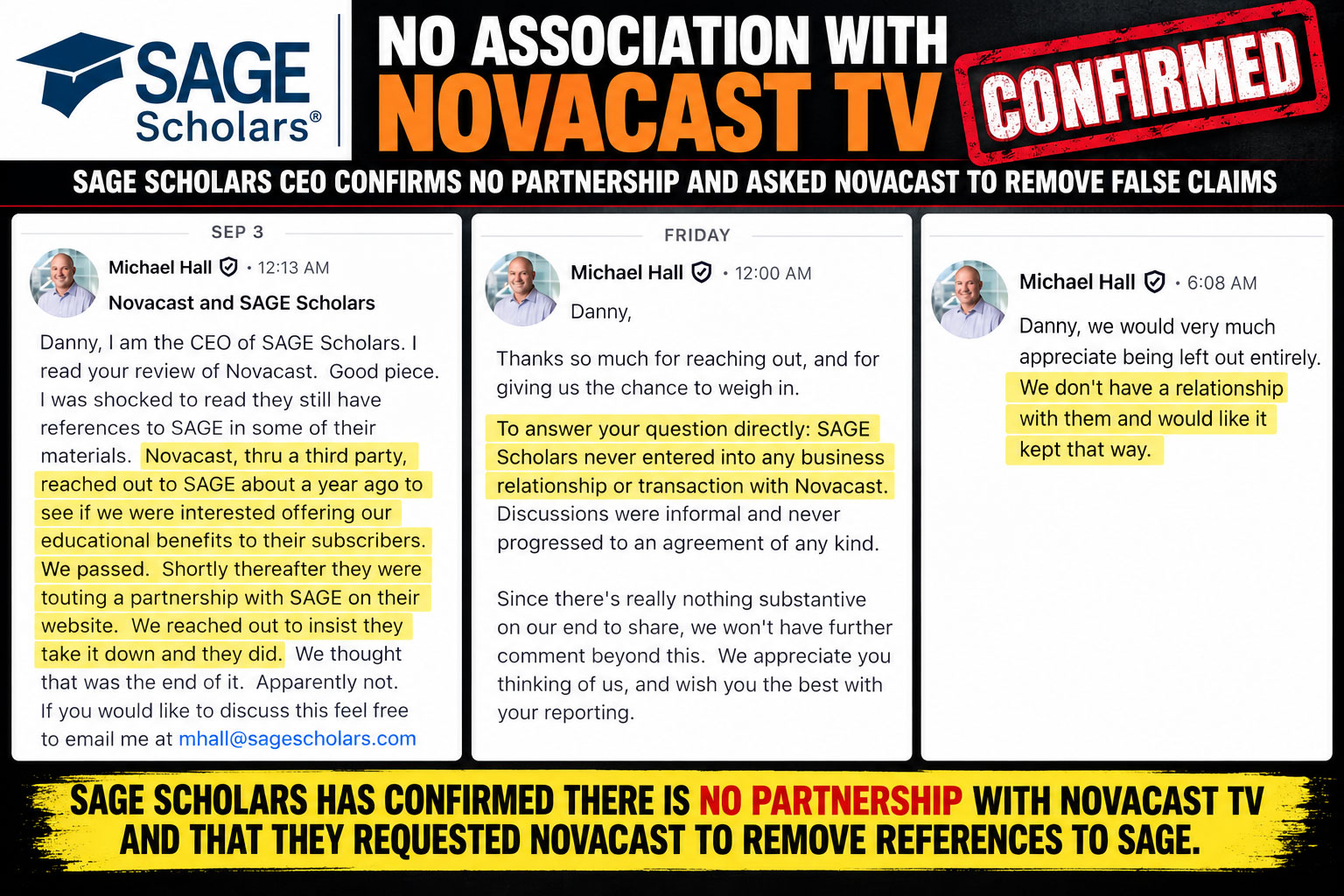
Since publishing this investigation, I have received an unexpected message from Michael Hall, CEO of SAGE Scholars, concerning references to his organisation in NovaCast’s promotional material.
Hall contacted me directly after reading my earlier NovaCast investigation. He said he was “shocked” to discover that references to SAGE were apparently still appearing in NovaCast-related material.
According to Hall, NovaCast had previously approached SAGE through a third party about offering SAGE’s educational benefits to NovaCast subscribers. SAGE passed on the proposal. Hall says NovaCast subsequently began “touting a partnership with SAGE on their website,” prompting SAGE to contact NovaCast and insist that it be removed.
Hall later clarified the position even further:
“SAGE Scholars never entered into any business relationship or transaction with Novacast. Discussions were informal and never progressed to an agreement of any kind.”
He ultimately told me that SAGE would prefer to be left out of the matter entirely, adding:
“We don’t have a relationship with them and would like it kept that way.”
I respect that request. SAGE Scholars is not under investigation here. What interests me is why NovaCast and its affiliates were promoting SAGE Scholars as part of the NovaCast offering when SAGE’s own CEO says no business relationship or transaction ever existed — and says SAGE had previously already intervened after discovering NovaCast promoting a partnership.
This development also answers one of the questions I raised in my original NovaCast investigation, where I specifically asked how SAGE Scholars became connected to NovaCast in the first place.
I have now updated that original investigation with Hall’s correspondence and the full background to what SAGE says happened.
[READ THE ORIGINAL NOVACAST INVESTIGATION AND SAGE SCHOLARS UPDATE HERE]
Disclaimer: How This Investigation Was Conducted
This investigation relies entirely on OSINT — Open Source Intelligence — meaning every claim made here is based on publicly available records, archived web pages, corporate filings, domain data, social media activity, and open blockchain transactions. No private data, hacking, or unlawful access methods were used. OSINT is a powerful and ethical tool for exposing scams without violating privacy laws or overstepping legal boundaries.
About the Author
I’m DANNY DE HEK, a New Zealand–based YouTuber, investigative journalist, and OSINT researcher. I name and shame individuals promoting or marketing fraudulent schemes through my YOUTUBE CHANNEL. Every video I produce exposes the people behind scams, Ponzi schemes, and MLM frauds — holding them accountable in public.
My PODCAST is an extension of that work. It’s distributed across 18 major platforms — including Apple Podcasts, Spotify, Amazon Music, YouTube, and iHeartRadio — so when scammers try to hide, my content follows them everywhere. If you prefer listening to my investigations instead of watching, you’ll find them on every major podcast service.
You can WORK WITH ME for dedicated access to my time and investigative services — including private consultations, scam-risk reviews, sponsored investigations, support sessions, livestream scam breakdowns, and interviews. I’m also available for SPEAKING ENGAGEMENTS, where I share first-hand experience from years of exposing large-scale fraud, investigating scams, and supporting victims.
“Stop losing your future to financial parasites. Subscribe. Expose. Protect.”
My work exposing crypto fraud has been featured in:
- Coffeezilla 2026): Featured in the investigation exposing the alleged $328M Goliath Ventures Ponzi scheme
- Bloomberg Documentary (2025): A 20-minute exposé on Ponzi schemes and crypto card fraud
- News.com.au (2025): Profiled as one of the leading scam-busters in Australasia
- OpIndia (2025): Cited for uncovering Pakistani software houses linked to drug trafficking, visa scams, and global financial fraud
- The Press / Stuff.co.nz (2023): Successfully defeated $3.85M gag lawsuit; court ruled it was a vexatious attempt to silence whistleblowing
- The Guardian Australia (2023): National warning on crypto MLMs affecting Aussie families
- ABC News Australia (2023): Investigation into Blockchain Global and its collapse
- The New York Times (2022): A full two-page feature on dismantling HyperVerse and its global network
- Radio New Zealand (2022): “The Kiwi YouTuber Taking Down Crypto Scammers From His Christchurch Home”
- Otago Daily Times (2022): A profile on my investigative work and the impact of crypto fraud in New Zealand



Leave A Comment