


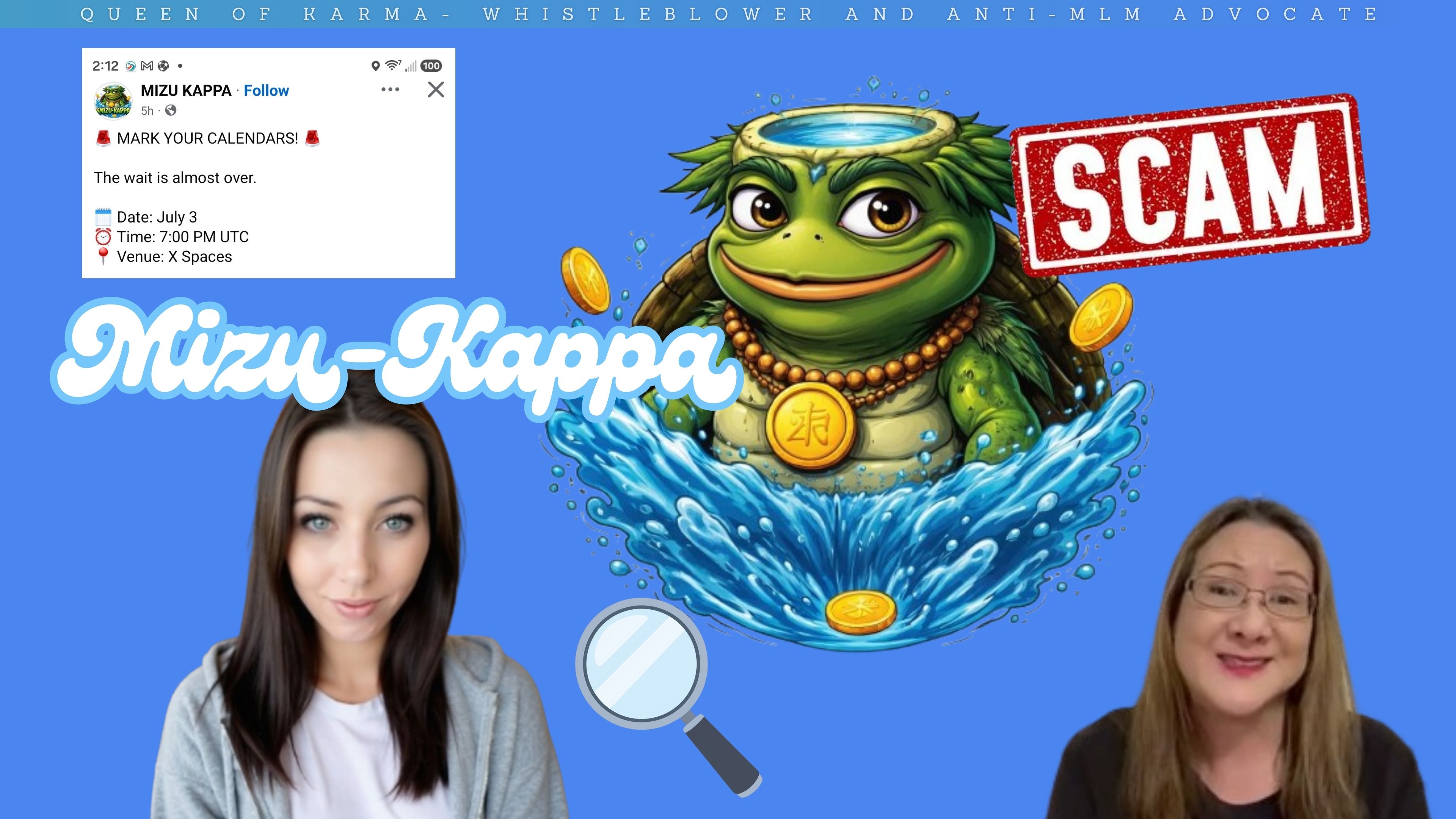
For years, Lynn Nakamoto has been one of the most recognizable promoters inside the OnPassive and Victory With Ash ecosystem — a sprawling network of hype, false promises, and cult-like loyalty built around Ash Mufareh’s never-launched “AI business-in-a-box.”
So when Lynn resurfaced with a new video discussing “AI innovation,” I assumed it was more of the same Victory With Ash content. But something felt off.
The tone was different. The branding was different. The language was different. And when I followed the breadcrumbs, they led to a project I had never heard before: Mizu-Kappa.
What I found was not innovation. Not AI. Not an ecosystem. But a textbook crypto scam, wrapped in futuristic language and pushed by promoters who have already spent years inside another high-control, manipulative system.
This is the investigation.
The Manufactured Symbol of a Manufactured Ecosystem
Mizu-Kappa’s mascot is one of the most conspicuous pieces to their branding — a cartoonish, stylized kappa character meant to evoke playfulness, cultural mystique, and technological whimsy. On the surface, it looks harmless: a bright, friendly figure designed to make the project feel approachable and modern. But in context, the mascot serves a very different purpose. It is a distraction, a marketing device used to mask the absence of any real company, leadership, or technology behind the project.
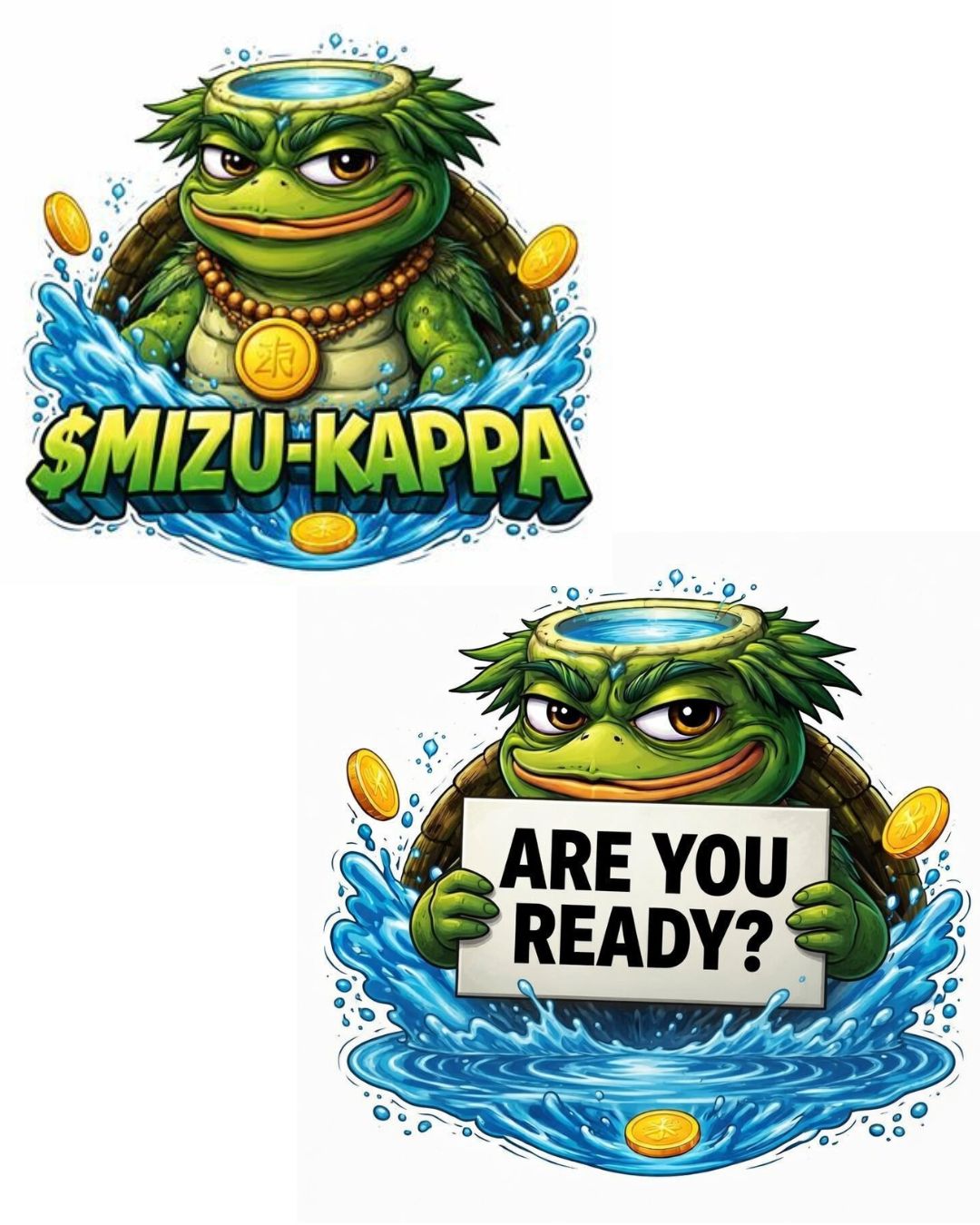
The mascot appears across their websites and social media posts, functioning as a visual anchor for an ecosystem that doesn’t exist. It gives followers something recognizable to latch onto, creating the illusion of a fully developed brand. This tactic is common in scam-based crypto projects: when there is no substance to show, they show a character instead. The mascot becomes a stand-in for legitimacy, a symbol of identity for a project that has none. In Mizu-Kappa’s case, the mascot is not a representation of innovation — it’s a representation of how carefully the illusion has been constructed.
A Scam That Looked Suspicious From Day One
Before Mizu-Kappa announced any “launch,” before they dropped a contract address, and long before they claimed to be “live on the exchange,” their websites were already raising red flags.
I began researching Mizu-Kappa simply by examining their online presence — and what I found was a familiar pattern: a project built on hype, vague promises, AI buzzwords, and absolutely no verifiable corporate structure.
My first encounter with Mizu-Kappa came through their websites.
Their Main Website appears to be a recruitment funnel.
Their Secondary Website appears to be about the gaming aspect of this business.
Multiple domains, all with the same problems:
- No legal disclosures: No company name. No LLC registration. No physical address. No jurisdiction. No compliance statements. Legitimate financial platforms must disclose these things. Mizu-Kappa discloses nothing.
- No leadership information: There is no CEO, no founders, no developers, no team page, no LinkedIn profiles, no corporate officers, and no verifiable identities. For a project claiming to be an “AI ecosystem,” this is unheard of.
- AI claims with no evidence: Their websites repeatedly mention AI trading, AI arbitrage, AI automation, AI-powered dashboards. However they provide no whitepaper, no documentation, no code, no GitHub, no patents, and no technical explanation. The “AI” is nothing more than a marketing script.
- Recycled scam templates: The layout, language, and structure match dozens of known crypto scam templates — including MIZUHAIQPRO and other “Mizu” branded schemes. This strongly suggests Mizu-Kappa is part of a template-based scam network, not a real company.
The Social Media Footprint of Manufactured Hype
After reviewing the websites, I turned to their social media accounts and the pattern became even clearer.
Their Facebook page shows its first appearance on May 7, 2026. Before that date there is:
- no history
- no development timeline
- no early community
- no announcements
- no founders
- no project origins
This is not how legitimate tech companies emerge. This is how scams appear: suddenly, with no traceable past.
Their YouTube account has 45 subscribers and One Video. The video was uploaded on May 22, 2026 and nothing has been uploaded since. This is not what we are used to seeing on a company’s YouTube page. Especially a legitimate company.
Their Telegram, WhatsApp, and Twitter are all pure hype. Across all platforms the content is identical:
- motivational quotes
- vague promises
- hype videos
- countdowns
- “big announcements coming”
- “AI revolution”
- “ecosystem launch soon”
But no substance:
- no team
- no roadmap
- no audits
- no legal structure
- no technical documentation
Their social media presence is designed to create excitement without providing information. This is a hallmark of scam operations.
The MLM Structure: From 10 Levels to 15
One of the clearest indicators that Mizu‑Kappa is not a legitimate tech or AI company is the compensation structure built into the project. Long before the token launch, the platform was already promoting a multi‑level referral system — a hallmark of MLM and pyramid‑style schemes. At first, the structure included ten levels of commissions, but as recruitment slowed, the operators quietly expanded it to fifteen. This kind of escalation is common in fraudulent ecosystems: when growth stalls, the promise of deeper earning tiers is used to reignite recruitment.
The referral system is not presented as an MLM, of course. It is framed as a “community rewards program,” a “growth incentive,” or a “team-building bonus.” But the mechanics are unmistakable. Users earn money not through trading, not through AI, and not through any verifiable product — but through bringing in new participants. The more people someone recruits, the more they climb through the levels, unlocking higher percentages and additional bonuses. This structure encourages aggressive promotion, emotional manipulation, and the creation of small, insular groups where members pressure one another to deposit more money.
The expansion from ten levels to fifteen is particularly telling. In legitimate businesses, compensation plans are stable and tied to measurable performance. In scams, they are fluid, constantly adjusted to keep participants chasing the next tier. By adding five more levels, Mizu‑Kappa effectively admitted that the original structure was not generating enough momentum. The operators needed more layers of promised income to keep people engaged, especially as skepticism grew and withdrawals became increasingly difficult.
This MLM-style system also serves another purpose: it shifts blame. When victims lose money, they often feel responsible because they recruited others or failed to recruit enough people to reach higher tiers. The project’s operators remain anonymous and untouched, while participants are left to navigate the emotional fallout of a structure designed to exploit them. In Mizu‑Kappa’s case, the referral program is not an add-on — it is the core engine of the entire operation. The token, the AI claims, and the ecosystem language are simply decorative elements wrapped around a recruitment-based financial trap.
The AMAs: Performative Transparency
One of the most revealing components of Mizu-Kappa’s marketing strategy was their series of AMAs — “Ask Me Anything” sessions that were promoted as opportunities for the community to engage directly with the project. In legitimate crypto or tech environments, AMAs serve as open forums where developers answer difficult questions, clarify technical details, and provide transparency. Mizu-Kappa’s AMAs did none of that. Instead, they operated as carefully controlled performances designed to create the appearance of openness while avoiding every question that mattered.
The structure of these sessions was always the same. Hosts delivered long, motivational monologues about innovation, community strength, and the future of AI. They spoke in broad, emotional language, emphasizing how early supporters were part of something revolutionary. But when viewers attempted to ask substantive questions — about audits, liquidity, contract verification, leadership, or corporate registration — those questions were ignored, deleted, or reframed. Moderators removed critical comments in real time, ensuring that only praise and enthusiasm remained visible.
Rather than providing information, the AMAs focused on hype. They repeated vague promises about upcoming features, future partnerships, and “major announcements” that never materialized. They leaned heavily on the idea of an “ecosystem,” a term that was never defined and never supported by any technical documentation. The sessions were less about answering questions and more about maintaining emotional momentum, keeping followers excited enough to overlook the absence of verifiable details.
The timing of the AMAs was also strategic. They were often held shortly before deposit pushes or major announcements, functioning as warm-up events designed to prime the audience for the next phase of the scam. By presenting themselves as accessible and communicative, the operators created a false sense of trust — a psychological buffer that made victims more willing to deposit funds or believe in the legitimacy of the upcoming launch.
In reality, the AMAs revealed exactly what Mizu‑Kappa was trying to hide. A legitimate project welcomes scrutiny. A legitimate team answers hard questions. A legitimate ecosystem has nothing to fear from transparency. Mizu‑Kappa’s AMAs did the opposite: they controlled the narrative, suppressed skepticism, and used emotional manipulation to maintain the illusion of progress. The sessions were not a window into the project — they were a curtain designed to obscure what was behind it.
The Missing Corporate Records
As I dug deeper into Mizu-Kappa’s origins, one thing became immediately clear: there is no company behind this project. Not on paper, not in public records, and not in any jurisdiction where legitimate financial or technological entities typically register. I searched corporate databases across the United States, Canada, the United Kingdom, Singapore, Dubai, Hong Kong, and several offshore jurisdictions. Nothing surfaced. No LLC. No corporation. No business license. No trademark filings. No regulatory disclosures. No tax documents. No incorporated certificates.
The absence of a legal entity is not a minor oversight, it’s a defining feature of scam operations. Without a registered company, there is no accountability, no regulatory oversight, and no legal protection for anyone depositing money into the platform. It also means there is no identifiable leadership. Mizu-Kappa provides no CEO, no founders, no developers, no advisors and no team. There are no public-facing individuals willing to attach their names to the project.
For a platform claiming to be an “AI ecosystem,” this level of anonymity is not just suspicious, it’s damning. Real companies, especially those dealing with financial technology, are required to disclose their leadership and legal structure. Mizu-Kappa has gone out of its way to hide both. The deeper the search went, the more obvious it became that Mizu-Kappa is not a startup, not a tech company, and not an emerging AI enterprise. It is a ghost operation, deliberately constructed without a traceable origin or responsible party.
The July 8th Token Launch
On July 8th, Mizu-Kappa announced their official launch and published a contract address, claiming they were now “LIVE on the exchange.” Unlike many scam projects that only pretend to deploy a token, Mizu-Kappa did launch something on-chain. The contract at 0xb1d1f602034f7c4b242169b818200d07c117ffff is real, active, and fully deployed on the BNB Smart Chain. It shows genuine blockchain activity: transfers, approvals, liquidity interactions, and wallet movements. From a technical standpoint, the token is live.
The launch becomes even more evident when examining the CoinMarketCap DEX page associated with the contract. CMC only generates these pages when a token has an active liquidity pool and is tradeable on a decentralized exchange such as PancakeSwap. The presence of price data, liquidity information, and trading volume confirms that Mizu-Kappa added liquidity and made the token tradable. In this narrow sense, the launch is real: the token exists, it has a market pair, and users can buy and sell it.
But this is where the illusion begins.
A DEX listing is not a traditional exchange listing. It does not mean CoinMarketCap has vetted the project, approved it, or recognized it as legitimate. CMC’s DEX pages are automatically generated whenever a token pair exists on a decentralized exchange. They do not confirm the existence of a company, a development team, an AI ecosystem, or any underlying technology. They simply confirm that a token contract has liquidity and can be traded.
The blockchain tells the same story. The contract remains unverified, meaning the underlying code cannot be inspected or audited. The creator wallet is anonymous. The trading activity visible on both BscScan and CMC resembles early-stage noise typical of low-effort token deployments: sporadic buys and sells, small transfers, and interactions that create appearance of momentum without demonstrating real adoption or utility.
In other words, Mizu-Kappa did launch a token — but they did not launch a company. They did not launch an ecosystem. They did not launch a product. What went live on July 8th was a contract and a liquidity pool, not a business. The blockchain confirms the existence of a tradable token, but everything surrounding that token remains opaque unverified, and unsupported by any identifiable entity. The launch is real, but the legitimacy is not.
The Scam Pattern
Here’s the full lifecycle of the scam, exactly as we’ve documented it:
- Hype and recruitment: Motivational language, cute mascot, promises of generational wealth.
- Community building: Telegram groups, AMAs, social media posts.
- Deposit extraction: Users encouraged to stake, spend, and interact.
- Withdrawal traps: Fees, taxes, liquidity deposits — the same pattern seen in MIZUHAIQPRO
- Collapse and rebrand: The scam family launches a new “Mizu” project.
This is a textbook ecosystem-style fraud.
Legitimacy Theater
Scams like Mizu-Kappa don’t just steal money. They steal trust. They steal time. They steal emotional energy. They steal people’s sense of financial stability.
And when someone from a high-control group like OnPassive starts promoting these schemes, it spreads harm into communities that are already vulnerable.
This is why we investigate.
This is why we speak out.
This is why we expose these patterns.
This investigation is ongoing, and we’re going to keep digging.
If you’ve seen Mizu-Kappa promoted in your circles, or if you’ve been approached about it, feel free to share your experience. The more information we gather, the easier it becomes to protect people from falling into these traps.
To Lynn Nakamoto, thank you for unintentionally kicking off this investigation. You never disappoint.
More updates coming soon.
By Beth Gibbons (Queen of Karma)
Beth Gibbons, known publicly as Queen of Karma, is a whistleblower and anti-MLM advocate who shares her personal experiences of being manipulated and financially harmed by multi-level marketing schemes. She writes and speaks candidly about the emotional and psychological toll these so-called “business opportunities” take on vulnerable individuals, especially women. Beth positions herself as a survivor-turned-activist, exposing MLMs as commercial cults and highlighting the cult-like tactics used to recruit, control, and silence members.
She has contributed blogs and participated in video interviews under the name Queen of Karma, often blending personal storytelling with direct confrontation of scammy business models. Her work aligns closely with scam awareness efforts, and she’s part of a growing community of voices pushing back against MLM exploitation, gaslighting, and financial abuse.



Leave A Comment