


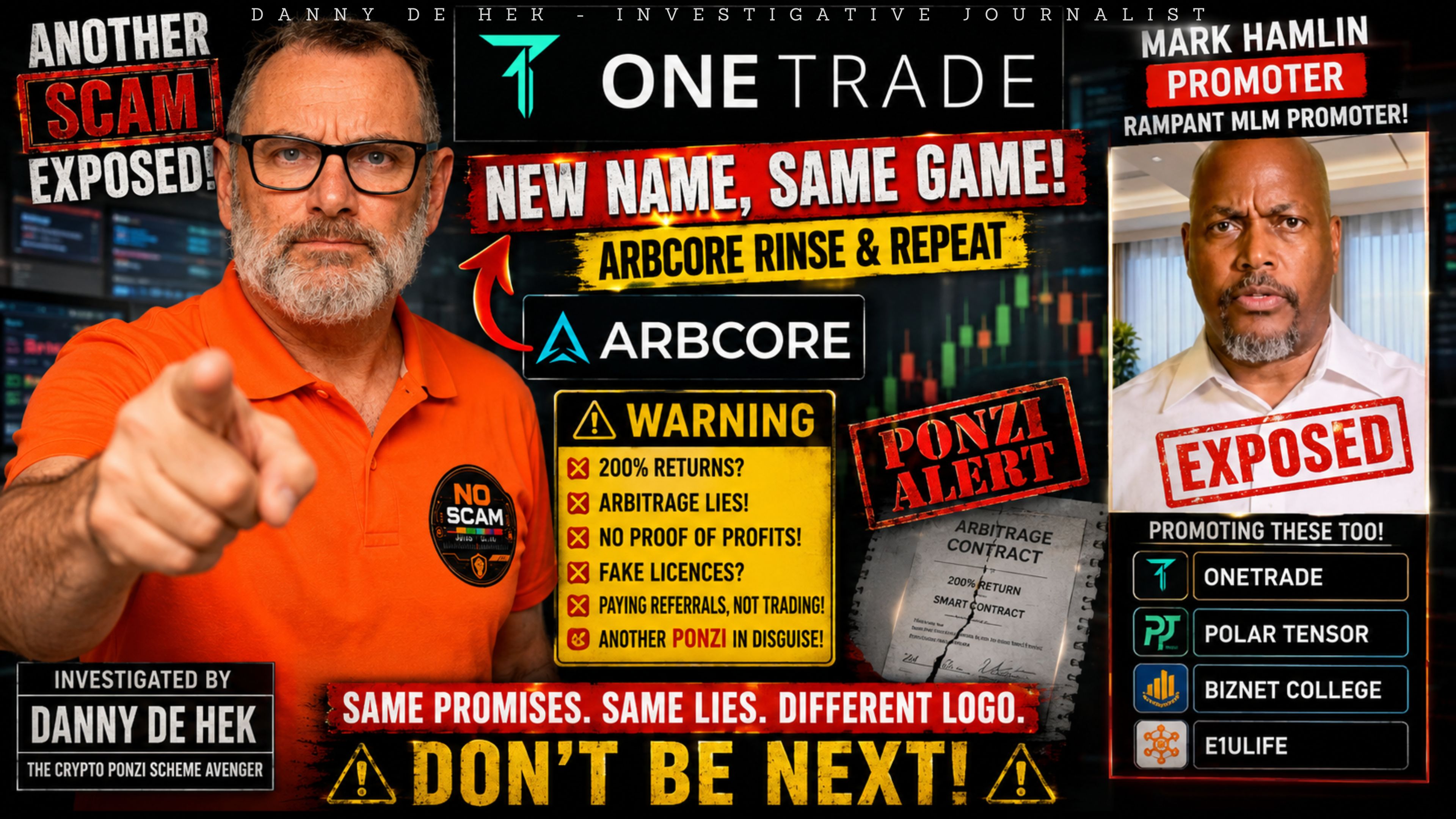
“The company guarantees that all arbitrage spreads will be obtained with profit.” — OneTrade Contract
It started, as so many of my investigations do, with a message from one of my Avengers.
They had come across a new cryptocurrency opportunity called OneTrade AI Arbitrage, a platform claiming to generate substantial returns through fully automated cross-exchange cryptocurrency arbitrage.
At first glance, it looked familiar. Slick presentations. Professional branding. Technical jargon. Smart contracts. Institutional liquidity. Licences. Blockchain transparency. Everything had been carefully packaged to give the impression of a sophisticated financial technology company operating at the cutting edge of the cryptocurrency industry.
My source wasn’t convinced.
They believed OneTrade had another identity.
 According to the information they shared with me, OneTrade had previously operated under the name ARBCORE before quietly rebranding. They pointed me towards Telegram groups, promotional videos, PowerPoint presentations and public posts discussing the transition. If they were right, this wasn’t the launch of a new opportunity at all. It was the continuation of an older one.
That immediately caught my attention.
Over the years I’ve investigated hundreds of cryptocurrency investment schemes, Ponzi operations and MLM opportunities. One of the most common patterns I see is not simply collapse, but reinvention. A project runs into trouble, withdrawals slow or stop, confidence begins to disappear, and before long a fresh brand emerges promising improved technology, stronger infrastructure and an exciting new future. Sometimes the logo changes. Sometimes the website changes. But when you begin comparing the underlying documents, compensation plans and marketing language, the similarities often become impossible to ignore.
Rather than jumping to conclusions, I approached this investigation the same way I always do: by following the evidence.
I joined the official Telegram channels, downloaded every document I could find, watched the promotional presentations, examined the legal policies, reviewed the compensation model, studied the contract terms and began comparing OneTrade with the historical material relating to ARBCORE. The deeper I dug, the more questions emerged. Some of the company’s claims were ambitious. Others were highly technical. Several deserved careful independent verification. And perhaps most importantly, there were already signs that the story behind OneTrade could not be understood without first understanding what happened to ARBCORE.
This investigation is not about proving guilt or making accusations that cannot be supported. It is about documenting the available evidence, identifying contradictions, testing public claims against independently verifiable facts and giving readers the information they need to make informed decisions. Where claims can be verified, I will say so. Where questions remain unanswered, I will say that too.
Because if OneTrade really is the next chapter of ARBCORE, investors deserve to know exactly what changed, what stayed the same, and why the past may be far more relevant than the marketing would have you believe.
A Tip-Off From An Avenger
Every investigation has a starting point, and in this case it began with an email from one of my Avengers who had stumbled across a new cryptocurrency opportunity being promoted as OneTrade AI Arbitrage. They had already spent some time looking into it and immediately recognised patterns that reminded them of previous schemes. Rather than dismissing it as “just another AI trading platform,” they began digging deeper and shared everything they had uncovered with me.
Their email contained links to the official Telegram group, promotional YouTube videos, Facebook posts and the company’s presentations. One comment stood out more than anything else. They believed OneTrade wasn’t a new company at all. According to the information they had found, it had previously operated under the name ARBCORE before undergoing a rebrand. They also identified one of the public promoters, Mark Hamlin, who had already published several presentations explaining the opportunity and encouraging people to join his team.
At that stage, there was no reason to assume the claim was true. Rebranding alone is not evidence of wrongdoing. Companies change names for legitimate reasons every day. However, when a business promoting high-yield investment opportunities changes its identity, particularly after reports of withdrawal problems or operational issues, it deserves closer scrutiny. Rather than accepting or rejecting the claim, I decided to verify it for myself.
The first step was to join the official OneTrade Telegram channels and download every document available. Almost immediately I noticed something unusual. There weren’t just OneTrade presentations available for download. There were also documents referring to ARBCORE. That discovery transformed what I expected to be a routine review of another crypto arbitrage platform into something much larger. Instead of investigating a single opportunity, I was now following what appeared to be the evolution of an entire project, and the timeline was beginning to tell a very different story.
Comparing OneTrade And ARBCORE
With both presentations sitting side by side, I started doing what I always do during these investigations: comparing them page by page instead of accepting the marketing at face value.
What immediately stood out wasn’t just the similarity of the design. The language, structure and underlying business model were remarkably alike. Both presentations described automated cryptocurrency arbitrage using smart contracts, both promoted invoice-based investment contracts, both referred to blockchain transaction hashes (TXIDs) as evidence of transparency, and both claimed users could simply deposit funds and allow the platform to generate daily returns through automated cross-exchange trading.
The similarities extended well beyond the sales pitch. The compensation structure followed the same blueprint, with direct referral commissions, network-based rewards and cashback incentives designed to encourage recruitment alongside investment. Even the technical explanations of how the arbitrage supposedly worked were presented in almost identical terms, with only minor changes to the branding and some updated figures.
One noticeable change was the promised return. ARBCORE promoted contracts paying up to 250%, while OneTrade reduced that figure to 200%. On the surface that might appear to be a significant change, but the underlying concept remained the same. Participants were still being asked to deposit cryptocurrency into an arbitrage program with the expectation of receiving substantially more back over time through automated trading.
As I continued comparing the documents, it became increasingly difficult to view OneTrade as an entirely new opportunity. It looked far more like the next iteration of the same business model. The branding had changed. Some corporate claims had been updated. Certain figures had been adjusted. But the mechanics of the opportunity, the marketing narrative and the overall structure appeared largely unchanged. That discovery shifted the focus of the investigation from “What is OneTrade?” to a much more important question:
Why did ARBCORE disappear, and what really happened between its reported collapse and the emergence of OneTrade?
The Story Behind ARBCORE
At this point, I stopped looking at OneTrade as a standalone opportunity and shifted my attention to ARBCORE. If the two platforms were connected, understanding what happened to ARBCORE would be essential to understanding OneTrade.
That decision changed the direction of the investigation.
As I dug through archived material, presentations and public discussions, a much clearer timeline began to emerge. ARBCORE had launched earlier in 2026 promoting automated cryptocurrency arbitrage, daily returns and contracts promising investors up to 250% of their deposited funds. Like OneTrade, it relied on a combination of technical language, blockchain terminology and a referral-based marketing structure to attract new participants.
Then everything changed.
By late April 2026, reports began surfacing that withdrawals had stopped. Members were told there were problems with exchange APIs, frozen accounts, compliance checks and even cryptocurrency that had allegedly been flagged as “dirty Bitcoin.” These explanations were presented as temporary operational issues that would soon be resolved.
I’ve heard similar explanations before.
Over the years I’ve investigated enough collapsed crypto schemes to recognise a familiar pattern. When investors can no longer withdraw their money, the explanations often become increasingly technical. APIs stop working. Liquidity providers encounter problems. Exchanges freeze funds. Regulators intervene. Sometimes those explanations turn out to be legitimate. Other times they become the bridge between an old project and a brand-new one.
In ARBCORE’s case, that bridge appeared to have a name.
OneTrade.
Instead of simply disappearing, the project appeared to evolve into a new platform with updated branding, revised corporate claims and a fresh marketing campaign. The more evidence I gathered, the more it looked as though I wasn’t investigating two separate companies at all. I was documenting the timeline of a single project that had changed its identity while asking investors to place their trust in a new name.
Following The ARBCORE Timeline
At this point, I stopped treating OneTrade as a standalone opportunity and began investigating ARBCORE in its own right. If the two platforms were genuinely connected, understanding what happened to ARBCORE would be essential to understanding the story now being told by OneTrade.
The timeline quickly became interesting.
ARBCORE emerged in early 2026 promoting automated cryptocurrency arbitrage, daily returns and contracts promising investors up to 250% of their deposited funds. The opportunity was built around the same core themes now being promoted by OneTrade: sophisticated trading technology, smart contracts, blockchain transparency, invoice-based investment contracts and a compensation plan that rewarded both investors and recruiters.
Then reports of problems began to surface.
By late April 2026, members were discussing delayed and suspended withdrawals. The explanations given centred around frozen exchange accounts, API failures, anti-money laundering checks and cryptocurrency that had allegedly been flagged during compliance reviews. Investors were repeatedly encouraged to remain patient while the issues were supposedly being resolved.
What happened next is what caught my attention.
Rather than quietly disappearing, ARBCORE appeared to evolve into OneTrade. Existing members were introduced to a new platform carrying a different name but promoting a remarkably similar arbitrage model. As I compared presentations, contracts and marketing material from both projects, it became increasingly difficult to ignore the similarities. The branding had changed, some of the corporate claims had changed, and the promised return had been reduced from 250% to 200%, but much of the underlying structure appeared to remain intact.
That raised an obvious question.
Was OneTrade genuinely a new opportunity, or was it simply ARBCORE under a new name?
BehindMLM Connects OneTrade To ARBCORE
As I continued piecing together the timeline, I discovered I wasn’t the only investigator asking difficult questions about OneTrade.
Back in March 2026, Oz at BehindMLM published an Independent Review of ARBCORE, highlighting concerns about the company’s lack of transparent ownership, its reliance on an automated arbitrage narrative and a compensation plan built around passive returns and recruitment. In hindsight, that review proved remarkably prescient, with ARBCORE reportedly experiencing withdrawal problems before ultimately collapsing only weeks later.
Since publishing my own investigation into OneTrade, Oz has also released a New Article examining the apparent relationship between ARBCORE and OneTrade. His investigation reaches many of the same conclusions I had begun documenting, identifying OneTrade as what appears to be a continuation of the earlier project rather than an entirely new opportunity.
Among the additional findings he highlights are the renaming of the “Arbcore Global Leaders” Facebook group to “One Trade”, the registration of the OneTrade domain shortly after ARBCORE’s reported collapse, and the continued involvement of several individuals who were previously associated with promoting ARBCORE. He also notes that the business model remains fundamentally unchanged, continuing to combine promised passive returns with recruitment-based rewards through an MLM compensation plan.
One aspect of Oz’s investigation that particularly caught my attention was his observation that many of OneTrade’s early participants appear to be former ARBCORE members. If that is correct, it raises an important question. Are existing investors being given a genuine opportunity to recover previous losses, or are they simply being encouraged to place further funds into what is presented as a new platform?
While my investigation relies on independently reviewing OneTrade’s own documents, contracts and public claims, it’s encouraging to see another experienced investigator following a separate path and uncovering many of the same patterns. Where our findings overlap, they strengthen the broader timeline. Where new information emerges, I’ll continue updating this investigation as additional evidence becomes available.
A Familiar Pattern Emerges
The more documents I reviewed, the more difficult it became to accept the narrative that OneTrade was simply an upgraded version of ARBCORE.
The presentations were strikingly similar. Both revolved around automated cryptocurrency arbitrage, invoice-based investment contracts, blockchain transaction hashes (TXIDs), daily payouts, and a referral structure designed to reward participants for introducing new investors. Even the technical explanations of how the arbitrage supposedly worked followed almost identical language.
Some things had changed.
ARBCORE promoted contracts paying up to 250%, while OneTrade reduced that figure to 200%. The corporate entities had also been updated, with new licensing claims, new exchange names and an expanded story about the infrastructure supporting the arbitrage operation. On the surface, it looked like a significant evolution.
Underneath, however, the foundation appeared remarkably familiar.
That doesn’t automatically prove OneTrade and ARBCORE are the same company. Rebranding can happen for perfectly legitimate reasons. But when a high-yield investment platform reportedly experiences withdrawal issues, adopts a new identity, and continues promoting a business model that closely mirrors its predecessor, it raises questions that deserve careful examination.
Those questions only became more important as I began reading OneTrade’s own contracts, legal documents and frequently asked questions. Far from answering my concerns, they introduced a series of contradictions that would become one of the most revealing parts of this investigation.
Reading The Fine Print
Marketing presentations are designed to sell a dream. Legal documents, on the other hand, often tell a very different story. That’s why I always make a point of reading the Terms of Use, Risk Disclosure Statement, AML/KYC Policy, Privacy Policy and FAQs. Hidden among the legal language is often the clearest explanation of how a business actually expects to operate.
OneTrade has published an extensive collection of documents, and to its credit, there is certainly no shortage of reading material. The company attempts to explain everything from its arbitrage strategy and smart contracts to liquidity providers, exchange infrastructure, automated payouts and client obligations. On first impression, the sheer volume of documentation gives the appearance of transparency.
As I worked through the documents, however, I found myself highlighting more and more passages that didn’t seem to fit together. Some statements appeared to contradict others. Some guarantees seemed difficult to reconcile with the company’s own risk disclosures. Other claims were highly specific and, importantly, capable of being independently verified.
Those documents became one of the most revealing parts of the investigation.
Rather than relying on promotional videos or enthusiastic testimonials, I decided to let OneTrade’s own words tell the story.
The Internal Affiliate Playbook
Just when I thought I’d finished reviewing OneTrade’s public documentation, I received what appears to be an Internal Instruction Manual distributed to affiliates. Rather than explaining how the arbitrage technology works, the document focuses on helping promoters answer the questions members begin asking once they are inside the system.
One of the first things that stood out was the emphasis on recruitment. Affiliates are instructed to ensure that every new member registers through their referral link and are warned that, if registration isn’t completed correctly, the new member may instead become assigned to the company. The solution? Register the person again using a completely new email address.
The guide also spends considerable time explaining why investors may see balances fall, why invoices disappear, why profits vary, why cashback hasn’t been received, why partner rewards haven’t appeared, and why reinvested funds remain inside the system instead of being withdrawn. Rather than a simple investment product, members are introduced to a growing list of internal rules, conditions and explanations designed to answer concerns after funds have already been committed.
Perhaps the most revealing aspect of the document is how frequently it explains why something didn’t happen. Why wasn’t my reward paid? Why has my balance dropped? Why wasn’t my deposit credited? Why didn’t my partner commission arrive? Why hasn’t my frozen balance been released? The sheer number of troubleshooting scenarios suggests these are not isolated questions but common enough that the company has produced a detailed guide for promoters to respond to them.
I also found repeated references to “frozen” assets being unlocked through new deposits, reinvestments and even the deposits made by recruited partners. That immediately caught my attention because it introduces an additional layer of complexity beyond the arbitrage model itself. Existing balances are linked to future activity, creating incentives for members to continue depositing and recruiting in order to satisfy various conditions within the system.
On its own, this document doesn’t prove wrongdoing. However, it does provide a fascinating insight into the day-to-day issues promoters are expected to handle. When combined with the contracts, compensation plan and marketing material, it paints a much more complete picture of how the OneTrade ecosystem is intended to operate after someone has already joined.
One Contradiction Immediately Stood Out
One of the first documents I examined was OneTrade’s AML/KYC Policy. In it, the company describes itself as “a non-custodial service”, stating that it does not store user funds and only requests identity verification in limited circumstances. On its own, that sounds fairly straightforward and is language commonly associated with decentralised cryptocurrency services.
Then I opened the Terms of Use.
The wording there paints a very different picture. Rather than simply providing software or acting as a facilitator, the contract states that the client transfers assets to OneTrade for management so they can participate in arbitrage operations. Later, the same document explains that once the contractual obligation has been fulfilled, the client’s original asset transfers to the management and ownership of OneTrade.
That immediately raised a question.
If OneTrade is genuinely a non-custodial service that does not hold customer funds, how can it simultaneously state that investors transfer their assets into the company’s management, and ultimately into the company’s ownership? Those are two very different descriptions of how the platform operates, and reconciling them is not straightforward.
I’m not suggesting this contradiction proves wrongdoing. It doesn’t. But it does illustrate why reading the legal documents matters. Marketing material often tells one story, while the contractual terms reveal another. When those documents appear to describe the business in fundamentally different ways, it’s a contradiction that deserves explanation.
The 200% Contract Promise
The next issue was even more direct.
OneTrade’s contract language does not simply describe access to trading software. It says the company undertakes to pay the client an amount equal to 200% of the asset volume placed under company management. In plain English, if a participant deposits 1,000 USDT into the arbitrage contract, the contractual obligation is presented as 2,000 USDT in total payouts over time.
That is not a small claim.
The company explains that these payouts are supposed to come from arbitrage spreads generated through cross-exchange trading. Those profits are then said to be transferred from exchange wallets into a smart contract, which performs daily automatic payouts to the client’s personal wallet. Once total payouts reach 200%, the invoice and contract are closed, and the original contract amount remains inside the company’s arbitrage pool as OneTrade’s income.
This is where the model becomes important.
The investor is not simply paying a platform fee. According to OneTrade’s own FAQ and contract wording, the original asset eventually belongs to the company after the 200% obligation is fulfilled. OneTrade presents this as financially beneficial for both sides: the investor supposedly receives their original amount plus an equal amount of profit, while the company keeps the original asset to expand its working capital.
For any investor reading this, the key question is obvious.
What independent evidence proves that enough external arbitrage profit exists to fund those 200% obligations without relying on continuous new deposits from new participants?
Guaranteed Profit Or Guaranteed Marketing?
As I continued reading through OneTrade’s documentation, I kept coming back to one word.
Guarantee.
The company doesn’t merely suggest that its arbitrage strategy has been successful historically. It goes much further. Its contract states that the average arbitrage spread cannot be less than 0.6% within a 24-hour period, that all arbitrage spreads will be obtained with profit, and that the company’s contractual obligations will be fulfilled in full. Those are strong statements, particularly in a market as volatile and unpredictable as cryptocurrency.
Yet elsewhere, the company’s own Risk Disclosure Statement paints a very different picture. That document reminds users that digital assets are highly volatile, blockchain transactions can be irreversible, regulations can change without warning and, most importantly, that users should not invest digital assets they are not prepared to lose completely. It repeatedly warns that cryptocurrency transactions involve significant financial risk. Those warnings are entirely consistent with the nature of the cryptocurrency market.
Placed side by side, however, the contrast is difficult to ignore.
On one hand, investors are told that they could lose everything because cryptocurrency is inherently risky. On the other, they are presented with contractual language promising minimum arbitrage spreads, profitable trades and full performance of contractual obligations. Those are very different messages, and they raise an obvious question that I believe deserves an independent answer.
If cryptocurrency markets are as unpredictable as OneTrade’s own Risk Disclosure acknowledges, on what basis can the company confidently guarantee that every arbitrage spread will be profitable and that investors will ultimately receive 200% of their contracted amount?
Locked In Until The Company Says Otherwise
OneTrade also makes it clear that this is not a product investors can simply walk away from whenever they choose.
According to the arbitrage contract, there is no provision for early exit from the arbitrage pool and no option for early contract termination. Once a participant activates the arbitrage contract and transfers assets into the program, the contract remains in force until OneTrade considers its obligations to have been fulfilled.
The company explains that the contract has no fixed end date because arbitrage profits are said to fluctuate with market conditions. It suggests the 200% obligation could be reached in as little as two months, or it could take six months or longer. Until that point, investors are expected to remain in the arbitrage pool while daily payouts are generated through the company’s automated trading system.
That is a significant commitment, particularly for anyone investing a substantial amount of cryptocurrency. Before transferring funds, investors should understand that, according to OneTrade’s own documentation, they are entering into an arrangement where the timing of the contract is determined by the company’s reported trading performance rather than by a fixed maturity date or the investor’s ability to withdraw on demand.
Whether that arrangement is appropriate is a decision each investor must make for themselves. My role is simply to point out what the contract actually says, because those details are easy to overlook when the focus is placed on promised returns rather than the conditions attached to receiving them.
The Illusion Of Transparency
OneTrade repeatedly tells investors that its arbitrage activity is transparent because clients can track transactions using TXIDs on public blockchains. On the surface, that sounds reassuring. Blockchain transactions can be viewed publicly, and transaction hashes can prove that cryptocurrency moved from one address to another.
But there is an important distinction.
A TXID can show movement of funds. It can show that cryptocurrency was transferred between wallets or exchanges. What it does not automatically prove is that a profitable arbitrage trade occurred, that the trade was executed on behalf of a specific investor, or that the profit being paid out came from genuine external trading revenue rather than from another source.
OneTrade’s documentation also acknowledges that the actual trading takes place off-chain on centralised exchanges through bots, APIs and corporate exchange accounts. That matters because off-chain trading activity is not independently visible on a public blockchain in the same way as a wallet transfer. Investors may be shown transaction hashes, account screenshots or exchange histories, but those records still require trust in the platform controlling the data.
This is one of the most important issues in the entire investigation.
Blockchain visibility is not the same thing as audited proof of revenue. If OneTrade wants investors to believe that 200% obligations are being funded by real arbitrage profits, the evidence would need to show more than movement between wallets. It would need to demonstrate independently verifiable trading activity, profit generation, custody of funds and the source of every payout.
Following The Corporate Trail
As the investigation expanded, so did the list of companies that OneTrade says form part of its ecosystem.
Rather than presenting itself as a single business, OneTrade describes a much larger corporate structure. According to its own documentation, ARB GROUP sits at the centre of the operation, with ARB ASSOCIATES PTY LTD in Australia identified as the IT company, OneTrade LTD incorporated in the Union of Comoros as the arbitrage operator, Cybercento s.r.o. in the Czech Republic handling the marketing segment, and several cryptocurrency exchanges operating under the same umbrella.
On paper, it sounds impressive.
The documentation goes on to name Sakura Moon Capital, Nexora Fintech, BITCIARZ and CX1 as exchanges connected to the ecosystem, while also listing well-known cryptocurrency exchanges such as Binance, Coinbase, Kraken, Bybit, OKX and KuCoin as external liquidity providers. It further claims that OneTrade operates under both a cryptocurrency trading platform licence and an international brokerage licence issued in the Union of Comoros.
Those are not vague marketing statements. They are specific factual claims that can, and should, be independently verified.
Throughout this investigation, I won’t simply accept corporate registrations, licensing claims or business relationships because they’re printed in a presentation or legal document. Every claimed licence, company registration, exchange ownership and regulatory approval deserves to be checked against the relevant public records. If those claims withstand independent scrutiny, that’s worth documenting. If they don’t, investors deserve to know that as well.
The Roadmap Promises An Entire Financial Ecosystem
OneTrade isn’t just selling an arbitrage platform. According to its published roadmap, the company has ambitions that extend far beyond cryptocurrency trading.
The roadmap outlines plans for additional exchanges, artificial intelligence strategies, machine learning, white-label arbitrage platforms, decentralised exchange (DEX) integration, API products and institutional trading services. It also speaks of expanding into new jurisdictions while obtaining additional licences and increasing the number of connected liquidity providers around the world.
Then the vision becomes even broader.
Alongside the arbitrage business, OneTrade’s documentation promotes future products including GameFi, blockchain gaming, a bookmaker, an online casino, an ARB Wallet, an ARB Token, hedge funds, venture funds and even a fully digital neobank. Existing members are invited to join Telegram groups to receive updates on these future opportunities and, where applicable, secure positions within the developing partner structures.
There is nothing inherently wrong with a company having ambitious plans. Every successful business starts with a vision.
However, experienced investors know that roadmaps are not evidence. They are aspirations. Until products are launched, independently verified and operating successfully, they remain promises about the future rather than proof of what exists today. Throughout the cryptocurrency industry, I’ve seen countless projects promote expansive ecosystems that never progressed beyond PowerPoint presentations and promotional webinars.
For that reason, I treat OneTrade’s roadmap the same way I treat every other claim made during this investigation—with interest, but also with healthy scepticism until the evidence catches up with the marketing.
The Role Of Promoters
No scheme like this grows on documents alone. It grows because people promote it, explain it, normalise it and present it to new audiences as an opportunity worth trusting.
One of the public promoters I found was Mark Hamlin, who had uploaded several OneTrade videos to his YouTube Channel, including presentations on how the platform works, passive income, updates and registration tutorials. His description positioned OneTrade as a fintech company specialising in cross-exchange arbitrage, while also directing viewers to register through his team link and contact him directly for training and support.
In the promotional video I reviewed, Mark repeatedly described the opportunity as automated, simple and accessible. He discussed 200% contract returns, daily payouts, compounding, a 5% direct referral reward, a 3% network reward and cashback bonuses. He also displayed back-office examples showing daily earnings and referral income, while reminding viewers that past results do not guarantee future results.
That contradiction matters.
The disclaimer says earnings are not guaranteed, but the presentation still builds excitement around examples of accounts earning daily returns, compounding quickly and producing potentially life-changing income. This is a familiar pattern in high-yield crypto promotions: the legal disclaimer attempts to reduce responsibility, while the sales presentation does the real work of selling the dream.
Questions That Deserve Answers
By this stage of the investigation, I’d accumulated pages of notes, screenshots, contracts and promotional material. Rather than reducing everything to a simple conclusion, I found myself writing down a growing list of questions that I believe deserve clear, independently verifiable answers.
If ARB GROUP genuinely operates the ecosystem described in its own documentation, who ultimately owns and controls each of the companies listed? Can the claimed relationship between ARB ASSOCIATES PTY LTD, OneTrade LTD, Cybercento, Sakura Moon Capital, Nexora Fintech, BITCIARZ and CX1 be demonstrated through corporate records rather than marketing material?
The licensing claims also warrant careful examination. OneTrade repeatedly refers to cryptocurrency operator licences, brokerage licences and regulatory oversight. Those are factual claims. They should be capable of being verified through the relevant authorities, and investors should not have to rely solely on licence numbers displayed in a presentation or on a website.
Then there is the arbitrage itself.
If OneTrade is genuinely generating sufficient external trading profits to fulfil contracts paying 200% of the invested amount, is there an independent audit demonstrating that performance? Can the reported trading activity be verified by a recognised third party? Do the published transaction hashes demonstrate profitable arbitrage, or do they simply show cryptocurrency moving between wallets controlled by the company?
These aren’t hostile questions.
They are the same questions any prudent investor should ask before transferring funds into a platform that promises substantial returns through proprietary trading technology. The answers may ultimately strengthen OneTrade’s claims, or they may expose significant weaknesses. Either way, they deserve to be answered with evidence rather than marketing.
Where The Investigation Goes From Here
This investigation is still in its early stages.
So far, I’ve traced the apparent transition from ARBCORE to OneTrade, reviewed the company’s presentations, analysed its legal documents, examined its published roadmap and begun identifying the individuals publicly promoting the opportunity. Along the way, I’ve found a number of claims that appear capable of independent verification, together with several contradictions that deserve further explanation.
The next phase of this investigation will move beyond the company’s own marketing.
I’ll be examining corporate registrations, verifying licensing claims, reviewing blockchain activity, analysing wallet movements, researching the exchanges OneTrade claims to operate, checking the history of the domains involved and following the money wherever the evidence leads. I’ll also be looking more closely at the individuals behind the project and the network of promoters introducing new investors to the platform.
If you have information about OneTrade, ARBCORE, ARB GROUP, or any of the companies or individuals mentioned in this investigation, I’d like to hear from you. Whether you’re a current member, a former participant, a promoter, or someone with first-hand knowledge, your information could help build a clearer picture of how this operation developed and where it may be heading.
As always, my goal isn’t to tell people what to think.
It’s to present the evidence, document the timeline, ask the questions that matter and allow the facts to speak for themselves.
Because if OneTrade really is the next chapter in the ARBCORE story, then understanding how one became the other may prove to be the most important part of this entire investigation.
Disclaimer: How This Investigation Was Conducted
This investigation relies entirely on OSINT — Open Source Intelligence — meaning every claim made here is based on publicly available records, archived web pages, corporate filings, domain data, social media activity, and open blockchain transactions. No private data, hacking, or unlawful access methods were used. OSINT is a powerful and ethical tool for exposing scams without violating privacy laws or overstepping legal boundaries.
About the Author
I’m DANNY DE HEK, a New Zealand–based YouTuber, investigative journalist, and OSINT researcher. I name and shame individuals promoting or marketing fraudulent schemes through my YOUTUBE CHANNEL. Every video I produce exposes the people behind scams, Ponzi schemes, and MLM frauds — holding them accountable in public.
My PODCAST is an extension of that work. It’s distributed across 18 major platforms — including Apple Podcasts, Spotify, Amazon Music, YouTube, and iHeartRadio — so when scammers try to hide, my content follows them everywhere. If you prefer listening to my investigations instead of watching, you’ll find them on every major podcast service.
You can BOOK ME for private consultations or SPEAKING ENGAGEMENTS, where I share first-hand experience from years of exposing large-scale fraud and helping victims recover.
“Stop losing your future to financial parasites. Subscribe. Expose. Protect.”
My work exposing crypto fraud has been featured in:
- Coffeezilla 2026): Featured in the investigation exposing the alleged $328M Goliath Ventures Ponzi scheme
- Bloomberg Documentary (2025): A 20-minute exposé on Ponzi schemes and crypto card fraud
- News.com.au (2025): Profiled as one of the leading scam-busters in Australasia
- OpIndia (2025): Cited for uncovering Pakistani software houses linked to drug trafficking, visa scams, and global financial fraud
- The Press / Stuff.co.nz (2023): Successfully defeated $3.85M gag lawsuit; court ruled it was a vexatious attempt to silence whistleblowing
- The Guardian Australia (2023): National warning on crypto MLMs affecting Aussie families
- ABC News Australia (2023): Investigation into Blockchain Global and its collapse
- The New York Times (2022): A full two-page feature on dismantling HyperVerse and its global network
- Radio New Zealand (2022): “The Kiwi YouTuber Taking Down Crypto Scammers From His Christchurch Home”
- Otago Daily Times (2022): A profile on my investigative work and the impact of crypto fraud in New Zealand



Leave A Comment