


“The technology changes. The branding changes. The promises change. But sooner or later every opportunity must answer the same question: where does the money come from?”
When a long-time member of my community contacted me about a new opportunity called G3Unity, there was surprisingly little information available.
No major social media presence. No extensive history. No flood of testimonials. No established track record. Just a recently registered website, a small Telegram group, a handful of videos and a growing number of promoters claiming they had finally found a transparent alternative to the countless crypto opportunities that had failed before it.
That immediately caught my attention.
Having investigated hundreds of crypto schemes, matrix cyclers, MLM opportunities and passive income programs over the years, I have learned that many of them begin in exactly the same way. A small group of believers. A handful of enthusiastic promoters. A promise that this time the model is different. The deeper I dug into G3Unity, the more familiar the pattern became.
How G3Unity Came To My Attention
The investigation began after receiving information from a community member who had encountered G3Unity being promoted inside a Facebook group known as The Best Community.
According to the information provided, Braden Grist and Michael Williams were among those encouraging members to join the platform. The source also alleged that many of the same individuals had previously promoted opportunities including Vortic United, VYB, Quantro Network and various other programs that ultimately failed to deliver on their promises.
What stood out was the way G3Unity was being presented.
The recruitment message openly acknowledged that many people had lost money in trading platforms, AI bot schemes, mining programs, staking projects and other crypto ventures. Readers were told that G3Unity was different because the founder was personally known and trusted. The implication was clear: previous opportunities failed because the wrong people were behind them, whereas this one could supposedly be trusted because of personal relationships.
That may sound reassuring, but trust is not a business model. A sustainable opportunity still needs sustainable economics.
A Three-Month-Old Project With Big Claims
One of the first things I checked was the age of the domain.
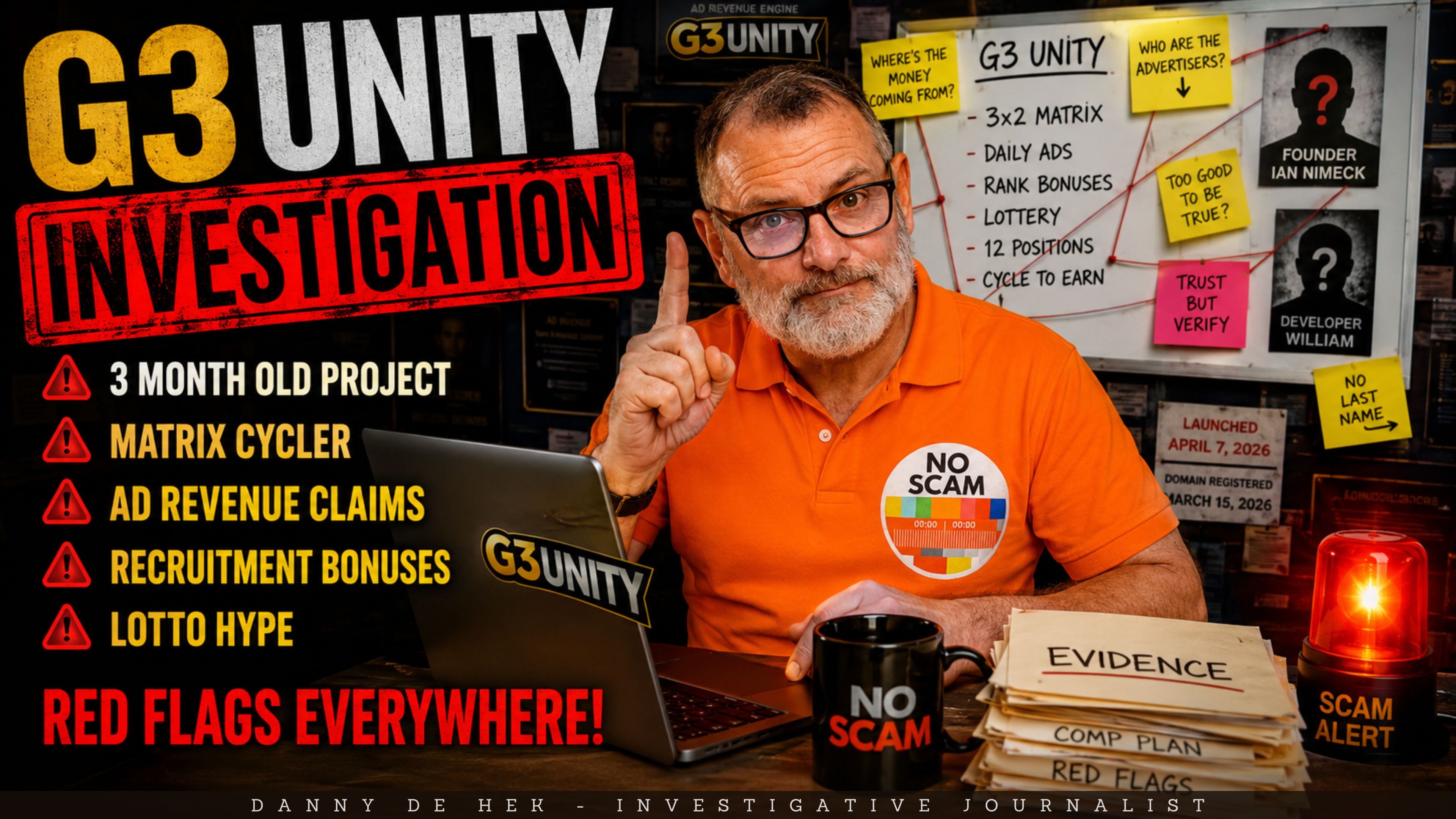
Public records show that g3unity.com was registered on March 15, 2026. Promotional material states that G3Unity launched on April 7, 2026.
That means the public history of this project spans only a few months.
Despite being extremely new, G3Unity already promotes an ecosystem that includes matrix participation, rank bonuses, advertising rewards, lottery participation, residual income, automatic upgrades and multiple earning levels.
The scale of the claims contrasts sharply with the visible footprint.
At the time of my review, the official Telegram group contained approximately 71 members. While relatively small, the group proved to be one of the most useful sources of information during this investigation, providing additional promotional material, onboarding guidance and insight into how the opportunity was being presented to participants. The YouTube Channel claimed around 1,050 subscribers, yet engagement appeared minimal. The main introduction video had only a few dozen views despite being newly released. The website itself consists largely of a landing page and downloadable presentation.
For a project presenting itself as the future of decentralized earning, the public presence is remarkably small. The contrast between the ambitious claims being made and the limited size of the visible community became one of the recurring themes throughout this investigation.
The Founder And The Missing Transparency
One of the first questions I ask when investigating any opportunity is simple:
Who is running it?
Surprisingly, the official website provides very little information.
Visitors are encouraged to connect wallets, activate memberships and participate in the ecosystem, yet there is no prominent founder biography, executive profile or company background explaining who created the platform.
The answer only appeared within referral material being shared by promoters.
According to that material, the founder is Ian Nimeck, while the developer is identified only as William. Promoters repeatedly emphasise that Ian can be trusted because they have known him personally for many years and communicate with him regularly.
That claim may satisfy existing members, but it raises an obvious question.
If transparency is one of G3Unity’s strongest selling points, why is the founder’s identity largely absent from the official website and only discoverable through recruitment material?
Transparency normally starts with the company itself.
Not with a referral link.
Inside The Telegram Community
As part of this investigation, I joined the official G3Unity Telegram group to understand how the opportunity was being promoted behind the public-facing website.
At the time of my review, the group contained approximately 71 members, making it considerably smaller than many established crypto networking opportunities. Despite the modest membership numbers, the group provided a useful glimpse into the people already participating in the ecosystem and the messaging being shared with prospective members.
Among the names visible within the Telegram community were Andrew Sherratt, Braden DeFiBoy, Brikesh Kumar, Carl White, Carla Cuervo, Craig Shepard, Daniel Borrero, Deonne Britton, Echem Eze, Fidele Frank, Florencio Gido Jr, Ibrahim Al-Mutairi, Igors Šapovals, Jane Mutinda, Jeffrey Barlow, Joselito Quitilen, Lou Velazquez, Margo McSweeney, Mark Proost, Miroslav Topic, Muhammad Yasir, Prakash Vaghela, Rhonda Olin, Sonia Silverio-Licop, Steve Carter, Tony Masuen and Vicki Houston, along with numerous other members using nicknames, partial identities or first names only.
The significance of these names is not that they are necessarily founders or leaders of G3Unity. Rather, they demonstrate that real people are actively participating in and promoting the opportunity. Several of the names identified are familiar to me from previous investigations involving crypto-based networking opportunities, matrix programs and MLM-style ventures. As always, participation alone should not be interpreted as wrongdoing. However, documenting who is involved can become important if questions later emerge about how the opportunity was marketed and who introduced others into the program.
What I found particularly interesting was that some of the promotional material and operational guidance being shared inside Telegram went beyond what was publicly available on the website. Members were encouraged to focus on growth, positioning and duplication strategies, while administrators shared onboarding information and community guidance designed to support expansion of the network.
For investigators, these private communities often provide a more accurate picture of how an opportunity functions than the polished marketing found on a website. The public website sells the vision. The Telegram group reveals how participants are encouraged to build it.
The Matrix At The Centre Of The Opportunity
 The most revealing document I reviewed was G3Unity’s own Presentation Deck.
Unlike many opportunities that attempt to disguise their structure, G3Unity openly promotes a 3×2 matrix system. According to the presentation, participants enter a structure consisting of 12 positions, with three positions on the first level and nine positions on the second.
The presentation explains that members must:
“Fill 12 spots to complete the cycle.”
That statement is important because it reveals how progression occurs within the system.
The matrix advances when positions are filled.
The presentation repeatedly focuses on placements, referrals, upgrades and cycling. It does not spend much time discussing customers purchasing products or businesses paying for services. Instead, the emphasis remains on network growth and matrix activity.
The terminology may be modern and wrapped in blockchain language, but the mechanics are familiar to anyone who has spent time examining matrix programs.
Following The Money
The compensation plan is surprisingly straightforward.
According to G3Unity’s own material, matrix payouts are divided equally:
- 50% goes to the direct sponsor
- 50% goes to the placement matrix
The company presents this as a fair and automated distribution model.
From an investigative perspective, however, the more important question is not how the money is divided. The more important question is where the money originates.
When evaluating opportunities like this, I look for evidence of genuine external revenue entering the system. Are products being sold? Are services being provided? Are external customers generating revenue independently of recruitment?
The available G3Unity material repeatedly focuses on members joining, positions filling, matrices cycling and networks expanding.
That does not automatically prove the model is unsustainable.
It does mean the burden falls on the promoters to demonstrate where the underlying revenue comes from.
The Ad Revenue Claims Deserve Closer Examination
One of the most interesting aspects of the G3Unity pitch is what it calls the Ad Revenue Engine.
According to the website and presentation, members can spend a few minutes each day watching advertisements and receive rewards generated through advertising activity. On the surface, that sounds plausible. Advertising is a legitimate global industry.
The problem emerges when the projected rewards are examined more closely.
The presentation includes examples showing participants activating positions and receiving significantly larger rewards over time. In several cases, the examples effectively show a doubling of the amount committed.
Naturally, that raises important questions.
Who are the advertisers?
What advertising networks are involved?
How much revenue is generated per advertisement viewed?
What independently verifiable evidence exists showing that advertising activity alone can support the rewards being promoted?
During my review, I found promotional claims. What I did not find were detailed financial disclosures, advertiser information, revenue reports or independently verifiable evidence capable of answering those questions.
For a project built around transparency, that absence is significant.
Recruitment, Rank Bonuses And Lottery Rewards
Supporters often describe G3Unity as something participants can enjoy without actively recruiting others.
Technically, that may be true.
The compensation plan tells a different story.
The presentation includes rank bonuses tied directly to recruitment activity. Members receive rewards for reaching various milestones, beginning with three active referrals and extending all the way to 160 active directs.
Compensation plans reveal priorities. Companies reward the behaviour they want repeated. When bonuses are tied to recruitment, recruitment becomes an important part of the ecosystem regardless of how it is described in marketing material.
The platform also includes a lottery component, allowing members to purchase tickets and participate in weekly draws. Combined with matrix cycling, rank bonuses and advertising rewards, the lottery adds yet another layer to an already complex compensation structure.
The recurring question remains the same:
How much value is entering the ecosystem from external sources, and how much is simply being redistributed among participants already inside it?
What Happens When Growth Slows
This is where the investigation ultimately leads.
The website promotes a 3×2 matrix. The presentation explains that participants complete cycles when twelve positions are filled. Members can earn through referrals, matrix placements, rank bonuses, advertising rewards and lottery participation. Every one of those features creates obligations within the system.
As long as participation continues growing, those obligations may appear manageable.
The challenge comes when growth slows.
Matrix structures depend on positions being filled. Recruitment bonuses depend on people joining. Lottery pools depend on participation. Advertising claims require genuine revenue. Residual rewards require ongoing funding.
Supporters point to blockchain technology, smart contracts and decentralization as evidence that the model is different. Those technologies may automate transactions, but they do not solve the underlying economic question.
Where does the money come from?
That is the question that sits at the centre of this investigation.
After reviewing the website, the presentation deck, the YouTube content, the Telegram activity and the recruitment material, I believe G3Unity displays many of the characteristics commonly associated with crypto matrix opportunities. The project is extremely new. Its public footprint is tiny. Its compensation structure relies heavily on matrix participation and recruitment activity. Its advertising claims remain largely unsupported by publicly available evidence.
Perhaps the founders will provide detailed information demonstrating exactly how the economics work. Perhaps additional evidence will emerge as the project develops.
Until then, the most important question remains unanswered.
Is G3Unity generating sufficient external revenue to support the rewards being promoted, or are those rewards ultimately dependent upon a continuous flow of new participants entering the system?
Because after investigating hundreds of opportunities over the years, I have learned that flashy websites, smart contracts, referral systems and promises of decentralized wealth are not what determine whether an opportunity succeeds.
The money does.
Disclaimer: How This Investigation Was Conducted
This investigation relies entirely on OSINT — Open Source Intelligence — meaning every claim made here is based on publicly available records, archived web pages, corporate filings, domain data, social media activity, and open blockchain transactions. No private data, hacking, or unlawful access methods were used. OSINT is a powerful and ethical tool for exposing scams without violating privacy laws or overstepping legal boundaries.
About the Author
I’m DANNY DE HEK, a New Zealand–based YouTuber, investigative journalist, and OSINT researcher. I name and shame individuals promoting or marketing fraudulent schemes through my YOUTUBE CHANNEL. Every video I produce exposes the people behind scams, Ponzi schemes, and MLM frauds — holding them accountable in public.
My PODCAST is an extension of that work. It’s distributed across 18 major platforms — including Apple Podcasts, Spotify, Amazon Music, YouTube, and iHeartRadio — so when scammers try to hide, my content follows them everywhere. If you prefer listening to my investigations instead of watching, you’ll find them on every major podcast service.
You can BOOK ME for private consultations or SPEAKING ENGAGEMENTS, where I share first-hand experience from years of exposing large-scale fraud and helping victims recover.
“Stop losing your future to financial parasites. Subscribe. Expose. Protect.”
My work exposing crypto fraud has been featured in:
- Coffeezilla 2026): Featured in the investigation exposing the alleged $328M Goliath Ventures Ponzi scheme
- Bloomberg Documentary (2025): A 20-minute exposé on Ponzi schemes and crypto card fraud
- News.com.au (2025): Profiled as one of the leading scam-busters in Australasia
- OpIndia (2025): Cited for uncovering Pakistani software houses linked to drug trafficking, visa scams, and global financial fraud
- The Press / Stuff.co.nz (2023): Successfully defeated $3.85M gag lawsuit; court ruled it was a vexatious attempt to silence whistleblowing
- The Guardian Australia (2023): National warning on crypto MLMs affecting Aussie families
- ABC News Australia (2023): Investigation into Blockchain Global and its collapse
- The New York Times (2022): A full two-page feature on dismantling HyperVerse and its global network
- Radio New Zealand (2022): “The Kiwi YouTuber Taking Down Crypto Scammers From His Christchurch Home”
- Otago Daily Times (2022): A profile on my investigative work and the impact of crypto fraud in New Zealand




Leave A Comment