



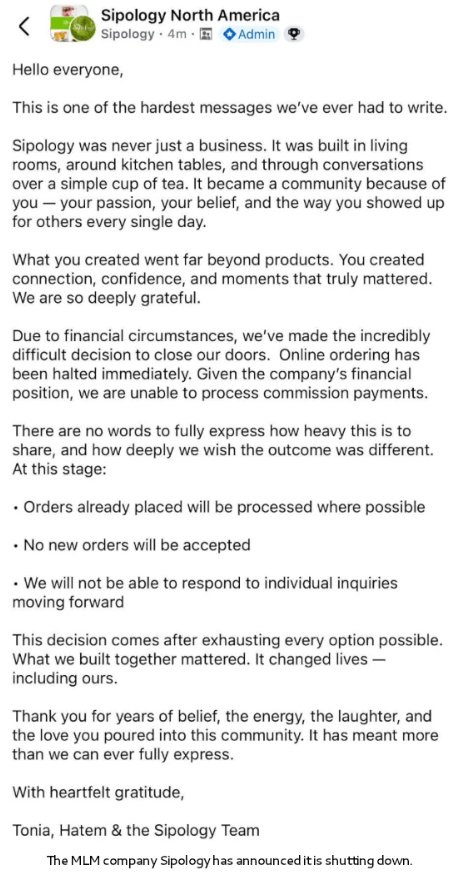
Sipology (formerly Steeped Tea) has abruptly terminated its MLM opportunity and halted operations, leaving thousands of distributors without commissions and customers uncertain about outstanding orders. The shutdown, announced through a brief notice on Sipology’s website, cites unspecified “financial circumstances” and offers no timeline for resolution.
The company’s website has been replaced with a password-protected Spotify page, and Sipology states it is unable to respond to individual inquiries. Distributors report being locked out of back-office systems and unable to access their own sales data.
The sudden collapse marks the end of a 20-year run for the Canadian tea MLM and raises serious questions about the stability of the MLM model in 2026 and beyond.
Immediate Termination, No Commissions Paid
Sipology’s April 21, 2026 notice confirms:
- The MLM opportunity is terminated effective immediately
- No new orders are being accepted
- Existing orders will be fulfilled only “where possible”
- The company is unable to process commission payments
- Customer service is not responding to individual messages
- The website has been replaced with a password-locked storefront
Sipology did not provide:
- A plan for paying earned commissions
- A timeline for resolving outstanding orders
- Any explanation of the “financial circumstances”
- Any communication from leadership beyond the brief notice
(Above image provided by BehindMLM Here)
For distributors, this means income already earned may never be paid.
Receivership Rumors and Lack of Transparency
Across social media, multiple Sipology distributors claim the company has entered receivership. Sipology has not confirmed this publicly, and no court filings have yet been located to verify the claim.
If receivership is confirmed, distributors would be classified as unsecured creditors — historically the group least likely to recover losses in MLM collapses.
The lack of transparency from Sipology’s leadership has intensified frustration among distributors, many of whom invested heavily in inventory, events, and recruitment.
The Broader Industry Context
Sipology’s Shutdown is part of a larger pattern. Since 2023, dozens of MLMs have downsized, restructured, or collapsed entirely. The industry is facing unprecedented pressure:
- Declining Recruitment
Public awareness of MLM risks has grown dramatically. Younger generations are rejecting MLMs outright, and older distributors are burning out. - Shrinking Customer Bases
Non-MLM competitors — especially online tea retailers — offer better pricing, better quality, and no recruitment pressure. - Post-Pandemic Cost Increases
Shipping, packaging, and supply chain costs have risen sharply since 2021. MLMs with physical products have been hit especially hard. - Regulatory Scrutiny
Regulators in Canada and the US have increased pressure on deceptive income claims and inventory-loading practices. - Collapse of the Party-Plan Model
Sipology’s relied heavily on home parties, a model that has been in steep decline since 2020.
Sipology’s collapse fits the pattern: when recruitment slows and sales decline, MLM companies often collapse suddenly, leaving distributors financially exposed.
The Human Impact
The most significant fallout is the unpaid commissions. Distributors who hosted parties, placed orders, recruited others, and invested in inventory may never receive the income they were promised.
Common distributor reports include:
- Hundreds to thousands of dollars in unpaid commissions
- Unfulfilled customer orders that distributors now feel responsible for
- Inventory purchased for upcoming events that can no longer be sold
- Loss of business expenses that cannot be recouped
- Emotional distress from feeling responsible for downline losses
This is a recurring pattern in MLM collapses: distributors absorb the financial and emotional damage while corporate leadership remains insulated.
For many, Sipology was not just a side gig — it was a community, source of identity, and a promised path to financial independence. The abrupt shutdown has left many feeling betrayed.
Timeline of Sipology’s Decline (2006-2026)
2006 — Steeped Tea Launches
Founded in Canada as a party-plan MLM selling loose-leaf tea and accessories.
2012-2016 — Rapid Growth
Steeped Tea gains traction through home parties and social selling. Recruitment expands across Canada and into the US. Tonia and husband Hatem pitched the business on Dragons’ Den, the Canadian version of Shark Tank.
2017 — Plateau Begins
Distributor complaints increase about:
- declining sales
- market saturation
- difficulty maintaining ranks
- rising costs of hosting parties
2018 — Rebrand to Sipology
Steeped Tea rebrands to Sipology in an attempt to modernize the brand and appeal to younger consumers. The shift fails to reverse declining recruitment.
2021-2023 — Industry-Wide Downturn
Sipology faces the same pressures as other MLMs:
- shrinking customer demand
- increased competition from non-MLM tea brands
- higher shipping and supply chain costs
- difficulty retaining distributors
Distributor chatter reflects growing frustration with compensation changes and reduced support.
2024 — Operational Strain Becomes Visible
Reports surface of:
- delayed orders
- reduced customer service response times
- inconsistent commission payouts
2025 — Quiet Retrenchment
Sipology reduces marketing, cuts back on events, and scales down operations. Distributor numbers continue to fall.
Early 2026 — Financial Instability
Distributors report:
- missing commissions
- unprocessed refunds
- unfulfilled orders
- lack of communication from corporate
April 2026 — Sudden Collapse
Sipology announces:
- termination of the MLM opportunity
- inability to pay commissions
- shutdown of ordering systems
- website replaced with a password-protected page
Distributors are left without answers.
What This Means for Consumers and Distributors
Sipology’s collapse highlights several ongoing risks inherent to the MLM model:
- Distributors have no financial protections
- Companies can terminate opportunities without notice
- Earned commissions are not guaranteed
- Inventory-based models leave distributors holding unsellable stock
- Corporate leadership faces little accountability
For consumers, this means:
- outstanding orders may not be fulfilled
- refunds may be difficult or impossible to obtain
- customer service may be unreachable
For distributors, the financial and emotional fallout may last far longer than the company itself.
Another Example
Sipology’s shutdown is another example of the instability built into the MLM model. When recruitment slows or sales decline, companies often collapse suddenly, leaving distributors unpaid and unsupported.
As more MLMs face financial strain in 2026, Sipology’s collapse serves as a warning: the risks of MLM participation are real, and the consequences fall hardest on the people least protected.
I will continue to monitor the situation and will update this article if receivership filings or additional disclosures become available.
By Beth Gibbons (Queen of Karma)
Beth Gibbons, known publicly as Queen of Karma, is a whistleblower and anti-MLM advocate who shares her personal experiences of being manipulated and financially harmed by multi-level marketing schemes. She writes and speaks candidly about the emotional and psychological toll these so-called “business opportunities” take on vulnerable individuals, especially women. Beth positions herself as a survivor-turned-activist, exposing MLMs as commercial cults and highlighting the cult-like tactics used to recruit, control, and silence members.
She has contributed blogs and participated in video interviews under the name Queen of Karma, often blending personal storytelling with direct confrontation of scammy business models. Her work aligns closely with scam awareness efforts, and she’s part of a growing community of voices pushing back against MLM exploitation, gaslighting, and financial abuse.




Leave A Comment