


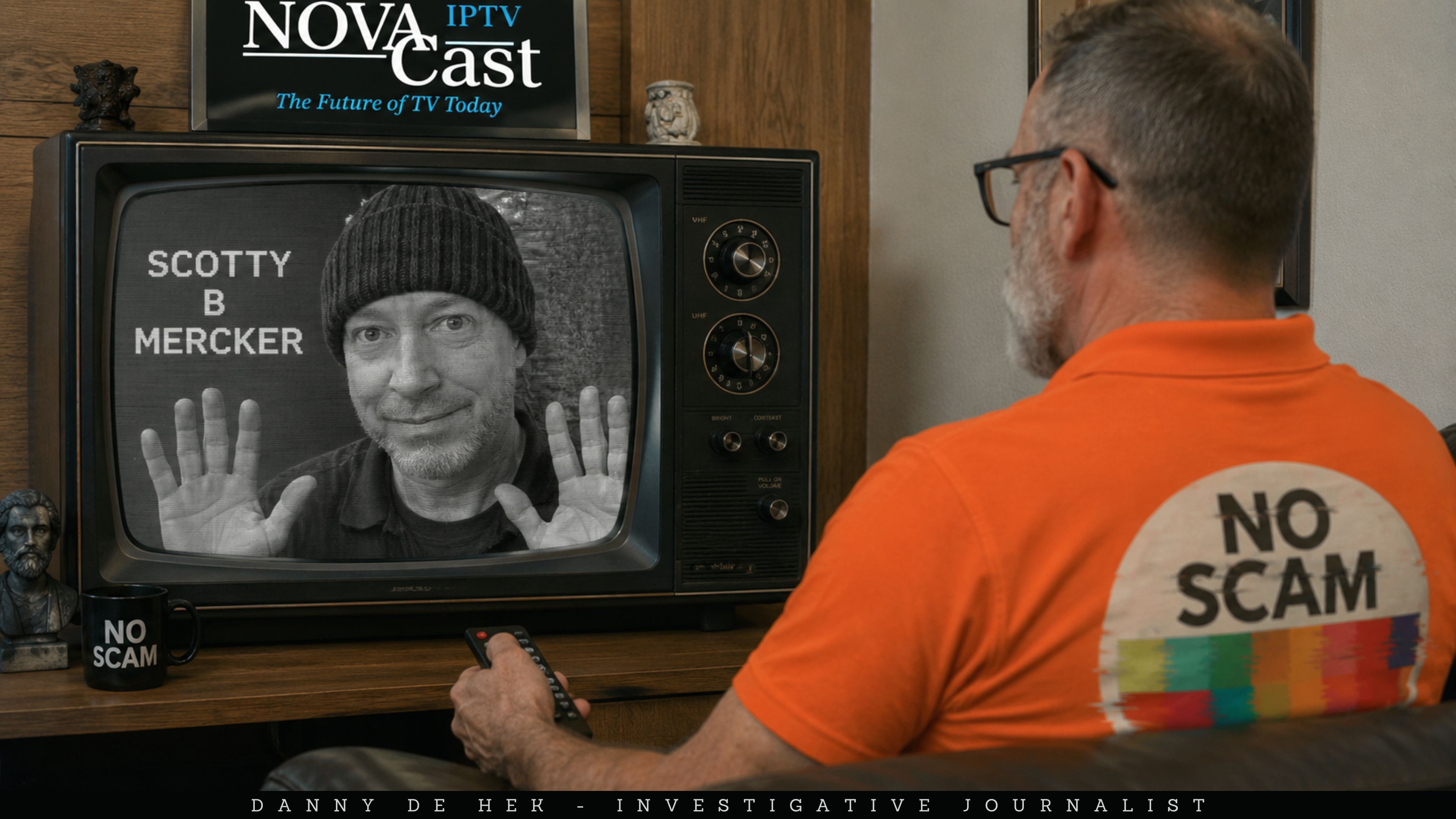
“Do not refer to NovaCast as an MLM.”
I wasn’t looking for another affiliate opportunity when NovaCast TV landed on my radar.
I was investigating what appeared to be a new streaming television service claiming to offer 20,000 live channels, premium sports, blockbuster movies and worldwide entertainment for $49.95 a month. On the surface, it looked like another company trying to convince people to cut the cord and cancel expensive cable subscriptions.
It didn’t take long for the cracks to appear.
After attending NovaCast presentations, attempting to subscribe, reviewing company documents and tracing the businesses operating behind the scenes, I discovered this wasn’t simply a story about internet television. The investigation uncovered a referral-only sign-up process, multiple interconnected companies, a ten-level affiliate compensation plan, dozens of promotional websites and a sales model that appeared to place as much emphasis on recruiting new affiliates as it did on acquiring customers.
What I uncovered
- A 10-level unilevel compensation plan.
- Customers encouraged to join through authorised affiliates.
- ACZ Media Group LLC operating behind the NovaCast brand.
- Multiple websites promoting the same opportunity under different domains.
- Marketing aimed at churches, schools, charities and community organisations.
- Repeated claims of “100% Licensed Content” alongside questions that deserve closer examination.
None of these points, taken on their own, prove wrongdoing.
Taken together, however, they reveal a business model that deserves much closer scrutiny.
This investigation follows the evidence step by step, separating documented facts, marketing claims and unanswered questions, so readers can decide for themselves whether NovaCast is simply selling television—or whether the real product is the opportunity itself.
The Presentation That Raised My First Red Flag
Like many opportunities I’ve investigated over the years, NovaCast didn’t first appear through a company website. It appeared through a Zoom presentation hosted by promoters eager to introduce what they described as the future of television. The pitch was polished, the presenters were enthusiastic, and the audience was encouraged to believe they had discovered a better alternative to traditional cable.
At first, everything sounded like a consumer product.
For $49.95 a month, NovaCast claimed subscribers could access 20,000+ live television channels, 140,000+ movies, 32,000+ TV series, premium sports packages and content from more than 150 countries. The message was simple: cancel your expensive cable subscription, save money every month and enjoy everything from one platform.
Then the conversation started to change.
The presenters spent a surprising amount of time talking about sharing the opportunity, introducing other people and becoming involved as affiliates. The television service remained the headline attraction, but recruitment kept finding its way back into the conversation.
When I joined the meeting, the atmosphere changed almost instantly. The organisers tried to identify me, participants accused me of impersonating other attendees, and genuine members were accidentally removed from the call. Meanwhile, supporters continued posting comments praising Scotty B Mercker and asking how they could join.
What stood out during the presentation
- The focus quickly shifted from watching television to sharing the opportunity.
- Existing members actively defended the presenters.
- New attendees were asking how to join, not just how to subscribe.
- The disruption appeared to concern the organisers more than the questions being asked.
By the end of the meeting, I wasn’t convinced I was looking at just another streaming service. The presentation had raised enough questions for me to do what I always do next—ignore the sales pitch and follow the evidence instead.
Trying To Subscribe Changed Everything
Rather than speculate, I decided to become a customer myself. If NovaCast was simply another streaming platform, signing up should have been no different from subscribing to Netflix or Disney+. I wanted to experience exactly what an ordinary customer would see before handing over their credit card.
That’s not what happened.
Instead of creating an account directly with NovaCast, I discovered I needed an authorised referral link from an affiliate. Every path seemed to lead through a promoter rather than the company itself. That immediately changed the way I looked at the business because it suggested the affiliate network wasn’t optional—it appeared to be central to how new customers entered the system.
The deeper I went into the registration process, the stranger it became.
Instead of dealing exclusively with Nova Cast Television LLC, I found myself being redirected to a company called ACZ Media Group LLC. The customer portal, the Terms & Conditions, the Privacy Policy and the subscription process all pointed back to ACZ Media rather than NovaCast itself.
My immediate questions were simple:
- Who was ACZ Media Group LLC?
- Why wasn’t I subscribing directly through Nova Cast Television LLC?
- Why did I need an affiliate to purchase a television subscription?
- If something went wrong, which company would actually be responsible?
Those questions became even more important after reading the legal documents. The more paperwork I downloaded, the clearer it became that ACZ Media wasn’t just providing technical support—it appeared to sit at the centre of the entire customer experience.
Following The Money Led Somewhere Else
I expected to subscribe to NovaCast TV.
Instead, I found myself dealing with ACZ Media Group LLC.
That was the moment this investigation changed.
As I worked through the registration process, NovaCast gradually disappeared into the background. The Terms & Conditions were issued by ACZ Media. The Privacy Policy belonged to ACZ Media. Customer support was handled through ACZ Media, and subscribers were directed to an ACZ Member Portal before they even started watching television.
That isn’t what I expected from a company presenting itself as NovaCast TV.
The more documents I downloaded, the more questions I had. If NovaCast was the company being promoted, why was another business handling so much of the customer relationship? Was ACZ Media simply providing back-office services, or was it the company actually operating the subscription platform?
Those weren’t the only surprises.
While tracing ACZ Media’s online presence, I discovered a growing collection of connected websites. Some sold NovaCast directly. Others promoted affiliate recruitment. Others focused on fundraising opportunities or educational benefits. They all appeared to feed into the same ecosystem, but they weren’t telling exactly the same story.
By now, the investigation had moved well beyond a television streaming service.
It had become an investigation into who was really behind NovaCast and how the business was actually structured.
The Affiliate Model Was Impossible To Ignore
The more I investigated NovaCast, the harder it became to separate the streaming service from the business opportunity.
It wasn’t just one presentation or one enthusiastic promoter. The same message appeared across multiple websites, YouTube videos and affiliate pages. People weren’t simply being encouraged to subscribe—they were being encouraged to share NovaCast, recruit others and build a recurring income.
One affiliate page introduced visitors to their personal NovaCast representative, complete with a phone number, email address and referral link. Another promoted NovaCast as the ideal fundraiser for churches, schools and charities, claiming organisations could generate monthly income simply by encouraging their members to subscribe.
Then there was Scotty B Mercker’s own messaging.
He wasn’t just talking about television.
He invited viewers to become full-time or part-time Brand Ambassadors, describing NovaCast as a business that could be taken to the global marketplace. The emphasis wasn’t solely on replacing cable television—it was on building a network of subscribers.
That distinction matters.
There’s nothing unusual about a company paying referral commissions. Plenty of legitimate businesses do exactly that. What caught my attention was that recruitment appeared to be woven into almost every part of the customer journey. From the moment I attempted to subscribe, through to the presentations and affiliate websites, the same pattern kept repeating.
It left me with one obvious question.
If recruitment is such a central part of NovaCast’s growth strategy, how exactly are affiliates rewarded?
The answer was sitting inside NovaCast’s own compensation plan.
The Compensation Plan Answers A Lot Of Questions
Everything I’d uncovered up to this point suddenly started to make sense when I found NovaCast’s affiliate compensation plan.
The presentation described what it called a “Pure 10 Level Uni-Level” compensation structure. Affiliates received 20% for personally enrolling a subscriber, with additional commissions flowing through ten levels of the organisation. Another slide stated that “$49.95 PV Makes You Active Affiliate,” meaning an active subscription was tied to participation in the commission plan.
That immediately explained why customers were encouraged to register through an affiliate rather than directly with the company.
“Do not refer to NovaCast as an MLM.”
I found that instruction particularly interesting because it appeared in the same presentation explaining a ten-level unilevel compensation plan.
I’m not interested in arguing over terminology. Readers can decide for themselves whether they believe NovaCast fits the definition of multi-level marketing. What matters to me is how the business actually operates, not what it’s called.
According to NovaCast’s own presentation, affiliates receive:
- 20% for personally enrolling a subscriber.
- Commissions across 10 levels.
- Ongoing income linked to active subscriptions.
- Qualification through maintaining an active account.
By itself, none of this proves NovaCast is operating unlawfully. However, it does demonstrate that affiliate recruitment is far more than a side feature. The compensation plan appears to be a core part of the business model.
For me, that was a turning point.
I was no longer investigating an IPTV subscription.
I was investigating an affiliate opportunity built around an IPTV subscription.
The More I Dug, The More Questions I Had
Just when I thought I understood NovaCast’s business model, another name kept appearing.
SAGE Scholars Tuition Rewards.
At first, I assumed it was unrelated. After all, I was investigating a television streaming service. Why was I suddenly reading about college tuition discounts, private universities and an education rewards programme?
The answer wasn’t immediately obvious.
Several NovaCast affiliate websites promoted SAGE Scholars as an exclusive subscriber benefit, claiming members could earn guaranteed tuition discounts at hundreds of participating colleges across the United States. It seemed like an unusual pairing—IPTV and college education—but it was being marketed as another reason to subscribe.
Rather than assume anything, I investigated SAGE Scholars separately.
Unlike NovaCast, SAGE wasn’t a new organisation. It had been operating for many years, with an established network of participating colleges and a documented tuition rewards programme. From everything I could verify, SAGE Scholars appeared to be a legitimate organisation in its own right.
That wasn’t the issue.
The question wasn’t whether SAGE was legitimate.
The question was how NovaCast became connected to it.
As I continued tracing domains, I also discovered references to MarketCapAndGown.com and later World Transfer Alliance (WTA). Suddenly the investigation wasn’t just about television, affiliate commissions or ACZ Media. There appeared to be an entire ecosystem of organisations connected, either directly or indirectly, to NovaCast’s marketing strategy.
Instead of simplifying the story, each new discovery made it more complicated.
And that complexity only reinforced why transparency matters. If prospective customers are expected to trust a company with their personal information and ongoing subscription payments, they should also be able to clearly understand who they’re dealing with and how all of these organisations fit together.
Another Investigation Reached Similar Conclusions
As I was wrapping up my own investigation, BehindMLM published its review of NovaCast. We approached the story independently, yet several of our findings overlapped. Whenever two separate investigations begin identifying the same corporate relationships and asking the same questions, it’s worth paying attention.
BehindMLM also identified ACZ Media Group LLC as the company operating behind NovaCast’s customer platform and noted that the streaming service relied on a multi-level affiliate compensation plan to recruit distributors. Those findings closely matched what I had already uncovered through the customer documentation, affiliate presentations and compensation plan.
There was one area where my investigation went further.
Rather than relying solely on public websites, I had attended Zoom meetings, recorded presentations, attempted to subscribe, reviewed the legal documents, recovered archived websites and analysed promotional material from multiple affiliates. That allowed me to see how NovaCast was being sold, not just how it presented itself publicly.
BehindMLM also questioned NovaCast’s claims surrounding its streaming content.
NovaCast repeatedly advertises “100% Licensed Content”, while BehindMLM reached a different conclusion after conducting its own research. Rather than speculate, I’ll simply note the difference. The licensing claims deserve clarification, particularly given the size of the content library being promoted and the emphasis placed on that claim throughout NovaCast’s marketing.
Independent investigations don’t prove each other correct.
But when they begin uncovering the same companies, the same compensation structure and many of the same unanswered questions, it strengthens the case for taking a much closer look at the opportunity.
Questions NovaCast Should Be Able To Answer
The purpose of this investigation isn’t to tell people what to think. It’s to present the evidence, identify the inconsistencies and ask the questions that any reasonable consumer should ask before subscribing or becoming an affiliate.
After reviewing the presentations, legal documents and affiliate material, these are the questions I believe NovaCast should answer publicly.
Questions that deserve clear answers
- Why do customers need to subscribe through an authorised affiliate instead of purchasing directly from NovaCast?
- What is the exact relationship between Nova Cast Television LLC and ACZ Media Group LLC?
- Who is legally responsible for customer subscriptions and personal data?
- Why is the affiliate compensation plan structured across ten levels while affiliates are instructed not to refer to NovaCast as an MLM?
- Can NovaCast provide independent evidence supporting its repeated claim of “100% Licensed Content”?
- How does the advertised “100% Money Back Guarantee” align with the Terms & Conditions, which state refunds are considered on a case-by-case basis?
- What formal agreements exist between NovaCast, SAGE Scholars and World Transfer Alliance?
None of these are trick questions.
They’re the sort of questions I would expect any prospective customer, regulator or investigative journalist to ask before committing to an ongoing monthly subscription or recommending the opportunity to family, friends or their community.
So far, I’ve found plenty of marketing material.
What I’ve struggled to find are clear, transparent answers.
Right Of Reply
I believe in giving every company and every individual the opportunity to respond.
If Nova Cast Television LLC, ACZ Media Group LLC, Scotty B Mercker, Jim Bland, David Richardson, or any promoter connected with NovaCast believes I have misunderstood the evidence or omitted important information, I invite them to contact me with documentation that supports their position.
I’m particularly interested in evidence relating to:
- The relationship between Nova Cast Television LLC and ACZ Media Group LLC.
- The operation of the affiliate compensation plan.
- The basis for the repeated “100% Licensed Content” claims.
- The partnerships promoted with SAGE Scholars and World Transfer Alliance.
- Any clarification regarding the customer sign-up process, refund policy or corporate structure.
Investigations are never about proving a predetermined conclusion. They’re about following the evidence wherever it leads. If credible documentation materially changes the facts presented in this article, I’ll review it objectively and update this investigation accordingly.
Transparency should work both ways.
I’ve published the evidence that informed my conclusions.
Now it’s NovaCast’s turn to answer the questions.
The Investigation Continues
When I first joined a NovaCast presentation, I thought I was reviewing another streaming television service. I didn’t expect to uncover multiple company names, an affiliate-driven sign-up process, a ten-level compensation plan, interconnected websites and a business model that appeared to rely heavily on recruitment. The deeper I dug, the more questions emerged.
That doesn’t automatically mean NovaCast is operating unlawfully.
It does mean prospective customers and affiliates should carry out their own due diligence before committing their money or recommending the opportunity to others.
If you’re considering joining NovaCast, don’t stop at the presentation.
Read the legal documents.
Ask who you’re actually contracting with.
Understand how the compensation plan works.
Verify the claims being made.
And most importantly, don’t be afraid to ask difficult questions.
Good businesses welcome scrutiny.
This investigation represents the evidence available at the time of publication. If new documents emerge, additional whistleblowers come forward, or NovaCast responds with information that materially changes the facts, I’ll review that evidence and update this article accordingly.
If you have screenshots, recordings, internal documents or firsthand knowledge relating to NovaCast TV, ACZ Media Group LLC, Scotty B Mercker or any of the individuals mentioned in this investigation, I’d be interested in hearing from you.
Because investigations like this don’t end when an article is published.
They end when the questions have been answered.
Evidence Reviewed
This investigation wasn’t built from rumours, anonymous social media posts or recycled marketing claims. It was built by following the evidence wherever it led.
Primary evidence reviewed
- Live NovaCast Zoom presentations.
- Affiliate training sessions and compensation plan presentations.
- NovaCast promotional videos featuring Scotty B Mercker and other promoters.
- Customer Terms & Conditions and Privacy Policy.
- The NovaCast customer sign-up process.
- Affiliate websites, including DMVStreamingTV.com.
- Historical websites recovered using the Wayback Machine.
- Company websites linked to Nova Cast Television LLC and ACZ Media Group LLC.
- Promotional material relating to SAGE Scholars Tuition Rewards.
- Public information relating to World Transfer Alliance (WTA).
- Independent reporting published by BehindMLM.
Throughout this investigation I deliberately compared what promoters said, what the documents said, and what I experienced myself. Whenever those three things aligned, my confidence increased. Whenever they contradicted each other, I dug deeper.
As with every investigation I publish, this article reflects the evidence available at the time of writing. If additional documentation becomes available or NovaCast provides evidence that changes any of these findings, I’ll examine it objectively and update this investigation where appropriate.
The goal has never been to win an argument.
The goal has always been to follow the evidence.
Update: NovaCast Affiliate Contact Details Exposed Through Public Referral Pages
While continuing my investigation into NovaCast, I discovered something that raises a separate and serious privacy concern for people participating in the affiliate programme.
NovaCast affiliates appear to be assigned individual referral pages using a predictable URL structure on the novacast.info domain. Examples I identified followed the format Nc100, Nc101, Nc102 and continued through hundreds of sequential numbers. When these pages were opened, many displayed contact information associated with the individual affiliate, including their name, telephone number and email address.
The problem isn’t simply that these details could be viewed on a webpage. The numbering system was sufficiently predictable that I was able to demonstrate how the information could be collected automatically using a basic Python script. Rather than manually opening hundreds of pages, the script systematically requested the publicly accessible referral URLs and extracted the contact information displayed on them.
I ultimately collected 821 referral records from this system.
That demonstrates an important security issue: if I could automate the collection of this information for investigative purposes, somebody harvesting personal information for spam, phishing, social engineering or other malicious purposes could potentially attempt exactly the same thing.
To be clear, I did not bypass a password, hack a server, exploit an account or circumvent access controls. The information was exposed through publicly accessible URLs generated using a predictable numbering structure. My script simply automated what anyone with a web browser could otherwise have done manually.
The information I collected included combinations of:
- Affiliate names
- Telephone numbers
- Email addresses
- Individual NovaCast referral identifiers
- Public referral URLs
I am deliberately not publishing the scraped telephone numbers or email addresses in this article. Demonstrating the vulnerability is important; unnecessarily republishing people’s contact information would only compound the privacy problem.
People Whose Details Appeared In The Referral System
The following names appeared within the records I collected. Inclusion in this list does not mean that I am accusing every person named of wrongdoing, nor does it establish that every person was an active promoter at the time of publication. Their names are included because contact information associated with these records was accessible through the NovaCast referral-page system I examined.
Lusine Karapetyan, Jeremy Green, Max Newman, Chris Koutrotsios, Solomon McCluster, JD Gibson, Jim Heldreth, Francisco Palacios, Theresa Burns, Karen Small, Michael Ciletti, Helene Weiner, David Byers, Karla Landry, Fred Shatzoff, Jodi Pottorff, Louis Burns, Javious Wright, Kelly Kohler, Cliff Miller, Jamie Stafford, Patrick Laing, Ted Rogers, Rick McCord, Sky Point, Daniel Williams, Cassidy Laurich, David Agrinsonis, William Wilson, Shaelynn Hathaway, Nick Kuespert, Clint Barreras, Edwin Rivera Jr, Dalton Edwards, Frank Helring, Brian Hitchens, Stewart Allen, Martha Spears, Ken Jefferson, Deb Mack, Dinah Beverly, Dan Hughes, Joe Leech, Rosie Gordon, Penelope Taylor, David Archibald, Lawrence Mallgrave, Joseph Anthony, Willie Middleton, Betty Ho, Peter Gibson, Brandon Ong, Judy McOsker, Thomas Johnson, Jack Welch, Lydia Yukon, Amnit Seto, Bryan Geoffroy, Casey Riegert, George Caffey, Mark Brown, Rod Milliman, Jason Winter, John Wolff, Bill Samagalsky, Kristy Mercker, Chloe Goodfriend, Chester Dilday, Sheila Stirling, Lee Mercker, M Thomas Sterling, Chantell Mc Crate, Karin Parsons, Dennis Camp, Greg Wilson, Teri Norgrove, Willie Ragland, Otis Corbett, Khanh Tran, Bill Marcell, Ron Crane, Antonio Lopez, Scotty Mercker, Tim Reynolds, Jeff Fitting, Bob Murray, Dale Mercker, Brad Nellis, Jennine Pennix, Susan Heckman, Hilry Thomas, Jeff Salm, Paul Peiffer, Jeff Evers, Dewayne W Moffat, Mike Lee, Ryan Wiebusch, Emilio Pineda, Janet Brennan, Michael Wisniewski, Sergio Rodriguez, Ruth Scruggs, Roddy Roy, John Melcher, Chris Egan, Lisa Vivori, Nate Jackson, Gary Luersen, Bayo Oshinnaiye, Shane Bowman, Wendy Coan, Gary Klasnic, Joey Fletcher, Russell Edwards, David Schroeder, Peter Pesco, Rodney Roberts, Mahana Garcia, Mark Schroeder jr, Craig Rhodes Sr., Denise Ivey, Theodora Mays, Luigj Berishaj, James Harper, Natalie Odumes, Ed LaRosa, Orrien Trigg, Shannon Simecek, Theron Embry, Joe Gutierrez, Timothy Dunn, Mario Milianti, Kelly Burris, Michael OBrien, Shirley Stull, William Bell, Craig Thomas, Kurtis McBride, Timothy Satterfield, Sonny Ramirez, Terry Sneed, Rik McCoy, Carl Mobley, Heather Osbourne, Tony Elizondo, Michael Stief, Wanda Wallace, Ronald Stanford, Bob Uyematsu, Paul David, Catherine Aikins, Clarence Williams, Ron Cox, Richard Acuff, Bill Campbell, Mark Wilten, Thoi Tran, Joel Peskin, Gina McWilliams, Jeff Mooney, Bryan Trigg, Robert Adams, Lynn Harris, Rodney Bush, Will Mayer, Joyce Crawford, Melvin Mapp, Naira Alamilla, Jacki Smith, Stephen Steele, JB Burnett, Tim Traxler, Joe Olivetti, Tam Nguyen, Cynthia Crabtree, Franklin Thompson, Paul Kari, Freddie Lee, Jodi Forte, Diana Barela, Victor McLeod, John Bolenbaugh, Trish Harper, FARRIS Deloney, Daniel Bauman, Andre Passee, Jeannie Schulman, Alyce Smith, Dennis Ferguson, Victoria Foster, Leanna Mason, Ini Nwoko, Daniel Bernard, Denise Graham, Liz Diehl, Benjie Benas, Howard Feingold, Don Shickle, Justin Davis, Arthur Reaume, Join Now, Nina Hoang, Fred Bender, Duke Truong, Jenny Tran, Kim Le, Shirley Baker, Ginalyn Arado, Barry Hoffman, Dewain Menter, Alvin Williams, Jack Herbert, Kevin Morris, Larry Young, Randy Thompson, Judy McFall, Rob Gillpatrick, Enos Glaspie, Larry Nordlinger, Luis Sierra, Jordan Long, Douglas Burch, Jodie Ballou, Vondell Boyer, Marcus Fontenot, Jessica Prince, Gloria Colon, James Copeland, Steve McBrayer, Darius Balaoing, Timothy Keevers, Tony Pormento, Willy Blanco, Donald Shickle, Pat Ward, Tom Schaefer, Michael Vinson, Maria Avila, Bobbie Jo Wade, Dave Forsgren, Kercedric Holley-Bell, Junko Borge-Harris, Jay Johnson, Jimmie Abston, Cuong Huynh, Christine White, Eric Stratton, Ann Rodgers, Joseph Mumbu, Thomas Lewis Iii, Minh Chau Ho, Tomilola Timilehin, Dave Senor, Craig Rhodes Jr., Ray Antonelli, Rhoda Alale, Roosevelt Eaddy, Bob Hadley, Don Van Dyke, Saleem Ameer Hakim, Alan Holmes, Brian Causey, Rhett Causey, Lonna Noland, Gary Durst, Gary Singh, Hally Tran, Ken Che, David Richardson, Karen Ferro, Ken Laughlin, Glenn Coplin, John Tran, Connie King, Dennis Moranz, Ed Farrel, Eugene Moseley, Cindy Dillahunty, Kenneth Barzilla, Charles Carlton, Tan Nguyen, Greg Beatty, Lisa Lothian, Martel Matthews, Greg Ballew, Nina Ashradi, Steve Christian, Uncle Dan Evertsz, Ed Taylor, Roy Hockenberry, Edward CHOU, Elliott Wynn Jr, Jane Petty, Kerling Eldred, Glen Jefferson, Cedric Burl, Tami Ford, Robert Aguilar, Jorge Le, Willie Adams, Mike Grear, David Bailey, Julio Munizaga, Deborah Brolley, Jeffrey Hobbs, Ron Davis, Duane Henneman, Linette Williams-Grant, Michael Henry, Stan Williams, Alonya Bates, Elena Sik, Rpk Hc, Shoshannah Born, DiQuentin Brown, Larry Carter, Chad Crocker, Debra Batterson, Naheed Abdelnaby, Pancy Nuckols, Ava Johnson, Claude Sivels, Joshua Ong, Robert Miller, Wendell Strauss, Brian Route, Tony Ferrell, Elise Tooley, Jerry Yerke, Myra Jackson, Gino Nicoli, Steven Axelrod, Justin Williams, Frances Hardy, Robin Tennille, Kirk Cox, Australia Palmers, LaDaisha Vickers, Rebecca Dunn, Todd Wolfe, Mike Martin, Tina Brorby Cox, Greg Matthews, Kainoa Kamaka, John Kennedy, Robert Perkins, Richard Mendez, Tammy Richard, Bruce George, George Garza, Vonzell Batchelder, Clarence Brown, Jeff Rencher, Enrico Campbell, Allen Moss, Pete Lance, Tini Purcell, Mark Payne, Frantz Andre, T. Scott Erwin, Bart Fraenkel, Taylor Vincent, Sheldon Weaver, Donnie Benda, Monica Dupre, Monica Rivera, Harold Phillipoff, Zia Hassan, Mark Herrera-Schmitz, Chris Catania, Jim Shugart, Mike Taylor, Andrew Porto, Nancy Stewart, Olubanke Ogunkunle, Thurman Jones, Dylan Lirette, James Davis, Alfred Healy, Roxi Krieps, Yon Harrison, John Abkemeier, David Kosack, Barbara Horsfall, Beverly Owens, Brian Sheehan, Jacob Morton, Gina Kelly, Toni-Jo Birk, John Helms, thurman Robinson, Vince Flores, Brian Nagle, Harvey Lee, Norberto Cruz Jr., Roger Tew, Melvin Lovette, Bernard DawnMarie Aime, Barbara Vagnoni, Joyce Carrington, Jon Gruett, Chris Caseber, Irving Gilbert, Terry Miller, Scott McGrath, Kenya Ward, Harold Swanson, David Aldridge, Zenina Nina, Tom Stevenson, Paul Fallers, Chandra Griham, Alexzander Amini, Bob Kirschner, Jacqueline Rauf, James Kopeck, Paul Silcox, Dennis Whipple, Robert Baran, Alexander Vlahos, Glenn LeBlanc, Kerwin Rawlings, Bobby Buck, Pauline Talley, William Jones, Hulda Perez, Donna Young, Isaac Passee, Yasmin Nixson, John Brishbon, Angela Foreman, Gladys Woodard-Howard, Okena Littlehawk II, Anthony Fletcher, Renee Buice, Ken Meadows, Kenny Nguyen, Ernie Svara, Natasha Moore, Hosea Thornton, Pamela Pierce-Dawson, Mary Bird, Bruce Kaufman, Salena Strickland, Jarvis Bailey, Omari Bailey, Charles Diller, Ursula Ashley, Marsha Frink, Lisa Pezzella, Anthony Furlow, Paul Mercier, Linda Woods, Meshach Hislop, Jose Gomez, Don Henson, Amos Morgan, Brian Poynter, Les Riggs, Rocky Khan, Dean Hernandez, ONeil Anderson, Matthew Bailey, Steve Gewecke, Joyce ROWTON, Keith Hawkins, Barry Skywalker, Yolleni Izquierdo, Cassie Greenhow, Roger Cox, Carressa Taylor, Luther Evans, Alvin c Williams Jr, Steve Shaw, Cole Lindsay, Christopher Payne Sr, Tisha Scott, Perry Paulsen, Mark Gustafson, Belinda Hayes, Dianne Barwick, Carletta Carter, John Ziegenhorn, Julie Benson, Robert Magee, Austin Haberman, Vern Martell, Edward Gary, Sue Harrison, Jim Miller, David Schlute, Edward Ford, Angela Rolling, Don LaPlume, George Copeland, Valerie Johnson, Ed Roche, Jacqueline Hamblin, Don Klement, Chrisandra Lee, Brad Weber, Donald O, Rick Roberts, Katie Oudekerk, James Smith, Donald Hogue, Isiah Hill, Joey Dalessio, Thomas Earl Cash, Michael Harvey, Bill Staples, George Hollins, Rodderick Reddick, Candice Keller, Paloma Baillie, Hector Perdomo, Priest Kemper, Dewey Mackay, Laquitta Daniels, Melody Mann, Shane Jackson, Bob Wright, Mike Butler, Daniel Fontenot, Zayne Roberts, Warren Thermidor, Raji OPEYEMI, Andy Reyes, Jim Esposito, Monica Leal, Andrea Martin, Allen Marcus, Sheila Daniels, Bobbe Allen, Irv Samuels, Vivian Bogul, Ryland Huyghue, Susan Levinson, Keith L, Jaye Siqueiros, Alana Campo, Ronald Lewis, Rich Bruggeman, Adriana Plaiasu, Chris Pepple, Chris Berger, Edward Ayala, Paulette Tuttle, Gloria Estillore, Brian Miracle, Danise Rodriguez, Pamela Thorn, Eddie Harris, Richard Edkins, Derrick Nylander, Scott Lamphere, Carl Scott, Leni Garfunkel, Jesus Cortez, Lisa Frank, Willie Jackson, Keith Stricklen, Michael Dotterer, Helge Normann, Preston Edmondson, Sally Earle, Paul J. Peiffer, Kevin Willms, American Disability Benefits, Terryac Riely, Kevin Durham, Jim Hutchins, Walter Gist, Charles Regnery, Cliff Tetle, Monica Richardson, Alain Cesar, Dave C, Sandra Hough, Robert Avola, Jimmy Wright, Tony Maldonado, Don Bui, Usman Khan, John Sabala, David Clingo, Kenny Canz, Malik Sarfaraz, Cordell Dubuclet, Cheeano Cambridge, JOSEPH Jones, Daniella Chapman, Rick Ethell, Mark Verville, Michael Zastrow, Jason Bail, Bill Helin, Kay Shook, Cecil Nelson, Juan Cruz, Ryan Smerber, Ronald Ostergaard, Traci Rivers, Edward Brown, Richard Donahue, Larry Harvey, Harry Lutman, Ron Johnson, Frank Vicaretti, Trulie Cole, Stephen Laski, Tim Orbaker, Norma Hutchison, Anthony Hillard, Glen Walker, Kelvin Jones, Shanard Thomas, Denny Royce, James Kosmatka, Gerardo Garcia, Mark Little, John Rafter, John Keffer, STEVEN Rosenquist, Courtney Clark, Eli Gailliard, Gail Anderson – Helin, Chuck Chance, Todd Kahler, Rachel Perry, Julia Wright, Vyte Paquette, Tim R Quinn, Sherry Halsey, Lucy Jay, Lucy Johnson, Neil Wagner, Lenny Brokenbrough, Andrew Cwik, Bruce Taylor, Fadi Tawil, Jerry Sorrell, Elizabeth Gilbert, Cy Ryberg, Richard Reeder, Keenan Finlayson, Karen Schoolfield, William Brown, John Zwald, James Gibson
There is another important distinction. Some of these people may have knowingly provided their contact information because they wanted prospective customers to contact them. Public-facing affiliate contact information is not automatically a “data breach” in the legal sense. The concern I am documenting is the architecture of the system: hundreds of individual records could apparently be enumerated through sequential URLs and harvested automatically.
That creates questions NovaCast should answer.
Were affiliates clearly informed that their telephone numbers and email addresses would be exposed on publicly accessible referral pages? Were they told those pages could be systematically enumerated? Was any protection implemented to prevent automated harvesting? And has NovaCast assessed how much affiliate information has already been collected by third parties?
If you’re a NovaCast affiliate whose name appears above, I would recommend checking exactly what information your referral page exposes. If you weren’t aware that your personal contact details were publicly accessible in this manner, contact NovaCast and ask for the information to be removed or protected.
For me, the most concerning part of this discovery wasn’t that I found one exposed email address.
It was that once I understood the URL pattern, a computer could find hundreds of them for me.
Amendment — SAGE Scholars CEO Contacts Me About NovaCast
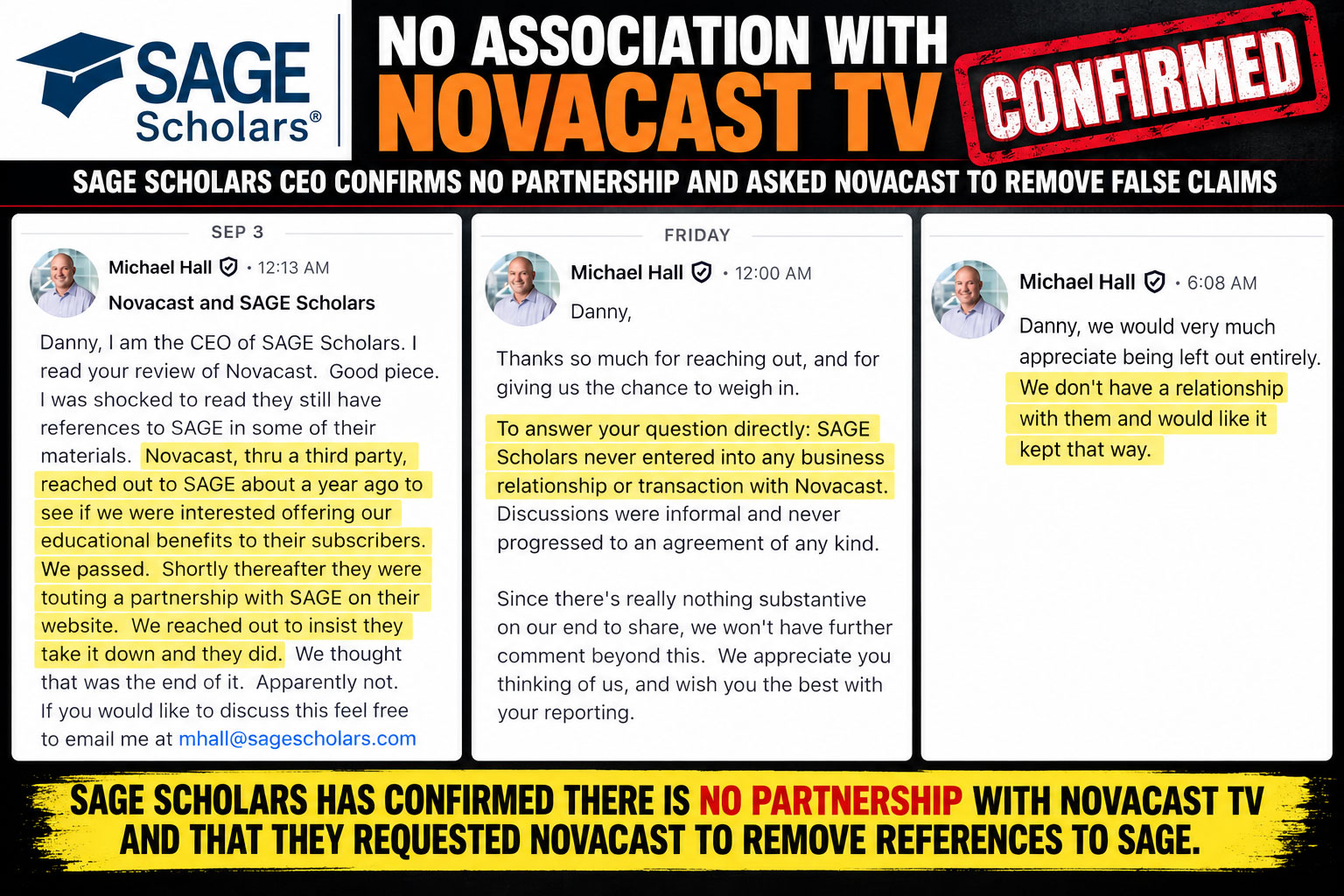
Since publishing this investigation, I finally received an answer to one of the questions I raised above — and it came directly from Michael Hall, CEO of SAGE Scholars.
Hall contacted me unsolicited through LinkedIn after reading my NovaCast investigation. He told me he was “shocked” to discover that references to SAGE were apparently still appearing in NovaCast-related material.
According to Hall, NovaCast had approached SAGE through a third party approximately a year earlier to see whether SAGE would be interested in offering its educational benefits to NovaCast subscribers.
SAGE passed.
What Hall told me happened next is particularly important. He said that shortly afterwards NovaCast was “touting a partnership with SAGE on their website.” According to Hall, SAGE contacted NovaCast and “insist[ed] they take it down,” which NovaCast did. Hall said SAGE believed that was the end of the matter, adding: “Apparently not.”
I subsequently asked Hall whether SAGE had ever actually entered into a partnership or agreement with NovaCast. His response was unequivocal:
“SAGE Scholars never entered into any business relationship or transaction with Novacast. Discussions were informal and never progressed to an agreement of any kind.”
Hall later asked that SAGE Scholars be left out of the matter entirely, telling me:
“We don’t have a relationship with them and would like it kept that way.”
I respect that request. SAGE Scholars is not the subject of this investigation, and nothing I have uncovered suggests otherwise.
But this new information answers the question I originally raised in this very section: how did NovaCast become connected to SAGE Scholars?
According to SAGE Scholars’ own CEO, there was never a business relationship or agreement. SAGE considered the possibility, passed on it, subsequently discovered NovaCast promoting a partnership, and asked NovaCast to remove it.
That distinction matters because NovaCast affiliate websites were promoting SAGE Scholars Tuition Rewards as a subscriber benefit when I conducted my original investigation.
The question therefore no longer rests with SAGE Scholars.
It rests with NovaCast.
Why were NovaCast customers and prospective affiliates being presented with SAGE Scholars as part of the NovaCast offering when SAGE’s CEO says no business relationship or transaction ever existed, and SAGE had already previously intervened to have a claimed partnership removed?
That is a question NovaCast should answer.
Disclaimer: How This Investigation Was Conducted
This investigation relies entirely on OSINT — Open Source Intelligence — meaning every claim made here is based on publicly available records, archived web pages, corporate filings, domain data, social media activity, and open blockchain transactions. No private data, hacking, or unlawful access methods were used. OSINT is a powerful and ethical tool for exposing scams without violating privacy laws or overstepping legal boundaries.
About the Author
I’m DANNY DE HEK, a New Zealand–based YouTuber, investigative journalist, and OSINT researcher. I name and shame individuals promoting or marketing fraudulent schemes through my YOUTUBE CHANNEL. Every video I produce exposes the people behind scams, Ponzi schemes, and MLM frauds — holding them accountable in public.
My PODCAST is an extension of that work. It’s distributed across 18 major platforms — including Apple Podcasts, Spotify, Amazon Music, YouTube, and iHeartRadio — so when scammers try to hide, my content follows them everywhere. If you prefer listening to my investigations instead of watching, you’ll find them on every major podcast service.
You can WORK WITH ME for dedicated access to my time and investigative services — including private consultations, scam-risk reviews, sponsored investigations, support sessions, livestream scam breakdowns, and interviews. I’m also available for SPEAKING ENGAGEMENTS, where I share first-hand experience from years of exposing large-scale fraud, investigating scams, and supporting victims.
“Stop losing your future to financial parasites. Subscribe. Expose. Protect.”
My work exposing crypto fraud has been featured in:
- Coffeezilla 2026): Featured in the investigation exposing the alleged $328M Goliath Ventures Ponzi scheme
- Bloomberg Documentary (2025): A 20-minute exposé on Ponzi schemes and crypto card fraud
- News.com.au (2025): Profiled as one of the leading scam-busters in Australasia
- OpIndia (2025): Cited for uncovering Pakistani software houses linked to drug trafficking, visa scams, and global financial fraud
- The Press / Stuff.co.nz (2023): Successfully defeated $3.85M gag lawsuit; court ruled it was a vexatious attempt to silence whistleblowing
- The Guardian Australia (2023): National warning on crypto MLMs affecting Aussie families
- ABC News Australia (2023): Investigation into Blockchain Global and its collapse
- The New York Times (2022): A full two-page feature on dismantling HyperVerse and its global network
- Radio New Zealand (2022): “The Kiwi YouTuber Taking Down Crypto Scammers From His Christchurch Home”
- Otago Daily Times (2022): A profile on my investigative work and the impact of crypto fraud in New Zealand

Leave A Comment