


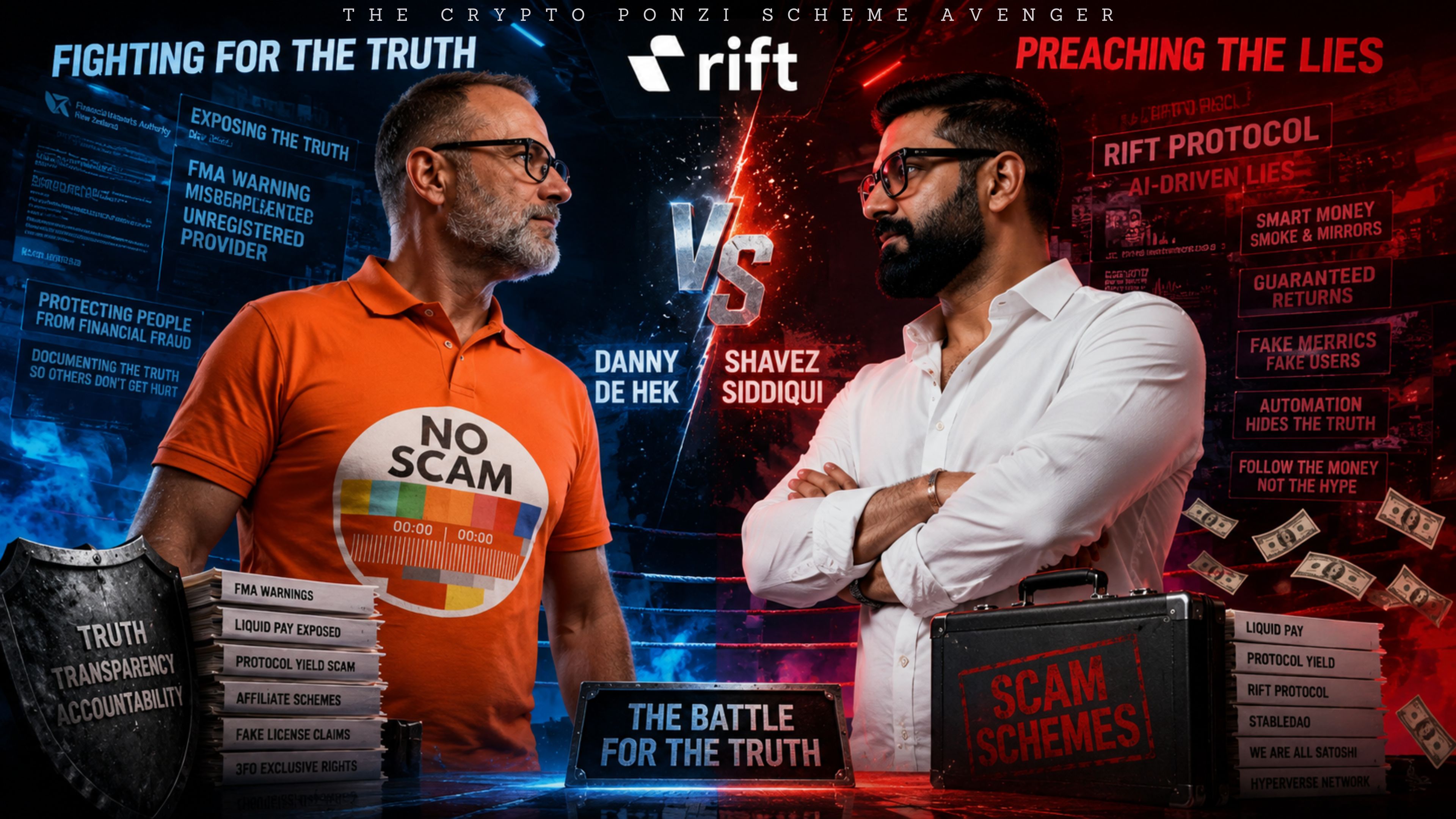
“The future of trading isn’t human. It’s structured, automated, and intelligent.”
That statement sits at the heart of RIFT Protocol’s marketing.
Visitors arriving at the website are greeted with promises of AI-driven execution, intelligent automation, non-custodial infrastructure, routing intelligence, automated trading engines, smart money strategies and one-tap trade execution. The branding is modern. The presentation is polished. The language is filled with references to technology, transparency and the future of finance.
At first glance, RIFT looks like another ambitious fintech startup attempting to simplify trading for everyday investors.
But as I worked through the platform’s public website, legal documents, memorandum and supporting material, I quickly realised that RIFT cannot be viewed in isolation.
To understand RIFT, you first need to understand the history behind the people and companies building it.
Following The Trail Backwards
 The further I dug into RIFT, the more familiar everything began to feel.
The project is openly linked to Shavez Ahmed Siddiqui and MARIDA LTD. Neither name is new.
Over the past several years, Shavez has been associated with a growing collection of cryptocurrency and fintech ventures that have repeatedly promised to revolutionise some aspect of finance. The branding has changed. The products have evolved. The marketing narratives have shifted with whatever trend happened to be attracting attention at the time.
What remains remarkably consistent is the underlying formula.
First came projects tied to the broader HyperVerse ecosystem and ventures such as StableDAO and We Are All Satoshi. Then came 9Pay, which later became LQUID Pay. That evolved into Protocol Yield, a platform promoting AI-powered trader rankings, profit-sharing and social finance. Now we arrive at RIFT, marketed as a sophisticated automated trading ecosystem built around artificial intelligence and execution infrastructure.
Viewed separately, each project appears unique.
Viewed together, they look like chapters in the same story.
The Warning That Changes Everything
One of the most important pieces of evidence surrounding this network is not found on any RIFT website.
It comes from New Zealand’s Financial Markets Authority (FMA).
In January 2026, the FMA issued a warning regarding LQUID Pay. According to the regulator, LQUID Pay had operated in New Zealand without complying with New Zealand financial markets legislation. The FMA stated that the company’s Chief Executive had made false and misleading statements regarding compliance with New Zealand law and trademark registrations.
The warning became even more significant when the regulator referenced Protocol Yield.
According to the FMA, Protocol Yield had incorrectly stated that its parent company, MARIDA Limited, was licensed in Hong Kong. The regulator went on to state that misrepresentations of regulatory status of this nature are commonly associated with scam operations.
That warning sits uncomfortably alongside RIFT’s current marketing.
The same MARIDA name appears throughout the RIFT ecosystem. The same founder remains at the centre. The same promises of innovation and financial transformation continue to be made.
When a regulator has already raised concerns about compliance claims linked to the same corporate structure, it becomes impossible to simply accept the latest narrative at face value.
From Crypto Cards To AI Trading
One of the most fascinating aspects of this investigation is watching how the narrative has evolved over time.
LQUID Pay promised to transform spending through cryptocurrency debit cards, merchant adoption and global payments. Visitors were told they would soon be able to spend crypto anywhere while enjoying rewards, cashback and seamless financial services.
When those promises failed to materialise, the focus shifted.
Protocol Yield moved away from payments and towards investing. Suddenly the emphasis was on AI scoring systems, profit-sharing, trader rankings and social finance. Investors were encouraged to trust sophisticated algorithms and experienced traders rather than attempting to navigate markets themselves.
Now RIFT has arrived.
The terminology has changed once again. Artificial intelligence has become Routing Intelligence. Trader rankings have become Smart Money. Profit-sharing has become Automated Execution. Social finance has become Trading Infrastructure.
Yet beneath the new branding, many of the same themes remain visible.
Technology.
Automation.
Passive participation.
Community growth.
And a promise that complex financial markets can somehow be made easy.
The Numbers That Demand Verification
As I worked through the RIFT memorandum and supporting material, I eventually arrived at what appeared to be the evidence that everything was working exactly as advertised.
Prominently displayed on the website was a performance snapshot showing more than 10,000 registered users, over 54,000 executed trades and US$45.7 million in trading volume. The platform also claimed an average win rate of 57.09% alongside a highest recorded return on investment of 47.76%.
At first glance these figures appear designed to reassure visitors that RIFT is already gaining traction and producing results. The problem is that numbers by themselves prove very little. What matters is how they were calculated, who verified them and whether they can be independently confirmed.
The claimed win rate is a perfect example. A 57.09% win rate sounds impressive until you begin asking basic questions. Does that figure represent every trade on the platform or only selected strategies? Does it cover a week, a month or the entire life of the project? Were losing trades excluded? Were closed positions measured differently from open ones? Without transparency, the figure becomes a marketing statistic rather than evidence.
The same applies to the claimed 47.76% return on investment. Was that achieved by one trader, one strategy or one isolated trade? Was leverage involved? Was it sustained over time or simply a snapshot of a favourable market condition? The website provides the headline number but none of the context necessary to evaluate its significance.
This pattern appears repeatedly throughout the RIFT ecosystem. Impressive figures are presented as proof of success, yet the underlying data needed to independently verify those claims remains absent.
The Smart Money Proposition
One section of the memorandum introduces what RIFT calls Smart Money.
According to the platform, users can participate in trading books operated by approved traders. Through mirror wallet infrastructure, subscribers automatically replicate trading activity while maintaining visibility over their capital.
The concept is presented as a sophisticated evolution of traditional copy trading.
What interested me wasn’t the technology itself but the lack of information surrounding the people operating these trading books.
Who are they?
What qualifications do they possess?
What regulatory framework applies to their activities?
How are they selected?
How are conflicts of interest managed?
What independent oversight exists?
The memorandum spends considerable time explaining how the system works but comparatively little time explaining who is actually responsible for managing capital and making decisions.
When real money is involved, that distinction matters.
The Affiliate Engine Hidden In Plain Sight
The most revealing section of the entire memorandum is not the technology discussion.
It is the growth strategy.
RIFT repeatedly describes expansion through affiliate communities, community incentives, digital distribution channels and global network effects. Entire sections are dedicated to explaining how affiliates, educators and community leaders will drive adoption around the world.
The memorandum even references exclusive distribution rights involving the 3FO community.
This is significant because it demonstrates that affiliate-driven expansion is not a side feature of the platform. It appears to be central to the business model.
Throughout the presentation, community growth is portrayed as a competitive advantage. New users bring additional activity. Additional activity drives platform engagement. Platform engagement drives revenue.
That creates an important question for prospective participants.
Is RIFT primarily a trading platform that happens to use affiliates, or is it an affiliate-driven growth model wrapped around a trading platform?
The answer matters because history has shown that the incentives within those two models can be very different.
Following The Money
One of the most revealing sections of the memorandum is the section called Platform Economics.
Unlike many projects that attempt to obscure how revenue is generated, RIFT openly explains the mechanics of its business model. Revenue is tied directly to user activity. The more users join, the more trades they place, the larger their balances become and the more frequently they interact with the platform, the greater the revenue opportunity becomes for the business itself.
The memorandum repeatedly highlights that automation increases participation, increases engagement and increases trading activity. In other words, the platform’s own documentation acknowledges that automated systems are expected to encourage users to trade more frequently than they otherwise might.
From a commercial perspective, that makes perfect sense.
The challenge is that more trading does not necessarily mean more profits for traders.
The platform benefits from activity.
The trader benefits from successful outcomes.
Those are not always the same thing.
History has shown that some of the largest trading businesses in the world generate substantial revenue regardless of whether their users ultimately make or lose money. Transaction fees, execution fees, spreads and platform activity can all generate income even when traders experience losses.
I am not suggesting RIFT operates in that manner. What I am saying is that investors should understand where the incentives sit.
The RIFT memorandum discusses active users, trading frequency, automation adoption, leverage usage and account growth in considerable detail. What receives far less attention is independently verified evidence showing that users are consistently benefiting from this increased activity.
That distinction is important.
A platform can be highly successful as a business while many of its users struggle financially.
The two outcomes are not mutually exclusive.
The Compliance Contradiction
Another area that deserves scrutiny is the gap between the platform’s marketing language and the legal reality presented in its own documentation.
Throughout the website and memorandum, visitors are presented with concepts such as Responsible Trading Architecture, Regulatory Alignment, Compliance Monitoring, User Protection and Future Licensing Pathways.
These phrases are clearly designed to reassure prospective users.
Yet when you move beyond the marketing material and into the legal documents, a very different picture emerges.
RIFT states that it is not a broker.
It is not an exchange.
It is not a custodian.
It is not an investment adviser.
Users are responsible for their own decisions.
Users are responsible for their own risk.
Users are responsible for their own losses.
The platform repeatedly distances itself from responsibility while simultaneously encouraging confidence in its automation systems, intelligence layers and structured execution models.
That contradiction becomes even more difficult to ignore when viewed alongside the FMA warning involving LQUID Pay and Protocol Yield.
The same MARIDA name appears.
The same founder appears.
The same emphasis on compliance and legitimacy appears.
Yet investors are once again expected to trust statements that have not been independently verified.
For me, that is one of the most important issues surrounding the entire project.
Trust should be earned through transparency.
Not marketing.
Questions For Shavez Ahmed Siddiqui
As I reached the end of the RIFT memorandum, I found myself with more questions than answers.
Perhaps Shavez Ahmed Siddiqui can help clarify them.
Can the reported user numbers be independently verified?
Can the claimed US$45.7 million in trading volume be independently verified?
How was the 57.09% win rate calculated?
Who operates the Smart Money trading books?
What qualifications do those individuals possess?
What percentage of platform revenue is allocated to affiliate commissions?
How many affiliates are currently promoting RIFT?
What exactly does “exclusive distribution rights to the 3FO community” mean?
What licences, if any, does MARIDA LTD currently hold?
Has any independent third party audited the platform’s trading results?
Has any independent third party verified the platform’s reported user metrics?
These are not unreasonable questions.
They are the same questions that should be asked of any platform seeking public trust.
The Bigger Picture
Could RIFT ultimately become a legitimate trading platform?
Possibly.
The existence of unanswered questions is not proof of wrongdoing.
However, credibility is not built through slick branding, artificial intelligence buzzwords or carefully designed presentations. Credibility is built through transparency, independent verification, regulatory compliance and accountability.
At the moment, RIFT asks potential users to place considerable trust in a founder, a company and a collection of technologies that remain difficult to independently verify.
What makes that particularly noteworthy is the history surrounding MARIDA LTD, LQUID Pay and Protocol Yield. Those connections do not automatically condemn RIFT, but they do create a context that investors cannot afford to ignore.
The further I investigated, the less RIFT looked like a completely new venture and the more it resembled the latest evolution of an existing ecosystem.
The names have changed.
The branding has changed.
The terminology has changed.
But the underlying themes remain remarkably familiar.
Whether RIFT ultimately becomes a genuine trading platform or simply another chapter in a long-running cycle of reinvention remains to be seen.
For now, the questions deserve answers.
And until those answers are independently verified, caution remains the most sensible investment strategy of all.
Disclaimer: How This Investigation Was Conducted
This investigation relies entirely on OSINT — Open Source Intelligence — meaning every claim made here is based on publicly available records, archived web pages, corporate filings, domain data, social media activity, and open blockchain transactions. No private data, hacking, or unlawful access methods were used. OSINT is a powerful and ethical tool for exposing scams without violating privacy laws or overstepping legal boundaries.
About the Author
I’m DANNY DE HEK, a New Zealand–based YouTuber, investigative journalist, and OSINT researcher. I name and shame individuals promoting or marketing fraudulent schemes through my YOUTUBE CHANNEL. Every video I produce exposes the people behind scams, Ponzi schemes, and MLM frauds — holding them accountable in public.
My PODCAST is an extension of that work. It’s distributed across 18 major platforms — including Apple Podcasts, Spotify, Amazon Music, YouTube, and iHeartRadio — so when scammers try to hide, my content follows them everywhere. If you prefer listening to my investigations instead of watching, you’ll find them on every major podcast service.
You can BOOK ME for private consultations or SPEAKING ENGAGEMENTS, where I share first-hand experience from years of exposing large-scale fraud and helping victims recover.
“Stop losing your future to financial parasites. Subscribe. Expose. Protect.”
My work exposing crypto fraud has been featured in:
- Coffeezilla 2026): Featured in the investigation exposing the alleged $328M Goliath Ventures Ponzi scheme
- Bloomberg Documentary (2025): A 20-minute exposé on Ponzi schemes and crypto card fraud
- News.com.au (2025): Profiled as one of the leading scam-busters in Australasia
- OpIndia (2025): Cited for uncovering Pakistani software houses linked to drug trafficking, visa scams, and global financial fraud
- The Press / Stuff.co.nz (2023): Successfully defeated $3.85M gag lawsuit; court ruled it was a vexatious attempt to silence whistleblowing
- The Guardian Australia (2023): National warning on crypto MLMs affecting Aussie families
- ABC News Australia (2023): Investigation into Blockchain Global and its collapse
- The New York Times (2022): A full two-page feature on dismantling HyperVerse and its global network
- Radio New Zealand (2022): “The Kiwi YouTuber Taking Down Crypto Scammers From His Christchurch Home”
- Otago Daily Times (2022): A profile on my investigative work and the impact of crypto fraud in New Zealand


Leave A Comment