


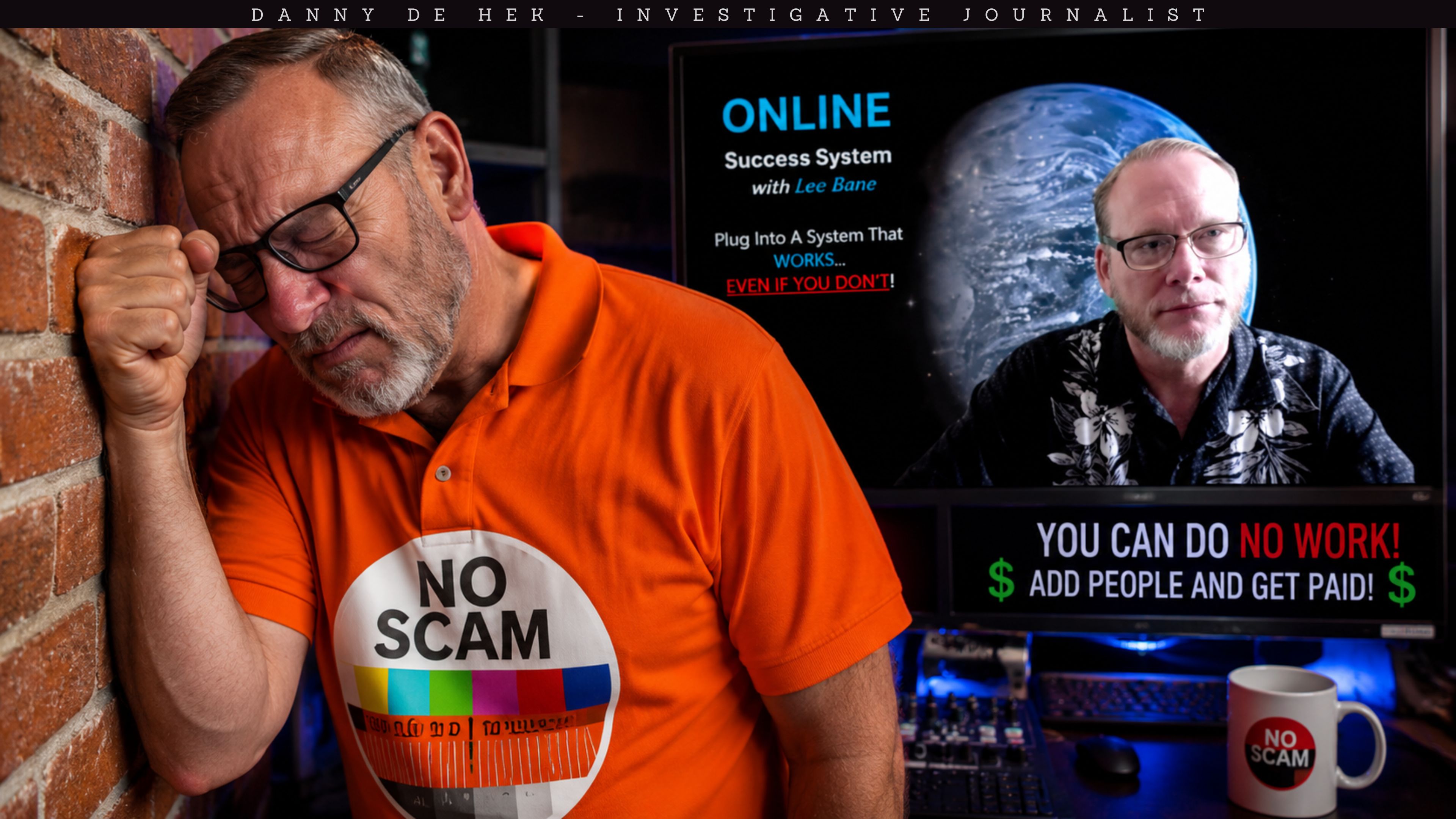
“You can do no work and potentially receive $900 within one week and $23,000 within 30 to 90 days.”
When I hear claims like that, I don’t start calculating how much money I could make.
I start asking questions.
 Over the years, I’ve investigated countless Ponzi schemes, gifting programs, matrix cyclers, MLM opportunities and crypto scams. While the names, logos and websites change, the sales pitch often follows a familiar script. Someone claims to have discovered a system that can create financial freedom. The barriers to entry are low. The income potential is enormous. The risk is downplayed. The hard work is supposedly handled by someone else. All you need to do is get positioned before everyone else arrives.

That was exactly what caught my attention when I started reviewing material promoted by Lee Bane. At first glance, it looked like another online income opportunity promising passive wealth through a system called the $100 Experience and the Online Success System. But the deeper I dug, the more I realised the current opportunity was only the latest chapter in a much longer story.
The Promise Of Easy Money
The current pitch is remarkably straightforward, and that is precisely what makes it so effective.
 Prospective members are told they can join for a one-time payment of $125 and position themselves to potentially receive payments from other participants entering the system. Throughout the promotional material, the same themes appear repeatedly. Members are told they can “do no work,” benefit from spillover, leverage the efforts of the wider team and eventually work their way toward what is presented as life-changing income.
According to the presentations I reviewed, participants are shown projections involving $900 within a week, $23,000 within a matter of months, and eventually hundreds of thousands of dollars through a series of matrix-style levels and upgrades. These figures are not mentioned in passing. They sit at the centre of the sales message and are used to create the impression that significant financial rewards are available to ordinary people willing to take action today.
What stood out to me wasn’t simply the income claims themselves.
It was how those claims were packaged and presented.
The sales material consistently reinforces the idea that effort is optional. The heavy lifting is supposedly handled by the system, the team, the automation tools, the AI marketing platform, or by the people who join after you. The opportunity is deliberately framed as something that almost anyone can succeed with, regardless of their experience, education, sales ability, marketing skills or business background.
That is an incredibly powerful message, particularly for people who are feeling trapped financially, worried about rising living costs or frustrated by the reality that building a traditional business usually requires years of hard work and uncertainty. The presentation offers something far more appealing: the possibility that financial freedom can be achieved through positioning rather than effort, duplication rather than expertise, and automation rather than work.
And that is exactly why these claims deserve careful scrutiny.
The more a presentation focuses on how little work is required, the more important it becomes to examine where the money is actually coming from and whether the promised results depend on a sustainable business model or simply a constant flow of new participants entering the system.
A Familiar Name Reappears
The interesting thing about this investigation is that I didn’t discover Lee Bane through the $100 Experience or the Online Success System.
I had actually crossed paths with him several years earlier while exposing HyperVerse. At the time, I was producing videos about one of the largest crypto schemes operating in the world, documenting victim stories and examining the people promoting it. While reviewing comments beneath my YouTube videos, I noticed Lee repeatedly posting about what he claimed was a better and safer alternative.
That alternative wasn’t cryptocurrency. It was a program built around gold and silver, which Lee frequently described as “God’s money.” According to his marketing, people could accumulate precious metals, protect themselves from economic uncertainty and potentially create an additional income stream by sharing the opportunity with others.
On the surface, there is nothing unusual about buying gold or silver. Investors have been doing that for generations. What caught my attention wasn’t the precious metals themselves but the familiar structure wrapped around them. The lead capture pages, the recruitment incentives, the promises of additional income and the repeated references to financial freedom, passive income and helping others discover the same opportunity all felt strikingly familiar.
I investigated the promotion, documented what I found and moved on. At the time, I assumed it was simply another opportunity in a crowded online marketplace. I certainly didn’t expect to encounter the same name years later attached to a completely different program making many of the same promises.
Yet as I sat through presentations for the $100 Experience, reviewed the compensation structure and listened to repeated claims about making money while doing little or no work, I couldn’t shake the feeling that I had seen this story before. The product was different. The technology had changed. But the underlying message felt remarkably familiar.
Following The Trail Backwards
One of the advantages of investigating online opportunities is that the internet has a surprisingly long memory. While promoters often move on to the next opportunity, old websites, archived domains, forgotten videos and social media posts frequently remain behind as a digital paper trail.
Once I started digging into Lee Bane’s online history, that paper trail quickly began to grow. Using archived websites and historical records, I found evidence of promotions stretching back well over a decade. Some of the earliest material I located dated back to 2009, where Lee was already promoting home-based business opportunities and income-generating systems. Over the years, the opportunities evolved to include precious metals programs, Bitcoin investment schemes, crowdfunding concepts, 50/50 gifting-style programs, and a variety of other ventures built around passive income and financial freedom.
One archived promotion encouraged people to believe they could double their Bitcoin every 90 days. Another centred around crowdfunding systems that promised participants could receive money by helping others join. Later came the precious metals opportunity that first brought Lee to my attention during the HyperVerse era. Today, the focus has shifted again, this time to the $100 Experience, a system promising that participants can potentially earn substantial income while doing little or no work.
Viewed individually, each opportunity appears different. Different products. Different websites. Different explanations for why this particular opportunity is supposedly unique.
Yet when viewed together, a pattern begins to emerge.
The products changed from Bitcoin to silver, from crowdfunding to AI-powered marketing systems, but the underlying message remained remarkably consistent.
Seven Years Of Promotions On YouTube
One of the most revealing discoveries during this investigation wasn’t an archived website or an old social media post.
It was Lee Bane’s own YouTube Channel.
The channel, Make Money Global Leaders, was created in November 2018 and contains more than 70 videos spanning multiple business opportunities, crowdfunding programs, marketing platforms and income systems. Viewed individually, many of these videos appear to be unrelated. Viewed collectively, they tell a very different story.
Over the years, Lee has promoted a long list of opportunities including 5050 Crowd Funding, Impact101, IcomTech, Tryp, Royaltie, WeProveItFree, CoopCrowd, NowSite, QuickSilver, TextALN, and more recently the Online Success System and $100 Experience.
What makes the channel particularly interesting is not the variety of opportunities but the consistency of the messaging.
Video titles include phrases such as “How to Make Money Without Doing Anything On A Daily Basis,” “Make Money, up to $1 Million On Auto-Pilot,” “Receive Well Over $150,000 Every 28 Days On Auto-Pilot,” and “Become a Multi-Millionaire by Doing 3 Simple Steps.” Across multiple opportunities, viewers are repeatedly presented with the idea that significant income can be generated through systems, automation, duplication and team growth rather than through traditional business activity.
One video from three years ago is particularly striking. Titled “How to Make Money Without Doing Anything On A Daily Basis,” it mirrors many of the same themes now being promoted through the $100 Experience. While the branding has changed, the underlying message remains familiar: position yourself correctly, plug into the system and allow the process to work for you.
For me, the YouTube channel provides something more valuable than any single presentation. It creates a public record. Rather than looking at one opportunity in isolation, readers can see a pattern stretching across many years. Different company names, different products and different compensation plans appear throughout the channel, but the central promise remains largely unchanged.
That historical context matters.
Because the question isn’t whether the latest opportunity is legitimate.
The question is why so many different opportunities over such a long period have been marketed using such remarkably similar promises.
The Pattern Became Impossible To Ignore
The deeper I dug into Lee Bane’s promotional history, the less interested I became in the individual opportunities themselves.
What fascinated me was the pattern.
On paper, the opportunities appeared completely different. One involved gold and silver. Another centred on Bitcoin. Others revolved around crowdfunding, gifting concepts, passive-income systems, and now an AI-powered marketing platform attached to the $100 Experience. If you looked only at the product being promoted, it would be easy to conclude that each opportunity stood on its own.
But that isn’t what I was seeing.
What I found was a remarkably consistent sales message wrapped around a constantly changing product. The product was often little more than the delivery mechanism. The real focus was almost always the same: financial freedom, passive income, escaping financial pressure, and the possibility of earning more money without the limitations of a traditional job.
As I reviewed presentations spanning more than a decade, I noticed the same psychological triggers appearing again and again. Prospective members were encouraged to think about rising living costs, job insecurity, retirement concerns and the feeling that they were working harder while falling further behind. Once those frustrations had been established, the opportunity was presented as the solution. Not a complex business requiring years of experience, but a simple system that supposedly allowed ordinary people to leverage automation, duplication, teamwork and the efforts of others.
That is what makes these presentations so persuasive. They are not designed to appeal to spreadsheets, balance sheets or detailed due diligence. They are designed to appeal to emotion. People struggling financially are shown examples of freedom. People worried about retirement are shown examples of wealth. People frustrated with their jobs are shown examples of flexibility and independence. The opportunity itself becomes the bridge between where they are today and where they hope to be tomorrow.
The more material I reviewed, the clearer it became that the product was often secondary to the dream being sold. Whether the vehicle was precious metals, Bitcoin, crowdfunding or an AI marketing system mattered less than the promise attached to it. The destination remained largely unchanged even as the route kept changing.
That is why I believe the most important question isn’t whether the latest opportunity is different from the last one. The more important question is whether the underlying business model has changed at all, or whether the same promise has simply been repackaged for a new audience searching for the same solution.
The AI Marketing Angle
One of the more noticeable changes in Lee Bane’s latest promotion is the addition of artificial intelligence to the sales narrative.
Throughout the presentations, prospective members are told they can tap into an AI-powered marketing system that generates leads, automates follow-up and helps grow their business. The technology is presented as a major advantage, reinforcing the broader claim that participants can potentially succeed without needing extensive experience, marketing knowledge or significant effort of their own.
On the surface, that sounds impressive.
The problem is that the presence of AI tells us very little about whether the underlying opportunity is legitimate, sustainable or profitable.
Artificial intelligence is simply a tool. It can write emails, create marketing content, analyse data and automate repetitive tasks. Businesses around the world use AI every day for perfectly legitimate reasons. What matters is not the technology itself, but what the technology is being used to achieve.
As I reviewed the material, it became clear that the AI component was being used primarily as a recruitment tool. The system appears designed to help participants generate leads, attract prospects and bring additional people into the same opportunity. In other words, the technology may have changed, but the objective remains largely the same.
I’ve seen similar tactics before. Years ago, promoters attached opportunities to cryptocurrency because Bitcoin was the buzzword everyone was talking about. Before that, it was blockchain. Before that, automated trading bots. Today, AI has become the latest marketing magnet. For many people, the term instantly creates an impression of innovation, sophistication and credibility, even when very little is explained about what the technology is actually doing behind the scenes.
That is why I believe the AI component deserves to be viewed with a healthy degree of scepticism. Not because artificial intelligence is inherently problematic, but because it risks distracting people from the far more important questions. How does the opportunity generate revenue? Where do the promised payments come from? And would the model still function if recruitment slowed or stopped altogether?
The Question That Never Goes Away
After reviewing presentations, archived websites, old videos and years of promotional material connected to Lee Bane, I kept returning to the same question.
Not the questions being asked during the Zoom calls.
Not the questions being answered by the marketing material.
A much simpler question.
What happens if recruitment stops?
Every presentation I reviewed focused heavily on projected income, team growth, duplication, automation, spillover and the possibility of building an income stream that eventually runs itself. Prospective members are encouraged to think about where they could be in six months, a year or even several years from now if they simply position themselves correctly within the system.
What receives far less attention is what happens when growth slows.
If new participants stop joining tomorrow, where do future payments come from?
That question matters because the answer reveals whether an opportunity is being driven by genuine external revenue or by the continual arrival of new participants. It cuts through the marketing language, the income projections, the testimonials and the technology. It gets to the heart of how the opportunity actually functions.
Throughout this investigation, I repeatedly encountered promises that people could earn substantial sums of money while doing little or no work. I saw claims that automation, artificial intelligence and team duplication could remove many of the traditional barriers associated with building a business. Yet none of those things answer the fundamental question of sustainability.
For me, that is where the investigation ultimately ends.
Not with the latest product.
Not with the latest compensation plan.
Not with the latest marketing system.
It ends with a question that remains unanswered.
If recruitment stopped tomorrow, where would the money come from?
Until that question can be answered clearly and convincingly, everything else is simply marketing.
Disclaimer: How This Investigation Was Conducted
This investigation relies entirely on OSINT — Open Source Intelligence — meaning every claim made here is based on publicly available records, archived web pages, corporate filings, domain data, social media activity, and open blockchain transactions. No private data, hacking, or unlawful access methods were used. OSINT is a powerful and ethical tool for exposing scams without violating privacy laws or overstepping legal boundaries.
About the Author
I’m DANNY DE HEK, a New Zealand–based YouTuber, investigative journalist, and OSINT researcher. I name and shame individuals promoting or marketing fraudulent schemes through my YOUTUBE CHANNEL. Every video I produce exposes the people behind scams, Ponzi schemes, and MLM frauds — holding them accountable in public.
My PODCAST is an extension of that work. It’s distributed across 18 major platforms — including Apple Podcasts, Spotify, Amazon Music, YouTube, and iHeartRadio — so when scammers try to hide, my content follows them everywhere. If you prefer listening to my investigations instead of watching, you’ll find them on every major podcast service.
You can BOOK ME for private consultations or SPEAKING ENGAGEMENTS, where I share first-hand experience from years of exposing large-scale fraud and helping victims recover.
“Stop losing your future to financial parasites. Subscribe. Expose. Protect.”
My work exposing crypto fraud has been featured in:
- Coffeezilla 2026): Featured in the investigation exposing the alleged $328M Goliath Ventures Ponzi scheme
- Bloomberg Documentary (2025): A 20-minute exposé on Ponzi schemes and crypto card fraud
- News.com.au (2025): Profiled as one of the leading scam-busters in Australasia
- OpIndia (2025): Cited for uncovering Pakistani software houses linked to drug trafficking, visa scams, and global financial fraud
- The Press / Stuff.co.nz (2023): Successfully defeated $3.85M gag lawsuit; court ruled it was a vexatious attempt to silence whistleblowing
- The Guardian Australia (2023): National warning on crypto MLMs affecting Aussie families
- ABC News Australia (2023): Investigation into Blockchain Global and its collapse
- The New York Times (2022): A full two-page feature on dismantling HyperVerse and its global network
- Radio New Zealand (2022): “The Kiwi YouTuber Taking Down Crypto Scammers From His Christchurch Home”
- Otago Daily Times (2022): A profile on my investigative work and the impact of crypto fraud in New Zealand




Leave A Comment