



“A regulator can order a company to stop selling securities. It can’t stop promoters from telling investors everything is fine.”
When I first began investigating E-Estate, I was told I simply didn’t understand blockchain, tokenisation or the future of real estate investing.
Promoters insisted the company was revolutionising property ownership by allowing anyone to invest from as little as US$10, while earning passive daily income from a portfolio of supposedly income-producing real estate around the world.
My questions were brushed aside as fear, uncertainty and doubt.
The more evidence I uncovered, however, the more I became convinced that the real story wasn’t the technology. It was the marketing, the people behind it, and the growing gap between what investors were being promised and what could actually be verified.
Over the following months I immersed myself in the world of E-Estate. I attended private Zoom presentations, questioned company representatives and promoters directly, analysed archived websites, reviewed corporate records, examined promotional videos, tracked social media activity and compared the company’s public claims against independently verifiable evidence.
Along the way, several themes kept appearing:
- Questionable executive profiles.
- AI-generated marketing.
- Unexplained corporate structures.
- Inconsistencies surrounding the company’s property portfolio.
- An aggressive multi-level marketing compensation model that rewarded participants for recruiting new investors.
Then came the moment that changed this investigation entirely.
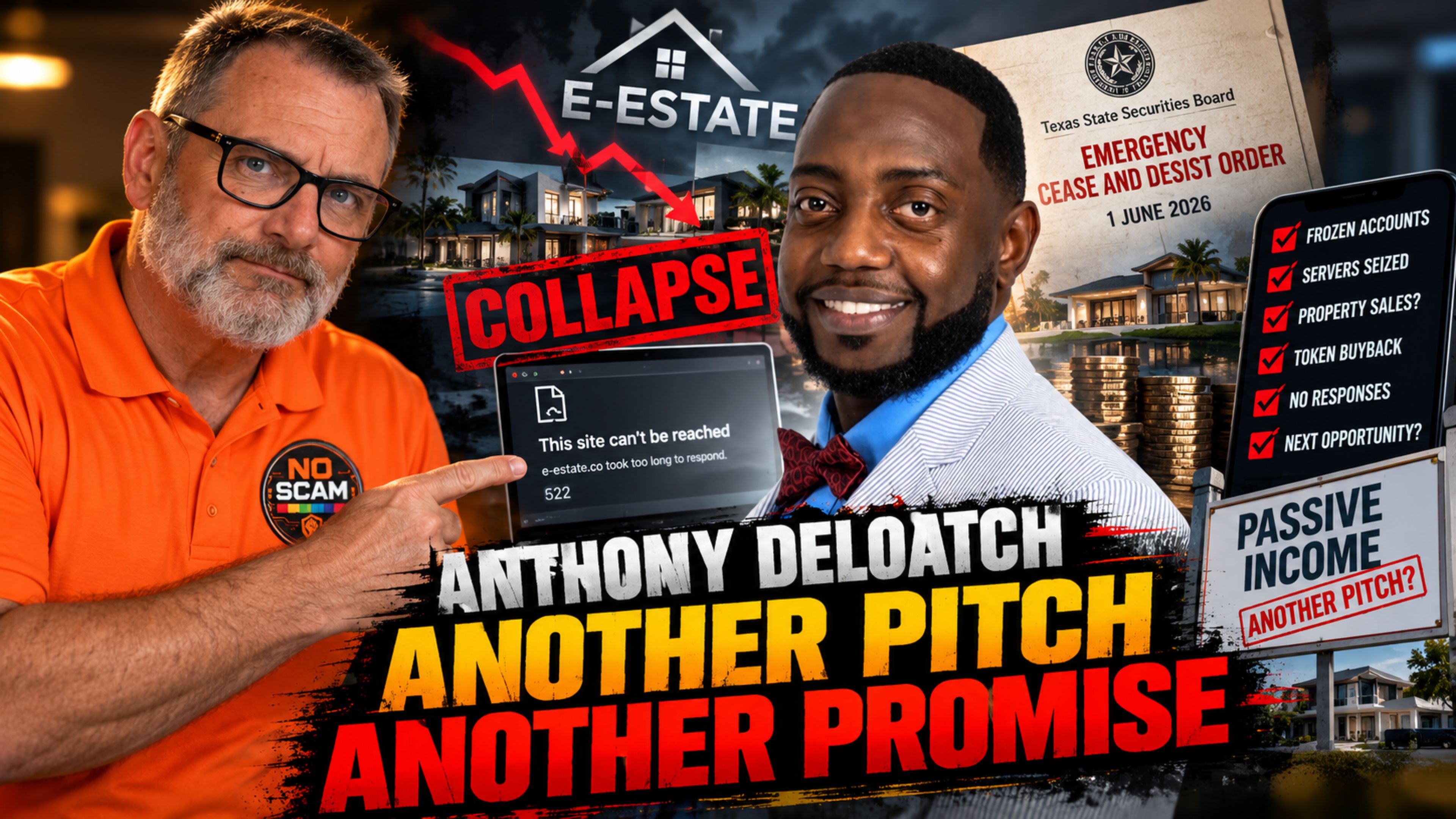
On 1 June 2026, the Texas State Securities Board issued an Emergency Cease and Desist Order against E-Estate Group Inc., naming CEO Brandon Stephenson, Mike Hamilton, Karoll Peterson and Texas promoter Darrell Porter. The regulator alleged they were offering fraudulent, unregistered securities through a multi-level marketing network and made a series of detailed findings that mirrored many of the concerns I had already been documenting.
Among the most significant allegations was that E-Estate and its alleged property management partner did not own or have management rights to one of the very properties being marketed to investors.
Most companies facing allegations of this magnitude would be expected to pause, address the regulator’s concerns and reassure investors with independently verifiable evidence.
That isn’t what I found.
Instead, I watched prominent promoters continue recruiting, posting motivational content across social media, celebrating company milestones, encouraging new investments and assuring their followers that everything was “business as usual.”
I also received information from an anonymous whistleblower who had been conducting their own research, filing complaints with multiple U.S. agencies and uncovering additional public records that helped connect even more pieces of the puzzle.
This investigation is not an update to my previous work.
It is the story of what happened after regulators intervened.
It is the story of how a company continued to be promoted while facing serious regulatory allegations, how its public representatives responded when challenged, and why every investor deserves to examine the evidence before deciding who to believe.
The Opportunity That Promised To Change Real Estate Investing
E-Estate presented itself as a revolutionary investment platform built around the idea of tokenised real estate. Rather than requiring investors to purchase an entire property or secure a traditional mortgage, the company claimed anyone could participate in income-producing real estate by purchasing digital EST Tokens. Those tokens could then be exchanged for fractional interests in properties listed on the E-Estate platform, with investors told they would receive passive income generated from rental operations.
On the surface, the concept sounded both innovative and accessible. The company claimed investors could get started with as little as US$10, removing the traditional barriers associated with property ownership. Promotional videos described a future where investors no longer needed to worry about tenants, maintenance, mortgages or property management. Instead, E-Estate promised that experienced professionals would handle every aspect of acquiring, managing and maintaining the real estate while investors simply collected regular income distributions.
For many people priced out of conventional property markets, it was an attractive proposition.
The marketing became even more persuasive because it blended legitimate concepts with ambitious financial promises. Tokenisation is a genuine technology that has attracted interest from governments, financial institutions and property developers around the world. E-Estate wrapped itself in that emerging industry, presenting itself as one of the companies leading the next generation of real estate investing.
Professional-looking presentations, polished websites, glossy graphics and confident presenters all helped reinforce the impression that investors were looking at an established international business rather than a speculative start-up.
According to the company’s own promotional material, investors were promised:
- Daily returns for the first 18 months, with some properties advertising between 0.41% and 1.00% per day.
- A long-term passive phase paying 10% annually, distributed twice a year.
- Returns generated through rental income and professional property management.
These representations are also summarised in the Texas State Securities Board’s Emergency Cease and Desist Order.
For many investors, those claims appeared to answer the most important question of all:
Where does the money come from?
If the income genuinely flowed from a growing portfolio of professionally managed real estate, the model might appear both understandable and credible.
That is precisely why I wanted to look beyond the marketing and independently verify the underlying assets, the people behind the company and the evidence supporting those claims.
As my investigation progressed, that process became far more difficult than I expected—and the questions started multiplying much faster than the answers.
My Investigation Began Long Before Regulators Stepped In
When I investigate an investment opportunity, I don’t begin by assuming it’s legitimate or fraudulent. I start by asking one simple question:
Can the company’s claims be independently verified?
That usually means reviewing corporate records, archived websites, promotional material, public filings and speaking directly with the people promoting the opportunity. In E-Estate’s case, the more I looked, the more I found myself chasing claims that either couldn’t be verified or led to even bigger questions.
One of the first things that caught my attention was the people behind the company. Investors were introduced to executives with polished biographies, impressive titles and ambitious visions for the future of tokenised real estate. Yet when I searched for evidence of their previous careers, business history and industry experience, much of it proved surprisingly difficult to verify.
As my research continued, a number of red flags began appearing:
- Executive profiles that couldn’t easily be verified.
- Corporate timelines that didn’t always match publicly available records.
- Websites that appeared much newer than the history being presented.
- An asset management company, Eli Property, that seemed central to the business but raised further questions.
On paper, Eli Property appeared to provide the professional infrastructure needed to support E-Estate’s investment model. It was presented as the company responsible for acquiring, managing and operating many of the real estate assets offered to investors.
The problem was that the evidence didn’t always match the marketing.
Archived websites, domain registration records and other publicly available information often painted a very different picture from the polished corporate presentations. Some websites appeared to have been created only recently despite claims of long operating histories. Corporate timelines didn’t always align, and statistics presented as evidence of an established international business frequently lacked any independently verifiable source.
None of these findings proved wrongdoing on their own.
But together they steadily undermined confidence in the story being presented to prospective investors.
Instead of answering my questions, each new discovery seemed to raise another one. Rather than strengthening E-Estate’s credibility, my investigation was exposing a growing pattern where the marketing consistently ran ahead of the evidence.
By the time regulators eventually stepped in, many of the concerns I’d already documented no longer seemed quite so speculative.
The Illusion Started To Crack
As my investigation expanded, I shifted my focus away from the marketing and onto the evidence supporting E-Estate’s central claims. The company wasn’t just selling a concept—it was asking investors to trust that real properties existed, that they generated rental income, and that people were genuinely acquiring fractional interests backed by tangible assets.
Those are the kinds of claims that should leave a paper trail.
Property ownership can usually be verified. Asset managers have corporate histories. Financial operations leave records.
The more I searched for that evidence, the harder it became to reconcile what I was finding with what investors were being told.
One message came through loud and clear during E-Estate’s presentations: every property had supposedly been carefully vetted, legally verified and professionally managed. Investors were encouraged to believe that experienced property specialists handled acquisitions, leasing, maintenance and income distribution on their behalf.
This wasn’t presented as another speculative crypto project.
It was marketed as a property business that simply used blockchain technology to make investing more accessible.
That distinction mattered because it shifted the focus away from the digital token and onto the strength of the underlying real estate portfolio.
Then Texas weighed in.
Among the regulator’s most significant allegations was that E-Estate and its alleged property management partner, Eli Property, did not own or have management rights to the Oregon Lake House being promoted to investors. The Order further alleges they had no right to receive income or profits from that property, despite representing it as part of E-Estate’s investment portfolio.
This wasn’t a minor discrepancy buried in the fine print.
The Oregon Lake House was one of the showcase properties used to demonstrate how the platform supposedly worked.
If the regulator’s allegations are ultimately upheld, they raise an obvious question:
How could investors legitimately receive rental income from a property the company allegedly neither owned nor managed?
It also raises a much broader question about the due diligence behind the rest of the portfolio. If one flagship property could become the subject of such serious allegations, investors are entitled to ask whether similar verification has been carried out across every other property being marketed through the platform.
For me, this marked a turning point.
Up until then, many of my concerns centred on inconsistencies, unanswered questions and gaps in publicly available information. The Texas findings took the investigation to another level. A state securities regulator wasn’t simply questioning the company’s marketing—it was alleging that key representations about one of its featured investment properties were materially misleading.
That transformed what had been an investigation into unanswered questions into one with significant regulatory implications.
The SEC Filing Used As A Selling Point
 Not long after questions began circulating about E-Estate, promoters began pointing to the company’s SEC Form D filing as evidence that everything was above board.
I saw it referenced repeatedly in Zoom meetings, social media posts and private conversations, often in a way that suggested the filing somehow proved E-Estate had received regulatory approval. Whether that was a genuine misunderstanding or simply a convenient sales narrative, the effect was the same. Many investors stopped asking questions and accepted the filing as proof the company had been vetted by the U.S. Securities and Exchange Commission.
The reality is very different.
The very first page of E-Estate’s Form D contains an important disclaimer that many promoters conveniently overlooked. It states:
“The Securities and Exchange Commission has not necessarily reviewed the information in this filing and has not determined if it is accurate and complete.”
In other words, filing a Form D is not the same as receiving SEC approval, endorsement or verification. It is simply a notice filed by the issuer claiming an exemption from the normal securities registration requirements.
The filing itself contains several interesting disclosures. It identifies E-Estate Group Inc. as a New York corporation, lists Brandon Stephenson as CEO, director and promoter, claims an exemption under Rule 506(c) of Regulation D, and states that investments could be made from as little as US$10.
At the time of filing, the company also reported:
- US$35 million had already been sold.
- 12,532 investors had participated in the offering.
- The total capital raise sought was US$109.44 million.
Those disclosures become particularly significant when read alongside the findings of the Texas State Securities Board.
The Emergency Cease and Desist Order alleges that E-Estate’s offering did not comply with the requirements of its claimed Rule 506(c) exemption. According to the regulator, the investment was being marketed to non-accredited investors without taking the steps required under that exemption.
The Order also alleges that the securities were never registered in Texas and that no permit had been granted for their sale within the state.
That distinction is important because it demonstrates how easily regulatory filings can be used to create an appearance of legitimacy without explaining what those filings actually mean.
A Form D does not verify ownership of the underlying properties.
It does not confirm that the advertised returns are achievable.
It does not establish that the offering complies with every applicable securities law.
Those are precisely the issues regulators began examining as this investigation unfolded.
While Regulators Were Investigating, The Recruitment Continued
One of the most surprising discoveries wasn’t found in a government filing or a corporate record.
It came from watching how E-Estate’s promoters responded after the Texas State Securities Board issued its Emergency Cease and Desist Order.
Ordinarily, when a securities regulator alleges that a company is offering fraudulent, unregistered securities, you might expect the marketing to pause while those allegations are addressed. Investors would reasonably expect public statements, detailed explanations or independently verifiable evidence rebutting the regulator’s findings.
That isn’t what I observed.
Many of the company’s public promoters carried on as though nothing had happened. Facebook posts continued celebrating tokenised real estate. Zoom presentations continued introducing new audiences to the opportunity. Recruitment continued, and the overall message remained remarkably consistent:
Business was continuing as usual.
One promoter I spoke with directly was Siua Tongi, who had been actively promoting E-Estate across social media.
Rather than denying that Texas had taken action, he acknowledged the regulator had raised concerns but assured me the company’s legal team was dealing with the matter. He maintained that investors were still purchasing properties, commissions were still being paid and withdrawals were continuing without interruption.
The overall impression was that the regulatory action represented little more than a temporary inconvenience rather than a significant development that prospective investors should carefully consider.
What struck me most wasn’t simply his response—it was the lack of meaningful engagement with the issues raised by the regulator.
The Texas Order contains detailed allegations about property ownership, securities registration, marketing practices and the compensation structure used to recruit investors. Yet much of the promotional material I continued monitoring focused on growth, opportunity and passive income, with little acknowledgment of the serious questions now being asked by a U.S. securities regulator.
As an investigator, I find that particularly significant.
Promoters play a critical role in shaping investor confidence. When difficult questions arise, investors naturally look to the people promoting the opportunity for clear answers backed by evidence.
Instead, I repeatedly saw reassurance take priority over transparency.
The message wasn’t:
“Let’s examine the regulator’s concerns together.”
It was:
“Everything is under control.”
For anyone considering investing, that difference matters.
One approach encourages due diligence.
The other encourages trust.
The more I watched these interactions unfold, the more I realised this investigation had evolved beyond E-Estate itself. It had become a case study in how modern investment schemes can continue gathering momentum even after formal regulatory intervention.
Marketing doesn’t necessarily stop when regulators issue warnings.
Sometimes it simply adapts.
Independent Reporting Reached Similar Conclusions
 Following the Texas State Securities Board’s Emergency Cease and Desist Order, other independent investigators were also documenting what happened next.
A tip of the hat to Oz at BehindMLM, who reported that E-Estate continued operating after the regulatory action and that several promoters appeared to carry on recruiting despite the allegations made by Texas. His reporting also noted that E-Estate removed its public list of “Agent” promoters from its website shortly after the Order was issued, while continuing to reassure investors that the business remained fully operational.
BehindMLM also highlighted a company communication sent to investors stating that E-Estate disagreed with the Texas regulator’s findings, intended to challenge the allegations and claimed that investor funds had not been frozen or restricted. At the same time, Oz questioned why audited financial statements had not been produced to support the company’s representations about its real estate business.
His Article went on to identify several U.S.-based promoters who continued publicly promoting E-Estate after the Texas Order, including Darrell Porter, Chelsi Leers, Anthony DeLoatch and Brandon Ivey, while also noting an E-Estate promotional event scheduled to take place at the Watergate Hotel in Washington, D.C.
Although my investigation follows its own evidence, it is noteworthy when multiple independent investigators reach similar observations. Independent reporting does not prove the allegations, but it does demonstrate that concerns about E-Estate’s ongoing promotion were being documented by more than one source.
Following The Money… Or Trying To
Every investment ultimately comes down to one simple question:
Where does the money come from?
E-Estate’s answer was straightforward. Investors were told that EST Tokens represented fractional interests in carefully selected real estate, that rental income generated regular returns, and that professional asset managers handled everything from acquiring the properties through to leasing, maintenance and ongoing management.
It was an attractive story because it replaced speculation with something most people understand.
Property generating rental income.
The difficulty I encountered was independently verifying those claims.
Throughout my investigation, I repeatedly searched for evidence linking E-Estate’s advertised properties to the company or its alleged asset management partner. Investors were assured the properties had been legally verified, professionally managed and carefully selected.
Yet establishing those connections through independently verifiable public records proved far more difficult than the promotional material suggested.
The further I looked, the more I found myself relying on what the company said, rather than what I could independently verify.
That issue became even more significant after reading the Texas State Securities Board’s Emergency Cease and Desist Order.
The regulator alleges that E-Estate intentionally failed to disclose material information relating to its assets, liabilities, capitalisation and financial statements—information that would ordinarily allow investors to assess the financial health and profitability of a business.
The Order also alleges that investors were not provided with enough information to properly evaluate the company’s financial position while, at the same time, being promised secure passive income and capital protection.
For me, that highlights a lesson that applies to every investment opportunity, not just E-Estate.
If a company is asking you to trust it with your money, you should be able to independently verify the fundamentals. That means understanding who owns the assets, where the income comes from, how the business is structured, and whether the financial information supports the promises being made.
Throughout this investigation, I found no shortage of promotional videos, webinars, testimonials and social media posts encouraging people to invest.
What I found far less often was independently verifiable evidence supporting the scale of the operation being presented.
Marketing can create confidence.
Evidence creates trust.
In my view, investors should never confuse the two.
The People Behind The Promotion
One pattern I see time and time again when investigating investment schemes is that the company itself often becomes secondary to the people promoting it.
Most investors don’t hand over their money because they have read a corporate filing or studied a white paper. They invest because someone they know and trust introduced them to the opportunity.
That’s why I spend so much time documenting the people hosting webinars, posting on social media, conducting one-on-one calls and reassuring prospective investors that everything is legitimate.
Throughout my investigation, I observed a growing network of promoters presenting E-Estate across YouTube, Facebook, Zoom and Telegram. Some described themselves as educators. Others positioned themselves as successful investors who had discovered a life-changing opportunity.
The message was remarkably consistent.
Financial freedom.
Passive income.
The future of tokenised real estate.
Many encouraged viewers to act quickly before property allocations sold out, creating a sense of urgency that is common in many investment promotions.
The Texas State Securities Board identified several individuals by name. The Emergency Cease and Desist Order names Brandon Stephenson, Mike Hamilton, Karoll Peterson and Darrell Porter as respondents.
According to the regulator, E-Estate operated through a multi-level marketing (MLM) structure that rewarded sales agents not only for selling investments themselves but also for recruiting additional agents into their downline. The Order alleges commissions were paid on both direct sales and the sales generated by those recruits, reinforcing the importance of continual recruitment to the business model.
The Order also contains particularly serious allegations concerning Darrell Porter.
According to the Texas regulator, Porter continued promoting E-Estate despite previously being the subject of an earlier Emergency Cease and Desist Order involving Trage Technologies. That earlier Order became final after it was not contested, yet Texas alleges Porter continued offering securities through E-Estate without the required registration.
These are allegations made by the Texas State Securities Board, and Mr Porter, like the other respondents, has the opportunity to respond through the legal process.
Beyond those specifically named by regulators, my own investigation documented numerous other public promoters who actively encouraged investment in E-Estate.
Names that repeatedly appeared during my research included Anthony DeLoatch, Brandon Ivey, Andy Galloway and Siua Tongi.
I attended their webinars, watched their presentations and, in several cases, communicated with them directly.
While these individuals are not respondents in the Texas Emergency Cease and Desist Order, they nevertheless played visible roles in promoting E-Estate to prospective investors. That distinction is important because documenting someone’s public promotional activities is very different from suggesting they have been accused of wrongdoing by a regulator.
When regulators step in, promoters become the bridge between the company and its investors.
They’re the people answering questions, calming concerns and explaining why supporters should stay the course.
How they respond during those moments can often be just as revealing as the investment opportunity they were promoting in the first place.
The Whistleblower Who Confirmed My Concerns
As this investigation gathered momentum, something happened that often marks a turning point in my work.
People connected to the company began contacting me privately.
Not everyone who reached out was an angry investor who had lost money. Some simply wanted to share information anonymously because they were uncomfortable with what they had witnessed from inside the organisation. Like every source I deal with, I approached their claims cautiously. Anonymous information is never enough on its own. It must be tested against documents, public records, archived material and anything else that can either support or contradict what is being alleged.
One whistleblower, whose identity I have chosen to protect, provided information that closely aligned with many of the concerns I had already documented independently. Rather than introducing an entirely new theory, the information helped explain why so many of the inconsistencies I had uncovered appeared to follow a common pattern. It also reinforced my decision to continue preserving evidence, recording presentations and archiving promotional material before it could disappear from public view.
Over the years, I’ve learnt that insiders often contact investigators for similar reasons. Sometimes they realise the promises being made to investors cannot be substantiated. Sometimes they become concerned about the way difficult questions are handled internally. Others simply reach a point where their conscience outweighs their loyalty to the organisation. Whatever their motivation, their information is only valuable if it can be independently verified.
That’s why I have never relied solely on confidential sources. Every significant conclusion in this investigation is supported, wherever possible, by publicly available evidence. The Texas State Securities Board’s findings, corporate records, archived websites, promotional videos, SEC filings and my own recordings all stand on their own.
The whistleblower’s information didn’t replace that evidence—it complemented it. In many respects, it confirmed that the questions I had been asking long before the regulator intervened were the same questions being asked behind the scenes.
For me, that was one of the strongest indicators that this investigation was heading in the right direction. Independent evidence is powerful. But when that evidence begins to align with information coming from someone who has seen the operation from the inside, it provides an additional layer of confidence that the concerns being raised deserve serious public scrutiny.
The Bigger Lesson For Every Investor
Although this investigation focuses on E-Estate, the lessons extend far beyond a single company. Over the past several years, I have investigated dozens of investment programmes that looked very different on the surface but followed remarkably similar patterns underneath. The branding changes. The technology evolves. New buzzwords replace old ones. Yet the fundamental questions remain exactly the same.
Whenever you’re presented with an investment opportunity, take a step back and ask yourself a few simple questions. Who owns the underlying assets? Can those assets be independently verified? Is there independently audited financial information? Is the investment properly registered, or is it relying on a legitimate exemption? If promoters are quoting regulatory filings, have you actually read those filings yourself? Most importantly, if a regulator has issued a warning, have you read what the regulator says, rather than relying on someone else’s interpretation?
One of the greatest dangers facing investors today is information overload. Social media makes it incredibly easy for promotional videos, testimonials and success stories to spread rapidly, while regulatory actions, court filings and investigative reporting often receive only a fraction of the attention. By the time someone discovers that a securities regulator has intervened, they may already have invested substantial sums based on incomplete or misleading information.
That is why independent due diligence matters. It should never be outsourced to the person earning a commission from your investment, nor should it be based solely on a company’s own marketing materials. Read the filings. Verify the claims. Ask difficult questions. If the answers cannot be independently substantiated, that should not automatically be taken as proof of fraud—but it should certainly make you think twice before risking your money.
My role has never been to tell people what to invest in. My role is to ask the questions that many investors don’t know to ask until it’s too late. Sometimes those questions lead to perfectly reasonable explanations. Other times they expose significant gaps between the story being sold and the evidence available to support it.
In the case of E-Estate, those questions eventually attracted the attention of a state securities regulator. Whether further regulatory or legal action follows remains to be seen, but one thing is certain:
Critical thinking will always be an investor’s best defence.
Disclaimer: How This Investigation Was Conducted
This investigation relies entirely on OSINT — Open Source Intelligence — meaning every claim made here is based on publicly available records, archived web pages, corporate filings, domain data, social media activity, and open blockchain transactions. No private data, hacking, or unlawful access methods were used. OSINT is a powerful and ethical tool for exposing scams without violating privacy laws or overstepping legal boundaries.
About the Author
I’m DANNY DE HEK, a New Zealand–based YouTuber, investigative journalist, and OSINT researcher. I name and shame individuals promoting or marketing fraudulent schemes through my YOUTUBE CHANNEL. Every video I produce exposes the people behind scams, Ponzi schemes, and MLM frauds — holding them accountable in public.
My PODCAST is an extension of that work. It’s distributed across 18 major platforms — including Apple Podcasts, Spotify, Amazon Music, YouTube, and iHeartRadio — so when scammers try to hide, my content follows them everywhere. If you prefer listening to my investigations instead of watching, you’ll find them on every major podcast service.
You can WORK WITH ME for dedicated access to my time and investigative services — including private consultations, scam-risk reviews, sponsored investigations, support sessions, livestream scam breakdowns, and interviews. I’m also available for SPEAKING ENGAGEMENTS, where I share first-hand experience from years of exposing large-scale fraud, investigating scams, and supporting victims.
“Stop losing your future to financial parasites. Subscribe. Expose. Protect.”
My work exposing crypto fraud has been featured in:
- Coffeezilla 2026): Featured in the investigation exposing the alleged $328M Goliath Ventures Ponzi scheme
- Bloomberg Documentary (2025): A 20-minute exposé on Ponzi schemes and crypto card fraud
- News.com.au (2025): Profiled as one of the leading scam-busters in Australasia
- OpIndia (2025): Cited for uncovering Pakistani software houses linked to drug trafficking, visa scams, and global financial fraud
- The Press / Stuff.co.nz (2023): Successfully defeated $3.85M gag lawsuit; court ruled it was a vexatious attempt to silence whistleblowing
- The Guardian Australia (2023): National warning on crypto MLMs affecting Aussie families
- ABC News Australia (2023): Investigation into Blockchain Global and its collapse
- The New York Times (2022): A full two-page feature on dismantling HyperVerse and its global network
- Radio New Zealand (2022): “The Kiwi YouTuber Taking Down Crypto Scammers From His Christchurch Home”
- Otago Daily Times (2022): A profile on my investigative work and the impact of crypto fraud in New Zealand



Leave A Comment