


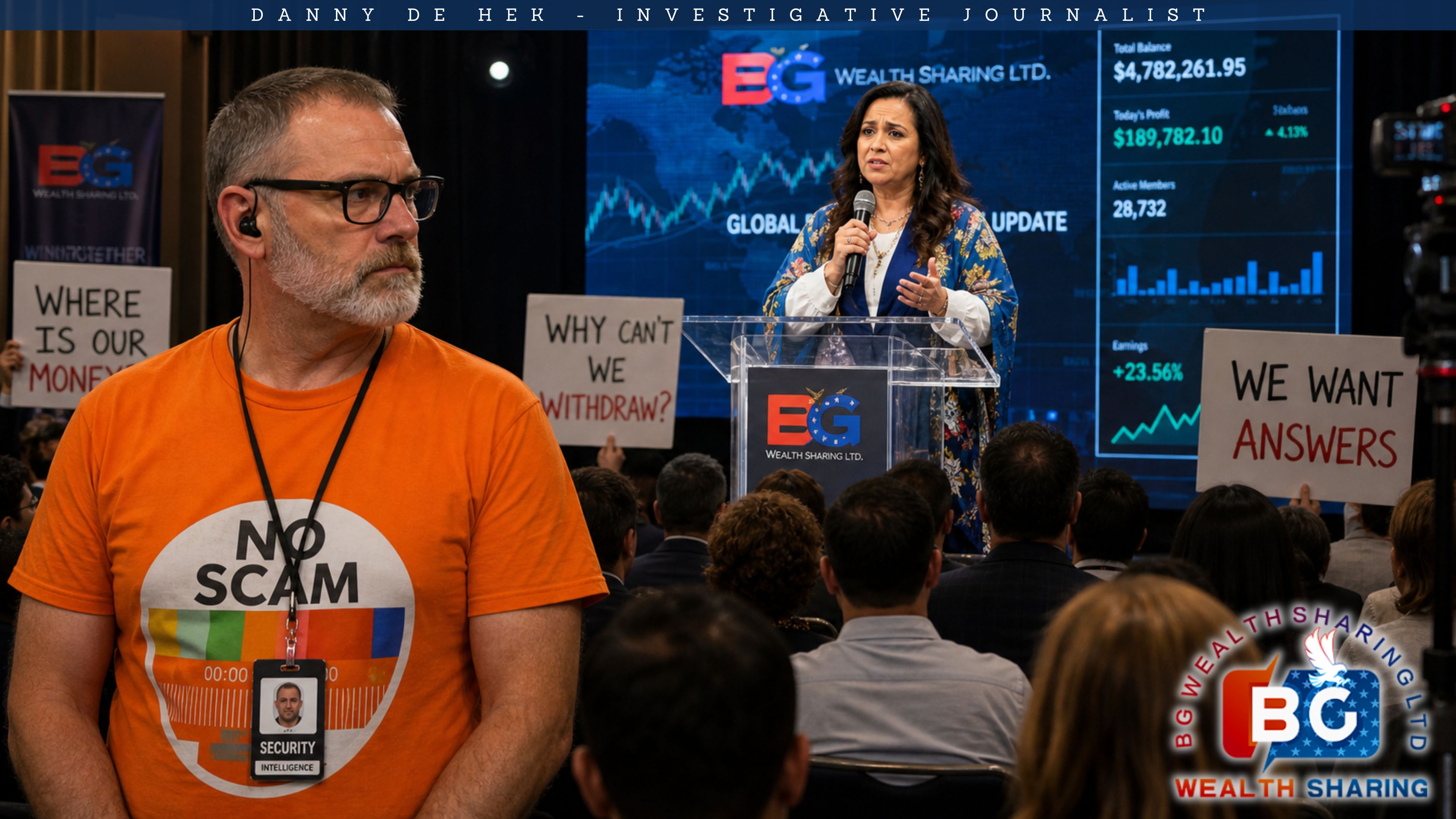
“You can withdraw anytime. Nobody’s going to stop you.”
I’ve seen this pattern before. The confidence. The stage presence. The certainty in the message. And then, quietly, almost overnight, the tone changes.
I sat down and watched Gagan Sarkaria’s April 12 presentation in Utah — not as a casual viewer, but as someone who has spent years documenting how these schemes are built, scaled, and ultimately collapse. What I saw wasn’t just a motivational talk. It was a carefully constructed narrative designed to remove doubt, override skepticism, and replace it with belief.
In that room, surrounded by applause and reinforcement, she told people that BG Wealth Sharing was regulated, compliant, profitable, and safe. She told them withdrawals were a right. She told them the system worked, the trades were real, and the results were proven. And most importantly, she told them — directly and indirectly — that anyone questioning it simply didn’t understand it yet.
Now fast forward to her most recent video.
The same person who stood on stage projecting certainty is now telling her audience to be patient, stop panicking, and trust the process while her own withdrawal sits “under audit.” Seven days and counting. At the same time, we’re told there are 700,000 withdrawal requests in the system.
That’s not a minor delay. That’s a system under pressure.
What I’m doing here is not reacting to one video. I’m connecting the dots between what was promised publicly and what is happening privately inside the system right now. Because when you line those two things up side by side, the contradictions are no longer subtle — they’re impossible to ignore.
This isn’t about one person misspeaking or a temporary issue with withdrawals. This is about a pattern of promotion, recruitment, and control that I’ve documented time and time again. And once you see it clearly, you realise something very uncomfortable:
The people at the top didn’t just believe in this system.
They sold it to others as something it never was.
The Sales Pitch That Built The Machine
When I reviewed the Utah presentation, what stood out wasn’t just the energy in the room — it was the certainty of the claims being made. There was no framing of risk, no room for doubt. Everything was presented as established fact, and that tone matters because it removes the very instinct people rely on to question what they’re being told.
Gagan Sarkaria positioned BG Wealth Sharing as a regulated, high-level financial system, describing it as a US SEC-linked advisory firm and even referring to it as the world’s largest hedge fund for retail investors. At the same time, she dismissed the idea that it was MLM, while openly talking about ranks, teams, and leadership structures. That contradiction wasn’t explored — it was simply absorbed by the audience because of how confidently it was delivered.
The profit narrative was equally direct. Members were told they could double their money in under 60 days, supported by daily returns of around 1.3% to 1.8% through copy trading. These weren’t presented as possibilities — they were framed as outcomes already being achieved. And when you present results like that without context or verification, you’re not informing people — you’re anchoring belief.
What reinforced that belief wasn’t transparency — it was visible success. Testimonials, recognition, and stage moments showcasing luxury cars, cleared debts, and large accounts created the impression that the system was not only working, but working consistently. It’s a powerful psychological effect. When people see others winning, especially in a room full of reinforcement, they stop asking whether it’s real and start asking how to get involved.
This wasn’t a balanced presentation. It was a controlled narrative designed to build confidence quickly and silence doubt before it could take hold. And once that belief is established, the system no longer needs proof — it runs on trust.
The System Behind The Story
If you strip away the stage presence and the confidence of the delivery, what’s left is a very specific and repeatable mechanism. It’s not complicated — in fact, that’s part of the appeal. People are told to deposit funds into DSJ Exchange, follow simple instructions, and let the system do the work. Copy, paste, confirm. That’s it.
From there, the routine becomes almost automatic. Members allow 1% of their balance to be used per trade, follow daily signals, and watch their account grow through what’s described as compounding. At the same time, they’re encouraged to bring others in, build teams, and unlock additional signals and rewards. It’s presented as optional, but in practice, it becomes a central part of how people engage with the system.
What this creates is two things running side by side. On one level, you have the appearance of trading activity and daily profits. On another, you have a structure that grows through referrals, ranks, and incentives tied to expansion. Those two elements are constantly reinforcing each other, which makes the system feel both active and sustainable — even if the underlying mechanics aren’t clearly visible.
And that’s where the problem sits.
There is no independently verifiable evidence presented that these trades are happening in the way they’re described, or that they are generating the consistent returns being claimed. What is visible is a closed environment — communication happening inside controlled channels like BonChat, dashboards showing internal balances, and a strong reliance on community validation to reinforce belief.
That’s not transparency.
That’s containment.
“You Can Withdraw Anytime” — Until You Can’t
One of the clearest promises made during the Utah presentation was simple and repeated with confidence: withdrawals are your right. It was framed as one of the core pillars of the system — no restrictions, no barriers, no hesitation. If you wanted your money, you could take it. That’s what people were told, and more importantly, that’s what they believed.
That claim matters, because it sets the expectation. It tells participants they are in control. It removes the fear that usually comes with handing money over to a third party. And once that fear is gone, people are far more willing to commit — not just financially, but emotionally.
Now compare that to what we’re seeing today.
In her latest video, Gagan openly states that her own withdrawal has been pending for over seven days. At the same time, she tells her audience there are 700,000 withdrawal requests in the system, all being processed in batches, all subject to internal audits. Members are being told to wait, to be patient, and to trust that their turn will come.
That is not a small shift in process.
That is a fundamental change in how the system operates.
Because once withdrawals are delayed, filtered, or controlled, they stop being a right. They become a request — one that depends entirely on the system approving it. And when that happens, the original promise doesn’t just weaken.
It collapses.
The Language Shift: From Certainty To Control
What stands out most here isn’t just the delay in withdrawals — it’s the shift in language. When everything appeared to be working, the messaging was built around confidence and control. People were told they were in charge of their money, that withdrawals were always available, and that this system represented a clear path to financial freedom.
Now the tone has changed.
Instead of empowerment, the messaging is focused on restraint. Members are being told not to panic, to be patient, to trust the process, and in some cases, to reconsider how much they’re trying to withdraw. There’s also a subtle but important introduction of responsibility — the idea that if you truly understand the system, you wouldn’t be reacting the way others are.
This shift isn’t random.
It’s what happens when a system comes under pressure and needs to slow the rate at which money leaves. The language is no longer about access — it’s about behaviour. And that behaviour is being reframed in a way that benefits the system, not the individual.
You can see it in how actions are being reinterpreted. Wanting your money back becomes a sign that you don’t understand compounding. Asking questions becomes negativity. Acting quickly becomes panic. These are not neutral descriptions — they are labels designed to discourage certain actions.
This is how control is maintained when confidence begins to crack.
Not by restricting people outright, but by reshaping how they think about their own decisions.
The Compounding Fantasy
A central pillar of the BG narrative is daily compounding. It’s repeated often, reinforced with examples, and presented as the engine behind everything. Members are told they can earn between 1.2% and 1.8% per day, with some scenarios pushing even higher through additional signals.
At first glance, those numbers sound attractive. But when you actually step back and run the math, the picture changes quickly. Even at the lower end, you’re looking at returns that compound into hundreds of percent annually. At the higher end, the figures stop making sense entirely. There is no credible, regulated financial institution anywhere in the world delivering consistent, fixed daily returns at that level.
And that’s where the real function of this narrative becomes clear.
Compounding isn’t just being used to explain growth — it’s being used to shape behaviour. Members are repeatedly told that withdrawing funds interrupts the process, that pulling money out too early means losing future gains, and that true investors stay committed for the long term. Over time, that messaging creates a mindset where leaving money in the system feels like the smart move, even when warning signs begin to appear.
This is how capital gets trapped.
Because once people believe that their real gains are still ahead of them, they become far less likely to withdraw what they already have. The focus shifts from securing profits to chasing larger ones, and in doing so, the system keeps hold of the very thing it depends on — your money.
So while it’s presented as a wealth-building strategy, the effect is something else entirely.
It’s not just about making money.
It’s about keeping it inside the system for as long as possible.
“This Isn’t MLM” — While Building A Hierarchy
One of the most repeated claims in the Utah presentation was that “BG is not MLM.” It was stated clearly, almost defensively, as if addressing a concern that the audience was expected to have. But what followed that claim tells a very different story.
Within the same presentation, we see a structure built around levels, teams, and progression. People are recognised for reaching Level 1 through Level 9. There are incentives tied to bringing others into the system. There are leadership ranks, rewards, and visible status markers for those who build and expand their networks. None of this is hidden — it’s celebrated on stage, reinforced through recognition, and used as motivation for others to follow the same path.
That’s not ambiguous.
It’s a multi-level structure where financial outcomes are directly influenced by recruitment and team growth. Whether someone chooses to call it MLM or avoid the label altogether doesn’t change how it operates. The terminology can be adjusted, softened, or rebranded — but the mechanics remain the same.
And those mechanics matter.
Because when income is tied not just to participation, but to bringing others into the system, the focus shifts. It’s no longer just about the product or the platform — it becomes about expansion. Growth becomes dependent on new participants, and success stories become tools for attracting them.
So when you hear “this isn’t MLM,” it’s worth looking past the label and focusing on what’s actually happening.
Because in the end, it’s not the name that defines the structure.
It’s the behaviour behind it.
The People Who Drove It
This didn’t spread because of one presentation or one personality. What I’ve been documenting is a network — a layered structure of promoters who amplified the message, reinforced the belief, and expanded the reach of BG Wealth Sharing across multiple countries.
At the centre of that network sits Gagan Sarkaria, who positioned herself as both an educator and a leader. From there, the structure branches out through individuals like Cornelius Jones, Yitzhak Morrison, Iggy Pena, Milton Chisom, and Binod Ray, all of whom have been actively involved in promoting the opportunity and building teams.
As the network widened, more names consistently appeared — Drew Burton, Thaddious Thomas, Arthur Bankston Jr, Faiana Brown, and Dawn & Bill Keeler — each contributing to the same pattern of presentations, onboarding, and reinforcement. These weren’t isolated efforts. They were part of a coordinated expansion, where the same message was repeated across different audiences with the same level of confidence.
What becomes clear when you look deeper is how broad this actually is. Figures like Dr. Emmanuel Bernstein, Chanse Carlson, Marcus & Angela Smith, Randy & Sonya Crosby, Mark & Kim Brown, Oliver Sagala, and Jossie G Gallizia were all positioned within this ecosystem, helping to sustain momentum and credibility as the scheme grew.
And it doesn’t stop there. Additional promoters — including Laie Namoa Laakulu, Anthony Bryant, Natasha Sepetaio, Anh Pham, Don Williams, Ben Acorda, Keith Darren Hudson, Richard & Sumana Chea, Bud Ayers, Cynthia Tran, Tu Tran, and Lee Meadows — further demonstrate that this wasn’t a small group. It was a distributed network, each node playing its role in keeping the system active and expanding.
This matters, because when people look at something like BG Wealth Sharing, they often focus on the platform itself — the exchange, the signals, the so-called leadership behind the scenes.
But platforms don’t grow on their own.
They grow because real people stand in front of others and say, “This works.”
And those people — whether they fully understood what they were promoting or not — became the bridge between the system and the victims.
Without that bridge, none of this reaches the scale we’re now seeing.
The Disappearance Of The Narrative
There’s another detail here that’s easy to miss if you’re only looking at the presentations — but once you see it, it’s hard to ignore.
Gagan Sarkaria’s online presence has shifted.
The YouTube channel that was actively used to promote and educate around BG Wealth Sharing appears to have been renamed or removed. At the same time, her main website is still live, still polished, still presenting her as a high-achievement business coach, consultant, and multi-brand operator — but there is no mention of BG Wealth Sharing anywhere on it.
That’s not a small omission.
Because this wasn’t a side project. This was something she stood on stage and spoke about with authority, something she encouraged others to build around, something she positioned as a pathway to financial freedom. And yet, when you look at her controlled, public-facing business presence today, that entire narrative has quietly disappeared.
That raises a very simple question.
Why distance yourself from something you were so confident promoting?
If BG Wealth Sharing is exactly what it was presented to be — regulated, profitable, sustainable — then there would be no reason to remove it from your public identity. In fact, you would expect the opposite. You would expect it to be front and centre, showcased as a flagship success.
But that’s not what we’re seeing.
Instead, we’re seeing a return to broader, safer positioning — coaching, consulting, publishing, personal development — areas that don’t carry the same immediate scrutiny as a financial platform making aggressive return claims.
And that’s where the absence becomes meaningful.
Because when something is removed without explanation, especially after being promoted at scale, it often tells you more than the original promotion ever did.
The Reality Behind The Numbers
Right now, members are being reassured that their money is still there, that withdrawals are on the way, and that the system is simply under pressure. On the surface, that sounds reasonable. Delays happen. Systems get overloaded. But when you’ve looked at enough of these operations, you start to recognise when something isn’t just a delay — it’s a pattern unfolding in real time.
Because this isn’t new.
What we’re seeing follows a sequence that has played out again and again in similar schemes. It begins with rapid growth, driven by recruitment and reinforced by early success stories. People see results, withdrawals are processed, and confidence builds. That confidence becomes the fuel for expansion, and before long, the system reaches a point where incoming money is expected to keep everything moving.
Then the pressure starts.
Withdrawals increase. More people want to take money out than put money in. That’s when the language begins to shift — delays are introduced, audits are mentioned, and members are encouraged to stay calm. It doesn’t stop overnight. Instead, the system begins to slow down in a controlled way, buying time while trying to maintain belief.
And that’s the critical moment.
Because from the outside, it still looks functional. Accounts still show balances. Communication is still active. Leaders are still reassuring their teams. But underneath that surface, something fundamental has changed — the ability to meet withdrawal demand consistently.
At that point, the system doesn’t collapse in a dramatic way.
It stalls. It stretches. It fragments.
And by the time most people realise what’s actually happening, they’re no longer deciding whether to stay or leave — they’re waiting, hoping, and reacting to a system that has already moved beyond their control.
The Hard Truth
I’m going to say this clearly, because people deserve clarity, not comfort.
The presence of a balance does not mean the presence of funds.
A number on a screen can be updated at any time. It can go up, it can go down, and it can give the appearance of growth. But unless that number can be converted into money in your control — consistently, without delay — it’s not the same thing as liquidity. And that distinction is where most people get caught out.
Right now, members are being reassured that everything is still there, that withdrawals are coming, and that delays are temporary. But a pending withdrawal is not a payout, and a promise — no matter how confidently delivered — is not a guarantee. The only thing that matters is whether funds are being released in a way that matches what was originally promised.
And this is where the situation becomes very real.
When you have hundreds of thousands of people trying to withdraw at the same time, the dynamic changes completely. It’s no longer about whether the system works in principle. It becomes about whether it can meet demand under pressure. Because that’s the moment where the difference between perception and reality is exposed.
At that point, the question shifts.
It’s no longer: “Will I get paid?”
It becomes: “Who gets paid first — and who doesn’t?”
And once a system reaches that stage, outcomes are no longer equal.
They’re selective.
What This Really Is
BG Wealth Sharing presents itself as a trading platform, a financial education system, and a wealth-building opportunity. That’s the surface-level identity — the version people are introduced to through presentations, testimonials, and onboarding calls. It’s designed to feel modern, accessible, and structured in a way that removes complexity while promising strong outcomes.
But when you step back and analyse what’s actually happening — not just what’s being said — a very different picture starts to form.
You’re looking at a system that controls how money enters and how it leaves, where deposits are simple and fast, but withdrawals become conditional once pressure builds. You’re looking at a structure that relies on continuous inflow to maintain momentum, reinforced by internal dashboards that show growth but don’t provide independent verification of where that growth is coming from. And alongside that, you have a strong emphasis on recruitment and expansion, which helps sustain the system while reinforcing belief among participants.
None of these elements exist in isolation.
They work together.
The messaging keeps people confident. The structure encourages growth. The mechanics keep funds inside. And when stress hits the system, the narrative adjusts to maintain stability for as long as possible. That combination isn’t accidental — it’s what allows the operation to function the way it does.
So while it’s presented as innovation, education, or opportunity, the underlying structure points to something else.
This isn’t financial innovation.
It’s a closed financial loop, supported by external marketing and internal control.
The Collapse Phase Has Begun
What we are witnessing right now is not the beginning of BG Wealth Sharing.
It’s the beginning of the end phase — the point where pressure builds, cracks start to show, and the narrative shifts from confidence to control.
This is the stage where everything gets tested. Confidence starts to wobble. Withdrawals slow down or become restricted. Leaders who once spoke with certainty begin changing their tone. And anyone raising concerns is quickly labelled as negative, misinformed, or an outsider trying to cause damage.
At the same time, something more subtle begins to happen.
Reality starts to surface — not all at once, but in fragments. A delayed withdrawal here. A conflicting explanation there. A quiet disappearance of content or messaging. Each piece on its own might be dismissed, but together they form a pattern that becomes harder to ignore.
And this is the part most people underestimate.
The real damage isn’t just financial.
It’s relational.
Because people weren’t just investing — they were bringing others in. Friends, family, entire communities were introduced under the belief that this was something legitimate, something safe, something worth sharing. That trust wasn’t accidental. It was built deliberately through confidence, repetition, and visible success.
Now those same people are being told to stay calm.
And that’s the moment where everything changes.
Because once trust breaks, it doesn’t reset. It doesn’t rebuild overnight. And it doesn’t come back just because the system says it will.
No amount of compounding can fix that.
Disclaimer: How This Investigation Was Conducted
This investigation relies entirely on OSINT — Open Source Intelligence — meaning every claim made here is based on publicly available records, archived web pages, corporate filings, domain data, social media activity, and open blockchain transactions. No private data, hacking, or unlawful access methods were used. OSINT is a powerful and ethical tool for exposing scams without violating privacy laws or overstepping legal boundaries.
About the Author
I’m DANNY DE HEK, a New Zealand–based YouTuber, investigative journalist, and OSINT researcher. I name and shame individuals promoting or marketing fraudulent schemes through my YOUTUBE CHANNEL. Every video I produce exposes the people behind scams, Ponzi schemes, and MLM frauds — holding them accountable in public.
My PODCAST is an extension of that work. It’s distributed across 18 major platforms — including Apple Podcasts, Spotify, Amazon Music, YouTube, and iHeartRadio — so when scammers try to hide, my content follows them everywhere. If you prefer listening to my investigations instead of watching, you’ll find them on every major podcast service.
You can BOOK ME for private consultations or SPEAKING ENGAGEMENTS, where I share first-hand experience from years of exposing large-scale fraud and helping victims recover.
“Stop losing your future to financial parasites. Subscribe. Expose. Protect.”
My work exposing crypto fraud has been featured in:
- Coffeezilla (2026): Featured in the investigation exposing the alleged $328M Goliath Ventures Ponzi scheme
- Bloomberg Documentary (2025): A 20-minute exposé on Ponzi schemes and crypto card fraud
- News.com.au (2025): Profiled as one of the leading scam-busters in Australasia
- OpIndia (2025): Cited for uncovering Pakistani software houses linked to drug trafficking, visa scams, and global financial fraud
- The Press / Stuff.co.nz (2023): Successfully defeated $3.85M gag lawsuit; court ruled it was a vexatious attempt to silence whistleblowing
- The Guardian Australia (2023): National warning on crypto MLMs affecting Aussie families
- ABC News Australia (2023): Investigation into Blockchain Global and its collapse
- The New York Times (2022): A full two-page feature on dismantling HyperVerse and its global network
- Radio New Zealand (2022): “The Kiwi YouTuber Taking Down Crypto Scammers From His Christchurch Home”
- Otago Daily Times (2022): A profile on my investigative work and the impact of crypto fraud in New Zealand



Leave A Comment