


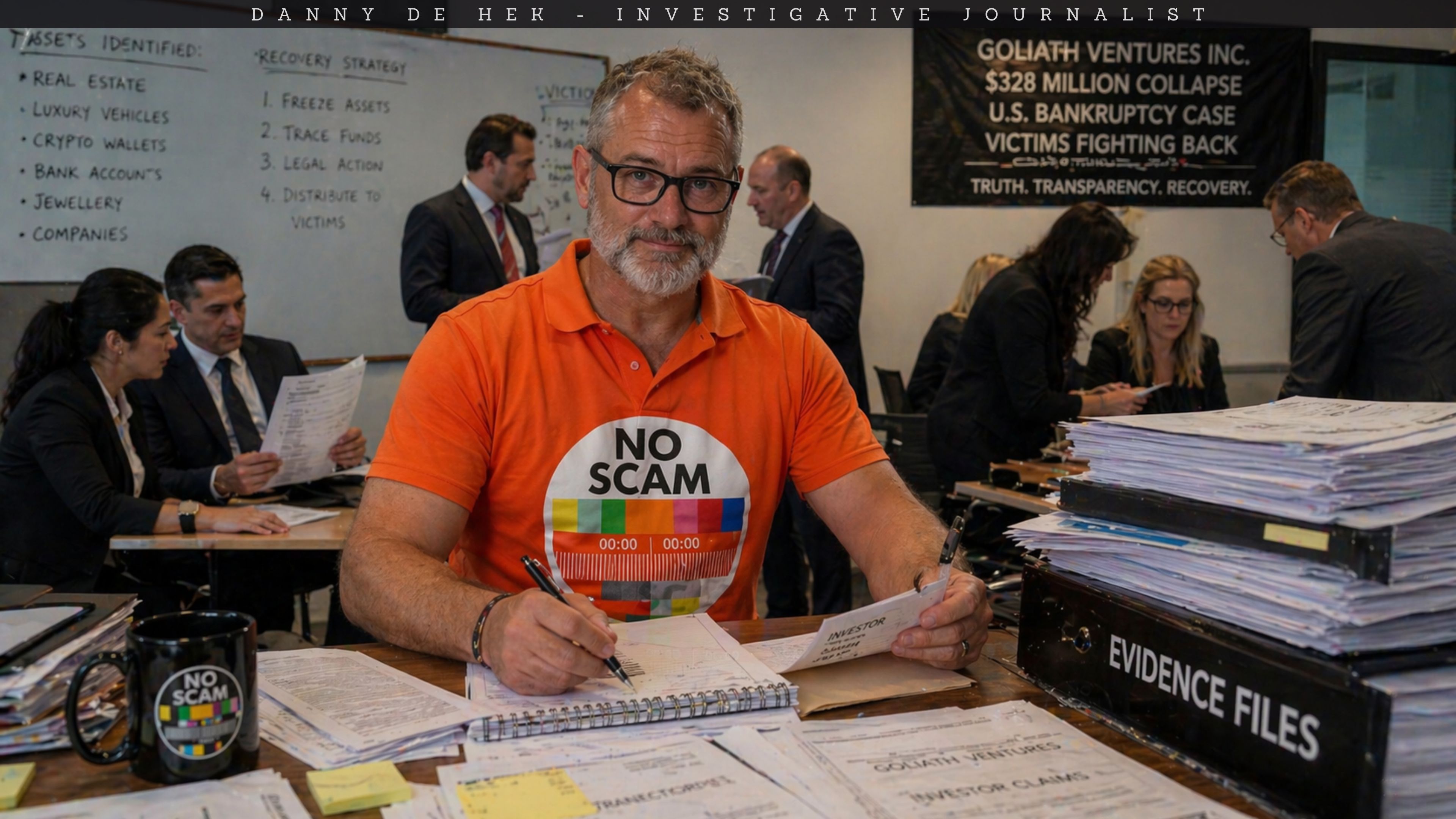
“Most of the creditor body consists of crime victims… and we’re committed to being as creative and aggressive as possible to maximise recovery.”
That line didn’t come from a promoter, a webinar, or a marketing deck. It came from inside a U.S. Bankruptcy Court hearing on April 22, 2026 — and it marks the moment where Goliath Ventures Inc. stops being a story people were sold and starts becoming a case built on evidence.
The Avengers and I listened carefully to the hearing and compared notes. We documented the key exchanges, not just for what was said, but for how it was said. This isn’t about repeating talking points — it’s about understanding the patterns, the gaps, and the mechanics behind what is now being presented under legal scrutiny, while also protecting the individuals who continue to provide information behind the scenes.
What stood out wasn’t drama or headline moments. It was the structure. The tone. The way the case is being positioned at this early stage. Because this is what the beginning of a large-scale fraud recovery actually looks like: controlled, procedural, and focused on building a foundation that will determine everything that follows.
If you’re a victim, this is the point where expectations need to shift. This is no longer about what Goliath claimed it was doing. It’s about what can be proven, what can be recovered, and how that recovery will be distributed. And those are three very different things.
A procedural hearing that quietly establishes control
At first glance, this hearing might feel underwhelming. There were no confrontations, no emotional testimony, and no immediate answers about money. But that’s because this wasn’t a hearing about outcomes — it was about control. Who is in charge, how the case will be managed, and how different parts of the system will interact with each other.
What became clear early on is that Michael Budwick, as receiver, now effectively controls the estate, operating with broad authority granted by the court. At the same time, the U.S. Attorney’s Office is pursuing a criminal investigation, and the bankruptcy court is overseeing how any recovered funds will ultimately be distributed. These three elements — civil recovery, criminal prosecution, and judicial oversight — are now aligned.
That alignment is not something to take for granted. In many fraud cases, you see conflict between agencies, duplication of effort, and unnecessary legal battles that reduce what’s left for victims. Here, there is a conscious effort to avoid that. The receiver openly discussed coordination with federal prosecutors, and the judge acknowledged that cooperation as a positive step forward.
One of my Avengers picked up on something subtle but important. Budwick and his team didn’t just sound experienced — they sounded aware of cost, efficiency, and impact. That matters, because every decision from this point forward — whether to litigate, settle, or pursue an asset — directly affects what victims ultimately recover.
The collapse of the Goliath narrative
The court did not avoid the central issue. The case being built is based on allegations that Goliath Ventures operated a $328 million Ponzi scheme, supported by a federal affidavit from an IRS special agent.
The mechanics described are consistent with what I’ve seen repeatedly. New investor funds are used to pay earlier investors, creating the illusion of profitability. Those payouts then become proof, reinforcing belief and attracting more capital. The system feeds itself — not through real earnings, but through continuous inflow.
The judge clarified that the term “Ponzi” is being used descriptively at this stage, not as a final legal conclusion. But from an investigative standpoint, the pattern is already clear. There is no evidence of a sustainable external revenue model capable of producing the returns that were promised.
This is where many investors struggle to adjust. They point to crypto transactions and movement of funds as evidence of legitimacy. But movement is not profit. Transactions are not proof of a real business. The presence of crypto does not validate the system — it simply shows how the money moved.
The empty office and what it really tells you
One of the most revealing details in the hearing came from the receiver’s first visit to Goliath’s office. What they found wasn’t a struggling business — it was an operation that had already been stripped clean.
The office was empty. Computers were gone. Records had been removed. There was no meaningful operational presence left behind.
That is not how legitimate companies wind down.
What this suggests is something far more deliberate. It suggests that those running the operation anticipated scrutiny and removed accessible evidence before control shifted. At the same time, the government had already begun seizing assets, including real estate, vehicles, and personal property connected to Delgado.
This overlap — disappearance on one side, seizure on the other — is a pattern seen repeatedly in collapses like this. It marks the transition from private control to legal control, and that’s where the real investigation begins.
Following the money and the complexity ahead
The question everyone wants answered is simple: where is the money?
Right now, the answer is incomplete.
There is evidence of substantial crypto activity, including transfers through Coinbase. Physical assets have been seized. There are indications of funds and property overseas, including Dubai. But there is no complete financial picture yet.
A major complication is that many assets are not held in the company’s name. Instead, they are tied to Delgado personally or through affiliated entities. That creates layers of ownership that must be untangled before recovery can even begin.
The government is continuing to identify and seize assets, including cryptocurrency where possible. Those proceeds are expected to flow into the bankruptcy estate. But there is still a significant gap between what is known, what is suspected, and what can be proven.
There were also claims about massive crypto wallets holding hundreds of millions. These claims remain unverified. No one in the hearing could confirm them. This is a classic pattern — when facts are missing, speculation fills the gap.
Coordination between agencies and why it matters
One of the strongest signals in this hearing was the level of coordination between the receiver and federal prosecutors. Instead of competing over assets, they are working together under a structured agreement.
That agreement allows the government to handle seizure and liquidation, with proceeds flowing into the bankruptcy estate for distribution.
This avoids duplication, reduces legal costs, and keeps the focus on recovery.
The judge acknowledged this cooperation as a strong starting point, and that matters. Because in cases where agencies fight each other, victims lose twice — once in the scheme, and again through inefficiency.
There was also a consistent theme throughout the hearing: cost awareness. The receiver made it clear that most creditors are victims, and efficiency matters. That doesn’t eliminate legal costs, but it shows an understanding that recovery is about what’s left after the process — not just what’s recovered in total.
Key developments from the hearing
The hearing wasn’t just procedural — it also clarified several important developments that directly affect creditors and the overall recovery process. These are the details that often get buried in legal language, but they matter because they shape what happens next and how this case will unfold.
To make this clear, here are the key developments as they came through during the hearing:
- The 341 meeting of creditors, held earlier that day, had over 100 participants but ran into logistical issues, including noise and speakerphone problems. As a result, it was continued and rescheduled to June 26, 2026, at noon by telephone.
- A coordination agreement has been reached with the U.S. Attorney’s Office. The government will continue seizing and liquidating assets — including real estate, luxury vehicles, jewellery, and cryptocurrency — and will seek to transfer those proceeds into the bankruptcy estate for distribution to victims. This avoids duplication of effort and reduces costs.
- The claims bar date has been extended from May 26, 2026, to September 30, 2026. This gives creditors additional time to file a proof of claim, particularly as the full list of victims is still being compiled.
- A creditors’ committee has been appointed, made up of seven members selected from the largest creditors. They are meeting to appoint legal counsel, who will represent the interests of unsecured creditors, most of whom are investor victims.
- Receiver Michael Budwick and his firm are actively progressing the case. Subpoenas have been issued, forensic work is underway, and specialist accountants are being engaged to assist with financial reconstruction. A website and communication channels, including goliathventuresreceiver@gmail.com, are being established for updates.
- One detail that reinforces how serious this process has become is the intention to retain GlassRatner as forensic accountants. This isn’t a generic accounting firm — they specialise in complex financial investigations, particularly in cases involving fraud, insolvency, and asset tracing. Their role will be to help reconstruct the financial flows behind Goliath Ventures, identify where funds moved, and support recovery efforts with evidence that can stand up in court.
- What this means in practical terms is that the case is moving beyond surface-level analysis and into deep forensic reconstruction. Transactions will be traced, patterns will be identified, and inconsistencies will be tested against actual financial data. In cases like this, that level of detail is critical — because recovery doesn’t come from assumptions, it comes from provable financial evidence.
- The case involves two related debtor entities, one in Florida and one in Wyoming, operating under the same name and EIN. This has resulted in some duplication of claims that will need to be resolved.
- The scale of the case has been reinforced, with approximately $328 million raised from investors and potentially up to 1,500 victims. Christopher Delgado is facing federal wire fraud and money laundering charges, although a formal indictment had not yet been filed at the time of the hearing.
Taken together, these developments show that while the process is still in its early stages, it is already structured, coordinated, and actively moving forward.
Frequently Asked Questions From The Hearing (And What They Actually Mean)
What stood out during this hearing wasn’t just the legal updates — it was the volume of questions coming directly from victims. These questions reveal confusion, expectation, and in some cases, lingering belief in the original narrative. When you look at them properly, they tell you exactly where people are at mentally as this shifts from an “investment” to a legal case.
How to contact the receiver and provide information
One detail that came through during the hearing — and shouldn’t be overlooked — is that information can be submitted directly to the receiver. Victims, insiders, or anyone with relevant documentation can send details to goliathventuresreceiver@gmail.com. That includes transaction records, screenshots, communications, or anything that helps establish the flow of funds.
This matters because the case is still in the evidence-gathering phase. The receiver is actively building a clearer picture of what happened, and that picture depends on the quality and volume of information being provided. In schemes like this, some of the most valuable insights come from individuals who were directly involved or affected.
If you have evidence, this is one of the few ways to contribute directly to the recovery process. It won’t lead to immediate results, and it doesn’t guarantee any specific outcome, but it does feed into the broader effort to trace assets, identify transactions, and support potential recovery actions.
What these questions actually reveal
When you step back and look at all of these questions together, a pattern becomes clear. These aren’t just questions — they reflect where people are mentally as this shifts from an investment story into a legal process.
There is still a clear search for certainty, even though certainty doesn’t exist at this stage. People are asking about recovery amounts, timelines, and hidden assets as if there is a defined answer waiting to be revealed. There isn’t — not yet.
What stands out is the expectation that something is still “there” to be found. Whether it’s large crypto wallets or undisclosed funds, that belief hasn’t fully disappeared. It’s a reminder of how powerful the original narrative was, and how long it takes to unwind it.
At the same time, there is a growing awareness that this is now a legal process. Questions around claims, eligibility, and representation show that people are starting to engage with the reality of what comes next — even if they don’t fully understand it yet.
This gap — between what people were led to believe and what is now unfolding — is where the scheme operated. And it’s also where the hardest part of this process sits: accepting that the answers will come slowly, and only through evidence.
The reality of recovery
The judge did not attempt to soften expectations, and that in itself is telling. There was no attempt to offer reassurance, no effort to create optimism where it isn’t justified. What was presented instead was a clear, grounded view of what this process actually involves once a scheme of this scale collapses and moves into the legal system.
There are no guarantees about how much will be recovered. There are no timelines for distribution. There are no reliable projections at this stage because the underlying financial picture has not yet been fully reconstructed. Until the money trail is mapped properly, anything else would be speculation.
Recovery in cases like this is slow, complex, and resource-intensive. It involves forensic accounting to trace funds, legal action to challenge ownership and recover assets, and detailed investigation to identify where money has moved and who received it. Each of those steps takes time, and each comes with cost.
That does not mean recovery will not happen. It means recovery will depend entirely on what can be identified, proven, and successfully pursued through legal channels, not on what was promised, assumed, or believed when the scheme was operating.
When the story ends and the evidence begins
What we are witnessing now is the shift from perception to evidence, and that shift is not immediate or dramatic — it is gradual, methodical, and often uncomfortable for those still trying to make sense of what has happened. The confidence, presentation, and controlled messaging that once defined Goliath Ventures no longer carry weight in a courtroom. What replaces them is scrutiny, documentation, and the slow process of verifying what can actually be proven.
For a long time, the operation relied on belief. It relied on people accepting what they were shown without having access to what sat behind it. That phase is now over. The moment this moved into a legal framework, the standard changed. Claims are no longer measured by how convincing they sound, but by whether they can withstand examination under law.
What replaces that narrative is slower, more deliberate, and far more grounded in reality. Legal oversight, federal investigation, and financial reconstruction are not designed to move quickly — they are designed to be thorough. Every transaction, every transfer, and every claim now has to be traced, verified, and supported by evidence.
This hearing did not provide closure, and it was never going to. What it did provide was confirmation that the process now underway is being handled by people who understand the structure of these schemes and the challenges involved in unwinding them. That level of experience matters, because it shapes how decisions are made from this point forward.
That does not guarantee recovery, and it does not promise a favourable outcome. What it does mean is that the illusion that sustained the operation is no longer in control. What replaces it is a system built on evidence, accountability, and legal process — and that is where the real work begins.
Disclaimer: How This Investigation Was Conducted
This investigation relies entirely on OSINT — Open Source Intelligence — meaning every claim made here is based on publicly available records, archived web pages, corporate filings, domain data, social media activity, and open blockchain transactions. No private data, hacking, or unlawful access methods were used. OSINT is a powerful and ethical tool for exposing scams without violating privacy laws or overstepping legal boundaries.
About the Author
I’m DANNY DE HEK, a New Zealand–based YouTuber, investigative journalist, and OSINT researcher. I name and shame individuals promoting or marketing fraudulent schemes through my YOUTUBE CHANNEL. Every video I produce exposes the people behind scams, Ponzi schemes, and MLM frauds — holding them accountable in public.
My PODCAST is an extension of that work. It’s distributed across 18 major platforms — including Apple Podcasts, Spotify, Amazon Music, YouTube, and iHeartRadio — so when scammers try to hide, my content follows them everywhere. If you prefer listening to my investigations instead of watching, you’ll find them on every major podcast service.
You can WORK WITH ME for dedicated access to my time and investigative services — including private consultations, scam-risk reviews, sponsored investigations, support sessions, livestream scam breakdowns, and interviews. I’m also available for SPEAKING ENGAGEMENTS, where I share first-hand experience from years of exposing large-scale fraud, investigating scams, and supporting victims.
“Stop losing your future to financial parasites. Subscribe. Expose. Protect.”
My work exposing crypto fraud has been featured in:
- Coffeezilla (2026): Featured in the investigation exposing the alleged $328M Goliath Ventures Ponzi scheme
- Bloomberg Documentary (2025): A 20-minute exposé on Ponzi schemes and crypto card fraud
- News.com.au (2025): Profiled as one of the leading scam-busters in Australasia
- OpIndia (2025): Cited for uncovering Pakistani software houses linked to drug trafficking, visa scams, and global financial fraud
- The Press / Stuff.co.nz (2023): Successfully defeated $3.85M gag lawsuit; court ruled it was a vexatious attempt to silence whistleblowing
- The Guardian Australia (2023): National warning on crypto MLMs affecting Aussie families
- ABC News Australia (2023): Investigation into Blockchain Global and its collapse
- The New York Times (2022): A full two-page feature on dismantling HyperVerse and its global network
- Radio New Zealand (2022): “The Kiwi YouTuber Taking Down Crypto Scammers From His Christchurch Home”
- Otago Daily Times (2022): A profile on my investigative work and the impact of crypto fraud in New Zealand






Leave A Comment