


“If you can’t see where the money is really coming from, you are the product.”
I’ve spent enough time inside these groups, watching the behaviour, tracking the wallets, and listening to victims, to recognise the pattern immediately. What we’re dealing with here isn’t just another questionable crypto opportunity — it’s a structured system built on illusion, control, and deliberate information suppression.
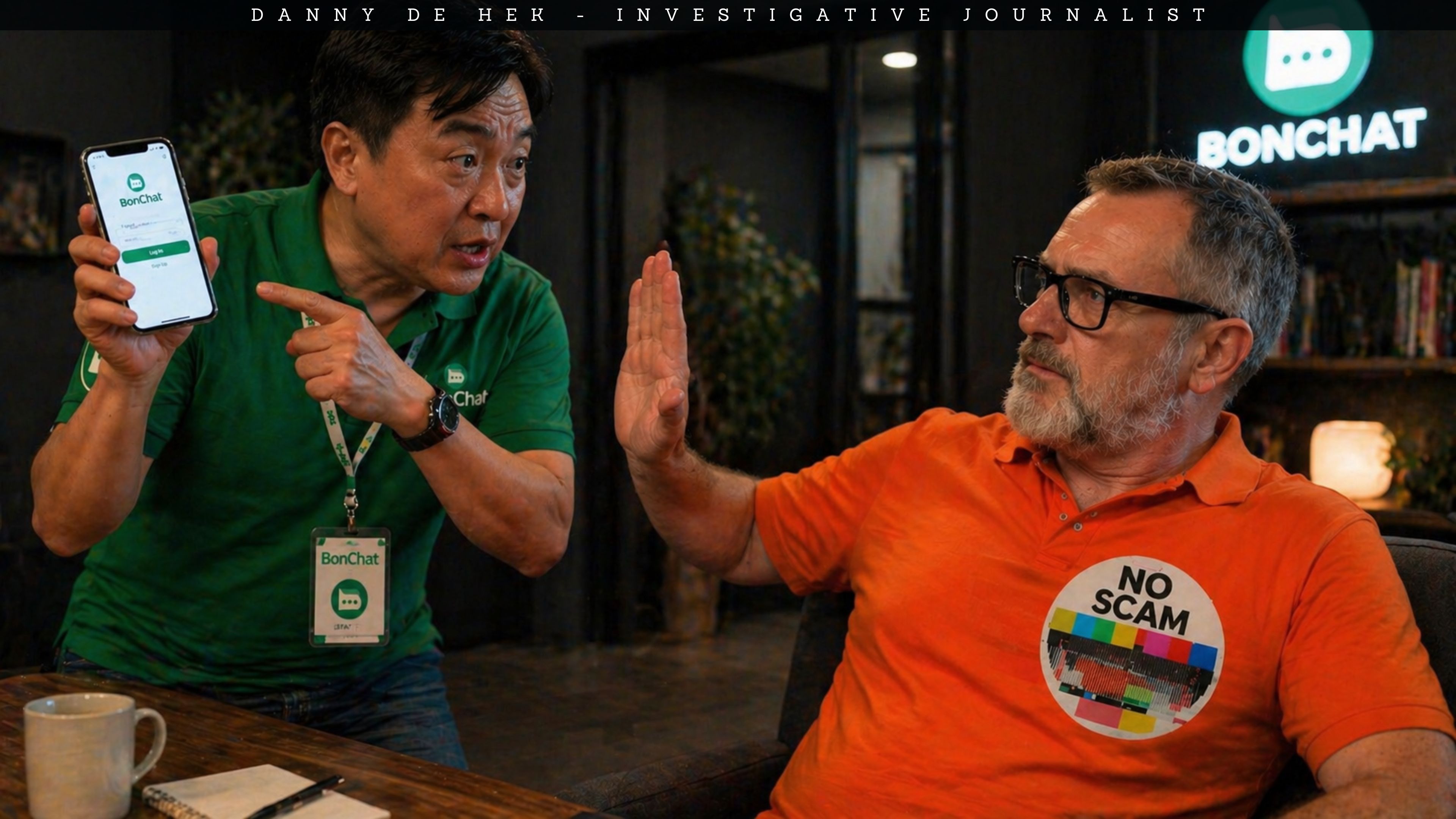
And at the centre of it, quietly operating in the background, is a piece of infrastructure most participants don’t even question: an app called BonChat.
This isn’t speculation. It’s not theory. It’s based on documented patterns, regulatory warnings, and technical behaviour that repeats itself across multiple jurisdictions. The same names. The same tactics. The same outcomes. People deposit money, see fabricated profits, struggle to withdraw, and eventually realise they were never participating in real trading at all.
What makes this case particularly important is that we’re no longer just looking at the “front-end” scam — the fake trading platform, the scripted signals, the recruitment pressure. We’re now seeing the underlying infrastructure that allows these operations to function, scale, and erase evidence in real time.
That’s where things start to get uncomfortable.
The Hidden Infrastructure Behind the Scam
Most people joining BG Wealth Sharing or DSJ Exchange think they’re entering a financial ecosystem. In reality, they’re being moved into a controlled communication environment designed to limit scrutiny and maximise compliance.
That environment is BonChat — a messaging app developed by Hong Kong CipherChat Tech Company Limited. On the surface, it presents itself as a privacy-focused, encrypted communication tool. But when you step back and look at how it’s actually being used, a very different picture emerges.
 According to a compiled Due Diligence Report, BonChat has become a preferred communication platform for organised crypto fraud networks, particularly those running pig-butchering style scams and copy-paste trading schemes like BG Wealth Sharing .
This isn’t accidental. It’s not coincidence. It’s behavioural alignment.
The app offers a combination of features that, when placed in the wrong hands, create the perfect environment for fraud:
- Messages can be deleted on both sides of a conversation
- Users can be instantly blocked and removed from groups
- Communication is encrypted and difficult to trace
- Servers can be self-hosted, meaning operators control the data
Taken individually, these features might sound like privacy tools. But combined, and used within a financial “opportunity,” they create something far more dangerous — a system where evidence can be erased faster than victims can react.
And that’s exactly what we’re seeing.
How the Illusion Is Built
If you strip away the branding, the hype, and the daily “signals,” the mechanics of this operation are remarkably simple — and disturbingly consistent with known scam models.
Victims are typically introduced through social media, referrals, or direct messaging. Sometimes it starts as a casual conversation. Other times it’s framed as an exclusive opportunity. Either way, the objective is the same: build trust just long enough to move the target into a more controlled environment.
That environment is BonChat.
Once inside, the structure becomes clear. There’s usually a “mentor,” often referred to as a professor or trading expert, who provides daily instructions. These instructions aren’t education. They’re not analysis. They’re copy-and-paste commands that users are told to follow without question.
This is where the illusion of trading is created.
Participants input these “signals” into a platform like DSJ Exchange, which displays profits — often within seconds. The speed is intentional. It creates excitement. It builds confidence. It reinforces the belief that something real is happening.
But here’s the problem: there is no verifiable evidence that any legitimate trading is taking place.
The due diligence report outlines this exact pattern, describing how victims are instructed to execute short-term trades based on signals, while seeing fabricated returns designed to build trust .
What people are actually interacting with is not a live market — it’s a controlled interface designed to simulate success.
Control, Compliance, and Silence
One of the most overlooked aspects of these schemes isn’t the money — it’s the behavioural control.
Inside these groups, questioning the process is discouraged. Doubt is framed as negativity. Independent thinking is quietly filtered out. And if someone pushes too hard, they’re removed entirely.
This isn’t random moderation. It’s structured.
BonChat’s administrative controls allow group leaders to:
- Delete messages retroactively
- Remove users instantly
- Restrict communication flow
- Prevent evidence from being shared externally
This creates an environment where only one narrative survives — the one that benefits the operators.
Victims often don’t realise this until it’s too late. By the time withdrawals are delayed or denied, the conversation history is gone, the group access is revoked, and the people they trusted have disappeared.
From an investigative standpoint, this is critical. It explains why so many victims struggle to provide evidence. It’s not because they didn’t document it — it’s because the system is designed to erase it.
The Role of BonChat: Tool or Enabler?
Now, it’s important to draw a line here. There is currently no direct evidence that the developers of BonChat are running these scams themselves. The company appears to be a small, recently incorporated entity with limited public transparency .
But that doesn’t remove the concern.
Because what we’re looking at is a platform that:
- Has no publicly identifiable leadership
- Provides minimal corporate transparency
- Offers features highly suited to fraud operations
- Has been rapidly adopted by known scam networks
That combination raises serious questions.
The report highlights this clearly, identifying BonChat as high-risk infrastructure being actively used in multi-jurisdictional fraud operations .
In simple terms, whether intentional or not, the platform is functioning as an enabler.
And in the world of financial crime, enabling the environment can be just as significant as running the operation itself.
Who Is Really Using This App — And Why That Matters
When you look at BonChat in isolation, it’s just another encrypted messaging tool. But once you start mapping where it shows up repeatedly, the pattern becomes very difficult to ignore.
This isn’t being driven by everyday investors, licensed brokers, or transparent trading communities. It’s being used by coordinated groups operating behind layers of anonymity, often presenting themselves as mentors, educators, or insiders with privileged access to “signals.”
These are not isolated individuals experimenting with an app. They are part of structured networks where communication is tightly managed and deliberately redirected away from public scrutiny.
A consistent behaviour pattern emerges:
- Victims are first contacted on mainstream platforms
- Trust is established through conversation and social proof
- They are then moved into BonChat groups for the “real opportunity”
- From that point forward, communication becomes controlled
That transition point is critical.
Because legitimate financial platforms do not need to relocate users into private, untraceable chat environments to operate. When that happens, it’s not about convenience — it’s about containment.
This Isn’t Just Communication — It’s Behavioural Control
Most people assume the purpose of BonChat is privacy. That’s how it’s marketed. That’s how it’s explained.
But in practice, within these schemes, it functions as something very different.
It becomes a centralised control system for behaviour, information, and narrative.
Once inside a BonChat group, participants are no longer exposed to balanced or independent information. Everything they see is filtered through the group structure. The leaders control the flow, the tone, and the direction of conversation.
They decide:
- What information is shared
- What questions are allowed
- Who remains in the group
- What evidence continues to exist
That creates a closed-loop environment, where the only version of reality participants are exposed to is the one being curated for them.
From an investigative standpoint, this is one of the strongest indicators that something is wrong.
Because the moment a financial opportunity requires you to limit your exposure to outside information, you’re no longer participating in an open market — you’re operating inside a controlled system.
The Psychological Playbook Behind the System
This is where the mechanics move beyond technical infrastructure and into behavioural engineering.
What’s happening inside these groups is not random. It follows a recognisable psychological framework that has been used across multiple fraud models, particularly in pig-butchering scams.
The structure is designed to gradually reduce independent thinking while increasing emotional commitment.
There are several consistent elements:
- Isolation from external input
Participants are moved away from open platforms into a closed environment where dissenting voices are removed quickly. - Authority positioning
A central figure — often called a “Professor” — is presented as an expert. Their instructions are followed without verification. - Repetition and routine
Daily signals create habit. Over time, participants stop analysing and start complying. - Reward conditioning
Visible profits, even if fabricated, reinforce belief and encourage continued participation. - Fear of exclusion
Questioning the system risks removal from the group, which discourages critical thinking. - Social proof pressure
Constant activity, screenshots, and testimonials create the illusion that success is widespread and normal.
None of this is accidental.
It is a structured environment designed to override doubt and reinforce compliance.
Why People Still Believe It’s Real
Despite the red flags, despite the warnings, and despite the growing number of victims, people continue to join these schemes and defend them.
That isn’t because they lack intelligence. It’s because the system is designed to feel real at every stage of the process.
Early withdrawals may be allowed in small amounts to build trust. The platform displays consistent profits. The group environment reinforces belief. And there is always someone positioned as a success story — someone who appears to have “made it.”
This creates a powerful psychological anchor.
Once someone has committed financially and emotionally, they are far less likely to question the system. Instead, they rationalise it. They defend it. And in many cases, they begin recruiting others — not out of malice, but because they genuinely believe it works.
By the time withdrawal issues begin, or inconsistencies become obvious, they are already deeply invested.
And that’s when the situation becomes difficult to reverse.
The Bigger Picture
What we’re seeing here is not an isolated case. It aligns with a global pattern of organised crypto fraud, often linked to operations based in Southeast Asia where similar models are deployed at scale.
These operations are not informal or improvised. They are structured, repeatable, and designed to operate across multiple jurisdictions while avoiding enforcement.
The due diligence report highlights that BonChat’s usage fits within this broader context, where encrypted communication platforms are used to manage victims, coordinate activity, and minimise traceability .
That context matters.
Because it shifts this from a questionable investment model into something far more serious — a coordinated system of financial exploitation operating across borders.
Where This Leads — And Why It Matters
When you follow the structure all the way through, the implications become clear.
This is not just about a platform or an app. It’s about a system that has been designed to:
- Control communication
- Influence behaviour
- Simulate legitimacy
- Remove evidence
- Extract funds
The use of encrypted, self-controlled communication channels makes it extremely difficult for victims to recover funds or for authorities to intervene in real time. By the time complaints are filed, the infrastructure has often shifted, and the individuals involved have moved on.
The report makes it clear that these operations align with larger organised cyber-fraud networks, which adds another layer of complexity when it comes to enforcement and accountability .
There are also legal realities that participants need to understand. When recruitment is part of the model, those promoting the scheme can find themselves exposed when the system collapses. Victims don’t chase anonymous platforms — they go after the people who introduced them.
And that’s where the consequences begin to surface.
Because while the system itself is designed to disappear, the impact it leaves behind does not.
Lost funds. Broken relationships. Reputations damaged. Trust eroded.
When you strip everything back — the branding, the promises, the illusion of trading — what remains is a structure built on control, not transparency.
And in any legitimate financial environment, transparency isn’t optional — it’s fundamental.
Disclaimer: How This Investigation Was Conducted
This investigation relies entirely on OSINT — Open Source Intelligence — meaning every claim made here is based on publicly available records, archived web pages, corporate filings, domain data, social media activity, and open blockchain transactions. No private data, hacking, or unlawful access methods were used. OSINT is a powerful and ethical tool for exposing scams without violating privacy laws or overstepping legal boundaries.
About the Author
I’m DANNY DE HEK, a New Zealand–based YouTuber, investigative journalist, and OSINT researcher. I name and shame individuals promoting or marketing fraudulent schemes through my YOUTUBE CHANNEL. Every video I produce exposes the people behind scams, Ponzi schemes, and MLM frauds — holding them accountable in public.
My PODCAST is an extension of that work. It’s distributed across 18 major platforms — including Apple Podcasts, Spotify, Amazon Music, YouTube, and iHeartRadio — so when scammers try to hide, my content follows them everywhere. If you prefer listening to my investigations instead of watching, you’ll find them on every major podcast service.
You can WORK WITH ME for dedicated access to my time and investigative services — including private consultations, scam-risk reviews, sponsored investigations, support sessions, livestream scam breakdowns, and interviews. I’m also available for SPEAKING ENGAGEMENTS, where I share first-hand experience from years of exposing large-scale fraud, investigating scams, and supporting victims.
“Stop losing your future to financial parasites. Subscribe. Expose. Protect.”
My work exposing crypto fraud has been featured in:
- Coffeezilla (2026): Featured in the investigation exposing the alleged $328M Goliath Ventures Ponzi scheme
- Bloomberg Documentary (2025): A 20-minute exposé on Ponzi schemes and crypto card fraud
- News.com.au (2025): Profiled as one of the leading scam-busters in Australasia
- OpIndia (2025): Cited for uncovering Pakistani software houses linked to drug trafficking, visa scams, and global financial fraud
- The Press / Stuff.co.nz (2023): Successfully defeated $3.85M gag lawsuit; court ruled it was a vexatious attempt to silence whistleblowing
- The Guardian Australia (2023): National warning on crypto MLMs affecting Aussie families
- ABC News Australia (2023): Investigation into Blockchain Global and its collapse
- The New York Times (2022): A full two-page feature on dismantling HyperVerse and its global network
- Radio New Zealand (2022): “The Kiwi YouTuber Taking Down Crypto Scammers From His Christchurch Home”
- Otago Daily Times (2022): A profile on my investigative work and the impact of crypto fraud in New Zealand






Leave A Comment