


“When a scheme starts demanding more money to unlock your own money, you’re no longer investing. You’re negotiating with a hostage situation.”
For the past several months, I’ve been investigating BG Wealth Sharing and the connected DSJ Exchange ecosystem — a so-called AI-powered trading opportunity that has spread rapidly through WhatsApp groups, Zoom calls, BonChat channels, and social media recruiters promising “financial freedom” through copy-and-paste trading signals.
Now a new name has landed on my radar: Dr. Emmanuel Bernstein of Houston.
And after reviewing hours of Zoom recordings, transcripts, chat logs, archived websites, and testimony from victims inside the scheme, the pattern is becoming painfully familiar.
This isn’t just someone casually sharing an opportunity with friends. This is a highly polished MLM-style recruiter operating as a motivational authority figure, encouraging desperate people to continue funding a collapsing system while attempting to rationalise one of the biggest red flags imaginable: paying a “12% transaction fee” to regain access to your own money.
The anonymous whistleblower who contacted me described emotional pressure campaigns, confusion tactics, and constant moving goalposts inside the BG Wealth ecosystem. They also alleged people were encouraged to use services like Klarna, AfterPay, Zip, and other credit-based financing tools during the IPO promotion phase — effectively encouraging participants to borrow money to fund speculative crypto deposits.
That alone should set off alarm bells.
The whistleblower’s testimony also paints a picture of people becoming trapped psychologically inside the scheme. Many no longer believe the story being sold, but they’re terrified of losing their original deposits if they stop cooperating. That’s exactly the kind of environment scammers rely on: fear, sunk-cost fallacy, group pressure, and manufactured urgency.
According to the tip submitted to me, Emmanuel Bernstein was actively reassuring participants that the controversial “12% tax” was not really a tax at all, but merely a “transaction fee” required to “verify real accounts” ahead of an IPO process.
That explanation collapses the moment you apply even basic scrutiny.
The “Dr.” Branding and the MLM Persona
Before even examining the BG Wealth material, Emmanuel Bernstein’s own online footprint raises serious concerns.
Archived versions of his website presented him as:
- A “documented millionaire”
- A “Millionaire Success Coach”
- A mentor helping “1000 families” earn six-figure residual income
- A global entrepreneur specialising in network marketing
His marketing language follows the exact psychological blueprint seen across countless MLM and Ponzi ecosystems: aspiration, authority, mentorship, personal transformation, and financial salvation.
The site promoted his private Facebook group Believe Big and Profit, along with coaching funnels promising to help people “expand globally,” overcome “mindset blocks,” and achieve “massive success.” The archived material repeatedly framed Bernstein as a leadership figure uniquely qualified to guide people toward wealth and residual income.
What’s noticeably absent is any verifiable evidence supporting the credibility implied by the title “Dr. Emmanuel Bernstein.”
The archived biography itself admits he never attended medical school after being rejected. Yet the “Doctor” branding remained central to his identity and marketing image.
That matters because titles create trust.
Inside schemes like BG Wealth Sharing, authority figures become emotional anchors. Participants stop critically evaluating claims because they believe someone more experienced has already done that thinking for them.
And Emmanuel Bernstein clearly understands the power of perceived authority.
The Zoom Call That Changed Everything
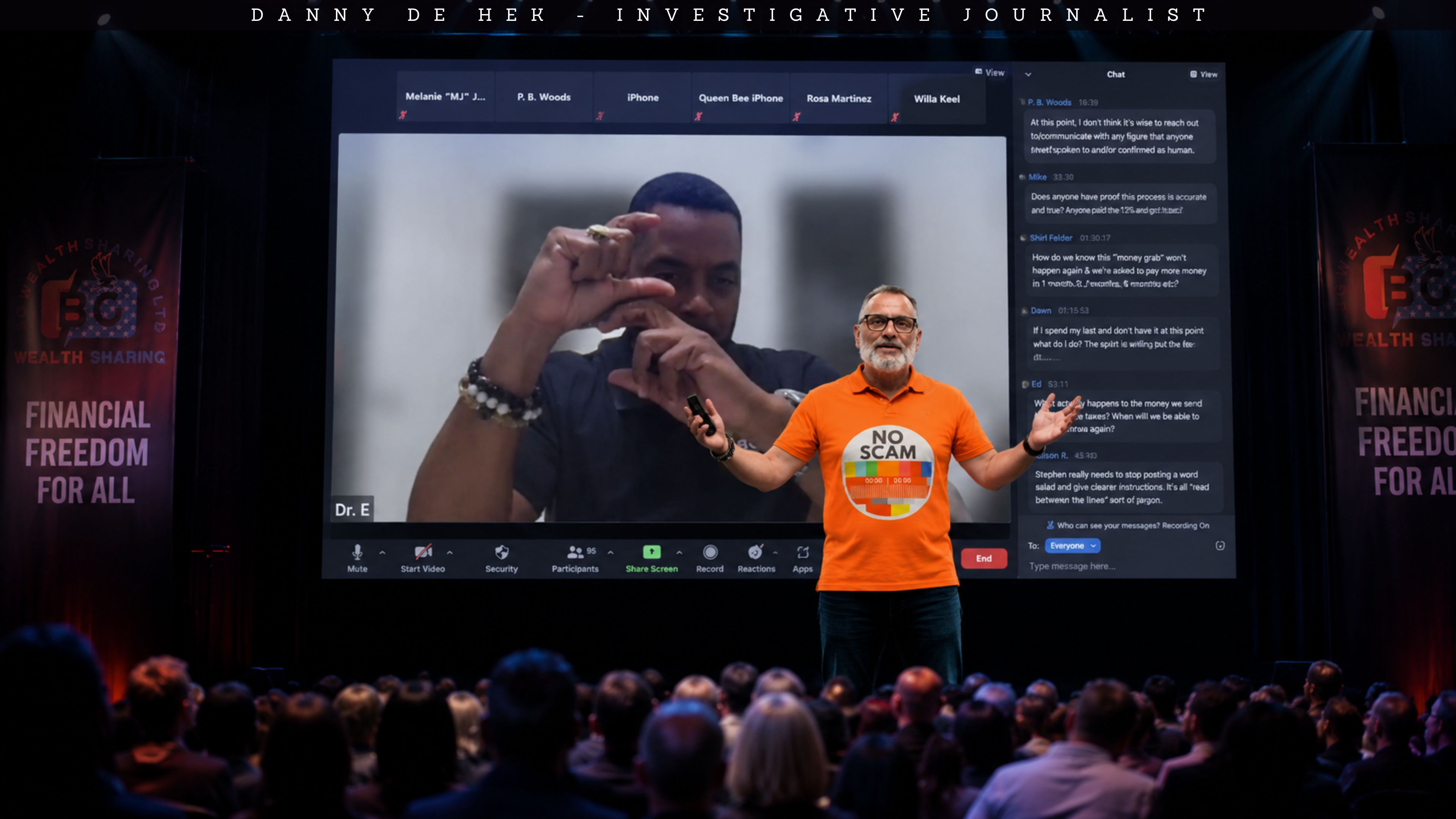
The transcript I reviewed from Bernstein’s Zoom meeting is extraordinary because it captures a scheme in visible distress.
Participants are confused, frightened, angry, and desperate for answers. Some openly question whether the entire thing is a scam. Others ask why leadership has disappeared. Several admit they cannot afford the demanded 12% payment.
One participant asked bluntly:
“Does anyone have proof this process is accurate and true? Anyone paid the 12% and got it back?”
Another questioned why members should trust anonymous figures nobody has ever actually seen:
“At this point, I don’t think it’s wise to reach out to/communicate with any figure that anyone hasn’t seen/met/spoken to and/or confirmed as human.”
That comment alone tells you how unstable this operation had become.
Instead of providing independently verifiable evidence, financial transparency, legal documentation, or proof of real trading activity, Bernstein attempted to calm the group by reframing the issue linguistically.
According to him, the “tax” wasn’t really a tax because overseas terminology is “different.”
He repeatedly insisted:
- The money was “never leaving” the account
- The fee was only for “verification”
- The process was needed for an IPO
- Fake accounts needed to be removed
- Regulators supposedly required it
But the logic never made sense.
Why the “12% Verification Fee” Makes No Sense
Legitimate financial institutions do not require customers to deposit additional money to prove they are real humans.
That is not how KYC works.
That is not how compliance works.
That is not how regulated IPO preparation works.
And several participants in the call correctly identified this.
One participant with banking experience explained that real KYC processes involve identification documents, database verification, and compliance procedures — not sending extra crypto payments.
Another participant pointed out the obvious contradiction:
“Sending money doesn’t verify I’m human.”
Exactly.
If a platform already has:
- Your name
- Your wallet
- Your deposits
- Your withdrawal history
- Your ID verification
- Your facial authentication
…then demanding another 12% payment is not “verification.”
It’s leverage.
And that distinction matters enormously.
The Real Psychology Happening Inside the Call
The most disturbing part of the recording isn’t the technical nonsense.
It’s the emotional manipulation.
Again and again, participants expressed fear of losing everything if they failed to comply.
One woman admitted she had spent her last available money and had nothing left.
Another asked:
“How do we know this ‘money grab’ won’t happen again?”
Others questioned why they should continue trusting invisible leadership figures who refused to appear publicly.
Yet throughout the meeting, Bernstein continually redirected responsibility back onto members themselves.
He framed compliance as faith.
He framed criticism as negativity.
He framed participation as loyalty.
And most importantly, he framed paying more money as the only pathway to recovering previous losses.
That is classic recovery-scam psychology.
“We’re Going Public” — Another Familiar Story
One of the most repeated claims in the Zoom call was that BG Wealth Sharing and DSJ Exchange were preparing for an IPO.
Bernstein repeatedly used terms like:
- “Going public”
- “Accredited hedge fund”
- “Reconciling the books”
- “Audit”
- “Regulatory authorities”
But participants quickly exposed the contradictions.
One attendee questioned how the company could possibly move toward a public offering while simultaneously facing widespread scam allegations online.
Another questioned why no verifiable executives appeared publicly.
And another directly challenged the supposed SEC filing narrative.
These are important questions because fraudulent schemes often borrow the language of legitimate finance to create false legitimacy.
Words like:
- IPO
- SEC
- hedge fund
- audit
- compliance
- accreditation
…sound impressive to inexperienced investors.
But using financial terminology is not the same thing as operating legally.
The Bigger Pattern
I’ve investigated enough crypto Ponzi schemes now to recognise the lifecycle.
It almost always unfolds like this:
- Easy deposits
- Exciting returns
- Constant recruitment
- Community hype
- Emotional dependency
- Withdrawal delays
- New verification requirements
- Additional fees
- Leadership disappears
- Victims blamed for “not understanding”
And somewhere near the end, there’s usually a final push demanding more money before accounts can supposedly be unlocked.
That’s exactly where BG Wealth Sharing appears to be now.
What Emmanuel Bernstein’s Zoom recordings reveal is not confidence.
It’s damage control.
The Human Cost Behind the Screens
What stood out most while reviewing these recordings wasn’t just the misinformation.
It was the desperation.
You can hear people trying to hold themselves together emotionally while being told they may lose everything if they fail to comply fast enough. Some are asking basic questions that should have been answered weeks earlier. Others are trying to understand why nobody from “upper leadership” is willing to appear publicly and speak directly to investors.
One participant openly admitted they had used their last available money. Another questioned whether this would simply happen again in another month or two. Others were desperately asking for “proof” from anyone who had supposedly completed the process successfully.
That’s the part outsiders often miss.
These schemes stop being about money long before they collapse. They become social ecosystems built on hope, fear, loyalty, and emotional dependency.
People don’t just stay because they believe the platform works.
They stay because:
- Friends recruited them
- Family members vouched for it
- Church communities became involved
- Leaders framed doubt as negativity
- Walking away means accepting the loss is real
That emotional trap is incredibly powerful.
And when respected community figures continue encouraging compliance despite mounting contradictions, the damage spreads far beyond finances.
The Dangerous Power Of Social Trust
I want to make something very clear.
People inside these schemes are not stupid.
Many are vulnerable, hopeful, financially pressured, or simply trusting the wrong people. They join because someone they know introduces them. Often it’s family. Church members. Friends. Mentors.
That’s what makes schemes like this so destructive.
The social trust becomes the delivery mechanism.
And when respected community figures continue promoting the scheme despite mounting red flags, they become part of the machine keeping victims trapped.
Emmanuel Bernstein may genuinely believe he is helping people.
Or he may simply be too financially and emotionally invested to admit the reality unfolding around him.
Either way, the outcome for victims can be devastating.
And once a scheme reaches the stage where participants are being pressured to send additional crypto payments to “verify” accounts and unlock withdrawals, history shows the ending is rarely good.
Disclaimer: How This Investigation Was Conducted
This investigation relies entirely on OSINT — Open Source Intelligence — meaning every claim made here is based on publicly available records, archived web pages, corporate filings, domain data, social media activity, and open blockchain transactions. No private data, hacking, or unlawful access methods were used. OSINT is a powerful and ethical tool for exposing scams without violating privacy laws or overstepping legal boundaries.
About the Author
I’m DANNY DE HEK, a New Zealand–based YouTuber, investigative journalist, and OSINT researcher. I name and shame individuals promoting or marketing fraudulent schemes through my YOUTUBE CHANNEL. Every video I produce exposes the people behind scams, Ponzi schemes, and MLM frauds — holding them accountable in public.
My PODCAST is an extension of that work. It’s distributed across 18 major platforms — including Apple Podcasts, Spotify, Amazon Music, YouTube, and iHeartRadio — so when scammers try to hide, my content follows them everywhere. If you prefer listening to my investigations instead of watching, you’ll find them on every major podcast service.
You can WORK WITH ME for dedicated access to my time and investigative services — including private consultations, scam-risk reviews, sponsored investigations, support sessions, livestream scam breakdowns, and interviews. I’m also available for SPEAKING ENGAGEMENTS, where I share first-hand experience from years of exposing large-scale fraud, investigating scams, and supporting victims.
“Stop losing your future to financial parasites. Subscribe. Expose. Protect.”
My work exposing crypto fraud has been featured in:
- Coffeezilla (2026): Featured in the investigation exposing the alleged $328M Goliath Ventures Ponzi scheme
- Bloomberg Documentary (2025): A 20-minute exposé on Ponzi schemes and crypto card fraud
- News.com.au (2025): Profiled as one of the leading scam-busters in Australasia
- OpIndia (2025): Cited for uncovering Pakistani software houses linked to drug trafficking, visa scams, and global financial fraud
- The Press / Stuff.co.nz (2023): Successfully defeated $3.85M gag lawsuit; court ruled it was a vexatious attempt to silence whistleblowing
- The Guardian Australia (2023): National warning on crypto MLMs affecting Aussie families
- ABC News Australia (2023): Investigation into Blockchain Global and its collapse
- The New York Times (2022): A full two-page feature on dismantling HyperVerse and its global network
- Radio New Zealand (2022): “The Kiwi YouTuber Taking Down Crypto Scammers From His Christchurch Home”
- Otago Daily Times (2022): A profile on my investigative work and the impact of crypto fraud in New Zealand




Leave A Comment