


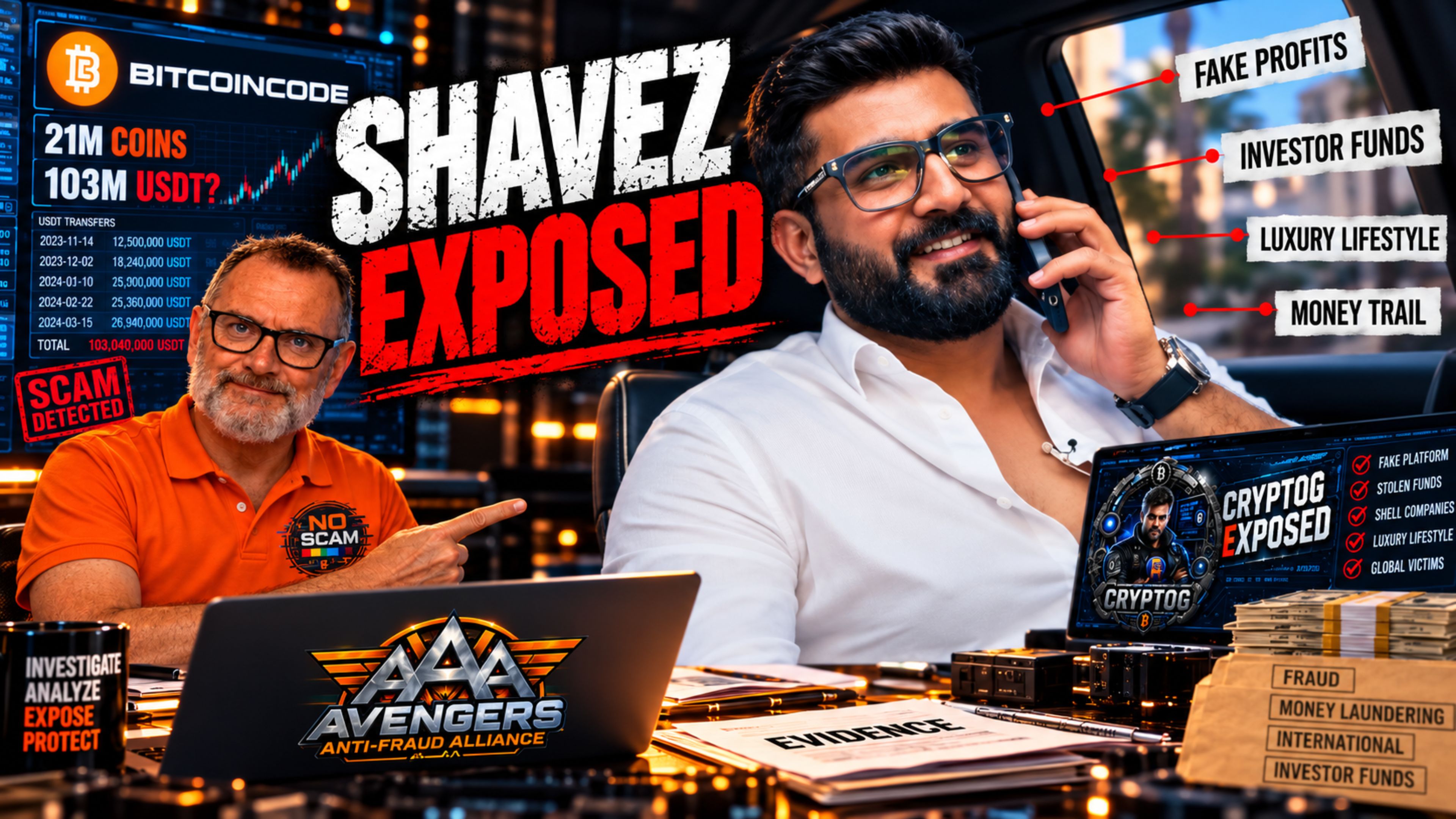
“They promised people the opportunity to mine the next Bitcoin. But when CryptoG examined the blockchain, the 21 million coins were already there.”
I’ve spent years investigating cryptocurrency scams, questionable investment schemes and the individuals who promote them. Certain names keep appearing, often attached to new ventures promising financial freedom, revolutionary technology and extraordinary opportunities.
Shavez Ahmed Siddiqui, previously known publicly as Shavez Anwar, is one of those names. From We Are All Satoshi (WAAS) to 9Pay and LquidPay, I’ve followed his promotional activities and challenged claims that deserved greater scrutiny. Now another chapter has emerged involving BitcoinCode (BTCC), a cryptocurrency project promoted around NFT mining, digital rewards and the promise of a decentralised financial ecosystem.
Shavez now operates a personal website, shavezahmedsiddiqui.com, where he presents himself as a blockchain entrepreneur and promotes BTC20 Smart Chain, the network associated with BitcoinCode. His website claims the blockchain can process 65,000 transactions per second and has more than 17 million active wallets, although those figures require independent verification. More importantly, his involvement isn’t limited to a professional biography. In September 2023, he appeared in recorded presentations explaining BitcoinCode’s mining technology, discussing its financial potential and encouraging confidence in the project’s development. He wasn’t simply observing the opportunity. He was helping promote it.
My previous investigation into 9Pay and LquidPay had already raised questions about another financial technology venture associated with Shavez. In December 2024, I publicly challenged its promotional claims and the credibility of its proposed cryptocurrency payment services. On 2 May 2025, the New Zealand Financial Markets Authority (FMA) issued a warning concerning LquidPay, raising concerns about misleading regulatory-compliance claims and the provision of financial services without the necessary authorisation in New Zealand. That warning concerned LquidPay and its representations, rather than constituting a criminal finding against Shavez personally. Nevertheless, it provided important independent context for examining his wider promotional activities.
 Then, on 13 October 2026, CryptoG, a blockchain forensic investigator working with our Avengers Anti-Fraud Alliance, published an extensive examination of BitcoinCode. Instead of relying on marketing presentations or allegations from disappointed participants, CryptoG examined 285,065 transaction rows involving 30,628 blockchain addresses, analysed smart contracts and reconstructed significant parts of the network’s financial activity. Eighteen promotional claims were assessed against the available technical evidence, with ten identified as false, misleading or contradicted by the blockchain records.
The findings immediately raised serious concerns. BitcoinCode’s entire advertised supply of 21 million BTCC coins was already held in one address before that address’s first recorded transaction. CryptoG also uncovered significant discrepancies involving the supposed NFT mining system, cryptocurrency valuations and the mechanisms used to request withdrawals. Particularly concerning was the creation of approximately 103.1 million tokens labelled USDT within BitcoinCode’s own blockchain, without demonstrated reserves establishing that those tokens were equivalent to genuine, externally redeemable Tether. These findings do not establish who personally controlled every wallet or what happened to every participant’s money, but they challenge important elements of the opportunity Shavez helped promote.
For me, this investigation is about the responsibility of people who encourage ordinary investors to trust financial opportunities they may not fully understand. A convincing presentation, a sophisticated website and impressive cryptocurrency balances are not substitutes for independently verifiable evidence. Shavez’s recorded statements provide a clear account of what audiences were told. CryptoG’s forensic findings now allow those statements to be tested against the technology itself.
What follows is the story of how BitcoinCode was promoted, how its underlying financial mechanisms operated and why the evidence deserves public attention. It also raises a question that cannot be answered simply by examining promotional material: who ultimately controlled the financial infrastructure, and what happened to the genuine money participants committed?
Because when a cryptocurrency opportunity promises financial freedom, the real test isn’t how convincing the presentation sounds. It’s whether the blockchain records support the story people were sold.
The Man Behind The Name: Shavez Ahmed Siddiqui
For years, I knew him as Shavez Anwar, a name that surfaced repeatedly during my investigations into cryptocurrency promotions connected to We Are All Satoshi (WAAS) and other financial opportunities. Today, he publicly identifies himself as Shavez Ahmed Siddiqui, presenting a very different image through his personal website, shavezahmedsiddiqui.com. His professional biography describes a technology entrepreneur originally from Lucknow, India, who began programming at 17 and went on to develop interests in blockchain technology, decentralised finance and artificial intelligence. It’s the sort of biography designed to establish credibility, but I’ve learned from investigating financial schemes that professional credentials and ambitious business claims need to be examined against an individual’s documented activities.
 The connection between the two names has also been reported independently by BehindMLM, which identified Shavez Anwar as Shavez Ahmed Siddiqui while investigating his involvement in cryptocurrency ventures. That matters because much of his earlier promotional history appeared under the name Shavez Anwar, while his more recent business activities are associated with his full name. Understanding that connection allows us to follow the documented history without treating those names as unrelated individuals.
My dealings with Shavez became particularly memorable during the 9Pay and LquidPay controversy in December 2024. While supporters were anticipating the launch of a cryptocurrency payment platform, I discovered that the LquidPay.com domain was available to register. I purchased it and used the website to challenge the operation’s promotional claims and draw public attention to questions surrounding its proposed financial services. The episode became the subject of my investigation, A Christmas Like No Other: Exposing LquidPay.com (9Pay) and Shavez Anwar. It also demonstrated how much confidence promoters could generate around a project before basic questions about its infrastructure and regulatory position had been answered.
The regulatory position became clearer on 2 May 2025, when the New Zealand Financial Markets Authority (FMA) published a warning concerning LquidPay. The regulator identified misleading statements about regulatory compliance and raised concerns about financial services being offered without the necessary authorisation in New Zealand. Its warning was subsequently updated in January 2026, identifying associated operations including We Are All Satoshi and Protocol Yield. These were findings and concerns relating to the financial services operation, not a criminal conviction against Siddiqui personally. Nevertheless, they provided an independent regulatory record relevant to claims I had previously challenged.
My reporting also attracted attempts to have material challenged or removed. In 2025, a complaint submitted to my website hosting provider, WP Engine, identified its author as Shavez Ahmed Siddiqui, CEO of LquidPay DeoBank, and alleged that my investigation contained defamatory and misleading statements. My website was temporarily taken offline following the complaint, an incident subsequently reported by BehindMLM. I have dealt with legal threats and attempts to suppress investigations before, but the significance here is that the complaint itself formed another documented connection between the full name Siddiqui was using and the LquidPay controversy I had investigated.
His current website is particularly relevant because it publicly associates him with BTC20 Smart Chain, the blockchain infrastructure connected to BitcoinCode. Alongside other ventures, including LQUIDPAY DeoBank, Protocol Yield, LFG and Alpha AI, Siddiqui promotes BTC20 Smart Chain with claims that it can process 65,000 transactions per second and has attracted more than 17 million active wallets. Those figures are promotional claims rather than independently established facts. They are nevertheless significant because they place the blockchain examined by CryptoG within Siddiqui’s publicly presented business portfolio.
There is an important distinction between promoting a project and controlling its technical infrastructure. His website and recorded presentations establish his public association with BitcoinCode and BTC20 Smart Chain, but they do not establish that he personally controlled the creator wallet, developed the smart contracts or authorised cryptocurrency transactions. Those are separate questions requiring technical and financial evidence. What can be examined directly is the role he played in explaining the opportunity and the relationship between his public claims and the blockchain’s documented operation.
This background matters because BitcoinCode did not appear in isolation. Siddiqui’s promotional activities overlapped with an established cryptocurrency community that had already experienced ambitious promises, changing business models and regulatory scrutiny.
To understand how BitcoinCode found its audience, we need to examine We Are All Satoshi and its connections to the wider HyperFund network, where many participants had already been encouraged to trust the next generation of cryptocurrency opportunities.
From HyperFund To We Are All Satoshi
To understand how Shavez Ahmed Siddiqui became involved in BitcoinCode, we need to examine the cryptocurrency community from which the opportunity emerged. HyperFund, later rebranded as HyperVerse, was one of the largest investment schemes I’ve investigated. Associated with Australian entrepreneur Sam Lee and his business partner Ryan Xu, the operation attracted participants through promises of substantial cryptocurrency returns and a recruitment-driven business model. As withdrawal problems escalated, new brands and proposed solutions emerged, keeping many participants hopeful that their money could eventually be recovered. I spent years documenting those promises, interviewing victims, confronting promoters and watching how quickly confidence could shift from one supposedly revolutionary opportunity to another.
Shavez had connections to that wider promotional network. BehindMLM identified him as a figure associated with HyperFund and HyperOne, reporting that he had held a regional leadership role before becoming involved with ventures connected to Sam Lee’s StableDAO ecosystem. Those ventures included StableOpinion, VidiLook, Satoshi Math Club and We Are All Satoshi (WAAS). Although their products and financial arrangements differed, they attracted attention from communities already familiar with cryptocurrency investment schemes. For participants who had followed earlier opportunities, the involvement of recognisable promoters could provide a sense of continuity, even when the underlying business model had changed substantially.
 WAAS was marketed around cryptocurrency participation, investment subscriptions and recruitment incentives. Its association with Sam Lee was particularly significant because authorities were already examining the financial arrangements behind his earlier operations. On 27 September 2023, the California Department of Financial Protection and Innovation (DFPI) issued a desist-and-refrain order against We Are All Satoshi and Sam Lee. According to the regulator, the investment arrangement allocated 68% of contributed funds towards recruitment-related payments, 30% towards purchasing and holding Bitcoin, and 2% as a management fee for Lee. The order raised serious concerns about the offering and its misleading representations. Importantly, it named WAAS and Lee, rather than constituting a separate regulatory finding against Siddiqui.
By this stage, the relationship between Lee and Siddiqui had reportedly deteriorated. BehindMLM documented their split during 2023, after which Shavez became more prominent in the WAAS community. This period is important because BitcoinCode was being introduced as another opportunity for participants to engage with cryptocurrency, this time through a dedicated blockchain and digital mining assets rather than relying solely on investment subscriptions. The change in presentation was substantial. Instead of concentrating on the returns promised through an investment programme, members were being offered a technological explanation for earning rewards through NFT ownership.
Regulatory scrutiny of WAAS continued. In August 2024, New Zealand’s Financial Markets Authority warned that WAAS and Boomerang Trade were not registered or authorised to provide financial services to New Zealand residents. Quebec’s financial regulator subsequently issued its own warning in November 2024, stating that WAAS was not authorised to solicit investors in the province. These warnings concerned the operations identified by the regulators and should not be confused with findings that Siddiqui personally committed an offence. Nevertheless, they establish that the wider promotional environment surrounding BitcoinCode had attracted significant regulatory concern.
What interests me about this history is the way existing relationships can carry investors from one opportunity into another. People who had trusted HyperFund or joined WAAS did not necessarily approach BitcoinCode as complete strangers encountering an unfamiliar cryptocurrency. Some were already part of communities where the presenters, terminology and promises of future financial opportunity were familiar. That existing trust made it particularly important for promoters to explain accurately what their new technology could and could not deliver.
By September 2023, Shavez was appearing in BitcoinCode presentations, explaining a blockchain inspired by Bitcoin and a system of digital miners designed to distribute cryptocurrency rewards. BitcoinCode was being presented as a new technological opportunity to an audience with a complicated investment history.
The next question is how that opportunity actually worked, and what participants were being encouraged to purchase.
BitcoinCode: Selling The Next Bitcoin
By September 2023, BitcoinCode (BTCC) was being promoted as a cryptocurrency opportunity inspired by the success of Bitcoin. The similarities were central to its appeal: a maximum advertised supply of 21 million coins, a mining reward system and the prospect of participating in a blockchain economy before it achieved widespread adoption. For someone who had watched Bitcoin rise dramatically in value over the years, the attraction was understandable. BitcoinCode offered a way to participate in what appeared to be a similar opportunity without needing the technical knowledge, expensive equipment or electricity required for conventional cryptocurrency mining.
The opportunity revolved around specialised digital assets known as ZEON NFT miners, with models including GT 1X, GT 10X and GT 100X. These NFTs were promoted as virtual mining machines, with different levels of assigned mining power determining the rewards participants could potentially earn. Instead of purchasing physical computers to validate transactions, members could acquire an NFT, connect it to BitcoinCode’s ecosystem and supposedly begin generating cryptocurrency. The more powerful the miner, the greater its expected share of the rewards. This gave participants something tangible within their digital wallets that appeared to represent ownership of productive mining equipment.
BitcoinCode also introduced BFUEL, a separate cryptocurrency token described as the electricity or energy needed to operate those miners. During promotional presentations, a GT 1X miner was associated with one kilowatt of theoretical mining power and a consumption rate of approximately 0.00278 BFUEL per second. That explanation made the virtual mining system sound remarkably similar to a conventional mining operation, complete with equipment, energy consumption and operating expenses. For prospective participants, it created the impression that their digital miners were performing a productive function rather than merely qualifying them to receive cryptocurrency rewards.
The advertised reward structure strengthened that impression. BitcoinCode was promoted as distributing 50 BTCC every ten minutes, equivalent to 7,200 coins per day, with a proposed halving after four years. These figures echoed Bitcoin’s familiar mining model, where the issuance of new cryptocurrency follows programmed rules and mining rewards decline over time. The terminology was important because it encouraged participants to associate BitcoinCode with the scarcity and long-term economic principles that had helped make Bitcoin attractive to investors.
But the opportunity extended beyond owning NFT miners.
Promotional presentations described plans for blockchain nodes, cryptocurrency trading and an expanding financial ecosystem. Participants were encouraged to see BitcoinCode as more than a token they might eventually sell. It was presented as infrastructure for a developing network, with opportunities to benefit from mining rewards, growing adoption and potentially valuable blockchain services. The suggested relationship between increasing participation and future cryptocurrency value reinforced the appeal of getting involved early.
The business model was designed around several connected elements: purchasing digital miners, acquiring BFUEL, accumulating BTCC rewards and eventually exchanging those rewards through BitcoinCode’s trading infrastructure. Each component gave participants another reason to engage with the ecosystem. Mining rewards provided an incentive to hold the NFTs, BFUEL introduced an ongoing requirement for participation, and the proposed trading facilities offered the possibility of turning accumulated cryptocurrency into something financially useful.
The crucial distinction, however, was between what BitcoinCode promised its mining system would accomplish and what its technology could independently demonstrate. Owning an NFT does not necessarily mean that cryptocurrency mining is taking place, just as receiving tokens does not automatically establish that a profitable business is generating them. Those are questions that require examination of the actual blockchain contracts and the source of the rewards.
For participants watching the presentations in September 2023, BitcoinCode appeared to offer an accessible route into cryptocurrency mining, supported by familiar Bitcoin terminology and an expanding technical ecosystem.
And Shavez Ahmed Siddiqui was one of the people explaining why they should believe in it.
What Shavez Promised On Camera
One of the most valuable sources of evidence in any cryptocurrency investigation is the promoter’s own recorded statements. Long before investors begin questioning withdrawals or asking where their money has gone, there are often Zoom meetings and presentations in which the people behind an opportunity confidently explain how everything supposedly works. Shavez Ahmed Siddiqui’s BitcoinCode presentations from September 2023 provide exactly that kind of evidence. CryptoG recovered recordings that allowed investigators to compare what participants were told with the technical systems subsequently deployed. Instead of relying on conflicting recollections, we can examine specific claims, the dates they were made and what the blockchain records reveal.
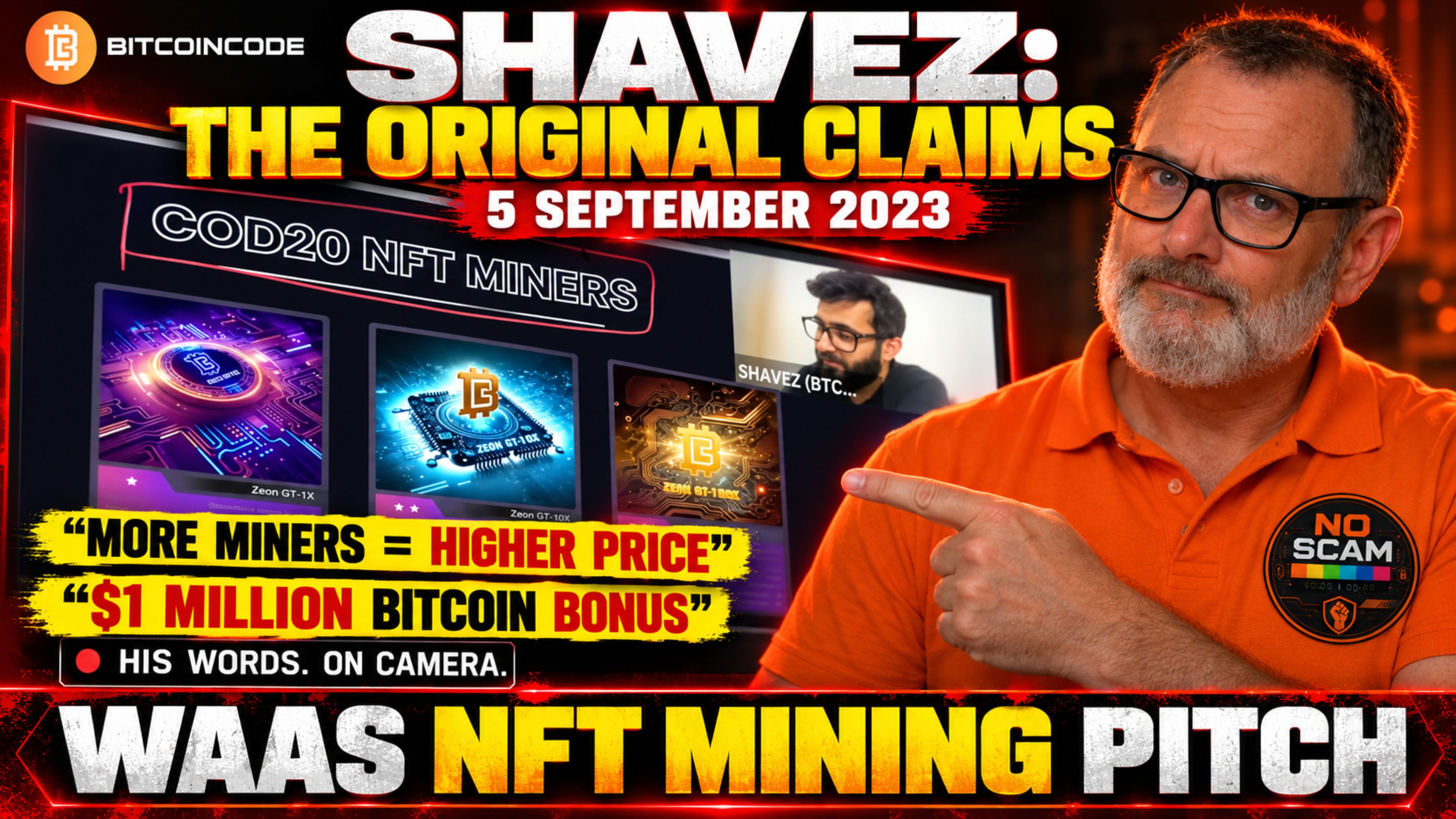
During a 5 September 2023 WAAS Affiliate Marketing Training session, Shavez explained BitcoinCode’s mining opportunity and discussed how increasing participation would supposedly benefit the ecosystem. At approximately 19 minutes into the recording, he made a particularly revealing statement:
“When there are more miners, the price goes up.”
That was a powerful message for anyone considering purchasing a digital miner. It suggested that as more people joined the network, existing participants could benefit from increasing cryptocurrency values. But adding miners does not automatically increase the market price of a coin. Demand, available liquidity and selling activity all influence what buyers are prepared to pay. CryptoG’s examination also found that BitcoinCode’s reward system allocated a fixed amount of cryptocurrency among participating miners according to their assigned mining power. Increasing participation could therefore reduce an existing miner’s share of the available rewards, even if the wider ecosystem continued to grow. The claim created an expectation of financial benefit that the reward mechanism itself could not guarantee.
The promises became more specific during another presentation on 22 September 2023, when Shavez announced a schedule for the launch of BitcoinCode’s mining operation:
“Today the chain is live, tomorrow the product is going to be live. In 24 hours the minting will start, and on 29th we will start mining.”
These were not vague ambitions about something that might eventually happen. Shavez was giving the audience dates on which important features were supposed to become operational. CryptoG later established that the NFT miner contracts were deployed on 23 September, but the contract responsible for distributing mining rewards was not deployed until 2 October 2023, three days after the announced mining start date. That discrepancy does not establish whether any alternative mining activity occurred on 29 September, but it demonstrates that the reward mechanism examined by CryptoG was not deployed when participants had been told mining would begin.
The presentations also introduced the possibility of owning blockchain nodes, which were described as potentially valuable infrastructure within the developing ecosystem. During the September meeting, Shavez declared:
“I will not sell nodes [for] less than half a million dollars.”
That statement helped reinforce the impression that BitcoinCode was developing technology with substantial commercial potential. However, an announced selling price is not evidence of an asset’s actual market value. CryptoG did not identify independently verified node sales or demonstrated fee income establishing that such valuations were justified. The statement remains significant because it reveals the scale of the financial expectations Shavez was encouraging participants to consider.
Perhaps the most important issue raised during these presentations concerned decentralisation and community control. Shavez described an ambition to move BitcoinCode towards a network operated for the benefit of its community, rather than remaining dependent on a central authority. That promise was important because decentralisation is frequently presented as one of blockchain technology’s greatest advantages. Participants could reasonably interpret such statements as assurances that the system’s rules and financial mechanisms would not remain subject to the decisions of a single operator.
CryptoG subsequently identified administrative powers that complicated that narrative. The creator address beginning 0x34cCC8 deployed critical contracts and retained significant authority over the reward infrastructure. The pool’s implementation was changed three times by its owner, demonstrating that important aspects of the system could be modified after deployment. This did not establish that Shavez personally controlled those administrative functions, but it did expose a meaningful distinction between the decentralised future he described and the control mechanisms built into the technology.
What makes these recordings significant is not simply that Shavez made ambitious predictions. Cryptocurrency projects frequently discuss future development, adoption and potential value. The issue is that he presented specific operational claims and financial expectations that can now be tested against documented evidence. Participants were entitled to understand whether the technology worked as described, particularly when those explanations influenced decisions to purchase digital assets or commit money to the ecosystem.
The promotional recordings establish what Shavez said. The blockchain records provide a way to examine what BitcoinCode actually did.
That distinction is what turned CryptoG’s investigation from a review of promotional promises into a forensic examination of the system behind them.
CryptoG Follows The Blockchain Evidence
When CryptoG, our blockchain forensic investigator with the Avengers Anti-Fraud Alliance, began examining BitcoinCode, the objective was to establish whether the technology supported the claims made during its promotional presentations. That required considerably more than examining a few wallet balances or looking for suspicious transactions. BitcoinCode operated on its own network, BTC20 Smart Chain, with much of its publicly accessible transaction history available through the project’s official explorer, scan.bitcoincode.technology. Unlike established blockchains such as Bitcoin and Ethereum, where multiple independent services allow investigators to compare transaction records, BitcoinCode presented a more difficult challenge. Its principal public source of blockchain information was infrastructure maintained by the operation itself.
On 11 and 12 October 2026, CryptoG systematically collected approximately 371.4 megabytes of blockchain evidence, including transaction histories, smart-contract information, token creation records and responses from the explorer. The investigation ultimately examined 285,065 transaction rows involving 30,628 distinct addresses. Particular attention was given to the wallet beginning 0x34cCC8, which repeatedly appeared in the deployment and administration of BitcoinCode’s financial infrastructure. Reconstructing its activity allowed CryptoG to establish when important contracts were created, how cryptocurrency supplies were allocated and which addresses possessed authority over critical functions.
But collecting the evidence was not straightforward.
During the investigation, CryptoG documented 15 technical faults involving the blockchain explorer, including incomplete transaction histories, duplicated records, incorrect filtering and responses that appeared successful despite missing information. This created a significant obstacle because an investigator cannot assume that a wallet’s displayed history is complete simply because an explorer returns a list of transactions. Missing records could conceal important movements of cryptocurrency or create misleading impressions about the origin and destination of funds. Rather than overlooking these problems, CryptoG documented the failures and identified which portions of the evidence could be reconstructed reliably.
To address those limitations, CryptoG developed a forensic collection system called the Hashbook Engine, designed to retrieve available blockchain material, identify inconsistencies and preserve the original responses. Cryptographic hashes were recorded for the collected evidence files so their contents could subsequently be checked for alteration. One of the more difficult tasks involved BitcoinCode’s reward pool, where CryptoG recovered 175,000 transactions involving 11,075 addresses other than the creator, covering activity between 2 October and 14 December 2023. Because the explorer repeatedly failed before the entire history could be retrieved, those figures were treated as documented minimums rather than a complete account of every transaction.
Other records proved more accessible. CryptoG reconstructed the creator wallet’s outgoing transaction sequence, identifying 84 contract deployments that helped establish how the system was assembled. The investigation also examined 39 individual token-minting transactions, identifying the addresses authorised to create cryptocurrency and the wallets receiving the newly issued tokens. This distinction became important because creating tokens within a blockchain is fundamentally different from receiving genuine cryptocurrency deposited from an external source. Both activities may produce impressive balances, but they do not demonstrate the same financial reality.
The examination extended into BitcoinCode’s smart contracts, the computer programs responsible for functions such as managing NFT ownership, calculating rewards and processing token transfers. By studying the available code alongside transaction histories and recorded presentations, CryptoG could compare what promoters described with the functions actually implemented. Where contract source code was unavailable or historical records were incomplete, those limitations were documented rather than replaced with assumptions.
That methodology is what gives this investigation its significance. CryptoG was not simply deciding whether BitcoinCode sounded suspicious. The analysis connected specific promotional statements to identifiable contracts, wallet activity and transactions, creating a technical record that could be examined independently. It also distinguished between demonstrated findings and unresolved questions, particularly where the available blockchain information could not establish what happened outside BitcoinCode’s own network.
CryptoG published the resulting forensic investigation on 13 October 2026. It provided a detailed technical foundation for examining BitcoinCode, although it was not a court judgment, regulatory determination or complete accounting of every participant’s money.
The most revealing findings came from reconstructing how BitcoinCode’s cryptocurrency supply and reward infrastructure were established. The sequence of transactions showed that the advertised mining opportunity began with an extraordinary concentration of coins in a single address, before the contracts responsible for distributing mining rewards had even been deployed.
The 21 Million Coins That Already Existed
The first major discovery in CryptoG’s forensic investigation strikes at the foundation of BitcoinCode’s mining claims. All 21 million BTCC coins were already held in a single wallet before that address made its first recorded transaction. This finding raises a fundamental question about the opportunity Shavez Ahmed Siddiqui had been promoting. If participants were purchasing NFT miners to generate cryptocurrency, why had the entire advertised coin supply already been allocated before the mining infrastructure was deployed?
The evidence begins with the creator wallet identified by the opening characters 0x34cCC8. At block 43,736, BitcoinCode’s explorer recorded that address holding exactly 21,000,000 BTCC. Its first outgoing transaction occurred in the following block, 43,737, on 23 September 2023 at 13:30 UTC, when it created the first ZEON NFT miner contract. Additional mining-related contracts were deployed shortly afterwards. CryptoG reconstructed the wallet’s outgoing transaction sequence, establishing the order in which the infrastructure was assembled and demonstrating that the advertised coin supply was already present before those contracts were created.
There is an important technical limitation. The available records do not establish precisely how the original coins entered that wallet. They may have been allocated when the blockchain was created, but CryptoG could not verify the initial issuance mechanism because the explorer did not provide the necessary earlier balance records. What can be established is the sequence of events: the supply existed first, the NFT contracts followed, and the mechanism responsible for distributing mining rewards was deployed later.
That sequence became even more revealing on 2 October 2023.
On that date, the creator wallet deployed and activated BitcoinCode’s reward pool, initially supplying just 20 BTCC. The pool was then paused before the wallet transferred another 20,998,712.96 BTCC into it and reactivated the system. Almost the entire advertised supply had effectively been allocated to the contract responsible for distributing rewards to participating NFT holders. Rather than the reward pool demonstrating the gradual creation of cryptocurrency through mining activity, the transactions showed an existing reserve being used to fund future distributions.
This is a significant difference from the way Bitcoin mining works. Bitcoin’s proof-of-work system issues new coins through a process in which miners perform computational work to validate blocks according to rules enforced by the network. BitcoinCode’s NFT reward arrangement, as examined by CryptoG, relied on distributing cryptocurrency from a supply that had already been created. Participants could receive BTCC according to their assigned mining power, but those rewards did not demonstrate that their NFTs were producing newly issued coins.
A programmed distribution of existing cryptocurrency is not the same thing as mining new cryptocurrency.
The concentration of the original supply also raises questions about the control participants were being encouraged to believe they would possess. The creator wallet was not simply an address holding cryptocurrency. It deployed the contracts that established the NFT mining system and subsequently funded the reward pool. This placed crucial elements of BitcoinCode’s early financial infrastructure under the authority associated with one address, rather than demonstrating that the original coin distribution emerged independently from thousands of participants operating miners.
CryptoG also examined the total supply reported near the end of the explorer’s available history. At the final visible block on 24 September 2026, the reported figure was approximately 21.0027 million BTCC, only around 2,700 coins above the original 21-million balance. The investigation acknowledged limitations in interpreting that number, including uncertainty about initial allocations and the treatment of fees. Nevertheless, the overwhelming proportion of the reported cryptocurrency supply was already accounted for at the beginning of the documented sequence.
For someone who purchased a ZEON miner, this discovery changes how the opportunity should be understood. The NFT may have provided an entitlement to receive BTCC rewards, but that is materially different from owning equipment that independently creates cryptocurrency through mining. The distinction matters because the advertised mining model was central to explaining why participants should purchase those digital assets and how their rewards would supposedly be generated.
CryptoG’s findings establish that BitcoinCode’s examined reward system was funded from an existing coin allocation. They do not, by themselves, establish who personally controlled the creator wallet or whether every participant understood how the arrangement worked. But they expose a substantial contradiction between the impression of Bitcoin-style cryptocurrency mining and the actual distribution mechanism recorded on the blockchain.
The next discovery concerns the NFTs themselves. With the supply and reward funding established, CryptoG turned to the supposed digital mining machines to determine whether their smart contracts performed the functions participants had been encouraged to expect.
The NFT Mining Illusion
Having traced the original supply of BTCC into BitcoinCode’s reward infrastructure, CryptoG turned to the digital assets participants had been encouraged to purchase. ZEON NFT miners were promoted as virtual cryptocurrency mining machines, with different models supposedly providing different levels of earning potential. But the smart-contract evidence revealed something fundamentally different from conventional mining equipment. The NFTs existed on the blockchain, and their ownership could be verified, but the examined contracts contained no functionality for performing cryptocurrency mining. They could create, transfer and destroy NFTs, yet they did not independently generate BTCC or perform computational work to validate blockchain transactions.
CryptoG examined the published source code for three of the four ZEON NFT contracts, while the blockchain explorer identified the fourth as using the same code as the GT100X model. These contracts performed ordinary functions associated with managing digital collectibles and recording ownership. Mining rewards were instead calculated through a separate pool that recognised participating NFTs and allocated BTCC according to assigned mining-power values. The NFT represented an entitlement within the reward system, rather than a machine producing cryptocurrency. That is a significant distinction when the financial opportunity was marketed around purchasing equipment supposedly capable of earning mining rewards.
The arrangement also relied on another contract to provide the numerical values representing each miner’s power. CryptoG could examine how the reward pool used those figures, but the source code for the separate contract supplying them was not publicly available in the records examined. As a result, the investigation could not independently reconstruct every rule governing how those values were established. What it could demonstrate was that reward calculations depended on information and infrastructure beyond the NFT itself. Participants could own their digital miners without controlling the calculations determining their earning potential.
The administrative powers built into the reward system were equally revealing.
According to CryptoG’s examination, the pool’s owner could pause reward claims, change the contract’s implementation and withdraw BTCC held by the pool. These weren’t hypothetical concerns about what a blockchain operator might be able to do. CryptoG documented three occasions when the pool’s underlying implementation was changed. That meant important aspects of the reward mechanism could be modified after participants had acquired their NFTs. Ownership of a digital miner did not provide its holder with equivalent authority over the system responsible for calculating and distributing rewards.
This matters because decentralisation had featured prominently in BitcoinCode’s promotional narrative. Participants were encouraged to see themselves as part of an emerging cryptocurrency network, yet the examined contracts retained considerable administrative authority. CryptoG did not establish that Shavez Ahmed Siddiqui personally possessed those privileges. The relevant finding concerns the control built into the system, regardless of who ultimately operated the authorised wallet.
For someone using BitcoinCode, the distinction may not have been immediately obvious. A participant could acquire a GT 1X, GT 10X or GT 100X NFT, connect their wallet and observe rewards being calculated according to the advertised mining-power model. Transactions could be recorded on the blockchain, and BTCC could move into the participant’s wallet. Those were genuine functions of the system, but they did not prove the NFTs were performing the activity described in the mining promotions.
The technology supported NFT ownership and programmed reward distributions. It did not demonstrate cryptocurrency mining performed by the NFTs themselves.
That finding does not make every NFT transaction fictitious or mean that participants received nothing. It establishes something more specific: the apparent mining activity was dependent on a reward-allocation mechanism whose operation and administration remained separate from the digital assets participants purchased.
The distinction becomes especially important when examining the costs participants incurred to collect their rewards. BitcoinCode didn’t simply allocate BTCC to NFT holders. It also required them to use another cryptocurrency, BFUEL, described in the presentations as the electricity needed to keep their virtual miners operating.
CryptoG’s examination of that additional payment mechanism revealed where the supposed fuel actually went.
BFUEL: Paying To Collect Mining Rewards
BitcoinCode’s mining system came with an additional financial requirement that deserves particular attention. Participants weren’t simply purchasing ZEON NFT miners and receiving BTCC rewards. They also needed BFUEL, a separate cryptocurrency described by Shavez Ahmed Siddiqui during promotional presentations as the electricity or gas required to operate their virtual mining equipment. It was an unusual concept. Traditional cryptocurrency miners consume electricity because physical computers perform computational work. BitcoinCode’s NFTs weren’t operating physical machines, yet participants were expected to acquire another token to cover what was presented as an operating expense.
On 1 October 2023, BitcoinCode’s creator wallet, beginning 0x34cCC8, received an initial allocation of 100 million BFUEL tokens. CryptoG’s examination found that the token contract also permitted authorised addresses to create additional BFUEL, meaning the original supply was not necessarily a permanent limit. Shavez had promoted BFUEL with a reference price of $0.0125 per token, but the examined contract contained no mechanism guaranteeing that valuation. Its financial value depended on arrangements and market activity outside the token’s basic functionality, rather than any enforceable connection to the cost of electricity.
The most revealing discovery concerned what happened when participants used BFUEL to collect their mining rewards. The reward mechanism destroyed 50% of the BFUEL collected and directed the remaining 50% to a designated receiving address. CryptoG established that the creator wallet had configured itself as that recipient and found no subsequent change to the designation in the creator’s recorded transactions. The examined code did not demonstrate that those payments purchased electricity, paid for physical mining infrastructure or funded an identifiable external energy provider. Instead, the tokens were being divided according to rules programmed into BitcoinCode’s own financial system.
Destroying cryptocurrency tokens, commonly called burning, can be a legitimate mechanism for reducing supply. However, burning half the BFUEL collected did not establish that BitcoinCode was generating genuine economic value. Nor did directing the remaining half to the designated address demonstrate that the money was being used to support a productive mining operation. The cryptocurrency labelled as fuel was functioning as a payment requirement for collecting rewards, rather than evidence that the NFT miners were consuming real electricity.
The financial consequences became especially apparent during a recorded BitcoinCode Harvest Party on 16 September 2024. A presenter operating under the name Crypto Tech demonstrated the process of collecting rewards using figures displayed within the system. His example involved harvesting approximately 0.99648 BTCC, shown as being worth around $67, while requiring 6,748 BFUEL valued at approximately $84.35.
The calculation was extraordinary. The demonstrated cost of collecting the mining reward exceeded its displayed value by approximately $17.35.
These weren’t figures from someone complaining after losing money. They came from a presentation demonstrating how BitcoinCode’s own harvesting process operated. Even if the displayed BTCC valuation could have been realised through a genuine external market, the example showed participants spending more on BFUEL than the cryptocurrency they were collecting was supposedly worth. That also excluded whatever they had originally paid to acquire their NFT miners.
Despite those figures, participants were encouraged to continue harvesting, with explanations suggesting that ongoing activity could help support the ecosystem and its cryptocurrency value. I’ve encountered similar arguments during other investigations, where members are encouraged to keep committing resources because doing so is supposedly necessary for the long-term success of the opportunity. The immediate financial calculation becomes secondary to the belief that continued participation will eventually produce a better outcome.
There is an additional distinction worth preserving. CryptoG established where the BFUEL was directed by the examined reward mechanism, but that does not conclusively explain what happened to every token after reaching its destination. Further tracing would be required to establish whether tokens were transferred elsewhere, sold or exchanged for cryptocurrency with independently verifiable value.
What the evidence does establish is that BitcoinCode imposed a continuing token cost on participants attempting to collect rewards from an NFT system that did not itself perform mining. The financial implications were not hypothetical. The September 2024 demonstration provided a practical example in which collecting a reward was more expensive than the value attributed to it.
That discovery exposed a significant weakness in the economics of BitcoinCode’s supposed mining opportunity. But CryptoG also identified a separate issue within its trading infrastructure: the creation of enormous quantities of tokens carrying the familiar name USDT, without demonstrated reserves establishing their equivalence to genuine Tether.
The $103 Million USDT Mystery
Of all the findings in CryptoG’s investigation, the creation of more than 103 million tokens labelled USDT on BitcoinCode’s own blockchain raises some of the most serious questions about the operation’s financial credibility. USDT is widely recognised as the ticker for Tether, a cryptocurrency designed to maintain a value of approximately one US dollar. Its familiarity matters because participants seeing USDT balances or trading pairs could reasonably associate them with genuine, dollar-backed cryptocurrency. But creating a token on a privately operated blockchain and giving it the name USDT does not automatically make it genuine Tether, nor does it establish that the token can be exchanged for real money.
CryptoG identified 39 minting transactions responsible for creating 103,111,088 chain-labelled USDT tokens, initially distributed between two principal wallets. One received approximately 67 million tokens, while the other received around 36.1 million. Of those transactions, 35 were authorised by the creator wallet beginning 0x34cCC8, with another four authorised by an address temporarily permitted to mint tokens. Individual transactions created quantities ranging into the millions, including allocations of 5 million, 10 million and 12 million tokens. These were not demonstrated deposits of Tether arriving from an established external blockchain. They were transactions creating additional units within BitcoinCode’s own network.
The minting activity continued from October 2023 through March 2025, showing that the creation of these tokens was not confined to BitcoinCode’s original launch. CryptoG followed their subsequent movements and identified substantial transfers into the ecosystem’s trading infrastructure. One receiving wallet directed approximately 110.6 million chain-labelled USDT into a swap pool during its recorded history. That amount included tokens received through other transactions and should not be treated as an additional 110.6 million newly minted tokens. Nevertheless, the scale of the activity demonstrates how extensively BitcoinCode’s internally issued USDT was incorporated into its financial arrangements.
The importance of this discovery becomes clearer when we examine how BitcoinCode established the apparent value of BTCC.
During his 22 September 2023 presentation, Shavez Ahmed Siddiqui discussed an anticipated starting price of approximately $3 per BTCC, together with plans to establish trading liquidity. For participants considering purchasing NFT miners, that valuation could significantly influence their expectations. A miner generating cryptocurrency displayed as being worth several dollars per coin might appear to offer a substantial earning opportunity. But the quoted value of a cryptocurrency only becomes meaningful when there is genuine demand and sufficient independently valuable liquidity to support people wishing to sell.
CryptoG discovered that BitcoinCode’s initial liquidity arrangement used USDT created within its own blockchain, rather than independently demonstrated reserves of genuine Tether. The investigation identified tokens used for the initial pricing arrangement that had been minted approximately 52 minutes before the liquidity was established. This meant an exchange rate could be displayed between BTCC and another asset created within the same ecosystem, without the available blockchain evidence establishing that the quoted value was supported by an equivalent amount of externally redeemable cryptocurrency.
A cryptocurrency can display an impressive market price without that price representing money an investor can actually recover.
Consider the implications. If BTCC was quoted at $3 against BitcoinCode’s internally created USDT, participants might interpret that figure as a genuine dollar valuation. They could calculate mining returns, assess the apparent value of their holdings and make decisions about purchasing additional assets. But unless the USDT could be redeemed for genuine Tether or another independently recognised asset, the displayed exchange rate would not establish what those BTCC holdings were worth outside the system.
This is why the distinction between 103 million tokens labelled USDT and US$103 million in genuine cryptocurrency is so important. CryptoG documented the minting transactions, the addresses involved and the movement of the tokens through BitcoinCode’s infrastructure. The investigation did not establish that an equivalent US$103 million had been deposited, stolen or withdrawn. Nor did it conclusively prove that no external reserves existed. What remained missing was independently verifiable evidence demonstrating the backing and redemption arrangements necessary to treat those internally created tokens as equivalent to genuine Tether.
The central issue is therefore not simply the number of tokens created. It is the role those tokens played in establishing the appearance of financial value within BitcoinCode. Participants were encouraged to believe they were accumulating cryptocurrency through mining, while the system’s trading arrangements relied on assets whose external financial backing had not been demonstrated.
For me, that raises a far more important question than the balances displayed on BitcoinCode’s exchange: could participants convert those apparent holdings into cryptocurrency with genuine value outside the ecosystem?
CryptoG’s examination of the withdrawal infrastructure provides the next piece of evidence. And it reveals why creating an internal market is one thing, while delivering actual cryptocurrency to participants is quite another.
The Withdrawal Bridge And Missing Proof Of Payment
There is one question I always return to when investigating cryptocurrency investment schemes: Can participants actually withdraw their money? BitcoinCode had a mechanism described as a blockchain bridge, intended to allow cryptocurrency to move from BTC20 Smart Chain onto established networks such as TRON. On the surface, this provided an important connection between BitcoinCode’s internal economy and the wider cryptocurrency market. But CryptoG’s examination revealed a fundamental limitation. The bridge’s smart contract accepted tokens, destroyed them and recorded the destination wallet address, without containing the instructions necessary to complete a corresponding payment on the external blockchain.
The bridge contract, identified by an address beginning 0x556Da7, accepted BitcoinCode’s internally created USDT and calculated a 3% transaction fee, together with an additional configurable charge. Once a participant submitted tokens, the contract burned them, permanently removing those units from circulation. Burning tokens can be a legitimate part of transferring cryptocurrency between blockchains, particularly when a corresponding amount is released or created on another network. However, the examined BitcoinCode contract did not execute that second transaction. Instead, it recorded the intended destination, leaving any external payment dependent on a separate process outside the contract.
That distinction matters because a participant could complete the transaction on BitcoinCode’s network without receiving an equivalent amount of genuine cryptocurrency elsewhere. The blockchain would show that tokens had been surrendered, but the recorded event alone would not establish that the withdrawal had been fulfilled. The critical missing evidence was the corresponding external payment, which would need to be identified through transaction records on the destination network.
CryptoG established that the bridge was actively used. Between 9 October 2023 and 7 January 2024, at least 1,314 distinct addresses submitted a combined 1,437,295.80 BitcoinCode-labelled USDT through the mechanism. Approximately 99.4% of the submitted value was associated with withdrawal requests specifying TRON destination addresses. These figures represent the minimum documented activity available through the explorer and should not be interpreted as US$1.43 million in verified financial losses. The submitted assets were internally issued tokens whose equivalence to genuine Tether had not been established.
There is an important limitation to what these records prove. The absence of an automatic external payment mechanism does not establish that nobody received their money. BitcoinCode’s operators could theoretically have processed payments separately using wallets holding genuine cryptocurrency. To determine whether that occurred, investigators would need to match the recorded withdrawal requests against actual TRON transactions, identify the sending wallets and establish whether the intended recipients received the appropriate amounts. Without that reconciliation, the contract records demonstrate attempted transfers but cannot establish their ultimate financial outcome.
Then, on 7 January 2024 at 07:41:01 UTC, another significant event occurred.
Just eight minutes and thirty seconds after the final recorded bridge burn, the creator wallet beginning 0x34cCC8 removed BitcoinCode’s USDT from the bridge’s supported assets. CryptoG found no subsequent transfers through that mechanism before the explorer’s final available block. The blockchain establishes when the change occurred and which address authorised it, but not why the decision was made. What is clear is that a previously used withdrawal route stopped accepting the token participants had been submitting.
By 16 September 2024, the withdrawal arrangements being discussed publicly appeared to have changed. During a recorded BitcoinCode Harvest Party, a presenter operating under the name Crypto Tech demonstrated the WAAS back office, including balances and withdrawal-related functions. Participants discussed withdrawing through USDT TRC20, while another speaker indicated that the original bridge was no longer being used. This suggested that members were relying on a different process for obtaining cryptocurrency outside BitcoinCode, although the presentation did not establish how that system was funded or whether every requested payment was completed.
The move towards a back-office withdrawal process introduced another issue of transparency. A website can record a withdrawal request, change its status and display a completed transaction without independently establishing that cryptocurrency has reached the intended wallet. Genuine external transfers can be verified through transaction hashes and records on the destination blockchain. Those records are essential when attempting to distinguish actual payments from internal accounting entries.
For participants, the financial consequences could be significant. Someone might have purchased an NFT miner, accumulated BTCC, paid BFUEL to collect rewards and exchanged those rewards into BitcoinCode’s internally issued USDT. Yet converting those holdings into genuine cryptocurrency depended on a withdrawal arrangement whose complete operation could not be established from the examined contracts.
The evidence does not support declaring that every BitcoinCode withdrawal failed or that all submitted tokens represented lost investor funds. It does, however, identify a substantial gap between the withdrawal requests recorded on BitcoinCode and independently verified evidence of payment outside the network.
That is where further financial tracing becomes essential. The next stage is to establish which participants received genuine cryptocurrency, which transactions remain unmatched and who controlled the wallets responsible for making any external payments.
CryptoG has reconstructed what happened when tokens entered BitcoinCode’s bridge. Establishing what participants received on the other side remains one of the most important unanswered questions in this investigation.
BitcoinCode Goes Dark
By September 2026, almost three years had passed since BitcoinCode was introduced to participants as an ambitious cryptocurrency mining ecosystem. The project had promoted its own blockchain, NFT mining equipment, trading infrastructure and the prospect of community control. But when CryptoG began examining the network in October 2026, investigators encountered a troubling development. BitcoinCode’s public blockchain explorer had stopped displaying new blocks, leaving serious questions about the network’s ongoing operation and the ability of participants to independently verify their transactions.
According to CryptoG’s forensic examination, the final visible block was 30,834,158, recorded on 24 September 2026 at 06:21:32 UTC. Before that point, the network had been recording blocks at intervals of approximately three seconds. When CryptoG checked the explorer on 12 October 2026, nearly three weeks later, the same block remained the most recent available. For a project promoted around blockchain technology and decentralisation, the interruption was significant. Participants could no longer rely on the principal public explorer to establish whether recent transactions had been processed or whether the network was continuing to operate as expected.
CryptoG uncovered an interesting technical detail that may help explain what happened. The security certificate for rpc.bitcoincode.technology, the node endpoint identified by the explorer, had expired at 06:16:19 UTC on 24 September 2026. Just five minutes and thirteen seconds later, the explorer recorded its final visible block. That timing raised the possibility that the explorer had lost its ability to communicate securely with the node, rather than the blockchain itself necessarily having stopped. Other BitcoinCode infrastructure also appeared to remain active at the certificate-management level, with a new certificate issued for the project’s swap subdomain on 25 September.
This distinction is important because an explorer going offline is not the same as proving that an entire blockchain has collapsed.
CryptoG could not establish whether BTC20 Smart Chain continued producing blocks through other infrastructure that was not publicly accessible. Nor could the investigation identify an independent public explorer providing a reliable alternative view of the network’s latest activity. What the evidence demonstrated was a loss of publicly verifiable transaction visibility through the principal explorer. That was particularly concerning given the technical difficulties CryptoG had already encountered while reconstructing historical records.
The interruption also highlighted a weakness in BitcoinCode’s claims about decentralisation. A blockchain intended to operate independently of any single organisation should ideally provide participants with ways to connect to the network, verify activity and maintain access to transaction records without relying entirely on one operator-controlled website. CryptoG’s investigation could not establish that such independently accessible infrastructure was available for BitcoinCode. As a result, the public’s ability to examine the network depended heavily on systems maintained by the project itself.
For people holding BTCC or ZEON NFT miners, this created practical uncertainty. Their earlier transactions and digital assets might still be recorded in historical blockchain data, but the inability to inspect current activity made it harder to establish whether the network remained usable. It also complicated efforts to investigate outstanding transactions or determine whether previously advertised financial services were still operating.
The interruption did not resolve the more important question of what happened to genuine money contributed by participants. CryptoG’s forensic records document token creation, reward distributions and requests to move assets outside BitcoinCode, but they do not provide a complete accounting of external deposits, payments or outstanding obligations. Those answers require transaction evidence from established cryptocurrency networks, together with records held by the participants and individuals who operated the financial infrastructure.
This is why I want to hear from anyone who purchased BitcoinCode NFT miners, acquired BFUEL, participated through WAAS or attempted to withdraw cryptocurrency. Payment receipts, wallet addresses, transaction hashes, exchange records and communications with promoters could help establish what occurred beyond BitcoinCode’s internal transactions. Original evidence should be preserved, and nobody should disclose their wallet’s recovery phrase or private keys to someone claiming they can recover lost funds.
What happened on 24 September 2026 remains an unresolved technical question. The available evidence does not prove that BitcoinCode permanently ceased operating, but it does establish that its principal public explorer stopped providing current blockchain records at a time when the network’s financial mechanisms were already facing serious scrutiny.
For a cryptocurrency project whose promoters emphasised transparency, technological innovation and community participation, that loss of independent visibility is significant.
The people who participated in BitcoinCode deserve more than promotional explanations about what the technology was supposed to accomplish. They deserve verifiable evidence of what happened to the assets and money they entrusted to the operation.
The Blockchain Doesn’t Forget
When Shavez Ahmed Siddiqui appeared in BitcoinCode’s promotional presentations, he was helping introduce what was described as an exciting new cryptocurrency opportunity. The promise was attractive: a blockchain inspired by Bitcoin, digital mining equipment, a growing financial ecosystem and opportunities for ordinary people to participate in its development. But CryptoG’s forensic investigation has exposed substantial contradictions between that promotional story and the technology operating behind it. This is no longer simply a question of whether BitcoinCode fulfilled its commercial ambitions. It is a question of whether participants were given an accurate explanation of what they were purchasing and how their supposed cryptocurrency earnings were generated.
What makes these findings particularly significant is that they can be traced to specific contracts, wallet addresses, recorded presentations and blockchain transactions. CryptoG has established a technical foundation for examining the operation that goes beyond investor complaints or speculation about its legitimacy. The investigation documents how cryptocurrency was allocated, how reward mechanisms functioned and where important financial claims remain unsupported by independently verifiable evidence. I want to acknowledge CryptoG’s contribution to this investigation and the work being carried out through our Avengers Anti-Fraud Alliance. Without that forensic examination, many of these details would have remained buried beneath BitcoinCode’s complicated technical explanations.
But there is still unfinished business.
The most important unanswered question concerns the genuine money that entered BitcoinCode and what happened to it. Establishing that trail requires more than examining tokens created within the project’s own blockchain. Investigators need to identify external cryptocurrency deposits, trace payments between wallets and determine whether participants received the withdrawals they requested. The available evidence does not establish the total financial losses, the complete movement of externally deposited assets or the identities of everyone who controlled the operation’s financial infrastructure. Those are precisely the areas where further evidence could make a substantial difference.
That is also where accountability becomes important. Shavez Ahmed Siddiqui’s role in promoting BitcoinCode is documented through his recorded presentations and public association with BTC20 Smart Chain. However, the evidence examined does not establish that he personally controlled the creator wallet, authorised the USDT-labelled token creation or operated the withdrawal mechanisms. Those distinctions do not make his promotional claims irrelevant. They mean his public representations must be examined on their own evidence, while responsibility for the underlying financial operations must be established through further investigation.
I would particularly like to hear from anyone who purchased ZEON NFT miners, acquired BFUEL, exchanged cryptocurrency through BitcoinCode or attempted to withdraw funds using WAAS. Original transaction hashes, payment receipts, wallet addresses and communications with promoters could help reconstruct the financial trail. Anyone with relevant information can contact me confidentially through www.dehek.com/contact. Please preserve your evidence and never disclose cryptocurrency recovery phrases or private keys.
For readers considering any similar cryptocurrency opportunity, there is a lesson here that extends well beyond BitcoinCode. Technical sophistication is not proof of financial legitimacy. A project can operate a blockchain, issue NFTs, deploy smart contracts and display cryptocurrency balances without demonstrating that its promised economic activity exists or that participants can recover genuine value. Understanding where rewards originate, who controls critical functions and how withdrawals are funded matters far more than the confidence of the person delivering the presentation.
I’ve investigated enough financial schemes to know that promotional explanations can change when uncomfortable questions emerge. But this investigation is different because the historical transaction records and contract evidence have already been preserved. They provide a basis for continued examination, regardless of what happens to BitcoinCode’s websites or future business activities.
Shavez Ahmed Siddiqui helped promote the BitcoinCode opportunity. CryptoG examined the underlying technology. What the evidence revealed deserves to be seen by everyone who trusted the promises.
You can change a business name, launch another website or introduce a new financial opportunity.
But you cannot erase the blockchain history that investigators have already preserved.
Disclaimer: How This Investigation Was Conducted
This investigation relies entirely on OSINT — Open Source Intelligence — meaning every claim made here is based on publicly available records, archived web pages, corporate filings, domain data, social media activity, and open blockchain transactions. No private data, hacking, or unlawful access methods were used. OSINT is a powerful and ethical tool for exposing scams without violating privacy laws or overstepping legal boundaries.
About the Author
I’m DANNY DE HEK, a New Zealand–based YouTuber, investigative journalist, and OSINT researcher. I name and shame individuals promoting or marketing fraudulent schemes through my YOUTUBE CHANNEL. Every video I produce exposes the people behind scams, Ponzi schemes, and MLM frauds — holding them accountable in public.
My PODCAST is an extension of that work. It’s distributed across 18 major platforms — including Apple Podcasts, Spotify, Amazon Music, YouTube, and iHeartRadio — so when scammers try to hide, my content follows them everywhere. If you prefer listening to my investigations instead of watching, you’ll find them on every major podcast service.
You can BOOK ME for private consultations or SPEAKING ENGAGEMENTS, where I share first-hand experience from years of exposing large-scale fraud and helping victims recover.
“Stop losing your future to financial parasites. Subscribe. Expose. Protect.”
My work exposing crypto fraud has been featured in:
- Coffeezilla 2026): Featured in the investigation exposing the alleged $328M Goliath Ventures Ponzi scheme
- Bloomberg Documentary (2025): A 20-minute exposé on Ponzi schemes and crypto card fraud
- News.com.au (2025): Profiled as one of the leading scam-busters in Australasia
- OpIndia (2025): Cited for uncovering Pakistani software houses linked to drug trafficking, visa scams, and global financial fraud
- The Press / Stuff.co.nz (2023): Successfully defeated $3.85M gag lawsuit; court ruled it was a vexatious attempt to silence whistleblowing
- The Guardian Australia (2023): National warning on crypto MLMs affecting Aussie families
- ABC News Australia (2023): Investigation into Blockchain Global and its collapse
- The New York Times (2022): A full two-page feature on dismantling HyperVerse and its global network
- Radio New Zealand (2022): “The Kiwi YouTuber Taking Down Crypto Scammers From His Christchurch Home”
- Otago Daily Times (2022): A profile on my investigative work and the impact of crypto fraud in New Zealand





Leave A Comment