


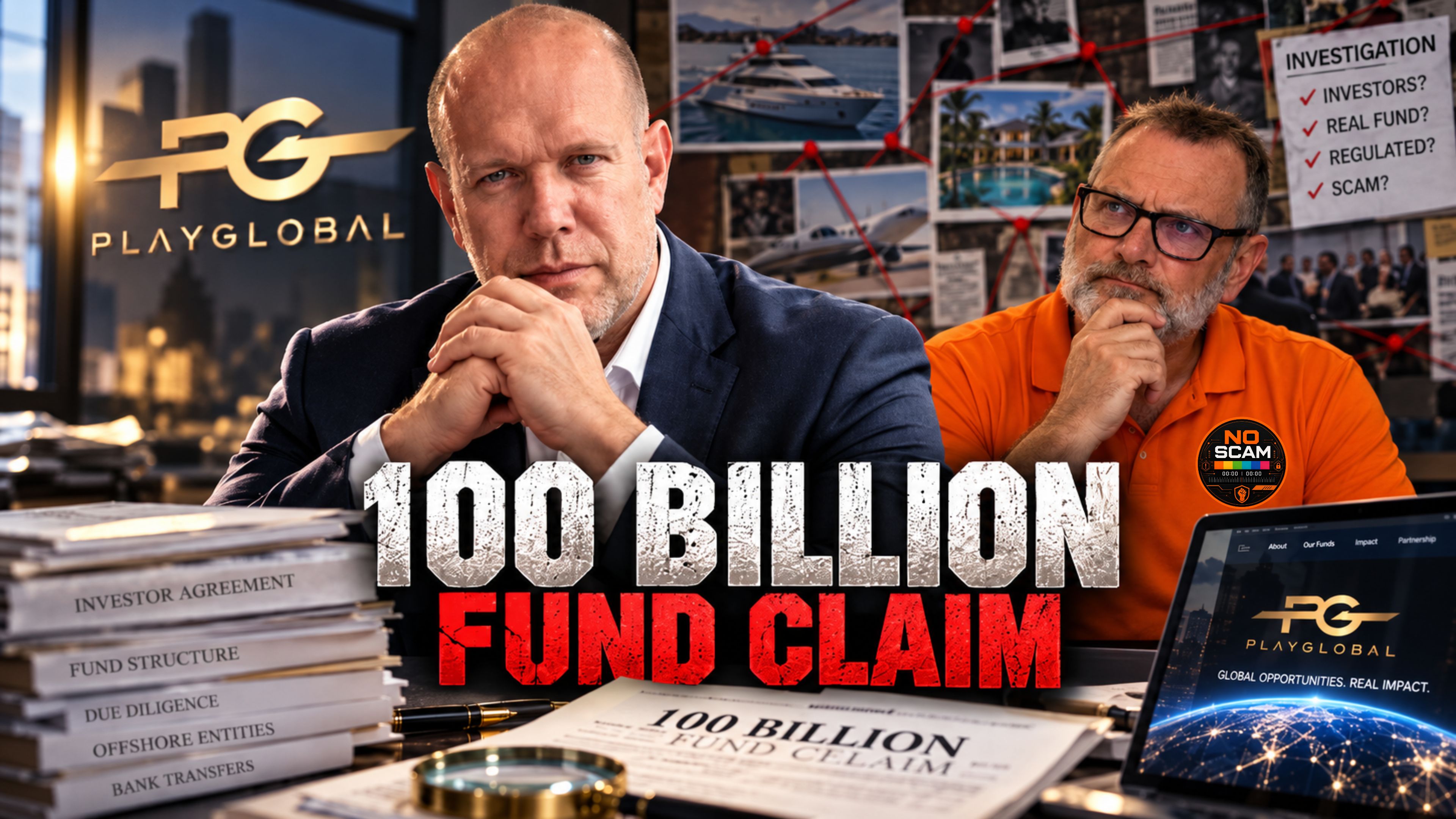
“When someone talks about a $100 billion fund, I want to see the evidence. Who controls the money? Where are the assets? Who audits the accounts? And what can investors actually verify?” — Danny de Hek
My investigation into PLAYGLOBAL began with people trying to recover money from MHT Trading Bot, an operation I had already investigated over its advertised investment returns and recruitment-based compensation structure.
An investor contacted me about difficulties recovering his money, and subsequent correspondence led me to an online meeting concerning the MHT recovery effort. Among those involved were representatives associated with PLAYGLOBAL, an organisation presenting ambitious plans involving international business ventures, a proposed US$100 billion Super Asset Fund and a digital ecosystem built around its PGD token. I wanted to establish why PLAYGLOBAL had become involved in the recovery story and whether the opportunities being discussed could withstand independent scrutiny.
During that meeting, I submitted approximately 30 due-diligence questions covering fund registration, regulatory oversight, capital raised, independent auditing, asset custody, token-holder rights, liquidity and evidence of completed projects. I subsequently examined corporate records, company representations, presentations and correspondence with Daniel Baumgartner, PLAYGLOBAL’s Chairman. The distinction between MHT Trading and PLAYGLOBAL was important from the beginning: they were presented as separate operations, and I have not established that PLAYGLOBAL operated MHT or participated in its alleged wrongdoing. My investigation instead focused on the evidence supporting PLAYGLOBAL’s own representations, the roles of the people involved and the considerable difference between describing a proposed financial structure and demonstrating that it has the assets, legal arrangements and operational substance being claimed.
Then the dispute moved beyond questions about corporate records and financial promises. On 16 September 2026, I received a five-page letter from New Zealand law firm Cuncannon, acting for PLAYGLOBAL SA and PLAYGLOBAL Digital Limited. Their lawyers alleged that my reporting conveyed defamatory meanings and demanded removal of publications, a retraction, an apology and undertakings restricting further publication of the disputed allegations. PLAYGLOBAL maintains that its businesses are legitimate and that it is not corporately connected to MHT Trading. Those positions deserve to be recorded fairly, just as the legal demands deserve public scrutiny. This investigation examines what the documents establish, what PLAYGLOBAL has explained, what remains unverified and why questions about a proposed billion-dollar-scale business network became the subject of formal legal threats.
How PLAYGLOBAL Entered The MHT Recovery Story
By the time PLAYGLOBAL entered my investigation, I had already published concerns about MHT Trading Bot, an operation promoting automated cryptocurrency trading and returns reportedly reaching 20% to 30% per month. Investors were encouraged to purchase licences, commit additional funds and participate in a referral structure that rewarded recruitment. The promise was attractive: sophisticated trading technology would supposedly generate substantial passive income without investors needing to understand the underlying markets. But the combination of unusually high advertised returns, restrictions on withdrawing capital and recruitment-based commissions raised serious questions about where the money was coming from and whether genuine trading activity could support the promised payouts.
As withdrawal problems emerged, I received information from an affected investor describing difficulties recovering funds. That contact eventually led to an invitation circulated within the MHT recovery community. The message described efforts to pursue accountability in India and referred to cooperation “together with PLAYGLOBAL”. It also suggested that official PLAYGLOBAL contacts in India were assisting with the recovery process. For people who believed they had lost their savings, the prospect of legal action, international contacts and help from an established business organisation could understandably provide renewed hope.
But recovering money from a failed investment operation and introducing people to another financial opportunity are two very different things.
The invitation led me to a Zoom meeting involving Daniel Baumgartner, PLAYGLOBAL’s Chairman, alongside other participants associated with the recovery initiative. The discussion extended beyond the immediate problem of recovering MHT investors’ money. PLAYGLOBAL’s wider business ambitions entered the conversation, including its international corporate activities, proposed Super Asset Fund and digital ecosystem. That was where the investigation began to change direction. I wanted to understand whether PLAYGLOBAL was simply offering contacts and practical assistance to people affected by MHT, or whether its involvement also provided an opportunity to introduce those people to a separate commercial venture.
PLAYGLOBAL has consistently maintained that it is a separate organisation from MHT Trading Bot. Baumgartner subsequently explained that PLAYGLOBAL had supported members of the affected community through available contacts and local connections in India, while denying that this created any legal, operational or regulatory relationship between the businesses. I have not established that PLAYGLOBAL operated MHT, controlled its funds or participated in its alleged wrongdoing. That distinction matters because the presence of two organisations in the same recovery discussion does not establish that they were jointly responsible for what happened to investors.
Another important part of the recovery story involved an Indian lawyer, Sandeep Roy, who was introduced in connection with efforts to pursue those believed responsible for MHT. References were made to criminal complaints and action involving Indian authorities. I subsequently sought independently verifiable details, including official case references and supporting documentation. The material available to me did not establish the status or outcome of the proceedings being described. That does not mean no proceedings existed, but it meant I could not independently confirm the legal progress that affected investors were being encouraged to believe was underway.
What made this situation particularly important was the audience. These were not simply prospective customers attending an ordinary presentation. They included people already affected by an investment operation whose advertised returns had prompted serious concerns. Some were looking for answers; others were hoping to recover money. That vulnerability made it especially important to distinguish documented recovery efforts from statements of intention, commercial promotion and promises about what might happen next.
I therefore approached the meeting with two separate questions. What evidence established the progress of the MHT recovery initiative? And what evidence supported PLAYGLOBAL’s own substantial financial and business claims?
The second question would become the focus of an entirely new investigation.
Thirty Questions And A Meeting That Raised More Questions
When I joined the MHT recovery Zoom meeting, I wasn’t there to be impressed by ambitious business plans or reassured by promises about the future. I wanted evidence. Daniel Baumgartner, Chairman of PLAYGLOBAL, was among those participating, and the discussion introduced the organisation’s wider international ambitions. Alongside the recovery effort, there were references to the proposed PLAYGLOBAL Super Asset Fund (PGSAF), a digital ecosystem and the PGD token. These were significant financial and commercial propositions, particularly in a meeting connected to people who had already experienced difficulties recovering money from MHT Trading Bot. I had spent enough time investigating questionable investment opportunities to recognise the importance of separating an attractive business presentation from independently verifiable financial activity.
Rather than rely on assurances, I submitted approximately 30 due-diligence questions through the Zoom chat while the meeting was underway. I asked for the fund’s legal registration number, the identity of its regulated manager, the financial authority responsible for oversight, the independent auditor and the bank or custodian holding its assets. I also wanted to know how much capital had actually been raised. A proposed fund targeting US$100 billion is not the same thing as a fund already controlling US$100 billion. That distinction is fundamental, yet easily lost when enormous figures are repeated alongside descriptions of international projects and institutional-scale financial ambitions.
The questions then moved to PGD, the digital token being promoted within PLAYGLOBAL’s proposed ecosystem. Company material described PGD as something other than a financial instrument, yet the promotional representations I was examining raised questions about bonuses, fund participation and potential increases in token value. I asked what legal rights token holders would acquire, whether holding PGD conferred ownership of company shares or underlying assets, and what supported its value if those ownership rights did not exist. I also asked about the reported 60% ownership position attributed to PLAYGLOBAL SA, the ultimate beneficial owners of the relevant corporate entities and whether minority participants would have meaningful voting rights. These were important distinctions because buying a digital token does not automatically give someone ownership of the assets, companies or projects associated with its marketing.
I also wanted to examine the technology rather than simply accept descriptions of a functioning token economy. Which blockchain was PGD deployed on? Where was the contract address? Had the smart contract undergone an independent security audit? Could token holders transfer or sell their holdings, and who would provide liquidity if they wanted to leave? I questioned the assumptions behind promotional references to a possible hundredfold increase in value, whether any projections had been documented and whether commissions were paid for recruiting additional participants. These questions were intended to establish how the proposed opportunity would work in practice, how money could move through the ecosystem and what protections participants would have if expectations were not met.
The questions were being submitted in real time, not assembled months afterwards to make the meeting appear more controversial. They formed part of my contemporaneous attempt to obtain information directly from people discussing the opportunity. However, posting a question in a Zoom chat is not proof that every participant read it, and the fact that a question was raised does not establish that no answer was given. The proper test is to compare the recording, chat record and subsequent correspondence against each question. Some explanations were provided during the meeting and later by Baumgartner, but I did not receive documentary verification resolving several of the central financial and legal questions.
One exchange became particularly revealing. I challenged the presentation of a sophisticated international business network whose public-facing website appeared to use WordPress. There is nothing inherently suspicious about using WordPress; legitimate organisations of every size use it. My concern was not the software itself. It was the contrast between the scale of the claims being presented and the level of independently verifiable information available to support them. Baumgartner left the meeting following a difficult exchange, although his departure alone cannot establish why he chose to leave or whether the underlying claims were accurate.
The recording also preserves an important moment later in the meeting when I stated that I was recording and intended to use the material in my investigation. I subsequently continued seeking answers through direct correspondence rather than treating the Zoom exchange as the final word.
The meeting had given me a series of claims to investigate, but it had not supplied the independent financial documentation needed to establish their substance. The next task was to examine the proposed Super Asset Fund itself: what PLAYGLOBAL said it intended to become, what legal and financial arrangements could be identified, and how much of the extraordinary scale being discussed could actually be supported by evidence.
The $100 Billion Super Asset Fund
One of the most ambitious claims I encountered during the PLAYGLOBAL investigation concerned the proposed PLAYGLOBAL Super Asset Fund (PGSAF), which was being presented with a long-term ambition of reaching US$100 billion. This was not a modest investment proposal. The wider PLAYGLOBAL vision involved international business development, real-world assets, technology, infrastructure and opportunities across multiple industries. In the material I examined, these ambitions were presented as parts of an interconnected business ecosystem, with the proposed fund intended to provide a financial structure through which projects could be developed and expanded. For anyone attending the MHT recovery meeting, particularly people hoping to recover earlier investment losses, the scale of that vision could understandably have created an impression of financial strength and institutional credibility.
But there is a fundamental difference between planning to establish a fund worth US$100 billion and demonstrating that such a fund already holds substantial assets or committed investment capital. A target is not a bank balance, an asset valuation or an independently audited financial statement. That distinction became central to my investigation. I wanted to establish whether PGSAF was an existing, legally constituted investment structure, a fund still being developed, or primarily a proposed framework for future projects. Those possibilities carry very different implications for anyone considering participation in the wider PLAYGLOBAL ecosystem.
The questions I submitted during the Zoom meeting addressed precisely those issues. I asked for the fund’s legal registration number, the identity of its regulated fund manager, the financial authority responsible for oversight, the independent auditor and the institution responsible for holding its assets. I also asked how much capital had actually been raised and whether audited financial statements were available. These were not unreasonable demands for commercially sensitive information. They were requests to establish the existence, legal status and financial substance of an organisation being discussed in connection with an extraordinarily ambitious fund.
The most important question was also the simplest: how much money had actually been raised?
Without that figure, it is impossible to determine how far the proposed fund has progressed towards its stated ambition. A project may have valuable commercial relationships, intellectual property, prospective investors and plans for future acquisitions without yet having substantial capital under management. Those are legitimate stages of business development, but they should not be confused with completed fundraising or ownership of assets. Similarly, a proposed acquisition or strategic partnership does not automatically establish that a company owns the assets involved. The distinction becomes especially important when promotional material discusses multiple businesses, jurisdictions and projects under one overarching brand.
PLAYGLOBAL’s broader public communications have described a financial architecture linking real-world business opportunities with capital structures, including PGSAF and PLAYGLOBAL Digital. The difficulty for an outside investigator is that a description of this architecture does not, by itself, identify the legal entity accepting funds, the contractual rights of participants, the responsible financial institutions or the location of the underlying assets. Those details must be established separately. Different jurisdictions also impose different regulatory requirements, so I would not assume that the absence of one particular licence proves unlawful activity. The first step is to determine exactly what financial activities are being undertaken, by whom, and where.
In my subsequent correspondence with Daniel Baumgartner, I continued seeking evidence that would allow these questions to be answered. Baumgartner distinguished PLAYGLOBAL’s different business activities and maintained that its international projects, corporate arrangements and digital initiatives should not be treated as a single regulated investment operation. He also indicated that PLAYGLOBAL would not provide various non-public internal corporate, financial, regulatory and commercial documents. That is an important part of the company’s position and deserves to be reported fairly. A private business is not automatically obliged to disclose every internal document requested by a journalist.
However, declining to provide documentation does not independently substantiate the underlying financial claims. It leaves an investigator to work with what can be established through public records, published company material and other verifiable evidence. At this stage, I had not obtained an independent audit or financial documentation establishing the amount of capital actually committed to PGSAF, the assets held by the proposed fund or the identity of an institution responsible for their custody.
That does not establish that the fund is fictitious or that PLAYGLOBAL has engaged in unlawful activity. It establishes a narrower but important finding: the scale of the ambition could be documented, while the financial substance behind that ambition remained insufficiently verified through the evidence available to me.
The next step was to move away from promotional descriptions altogether and examine the legal entities behind PLAYGLOBAL. Corporate registrations, filed accounts and ownership records would provide a more concrete starting point for understanding the organisation behind the proposed fund.
What The Corporate Records Actually Reveal
After examining PLAYGLOBAL’s proposed Super Asset Fund, I turned to something considerably less glamorous than presentations about international assets and billion-dollar ambitions: company registrations and filed financial statements. These documents cannot establish whether every commercial opportunity described by a business is genuine, but they provide an independent starting point. A company may announce projects, partnerships and future investments, yet its statutory accounts record a different kind of information: what a particular legal entity owned, owed and reported at a specific date. For an organisation promoting an extensive international business network, I wanted to understand which companies actually existed, how they were connected and whether the available financial records supported the scale of the activities being described.
The first company was PLAYGLOBAL SA, registered in Luxembourg under number B289162 on 10 September 2024, with its registered address at 70 Grand-Rue, Luxembourg. The company is recorded as an active société anonyme, with a registered business activity involving the holding of majority interests in other companies. That established an important fact: PLAYGLOBAL SA was not simply a name on a website. It was a legally registered Luxembourg company. But incorporation establishes legal existence, not the value of a company’s assets or the financial strength of the wider business network. Those questions required a closer examination of the accounts. The relevant registration and financial information can be checked through PLAYGLOBAL SA’s Luxembourg company record.
The financial statements for 2024, filed on 4 May 2026, presented a striking contrast with the much larger figures appearing in PLAYGLOBAL’s promotional narrative.
| Total assets | €39,144 |
| Cash | €102 |
| Equity | €19,987 |
| Liabilities | €19,157 |
| Annual loss | €10,013 |
PLAYGLOBAL SA — 2024 financial statements, filed May 2026. Luxembourg registry-derived financial data also confirms approximately €102 cash, €20,000 equity and a €10,000 loss. Source: pappers.lu
Just €102 in cash. That figure immediately attracted my attention, not because it proves anything dishonest, but because it illustrates why corporate records matter. PLAYGLOBAL was discussing a proposed fund with ambitions reaching US$100 billion, yet the historical accounts of its Luxembourg holding company showed a comparatively modest financial position. These figures do not establish the value of assets held by other companies, projects being negotiated, or capital that may have been raised after the reporting date. Nor does a proposed US$100 billion fund mean the holding company should already have that amount on its balance sheet. Nevertheless, anyone presented with claims about substantial international financial activity should understand the distinction between documented company finances, assets held elsewhere and money that an organisation hopes to attract in the future.
The investigation then moved beyond Luxembourg. Austrian public records identify PLAYGLOBAL Austria GmbH, registered under FN 532944t, with Manuel Neuwirth recorded as managing director. This business was originally registered in August 2020 and previously operated under the name PGI GmbH. The Austrian registry records a significant corporate development on 18 March 2026, when PLAYGLOBAL SA was entered as its shareholder. This provided an independently documented ownership relationship between the Luxembourg company and an Austrian operating entity. Rather than assuming that every organisation using the PLAYGLOBAL name belonged to the same legal structure, I could now identify at least one direct corporate connection. The Austrian government registry publishes the relevant company registration and ownership details.
The Austrian network also includes Playglobal Productions GmbH, registered under FN 551690i, whose stated business activities concern film production, distribution and related services. Its public-facing website describes television and film projects, production services and equipment rental. Additional Austrian company records identify PLAYGLOBAL Austria GmbH as its shareholder, establishing another documented link within the group. That matters because these are distinguishable business activities with their own legal identities, records and financial histories. A film production company is not automatically an investment fund, and evidence that a production business exists does not establish that a separate fund holds billions of dollars in assets. Equally, modest accounts for one company do not establish that another company in the network lacks genuine operations.
A further company raised questions about how PLAYGLOBAL’s proposed international financial arrangements were intended to operate. PGIC Trade Management Ltd, registered in the United Kingdom under company number 15626131 on 8 April 2024, had filed accounts describing it as dormant for the period ending 30 April 2025. Companies House records also show that its registered office was changed to a Companies House default address on 20 August 2026, followed by a first Gazette notice proposing compulsory strike-off on 29 September 2026. At the time of the records examined for this investigation, the company was still listed as active, although it was subject to a proposal to remove it from the register. This was not confirmation that the company had been dissolved. These developments warrant attention because a dormant company has reported no significant accounting transactions during the relevant financial period, although that historical classification does not establish its subsequent activity or explain the reasons for the registry action. The filings are available directly through UK Companies House.
Taken together, the records demonstrated that parts of PLAYGLOBAL’s corporate network were real, registered and traceable, including documented ownership relationships across Luxembourg and Austria. They also revealed why it would be misleading to treat the entire network as a single company with one balance sheet. Each entity has its own legal responsibilities, financial reporting obligations and operational history. The challenge was to establish which companies were responsible for the substantial financial propositions being discussed, which entities actually controlled relevant assets and whether the public documentation supported the functions attributed to them.
The corporate records established the existence of companies. They did not, on their own, establish the financial substance of the proposed Super Asset Fund or the rights attached to PLAYGLOBAL’s digital token. That distinction led directly to the next part of my investigation: PGD, the token economy surrounding it, and what participants would actually receive in exchange for their money.
PLAYGLOBAL Digital, PGD And The Token Economy
Having examined the corporate records behind PLAYGLOBAL, I returned to one of the most important questions raised during the MHT recovery meeting: what would someone actually receive if they put money into the PLAYGLOBAL Digital ecosystem? The organisation’s promotional material described a digital structure intended to connect participants with projects, business opportunities and the proposed Super Asset Fund. At its centre was the PGD Master Token, supported by references to additional sub-tokens and a digital application called “The Key”. PLAYGLOBAL presented this as a way for members to participate in an exclusive international ecosystem rather than simply purchasing a conventional investment product. The language was sophisticated, but understanding the legal and financial rights behind it required looking beyond the marketing.
My earlier examination of PLAYGLOBAL’s official website identified a particularly significant representation: PLAYGLOBAL Digital was described as the vehicle through which community members could access the proposed Super Asset Fund, with participation presented as fully tokenised. The material also referred to fund-related bonuses and arrangements involving a portion of the conventional fund. That raised an immediate question about the relationship between the token and the underlying assets. If participants were being encouraged to associate PGD with future projects, fund participation or increases in value, what contractual rights would they obtain? Would they own shares in a company, acquire an enforceable entitlement to profits, or simply receive access to services and opportunities that might be developed later?
Those are fundamentally different things, regardless of what a token is called.
PLAYGLOBAL’s position, subsequently reinforced in correspondence with Daniel Baumgartner, was that PGD should be understood as a utility token rather than a financial instrument or conventional investment. That distinction deserves to be reported accurately. However, calling a token a utility token does not, by itself, determine its legal classification in every jurisdiction. The answer depends on its actual rights, functions, contractual arrangements and the way it is offered. I was particularly interested in the relationship between that explanation and PLAYGLOBAL’s wider promotional language. Its own published principles refer to exclusive projects becoming more valuable and stable as additional projects are introduced, while its executive summary describes access to investment opportunities across real estate, healthcare, technology and renewable energy. These statements do not prove that PGD holders have investment rights, but they make clear why prospective participants need precise information about what purchasing the token would legally entitle them to receive.
The token documentation I examined identified PLAYGLOBAL DAM Ltd, an Anguilla entity, as the proposed issuer and described a total supply of 300 million PGD tokens, including 215 million allocated to “Private Community Access”. The distinction between the Luxembourg holding company, the proposed token issuer and other participating businesses matters. A token issued by one legal entity does not automatically confer ownership of another, even where both operate within a wider branded network. I therefore wanted to establish who would receive purchase proceeds, which entity would be responsible for delivering promised benefits, whether token holders could enforce those benefits and what would happen if the proposed projects were delayed or never developed. The allocation figures explained the intended token distribution, but did not independently establish asset backing, investor ownership rights or a guaranteed market for resale.
A further development emerged through VALYGO, which publicly describes its relationship with PLAYGLOBAL Digital as a “Joint Venture Partnership”. Its website presents VALYGO as a provider of blockchain and financial technology infrastructure, while attributing real-world project access and ecosystem development to PLAYGLOBAL Digital. The same VALYGO website now states that PGD has been deployed and verified on VYOChain. However, I have not independently verified the token’s contract address or its blockchain transactions. This represents a development in PLAYGLOBAL’s public claims, but independent verification remains necessary before the token’s deployment can be treated as an established technical finding.
However, there is an important distinction between verifying that a token exists on a blockchain and verifying the commercial claims associated with that token. A blockchain explorer can potentially establish a contract’s deployment, token supply, wallet balances, transfers and certain administrator permissions. It cannot, by itself, prove that a token represents ownership of real estate, renewable-energy assets, companies or an investment fund. Nor does deployment demonstrate that independent buyers will provide liquidity or that a particular market price is economically sustainable. The existence of PGD on VYOChain would answer one of my technical questions, but not the larger questions about legal rights, underlying assets and financial value.
VALYGO’s published material adds another layer worth examining. Its technical documentation describes a blockchain network, wallet infrastructure and links between digital assets and financial services. The platform also states that PGD and its own VYO token are digital assets, not bank deposits, and warns that digital assets can be volatile. Its published VALYGO Chain white paper describes the underlying network, while other pages refer to compliance arrangements and third-party financial-service providers.
These materials support the existence of a publicly described technical ecosystem. They do not automatically establish that PLAYGLOBAL’s proposed fund is regulated, that PGD carries enforceable rights to external assets or that all advertised services are available to every prospective participant. Those issues must be examined separately, using the documents and regulatory requirements applicable to each entity and activity.
I also revisited the questions surrounding potential token appreciation, recruitment incentives and liquidity. My concern was not simply whether PGD could increase in price. Almost any transferable digital asset can change in market value. The important questions were what would create genuine demand, who would provide buyers when holders wanted to sell, and whether value depended on working products, completed projects or continuing participation by new members. I had asked PLAYGLOBAL for its compensation arrangements, the assumptions behind promotional references to substantial potential increases in value and evidence of projects that had already generated returns for token holders. Without independently established commercial activity and clear contractual documentation, projections remain projections rather than demonstrated financial performance.
The available evidence therefore supported a more precise conclusion than either dismissing the token as fictitious or accepting the wider promotional narrative at face value. PGD had become part of a publicly identifiable blockchain ecosystem, and VALYGO was openly describing its relationship with PLAYGLOBAL Digital. What remained to be established was the practical value of the rights attached to that token, the relationship between its issuer and PLAYGLOBAL’s proposed assets, and whether the financial expectations surrounding the ecosystem were supported by completed business activity.
That brought me back to the people directing the organisation. Corporate registrations and token contracts can identify legal structures, but understanding who controls them, who makes the representations and who is responsible for delivering what has been promised requires examining the individuals behind PLAYGLOBAL.
The People Behind PLAYGLOBAL
The more I examined PLAYGLOBAL’s corporate structure, the more important it became to understand who was actually responsible for the decisions, financial representations and international projects being promoted. A company can register multiple entities, appoint experienced executives and assemble an impressive advisory board, but those arrangements do not automatically establish that its proposed investments are operational or financially sound. When an organisation describes itself as an international network involved in major commercial projects and a proposed US$100 billion fund, the individuals directing that network become central to the investigation. I wanted to distinguish the people with documented legal responsibilities from those presented as advisers, business-development specialists or strategic partners.
At the centre of PLAYGLOBAL’s public leadership structure is Daniel Baumgartner, identified on the company’s official leadership page as Chairman and CEO. His published biography describes more than 25 years of entrepreneurial experience, including technology consulting, international business development and earlier ventures involving software, media and trading services. PLAYGLOBAL also identifies Manuel Neuwirth as Vice-Chairman and Chief Operating Officer, with responsibilities extending to international projects and subsidiaries, while Thomas Liebert is listed as Chief Financial Officer. The company’s legal imprint names all three as authorised directors. These are PLAYGLOBAL’s own descriptions of its management team, rather than independent verification of every professional achievement or project attributed to them.
Neuwirth’s position was particularly relevant because his involvement could also be traced through official corporate records. Austria’s business register identifies him as the managing director of PLAYGLOBAL Austria GmbH, a company whose registered shareholder became PLAYGLOBAL SA in March 2026. This provided an independently verifiable connection between a named executive and a legally registered business within the network. By contrast, other claims about international responsibilities, strategic partnerships and access to major commercial opportunities require separate evidence before they can be treated as established business activity. The distinction is important: a verified directorship establishes a person’s corporate role, but it does not independently verify the assets, profitability or commercial progress of every project associated with that person.
Baumgartner was also the individual with whom I had the most substantial direct engagement. I encountered him during the MHT recovery Zoom meeting and subsequently corresponded with him about PLAYGLOBAL’s activities, corporate relationships, financial claims and the PGD token. He repeatedly distinguished PLAYGLOBAL’s international business operations from PLAYGLOBAL Digital and maintained that neither should be treated as part of MHT Trading Bot. His correspondence also explained that the PLAYGLOBAL brand encompassed different legal entities, business divisions and strategic initiatives, which did not necessarily share the same contractual obligations or operational responsibilities. That was a relevant clarification. The difficulty was establishing precisely which entity was responsible for each major representation, particularly where the public-facing material brought different activities together under the PLAYGLOBAL name.
The company’s advisory board introduced another dimension to that question. PLAYGLOBAL’s leadership website identified advisers at the time of my investigation who were associated with international business development, technology, investor relations, architecture and real estate. Among those listed were Dr Ibrahim Al-Mutrif, Dr Michael Hernler, Paul Bollwein, Milica Gruban and Alwin Morgenstern. Their published biographies described professional experience across different industries and jurisdictions. To someone encountering PLAYGLOBAL for the first time, such a group could reinforce the impression of an internationally connected organisation with access to expertise and commercial relationships. But an advisory-board appointment is not equivalent to responsibility for managing an investment fund, auditing financial statements or independently verifying company assets. Those functions require identifiable mandates, qualifications and, where applicable, formal regulatory responsibilities.
A development on 31 July 2026 made the advisory structure particularly relevant to my investigation. Former advisory-board member Dr Stephan Schimpf contacted me directly, without being approached by me for that particular announcement, to say he had resigned from PLAYGLOBAL’s advisory board with immediate effect. He also observed that two other members appeared to have disappeared from the company’s published advisory-board listing and specifically asked me to take that development into account in my ongoing reporting. I replied asking why he had resigned and whether his decision was connected to my investigation or arose from unrelated circumstances. I did not receive evidence establishing the reason for his resignation or the circumstances surrounding the other apparent departures. It would therefore be wrong to claim that my investigation caused them.
The significance of those departures became clearer when, on 16 September 2026, lawyers acting for PLAYGLOBAL SA and PLAYGLOBAL Digital Limited alleged that my publications had caused three advisory-board members to resign, along with losses of business and investment. That was a much stronger claim than anything Schimpf had told me. His correspondence established that he had resigned and believed others had followed; it did not establish that my reporting had caused those decisions. I subsequently asked the lawyers to identify the individuals concerned and provide the factual basis for attributing their resignations to my publications. This is an important distinction because the timing of a resignation does not, by itself, establish its cause, particularly when that resignation is being cited as evidence of financial or reputational damage.
What emerged was a network with identifiable executives, registered corporate relationships and publicly named advisers, but also important questions about decision-making authority, financial accountability and the responsibilities attached to the different legal entities. None of the individuals discussed here should be presumed to have engaged in wrongdoing merely because they hold, or previously held, a position within PLAYGLOBAL. The issue is whether the roles and responsibilities presented to the public can be matched with evidence showing who controls the relevant operations and who is accountable for the representations being made.
For me, the next question was no longer simply who appeared on PLAYGLOBAL’s website. It was how Daniel Baumgartner and the organisation responded when I asked them to substantiate those representations, and whether the explanations supplied resolved the concerns that had prompted the investigation in the first place.
Daniel Baumgartner’s Responses And The Missing Evidence
By this stage of my investigation, Daniel Baumgartner had been given several opportunities to explain PLAYGLOBAL’s business activities and address the questions raised in my reporting. I wasn’t expecting him to hand over every confidential commercial agreement or reveal information that genuinely needed to remain private. What I wanted was independent evidence supporting the substantial claims being presented to the public. There is a considerable difference between protecting confidential business information and being unable or unwilling to substantiate representations about financial structures, regulatory oversight, asset ownership and token-holder rights. My correspondence with Baumgartner was intended to establish that distinction, particularly after he challenged the implications of my earlier investigation.
Baumgartner’s responses repeatedly emphasised that PLAYGLOBAL was an international corporate organisation comprising separate legal entities, business divisions and strategic initiatives. He distinguished PLAYGLOBAL International, which he described as concentrating on real assets, business development and strategic partnerships, from PLAYGLOBAL Digital, which he presented as an emerging digital business involving technology and tokenised participation. He also maintained that PLAYGLOBAL and MHT Trading Bot were separate organisations, explaining that assistance offered to the affected MHT community through contacts in India did not establish corporate involvement in MHT’s operations. These were relevant explanations, and I have made a point of distinguishing PLAYGLOBAL’s stated position from the allegations surrounding MHT.
But explaining the organisational structure was not the same as answering the financial questions.
I had asked for information that could establish the legal and operational substance of the proposed PLAYGLOBAL Super Asset Fund. Who was responsible for managing it? Which regulator oversaw its activities, if regulation was required? How much capital had actually been raised? Who held the assets? Were independently audited financial statements available? I also sought clarification of the PGD token’s legal rights, its relationship with any underlying assets and the financial assumptions supporting references to substantial potential increases in value. Baumgartner’s correspondence explained why he considered certain questions to involve different companies or future business activities, but it did not provide me with the complete set of independently verifiable documents I had requested.
That difference became particularly important when I examined the proposed fund alongside the available corporate accounts. PLAYGLOBAL’s public narrative concerned ambitious international projects and a potential fund reaching US$100 billion, while the Luxembourg holding company’s 2024 accounts recorded €39,144 in assets and €102 in cash. Those figures describe one legal entity at a historical reporting date, not the entire PLAYGLOBAL network or its future fundraising potential. Nevertheless, they made the distinction between established assets, intended investments and prospective capital commitments especially important. A clear explanation of which entity would own or control the proposed fund’s assets, supported by appropriate documentation, would have helped readers understand how those different figures fitted together.
Baumgartner also challenged my approach to corporate and regulatory verification. His position was that PLAYGLOBAL should not be treated as a single regulated investment platform merely because its associated businesses discussed financial opportunities, and that PGD was intended as a utility token rather than a conventional investment instrument. These distinctions may matter under the laws applicable to the relevant activities. A digital token is not automatically a security, and a business describing a proposed fund does not necessarily mean it is already operating a regulated investment fund. Equally, the terminology chosen by a promoter cannot settle those questions on its own. The underlying contracts, activities, representations and legal rights remain important.
In subsequent correspondence, Baumgartner indicated that PLAYGLOBAL would not provide various internal corporate, financial, regulatory, investor, legal, technical and commercial documents. I recognise that businesses have legitimate reasons to protect commercially sensitive information. However, where the available public material does not independently establish the substance of significant financial claims, a refusal to provide supporting records leaves those claims unverified from an investigator’s perspective. That is a limitation of the available evidence, not proof that the claims are false.
Another issue concerned the MHT recovery effort itself. During the earlier discussions, an Indian lawyer, Sandeep Roy, had been introduced in connection with attempts to pursue action against those allegedly responsible for MHT. I sought official case references and documents capable of establishing the status of the reported proceedings. Although explanations were offered about efforts being undertaken in India, I did not receive the independently verifiable case material needed to confirm the specific legal progress described. Baumgartner subsequently distinguished PLAYGLOBAL’s assistance to the community from responsibility for those legal proceedings. That distinction was relevant, but it did not resolve the underlying question of what formal proceedings had actually been commenced and what results had been achieved.
Throughout the correspondence, I also made clear that I was willing to correct demonstrated factual errors. I asked Baumgartner to identify the particular statements he disputed and provide supporting evidence. This was not an invitation to control my editorial conclusions; it was an opportunity to ensure that the published record accurately reflected what could be established. Investigative journalism requires challenging substantial claims, but it also requires acknowledging information that contradicts an investigator’s initial concerns. If PLAYGLOBAL produced evidence establishing that a particular claim in my reporting was incorrect, that evidence would need to be assessed and the published material corrected where appropriate.
The latest response I received continued to explain PLAYGLOBAL’s international structure and the distinction between its conventional business activities and digital initiatives. It also emphasised that a shared brand did not mean every associated legal entity carried the same responsibilities. That was a useful clarification, but it did not resolve the central documentary questions concerning the fund’s capital, asset custody, independent financial verification and the enforceable rights associated with PGD. At the time of preparing this section, I had received no further substantive response from Baumgartner resolving those outstanding matters.
The correspondence therefore left two positions that readers should be able to distinguish. PLAYGLOBAL maintains that its business activities are legitimate and that its corporate and digital initiatives have been misunderstood. My investigation establishes that several important representations still require independent verification through the evidence available to me. Neither position should be distorted into something stronger than the documents support.
The next development was not another financial statement, audit report or detailed explanation of the proposed fund. It was a formal legal demand from New Zealand lawyers acting for PLAYGLOBAL SA and PLAYGLOBAL Digital Limited, challenging my reporting and seeking the removal of my publications.
From Investigative Questions To Legal Threats
By September 2026, my investigation into PLAYGLOBAL had moved well beyond the original MHT recovery meeting. I had examined corporate filings, questioned the proposed Super Asset Fund, investigated the PGD token and exchanged correspondence with Chairman Daniel Baumgartner. I had also made it clear that I was willing to correct demonstrable factual errors if PLAYGLOBAL identified them and supplied supporting evidence. Instead, on 16 September 2026, I received a five-page legal letter from Kate Muirhead, a partner at the New Zealand law firm Cuncannon, acting for PLAYGLOBAL SA and PLAYGLOBAL Digital Limited. Its subject was direct: “Your defamation of PLAYGLOBAL and its management.” The letter alleged that my reporting falsely portrayed PLAYGLOBAL as a cryptocurrency scam connected to MHT Trading Bot and threatened proceedings under New Zealand’s Defamation Act 1992.
The lawyers identified six alleged defamatory meanings, including that PLAYGLOBAL was involved in cryptocurrency fraud, knowingly connected to the MHT operation, promoting a fraudulent token offering and presenting fabricated business activities or assets. They also alleged that Baumgartner and PLAYGLOBAL’s management were dishonest. These were the lawyers’ interpretations of my publications, not findings made by a court. Cuncannon acknowledged that PLAYGLOBAL denied the allegations, maintained that its businesses were genuine and described its proposed token offering as lawful. Their letter also argued that presenting concerns as questions did not necessarily prevent those questions from conveying defamatory meanings. That is a relevant legal issue: investigative reporting must be judged on what it communicates to readers, not simply whether individual sentences are phrased as questions.
What concerned me most was the breadth of what PLAYGLOBAL’s lawyers wanted removed.
Paragraph 11 demanded that I permanently delete every publication identified in their schedule, together with copies, mirrors, reposts, downloads and derivative material under my control. They wanted me to identify every platform and URL where the material had appeared, undertake not to publish the same or substantially similar allegations again, and issue a retraction and apology in wording approved by PLAYGLOBAL. That apology would have to appear with equal prominence across the original publishing locations and remain available for at least six months. The deadline was 5 pm on 28 September 2026. If I refused, the company reserved the right to pursue damages and an injunction. These were not simply requests to correct particular factual statements; accepting the proposed undertakings would have required the removal of a substantial body of investigative reporting and imposed restrictions on future publication of the disputed allegations.
The letter also made a significant claim about the consequences of my reporting. In paragraph 9, Cuncannon alleged that my publications had caused three board members to resign, together with losses of business and investment. I already possessed correspondence from former PLAYGLOBAL advisory-board member Dr Stephan Schimpf, who had contacted me on 31 July to say that he had resigned with immediate effect and believed two others had followed. I had asked whether his departure was related to my investigation, but his correspondence did not establish that connection. The lawyers’ letter provided no particulars identifying the alleged lost investments or explaining why each resignation was attributed to my publications. It stated that PLAYGLOBAL would particularise its pecuniary loss if proceedings became necessary. I considered those assertions important enough to challenge directly rather than accept causation based on timing alone.
There was another distinction worth recording. The lawyers’ schedule included several versions and formats of my reporting, including the original article, republications, podcast material and YouTube videos. Two of the listed YouTube URLs contained the same substantive investigative programme, with a privacy-edited version showing blurred faces. The letter also referred to five YouTube videos while its schedule identified four YouTube URLs. Those details did not invalidate the legal complaint, but they mattered when determining precisely which statements the lawyers considered defamatory and whether supposedly separate publications contained substantially different material. Earlier YouTube privacy complaints had resulted in editing and republication, but I had no verified evidence identifying who submitted those complaints. I would not attribute them to PLAYGLOBAL without proof.
I subsequently sent Cuncannon a substantive written response disputing the lawyers’ characterisation of my investigation. My position was that PLAYGLOBAL and MHT Trading Bot had been expressly distinguished in my reporting, and that asking for independent verification of financial claims was not equivalent to asserting that every unanswered question proved fraud. I challenged the alleged meanings and requested identification of the precise words, images or passages relied upon, together with particulars of the claimed economic loss. I also declined to accept the proposed undertakings in their existing form while reiterating my willingness to correct factual errors supported by evidence. The distinction matters: challenging a demand for wholesale removal does not eliminate a journalist’s obligation to correct mistakes, just as a company’s right to defend its reputation does not automatically entitle it to dictate the removal of all critical reporting.
Cuncannon’s letter expressly stated that it was open correspondence and not without prejudice. In the interests of transparency, I am making both the original Cuncannon legal demand dated 16 September 2026 and my written response to Cuncannon available for readers to examine. These documents record PLAYGLOBAL’s allegations, the remedies demanded, my objections to the characterisation of my reporting and my requests for supporting evidence. Readers can examine the correspondence in its original form rather than relying solely on my interpretation of what was said.
The existence of a legal threat does not prove that PLAYGLOBAL intended to silence legitimate journalism, and a company is entitled to challenge reporting it believes is defamatory. Nevertheless, the potential effect of the requested undertakings was clear: my investigations would disappear from the platforms under my control, and my ability to repeat the disputed reporting would be contractually restricted. That raises a legitimate public-interest question about the proportionality of the demands, particularly while the underlying factual disagreements remain contested.
What began as an effort to establish whether PLAYGLOBAL’s financial representations could be independently verified had become a dispute about whether the public should continue to have access to the investigation itself.
What Remains Unverified
After months of examining PLAYGLOBAL’s corporate structure, financial representations, digital token arrangements and correspondence with Daniel Baumgartner, I have reached a point where several important facts can be established independently, while other substantial claims remain unverified. PLAYGLOBAL SA is a registered Luxembourg company. Its wider network includes identifiable businesses in Austria and the United Kingdom. The PGD token has been presented within a publicly identifiable blockchain ecosystem, and PLAYGLOBAL has provided explanations about its international operations and proposed business model. These findings matter because an investigation should not dismiss verifiable facts simply because other aspects of a company’s promotional narrative raise concerns.
The financial evidence, however, tells a more limited story than the ambitions presented. PLAYGLOBAL SA’s 2024 accounts recorded €39,144 in total assets, including €102 in cash, while the organisation discussed a proposed Super Asset Fund with an eventual target of US$100 billion. These figures concern different things: a particular company’s historical balance sheet and the proposed future scale of a financial structure. Comparing them does not establish that PLAYGLOBAL has misrepresented its assets. What it does establish is the need to identify which entity would own or control the proposed fund, what capital has genuinely been committed and whether independently verifiable financial statements support the amounts being discussed.
Those questions have remained central throughout my investigation. I have sought the fund’s legal registration details, the identity of any responsible regulated manager, information about applicable regulatory oversight, independent auditing, asset custody and evidence of completed investments. I have also asked whether PGD token holders receive enforceable rights to underlying assets or company shares, how any potential financial benefits are determined and what arrangements exist for transferring or selling tokens. A token’s existence on a blockchain does not establish that it is backed by real-world assets, just as a company’s incorporation does not establish the financial performance of its proposed projects. Without the relevant contracts, financial records and independently verifiable evidence, those broader claims cannot be treated as established facts.
I also remain concerned about the context in which PLAYGLOBAL first entered this investigation. The connection arose through an MHT Trading Bot recovery initiative, involving people who had already reported problems recovering money. PLAYGLOBAL maintains that it was offering assistance through international contacts and had no corporate responsibility for MHT’s activities. I have not established otherwise. Nevertheless, the reported legal recovery efforts in India remain an important unresolved part of the story. Despite requests for official case references and supporting documentation, I have not obtained the records necessary to independently establish the progress and outcome of the proceedings described to the affected community. That uncertainty should not be mistaken for proof that no legal action occurred, but investors deserve to know which developments can actually be confirmed.
The corporate network presents further questions. PLAYGLOBAL has explained that its different entities, business divisions and strategic relationships must not be confused with one another. That is a reasonable distinction, but it also makes clear identification of the responsible legal entity essential. When promotional material discusses fund participation, tokenised opportunities, international assets or future distributions, prospective participants need to understand which company is making the representation, which company receives their money and against whom any contractual rights could be enforced. The available company records establish some ownership relationships, while other responsibilities and financial arrangements require additional documentation.
There is also the question of accountability when those representations are challenged. Baumgartner has disputed aspects of my reporting and provided explanations about PLAYGLOBAL’s activities. His lawyers have alleged that my publications caused reputational and economic harm and demanded substantial restrictions on their continued publication. Both positions deserve to be recorded. But legal correspondence cannot substitute for independent financial evidence, and the existence of a dispute does not resolve the underlying questions about fund assets, token-holder rights or commercial performance. Equally, the fact that PLAYGLOBAL has declined to provide particular documents does not establish that those documents do not exist.
I have investigated enough questionable financial opportunities to recognise a recurring problem: people can become so focused on what a project promises to achieve that they overlook what has actually been demonstrated. International company registrations, impressive professional biographies, ambitious investment targets and blockchain technology can all contribute to an appearance of legitimacy. Some may represent genuine business development. Others may be preliminary plans that never become operational. The responsibility of an investigator is to separate those possibilities using evidence, rather than assume the most favourable or most suspicious explanation.
That is where this investigation presently stands. PLAYGLOBAL has an opportunity to resolve significant questions through independently verifiable documentation, and I remain willing to assess new evidence, publish material that changes the findings and correct any demonstrated factual errors. I will not describe unanswered questions as proof of fraud, but neither will I present ambitious financial claims as established simply because they have been repeated by company representatives.
Until the supporting evidence is available, PLAYGLOBAL’s proposed financial scale, the substance of its Super Asset Fund and the economic rights associated with PGD remain matters requiring further verification. The public deserves that distinction, particularly when financial opportunities are presented alongside promises of future value and international business success
Disclaimer: How This Investigation Was Conducted
This investigation relies entirely on OSINT — Open Source Intelligence — meaning every claim made here is based on publicly available records, archived web pages, corporate filings, domain data, social media activity, and open blockchain transactions. No private data, hacking, or unlawful access methods were used. OSINT is a powerful and ethical tool for exposing scams without violating privacy laws or overstepping legal boundaries.
About the Author
I’m DANNY DE HEK, a New Zealand–based YouTuber, investigative journalist, and OSINT researcher. I name and shame individuals promoting or marketing fraudulent schemes through my YOUTUBE CHANNEL. Every video I produce exposes the people behind scams, Ponzi schemes, and MLM frauds — holding them accountable in public.
My PODCAST is an extension of that work. It’s distributed across 18 major platforms — including Apple Podcasts, Spotify, Amazon Music, YouTube, and iHeartRadio — so when scammers try to hide, my content follows them everywhere. If you prefer listening to my investigations instead of watching, you’ll find them on every major podcast service.
You can BOOK ME for private consultations or SPEAKING ENGAGEMENTS, where I share first-hand experience from years of exposing large-scale fraud and helping victims recover.
“Stop losing your future to financial parasites. Subscribe. Expose. Protect.”
My work exposing crypto fraud has been featured in:
- Coffeezilla 2026): Featured in the investigation exposing the alleged $328M Goliath Ventures Ponzi scheme
- Bloomberg Documentary (2025): A 20-minute exposé on Ponzi schemes and crypto card fraud
- News.com.au (2025): Profiled as one of the leading scam-busters in Australasia
- OpIndia (2025): Cited for uncovering Pakistani software houses linked to drug trafficking, visa scams, and global financial fraud
- The Press / Stuff.co.nz (2023): Successfully defeated $3.85M gag lawsuit; court ruled it was a vexatious attempt to silence whistleblowing
- The Guardian Australia (2023): National warning on crypto MLMs affecting Aussie families
- ABC News Australia (2023): Investigation into Blockchain Global and its collapse
- The New York Times (2022): A full two-page feature on dismantling HyperVerse and its global network
- Radio New Zealand (2022): “The Kiwi YouTuber Taking Down Crypto Scammers From His Christchurch Home”
- Otago Daily Times (2022): A profile on my investigative work and the impact of crypto fraud in New Zealand


Leave A Comment