


“If a company cannot clearly explain who runs it, where the money comes from, and why investors are being paid, those are not minor details. They are the story.”
Over the years I have investigated hundreds of crypto schemes, MLM opportunities, trading platforms, staking programs, and so-called Web3 ecosystems.
The names change, the branding changes, and the buzzwords evolve, but the underlying patterns often remain remarkably similar.
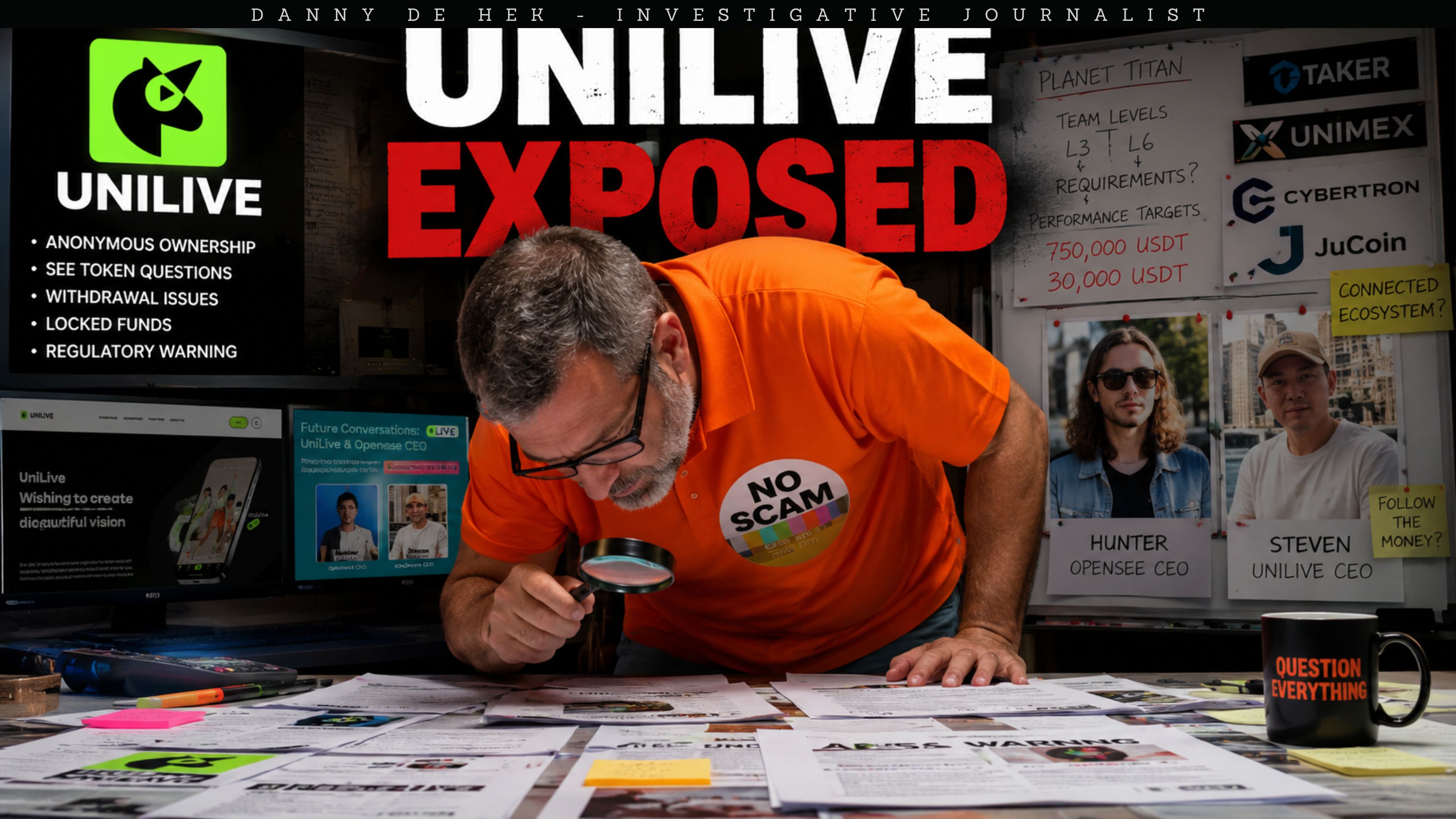
UniLive first came to my attention after receiving an anonymous tip from someone concerned about what they described as a major crypto operation operating through Telegram communities and connected projects. According to the source, users had deposited anywhere from a few hundred USDT to tens of thousands of dollars into a network involving UniLive, UniMex Exchange, Taker Protocol, Cybertron, and other related platforms.
What immediately caught my attention was not the marketing itself. It was the allegation that users who wanted to withdraw their funds were being told to deposit additional money in order to unlock what they had already invested.
That claim remains an allegation until supported by evidence. However, it was enough to justify taking a closer look.
The deeper I dug, the more familiar the story became.
The Livestreaming Story
At first glance, UniLive presents itself as something entirely different from a crypto investment platform.
According to its website, UniLive is a “global short video live social platform” and a service tool for the Web3 ecosystem. Visitors are greeted with marketing language about creativity, individuality, fan economies, content creators, social interaction, and digital innovation.
The company repeatedly describes itself as a platform where users can express themselves, interact with audiences, and participate in a new generation of social entertainment.
On the surface, it sounds like a mixture of TikTok, Twitch, and Web3 technology.
The problem is that the public-facing description raises more questions than it answers.
After reviewing the website, I found very little information about the actual operation of the business. There were no meaningful details about revenues, user numbers, creator payouts, platform economics, or independently verifiable business activity. Instead, visitors are presented with broad claims about innovation, growth, and future ambitions.
As an investigator, that immediately raises an important question:
If people are depositing USDT and expecting returns, where exactly is the money coming from?
A Website Full Of Vision But Short On Evidence
One of the first things that stood out during my review was how much of UniLive’s website focuses on aspirations rather than evidence.
The platform talks about becoming a global benchmark for social entertainment. It discusses creativity, fan economies, content creation, and digital interaction. It promises future expansion into more than twenty countries, ten million monthly active users, and a position among the world’s leading social media platforms.
What I struggled to find was evidence supporting any of those claims.
The website contains no meaningful discussion of current revenues, no independently verified user statistics, and no audited financial information. Visitors are told where the company hopes to go, but very little about where it is today.
That distinction matters.
Legitimate businesses typically use achievements to establish credibility. Problematic opportunities often rely on future promises and ambitious projections because there is less evidence available in the present.
That does not prove wrongdoing. However, it is a pattern I have seen repeatedly throughout the crypto industry.
The Missing Leadership Problem
One of the most obvious concerns involves transparency.
For a company presenting itself as a global Web3 ecosystem, there is surprisingly little information about the people behind it.
Early marketing materials featured cartoon-style executives rather than identifiable individuals. Later promotional content introduced figures identified only as “Steven” and “Hunter”, presented as the CEOs of UniLive and OpenSee respectively.
What is missing are the details investors would normally expect.
Who are they?
What are their full legal names?
What companies have they previously operated?
What verifiable track record do they have in technology, finance, or social media platforms?
These questions are not unreasonable.
If a platform is encouraging users to commit funds, lock assets, and participate in an ecosystem built around token economics, transparency about leadership should be considered the minimum standard rather than an optional extra.
The fact that investors appear to be asked to trust first names and marketing biographies should concern anyone considering involvement.
The Curious Case Of Steven
One promotional profile describes UniLive CEO “Steven” as having more than twenty years of experience in forex and cryptocurrency, having founded multiple successful projects, and holding advanced academic qualifications including a Master’s degree in Computer Science from Columbia University.
Those are impressive claims.
The issue is not the claims themselves.
The issue is the absence of verifiable information connecting those claims to a real, identifiable individual.
When executives ask investors to trust them with money, credibility cannot simply be asserted through marketing graphics. It must be independently verifiable.
At the time of writing, I have been unable to identify a publicly verifiable executive matching the profile being promoted by UniLive.
That does not mean such a person does not exist.
It does mean investors should be asking questions before accepting these credentials at face value.
The SEE Token Machine
A significant part of UniLive’s ecosystem revolves around the SEE token.
Promotional materials describe a complicated token production mechanism involving computing power, production coefficients, weight parameters, mathematical formulas, and daily token output calculations.
To many investors, these diagrams may appear sophisticated.
In reality, complexity is not the same thing as transparency.
The most important question is not whether a formula exists.
The most important question is whether the inputs are independently verifiable.
If the platform controls token issuance, controls the variables used within the formula, and controls the underlying ecosystem, then investors are effectively relying on the operator’s discretion rather than a transparent market process.
Several reviewers, including Oz at BehindMLM, have previously raised concerns that SEE token generation appears to rely primarily on internal platform mechanics rather than independently verifiable external demand.
Credit where it is due. Much of the early public analysis of UniLive’s compensation structure, token model, recruitment incentives, and ownership concerns was first documented by Oz at BehindMLM. His March 2025 review identified many of the same questions that remain unanswered today.
The Business Model Behind The Marketing
One of the most striking discoveries during my research was the gap between UniLive’s public image and the opportunity being promoted to participants.
The website largely focuses on livestreaming, social interaction, content creation, fan engagement, and creator opportunities.
Yet discussions among participants, compensation documents, marketing presentations, and independent reviews focus heavily on USDT deposits, token rewards, lock-up periods, daily returns, and recruitment incentives.
Those are two very different stories.
If UniLive is fundamentally a social media platform, then its revenues should primarily come from:
- Advertising
- User subscriptions
- Creator partnerships
- Live commerce
- Content licensing
The company itself lists these as revenue sources on its website.
However, I could find no audited financial statements, no revenue disclosures, and no independent evidence showing these activities generate sufficient income to support the rewards being promoted.
If investor returns are instead being generated through deposits, token issuance, and recruitment activity, then the livestreaming narrative may simply be functioning as a credibility layer wrapped around a financial opportunity.
That distinction is important because it changes the question from:
“How successful is the platform?”
to:
“How are returns actually being generated?”
The Planet Titan Connection
 While reviewing additional UniLive documentation, I came across a document titled “UniLive Guild And Star Streamer Application And Management Regulations.“ At first glance, it appears to be an operational guide for content creators and livestreaming guilds. However, several sections raise questions about how the wider ecosystem actually functions.
One of the most surprising discoveries was the repeated reference to Planet Titan Wealth Management. According to the document, only users whose Planet Titan wealth-management account team level is L6 or higher may apply to establish a guild, while applicants seeking “Blue Star Streamer” status must hold a Planet Titan team level of at least L3.
The document also introduces substantial performance targets measured in USDT. Guilds are required to achieve 750,000 USDT in new monthly performance, while star streamers must generate 30,000 USDT in newly added monthly performance to retain their status. Elsewhere, the document references 50,000 USDT monthly Planet Titan team performance as a threshold for increased rewards.
Perhaps most interestingly, the document references TAKER gifts, stating that users who send them may receive a TAKER transfer quota. This immediately caught my attention because independent sources have separately identified Taker Protocol as part of the broader ecosystem surrounding UniLive. While the exact relationship remains unclear, the connection warrants further investigation.
On its own, this document does not prove wrongdoing. However, it raises an obvious question. If UniLive is primarily a livestreaming and content creation platform, why are guild qualifications, performance assessments, and reward structures tied so heavily to Planet Titan, USDT performance targets, and other ecosystem components that appear unrelated to ordinary social media activity? That is a question investors and participants deserve clear answers to.
The Broken Legal Pages
Another issue that stood out during my review was surprisingly basic.
The website prominently links to:
- Terms and Conditions
- Privacy Policy
- Legal Explanation
Yet when I attempted to access these pages, they did not load.
For a platform presenting itself as a global Web3 ecosystem, this is difficult to ignore.
Investors are expected to understand the rules governing their participation, how their data is handled, what rights they have, and what obligations the company accepts.
Without functioning legal documents, users are effectively being asked to trust a platform without being able to review the terms under which it operates.
That may seem like a small detail.
It isn’t.
The Regulatory Warning
The concerns surrounding UniLive are not limited to independent investigators.
In May 2026, the Astana Financial Services Authority (AFSA) issued a public warning regarding UniLive Central Asia Ltd.
According to AFSA, the company was not authorised to provide financial services or digital asset services within its jurisdiction.
The regulator also warned about promotions involving investment opportunities and daily returns.
Regulatory warnings do not automatically prove fraud.
However, they are important because they indicate that concerns have moved beyond internet speculation and attracted the attention of financial authorities.
For investors, that should serve as a signal to perform significantly more due diligence before committing funds.
The Real Test Comes At Withdrawal
Throughout my investigation, I kept coming back to the same question.
Not the livestreaming platform.
Not the SEE token.
Not the mathematical formulas.
Not the promises of a Web3 ecosystem.
The question that matters most is what happens when investors attempt to withdraw their money.
Every opportunity looks legitimate when deposits are flowing in. Every platform appears successful while people are joining, recruiting, and sharing screenshots of balances growing on a dashboard. The real test comes when participants decide they want their money back.
That is where the most serious allegations surrounding UniLive begin to emerge.
Multiple sources have claimed that withdrawal conditions changed over time, that funds became difficult to access, and that users were encouraged to make additional deposits in order to unlock existing balances. At the time of writing, these claims still require further verification. I have requested supporting evidence including account screenshots, withdrawal requests, wallet transactions, support communications, and platform announcements.
If those allegations are substantiated, they would raise significant questions about how the platform is operating and whether participants are being treated fairly.
What makes this particularly important is that UniLive’s public image bears little resemblance to the concerns being raised privately by users. The website promotes creativity, social interaction, content creation, fan engagement, and Web3 innovation. Yet the conversations happening behind the scenes appear to revolve around locked funds, withdrawal concerns, token rewards, and investment-related activity.
That disconnect is difficult to ignore.
There are also broader questions that remain unanswered. Who are the individuals ultimately responsible for operating UniLive? What independent evidence exists to support the revenue claims behind the ecosystem? How much of the platform’s activity is driven by genuine users versus participants attracted by financial incentives? What relationship exists between UniLive, UniMex Exchange, Taker Protocol, Cybertron, and the other projects repeatedly mentioned by sources?
These are not minor details.
They go to the heart of whether UniLive is delivering what it promises.
For now, the public evidence paints a picture of a platform with anonymous leadership concerns, an internally generated token economy, regulatory scrutiny, broken legal documentation, and a growing number of unanswered questions from participants.
As always, I encourage anyone involved with UniLive, UniMex, Taker Protocol, Cybertron, or related projects to contact me if they have documentation, screenshots, wallet addresses, transaction records, presentations, Zoom recordings, or other evidence that may assist this investigation.
The story is still developing.
And as I have learned after investigating hundreds of schemes over the years, the most important information often emerges only after people start asking difficult questions.
Disclaimer: How This Investigation Was Conducted
This investigation relies entirely on OSINT — Open Source Intelligence — meaning every claim made here is based on publicly available records, archived web pages, corporate filings, domain data, social media activity, and open blockchain transactions. No private data, hacking, or unlawful access methods were used. OSINT is a powerful and ethical tool for exposing scams without violating privacy laws or overstepping legal boundaries.
About the Author
I’m DANNY DE HEK, a New Zealand–based YouTuber, investigative journalist, and OSINT researcher. I name and shame individuals promoting or marketing fraudulent schemes through my YOUTUBE CHANNEL. Every video I produce exposes the people behind scams, Ponzi schemes, and MLM frauds — holding them accountable in public.
My PODCAST is an extension of that work. It’s distributed across 18 major platforms — including Apple Podcasts, Spotify, Amazon Music, YouTube, and iHeartRadio — so when scammers try to hide, my content follows them everywhere. If you prefer listening to my investigations instead of watching, you’ll find them on every major podcast service.
You can WORK WITH ME for dedicated access to my time and investigative services — including private consultations, scam-risk reviews, sponsored investigations, support sessions, livestream scam breakdowns, and interviews. I’m also available for SPEAKING ENGAGEMENTS, where I share first-hand experience from years of exposing large-scale fraud, investigating scams, and supporting victims.
“Stop losing your future to financial parasites. Subscribe. Expose. Protect.”
My work exposing crypto fraud has been featured in:
- Coffeezilla 2026): Featured in the investigation exposing the alleged $328M Goliath Ventures Ponzi scheme
- Bloomberg Documentary (2025): A 20-minute exposé on Ponzi schemes and crypto card fraud
- News.com.au (2025): Profiled as one of the leading scam-busters in Australasia
- OpIndia (2025): Cited for uncovering Pakistani software houses linked to drug trafficking, visa scams, and global financial fraud
- The Press / Stuff.co.nz (2023): Successfully defeated $3.85M gag lawsuit; court ruled it was a vexatious attempt to silence whistleblowing
- The Guardian Australia (2023): National warning on crypto MLMs affecting Aussie families
- ABC News Australia (2023): Investigation into Blockchain Global and its collapse
- The New York Times (2022): A full two-page feature on dismantling HyperVerse and its global network
- Radio New Zealand (2022): “The Kiwi YouTuber Taking Down Crypto Scammers From His Christchurch Home”
- Otago Daily Times (2022): A profile on my investigative work and the impact of crypto fraud in New Zealand

Leave A Comment