


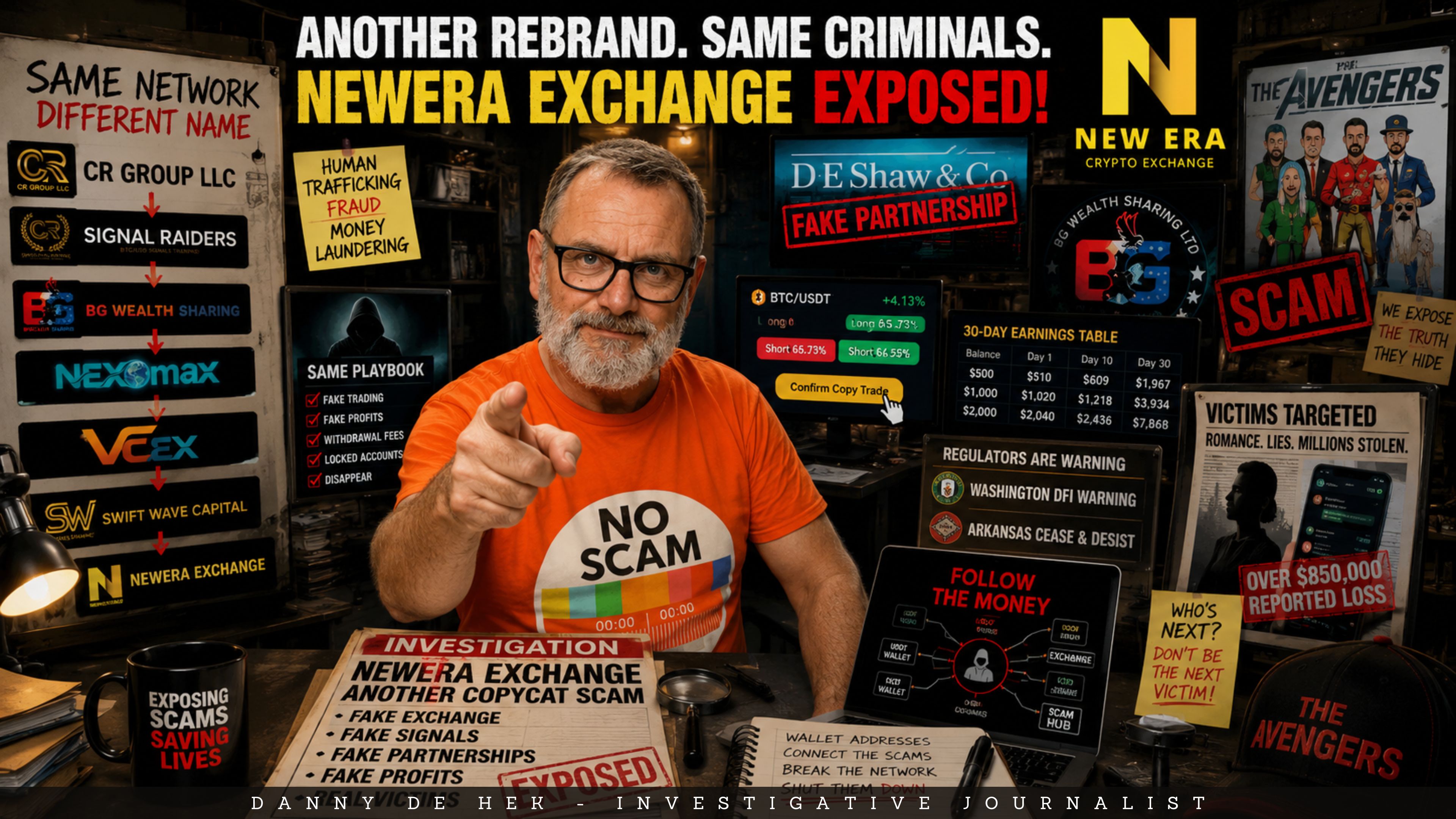
“The names change, the colours change, the domains change — but the trap underneath is painfully familiar.”
I want people to understand something before they look at NEW ERA WE, New Era Exchange, or whatever name this thing decides to use next week. I am not looking at this as a random crypto website that suddenly appeared on the internet.
I am looking at it through the lens of what we have already witnessed with CR GROUP LLC, Signal Raiders, BG Wealth Sharing, NEXO, and Swift Wave Capital. These scams do not simply collapse, vanish, and die. They study what went wrong, tweak the script, change the branding, move victims into a more controlled environment, and start again under a new costume.
With BG Wealth Sharing, many people only saw the final act. They saw the frozen withdrawals, the panic, the excuses, the meetings, the promoters trying to calm everyone down, and the desperate push to get victims to pay even more money. But this pattern did not begin with BG Wealth Sharing. Before that, we saw CR GROUP LLC in New Zealand. When that operation went pear-shaped around 25 December, people were allegedly told they had to pay 20% of whatever was showing in their account balance to free up their own money. That is not investing. That is not trading. That is a hostage situation dressed up as a financial platform.
Just before the collapse, CR GROUP LLC rebranded itself into Signal Raiders. The Avengers managed to expose that quickly and helped stop it gaining the traction they were hoping for. Then came BG Wealth Sharing, with the same kind of fake wealth-building dream, but with a more refined control system. The scammers learned from Telegram. Telegram was too open. People like us could get inside, collect evidence, warn victims, and expose promoters. So when the model evolved, the victims were pushed into BonChat, a far more dangerous and controlled app environment where the scammers could manage the room, control the narrative, and keep people away from outside scrutiny.
Now we are looking at newerawe.com, and the pattern is there again. I am not saying every single domain, promoter, or fake platform has been legally proven in court to be controlled by the exact same people. What I am saying is that the behavioural pattern, website structure, recruitment model, fake-yield logic, signal-trading theatre, withdrawal obstruction, and rebrand timing all deserve serious public scrutiny. When you have seen enough of these scams, you stop being fooled by a new logo and a different colour scheme.
This matters because victims of one scam are often targeted again. In my experience, once someone has been pulled into one of these “investment opportunity” groups, they become a warm lead for the next one. They already understand USDT. They already know how to use a wallet. They have already been taught to trust screenshots, fake dashboards, group leaders, daily signals, and withdrawal stories. That is why these rebrands are so dangerous. They are not just looking for new victims. They are recycling the same damaged communities and bleeding them again.
New Era Is Not Just A Website — It Is A Recycled Playbook
When I first looked at newerawe.com, one thing stood out immediately. If you visited the domain without the www, the site did not behave like a normal public-facing crypto exchange. Instead, it displayed a strange technical warning saying the current access method was not permitted. It listed the host as newerawe.com, the URL as /, the IP address as 239.345.118.51, and the node as Cluster 4 Eu Google 1. It then claimed users were accessing the service directly through a node IP address, even though the domain name had been used.
The wording was also suspicious. It talked about using the correct domain name to “enable full security protection” and “correctly load all resources.” Then came the grand claim: an “industry-exclusive, top-tier intelligent CDN system” that was supposedly “impervious to CC attacks and immune to firewall-bypassing attacks.” That is not how legitimate financial platforms normally talk to the public. It reads more like infrastructure designed to block casual inspection, frustrate investigators, and funnel users through specific access points.
But when you visited https://www.newerawe.com and used an affiliate-style pathway, the platform opened. That is important. Scams like this often hide behind invitation links, referral links, app downloads, private groups, or controlled onboarding instructions. The public face can be vague or restricted, while recruited members are walked through a specific process by someone they already trust. That is how victims are moved from curiosity into compliance.
The New Era website then presents itself as a professional crypto exchange. It uses a black and yellow New Era Crypto Exchange logo, displays crypto markets, promotes spot trading, perpetual contracts, delivery contracts, copy trading, financial products, locked mining, USDT deposits, app downloads, and referral rewards. On the surface, it looks like a complete trading ecosystem. But when you look deeper, it starts to look less like a real exchange and more like a scam template wearing an exchange costume.
A few of the early red flags are obvious:
- Restricted access behaviour depending on how the domain is entered
- Affiliate-style access pathways instead of normal public transparency
- Huge security claims with no meaningful proof
- Exchange-style visuals without verifiable exchange accountability
- USDT deposit pathways wrapped in fake trading language
That is why I do not look at this as a standalone website. I look at it as part of a wider pattern. The branding changes, but the scam logic keeps showing its face.
The Fake Exchange Illusion
“A website can display crypto prices. That does not mean real trading is happening.”
The markets page is designed to make people feel they are looking at a functioning cryptocurrency exchange. It shows trading pairs like BTC/USDT, ETH/USDT, YFI/USDT, LTC/USDT, DOGE/USDT, XTZ/USDT, XRP/USDT, and others. It has “Trade” buttons, top gainers, top losers, volume rankings, spot markets, perpetual markets, and delivery markets. For someone new to crypto, that looks impressive. It looks like activity. It looks like legitimacy.
But the question is not whether a website can display crypto prices. Any scammer can scrape prices, fake prices, delay prices, or build a front end that looks like an exchange. The real question is whether there is verifiable trade execution, regulated custody, proper licensing, audited financials, named directors, real corporate accountability, and unrestricted withdrawals. That is where these platforms usually fall apart. They show the performance, but not the proof.
The homepage throws in all the usual bait. It talks about discovering the next “meme gems,” grabbing a 200,000 USDT cash prize, new users getting $10, trading new coins to share $10,000, and buying mainstream coins to receive interest coupons. It even promotes strange token activity and carnival-style trading events. This is not calm, regulated financial communication. It is casino-style engagement wrapped in crypto language.
Then we get the big global claims. New Era claims to have 15,000,000+ registered users, 210+ countries and regions covered, 800+ super altcoins, and more than 5.8 billion USDT in 24-hour trading volume. Those are enormous claims. Yet the website gives no meaningful evidence to support them. No named leadership. No credible regulatory footprint. No transparent company structure. No serious proof that this exchange is trusted by millions of real users.
That contradiction is one of the biggest red flags: huge claims, tiny accountability. A real global exchange with millions of users should be easy to verify. You should not have to dig through strange domain behaviour, app links, shell-company claims, recycled templates, and anonymous promotional material to work out who is actually behind it.
The Daily Yield Trap
The “Financial business” section is where the mask starts slipping badly. The website lists fixed financial products with daily yields and locked periods. It shows products such as Financing 5 Days, Financing 15 Days, Financial 30 Days, Financial 60 Days, and Financing 90 Days. The daily yields increase from 0.3% to 1.2% depending on the product, with single limits reaching up to 9,999,999.
That is the same psychological hook we saw in BG Wealth Sharing and similar schemes. Victims are shown a daily return. The number feels small enough to seem believable, but large enough to become addictive. A person sees their balance grow every day and starts to believe the platform is working. They stop asking where the money is really coming from because the dashboard gives them the answer they want to see.
New Era’s own “Revenue calculation” example is even more revealing. It describes a member depositing 10000U and choosing a wealth management product with a daily income of 1.0% to 3.0%. It then calculates the income as 100U to 300U per day. That is not normal investment language. That is Ponzi bait. A platform casually implying that someone can earn hundreds of dollars a day from a fixed deposit is not educating investors. It is conditioning victims.
There is also wording about “moving bricks” by hosting USDT on the platform while a professional team carries out arbitrage. That phrase alone should make people stop. It sounds like poor translation, but it also sounds like the same vague arbitrage story used by countless crypto scams. They never show you the trades. They never show you the counterparty. They never show you the audited books. They just tell you there is a professional team somewhere generating magical returns.
The formula is simple:
- Show the victim a daily return
- Make the dashboard balance increase every day
- Let them believe the “professional team” is doing the work
- Encourage them to deposit more
- Then block or complicate the withdrawal when it matters
That is why the daily yield is not just a marketing claim. It is the emotional engine of the scam.
The Click-A-Button Theatre
One of the strongest pieces of evidence is the app screenshot showing the user being asked to press “Confirm Copy Trade.” The screen shows BTC/USDT, a purchase duration of 60 seconds, an available balance of 706 USDT, and “Short” and “Long” percentages sitting around the mid-60s. This is the same basic theatre used in “click a button” Ponzi schemes. The victim is made to believe they are participating in trading, when in reality they are simply following instructions inside a closed system.
This is where people need to think critically. If New Era, or any platform like it, genuinely has profitable trading signals, why would it need thousands of random people pressing buttons manually? If the trade is real, the platform could execute it automatically. If the signal is real, it could be traded through a proper broker or exchange. If the strategy is real, it would not need victims sitting in WhatsApp, BonChat, Telegram, or an app clicking buttons at the right time.
The answer is simple: the button-clicking creates belief. It makes the victim feel involved. It makes them feel disciplined. It makes them think their daily action is producing the daily return. That is exactly what we saw with BG Wealth Sharing and DSJ Exchange. People were not really trading. They were being trained to obey a ritual.
BehindMLM described New Era Exchange as a “trading signals ‘click a button’ Ponzi” and reported that the first known iteration used neweraeducation.com before later domains such as qbguye.com, www.newerawe.com, and newerain.com appeared. A tip of the hat to Oz at BehindMLM for his research and opinion on this, because the “click a button” model is one he has documented across many similar app-based Ponzi schemes.
Source: https://behindmlm.com/mlm-reviews/newera-exchange-review-trading-signals-click-a-button-ponzi/
The D.E. Shaw & Co Name-Dropping
“Scammers love borrowed credibility because it lets them wear someone else’s reputation.”
The marketing material using D.E. Shaw & Co is one of the most serious red flags. The screenshot shows New Era branding alongside D.E. Shaw & Co, with phrases like “Global Strategic Partner”, “Trade NE With Precision”, and “Smart Signals • Stable Strategy • Long-Term Value.” This is not a small detail. This is the kind of borrowed credibility scammers use to make victims believe there is institutional backing behind the platform.
BehindMLM states that D.E. Shaw Group is a real multinational investment management firm, but says it has nothing to do with New Era Exchange. If New Era is falsely implying a relationship with D.E. Shaw, that is not just a marketing exaggeration. That is a deception designed to make victims lower their guard. It is the same kind of authority hijacking we have seen again and again: use a big financial name, a fake professor, a fake expert, a fake compliance certificate, or a fake partnership to make the scam feel safe.
The “Signal Trading Rules” screenshot goes further. It says users must register using an exclusive D.E. Shaw & Co invitation code, complete their first deposit, and join a globally unified trading signal program supposedly provided by D.E. Shaw & Co. It claims the program delivers three stable profit signals daily, with trades allocated at 1% of the account balance. This is almost a perfect example of how these scams blend fake authority with daily obedience.
That wording matters because it creates a chain of belief. The victim thinks: D.E. Shaw is real, therefore the signals must be real. The signals appear daily, therefore the system must be active. The account balance increases, therefore the profits must be real. But if the entire platform is controlled by the scammers, then the “profit” is just a number on a screen until a real withdrawal proves otherwise.
This is why fake partnerships are so dangerous. They do not need to fool everyone. They only need to fool the person who is about to send USDT.
The Earnings Table And The Compounding Fantasy
The 30-day earnings table is another powerful piece of evidence. It shows a $500 balance growing to $510 on Day 1, $520 on Day 2, and $609 by Day 10. It shows $1,000 growing to $1,218 by Day 10, and $2,000 growing to $2,436. That is roughly the same fantasy we keep seeing: daily growth, compounding confidence, and a dashboard that makes the victim feel richer every time they log in.
This is how the emotional trap works. At first, the person is nervous. Then they see small gains. Then they see a withdrawal, or they are shown someone else’s withdrawal. Then they deposit more. Then they recruit family and friends. Then the platform tells them they qualify for better returns, better ranks, better signals, or bigger rewards. Before they know it, they are no longer just a victim. They have become part of the distribution network.
That is why these scams are so destructive. The money loss is terrible, but the relationship damage can be even worse. People recruit parents, cousins, church friends, workmates, neighbours, and vulnerable people who trusted them. Then when the withdrawals stop, the scammers disappear and the promoter is left facing the community.
This is why I keep saying that people need to stop looking at these platforms as “investment mistakes.” Many of them are structured to weaponise trust. They do not just take money from individuals. They turn communities into pipelines.
The MLM Recruitment Structure
New Era also appears to include a multi-level reward system. The website material shows promotion invitation rewards across first-level, secondary, and tertiary users. The structure listed on the site includes 20% miner reward and 5% first buy reward for first-level users, 10% and 3% for secondary users, and 5% and 1% for tertiary users.
That matters because it moves the platform away from being a simple fake exchange and into the territory of recruitment-driven income. A real crypto exchange does not need users building downlines to generate returns. A real exchange makes money through trading fees, spreads, custody services, and legitimate products. It does not need ordinary people recruiting ordinary people into locked-yield schemes and signal-trading rooms.
BehindMLM’s breakdown also describes New Era’s compensation plan as paying on recruitment of promoter investors, including new member rewards, VIP team rewards, and ROI matches tied to downline activity. Again, a tip of the hat to Oz at BehindMLM for documenting those mechanics, because this is the kind of structure that helps explain why these schemes spread so quickly through social networks.
Once recruitment becomes part of the income model, the whole thing changes. People stop asking whether the trading is real and start asking how many people they can bring in. That is the point. The so-called investment becomes a recruitment race. The people who arrive early may get paid with money from those who arrive later. The majority are left holding the bag when the platform locks withdrawals, demands fees, or disappears.
The warning signs here are not subtle:
- Three-level rewards
- First-buy bonuses
- Recruitment-linked incentives
- VIP-style rank rewards
- ROI matches tied to downline activity
That is not the structure of a normal exchange. That is the structure of a recruitment machine.
The Washington Warning: Romance, WhatsApp And An $850,000 Loss
The Washington State Department of Financial Institutions issued an alert on February 3, 2026, warning that an alleged cryptocurrency trading platform called New Era Web appeared to be engaged in fraud. According to the warning, a Washington resident was introduced to New Era Web by someone using the name Thuy-Trang Pham, who first contacted the investor on LinkedIn, moved the communication to WhatsApp, cultivated a romantic relationship, and then encouraged the investor to invest in cryptocurrency online.
The details are chilling because they show the same psychological pattern we see in pig-butchering and investment scams. The victim was allegedly shown screenshots of large withdrawals, reportedly over $700,000, and then guided through transferring funds to the platform. Several months later, the platform showed the victim had achieved returns of almost five times the original investment. That is the bait: show the person that the system works, make the dashboard look profitable, then wait until they try to withdraw.
When the investor attempted to withdraw, the platform allegedly claimed the account was under suspicion for money laundering and demanded an additional $400,000 before the funds could be released. The reported loss was approximately $850,000. That is not a normal compliance process. That is an advance-fee trap. The excuse changes from platform to platform, but the demand is always the same: pay more money to access the money you already supposedly own.
This is where the comparison becomes unavoidable. CR GROUP LLC allegedly demanded 20% to unlock funds. BG Wealth Sharing allegedly pushed a 12% fee or unlock-style payment after withdrawals failed. New Era Web allegedly demanded $400,000 under the excuse of money-laundering verification. Different wording. Same trap.
The Arkansas Cease And Desist Order
The Arkansas Securities Department’s cease and desist order gives us another layer of evidence. The order, dated March 5, 2026, names neweraeducation.com as the respondent and states that Arkansas staff had evidence indicating New Era violated provisions of the Arkansas Uniform Money Services Act. The order describes New Era as a platform claiming to provide secure, transparent, and efficient digital asset trading through its website.

The order says New Era did not provide information on its website about its principal place of business or jurisdiction of formation. It also states that New Era’s website claimed it was operated and managed by individuals including Stephen A. Schwarzman, Joseph Baratta, Joan Solotar, and Jeremy Coller — people associated with Blackstone. But the order says there was no evidence showing Blackstone or those individuals were actually involved with New Era.
That is huge. It shows the same pattern as the D.E. Shaw material: attach the scam to real financial names to create trust. New Era also allegedly claimed partnerships with major institutions such as Coinbase and J.P. Morgan Asset Management, but the Arkansas order says there was no evidence indicating those partnerships existed. This is how fake legitimacy is built. You take real names, place them beside your scam, and hope victims do not check.
The Arkansas order also describes a customer complaint involving an Arkansas resident, referred to as AR1, who discovered New Era through Facebook and was introduced to someone called Carolynne Bowlan. Staff were unable to verify Bowlan’s identity, found no records linking Bowlan to New Era, and AR1 confirmed that Bowlan was using photos taken from an unrelated Instagram account. That led staff to conclude Bowlan was a persona being used by an unidentified individual.
The Arkansas Victim Story: Small Withdrawals, Big Deposit, Locked Funds
“The first withdrawal is not proof the platform is real. Sometimes it is bait.”
The Arkansas complaint follows the exact pattern we have seen so many times. AR1 was allegedly instructed to deposit and withdraw funds from their New Era account on two separate occasions. This is a classic trust-building tactic. The scammer lets the victim move money in and out early so they believe the platform is real. Once the victim sees that money can be withdrawn, their fear drops and their deposit size increases.
After those first two transfers, AR1 was allegedly instructed to move money to Crypto.com, convert it into cryptocurrency, and deposit it into the New Era account. According to the order, AR1 transferred over $1.4 million over several weeks. The order also says the cryptocurrency in the New Era account appeared to accrue interest at 2% daily, which caused AR1 to believe the account had grown with profits.
Then came the withdrawal attempt. When AR1 tried to withdraw, Bowlan allegedly told them they needed to provide an additional $405,000 for identification verification before the withdrawal could be processed. That is the moment the scam reveals itself. The dashboard profit was not the end goal. The end goal was to get one more payment.
The order then describes an even more disturbing step. Bowlan allegedly offered to help AR1 with the additional funds by arranging a $170,000 wire transfer from a supposed friend named Douglas Bacon. AR1 was then instructed to send those funds to Crypto.com, convert them to cryptocurrency, transfer the balance to Bacon’s New Era account, and Bacon would supposedly transfer the cryptocurrency to Bowlan. Thankfully, before AR1 transferred the money, a bank employee intervened and told AR1 they were being scammed.
That bank employee may have prevented an even larger loss. But the fact that AR1 had already transferred more than $1.4 million shows how powerful this model can be once trust has been built.
The Same Withdrawal Trap In A Different Costume
This is why I want people to stop focusing on the logo and start focusing on the mechanics. Whether the scam is called CR GROUP LLC, Signal Raiders, BG Wealth Sharing, NEXO, Swift Wave Capital, New Era, or something else next week, the withdrawal trap is usually the moment of truth.
The platform works perfectly while you are depositing. The dashboard grows. The groups celebrate. The promoters tell stories. The leaders talk about strategy, signals, AI, arbitrage, mining, quant trading, or institutional partners. But when enough people try to withdraw, suddenly there is a problem. Your account is suspicious. You need to verify your identity. You need to pay tax. You need to pay a fee. You need to unlock the funds. You need to show proof. You need to act quickly.
That is not how legitimate financial platforms behave. A real platform does not demand a fresh external payment before releasing your existing balance. Fees, taxes, and commissions are normally deducted from funds, not demanded as a separate payment into the same questionable system. When a platform says you must pay more money to access your own money, you are almost certainly looking at a scam.
This is the pattern people must remember: the fake profit gets you excited, the first withdrawal gets you confident, the big deposit gets you trapped, and the unlock fee finishes the job.
The Source Code And The Staging Site Clue
Another important clue comes from the source code screenshot showing https://www.newerawe.com/app.html. Inside the page source, there appears to be a reference to asiaex-pro.com. BehindMLM also reported that asiaex-pro.com appeared to be a staging site from which live New Era Exchange websites were pulled.
That matters because these scam sites are often mass-produced. The public sees a polished brand, a logo, a homepage, a fake exchange, and a story about global finance. But underneath, investigators often find reused templates, shared scripts, strange staging domains, Chinese-language code, recycled app structures, and the same operational fingerprints appearing across different brands.
BehindMLM also noted Chinese-language code in the New Era website source. That does not prove by itself who is running the scheme, but it is relevant when the public-facing narrative points elsewhere. These scams often use Western names, Canadian shell companies, New York financial institutions, fake global partnerships, and English-language marketing while the technical or operational trail points in another direction.
This is why OSINT matters. Screenshots matter. Source code matters. Wallet addresses matter. Domain history matters. App download links matter. Referral links matter. If victims only report the front-facing website name, we may miss the infrastructure connecting one scam to another.
Why Wallet Addresses Matter
If you have signed up for CR GROUP LLC, Signal Raiders, BG Wealth Sharing, NEXO, Swift Wave Capital, New Era, New Era Web, New Era Exchange, newerawe.com, neweraeducation.com, newerain.com, qbguye.com, or any related platform, please do not just send screenshots of your dashboard. The most useful thing you can provide is the wallet address you sent money to.
Wallet addresses help investigators connect schemes together. They can show whether different platforms are using shared infrastructure, shared laundering pathways, shared deposit wallets, shared exchange accounts, or related movement patterns. A website can be deleted. A Telegram group can be closed. A BonChat room can vanish. A promoter can change their name. But blockchain transactions leave a trail.
This is how we start linking these scams together. This is how we show that what looks like a “new opportunity” may actually be the next version of the same criminal machine. It also helps build pressure on exchanges, regulators, law enforcement, journalists, and blockchain investigators to follow the money instead of chasing fake company names.
There is also a bigger ethical issue here. Many of these scams are now linked to organised cybercrime and human trafficking compounds in Southeast Asia and beyond. That does not mean every promoter understands the full machine behind the platform. But it does mean that every deposit into one of these schemes may be feeding a much darker network than victims realise. This is not just “someone made a bad investment.” This is industrialised fraud.
What New Era Teaches Us About The Rebrand Cycle
The most important lesson from New Era is that these scams evolve. They do not become more legitimate. They become better packaged. CR GROUP LLC allegedly used one model, then Signal Raiders appeared, then BG Wealth Sharing refined the signal-trading and chat-room control model, then NEXO and Swift Wave Capital echoed the same structure, and now New Era appears with a more polished fake-exchange front end, copy trading, financial products, locked mining, institutional name-dropping, and app-based button-clicking.
The scammers are learning. They learned that Telegram could be infiltrated. They learned that fake dashboards need to look more like exchanges. They learned that victims trust big financial names. They learned that daily compounding tables are powerful. They learned that small withdrawals build confidence. They learned that urgency works. They learned that once a victim has been trained to use USDT, they can be moved from one scam to the next.
But we are learning too. We are learning to spot the rebrand before it reaches critical mass. We are learning to preserve screenshots, source code, wallet addresses, app links, promotional material, and domain records. We are learning to compare the scripts, the numbers, the withdrawal excuses, the chat platforms, and the fake authority figures.
That is why this blog exists. Not just to expose New Era, but to show the public how the machine works. If you understand the mechanics, you are harder to fool. If you recognise the pattern, the next logo will not impress you. If you know what the withdrawal trap looks like, you will not send another payment to “unlock” fake profits.
The Name Changes, But The Playbook Doesn’t
New Era has too many red flags to ignore. It presents itself as a crypto exchange, but promotes fixed daily returns, copy trading, financial management products, locked mining, referral rewards, app-based signals, and massive unverifiable global claims. It has been connected through reporting and regulatory material to fake institutional claims, suspicious withdrawal demands, romance-style grooming, fake personas, and alleged unlicensed money transmission activity.
The Washington DFI warning described a victim losing approximately $850,000 after being shown fake-looking profits and then being told to pay $400,000 to release funds. The Arkansas cease and desist order describes a separate case involving more than $1.4 million transferred, alleged 2% daily interest, and a demand for $405,000 for identification verification before withdrawal. These are not minor warning signs. These are the mechanics of a serious financial fraud operation.
If you are inside one of these platforms now, stop depositing. Do not pay any unlock fee, tax, verification charge, anti-money-laundering fee, withdrawal fee, or “temporary” security deposit. Do not believe screenshots of other people withdrawing. Do not trust a promoter just because they sound confident, spiritual, successful, or kind. Confidence is not evidence.
And if you have already deposited, preserve everything. Save screenshots. Save chats. Save wallet addresses. Save transaction hashes. Save referral links. Save app download links. Save names, phone numbers, usernames, and payment instructions. Then report it. The faster this evidence is collected, the harder it becomes for the scammers to simply rebrand and move on to the next group of victims.
Disclaimer: How This Investigation Was Conducted
This investigation relies entirely on OSINT — Open Source Intelligence — meaning every claim made here is based on publicly available records, archived web pages, corporate filings, domain data, social media activity, and open blockchain transactions. No private data, hacking, or unlawful access methods were used. OSINT is a powerful and ethical tool for exposing scams without violating privacy laws or overstepping legal boundaries.
About the Author
I’m DANNY DE HEK, a New Zealand–based YouTuber, investigative journalist, and OSINT researcher. I name and shame individuals promoting or marketing fraudulent schemes through my YOUTUBE CHANNEL. Every video I produce exposes the people behind scams, Ponzi schemes, and MLM frauds — holding them accountable in public.
My PODCAST is an extension of that work. It’s distributed across 18 major platforms — including Apple Podcasts, Spotify, Amazon Music, YouTube, and iHeartRadio — so when scammers try to hide, my content follows them everywhere. If you prefer listening to my investigations instead of watching, you’ll find them on every major podcast service.
You can WORK WITH ME for dedicated access to my time and investigative services — including private consultations, scam-risk reviews, sponsored investigations, support sessions, livestream scam breakdowns, and interviews. I’m also available for SPEAKING ENGAGEMENTS, where I share first-hand experience from years of exposing large-scale fraud, investigating scams, and supporting victims.
“Stop losing your future to financial parasites. Subscribe. Expose. Protect.”
My work exposing crypto fraud has been featured in:
- Coffeezilla (2026): Featured in the investigation exposing the alleged $328M Goliath Ventures Ponzi scheme
- Bloomberg Documentary (2025): A 20-minute exposé on Ponzi schemes and crypto card fraud
- News.com.au (2025): Profiled as one of the leading scam-busters in Australasia
- OpIndia (2025): Cited for uncovering Pakistani software houses linked to drug trafficking, visa scams, and global financial fraud
- The Press / Stuff.co.nz (2023): Successfully defeated $3.85M gag lawsuit; court ruled it was a vexatious attempt to silence whistleblowing
- The Guardian Australia (2023): National warning on crypto MLMs affecting Aussie families
- ABC News Australia (2023): Investigation into Blockchain Global and its collapse
- The New York Times (2022): A full two-page feature on dismantling HyperVerse and its global network
- Radio New Zealand (2022): “The Kiwi YouTuber Taking Down Crypto Scammers From His Christchurch Home”
- Otago Daily Times (2022): A profile on my investigative work and the impact of crypto fraud in New Zealand






Leave A Comment