


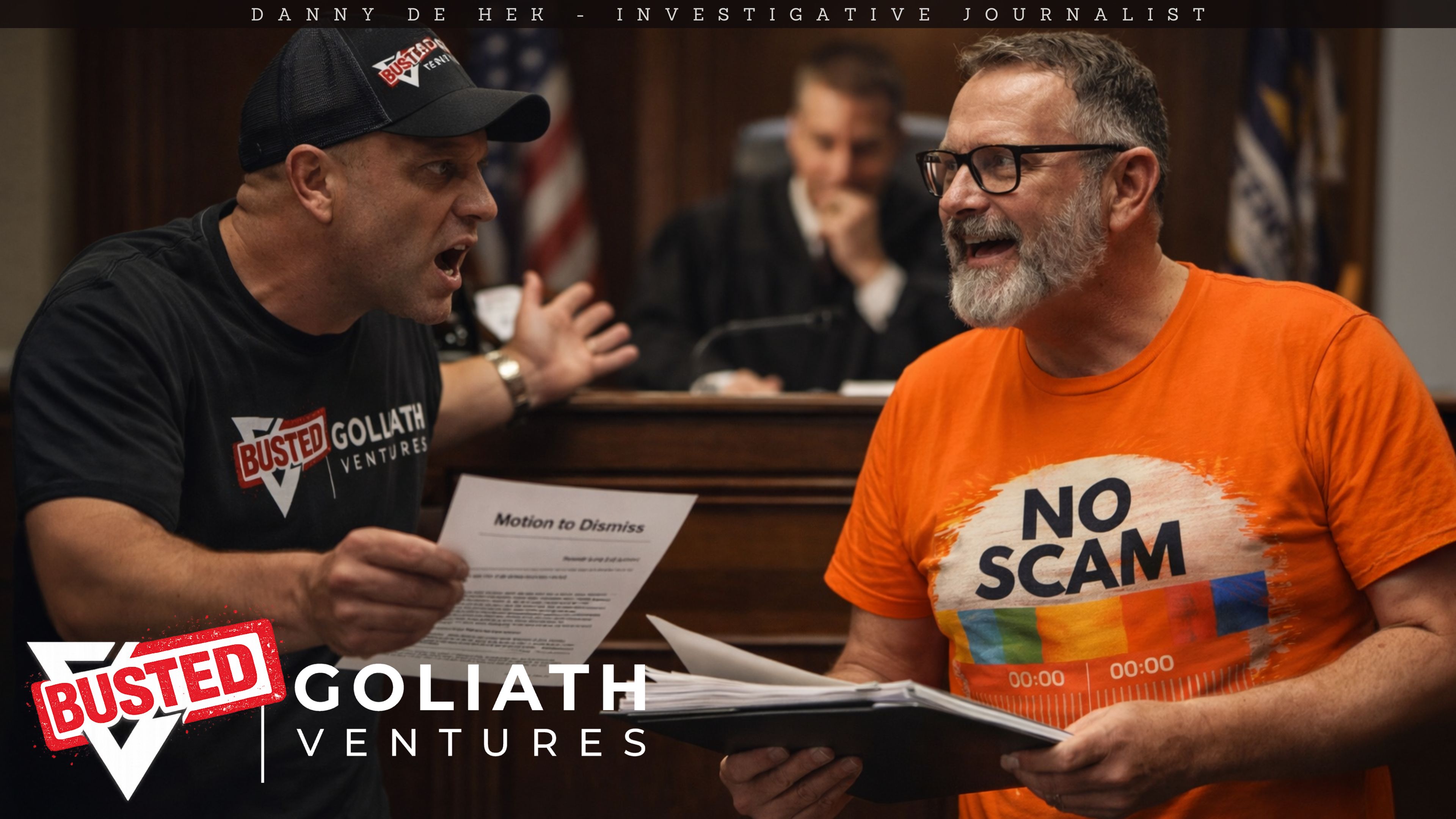
“The most dangerous person in a Ponzi scheme isn’t always the one selling it — it’s the one making it sound legitimate.”
I’ve been following the Goliath Ventures collapse from the inside out — not just the headlines, not just the arrests, but the emails, the court filings, the investor communications, and the excuses that surfaced as the structure began to crack. What started as a crypto “liquidity pool” promising 4–5% monthly returns has now unravelled into what authorities allege is a $328 million+ fraud, with Christopher Delgado at the centre.
But these schemes don’t operate in isolation. They rely on layers — promoters, systems, narratives, and most importantly, credibility anchors. People or institutions that give the entire operation just enough legitimacy to keep investors from asking the hard questions.
That’s where Eric Clayman comes in.
On the surface, he presents himself as external corporate counsel — a criminal defence lawyer with no involvement in the operational side of Goliath. In private correspondence, he goes even further, stating plainly that he has “nothing to do with Goliath as it relates to their actual endeavors.” That’s a clean line. A deliberate separation.
But when you start lining up the documents — the calls, the letters, the lawsuit, the motion to dismiss — that line begins to blur. And once it blurs, it raises a much more important question:
At what point does a lawyer stop being independent counsel and start becoming part of the machine?
The public position vs the paper trail
 Clayman’s position is clear, and to be fair, it’s consistent across both his private communications and his legal filings. In his April 10, 2026 Motion to Dismiss, he frames himself — and even his own family — as victims of Delgado’s scheme, arguing that he had no role in soliciting investors and no involvement at the critical moments when funds were committed.
The motion is structured around a familiar legal strategy: narrow the scope, isolate the timeline, and challenge the sufficiency of the allegations. It leans heavily on the idea that he never directly persuaded Prestige to invest, and that the complaint relies on “information and belief” rather than concrete facts when it comes to his role in drafting agreements. From a legal standpoint, it’s not a weak argument — it’s technical, precise, and designed to meet the threshold required at this stage of proceedings.
But investigative work doesn’t stop at what’s pleaded — it looks at patterns of behaviour across time. And when you step outside the narrow framing of the motion and look at the broader timeline, you start to see something the defence doesn’t address: ongoing involvement during the collapse phase.
That distinction matters. Because in Ponzi schemes, the collapse phase is where the real damage is managed — or concealed.
A lawyer operating outside his lane
Eric Clayman is not a securities lawyer. He’s not a crypto compliance expert. His background is in criminal defence — DUIs, narcotics, courtroom advocacy. There’s nothing inherently wrong with that, but it’s a world away from structuring or advising on high-yield investment programmes built around crypto liquidity strategies.
And yet, that’s exactly where he ended up.
According to the complaint and supporting materials, Clayman was involved — at least to some degree — in the joint venture agreements used to formalise investments into Goliath. Now, his defence challenges the sufficiency of those allegations, arguing they lack specificity. That’s a legal question the court will decide.
But from an investigative perspective, the more important issue is this:
Why was a criminal defence lawyer anywhere near the documentation of a high-risk investment structure promising fixed monthly returns?
That’s not a technicality. That’s a red flag.
Because one of the most common patterns in these schemes is the use of borrowed credibility — bringing in professionals whose titles carry weight, even if their expertise doesn’t align with the product being sold.
The moment withdrawals froze
By late 2025, the cracks were no longer theoretical — they were visible.
Withdrawals began to freeze. Investors started asking questions. The narrative shifted from growth and returns to delays, audits, and explanations. This is the phase where a scheme either collapses outright or tries to stabilise itself through communication.
On November 18, 2025, Clayman stepped into that communication channel during a call with Prestige, a firm that had already committed around $1.3 million.
During that call, he reportedly:
- Referenced having personally reviewed Goliath’s balances
- Suggested there were still “$100–200 million” remaining
- Attributed delays to banking and audit issues
- Advised against pushing aggressively for immediate withdrawals
His legal team later pointed out that, according to the investor’s own notes, he also said they could ask Delgado for their money back.
But that single line doesn’t cancel out the broader message being delivered.
Because the overall tone — and this is critical — was one of reassurance, not alarm. The message wasn’t “this is collapsing.” It was:
“There’s money there. There’s a process. Give it time.”
And that kind of messaging doesn’t happen in a vacuum.
The MSB explanation — structure replacing panic
If the November call planted the seed of reassurance, the January 19, 2026 Letter reinforced it with structure.
This wasn’t informal. It wasn’t speculative. It was a formal written update on law firm letterhead, addressed to “Goliath Ventures Partners and Directors,” outlining the company’s position regarding outstanding exits and distributions.
In that letter, Clayman explained that:
- Withdrawals were tied to a pending Money Services Business (MSB) application
- The application had been sitting at approximately the 80-day mark
- He was personally “involved in the handling” of that process
- Institutional wallets had been restricted due to policy violations
This is where the mechanics of the illusion become clear.
Because what that letter does — whether intentionally or not — is replace uncertainty with a narrative. Instead of investors asking, “Where is the money?” they are given a structured explanation:
- The funds exist
- The delay is regulatory
- The solution is in progress
- Legal counsel is overseeing it
This is classic lulling behaviour.
Not aggressive promotion. Not recruitment.
Stabilisation.
And in many cases, that phase is just as important to a scheme’s survival as the initial sales pitch.
The conflict that can’t be ignored
At the same time all of this was happening, Clayman wasn’t just advising the company — he was financially tied to it.
According to the filings, both he and his father had money invested in Goliath.
That creates a situation that is difficult to reconcile with independent legal oversight.
Because when you are:
- Providing legal advice
- Communicating with investors
- And personally exposed to financial loss
- You are operating under competing incentives.
There’s no need to speculate about intent here. The issue is structural.
Can a lawyer objectively advise on a situation where their own financial outcome is directly tied to the survival of the entity they are advising?
That’s not just an ethical question — it’s a practical one. And it’s one that regulators and courts take seriously.
The address that gave it legitimacy
Then there’s the detail that, in my view, ties everything together.
Goliath Ventures listed 200 South Andrews Ave, Suite 604, Fort Lauderdale — Clayman’s law office — as one of its company locations on its website.
This wasn’t buried in a document.
It wasn’t a backend registration detail.
It was public-facing.
And that matters because of how these schemes are perceived by investors.
A listed law office creates an immediate impression:
- There is legal oversight
- There is a physical presence
- There is accountability
Whether that perception is accurate or not becomes almost secondary — because the effect is the same.
It reduces skepticism.
It makes the opportunity feel grounded, structured, and legitimate.
And when that same individual is also:
- Acting as counsel
- Communicating during the collapse
- Referencing regulatory processes
- Financially invested
- The separation between roles becomes almost impossible to maintain.
Where this leaves things
At this stage, the legal process is still unfolding. The court will decide whether the claims against Clayman meet the threshold to proceed. His motion to dismiss is structured to challenge that, and it may succeed on some or all points — that remains to be seen.
But from an investigative standpoint, the picture is already detailed enough to draw conclusions about patterns and behaviour.
This is not a case of a lawyer appearing briefly on the periphery.
This is a case of someone who:
- Was embedded in the communication layer during collapse
- Provided structured explanations that delayed panic
- Had personal financial exposure to the outcome
- Allowed their professional identity and address to be associated with the company
Individually, each element might be explainable.
Together, they form a pattern that deserves scrutiny.
Final observations
I’ve seen this pattern before.
Not the exact same names. Not the exact same structure. But the same mechanics:
- High returns justified by complex language
- Delays explained through regulatory bottlenecks
- Authority figures stepping in to reassure investors
- Conflicts of interest hidden behind professional titles
What makes this case different is how clearly those elements are documented.
The emails.
The calls.
The letter.
The filings.
They don’t just tell a story — they map the progression from growth to collapse, and the role different people played along the way.
Whether Eric Clayman is ultimately found liable in court is a legal question.
But whether he played a meaningful role in sustaining investor confidence during the collapse is a question that the documents are already answering.
And in this line of work, that distinction matters.
Because schemes like this don’t survive on promises alone.
They survive on credibility.
And credibility is rarely accidental.
Disclaimer: How This Investigation Was Conducted
This investigation relies entirely on OSINT — Open Source Intelligence — meaning every claim made here is based on publicly available records, archived web pages, corporate filings, domain data, social media activity, and open blockchain transactions. No private data, hacking, or unlawful access methods were used. OSINT is a powerful and ethical tool for exposing scams without violating privacy laws or overstepping legal boundaries.
About the Author
I’m DANNY DE HEK, a New Zealand–based YouTuber, investigative journalist, and OSINT researcher. I name and shame individuals promoting or marketing fraudulent schemes through my YOUTUBE CHANNEL. Every video I produce exposes the people behind scams, Ponzi schemes, and MLM frauds — holding them accountable in public.
My PODCAST is an extension of that work. It’s distributed across 18 major platforms — including Apple Podcasts, Spotify, Amazon Music, YouTube, and iHeartRadio — so when scammers try to hide, my content follows them everywhere. If you prefer listening to my investigations instead of watching, you’ll find them on every major podcast service.
You can WORK WITH ME for dedicated access to my time and investigative services — including private consultations, scam-risk reviews, sponsored investigations, support sessions, livestream scam breakdowns, and interviews. I’m also available for SPEAKING ENGAGEMENTS, where I share first-hand experience from years of exposing large-scale fraud, investigating scams, and supporting victims.
“Stop losing your future to financial parasites. Subscribe. Expose. Protect.”
My work exposing crypto fraud has been featured in:
- Coffeezilla (2026): Featured in the investigation exposing the alleged $328M Goliath Ventures Ponzi scheme
- Bloomberg Documentary (2025): A 20-minute exposé on Ponzi schemes and crypto card fraud
- News.com.au (2025): Profiled as one of the leading scam-busters in Australasia
- OpIndia (2025): Cited for uncovering Pakistani software houses linked to drug trafficking, visa scams, and global financial fraud
- The Press / Stuff.co.nz (2023): Successfully defeated $3.85M gag lawsuit; court ruled it was a vexatious attempt to silence whistleblowing
- The Guardian Australia (2023): National warning on crypto MLMs affecting Aussie families
- ABC News Australia (2023): Investigation into Blockchain Global and its collapse
- The New York Times (2022): A full two-page feature on dismantling HyperVerse and its global network
- Radio New Zealand (2022): “The Kiwi YouTuber Taking Down Crypto Scammers From His Christchurch Home”
- Otago Daily Times (2022): A profile on my investigative work and the impact of crypto fraud in New Zealand



Leave A Comment